EFFECT OF STATIC MAGNETIC FIELD ON AFLATOXIN
PRODUCTION UNDER SOLID STATE FERMENTATION
Dena Natheer Rajab*1 and Assist Prof. Dr. Abdul Wahid Sh. Jabir2
1,2
College of Science/Al-Nahrain University.
ABSTRACT
This study was conducted to reduce aflatoxin B1 produced by
Aspergillus flavus under the influence of magnetic field and under
solid state fermentation. The fungus was exposed to the north pole and
then compared its effect with the control treatment (without the
magnetic field energy). The substrates used for the growth of A. flavus
(corn, wheat, rice and wheat flour) were obtained from the local
market and sterilized by autoclaving. A static magnetic field of 100
Gauss was subjected to the A. flavus for (7, 14 and 21) days of
fermentation at 28°C and 25% moisture content. The concentration of
aflatoxin B1 has been determined byEnzyme Linked Immunosorbent Assay (ELISA). At the
end of each fermentation period and according to the extraction procedure provided with the
ELISA kit. The extract was tested for the aflatoxin B1 concentration and the results were
statistically analyzed. The results showed that the north pole significantly decreased the
aflatoxin B1 concentration for the corn during (7, 14 and 21) days. The north pole also
significantly decreased the aflatoxin B1 concentration for the wheat for the two periods (7and
14) days, but there were no significant differences in the last period (21days). While for the
rice, the north pole significantly decreased the aflatoxin B1 concentration for the three
periods (7, 14 and 21) days, but there are no significant differences in the last period
(21days) between the control and the north pole treatment. There was no effect of the north
pole for the wheat flour with some rise in the proportion of aflatoxin B1 as compared with
control treatment and this would be due to the low moisture content in the three periods (7,14,
21) days. This study clearly demonstrated that there are significant effects of the static
magnetic field in decreasing the aflatoxin B1 concentration produced by Aspergillus flavus.
KEYWORD: Static Magnetic Field, Aflatoxin, Solid State Fermentation.
Volume 6, Issue 1, 116-128. Research Article ISSN 2277– 7105
*Corresponding Author
Dena Natheer Rajab
College of
Science/Al-Nahrain University. Article Received on 11 Nov. 2016,
Revised on 01 Dec. 2016, Accepted on 21 Dec. 2016
INTRODUCTION
The magnetic field is the force that surrounds the magnet in which magnetic materials
affected by it. Iron, cobalt and nickel are the only magnetic elements.[1]Plant cells affected by
a magnetic field, according to many factors including species, intensity of magnetic field
(MF) and the exposure period.[2][3] Recently, growing the interest in studying the effect of the
magnetic field on living organisms, especially human and animal, but few studies has
addressed to the effect of magnetic field on plants and microorganisms, also the effect of
magnetic field energy on the field of medicine, microbiology and biotechnology.[4]
Aflatoxin is a toxic metabolite produced by different species of toxigenic fungi, called
mycotoxins. There are 18 different types of aflatoxins identified; the major members are
aflatoxin B1 (AFB1), B2 (AFB2), G1 (AFG1), G2 (AFG2), M1 (AFM1) and M2 (AFM2)
which are produced by Aspergillus flavus and/or Aspergillus parasiticus.[5] Aflatoxins
biosynthesis as all secondary metabolites which strongly dependent on growth conditions
such as substrate composition or physical factors such as pH, water activity, and temperature
or modified atmospheres.[6][7]
Solid state fermentation is the process that occurs after a non-soluble material which acts as a
support and nutrient source, with a small quantity of water, under the action of the fermenting
agent.[8] SSF offers greatest possibilities for fungi. Unlike other microorganisms, fungi
typically grow in nature on solid substrates such as pieces of wood, seeds, stems, roots and
dried parts of animals such as skin, bones and fecal matter.[9]
MATERIALS and METHODS
Fungal species
The fungal species Aspergillus flavus were obtained from the College of Agriculture/
University of Baghdad, where it has been confirmed as aflatoxigenic species. Aspergillus
flavus has been identified after growing on Potato Dextrose Agar (PDA) medium by
observing the growth characteristics (color, texture, appearance and diameter of colonies) and
plates.[11][12] This test was repeated with another set after 7 days. A color change was
observed after 10 minutes.
Static Magnetic Field
Magnetic bar with thickness (2.9 cm) and single field strength of 100 Gauss which was
measured by Gaussmeter. The magnetic bars North Pole was put on the bottom of the
cultured flasks using adhesive tape.
Spores’ Suspension Preparation
According to[13] spore suspension was prepared with slight modifications as follows:
Plates containing fungal isolates inoculated on PDA medium were incubated at 28°C for
7 days.
5 ml of DW was added to the plate for spores harvesting.
A flask containing sterilized bread were inoculated with spore suspension and incubated
at 28°C for 7days.
One hundred ml of DW was added to the flask and mixed vigorously by hand.
Through sterile cotton wool, the suspension of spores was filtered.
The suspension was centrifuged at (3000 rpm for 5 min). Then, the supernatant was
discarded and the spores then washed twice by DW and further re-centrifuged.
Then, 1 ml of DW was added to the deposit and mixed vigorously.
Effect of Magnetic North Pole on Aflatoxin Production Under Solid State Fermentation
of Corn, Wheat, Rice and Wheat Flour
To test the effect of the magnetic north pole on the fungi cultures under solid state
fermentation the following steps were carried out for each of corn, wheat, rice and wheat
flour:
Twelve culture flasks were loaded with 25 g of the sample and autoclaved at 121°C for
15 min.
Inoculate each flask with 106spores/ml of fungus.
The twelve flasks were divided into three groups as follows: Each group consists of four
flasks, two flasks used as control and two flasks were put under the effect of northern
Extraction Procedurefor Corn, Wheat and Wheat Flour
The samples were extracted according to the instruction provided with the kit, extraction
solvent (70% methanol) was prepared. The ratio of the sample to extraction solvent is 1:5
(w/v). For corn and wheat, grind the sample to the particle size of fine instant coffee, while
this step was not included for the wheat flour. The extraction solvent was added to the grind
sample and shake then the extract was filtered through Whatman#1 filter paper and collect
the filtrate and read the optical density (OD) at 450nm.
Extraction ProcedureforRice
The samples were extracted according to the instruction provided with the kit, extraction
solvent (50% methanol) was prepared. The ratio of the sample to extraction solvent is 1:5
(w/v). Grind the rice to the particle size. The extraction solvent was added to the grind.
Centrifuge the rice at 3,500rpm for 5 minutes to pellet the particulate.Collect the supernatant
and and read the optical density (OD) at 450nm.
RESULTS
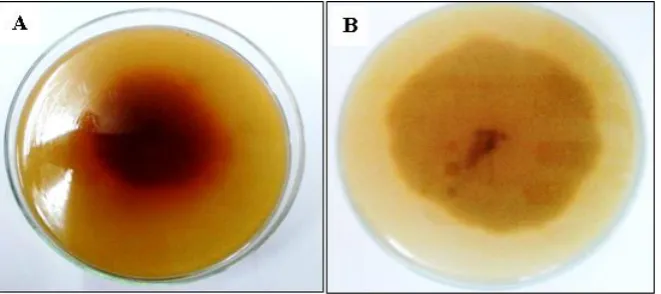
Detection of Aspergillus Flavus Aflatoxin Using Ammonium Hydroxide Vapor Test
A new and rapid method for detecting toxigenic strains of A. flavus are through vapor tests.
By exposing the aflatoxigenic colonies to ammonium hydroxide vapors, will result in a quick
color change of the reverse side.[14] After 3 days of incubation at 28°C on Yeast Extract
Sucrose (YES) medium of each A. flavus and A. niger, the results revealed that A. flavus
show moderate red pigmentation on the reverse side of the colony with the ammonium
hydroxide vapor test, while A. niger show no colour change, as shown in figure (1 (a,b).
Similarly, the test was done after 7 days of incubation at 28°C on YES medium. A. flavus
produce strong red pigmentation on the reverse side of the colony, whereas A. niger produces
no color change, as shown in figure (2 (a,b). The intensity of the color refers to the high
Figure 1: (a) Aspergillus flavus with moderate red color on the reverse side. (b)
Aspergillus niger with no color change on the reverse sideon YES medium after 3 days
of incubation at 28°C.
Figure 2: (a) Aspergillus flavus with moderate red color on the reverse side.
(b)Aspergillus niger with no color change on the reverse side on YES medium after 7
days of incubation at 28°C.
The Effect of Magnetic North Pole on Aflatoxin B1 Concentration (Ppb) in Corn
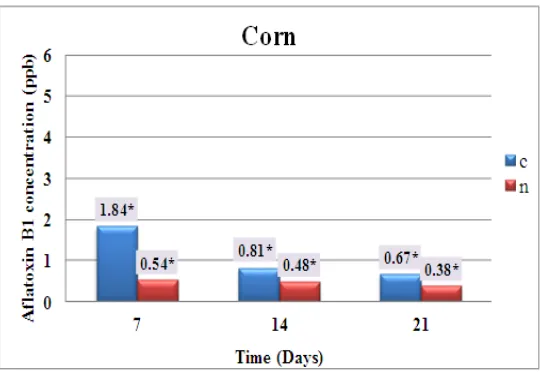
The effect of magnetic northern pole on aflatoxin B1 production by A. flavus in corn were
investigated. It was measured after (7, 14 and 21) days of fermentation on solid medium
(corn) at 28°C in the dark with moisture content of 25%. The Control of all experiments was
the solid medium without exposure to the effect of the magnetic north pole.Figure (3) shows
the results of aflatoxin B1 concentrations in corn medium produced by the fungus, which
were (0.54, 0.48 and 0.38) ppb when exposed to the northern pole compared to the control
which were (1.84, 0.81 and 0.67) ppb after (7, 14 and 21) days respectively. The results also
showed that the maximum production of aflatoxin B1 was on the seventh day and it was
[image:5.595.130.458.62.221.2] [image:5.595.135.466.301.448.2]The statistical analysis of the results in figures (3) clearly showed that the north pole
treatment significantly decreased aflatoxin B1 concentration as compared to the control for
the three periods (7, 14 and 21) days.
Figure 3: The effect of magnetic north pole on aflatoxin B1 concentration (ppb)
produced by A. flavus after (7, 14 and 21) days in corn medium at 28°Cand moisture
content of 25%. C: Control, N: Exposed to the north pole. Symbol star (*): The mean
difference is significant at the p< 0.05 level.
The Effect of Magnetic North Pole on Aflatoxin B1 Concentration (Ppb) in Wheat
Aflatoxin B1 production in wheat by A. flavus was determined under the effect of magnetic
north pole. After (7, 14 and 21) days of fermentation on solid media (wheat) at 28°C in the
dark with moisture content of 25%, the concentrations of aflatoxin B1 were (4.89, 0.62 and
0.53) ppb in controls while they were (0.27, 0.35 and 0.33) ppb when exposed to the northern
pole respectively (Figure 4).
The statistical analysis of the results in figure (4) revealed that the north pole treatment
significantly decreased the aflatoxin B1 concentration as compared with the control and for
the two periods 7 and 14 days, however there are no significant differences between the
[image:6.595.163.436.148.334.2]Figure 4:The effect of magnetic north pole on aflatoxin B1 concentration produced by
A. flavus after (7, 14 and 21) days in wheat at 28°C and moisture content 25%. C:
Control, N: Exposed to the north pole, the Symbol star (*): The mean difference is
significant at the p< 0.05 level, *NS: nonsignificant at the p< 0.05 level.
The Effect of Magnetic North Pole on Aflatoxin B1 Concentration (Ppb) in Rice
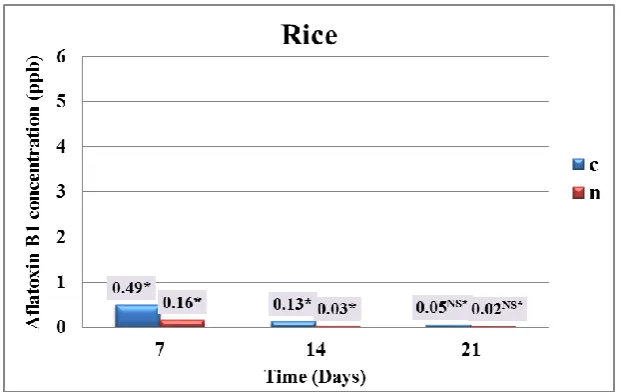
The effect of the north magnetic pole on aflatoxin B1 production in rice was measured. It was
estimated using ELISA technique after (7, 14 and 21) days of fermentation on solid medium
(rice) at 28°C in the dark with moisture content of 25% without being exposed to the
magnetic north pole or exposed to it. Figure (5) shows the concentration of aflatoxin B1
produced by the fungus in rice cereals medium. The concentration of the toxin of the exposed
sample to the north pole was 0.16 ppb in comparison to the control sample which was 0.49
ppb at the end of 7 days of fermentation. The next 7 days of fermentation, the concentration
of the toxin was 0.13 ppb of the control sample, whereas it was 0.03 ppb of the exposed
sample to the north pole. After 21 days of fermentation, the concentration of the toxin was
0.05 ppb for the control while it was 0.02 for the treated samples with northern pole (Figure
5).
The statistical analysis of the results as shown in figure (5) clearly demonstrated that the
north pole treatment significantly decreased the aflatoxin B1 concentration as compared with
the control for the two periods 7 and 14 days, on the other hand there are no significant
Figure 5:The effect of magnetic north pole on aflatoxin B1 concentration produced by
A. flavus after (7, 14 and 21) days in rice at 28°Cand moisture content 25%. C: Control,
N: Exposed to the north pole. Symbol star (*): The mean difference is significant at the
p< 0.05 level, *NS: nonsignificant at the p< 0.05 level.
The Effect of Magnetic North Pole on Aflatoxin B1 Concentration (Ppb) in Wheat Flour
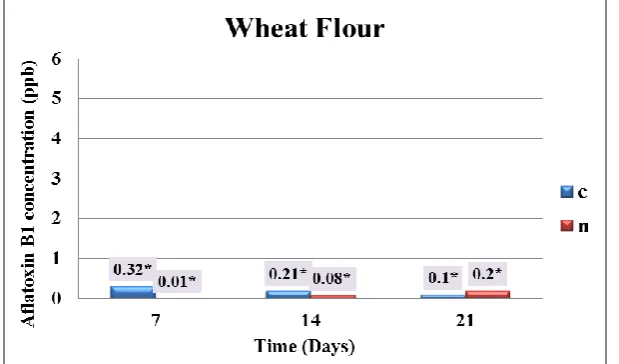
The effect of magnetic north pole on aflatoxin B1 production in wheat flour was investigated.
It was measured after 7, 14 and 21 days of fermentation on solid media (wheat flour) at 28°C
in the dark with moisture content 25%. The Control of all experiments was the solid media
without exposure to the effect of the magnetic north pole. Figure (6) revealed wheat flour
results, which was 0.01 ppb when treated with northern pole and 0.32 ppb when treated with
the control after 7 days, while it was 0.08 ppb when treated with northern pole and 0.21 ppb
when treated with the control after 14 days, after 21 days it was 0.2 when treated with
northern pole and 0.1 ppb when treated with the control.
The statistical analysis of the results in Figures (6) showed that the north pole treatment
revealed no significant differences with some rise in the proportion of aflatoxin B1 as
Figure 6:The effect of magnetic north pole on aflatoxin B1 concentration produced by
A. flavus after (7, 14 and 21) days in wheat flour at 28°Cand moisture content 25%. C:
Control, N: Exposed to the north pole. Symbol star (*): The mean difference is
significant at the p< 0.05 level.
DISCUSSION
A number of Aspergillus species have shown an ability to degrade aflatoxin, the degradation
rates of AFB1 and AFG1 proportionally increased with the increase of the initial aflatoxin
concentration or the size of mycelia inoculum.[15]Aspergillus sp. will normally have a period
of active synthesis and accumulation of the aflatoxins in the medium, which is followed by
reabsorption and metabolism by the producer mycelium, the metabolism or degradation of
aflatoxins is enzymicly and occurs largely by the involvement of the cytochrome P-450
monooxygenase enzyme system in this activity.[16]
The fungal biodegradation revealed that the percentage of aflatoxin B1 degradation differed
with the age of mycelium for both A. flavus and A. parasiticus. The highest rate of aflatoxin
B1 degradation was associated with nine days old mycelia for both fungi.[17] Large yield
of aflatoxins is associated with high carbohydrate concentrations, such as wheat and to a
lesser extent in rice, oilseeds such as cottonseed, soybean and peanuts.[18]
It well known that there are many factors affects aflatoxin production in cereals included
physical and chemical factors. The physical factors include temperature and moisture. The
chemical factors include the composition and the nature of the substrate.[19] It was found that
due to the hydrogen bond network strengthening and the perturbation of gas/liquid interface
from the air nano bubbles in the water.[20] Drought stress intensity increased aflatoxin
concentration in plants, it was suggested that drought stress for less than ten days was enough
to cause significant aflatoxin contamination in the field, the aflatoxin contamination is often
related to the intensity of drought stress, contamination increased with drought stress severity
this suggests the drought intensity increased aflatoxin accumulation in plants.[21]
The magnetic field has an important role in cation uptake capacity and it may consider as a
substitution of chemical additives, as it can reduce toxins and thus enhance food safety.[22]
The present data proved the cellular membrane of the microorganism had been affected by
the external magnetic field, and then one expects a disturbance in their metabolic activity and,
consequently, a change in their cell division.[23]
A theory that explains the effect of magnetic field on calcium ions bound in calcium-binding
proteins, such as calmodulin. The calcium ions on and on vibrate about an equilibrium
position in the binding site of calmodulin. A static magnetic field causes the calmodulin
vibration to rotate, or proceed in the direction of the magnetic field at a frequency that exactly
equals the frequency of the bound calcium, this will result in disturbing the bond between the
calcium ion and the calmodulin.[24] This can affect transport into the cells and result in
biological changes in the organism. The concentration of calcium ions in the cytosol (the
main part of the cell) is normally kept about a thousand times lower than that outside by
metabolically driven ion pumps in its membranes. Many metabolic processes are then
regulated by letting small amounts of calcium into the cytosol when needed.[25] The inhibitory
effect of magnetic field resulted from the interaction between electric charges of the magnetic
field and that of the cytoplasm membrane resulting in the partial abolishment of electric
potential of the cytoplasm membrane and this cause subsequent decrease in the
macromolecular biosynthesis. The magnetic field may also cause damage of bacterial DNA
and inhibition of its replication.[26]
Another theory assumed that biological free radicals are most commonly nitrogen or oxygen
radicals, which may lead to changes in chemical reaction kinetics and possibly altering
cellular function.[27]
The affected free radicals could effect on the enzymes which are involved in aflatoxin
biosynthesis, such as a reductase and a cyclase because they attack sites of increased electron
density like the nitrogen atom present in proteins and carbon-carbon double bonds present in
polyunsaturated fatty acids and phospholipids.[28] The biosynthesis of Aflatoxin affected by
one of the two stages from malonyl CoA, first with the formation of hexanoyl CoA, followed
by formation of a decaketide anthraquinone.
CONCLUSION
Magnetic field generally affects aflatoxin B1 concentration which produced by
Aspergillus flavus in solid substrate.
The north pole decreased aflatoxin B1 concentration in different solid substrates (corn,
wheat, rice and wheat flour) as well as in three periods (7, 14 and 21) days as compared
with the control under the same fermentation conditions.
The maximum concentration of aflatoxin B1 was on the first week and it gradually
lowered in the next two weeks.
REFERENCE
1. Cullity, B. D. and Graham, C. D. (2009). Introduction to Magnetic Materials, 2nd ed.
Wiley, Hoboken, NJ.
2. Belyavskaya, N. A. (2004). Biological effects due to weak magnetic field on plants. Adv.
Space Res, 34: 1566-1574.
3. Goodman, E. M., Greenebaum, B., and Marron, M. T. (1995). Effects of electromagnetic
fields on molecules and cells. Int. Rev. Cyto1, 158: 279- 338.
4. Wilson, B. W., and Stevens, R.G. (1990). Extremely low frequency electromagnetic
fields: the question of cancer. Battelle Press, Columbus, Ohio.
5. Coppock, W. R. and Christian, R. G. (2007). Aflatoxins, In: Veterinary Toxicology –
Basic and Clinical Principles, R. C. Gupta, Academic Press, SanDiego, 939-950.
6. Giorni, P., Battilani, P., Pietri, A. and Magan, N. (2008). Effect of Aw and CO2 level of
Aspergillus flavus growth and aflatoxin production in high moisture maize postharvest.
7. Schmidt-Heydt, M., Abdel-Hadi, A., Naresh, M. and Geisen, R. (2009). Complex
Regulation of the Aflatoxin Biosynthesis Gene Cluster of Aspergillus flavus in Relation
to Various Combinations of Water Activity and Temperature. International Journal of
Food Microbiology, 135: 231-237.
8. Couto, S. R., Sanroman, M. A. (2006). Application of solid state fermentation to food
industry – A review. Journal of Food Engineering, 76: 291-302.
9. Kumar, D., Jain, V. K., Shanke, G., Srivastava, A. (2003). Process Biochem. 38: 1731.
10.Atlas, R. M., Williams, J. F. and Huntington, M. K. (1995). Legionella contamination of
dental-unit waters. Appl. Environ. Microbio, 61: 1208-1213.
11.Saito, M., Machida, S. (1999). A rapid identification method for aflatoxinproducing
strains of Aspergillus flavus and A. parasiticus by ammonia vapor. Mycoscience, 40(2):
205-208.
12.Kumar, S., Shekhar. M., Ali, K. A., Sharma, P. (2007). A rapid technique for detection of
toxigenic and non-toxigenic strain of Aspergillus flavus from maize grain. Ind.
Phytopathol, 1: 31-34.
13.Faraj, M. K. (1990). Regulation of mycotoxins formation in Zea mays. Ph.D. Thesis.
Department of Bioscience and Biotechnology. University of Strathclyde, Glascow, U.K.,
117.
14.Sudini, H., Srilakshmi, P., Vijay Krishna Kumar, K., Samuel, M. C., Njoroge, Moses
Osiru, Anitha Seetha, and Waliyar, F. (2015). Detection of aflatoxigenic Aspergillus
strains by cultural and molecular methods. African Journal of Microbiology Research,
9(8): 484-491.
15.Cheng, J., Yu F., Lihong Z. (2016). Review on biological degradation of mycotoxins. J.
Animal Nutrition, 1-7.
16.Hesseltine, C.W. (1986). Resumé and future needs in the diagnosis of mycotoxins. J.L.
Richard and J.R. Thurston, (Eds.) "Diagnosis of Mycotoxicoses". Martinus Nijhoff
Publishers, Dordrecht, The Netherlands. 381-385.
17.Azab, R., Tawakkol, W., Hamad, A., Abou-Elmagd, M., El-Agrab., H. and Refai, M.
(2005). Detection and Estimation of Aflatoxin B1in Feeds and its Biodegradation by
19.Wojcik, S. (1995). Effect of the pre-sowing magnetic biostimulation of the buckwheat
seeds on the yield and chemical composition of buckwheat grain. Adv. Buckwheat Res.,
93: 667-674.
20.Szcześ, A., Chibowski, E., Hołysz, L. and Rafalski, P. (2010). Effects of static magnetic
field on water at kinetic condition. J. ELSEVIER, 124-127.
21.Hamidou, A. B., Rathore, D., Waliyar, C. and Vadez, D. (2014). Although drought
intensity increases aflatoxin contamination, drought tolerance does not lead to less
aflatoxin contamination. J. ELSEVIER, 156: 103-110.
22.Wojcik, S. (1995). Effect of the pre-sowing magnetic biostimulation of the buckwheat
seeds on the yield and chemical composition of buckwheat grain. Adv. Buckwheat Res.,
93: 667-674.
23.Mohamed, A. A., ALI, F. M., Gaafar, E. A., and Magda, H. R. (1997). Effects of
magnetic field on the biophysical, biochemical properties and biological activity of
Salmonella typhi: Master thesis submitted for Biophysics department, Faculty of science,
Cairo University, Egypt.
24.Pothakamury, U. R., Barbosa-Cánovas, G.V. and Swanson, B.G. (1993). Magneticfield
inactivation of microorganisms and generation of biological changes. Food Technol.
47(12): 85-93.
25.Mehedintu, M., and Berg, H. (1997). Proliferation response of yeast Saccharomyces
cerevisiae on electromagnetic field parameters, Bioelectrochem. J., Bioenerg, 43: 67-70.
26.Shun, H. L. and King-Chuen, C. (2001). Magnetic field exposure induces DNA
degradation, Biochemical and Biophysical research communications. 280: 1385-1388.
27.Brocklehurst, B. and McLauchlan, K. A. (1996). “Free radical mechanism for the effects
of environmental electromagnetic fields on biological systems,” International Journal of
Radiation Biology, 3-24.
28.Aziz, N. H. and Smyk, B. N. (2008). Influence of UV radiation and nitrosamines on the
induction of mycotoxins synthesis by nontoxigenic moulds isolated from feed samples, J.