DEVELOPMENT AND EVALUATION OF LERCANIDIPINE FAST
DISSOLVING TABLETS USING SOLID DISPERSION TECHNIQUE
Wagh Kalpesh S.*, Chaudhari Swapnil P.1 and Dr. Patil Prakash H.2
1
KVPS, Institute of Pharmaceutical Education, Boradi, Tal-Shirpur, Dist-Dhule, 425 428
(India).
ABSTRACT
The objective of the present study is to formulate the fast dissolving
tablet of lercanidipine they are use the various Superdisintegrants over
commonly used in Different Concentrations. The Super disintegrants
are Crospovidone, Croscarmellose use, Sodium Starch glycolate.
Lercanidipine is a dihydropyridines derivative. Lercanidipine is a
calcium antagonist of the dihydropyridines group and selectively
inhibits the transmembrane influx of calcium into cardiac and vascular
smooth muscle, with a greater effect on vascular smooth muscle than
on cardiac smooth muscle. Formulations containing Lercanidipine,
Polxmer 188, Aerosil (300) solid dispersionsin 1:4:2 ratio prepared by
Hot melt technique showed better Drug content dissolution rate. The disintegration time of
optimized formulation F3 was found to 17±0.18 seconds. It was found that as the
concentration of Superdisintegrants was increased, the time taken for wetting was reduced.
The wetting time of F3 formulation was found to be 38±0.11 seconds. In-vitro disintegration
of batch F3 gives rapid disintegration time and wetting time. Drug content was found to be
99.11% Results of in-vitro dissolution data shows that from formulation F1-F9 the batch F3
gives the drug release up to 98.03% in 25 min. Hence formulation F3 subjected for stability
studies. Optimum formulation F3 is stable under stability conditions.
KEYWORDS: Lercanidipine HCL, Fast Dissolving Tablet, In –vitro disintegration time.
INTRODUCTION
There is general consensus in the pharmaceutical industry that poorly water-soluble drug
candidates are becoming more prevalent.[1,2] Formulation plays a major role in determining
the rate and extent of absorption of such drugs from the gastrointestinal tract. When
water-Volume 8, Issue 5, 996-1006. Research Article ISSN 2277– 7105
Article Received on 30 Jan. 2019,
Revised on 20 Feb. 2019, Accepted on 13 March 2019
DOI: 10.20959/wjpr20195-14592
*Corresponding Author
Wagh Kalpesh S.
KVPS, Institute of
Pharmaceutical Education,
Boradi, Tal-Shirpur,
solubility is less than 1_g/ml, which is often the case for contemporary drug candidates, the
bioavailability from conventional tablet formulations may be unacceptable. Consequently, if
these drugs are not completely released in this gastrointestinal area, they will have a low
bioavailability.[3,4] Therefore, one of the major current challenges of the pharmaceutical
industry is related to strategies that improve the water solubility of drugs.[5,6,7] The choice of
formulation is often of critical importance to establishing a successful product for oral
administration of a class II drug. If bioavailability of the drug is recognized to be
formulation-dependent at an early stage it is desirable to have a strategy for maximizing
absorption as soon as possible.[8]
The term “solid dispersions” refers to the dispersion of one or more active ingredients in an
inert carrier in a solid state, frequently prepared by the melting (fusion) method, solvent
method or fusion solvent method. The drug can be dispersed molecularly, in amorphous
particles (clusters) or in crystalline particles.[9] One of the most promising methods for
promoting the dissolution of poorly water-soluble drugs is solid dispersion method. However,
the difficulty of pulverization, poor compressibility and poor flow of SDs prepared with
water-soluble polymers are challenging factors. These properties have led to a decrease in the
usefulness of SDs and handling difficulties in the manufacturing process. SD via an efficient
carrier A free-flowing SD granule was prepared by adsorbing the melt of the drug and
poloxamer 188 onto the surface of an adsorbent.[10] For drugs that have very poor aqueous
solubility, the rate at which the drug dissolves(dissolution)is often the lowest step and there
for exhibit eliminating effect on drug bioavailability. Fast dissolving tablet sare those when
put on tongue disintegrate instantaneously releasing the drug which dissolve orodispersesion
the saliva.[11]
Lercanidipine is a new Calcium channel blocker and antihypertensive drug is class of
dihydropyridines. Lercanidipine is completely absorbed after oral administration. Peak
plasma levels of 3.30 ng/mL±2.09 s.d and 7.66 mg/mL±5.90 s.d occur 1.5-3 hours after
dosing with 10 mg and 20 mg, respectively. The absolute bioavailability of lercanidipine is
about 10%, because of high first pass metabolism.[12]
MATERIALS AND METHOD Materials
Lercandipine Was Obtain as gift sample from Glenmark Pharmaceutical Ltd, Mumbai. India
Crospovidone, Croscarmellose Sodium Starch Glycolate was purchased from the Yarrow
chem, Mumbai. Talc, Aerosil, Microcrystalline cellulose obtained from Signet chemicals,
Mumbai. Indiaand Magnesium stearate, were obtained from S.D. Fine chemicals Pvt. limited,
Mumbai. All the chemicals and solutions used were of analytical grade.
Method
Preparation of solid dispersion[10]
The solid dispersion (SD) granules of Lercanidipine were prepared using a hot melt method.
The poloxamer 188 carrier was melted in a beaker at 60 ◦C in an oil bath and the drug was
added while stirring to obtain a homogenous mixture. Adsorbent (Aerosil 300) were added
gradually to the molten mixture with continuous stirring. The dispersion was cooled at
followed by passing through a sieve 100 um in diameter. The weight ratio of Lercanidipine,
poloxamer 188 and adsorbent is mention in Table 1.
Table 1: Formulation Codes of Solid Dispersion.
Batch Code Solid Dispersion Method
A1 Drug : Polxmer 188:Aersil (1:1:1) Hot melt method
A2 Drug : Polxmer 188:Aerosil (1:2:1) Hot melt method
A3 Drug : Polxmer 188:Aerosil (1:4:2) Hot melt method
A4 Drug : Polxmer 188:Aerosil (1:6:3) Hot melt method
Drug Content Study of Solid Dispersion
Drug content was determined by dissolving solid dispersion equivalent to 10 mg of drug in
the 0.1 N HCl and adjusted the volume up to 100ml. the solution was filtered through the
whatman paper no 41, suitably diluted and absorbance was measured at 238 nm using the UV
spectrophotometer (Shimadzu 1700, Japan).
Differential Sacnning Calorimetry
Differential Scanning Calorimetry(DSC) was performed using Schimazdu DSC 60
instrument. The samples were hermatically sealed in aluminium pans and heated over the
temperature range to with heating rate of min nert atmosphere was
provided by urging nitrogen gas flowing at 10 ml/min.
X-ray Diffraction Study
The powder X-ray diffraction pattern was determined for lercanidipine and lercanidipine:
diffractometer (PW1140) and Cu-k radiation diffrctogram were run at a scanning speed of 20/
mm and a chart speed of 20 mm per 2θ
Dissolution Studies of SD Granules
Dissolution studies of pure drug, and SDs granules, were performed by using the USP
dissolution test apparatus-2 at the paddle rotation speed of 50 rpm in 900 mL 6.8 phosphate
buffer as dissolution medium at 37±0.5°C. The SDs granules or pure drug equivalent to 10
mg of lercanidipine were weighed and added into the dissolution medium. At the specified
times (every 5 min to 60 min), 5 mL samples were withdrawn and then analyzed for
Lercanidipine content by measuring the absorbance at 238 nm using a UV-Visible
spectrophotometer (Shimadzu UV-1700, Japan). Fresh medium (5mL), which was pre
warmed at 37 °C, was added to the dissolution medium after each sampling to maintain its
constant volume throughout the test.
Preparation of Fast Dissolving tablets[13]
The best solid dispersion best solid equivalent to10mg of drug were taken then mixed with
directly compressible diluents and Superdisintegrants, Magnesium Stearate and talc were
passed through sieveno.100, mixedandblended with initial mixture followed by compression
end. The compositions of the different formulations are given in the Table 2.
Table 2: Formulation Code of Fast Dissolving Tablet. Ingredients
(Mg)
Formulation Code
F1 F2 F3 F4 F5 F6 F7 F8 F9
Solid Dispersion equivalent to
10 mg of lercanidipine 70 70 70 70 70 70 70 70 70
Crospovidone 4 6 8 - - - - - -
Croscarmellose - - - 4 6 8 - - -
Sodium Starch Glycolate - - - 4 6 8
MCC (Avicel PH-102) 50 50 50 50 50 50 50 50 50
D-Manntiol 23 21 19 23 21 19 23 21 19
Magnesium Stearate 1 1 1 1 1 1 1 15 15
Talc 1 1 1 1 1 1 1 1 1
Aspartam 1 1 1 1 1 1 1 1 1
Total 150 150 150 150 150 150 150 150 150
Evaluation of SD granules Fast Dissolving Tablets Thickness
Thickness and diameter were measured using a vernier caliper. Three tablets of each
Friability
For friability 20 tablets from each batch were examined using Roche friabilator and the
equipment was run for 4 min at 25 revolutions per minute. The tablets were removed from
friabilator, dedusted the tablet and reweighed. The percent friability was calculated as loss in
weight.
Percentage Friability (%) = X 100
Weight variation[14]
Weight variation test was conducted by selecting 20 tablets at random. Weighed each tablet
on electronic balance and calculated the average weight of tablet. It is the individual variation
of tablet weight from the average weight of 20 tablets.
Drug content
Twenty tablets from each batch were powdered and accurately weighed (10 mg) and
dissolved in methanol; solution was then suitably diluted with methanol in 100 ml volumetric
flask to get final stock solution of concentration μg ml Accurately pipette out 0.2, 0.4 and
0.6 ml of the above solution into three 10 ml standard flasks and the volumes were made
using methanol. The sample solution having concentration 2, 4 and 6 μg ml. The absorbance
of each concentration was measured at 238 nm and calculated the drug content.
Wetting time
A piece of tissue paper (10.75×12 mm) folded twice was placed in a petridish (d=6.5 cm)
containing 6 ml of water. A tablet was put on the paper and the time required. All parameter
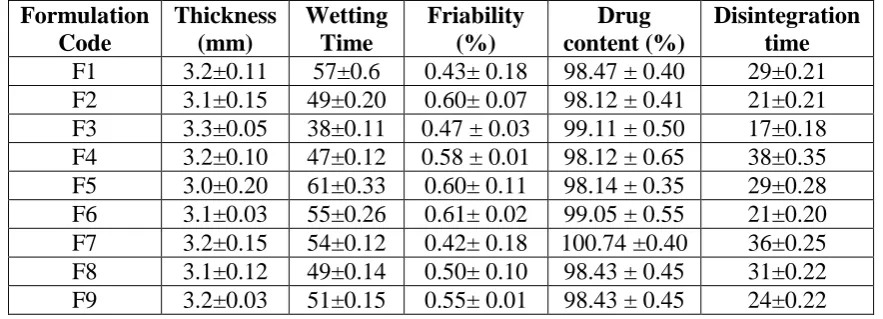
[image:5.595.77.519.605.764.2]are shown in Table No 3.
Table 3: Evaluation of various parameters of tablets (n=3).
Formulation Code
Thickness (mm)
Wetting Time
Friability (%)
Drug content (%)
Disintegration time
F1 3.2±0.11 57±0.6 0.43± 0.18 98.47 ± 0.40 29±0.21
F2 3.1±0.15 49±0.20 0.60± 0.07 98.12 ± 0.41 21±0.21
F3 3.3±0.05 38±0.11 0.47 ± 0.03 99.11 ± 0.50 17±0.18
F4 3.2±0.10 47±0.12 0.58 ± 0.01 98.12 ± 0.65 38±0.35
F5 3.0±0.20 61±0.33 0.60± 0.11 98.14 ± 0.35 29±0.28
F6 3.1±0.03 55±0.26 0.61± 0.02 99.05 ± 0.55 21±0.20
F7 3.2±0.15 54±0.12 0.42± 0.18 100.74 ±0.40 36±0.25
F8 3.1±0.12 49±0.14 0.50± 0.10 98.43 ± 0.45 31±0.22
In-vitro dissolution studies
Dissolution study was conducted for all the formulations using USPXXVIII test apparatus 2
(paddle type) (Electro lab TDT-08L). Dissolution test was carried out using 900 ml of
phosphate buffer (pH 6.8), at 37oC ± 0.5oC for 25 min at 50 rpm. A sample (5 ml) of the
solution was withdrawn from dissolution apparatus at 5, 10, 15, 20, 25 min. and withdrawn
volume of sample replaced with fresh dissolution media. The samples were filtered through
whatman filter paper and analyzed the samples by UV Spectrophotometry (Shimadzu 1700)
at 238 nm.
Zero-order, first-order, Higuchi and Korsmeyer–Peppas kinetic models were performed to
[image:6.595.65.540.326.501.2]study the drug release kinetic. As shown in table no 4.
Table 4: Kinetic Modeling of Different Batches (F1-F9).
Formulation Code
Zero Order equation
R2
First order equation
Higuchi equation
Korsmeyer-Peppas equation
R2 R2 R2 n
F1 0.834 0.961 0.836 0.836 1.2512
F2 0.907 0.931 0.823 0.817 1.2662
F3 0.828 0.969 0.983 0.783 1.2494
F4 0.925 0.943 0.782 0.840 1.2525
F5 0.867 0.946 0.947 0.805 1.2712
F6 0.833 0.949 0.956 0.845 1.2558
F7 0.934 0.944 0.963 0.835 1.2629
F8 0.951 0.933 0.924 0.823 1.2449
F9 0.983 0.905 0.992 0.805 1.2662
Stability Study
Accelerated stability study was performed as per ICH guidelines on best batch F3 to
determine the change in physical characteristics, dissolution study and disintegration time of
tablets on storage at 45oC and 75% relative humidity for 3 months. Every month the sample
was withdrawn and to evaluated for change in weight of tablets, hardness, friability, In vitro
[image:6.595.88.510.669.759.2]disintegration time, uniformity of drug content and dissolution, as shown in Table no 5.
Table 5: Stability study of best batch F3 at 45oC and 75% RH.
Physical parameters 0 Days 30 Days 60 Days 90 Days
Weight Variation(mg) 150.56±0.64 150.72±1.19 151.49±1.78 152.47±1.34
Friability (%) 0.47±0.03 0.47±0.11 0.47±0.08 0.47±0.31
Disintegration Time (sec) 17.0±0.18 17.04±0.55 17.4±0.23 17.8±0.33
Drug Content (%) 99.11±0.50 99.04±0.23 98.01±0.20 98.34±0.11
RESULT
Preliminary SD gives the 91.49±0.033 to 94.34±0.519 drug content. The A3 has the more
drug content 94.34±0.519 SD. Release profile of Lercanidipine with different carrier and
[image:7.595.114.484.167.374.2]ratios are shown in Figure 1.
Figure 1: Drug Release Profile Solid Dispersion A1-14 and Pure Drug.
The percent drug release of the SDs is more than the pure drug and it significantly increase
the solubility of Lercanidipine. The drug release of SD Granules was found between
80.11±1.34 to 92.56±1.11. Solid dispersion A3 of gives 92.56 drug releases. The combination
SDs of the Polxmer 188 and Aerosil (1:4:2) was gives faster drug release with in 60 min. The
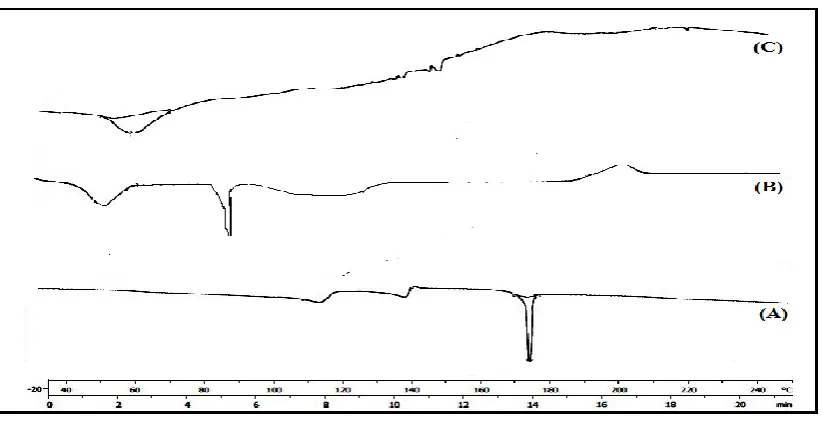
DSC thermo gram of Lercanidipine exhibited a sharp endothermic peak at 178.8°C (Fig 2).
[image:7.595.94.506.527.740.2]
Physical Mixture with respect to its melting point and decomposition. The peaks in Fig 2 show broad endothermic peak at 90.14 0C this could indicates that the drug transits to
amphorphous form due to solid dispersion.
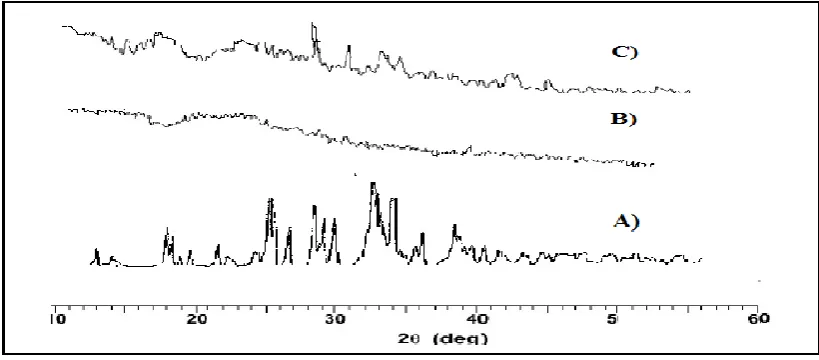
The XRD pattern of Lercanidipine, SDs and physical mixture was shown in Fig.3.
Figure 3: A) Lercanidipine B) Solid Dispersion C) Physical Mixture.
The pure Lercanidipine drug showed numerous sharp peaks demonstrating the crystalline
nature of the drug. Lercanidipine showed characteristic intense peaks between the 2θ of 150
and 250due to its crystalline nature. Whereas, in case of solid dispersions crystallinity of
lercanidipine was reduced to a greater extent as compared to physical mixture and pure
lercanidipine, more over peak at 150 and 250were disappeared in solid dispersion. All the SD
granules showed diffused peaks indicating that the drug is dispersed at the molecular level in
the polymer matrix and hence, no crystals were found then the solid dispersion is amorphous.
All batches of the Lercanidipine tablets prepared by solid dispersion by direct compression
method and were characterized for various physical parameters like weight variation,
thickness, friability, drug content, wetting time, disintegration time and dissolution. Results
were shown in Table 3. It was observed that the entire tablets meet the standard within the
Pharmacopoeia limits. The present investigation was undertaken to formulate and evaluate
fast dissolving tablets of Lercanidipine by Solid Dispersion method using Croscarmellose
sodium and crospovidone and Sodium starch glycolate Superdisintegrants.
Formulation F1, F4, F7 which contain 4% Super disintegrants release the drug (94.06±1.42,
[image:8.595.93.503.183.363.2]F5, F8 containing 6% Superdisintegrants release (96.01±1.56, 95.12±2.08, 95.45±1.98) and
increase in the release of drug found in formulation F3,F6,F9 8% super disintegrant release
the (98.03±1.59,96.03±1.68,96.07±2.09).
[image:9.595.113.480.178.381.2]Drug release profile of the fast dissolving tablet formulation is shown in Fig 4.
Figure 4: Dissolution Profile of Batch F1-F9.
After the studying different models, the zero order „R‟ values was found to be range of 0.834
to 98 , First order release in „R‟ values ranges from 9 to 969 the higuchi‟s diffusion equation „R‟ values of all formulations code ranges from 782 to 845, Korsemeyer-pepp as
plot was found in range of 0.783 to 0.845. The in-vitro drug release showed the highest
regression coefficient values for first order model. The kinetic modeling data is mention in
Table 4 First order is applicable to study hydrolysis kinetics and to study release profiles of
pharmaceutical dosage forms such as those containing water soluble drugs in porous
matrices.
After stability study of tablets, all the evaluation parameters of tablets was slightly and results
was found within limits. The accelerated stability study of batch (F3) revealed that no
significant change in physical properties and could be considered as stable formulation even
after 3 months. The accelerated stability study of fast dissolving tablets was shown in Table
5.
DISCUSSION
All batches of the Lercanidipine tablets prepared by solid dispersion by direct compression
thickness, hardness, friability, drug content, wetting time, disintegration time and dissolution.
It was observed that the entire tablets meet the standard within the Pharmacopoeia limits. The
percentage drug release of all the batches was found within the acceptable limits. The
cumulative percentage of the drug released for formulation batch F3 found by the dissolution
test shows the better drug release of 98.03±1.59 than the other formulation.
CONCLUSION
Fast dissolving tablets of Lercanidipine were prepared by direct Solid Dispersion method
using Croscarmellose sodium, Sodium Starch Glycolate and crospovidone as a
superdisintegrants. The tablets disintegrated rapidly in oral cavity and had acceptable
hardness and friability. In vitro drug release from the tablets shows significantly improved
drug dissolution. It was concluded that in Fast dissolving tablet, crospovidone was best
superdisintegrant. Hence it could be concluded that the superdisintegrant based fast
dissolving tablets of Lercanidipine would providing quick onset of action without need of
water for swallowing or administration.
ACKNOWLEDGEMENTS
The author wish to acknowledge with thanks the help and cooperation received from the
management of KVPS Institute of pharmaceutical Education, Boradi, India.
REFERENCES
1. Lipinski, C.A., 2000. Drug-like properties and the causes of poor solubility and poor
permeability. J. Pharmacol. Toxicol. Methods, 44: 235–249.
2. Lipinski, C.A., Lombardo, F., Dominy, B.W., Feeney, P.J., 1997. Experimental and
computational approaches to estimate solubility and permeability in drug discovery and
development settings. Adv. Drug Deliv. Rev., 23: 3–25.
3. Streubel, A. et al. (2006) Drug delivery to the upper small intestine window using
gastroretentive technologies. Curr. Opin. Pharmacol, 6: 501–508.
4. Desai, J. et al. (2006) Characterization of polymeric dispersions of dimenhydrinate in
ethyl cellulose for controlled release. Int J Pharm, 308: 115–123.
5. Vippagunta, S.R. et al. (2006) Factors affecting the formation of eutectic solid dispersions
and their dissolution behavior. J. Pharm. Sci., 96: 294–304.
6. Tanaka, N. et al. (2006) Development of novel sustained-release system,
disintegration-controlled matrix tablet (DCMT) with solid dispersion granules of nilvadipine (II): In
7. Ohara, T. et al. (2005) Dissolution mechanism of poorly water-soluble drug from
extended release solid dispersion system with ethylcellulose and
hydroxypropylmethylcellulose. Int. J. Pharm., 302: 95–102.
8. Colin W. Pouton, Formulation of poorly water-soluble drugs for oral administration:
Physicochemical and physiological issues and the lipid formulation classification system,
european journal of pharmaceutical sciences, 2006; 29: 278–287.
9. Chiou WL, Riegelman S, Pharmaceutical applications of solid dispersion systems. J.
Pharm Sci., 1971; (60): 1281-1302.
10.Thi TT, Parka JB, Honga KH, Choib HG, Leed J, Lee BJ. Preparation and
characterization of pH-independent sustained release tablet containing solid dispersion
granules of a poorly water-soluble drug. International Journal of Pharmaceutics, 2011;
415: 83– 88.
11.RenonJP, CorveleynS. Freez-driedrapidlydisintegrating tablets.US Patent No., 2000; 6:
010-79.
12.Martindale. Complete Drug Release Volume – A 37rd edition by Sean L Sweetman,
Published by Pharmaceutical Press. UK, 2002.
13.Dave B S, Amin A F and Patel M M; Gastroretentive drug delivery system of ranitidine
hydrochloride: formulation and in vitro evaluation. AAPS Pharm Sci Tech., 2004; 5(2):
Article 34.
14.Halakatti P, Gulgannavar R, Desai A. Development of mouth dissolving tablets of