GSJ: Volume 6, Issue 8, August 2018, Online: ISSN 2320-9186
www.globalscientificjournal.comSKIN
FRICTION
ANALYSIS
OF
MHD
FLOW
PAST
ON
ACCELERATED
VERTICAL
PLATE
WITH
VARIABLE
TEMPERATURE
AND
MASS
DIFFUSION
IN
THE
PRESENCE
OF
CHEMICAL
REACTION
B. Uma1 and Dr. V. Visalakshi2*
1, 2Department of Mathematics, Arignar Anna College of Arts and Science, Walajapet, India
E-mail: [email protected]
*Corresponding author: [email protected]
ABSTRACT
In this paper the unsteady laminar free-convection flow of a viscous incompressible fluid, past accelerated infinite vertical plate with variable temperature and mass diffusion in the presence of chemical reaction and magnetic field is considered. The Laplace transform method is used to obtain the expression for skin-friction, Nusselt number and Sherwood number. The effect of velocity profiles are studied for different physical parameters like Prandtl number, thermal Grashof number, mass Grashof number, Schmidt number and time
Keywords: Accelerated; isothermal; vertical plate; heat and mass transfer; chemical reaction; magnetic field.
INTRODUCTION
Hydromagnetic convection plays an important role i n the petroleum industry, geophysics and astrophysics. It also finds applications in many engineering problems such as magnetohydrodynamic (MHD) generators and plasma studies, in the study of geological formations, in the exploration and thermal recovery of oil, and in the assessment of aquifers, geothermal reservoirs and underground nuclear waste storage sites (Pai, 1962). MHD flow has applications in metrology, solar physics and in the movement of the earth’s core. It has applications in the field of stellar and planetary magnetospheres, aeronautics, chemical engineering and electronics. Free convection effects on flow past an accelerated vertical plate with variable suction and a uniform heat flux in the presence of a magnetic field was studied by Raptis, Tzivanidis and Peridikis (1981). Furthermore, MHD effects on flow past an infinite vertical plate for both the classes of impulse as well as accelerated motion of the plate were studied by Raptis and Singh (1983).
Chemical reactions can be codified as either heterogeneous or homogeneous processes. This depends on whether they occur at an interface or as a single phase volume reaction. In well-mixed systems the reaction is heterogeneous at an interface and homogeneous in solution (Cussler, 1998; Muthucumaraswamy & Valliammal, 2010; Sathappan & Muthucumaraswamy, 2011). In most chemical reactions the reaction rare depends on the concentration itself. The reaction is said to be of first order is when the rate of reaction is directly proportional to the concentration itself. Cambre and Young (1958) analyzed a first order chemical reaction in the neighborhood of a horizontal plate. Das, Deka, and Soundalgekar (1994) studied the effect of a homogeneous first order chemical reaction on the flow past an impulsively started infinite vertical plate with uniform heat flux and mass transfer. Once again, mass transfer effects on a moving isothermal vertical plate in the presence of chemical reaction have been studied by Das, Deka, and Soundalgekar (1999), where the dimensionless governing equations were solved by the usual Laplace-transform technique. Gupta, Pop, and Soundalgekar (1979) studied free convection on flow past a linearly accelerated vertical plate in the presence of viscous dissipative heat using the perturbation method. Kafousias and Raptis (1981) extended the above problem to include mass transfer effects subjected to variable suction or injection. Mass transfer effects on flow past a uniformly accelerated vertical plate were studied by Soundalgekar (1982). In addition, the mass transfer effects on flow past an accelerated vertical plate with a uniform heat flux were analyzed by Singh and Singh (1983). The effect of viscous dissipation on Darcy free convection flow over a vertical plate with an exponential temperature was analyzed by Magyari and Rees (2006). The combined effects of heat and mass transfer along a vertical plate in the presence of a transverse magnetic field were studied by Ramesh Babu, and Shankar (2009). Rajput & Kumar (2011) studied the magnetic field effects on flow past an impulsively started vertical plate with variable temperature and mass diffusion. Recently, Vijaya Kumar, Rajasekhara Goud, Varma, and Raghunath (2012) analyzed the radiation effects on MHD flow past a linearly accelerated vertical plate with variable temperature and mass diffusion.
Skin friction analysis of parabolic started infinite vertical plate with variable temperature and variable mass diffusion in the presence of magnetic field was studied by Indira Priyatharshini et al (2017). The solutions for velocity, temperature concentrations fields, Sherwood number and Nusselt number are derived in terms of exponential and complementary error functions.
Effect of parabolic motion of isothermal vertical plate with constant mass flux was discussed by Muthucumaraswamy and Geetha (2014). The effects of skin friction were also discussed.
Hence it is proposed to study the effects of skin friction on unsteady MHD flow past an accelerated infinite vertical plate with variable temperature and mass diffusion, in the presence of homogeneous chemical reaction of first order. The dimensionless governing equations are solved using the Laplace‐ transform technique. The solutions are in terms of exponential and complementary error function
MATHEMATICAL ANALYSIS
The hydro magnetic flow of a viscous incompressible fluid past a uniformly accelerated isothermal infinite vertical plate with variable temperature and mass diffusion in the presence of a chemical reaction of the first order has been considered. The unsteady flow of a viscous incompressible fluid is initially at rest and surrounds an infinite vertical plate with temperature T and concentration C. The x-axis is taken along the plate in the vertically upward direction, and the y-axis is taken as being normal to the plate. At time , the plate is accelerated with a velocity
in its own plane against the force of gravity. The temperature from the plate as well as the concentration levels near the plate are also raised linearly with time, t. It is assumed that the effect of viscous dissipation is negligible in the energy equation, and there is a first order chemical reaction between the diffusing species and the fluid. A transverse magnetic field of uniform strength B0 is assumed to be applied normal to the plate.
Then under the usual Boussinesq’s approximation, the unsteady flow is governed by the following equations:
MU
Y U GcC Gr
t
U
2 2
(1)
22
Pr 1
Y
t
(2)
KC
Y
C
Sc
t
C
2 2
1
(3)
The corresponding initial and boundary conditions in dimensionless form are as follows:
U 0, 0, C 0 for all Y,t 0
t 0: U t,
t , Ct at Y 0 (4)U 0, 0, C0 as Y By introducing the following non-dimensional quantities:
, 0
u u
U
' 2 0 t
u
t 0 ,
v yu
Y
T T
T T
w
,
C C
C C C
w
3
0
) (
u T T gv
Gr w , ( '3 ' ), 0
*
u C C gv
Gc w
k Cp
Pr ,
,
D
Sc 2 ,
0 2 0
u v B M
u02
v K K l
(5)
The solutions of equations under the boundary condition have been obtained by Muthucumaraswamy and Radhakrishnan. The solutions are in terms of exponential and complementary error function.
(6)
exp (2 ) ( ) exp ( 2 ) ( )
2
) (
) 2
exp ( )
( ) 2
exp ( 2
Kt Sc
erfc KtSc Kt
Sc erfc
KtSc K
Sct
Kt Sc
erfc KtSc
Kt Sc
erfc KtSc t
C
(7)
(
1
2
2Pr)
(
Pr
)
2
Pr
exp(
2Pr)
t
erfc
)
)
(
(
)
)
(
(
)
(
)
2
exp (
)
(
)
2
exp (
2
)
(
)
2
exp (
)
(
)
2
exp (
)
1
(
)
Pr
(
)
Pr
(
Pr)
exp (
Pr
2
)
Pr
(
Pr)
2
1
(
2
)
Pr
(
2
)
)
(
(
)
)
(
(
)
)
(
(
)
)
(
(
)
(
)
(
2
1
)
(
)
(
)
(
2
) ( 2 ) ( 2 Pr 2 Pr \ 2 2 2 ) ( 2 ) ( 2 ) ( 2 ) ( 2 2 2 2 2t
b
K
Sc
erfc
e
t
b
K
Sc
erfc
e
ce
Kt
Sc
erfc
KtSc
Kt
Sc
erfc
KtSc
K
Sct
bc
Kt
Sc
erfc
KtSc
Kt
Sc
erfc
KtSc
bt
c
at
erfc
e
at
erfc
e
de
erfc
adt
derfc
t
b
M
erfc
e
t
b
M
erfc
e
ce
t
a
M
erfc
e
t
a
M
erfc
e
de
Mt
erfc
e
Mt
erfc
e
M
t
bc
ad
Mt
erfc
e
Mt
erfc
e
d
c
bc
ad
t
t
U
t b K Sc t b K Sc bt t a at at t b M t b M bt t a M t a M at Mt Mt Mt Mt
Where (8)
t
Y
and
a
Gr
d
Sc
b
Gc
c
Sc
KSc
M
b
M
a
2
Pr)
1
(
2
,
)
1
(
2
,
1
,
1
Pr
2
2
By the expression (8) the skin-friction at the plate is given by
t b K bt Kt at at t b M bt t a M at Mt e t t b K erf b K Sc ce Kt erf K Sc bc e t Kt erf KSc bt c e t at erf a de t ad t d e t t b M erf b M ce e t t a M erf a M de Mt erf bc ad M e t Mt erf M d c bc ad t t ) ( ) ( ) ( 1 ) ) ( ( ) ( 2 ) ( 2 1 ) ( ) 1 ( 2 1 ) ( Pr 2 ) Pr 1 ( 2 2 1 ) ) ( ( ) ( 2 1 ) ) ( ( ) ( 2 ) ( 2 1 1 1 ) ( ) ( 2 2 (9) By the expression (6), the rate of heat transfer in terms of Nusselt number in non dimensional form is given by 0 y dy d Nu = 0 2 1 d d t ) Pr 1 ( t (10)
By the expression (7), the rate of mass transfer in terms of Sherwood number in non dimensional form is given by 0 y dy dC Sh = 0 2 1 d dC t ) ( 2 1 )
( erf Kt
K Sc e Kt erf KtSc t Kt
(11)
TABLE I: Numerical Values of Nusselt Number
Pr t Nu
0.71 0.2 0.464916
0.71 0.3 0.569404
0.71 0.4 0.657491
0.71 0.6 0.805258
7.0 0.2 0.919871
7.0 0.3 1.126608
7.0 0.4 1.300895
7.0 0.6 1.593264
TABLE II: Numerical Values of Sherwood Number for K=6
Sc t Sh
0.16 0.2 0.319920
0.16 0.3 0.404968
0.16 0.4 0.492461
0.16 0.6 0.676587
0.6 0.2 0.548354
0.6 0.3 0.736380
0.6 0.4 0.923332
0.6 0.6 1.299023
TABLE III: Numerical Values of Sherwood Number for K=5
Sc t Sh
0.16 0.2 0.318941
0.16 0.3 0.396933
0.16 0.4 0.475156
0.16 0.6 0.638900
0.6 0.2 0.53070
0.6 0.3 0.704085
0.6 0.4 0.874912
0.6 0.6 1.216849
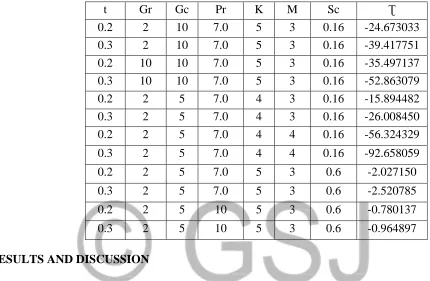
TABLE IV: Skin Friction Profile
t Gr Gc Pr K M Sc Ʈ
0.2 2 10 7.0 5 3 0.16 -24.673033
0.3 2 10 7.0 5 3 0.16 -39.417751
0.2 10 10 7.0 5 3 0.16 -35.497137
0.3 10 10 7.0 5 3 0.16 -52.863079
0.2 2 5 7.0 4 3 0.16 -15.894482
0.3 2 5 7.0 4 3 0.16 -26.008450
0.2 2 5 7.0 4 4 0.16 -56.324329
0.3 2 5 7.0 4 4 0.16 -92.658059
0.2 2 5 7.0 5 3 0.6 -2.027150
0.3 2 5 7.0 5 3 0.6 -2.520785
0.2 2 5 10 5 3 0.6 -0.780137
0.3 2 5 10 5 3 0.6 -0.964897
RESULTS AND DISCUSSION
For physical understanding of the problem numerical computations are carried out for different physical parameters Gr, Gc, Sc and t upon the nature of the flow and transport. The value of the Schmidt number Sc is taken to be 0.6 which corresponds to water-vapor. Also, the values of Prandtl number Pr are chosen such that they represent air (Pr = 0.71). The numerical values of the velocity are computed for different physical parameters like Prandtl number, thermal Grashof number, mass Grashof number, Schmidt number and time.
Table I shows the Nusselt number (rare of heat transfer) for different values of Prandtl number and time t. The values of Prandtl number for air (Pr=0.71) and water (Pr=7.0) is considered. From the table it is clear that rate of heat transfer increases with increasing values of Prandtl number and time t.
Table II and Table III depicts the Sherwood number (rate of mass transfer) for different values of Schmidt number (Sh), Chemical reaction parameter (K) and time (t). It shows that Sherwood number enhances with increasing values of Schmidt number and time. It is also observed that Sherwood number increases with increasing value of chemical reaction parameter.
The skin friction is tabulated in Table IV. The effect of skin friction for the different values of thermal Grashof number Gr, mass Grashof number Gc, Prandtl number Pr, Schmidt number Sc, Chemical reaction parameter, magnetic field parameter and time t was analyzed. Table IV displays
the effect of skin friction in the presence of water (Pr=7.0). It is clear that skin-friction enhances with increase of Schmidt number. It is also observed that skin-friction increases with increase of Prandtl number. As time t advances the value of skin-friction decreases. Moreover the value of the skin friction increases with increasing thermal Grashof number or mass Grashof number. It is also clear that skin friction increases with increasing values of magnetic field parameter and chemical reaction parameter.
CONCLUSION
The effects of skin friction on unsteady MHD flow past an accelerated infinite vertical plate with variable temperature and mass diffusion, in the presence of homogeneous chemical reaction of first order. The dimensionless governing equations are solved using the Laplace‐ transform technique. The solutions are in terms of exponential and complementary error function. The effect of the temperature, the concentration and the velocity fields for different physical parameters like Prandtl number, Schmidt number, thermal Grashof number and mass Grashof number are studied graphically. The conclusions of the study are as follows:
(i) The effect of skin friction increases with increases values of Gr, Gc, Sc, M, K, Pr and the trend is reversed with respect to time.
(ii) The Sherwood number increases with increasing values of Schmidt number, Chemical reaction parameter K and time
References
[1] Chambre, P. L., & Young, J. D. (1958). On the diffusion of a chemically reactive species in a laminar boundary layer flow. The Physics of Fluids, 1, 48-54.
[2] Cussler, E. L. (1998). Diffusion mass transfer in fluid systems. 2nd ed. London: Cambridge University Press.
[3] Das, U. N., Deka, R. K., & Soundalgekar, V. M. (1994). Effects of mass transfer on flow past an impulsively started infinite vertical plate with constant heat flux an chemical reaction. Forschung im Ingenieurwesen, 60, 284-287.
[4] Das, U. N., Deka, R. K., & Soundalgekar, V. M. (1999). Effects of mass transfer on flow past an impulsively started infinite vertical plate with chemical reaction. The Bulletin of GUMA, 5, 13-20.
[5] Gupta, A. S., Pop, I., & Soundalgekar, V. M. (1979). Free convection effects on the flow past an accelerated vertical plate in an incompressible dissipative fluid. Romanian Journal of Technical Sciences, 24, 561-568.
[6] Kafousias, N. G., & Raptis, A. (1981). Mass transfer and free convection effects on the flow past an accelerated vertical infinite plate with variable suction or injection Romanian Journal of Technical Sciences, 26, 11-22.
[7] Magyari, E., & Rees, D. A. S. (2006). Effect of viscous dissipation on the Darcy free convection boundary-layer flow over a vertical plate with exponential temperature distribution in a porous medium. Fluid Dynamics Research, 38, 405 429.
[8] Muthucumaraswamy, R., & Valliammal, V. (2010). Chemical reaction effects on flow past an exponentially accelerated vertical plate with variable temperature. International Journal of Automotive and Mechanical Engineering, 2, 231-238.
[9] Pai, S. I. (1962). Magnetogasdynamics and plasma dynamics. Wien, Springer.
[10] Rajput, U. S., & Kumar S. (2011). MHD flow past an impulsively started vertical plate with variable temperature and mass diffusion. Applied Mathematical Sciences, 5, 149-157.
[11] Ramesh Babu, K., & Shankar, B. (2009). Heat and mass transfer along a vertical plate in the presence of a magnetic field. Heat and Mass Transfer, 31, 21-26.
[12] Raptis, A., & Singh, A. K. (1983). MHD free convection flow past an accelerated vertical plate. International Communications in Heat and Mass Transfer, 10, 313-321.
[13] Raptis, A., Tzivanidis, G. J., & Peridikis, C. P. (1981). Hydromagnetic free convection flow past an accelerated vertical infinite plate with variable suction and heat flux. Letters in Heat and Mass Transfer, 8, 137-143.
[14] Sathappan, K. E., & Muthucumaraswamy, R. (2011). Radiation effects on exponentially accelerated vertical plate with uniform mass diffusion. International Journal of Automotive and Mechanical Engineering, 3, 341-349.
[15] Singh, A. K., & Singh, J. (1983). Mass transfer effects on the flow past an accelerated vertical plate with constant heat flux. Astrophysics and Space Science, 97, 57-61.
[16] Soundalgekar, V. M. (1982). Effects of mass transfer on flow past a uniformly accelerated vertical plate. Letters in Heat and Mass Transfer, 9, 65-72.
[17] Vijaya Kumar, A. G., Rajasekhara Goud, Y., Varma, S. V. K., & Raghunath, K (2012). Thermal diffusion and radiation effects on unsteady MHD flow past a linearly accelerated vertical plate with variable temperature and mass diffusion.International Journal of Mathematical Archive, 3, 574-585.
[18] Muthucumaraswamy R and Geetha E (2014), Effects of parabolic motion on an isothermal vertical plate with constant mass flux, Ain Shams Engineering Journal 5, pp. 1317-1323
[19] Indira Priyatharshini S and Neel Armstrong A (2017), Skin friction analysis of parabolic started infinite vertical plate with variable temperature and variable mass diffusion in the presence of magnetic field, International Journal of Pure and Applied Mathematics 4, pp. 81-92
NOMENCLATURE, GREEK SYMBOLS
A constant
D mass diffusion coefficient Gc mass Grashof number Gr thermal Grashof number
M Magnetic field parameter K Chemical reaction parameter g acceleration due to gravity q heat flux per unit area at the plate
k thermal conductivity of the fluid Pr Prandtl number
Sc Schmidt number
T temperature of the fluid near the plate T w temperature of the plate
T temperature of the fluid far away from the plate
t time
t dimensionless time
u velocity of the fluid in the x-direction
u 0 velocity of the plate
U dimensionless velocity component in x-direction
y coordinate axis normal to the plate
Y dimensionless coordinate axis normal to the plate
Volumetric coefficient of thermal expansion
* volumetric coefficient of expansion with concentration
coefficient of viscosity
kinematic viscosity
density of the fluid
dimensionless temperature
similarity parameter
erfc complementary error function
C' species concentration in the fluid C dimensionless concentration
Cw wall concentration
C Concentration in the fluid far away from the plate