
Ethyl 4-fluoro-3-nitrobenzoate
Shivanagere Nagojappa Narendra Babu,aAisyah Saad Abdul Rahim,a‡ Hasnah Osman,bIbrahim Abdul Razakc and Hoong-Kun Func*
aSchool of Pharmaceutical Sciences, Universiti Sains Malaysia, 11800 USM, Penang,
Malaysia,bSchool of Chemical Sciences, Universiti Sains Malaysia, 11800 USM,
Penang, Malaysia, andcX-ray Crystallography Unit, School of Physics, Universiti
Sains Malaysia, 11800 USM, Penang, Malaysia Correspondence e-mail: [email protected]
Received 12 February 2009; accepted 13 February 2009
Key indicators: single-crystal X-ray study;T= 100 K; mean(C–C) = 0.002 A˚; Rfactor = 0.045;wRfactor = 0.139; data-to-parameter ratio = 21.1.
In the title compound, C9H8FNO4, C—H O intermolecular
interactions form dimers withR22(10) motifs. These dimers are
arranged into chains parallel to thebaxis and the chains are stacked down thecaxis.
Related literature
For general background, see: Ishidaet al.(2006); Rida et al.
(2005); Mohd. Maidin, Abdul Rahim, Abdul Hamid et al.
(2008). For bond-length data, see: Allen et al. (1987). For related structures, see: Mohd. Maidin, Abdul Rahim, Osmanet al.(2008); Liet al.(2008, 2009). For details of hydrogen-bond motifs, see: Bernsteinet al.(1995). For details on the stability of the temperature controller, see: Cosier & Glazer (1986).
Experimental
Crystal data
C9H8FNO4 Mr= 213.16 Monoclinic,P21=c a= 9.9246 (3) A˚
b= 13.2883 (3) A˚
c= 6.9310 (2) A˚ = 94.410 (2)
V= 911.36 (4) A˚3 Z= 4
MoKradiation = 0.14 mm 1 T= 100 K
0.550.220.09 mm
Data collection
Bruker SMART APEXII CCD area-detector diffractometer Absorption correction: multi-scan
(SADABS; Bruker, 2005)
Tmin= 0.929,Tmax= 0.988
12540 measured reflections 2913 independent reflections 2411 reflections withI> 2(I)
Rint= 0.028
Refinement
R[F2> 2(F2)] = 0.045 wR(F2) = 0.139
S= 1.11 2913 reflections
138 parameters
H-atom parameters constrained
max= 0.55 e A˚ 3
[image:1.610.47.246.514.725.2]min= 0.36 e A˚ 3
Table 1
Hydrogen-bond geometry (A˚ ,).
D—H A D—H H A D A D—H A
C1—H1A O4i 0.93 2.44 3.2380 (15) 144
Symmetry code: (i) x 1; y; z.
Data collection:APEX2(Bruker, 2005); cell refinement:SAINT
(Bruker, 2005); data reduction:SAINT; program(s) used to solve structure: SHELXTL (Sheldrick, 2008); program(s) used to refine structure:SHELXTL; molecular graphics:SHELXTL; software used to prepare material for publication:SHELXTLandPLATON(Spek, 2009).
HKF and IAR thank the Malaysian Government and Universiti Sains Malaysia for the Research University Golden Goose grant No. 1001/PFIZIK/811012. Funding from the Malaysian Government and Universiti Sains Malaysia (USM) under USM Research University grant (1001/PFARMASI/ 815026) is gratefully acknowledged. SNNB thanks Universiti Sains Malaysia for a Postdoctoral Research Fellowship.
Supplementary data and figures for this paper are available from the IUCr electronic archives (Reference: AT2723).
References
Allen, F. H., Kennard, O., Watson, D. G., Brammer, L., Orpen, A. G. & Taylor, R. (1987).J. Chem. Soc. Perkin Trans. 2, pp. S1–19.
Bernstein, J., Davis, R. E., Shimoni, L. & Chang, N. L. (1995).Angew. Chem. Int. Ed. Engl.34, 1555–1573.
Bruker (2005).APEX2,SAINTandSADABS. Bruker AXS Inc., Madison, Wisconsin, USA.
Cosier, J. & Glazer, A. M. (1986).J. Appl. Cryst.19, 105–107.
Ishida, T., Suzuki, T., Hirashima, S., Mizutani, K., Yoshida, A., Ando, I., Ikeda, S., Adachi, T. & Hashimoto, H. (2006).Bioorg. Med. Chem. Lett.16, 1859– 1863.
Li, H.-Y., Liu, B.-N., Tang, S.-G. & Guo, C. (2009).Acta Cryst.E65, o91. Li, H.-Y., Liu, B.-N., Tang, S.-G., Xu, Y.-M. & Guo, C. (2008).Acta Cryst.E64,
o523.
Mohd. Maidin, S. M., Abdul Rahim, A. S., Abdul Hamid, S., Kia, R. & Fun, H.-K. (2008).Acta Cryst.E64, o1501–o1502.
Mohd. Maidin, S. M., Abdul Rahim, A. S., Osman, H., Kia, R. & Fun, H.-K. (2008).Acta Cryst.E64, o1550–o1551.
Rida, S. M., Ashour, F. A., El-Hawash, S. A. M., ElSemary, M. M., Badr, M. H. & Shalaby, M. A. (2005).Eur. J. Med. Chem.40, 949–959.
Sheldrick, G. M. (2008).Acta Cryst.A64, 112–122. Spek, A. L. (2009).Acta Cryst.D65, 148–155. Acta Crystallographica Section E
Structure Reports Online
supporting information
Acta Cryst. (2009). E65, o556 [doi:10.1107/S1600536809005224]
Ethyl 4-fluoro-3-nitrobenzoate
Shivanagere Nagojappa Narendra Babu, Aisyah Saad Abdul Rahim, Hasnah Osman, Ibrahim
Abdul Razak and Hoong-Kun Fun
S1. Comment
The nitro benzoic acid intermediates are convenient starting materials for the synthesis of various biologically active
heterocycles e.g. benzimidazoles (Ishida et al., 2006) and benzoxazoles (Rida et al., 2005). As a part of our ongoing
studies on new nitro benzoic acid derivatives (Mohd. Maidin, Abdul Rahim, Abdul Hamid et al., 2008), we have
synthesized the title compound as an intermediate and report its structure here.
The bond lengths (Allen et al., 1987) and angles observed in (I) are within normal ranges and are consistent with other
related structures (Mohd. Maidin, Abdul Rahim, Osman et al., 2008; Li et al., 2009; Li et al., 2008). The C1—H1A···O4i
intermolecular interactions (Table 2) linked the molecules into dimers forming 10-membered rings with R22(10) motifs
(Bernstein et al., 1995). In the crystal structure, these dimers are arranged into chains parallel to the b axis. The chains are
stacked down the c axis (Fig. 2).
S2. Experimental
For the preparation of the title compound, 4-fluoro-3-nitro-benzoic acid (5.0 g, 0.027 mol) was refluxed in absolute
ethanol (50 ml) and conc. H2SO4 (2.0 ml) for 8 h. Upon reaction completion, ethanol was evaporated and the reaction
mixture was diluted with water. The aqueous layer was extracted with ethyl acetate (25 x 2 ml). The combined organic
layer was collected and dried over anhydrous MgSO4. The solvent was removed under reduced pressure to afford yellow
oil as the crude product. Recrystallization with hot ethyl acetate and petroleum ether (60–80) yielded colourless crystals
that were found suitable for X-ray analysis.
S3. Refinement
All the H atoms were positioned geometrically and refined using a riding model with C—H = 0.93Å for aromatic and
0.96Å for CH3. The Uiso values were constrained to be -1.5Ueq of the carrier atom for the methyl H atoms and -1.2Uequ for
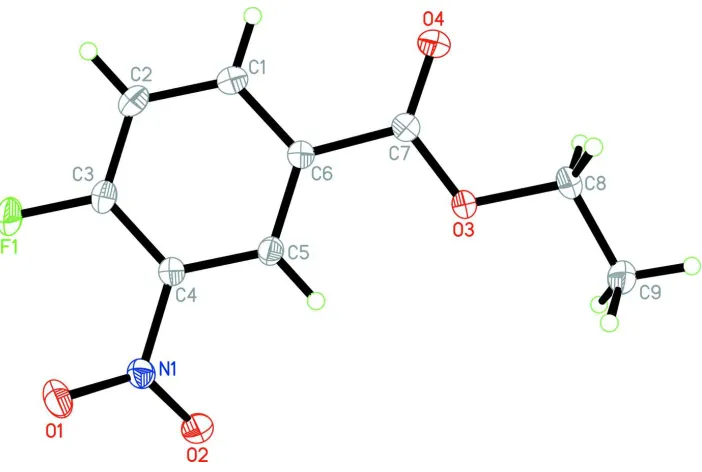
Figure 1
The asymmetric unit of the title compound, showing 50% probability displacement ellipsoids and the atom numbering
scheme.
Figure 2
The crystal packing of the title compound, viewed down the c axis. Intermolecular hydrogen bondings are shown as
dotted lines.
Ethyl 4-fluoro-3-nitrobenzoate
Crystal data
C9H8FNO4
Mr = 213.16 Monoclinic, P21/c
Hall symbol: -P 2ybc
a = 9.9246 (3) Å
b = 13.2883 (3) Å
c = 6.9310 (2) Å
β = 94.410 (2)°
V = 911.36 (4) Å3
Z = 4
F(000) = 440
Dx = 1.554 Mg m−3
Mo Kα radiation, λ = 0.71073 Å Cell parameters from 5027 reflections
θ = 2.6–30.8°
[image:3.610.130.473.358.522.2]T = 100 K Block, colourless
0.55 × 0.22 × 0.09 mm
Data collection
Bruker SMART APEXII CCD area-detector diffractometer
Radiation source: sealed tube Graphite monochromator
φ and ω scans
Absorption correction: multi-scan (SADABS; Bruker, 2005)
Tmin = 0.929, Tmax = 0.988
12540 measured reflections 2913 independent reflections 2411 reflections with I > 2σ(I)
Rint = 0.028
θmax = 31.1°, θmin = 2.1°
h = −14→14
k = −18→19
l = −10→10
Refinement
Refinement on F2
Least-squares matrix: full
R[F2 > 2σ(F2)] = 0.045
wR(F2) = 0.139
S = 1.11 2913 reflections 138 parameters 0 restraints
Primary atom site location: structure-invariant direct methods
Secondary atom site location: difference Fourier map
Hydrogen site location: inferred from neighbouring sites
H-atom parameters constrained
w = 1/[σ2(F
o2) + (0.0772P)2 + 0.1955P]
where P = (Fo2 + 2Fc2)/3
(Δ/σ)max < 0.001
Δρmax = 0.55 e Å−3
Δρmin = −0.36 e Å−3
Extinction correction: SHELXL, Fc*=kFc[1+0.001xFc2λ3/sin(2θ)]-1/4
Extinction coefficient: 0.018 (4)
Special details
Experimental. The crystal was placed in the cold stream of an Oxford Cryosystems Cobra open-flow nitrogen cryostat (Cosier & Glazer, 1986) operating at 100.0 (1) K.
Geometry. All e.s.d.'s (except the e.s.d. in the dihedral angle between two l.s. planes) are estimated using the full covariance matrix. The cell e.s.d.'s are taken into account individually in the estimation of e.s.d.'s in distances, angles and torsion angles; correlations between e.s.d.'s in cell parameters are only used when they are defined by crystal symmetry. An approximate (isotropic) treatment of cell e.s.d.'s is used for estimating e.s.d.'s involving l.s. planes.
Refinement. Refinement of F2 against ALL reflections. The weighted R-factor wR and goodness of fit S are based on F2,
conventional R-factors R are based on F, with F set to zero for negative F2. The threshold expression of F2 > σ(F2) is used
only for calculating R-factors(gt) etc. and is not relevant to the choice of reflections for refinement. R-factors based on F2
are statistically about twice as large as those based on F, and R- factors based on ALL data will be even larger.
Fractional atomic coordinates and isotropic or equivalent isotropic displacement parameters (Å2)
x y z Uiso*/Ueq
F1 0.04351 (7) 0.10679 (6) 0.18019 (12) 0.0241 (2) O1 0.07165 (9) 0.29746 (7) 0.29028 (14) 0.0240 (2) O2 −0.04092 (9) 0.39394 (6) 0.08249 (15) 0.0247 (2) O3 −0.52330 (8) 0.30897 (6) −0.00372 (14) 0.0203 (2) O4 −0.58597 (9) 0.14638 (7) −0.02358 (16) 0.0276 (2) N1 −0.02296 (10) 0.31401 (7) 0.16902 (15) 0.0172 (2) C1 −0.31523 (12) 0.08546 (9) 0.06256 (18) 0.0197 (2)
H1A −0.3804 0.0356 0.0410 0.024*
C2 −0.18146 (12) 0.05833 (9) 0.10726 (19) 0.0211 (3)
H2A −0.1566 −0.0091 0.1139 0.025*
C4 −0.12280 (11) 0.23409 (8) 0.12960 (16) 0.0154 (2) C5 −0.25648 (11) 0.26145 (8) 0.08154 (16) 0.0154 (2)
H5A −0.2807 0.3290 0.0710 0.018*
C6 −0.35338 (11) 0.18648 (8) 0.04945 (17) 0.0161 (2) C7 −0.49936 (11) 0.21032 (9) 0.00323 (18) 0.0179 (2) C8 −0.66549 (12) 0.33789 (10) −0.0398 (2) 0.0231 (3)
H8A −0.7170 0.3145 0.0648 0.028*
H8B −0.7035 0.3081 −0.1597 0.028*
C9 −0.67127 (13) 0.45039 (10) −0.0529 (2) 0.0280 (3)
H9A −0.7638 0.4716 −0.0713 0.042*
H9B −0.6233 0.4725 −0.1603 0.042*
H9C −0.6304 0.4791 0.0646 0.042*
Atomic displacement parameters (Å2)
U11 U22 U33 U12 U13 U23
F1 0.0168 (3) 0.0239 (4) 0.0312 (4) 0.0077 (3) 0.0003 (3) 0.0020 (3) O1 0.0153 (4) 0.0295 (5) 0.0264 (5) 0.0006 (3) −0.0037 (3) 0.0008 (4) O2 0.0228 (4) 0.0174 (4) 0.0333 (5) −0.0018 (3) −0.0025 (4) 0.0042 (4) O3 0.0123 (4) 0.0155 (4) 0.0324 (5) 0.0009 (3) −0.0017 (3) 0.0002 (3) O4 0.0191 (4) 0.0176 (4) 0.0453 (6) −0.0038 (3) −0.0041 (4) 0.0012 (4) N1 0.0141 (4) 0.0180 (5) 0.0196 (5) 0.0007 (3) 0.0017 (3) −0.0015 (4) C1 0.0201 (5) 0.0148 (5) 0.0242 (6) −0.0008 (4) 0.0010 (4) −0.0002 (4) C2 0.0229 (6) 0.0140 (5) 0.0263 (6) 0.0037 (4) 0.0015 (5) 0.0004 (4) C3 0.0166 (5) 0.0185 (5) 0.0192 (5) 0.0049 (4) 0.0015 (4) 0.0006 (4) C4 0.0144 (5) 0.0158 (5) 0.0159 (5) 0.0007 (4) 0.0010 (4) 0.0001 (4) C5 0.0144 (5) 0.0149 (5) 0.0169 (5) 0.0018 (4) 0.0014 (4) 0.0005 (4) C6 0.0148 (5) 0.0152 (5) 0.0181 (5) 0.0005 (4) 0.0004 (4) −0.0001 (4) C7 0.0157 (5) 0.0162 (5) 0.0216 (5) −0.0003 (4) 0.0005 (4) 0.0003 (4) C8 0.0119 (5) 0.0218 (6) 0.0350 (7) 0.0007 (4) −0.0013 (4) 0.0022 (5) C9 0.0188 (6) 0.0213 (6) 0.0426 (8) 0.0040 (4) −0.0050 (5) −0.0051 (5)
Geometric parameters (Å, º)
F1—C3 1.3368 (13) C3—C4 1.3932 (16)
O1—N1 1.2308 (13) C4—C5 1.3912 (14)
O2—N1 1.2261 (13) C5—C6 1.3906 (15)
O3—C7 1.3326 (14) C5—H5A 0.9300
O3—C8 1.4653 (13) C6—C7 1.4935 (15)
O4—C7 1.2127 (14) C8—C9 1.4984 (19)
N1—C4 1.4638 (15) C8—H8A 0.9700
C1—C2 1.3876 (16) C8—H8B 0.9700
C1—C6 1.3959 (16) C9—H9A 0.9600
C1—H1A 0.9300 C9—H9B 0.9600
C2—C3 1.3814 (17) C9—H9C 0.9600
C2—H2A 0.9300
O2—N1—O1 124.29 (10) C5—C6—C7 122.00 (10)
O2—N1—C4 117.80 (9) C1—C6—C7 118.14 (10)
O1—N1—C4 117.89 (10) O4—C7—O3 124.15 (11)
C2—C1—C6 120.96 (11) O4—C7—C6 123.28 (11)
C2—C1—H1A 119.5 O3—C7—C6 112.57 (9)
C6—C1—H1A 119.5 O3—C8—C9 107.69 (9)
C3—C2—C1 119.01 (11) O3—C8—H8A 110.2
C3—C2—H2A 120.5 C9—C8—H8A 110.2
C1—C2—H2A 120.5 O3—C8—H8B 110.2
F1—C3—C2 118.93 (10) C9—C8—H8B 110.2
F1—C3—C4 120.52 (10) H8A—C8—H8B 108.5
C2—C3—C4 120.51 (10) C8—C9—H9A 109.5
C5—C4—C3 120.56 (10) C8—C9—H9B 109.5
C5—C4—N1 118.32 (10) H9A—C9—H9B 109.5
C3—C4—N1 121.11 (10) C8—C9—H9C 109.5
C6—C5—C4 119.08 (10) H9A—C9—H9C 109.5
C6—C5—H5A 120.5 H9B—C9—H9C 109.5
C4—C5—H5A 120.5
C6—C1—C2—C3 0.93 (19) N1—C4—C5—C6 −178.04 (10)
C1—C2—C3—F1 −178.41 (11) C4—C5—C6—C1 −1.07 (18)
C1—C2—C3—C4 −0.74 (19) C4—C5—C6—C7 178.12 (10)
F1—C3—C4—C5 177.27 (10) C2—C1—C6—C5 −0.02 (19)
C2—C3—C4—C5 −0.36 (18) C2—C1—C6—C7 −179.25 (11)
F1—C3—C4—N1 −3.44 (17) C8—O3—C7—O4 2.20 (18)
C2—C3—C4—N1 178.93 (11) C8—O3—C7—C6 −177.35 (10)
O2—N1—C4—C5 −31.36 (16) C5—C6—C7—O4 −179.29 (12)
O1—N1—C4—C5 146.88 (11) C1—C6—C7—O4 −0.09 (19)
O2—N1—C4—C3 149.33 (12) C5—C6—C7—O3 0.26 (16)
O1—N1—C4—C3 −32.42 (16) C1—C6—C7—O3 179.47 (11)
C3—C4—C5—C6 1.27 (17) C7—O3—C8—C9 −177.07 (11)
Hydrogen-bond geometry (Å, º)
D—H···A D—H H···A D···A D—H···A
C1—H1A···O4i 0.93 2.44 3.2380 (15) 144

![Crystal structure of ethyl 4 [(1H pyrazol 1 yl)methyl]benzoate](data:image/gif;base64,R0lGODlhAQABAIAAAP///wAAACH5BAEAAAAALAAAAAABAAEAAAICRAEAOw==)