1
Experimental study of dense pyroclastic density currents using sustained gas-fluidized granular flows 1
Pete J. Rowley, Olivier Roche, Timothy H. Druitt, Ray Cas 2
Abstract 3
We present the results of laboratory experiments investigating the behaviour of relatively long-lived dense 4
granular flows on horizontal slope in which we simulate long-lived high pore pressure through the 5
continuous injection of gas through the flow base. Sustained (>30 s) supply of fine (75 ± 15 µm) particles 6
from a hopper simulates pyroclastic density current formation fed by long-lived fountain collapse, which is 7
inferred to deposit very large volume and often widespread ignimbrites. Material is released at initial particle 8
concentrations of ~3% to 45%, and dense flows form readily at the impingement surface even at lowest 9
concentrations due to particle accumulation. When gas is supplied at the flow base at rates below the 10
minimum fluidization velocity (i.e. aeration), three flow phases and regimes are identified; (1) an initial 11
dilute spray travelling at 1 - 2 m s-1, then (2) a dense gas-particle flow travelling at 0.5 – 1 m s-1, which 12
comes to rest at a distance linearly dependent on the initial mass flux, and finally (3) dense flow pulses that 13
aggrade a deposit much thicker than the phase-2 flow itself. The flow front velocity in phase 2 has a square-14
root dependence on mass flux, while the propagation speed of phase 3 deposit front has a linear relationship 15
with it. The mass of the charge released has no significant control on either flow velocity or runout. In 16
contrast, fully fluidized flows with gas supply equal to the minimum fluidization velocity remain within 17
phase 2 for their duration, no deposit forms, and the material exits the flume, precluding quantification of the 18
effect of mass flux on runout. During phase 3 in aerated conditions high-frequency unsteadiness leads to 19
flow waxing and waning, creating deposit architectures that exhibit features observed in many ignimbrites, 20
including localised progradational and retrogradational phases of deposition, and erosive contacts. 21
Keywords 22
Fluidization - Pyroclastic flow - Density current - Pore pressure – Sustained supply - Experiments 23
2
Pyroclastic density currents (PDCs) are particle-laden flows produced by the gravitational collapse of 25
lava domes, lateral explosion (cf. Mount St. Helens) or by the fallback of eruption columns (Druitt 1998; 26
Branney and Kokelaar 2002). They have runouts ranging from hundreds of meters to more than a hundred 27
kilometres (Lube et al. 2007; Cas et al. 2011), are able to surmount topographic obstacles (Loughlin et al. 28
2002), and contain a wide range of particle sizes and densities. Density currents propagate across the ground 29
due to a combination of initial momentum and density contrast with the atmosphere, with density contrast 30
usually acting as the main driving force (Middleton 1966; Simpson 1999; Esposti-Ongaro et al. 2011). PDCs 31
exhibit a spectrum of flow behaviours and bulk densities, from dense granular flows (commonly termed the 32
basal avalanche) with over-riding dilute ash clouds, to dilute, turbulent flows with bedload layers (e.g. 33
Dufek and Bergantz 2007a, 2007b; Dufek et al. 2009; Andrews and Manga 2011, 2012). 34
Pyroclastic density currents are hazardous to populations living on and around active volcanoes, and 35
the understanding of their dynamics is vital to both improved hazard assessment and better interpretation of 36
their deposits. The ability of some PDCs to traverse topographic obstacles and achieve long runouts even on 37
subhorizontal slopes (e.g. Cas et al. 2011) makes them a particular focus of hazard mitigation planning. The 38
high mobility of the dense basal avalanche of some PDCs is attributed to the combined effects of (i) low 39
intergranular friction caused by excess (i.e. above atmospheric pressure) gas pore pressures and consequent 40
fluidization effects (Sparks 1976; Wilson 1980; Druitt et al. 2007), and (ii) long-lived high pore pressure 41
favoured by slow pore diffusion due to the low permeability of the particulate material, dominated by very 42
fine ash (Druitt et al. 2007; Roche et al. 2010; Roche 2012). Possible origins of excess gas pore pressures 43
caused by gas-particle differential motion in dense PDCs include (hindered) settling of particles from an 44
initially expanded state (Girolami et al. 2008), exsolution of gas from juvenile clasts (Wilson 1980), 45
ingestion of air at the flow front and sides (Bareschino et al. 2008), and air escape from a rough substrate 46
(Chédeville and Roche 2014). 47
Fluidization is a process with many industrial applications in the transport and storage of granular 48
materials (Fan and Zhu 2005; Rhodes 2008; Savage and Oger 2013). By injecting gas vertically into a 49
3
the particles, at which point intergranular friction is lost and the bed behaves in a liquid-like manner (Geldart 51
1972; Gilbertson et al. 2008). The superficial vertical gas velocity, U (equal to the gas volumetric flux 52
divided by the surface area across which gas is supplied) at which this occurs is dependent on the material 53
properties, and is termed the minimum fluidization (Umf) velocity
54
, (1)
55
where kmf is the bed permeability, µ is the dynamic gas viscosity, hmf the bed height, ρmf the bulk density of 56
the mixture and g the gravitational acceleration. Beds of volcanic ash representative of the matrix material 57
within pyroclastic flows, have low permeabilities (kmf~10-12-10-11 m2 and Umf as low as ~1 mm s-1), and they
58
expand homogeneously when fluidized at gas velocities above Umf until gas bubbles form at Umb>Umf
59
(Druitt et al. 2007), showing that they belong to group A of Geldart's classification (Geldart 1973). Shear in 60
a moving dense particulate flow moreover favours homogeneous fluidization-generated expansion by 61
breaking down any bubbles (Nezzal et al. 1998; Druitt et al. 2004). A bed in which 0<U<Umf is termed
62
aerated, and one in which U≥Umf is termed fluidized. When gas is no longer provided to fluidized beds of
63
group A particles, negligible internal friction can be maintained for a while as excess pore pressure 64
decreases slowly by diffusion on a typical time scale of: 65
(3)
66
where D is the diffusion coefficient of the gas in the granular mixture (Iverson and LaHusen 1989; Druitt et 67
al. 2007; Roche 2012). 68
In experiments on fluidized granular flows applied to dense PDCs, the use of group A 69
particles is required to ensure dynamic similarity with the natural system as discussed by Roche (2012). 70
Previous experimental studies on dense PDCs focussed on releasing almost instantaneously a volume of 71
initially fluidized group A powder onto a horizontal surface (Roche et al. 2004; Girolami et al. 2008). One 72
problem is that the similar material mean grain size, and hence permeability and diffusion coefficient, in 73
both experiments and PDCs leads to pore pressure diffusion timescales that are significantly different, since 74
mf
mf mf
k
U ρ g
µ
= ×
2 ,
d mf
4
the experimental flows are 1-3 orders of magnitude thinner than the natural ones (Hoblitt 1986; Palladino 75
and Valentine 1995; Dellino et al. 2007). As such, pore pressure is lost more rapidly in fluidized 76
experimental flows than in natural PDCs. Experimental flows come to a relatively rapid halt and form 77
relatively much shorter deposits than those of their natural counterparts. One way to overcome the relatively 78
rapid decrease of pore pressure in experimental flows is to sustain fluidization through a continuous air 79
supply at the flow base (Eames and Gilbertson 2000; Savage and Oger 2013. We have developed a 80
methodology for sustaining fluidization during flow in order to better model the emplacement of ignimbrite-81
forming PDCs with long-lived high pore pressure. By supplying a continuous gas flux through the flow 82
substrate, we can simulate the behaviours of natural flows with long diffusion timescales. 83
This paper reports the results of experiments on sustained fluidized dense granular flows 84
(approaching maximum particle concentration) in which the material supply duration is equal to or greater 85
than the time taken for the flow front to reach its distal limit. We explore how the mass of particles, the 86
mass flux, and the degree of fluidization affect the speed, runout, and depositional behaviour of the flows. 87
These experiments differ from previous studies on fluidized free-surface granular flows, which provide no 88
air supply from below, and which are produced by rapid gravitational column collapse involving 89
instantaneous supply, dam-break experiments. 90
91
Methods and materials 92
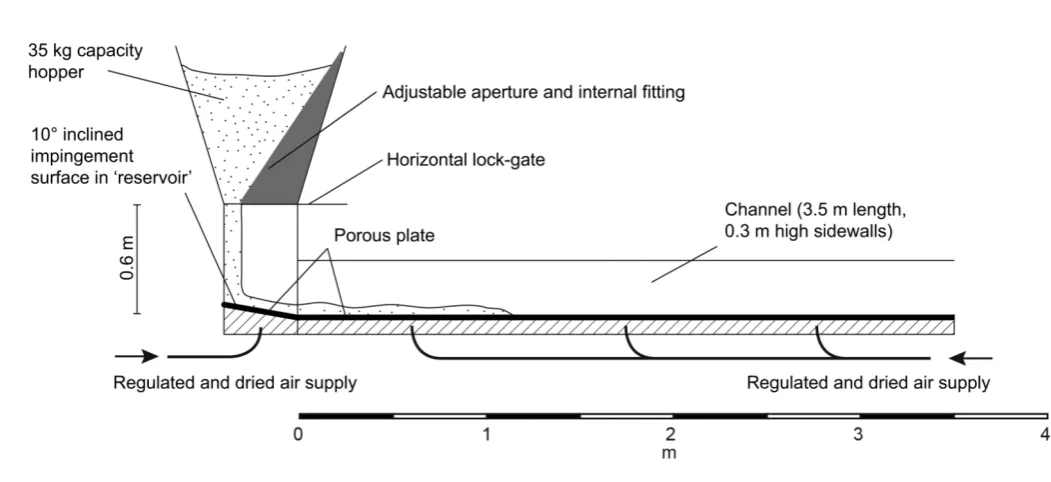
The experimental apparatus is shown in Figure 1. A 35 kg capacity hopper supplied the particles to a 93
3.5 m long horizontal flume through a lock-gate release mechanism, with a variable aperture to control the 94
mass flux. The particles dropped 60 cm onto an impingement plate consisting of a porous plate inclined at 95
10°, then propagated into the horizontal channel section, which also had a porous base. The drop height was 96
selected through testing in order to allow the particles to approach their terminal velocity when falling as 97
clusters (Nakashima et al. 2009). Air was supplied through both the impingement plate and the channel base 98
5
with vertical Perspex sidewalls 30 cm tall. These dimensions were selected to ensure that the flume was 100
wide enough to minimise sidewall effects (Girolami et al. 2008) without increasing the necessary particle 101
volumes to impractical values. We refer to the volume above the impingement plate as the ‘reservoir’, as it 102
is analogous to the reservoir in dam-break experiments (e.g. Roche et al. 2010). All experiments were 103
recorded using high-speed video at 500 frames per second with a horizontal resolution of 1024 pixels, 104
enabling frame-by-frame analysis to record front propagation, as well as to observe qualitative details of the 105
flow and deposit formation. By filling the hopper with alternating dyed and undyed particles it was possible 106
to analyse the behaviour of flow and deposition in detail. The particles exited the hopper in such a way as to 107
provide continuous variation in deposit colour (Figure 2), providing a high resolution method of imaging the 108
internal flow and deposit structure. All runout measurements are expressed as distance from the entry into 109
the channel, and times are given relative to the instant at which the flow first enters the channel from the 110
reservoir. 111
The experiments were carried out using glass ballotini with a grain size of 75 ± 15 µm and repose 112
angle of 27°, identical to those of Roche et al. (2004). These particles are fine enough to exhibit Geldart 113
group A properties (significant expansion prior to the onset of bubbling) and long pore pressure diffusion 114
timescales, but are coarse enough to experience negligible cohesion (Schellart 2000; Gilbertson and Eames 115
2003). Umf for the particles has been determined previously as 0.83 cm s-1, and Umb as 1.6 cm s-1 (i.e., about
116
2Umf , Roche et al. 2006).
117
The three variables in the experiments are (i) the total mass of particles leaving the reservoir and 118
entering the channel, (ii) the mass flux of particles leaving the reservoir, and (iii) the gas supply velocity 119
through base of the flume. The mass of particles ranged from 10 to 25 kg. The mass flux was calculated by 120
dividing the total mass by the time it took for the reservoir to empty. Mass fluxes of 0.8 to 65 kg s-1 were 121
achieved through a variable aperture at the base of the hopper of 1 to 20 cm width, respectively. The 122
experiments were conducted with the same fluidization conditions simultaneously in the reservoir and 123
channel : non-fluidized (U=0), aerated (U=0.5 Umf), or fluidized (U=Umf).
124
6 Results
126
Calibration of the particle supply 127
Visual inspection of videos of the falling material in the reservoir showed that it was quite 128
heterogeneous in both the early and latter stages (as the ballotini were first released and then as the hopper 129
finally emptied), consisting of clumps and curtains of particles of different concentrations. Arrival of 130
heterogeneities on the impingement plate caused splashing and a high frequency unsteadiness in particle 131
supply that was then transmitted to the horizontal flows, as described below. We calibrated the time-132
variation of mass flux for different aperture sizes of the hopper by placing a balance on the floor of the 133
reservoir and recording the force exerted on the balance as a function of time (0.04 second intervals and 0.1 134
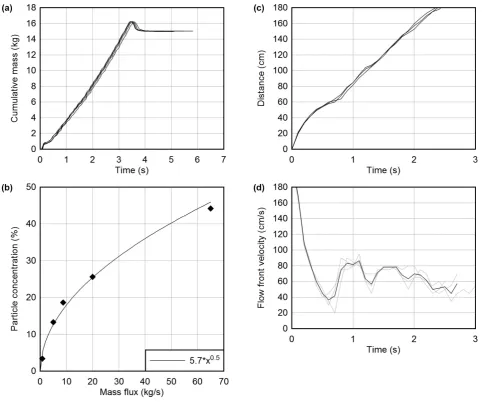
g precision). The results (Figure 3a) show that the time-averaged flux was approximately constant, but 135
increased slightly as the reservoir emptied. We concluded that our hopper supplied particles at an 136
approximately constant flux when averaged over periods greater than 0.12 seconds upon which the higher 137
frequency, splash-generated unsteadiness was superimposed. The observed velocity of impact on the 138
impingement plate was approximately 3.4 m s-1, which is equal to the freefall velocity √(2gh), where h is the 139
60 cm drop height. 140
We also estimated the time-averaged concentration of particles, C, impacting the impingement plate 141
under conditions of different mass fluxes, from the relationship 142
, (4)
143
where M is the measured mean mass flux, d is the distance particles fall during the period between frames t, 144
ρs is the particle density (2500 kg m-3), and A is the cross sectional area of the aperture. The results are
145
presented in Figure 3b, and show that higher mass fluxes generated higher particle concentrations upon 146
impingement. Mass fluxes of <1 kg s-1 are calculated to generate time-averaged concentrations as small as 3-147
4%, which must have then densified significantly before forming the dense flows that propagated through 148
the channel as described hereafter. In contrast, the higher mass flux experiments (65 kg s-1) produced 149
s
Mt C
dAρ
7
concentrations on impingement of approximately 45% (note that maximum particle concentration of 150
randomly packed spheres approaches 64%; (Bernal and Mason 1960; Song et al. 2008). 151
A series of initial tests, in which we repeated measurements under the same conditions, showed that 152
our experimental results were highly reproducible. This is true of the particle mass flux exiting the reservoir 153
(Figure 3a), distance-time plots for the flow fronts (Figure 3c), and flow front velocity, obtained from the 154
slope of the distance-time curves (Figure 3d). Comparing flow front position through time of the five repeat 155
experiments in Figure 3c, taking the flow front distance in each experiment at timestep X, for 80 timesteps 156
gives a mean correlation coefficient (Pearson’s r) of 0.998. 157
158
Flow and deposition behaviour 159
As the charge impinged on the reservoir base it rapidly coalesced into a thin (< 20 mm), dense flow. 160
Even in low mass flux experiments, for which the calculated particle concentration prior to impingement 161
was less than 20%, the bulk of falling material had gravitationally collapsed to form a coherent dense flow 162
within 0.1 s. Flow behaviour and deposition varied according to the fluidization state of the particles. 163
Non-fluidized and aerated flows 164
Emplacement of these flows took place in three overlapping phases (see representative video, Online 165
Resource 1). 166
Phase 1. The force of the initial impact of particles on the base of the reservoir generated a violent 167
spray of particles at high speed (up to ~2 m s-1) down the channel. This spray formed a rapidly moving, mm-168
thin dense flow of particles, accompanied by an ephemeral dilute cloud of particles travelling down the 169
flume above and in front of the denser flow, which rapidly form a deposit just a few particle diameters in 170
thickness with a diffuse front. The volume of particles involved in phase 1 was less than 1% of that involved 171
in the subsequent main flow (phases 2 and 3). In most, but not all, experiments the deposit from phase 1 was 172
8
when the granular mass first impacted the impingement plate and was translated laterally. A similar 174
phenomenon was observed in the 3D dam-break experiments of Roche et al. (2011) as a result of rapid pore 175
pressure release at the base of a collapsing fluidized granular column. 176
Phase 2. The precursor flow was followed, and in most experiments overtaken, by a slower-moving 177
(0.1 – 1.0 m s-1) dense granular flow. A key observation was that this flow formed even at lowest initial 178
mass fluxes (i.e., lowest impingement concentrations) as particles accumulated at the impingement surface. 179
The flow had thicknesses from a few particle diameters up to 10 – 20 mm (increasing with mass flux) and 180
was highly unsteady due to the high-frequency unsteadiness in particle supply. It travelled down the flume 181
as a series of pulsed waves; larger waves travelled faster than smaller ones, and entrained any smaller waves 182
that they over-rode. As each flow pulse travelled down the flume, it decreased in velocity and thickness. 183
Arrival of each successive flow pulses at the flow front caused transient fluctuations in frontal velocity that 184
are evident on a plot of flow front velocity versus distance (Figure 3c). 185
Under aerated conditions a granular jump (Boudet et al. 2007) appeared to form during phase 2 and 186
phase 3 at the transition from the impingement plate to the flume, with a possible chute-and-pool structure 187
(Schmincke et al. 1973). The granular jump and chute and pool are not observed in fluidized flows, and 188
occur too late in propagation to impact the flow front measurements. 189
Phase 3. Once the initial dense flow pulse had reached its distal limit, further supply then thickened 190
the existing deposit, and the distal limit moved at much slower rate, if at all. In non-fluidized cases this 191
growth occurred as a simple granular wedge, while in aerated flows the deposit formed through 192
subhorizontal aggradation, with the runout of individual flow pulses inhibited by friction with the 193
developing substrate. This resulted in non-fluidized phase 3 flows constantly prograding with a deposit front 194
angle of between 15-20°, depending on the mass flux (high mass fluxes producing lower angles). It is 195
notable that these are below the angle of rest of the ballotini particles (27°), likely as a result of flow 196
momentum. Aerated phase 3 flows demonstrated more varied behaviour, including retrogradational deposit 197
growth. The deposit surface from the aerated flows had more consistent angles, determined by the gas flow 198
velocity (approximately 10° for 0.5 Umf aeration), and generated deposits that were thinner and longer than
9
those from equivalent non-fluidized flows. In all cases the deposits could be described as having a lower 200
stationary part (the continuously aggrading deposit) and a moving surface layer (the flow). Whether or not 201
the phase 3 flow over-rode the distal extent of phase 1 and 2 deposits was controlled by the angle of the 202
advancing slope and the total mass of the charge in the experiment, with large total masses and low angles 203
favouring longer runouts. The fluidized flows travelled rapidly (up to 1 m s-1) down the length of the flume 204
and exited at the distal end. Source-generated unsteadiness caused the frontal velocity to fluctuate, as in the 205
non-fluidized and aerated flows. The thin precursor flow (phase 1) and the following main flow (phase 2) 206
could not be distinguished. The fluidized flows (5-100 mm in thickness) remained mobilised by gas support 207
throughout their duration and can be considered non-depositional. 208
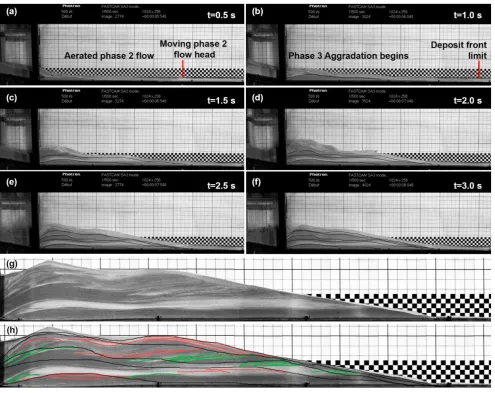
A typical example an aerated flow is shown in Figure 4. Following rapid emplacement of the 209
precursor flow (phase 1), the front of the initial dense flow reached its distal limit by 1.0 s (phase 2). The 210
deposit then aggraded, with no further advance of the front (phase 3). During phase 3, (which lasted until 211
shortly after the particle supply ceased at 2.0 s), the successive flow pulses interacted with an increasingly 212
steep and undulating depositional surface. Coloured beads within the final deposit revealed a mm-thick 213
stratification with multiple, stacked progradational and retrogradational surfaces resulting from the waxing 214
and waning of individual flow pulse. These surfaces occurred in localised groupings throughout the deposit, 215
due to the flow waxing at one point in the flume, while simultaneously waning at another. The 216
progradational surfaces (associated with waxing flow) also demonstrate erosive contacts, indicating that the 217
flow was not completely depositional. A final flow pulse formed a drape over the entire deposit. As the 218
deposit built, interaction with existing (and developing) topography became a strongly controlling factor in 219
flow behaviour, and the resulting deposit architecture. 220
Characteristic times 221
The compound behaviours of these flow phases described above can be used in conjunction with 222
material supply conditions to identify a number of characteristic times in each flow. We define tsupply as the
223
time at which the supply of material from the hopper ceases. This value ranged from 0.5 to 20 s depending 224
on the charge mass and mass flux. tlimit denotes the time at which the phase 2 flow comes to a halt, forming
10
a distal deposit front which may or may not be overpassed by subsequent phase 3 deposition. A flow is said 226
to be sustained when tlimit < tsupply. tstop identifies the time at which all flow motion ceases. In the
non-227
fluidized and aerated experiments tstop is within 1 second of tsupply, while in the fluidized case this is
228
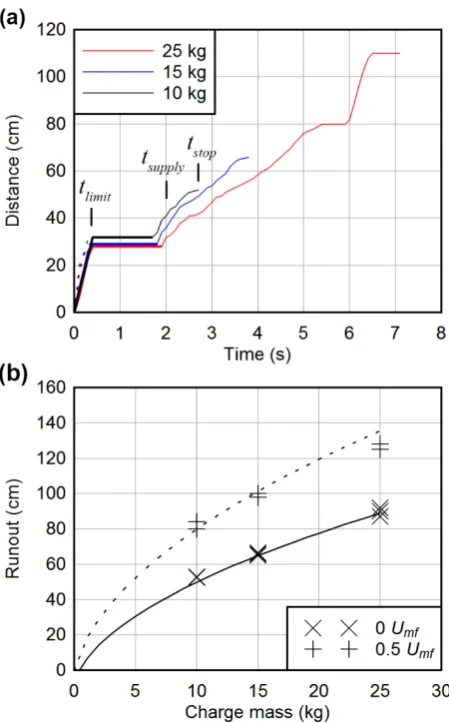
undefined as the flow left the channel. These characteristic times are illustrated by labels for a 10 kg flow in 229
Figure 5a. 230
Effect of mass released 231
We investigated the effect of total particle mass released on flow behaviour by carrying out 232
experiments with non-fluidized flows at masses of 10, 15 and 25 kg, and constant mass flux (5 kg s-1 - 233
similar results were achieved in experiments with mass flux between 0.8 and 65 kg s-1). At a fixed mass flux, 234
increasing the total mass (and therefore volume) increased flow runout (Figure 5a). The flow front 235
velocities, on the other hand (slope on Figure 5a), were much less dependent on total mass; the very weak 236
inverse dependence could be due to higher initial material compaction (and development of stress arches at 237
the hopper mouth) as mass increased (Walton and Braun 1986; GDR MiDi 2004; Carlevaro and Pugnaloni 238
2012), leading to a very subtly reduced initial mass flux (see below). Aerated flows travelled further than 239
non-fluidized flows of a given mass (and mass flux), but the curve of a plot of runout versus mass is similar 240
to that for the non-fluidized case (Figure 5b). 241
242
Effect of mass Flux 243
The approximately constant supply rate delivered by our hopper system with a given aperture (Figure 244
3a) allowed us to investigate the effect of mass flux on flow behaviour. This is illustrated in Figure 6 using 245
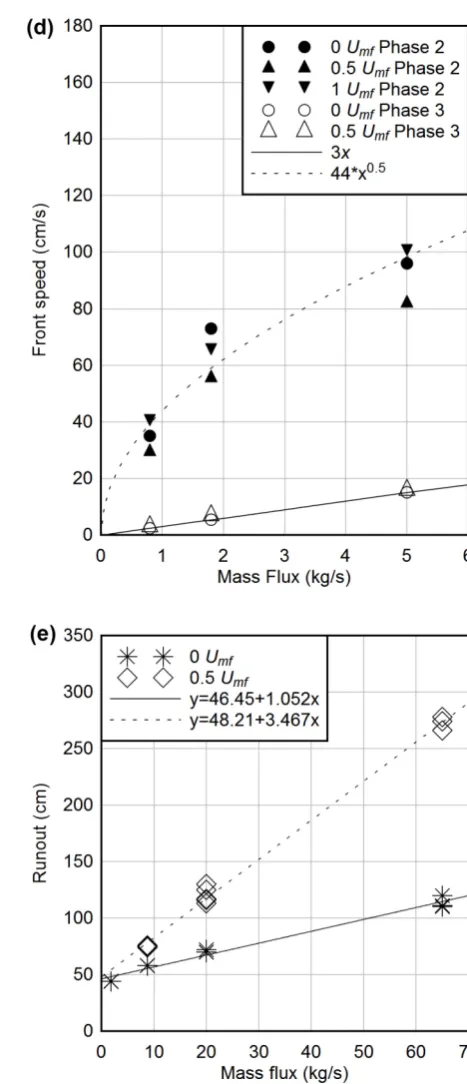
non-fluidized, aerated, and fluidized flows of 15 kg total mass at fluxes of 0.8, 1.8 and 5 kg s-1. Increasing 246
mass flux increased both the flow front velocity and runout distance in all cases, with phase 2 and phase 3 247
flows responding differently to mass flux (Figure 6d). Plotting of phase 2 front propagation velocity against 248
mass flux up to 5 kg s-1 shows a square-root relationship, perhaps related to the similar power-law 249
11
excluded from these analyses due to their very short duration, resulting in low confidence in both the 251
identification of flow phase transitions and measurement of average velocities. However, tentative 252
observations in the order of 3-4 m s-1 for phase 2 front speed in an aerated flow with a 65 kg s-1 mass flux 253
are in line with these measurements and related conclusions at a mass flux <5 kg s-1 since the fit curve for 254
0.5 Umf suggests 3.5 m s-1 at 65 kg s-1. Front velocities of phase 3 propagation have a linear relationship of
255
slope of 3.0 for both non-fluidized and aerated flows. 256
Figure 6e shows the results of a wider set of experiments using a range of mass fluxes between 0.8 257
and 65 kg s-1, and both non-fluidized and aerated conditions. The data demonstrate that flow runout 258
increased linearly with mass flux, with the effect amplified when the flow was aerated, which is an 259
important result of our study. The intercept of the lines on the vertical axis is the lowest possible runout for a 260
charge of that mass (i.e. a static granular wedge at angle of rest). 261
Effect of fluidization state 262
The fluidization state had a variable effect on flow front velocity and on flow runout. At a given 263
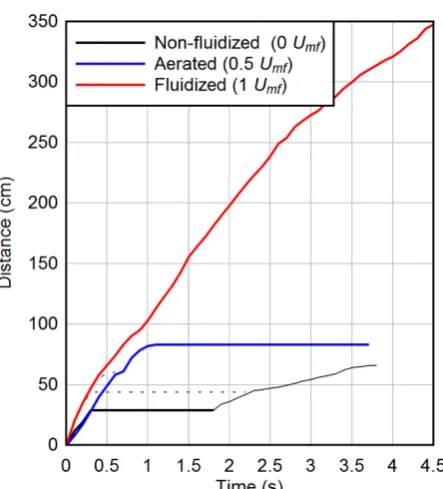
mass and mass flux, non-fluidized, aerated, and fluidized flows had similar phase-2 frontal velocities (Figure 264
7d). Non-fluidized flows formed angle-of-rest wedges; aeration increased the runout of the flow, resulting 265
in a lower-angle wedge with a lower mean-thickness-to-length ratio (Figs. 5b and 6e). 266
Discussion 267
Relative significance of variables 268
The effects of each of the three variables (mass, mass flux and fluidization state) on the dense flow 269
velocity and runout are now summarized and discussed. 270
Velocity. Phase 2 front velocity of the non-fluidized (U=0), aerated (U=0.5 Umf) and fluidized (U =
271
1.0 Umf) flows increased with mass flux according to a square-root relationship for mass fluxes up to at least
272
5 kg s-1 (Figure 6d), but was rather insensitive to either total particle mass (Figure 5a) or fluidization state 273
12
flux in both the non-fluidized and aerated flows, with flows of larger mass simply lasting longer due to the 275
longer supply time. The fundamental difference between these two phases is that phase 2 represents the 276
movement of a single flow pulse, while phase 3 is dependant entirely on the rate at which subsequent flow 277
pulses over-run the deposits of earlier pulses. Pre-existing deposit surfaces are uneven and unconsolidated, 278
and therefore act to dissipate energy from the over-riding flow, leading to generally reduced runout, except 279
where the slope angle becomes sufficient to add a compensating acceleration. 280
Flow runout. The runout of the non-fluidized (U=0) and aerated (U=0.5 Umf) flows with initial
281
particle concentration up to ~ 45% (at 65 kg s-1) increased linearly with mass flux (Fig. 6e). Increasing mass 282
flux from 0.8 to 65 kg s-1 caused a trebling of runout in non-fluidized flows, while having a nearly six-fold 283
effect on the runout of aerated currents (Figure 6e). Runout also increased with the total mass (Figure 5b), 284
and with the degree of fluidization (Figure 7). The runout of fully fluidized flow (U=Umf) exceeded the 350 285
cm length of the flume. 286
Owing to the characteristics of the hopper particle-feed system, changing the mass flux also resulted 287
in a change of the particle concentration in the collapsing granular mass. Lower mass fluxes were associated 288
with lower initial concentrations so that the granular material had to first densify (by gas expulsion) prior to 289
flow generation. Further experiments are required to separate the effects of mass flux and initial 290
concentration on flow behaviour. However, it is interesting to note that runout of non-fluidized and aerated 291
flows correlates linearly with mass flux up to at least 65 kg s-1. This suggests that the initial particle 292
concentration was unimportant in governing flow behaviour, as dense flows rapidly formed (<0.1 seconds 293
after impingement) even in the most dilute supply conditions, and that mass flux was the major controlling 294
variable. 295
296
Behaviours of sustained versus transient laboratory flows 297
Our experiments serve to highlight some significant difference between transient, dam-break flows 298
13
tsupply in sustained flows is longer that tlimit, in contrast to dam break flows, so that particles continue to be
300
supplied to the flow system after the maximum runout distance has been reached. Second, in the dam-break 301
case almost the entire particle volume is mobilised at once, with the flow steadily thinning as it propagates 302
and deposits. The final deposit thickness is less than or equal to the flow thickness. This is in contrast to the 303
sustained flow case, in which the dense flow pulses, caused by high-frequency fluctuiations of the source 304
supply, accumulated to form a final deposit that could be orders of magnitude thicker than the flow. 305
Another feature of our sustained experimental flows is that the series of pulses formed the deposit 306
through a series of waxing-waning cycles. This contrasts with dam-break experiments in which there is a 307
single, rapid cycle of waxing, then waning, flow (Girolami et al. 2008; Roche et al. 2010; Roche 2012). This 308
unsteadiness in the sustained flows generated deposits with complex internal architectures characterized by 309
multiple, stacked progradational and retrogradational surfaces. While these conditions are interesting from a 310
field perspective, as discussed below, a challenge in future experiments will be to employ source supply 311
conditions that do not generate such strong flow unsteadiness, in order to properly evaluate the influence of 312
other parameters. 313
Finally, the frontal velocity and runout of dam-break flows are controlled by the initial bed height 314
and the fluidization state (Roche et al. 2008). In sustained flows, an additional factor is the mass flux (and 315
through it the particle supply duration), which has an additional strong effect not relevant in transient flows. 316
Though higher bed height in dam-break experiments causes higher flow velocity and hence mass flux, we 317
recall that our sustained flows were generated from a source at constant height, demonstrating that the mass 318
flux also controls flow emplacement. 319
Implications for dense pyroclastic density currents 320
While fluidized granular flows generated in dam-break configurations provide insight into the 321
dynamics of either a single pyroclastic flow unit during a sustained eruption or transient flows from lava 322
dome collapse or the fallback of vulcanian columns, our present experimental system offers a way of 323
14
high pore pressure by injection of gas during flow allows us to mimic experimentally long-lived pore 325
pressure due to sustained external and/or internal gas sources, particle hindered settling, and slow pressure 326
diffusion characteristic of natural pyroclastic flows, which could not be achieved in experiments with initial 327
fluidization at source only. Sustained high pore pressure enables even thin (mm-scale) experimental flows to 328
propagate for several meters. Moreover, the apparatus allows even relatively thin flows (millimetres to 329
centimetres in these experiments) to progressively accrete a deposit, the final thickness of which is much 330
greater than the flow pulses themselves. 331
Although our results are very preliminary, it is worth noting some possible applications to the 332
transport and deposition behaviour of high-concentration PDCs (i.e., pyroclastic flows) and the formation of 333
thick ignimbrites. First, the experiments show that sustained aerated flows are emplaced as three phases. In 334
phase 1, initial impact of the collapsing particles (crudely analogous to a collapsing eruption column) may 335
generate high gas pressures and a ‘spray’ of particles that shoots ahead of the main flow, accompanied by a 336
dilute cloud of particles. This precursor flow lays down a very thin deposit, typically displaying a highly 337
asymmetric and/or lobate front, which is then over-run by the main phase 2 flow. Although our experiments 338
in no way scale to the natural system in this respect, regarding particularly turbulence, we speculate that this 339
kind of phenomenon might account in some cases for the ‘ground surge deposits’ commonly observed at the 340
base of ignimbrites (Sparks et al. 1973; Wilson 1980; Wright et al. 1980; Valentine et al. 1989; Fisher et al. 341
1993; Dellino and La Volpe 2000). The experiments presented here represent the dense end of the PDC 342
spectrum while natural flows are likely to encompass a broader range of characteristics, including the 343
turbulent dilute endmember (e.g. Andrews and Manga 2012). The spray observed in our experiments has 344
some similarities with the initial blast wave generated by collapsing eruption columns in the numerical 345
models of Wohletz et al. (1984). Also, the deposit resembles that of the so-called 'surge' observed by Roche 346
et al. (2011) in their experiments, as high pore pressure at base of a fluidized granular column is suddenly 347
released, being very thin and emplaced rapidly and asymmetrically ahead of the larger dense flow. 348
The second feature of our experiments is that the main phase 2 dense flow forms readily at the 349
15
important result of our study. The phase 2 flow travels out to a distal limit, determined by the mass flux, 351
total mass and particle fluidization state. Phase 3 sees the deposit aggrade vertically to a final thickness 352
much greater than that of the phase-2 flow. During the extended deposition of phase 3 material, the distal 353
limit may or may not advance further, essentially because the pulses have lower velocity than the main 354
phase 2 flow. We infer from this that sustained pyroclastic flows may reach a distal limit relatively early in 355
their emplacement, after which the remainder of the deposit will vertically aggrade through accumulation of 356
pulses to form thick ignimbrite. The exact behaviour in nature would, of course, depend on temporal 357
variations in the source mass flux, the fluidization state of the flow, and/or the ground slope. Nevertheless, 358
the experimental flows support the interpretation that thick ignimbrites can aggrade progressively from a 359
sustained supply of thin, flowing granular material, without the necessity of thick individual flow units 360
(Sparks 1976; Wright and Walker 1981; Hayashi and Self 1992; Palladino and Valentine 1995; Calder et al. 361
2000; Branney and Kokelaar 2002; Wilson and Hildreth 2003; Brown and Branney 2004b; Fierstein and 362
Wilson 2005) 363
Third, although the unsteadiness in our experimental flows was inherent to the feeder mechanism, it 364
is likely that natural pyroclastic flows are similarly unsteady on a short timescale (even if they are quasi-365
steady on a longer timescale). Unsteadiness leads to temporal and spatial variations of thickness, velocity, 366
and momentum in the flow system. The complex internal architectures of the experimental deposits (Figure 367
4), including stacked progradational and retrogradational surfaces, resembles those of some natural 368
ignimbrites (e.g. Branney and Kokelaar 2002; Wilson and Hildreth 2003; Brown and Branney 2004a; Brown 369
et al. 2007) It is possible such features are present in many deposits, but are masked by uniform grainsize 370
characteristics (Rowley et al. 2011). The response of the later stages of the experimental flows to topography 371
formed by earlier phases is entirely fitting with PDC behaviour, which are seen to have strong responses to 372
even relatively minor changes in topography (e.g. Giordano 1998; Pittari et al. 2006; Doronzo and Dellino 373
2014). 374
The ability of the experimental flows to aggrade deposits that are much thicker than the flows 375
16
(Branney and Kokelaar 1997; Cas et al. 2011). These experimental dense flows were fed purely from the 377
proximal end of the flume, with material ranging from highly dilute (~3-4% vol.%) to highly concentrated 378
(~45 vol.%). 379
Conclusions 380
Our experiments using granular flows on a horizontal slope fed by a continuous supply of collapsing 381
material onto an impingement surface enable the investigation of some of the behaviours of sustained PDCs. 382
They consider non-fluidized flows as well as aerated and fully fluidized flows generated by continuous gas 383
supply to their base, which permits the simulation of long-lived high pore pressure that favours propagation. 384
Non-fluidized and aerated flows propagate in three distinct but overlapping phases; an initial fast dilute 385
spray (phase 1), a subsequent slower dense unsteady flow which may over-ride the phase 1 deposit (phase 386
2), and finally sustained aggradation through unsteady dense flow pulses (phase 3). An important result of 387
our study is that dense flows at almost maximum particle concentration are generated as particles 388
accumulate at the impingement surface, even when the particle concentration at source is of a few percent. 389
Mass flux has a strong control on flow behaviour, with an inverse-quadratic relationship to phase 2 390
flow front velocity in the ranges observed, becoming a linear control on the propagation velocity of the 391
front of the deposit during phase 3, formed by accumulation of pulses in both non-fluidized and aerated 392
flows. A linear dependence is observed in the runout distance of non-fluidized and aerated flows for a range 393
of mass fluxes up to 65 kg s-1, corresponding to a particle concentration of ~45%. Fluidized flows remain 394
mobile, with essentially infinite runouts. As in dam break experiments, charge mass is of secondary 395
importance in the control of flow speed or runout, whatever the degree of fluidization of the flows. 396
The experiments demonstrate the ability of sustained granular flows to aggrade deposits many times 397
thicker than the primary phase-2 flow and the subsequent phase-3 pulses, with complex internal 398
architectures typical of many ignimbrites produced by temporal and spatial variation in flow properties. 399
400
17
PR was supported by a Université Blaise Pascal postdoctoral fellowship, with experimental work 402
funded by a grant from the volcanology group of the Laboratoire Magmas et Volcans. This is Laboratory of 403
Excellence ClerVolc (ANR-10-LABX-0006) contribution number 106. We thank the reviewers B. Andrews 404
and C. Wilson, whose comments and suggestions significantly improved this manuscript. 405
406
References 407
Andrews B, Manga M (2011) Effects of topography on pyroclastic density current runout and formation of 408
coignimbrites. Geology 39(12):1099-1103. doi: 1010.1130/G32226.32221 409
Andrews BJ, Manga M (2012) Experimental study of turbulence, sedimentation, and coignimbrite mass 410
partitioning in dilute pyroclastic density currents. Journal of Volcanol Geotherm Res 225:30–44. doi: 411
10.1016/j.jvolgeores.2012.02.011 412
Bareschino P, Lirer L, Marzocchella A,Petrosino P, Salatino P (2008) Self-fluidization of subaerial rapid 413
granular flows. Powder Tech 182:323–333. doi: 10.1016/j.powtec.2007.12.010 414
Bernal J, Mason J (1960) Packing of spheres: co-ordination of randomly packed spheres. Nature 188:910– 415
911. doi: 10.1038/188910a0 416
Boudet J, Amarouchene Y, Bonnier B, Kellay H (2007) The granular jump. J Fluid Mech 572:413–432. doi: 417
10.1017/S002211200600365X 418
Branney MJ, Kokelaar BP (2002) Pyroclastic density currents and the sedimentation of ignimbrites. Geol 419
Soc London Memoir, 27 420
Branney MJ, Kokelaar P (1997) Giant bed from a sustained catastrophic density current flowing over 421
topography: Acatlan ignimbrite, Mexico. Geology 25:115–118. doi: 10.1130/0091-422
7613(1997)025<0115:GBFASC>2.3.CO;2 423
Brown R, Kokelaar B, Branney M (2007) Widespread transport of pyroclastic density currents from a large 424
silicic tuff ring: the Glaramara tuff, Scafell caldera, English Lake District, UK. Sedimentology 54:1163– 425
18
Brown RJ, Branney M (2004a) Bypassing and diachronous deposition from density currents: Evidence from 427
a giant regressive bed form in the Poris ignimbrite, Tenerife, Canary Islands. Geology 32:445–448. doi: 428
10.1130/G20188.1 429
Brown RJ, Branney MJ (2004b) Event-stratigraphy of a caldera-forming ignimbrite eruption on Tenerife: 430
the 273 ka Poris Formation. Bull Volcanol 66:392–416. doi: 10.1007/s00445-003-0321-y 431
Calder E, Sparks R, Gardeweg M (2000) Erosion, transport and segregation of pumice and lithic clasts in 432
pyroclastic flows inferred from ignimbrite at Lascar Volcano, Chile. J Volcanol Geotherm Res 104:201– 433
235. doi: 10.1016/S0377-0273(00)00207-9 434
Carlevaro CM, Pugnaloni LA (2012) Arches and contact forces in a granular pile. Eur Phys J E 35:1–7. 435
doi:10.1140/epje/i2012-12044-7 436
Cas RA, Wright HM, Folkes CB, Lesti C, Porreca M, Giordano G, Viramonte JG (2011) The flow 437
dynamics of an extremely large volume pyroclastic flow, the 2.08-Ma Cerro Galán Ignimbrite, NW 438
Argentina, and comparison with other flow types. Bull Volcanol 73:1583–1609. doi: 10.1007/s00445-439
011-0564-y 440
Chédeville C., Roche O. (2014). Autofluidization of pyroclastic flows propagating on rough substrates as 441
shown by laboratory experiments. J Geophys Res, 119 : 1764–1776. doi 10.1002/2013JB010554. 442
Dellino P, La Volpe L (2000) Structures and grain size distribution in surge deposits as a tool for modelling 443
the dynamics of dilute pyroclastic density currents at La Fossa di Vulcano (Aeolian Islands, Italy). J 444
Volcanol Geotherm Res 96:57–78. doi: 10.1016/S0377-0273(99)00140-7 445
Dellino P, Zimanowski B, Büttner R, La Volpe L, Mele D, Sulpizio R. (2007) Large-scale experiments on 446
the mechanics of pyroclastic flows: Design, engineering, and first results. J Geophys Res 112:B04202. 447
doi: 10.1029/2006JB004313 448
Doronzo DM, Dellino P (2014) Pyroclastic density currents and local topography as seen with the conveyer 449
model. J Volcanol Geotherm Res 278:25–39. doi: 10.1016/j.jvolgeores.2014.03.012 450
Druitt TH (1998) Pyroclastic density currents. In: Gilbert JS, Sparks RSJ (eds) The physics of explosive 451
19
Druitt TH, Avard G, Bruni G, et al. (2007) Gas retention in fine-grained pyroclastic flow materials at high 453
temperatures. Bull Volcanol 69:881–901. doi: 10.1007/s00445-007-0116-7 454
Druitt TH, Bruni G, Lettieri P, Yates JG (2004) The fluidization behaviour of ignimbrite at high temperature 455
and with mechanical agitation. Geophys Res Lett 31: L02604 doi: 10.1029/2003GL018593 456
Dufek J, Bergantz G (2007a) Suspended load and bed-load transport of particle-laden gravity currents: the 457
role of particle-bed interaction. Theor Comp Fluid Dyn 21:119–145. doi: 10.1007/s00162-007-0041-6 458
Dufek J, Bergantz GW (2007b) Dynamics and deposits generated by the Kos Plateau Tuff eruption: Controls 459
of basal particle loss on pyroclastic flow transport. Geochem Geophy Geosy 8:1525-2027 460
Dufek J, Wexler J, Manga M (2009) Transport capacity of pyroclastic density currents: Experiments and 461
models of substrate-flow interaction. J Geophys Res 114:B11203 doi: 10.1029/2007GC001741 462
Eames I, Gilbertson M (2000) Aerated granular flow over a horizontal rigid surface. J Fluid Mech 424:169– 463
195. doi: 10.1017/S0022112000001920 464
Esposti-Ongaro T, Barsotti S, Neri A, Salvetti MV (2011) Large-eddy simulation of pyroclastic density 465
currents. In: Salvetti MV, Geurts B, Meyers J, Sagaut P (eds) Quality and reliability of large-eddy 466
simulations II. Springer Netherlands, pp 161–170. doi: 10.1007/978-94-007-0231-8_15 467
Fan L-S, Zhu C (2005) Principles of gas-solid flows. Cambridge University Press, USA 468
Fierstein, J. & Wilson, C.J.N., 2005. Assembling an ignimbrite: compositionally-defined flow packages in 469
the 1912 Valley of Ten Thousand Smokes ignimbrite, Alaska. Geol Soc Am Bull 117:1094-1107. doi: 470
10.1130/B25621.1 471
Fisher RV, Orsi G, Ort M, Heiken G (1993) Mobility of a large-volume pyroclastic flow—emplacement of 472
the Campanian ignimbrite, Italy. J Volcanol Geotherm Res 56:205–220. doi: 10.1016/0377-473
0273(93)90017-L 474
GDR MiDi (2004) On dense granular flows. Eur Phys J E 14:341–365. doi: 10.1140/epje/i2003-10153-0 475
Geldart D (1972) The effect of particle size and size distribution on the behaviour of gas-fluidised beds. 476
Powder Tech 6:201–215. doi: 10.1016/0032-5910(72)83014-6 477
20
Gilbertson MA, Eames I (2003) The influence of particle size on the flow of fluidised powders. Powder 479
Tech 131:197–205. doi: 10.1016/S0032-5910(02)00343-1 480
Gilbertson MA, Jessop DE, Hogg AJ (2008) The effects of gas flow on granular currents. Phil Trans R Soc 481
A 366:2191–2203. doi: 10.1098/rsta.2007.0021 482
Girolami L, Druitt TH, Roche O, Khrabrykh Z (2008) Propagation and hindered settling of laboratory ash 483
flows. J Geophys Res 113:B02202. doi: 10.1029/2007JB005074 484
Giordano G (1998) The effect of paleotopography on lithic distribution and facies associations of small 485
volume ignimbrites: the WTT Cupa (Roccamonfina volcano, Italy). J Volcanol Geotherm Res 87:255– 486
273. doi: 10.1016/S0377-0273(98)00096-1 487
Hayashi J, Self S (1992) A comparison of pyroclastic flow and debris avalanche mobility. J Geophys Res 488
(1978-2012) 97:9063–9071. doi: 10.1029/92JB00173 489
Hoblitt RP (1986) Observations of the eruptions of July 22 and August 7, 1980, at Mount St. Helens, 490
Washington. USGS Professional Paper 1335 491
Iverson RM, LaHusen RG (1989) Dynamic pore-pressure fluctuations in rapidly shearing granular materials. 492
Science 246:796–799. doi: 10.1126/science.246.4931.796 493
Loughlin S, Baxter P, Aspinall W, et al. (2002) Eyewitness accounts of the 25 June 1997 pyroclastic flows 494
and surges at Soufrière Hills Volcano, Montserrat, and implications for disaster mitigation. Geol Soc 495
London, Memoirs 21:211–230. doi: 10.1144/GSL.MEM.2002.021.01.10 496
Lube G, Cronin SJ, Platz T, et al. (2007) Flow and deposition of pyroclastic granular flows: A type example 497
from the 1975 Ngauruhoe eruption, New Zealand. J volcano Geotherm Res 161:165–186. doi: 498
10.1016/j.jvolgeores.2006.12.003 499
Middleton GV (1966) Experiments on density and turbidity currents: I. Motion of the head. Can J Earth Sci 500
3:523–546. doi: 10.1139/e66-038 501
Nakashima K, Johno Y, Shigematsu T (2009) Free fall characteristics of particle clusters in a vertical pipe. J 502
21
Nezzal A, Large J, Guigon P (1998) Fluidisation behaviour of very cohesive powders under mechanical 504
agitation. In: Fluidization VIII, Proc Eighth Engineering Foundation Conference on Fluidization, May 505
14–19. Am Inst Chem Eng 77-82 506
Palladino DM, Valentine GA (1995) Coarse-tail vertical and lateral grading in pyroclastic flow deposits of 507
the Latera Volcanic Complex (Vulsini, central Italy): origin and implications for flow dynamics. J 508
Volcanol Geotherm Res 69:343–364. doi: 10.1016/0377-0273(95)00036-4 509
Pittari A, Cas R, Edgar C, Nichols HJ, Wolff JA, Marti J (2006) The influence of palaeotopography on 510
facies architecture and pyroclastic flow processes of a lithic-rich ignimbrite in a high gradient setting: the 511
Abrigo Ignimbrite, Tenerife, Canary Islands. J Volcanol Geotherm Res 152:273–315. doi: 512
10.1016/j.jvolgeores.2005.10.007 513
Rhodes MJ (2008) Introduction to particle technology. John Wiley and Sons, Chichester. 514
Roche O (2012) Depositional processes and gas pore pressure in pyroclastic flows: an experimental 515
perspective. Bull Volcanol 74:1807–1820. doi: 10.1007/s00445-012-0639-4 516
Roche O, Attali M, Mangeney A, Lucas A (2011) On the run-out distance of geophysical gravitational 517
flows: Insight from fluidized granular collapse experiments. Earth Planet Sc Lett 311:375–385. doi: 518
10.1016/j.epsl.2011.09.023 519
Roche O, Gilbertson MA, Phillips JC, Sparks RSJ (2002) Experiments on deaerating granular flows and 520
implications for pyroclastic flow mobility. Geophys Res Lett 29:40–1. doi: 10.1029/2002GL014819 521
Roche O, Gilbertson MA, Phillips JC, Sparks RSJ (2004) Experimental study of gas-fluidized granular 522
flows with implications for pyroclastic flow emplacement. J Geophys Res 109:B10201. doi: 523
10.1029/2003JB002916 524
Roche O, Gilbertson MA, Phillips JC, Sparks RSJ (2006) The influence of particle size on the flow of 525
initially fluidised powders. Powder Tech 166:167–174. doi: 10.1016/j.powtec.2006.05.010 526
Roche O., S. Montserrat, Y. Niño, A. Tamburrino (2008). Experimental observations of water-like behavior 527
of initially fluidized, unsteady dense granular flows and their relevance for the propagation of pyroclastic 528
22
Roche O, Montserrat S, Niño Y, Tamburrino A (2010) Pore fluid pressure and internal kinematics of 530
gravitational laboratory air-particle flows: Insights into the emplacement dynamics of pyroclastic flows. J 531
Geophys Res 115:B09206. doi: 10.1029/2009JB007133 532
Rowley PJ, Kokelaar P, Menzies M, Waltham D (2011) Shear-derived mixing in dense granular flows. J of 533
Sed Res 81:874–884. doi: 10.2110/jsr.2011.72 534
Savage SB, Oger L (2013) Airslide flows, part 1-experiments, review and extension. Chem Eng Sci 91:35-535
43. doi: 10.1016/j.ces.2012.12.043 536
Schellart W (2000) Shear test results for cohesion and friction coefficients for different granular materials: 537
scaling implications for their usage in analogue modelling. Tectonophysics 324:1–16. doi: 538
10.1016/S0040-1951(00)00111-6 539
Schmincke H-U, Fisher RV, Waters AC (1973) Antidune and chute and pool structures in the base surge 540
deposits of the Laacher See area, Germany. Sedimentology 20:553-574. doi: 10.1111/j.1365-541
3091.1973.tb01632.x 542
Simpson JE (1999) Gravity currents: In the environment and the laboratory. Cambridge University Press, 543
Cambridge. 544
Song C, Wang P, Makse HA (2008) A phase diagram for jammed matter. Nature 453:629–632. doi: 545
10.1038/nature06981 546
Sparks RSJ (1976) Grain size variations in ignimbrites and implications for the transport of pyroclastic 547
flows. Sedimentology 23:147–188. doi: 10.1111/j.1365-3091.1976.tb00045.x 548
Sparks RSJ, Self S, Walker GPL (1973) Products of ignimbrite eruptions. Geology 1:115–118. doi: 549
10.1130/0091-7613(1973)1<115:POIE>2.0.CO;2 550
Valentine GA, Buesch DC, Fisher RV (1989) Basal layered deposits of the Peach Springs Tuff, 551
northwestern Arizona, USA. Bull Volcanol 51:395–414. doi: 10.1007/BF01078808 552
Walton OR, Braun RL (1986) Viscosity, granular-temperature, and stress calculations for shearing 553
assemblies of inelastic, frictional disks. J Rheol 30:949–980. doi: 10.1122/1.549893 554
Wilson CJN (1980) The role of fluidization in the emplacement of pyroclastic flows: An experimental 555
23
Wilson CJN, Hildreth W (2003) Assembling an ignimbrite: mechanical and thermal building blocks in the 557
Bishop Tuff, California. J Geol 111:653–670. doi: 10.1086/378335 558
Wohletz KH, McGetchin T, Sandford II M, Jones E (1984) Hydrodynamic aspects of caldera-forming 559
eruptions: Numerical models. J Geophys Res 89:8269–8285. doi: 10.1029/JB089iB10p08269 560
Wright JV, Smith AL, Self S (1980) A working terminology of pyroclastic deposits. J Volcanol Geotherm 561
Res 8:315–336. doi: 10.1016/0377-0273(80)90111-0 562
Wright JV, Walker GP (1981) Eruption, transport and deposition of ignimbrite: a case study from Mexico. J 563
Volcanol Geotherm Res 9:111–131. doi: 10.1016/0377-0273(81)90001-9 564
565
566
24 Captions
568
Figure 1 569
570
Fig.1 Scaled longitudinal section of the experimental apparatus. The flume exit (right) and top are open to 571
prevent air re-circulation or reflection artifacts. 572
573
Figure 2 574
575
Fig. 2 Sequence of three photographs showing emptying of the hopper using a 3-layer charge. Note the 576
temporal variation in the proportion of different coloured ballotini being supplied. 577
578
[image:24.595.22.548.99.340.2]25 580
Fig. 3 (a) Plot demonstrating steady supply of a 15 kg charge from the hopper, measured using a data 581
logging balance placed 60 cm below the mouth of the hopper at an aperture of 5 cm, providing a calculated 582
mean mass flux of ~5 kg s-1. (b) Calculated particle concentrations for varying mass flux conditions, using 583
high speed footage to estimate particle fall rate, assuming constant mass flux and that the cross-sectional 584
area of impingement is the same as the hopper aperture. Fit curve is applied, demonstrating concentration 585
has a power law dependence on mass flux. (c) Reproducibility of flow propagation for a 15 kg charge 586
supplied at 5 kg s-1, fluidized at U = Umf. The flows exit the video frame at approximately 2.3 seconds. All 587
distances are measured from the start of the channel. (d) Flow speed derived from (b), with individual flows 588
plotted in grey, and an average curve plotted in black. Of note is the rapid deceleration on entering the 589
channel, followed by a pulsing unsteady flow head. 590
[image:25.595.38.522.39.444.2]26 Figure 4.
592
593
Fig. 4 (a-f) High speed video frames taken at 0.5 second intervals through the flow and deposition of a 10 kg 594
multi-coloured charge supplied at 5 kg s-1 with a gas supply providing aeration at 0.5 Umf. Charge has been 595
fully released by 2 seconds, with the flow at complete rest by 3 seconds. The chequerboard squares are 1 cm 596
across for scale. Black lines indicate the deposit growth, highlighting the location of the top of the deposit at 597
each 0.5 s time interval. A video of this experiment is presented in Online Resource 1. (g) The final deposit, 598
showing complex internal structure from the aggradational formation. (h) Final deposit in (g) with 599
interpretation and deposit growth lines, highlighting a range of contacts including (red) progradational and 600
(green) retrogradational phases of deposition. The progradational features frequently demonstrate erosive 601
style contacts (e.g. the unit in the lower left of the deposit). 602
[image:26.595.37.533.74.467.2]27 Figure 5
604
605
Fig. 5 (a) Effect of mass on distances of flow front propagation in non-fluidized conditions, at 5 kg s-1 mass 606
flux, with the dotted line indicating phase 1 flow, the heavy line phase 2, and the fine line phase 3. The point 607
at which the flow front comes to a rest (tlimit), the hopper empties (tsupply) and the flow comes to a complete
608
rest (tstop)are indicated for the 10 kg charge. All three lines end at the relevant tstop. Note that phase 3 starts
609
after ~0.3 seconds, but only grows the deposit sufficiently to overcome the pre-existing phase 2 deposit front 610
after ~1.7 seconds. Phase 3 propagation between channel entry and over-riding of the distal extent of phase 611
2 is not plotted. The flows are remarkably similar for the first 2.7 seconds, with a very weak inverse 612
relationship between charge mass and propagation speed. Final runout is strongly determined by the volume 613
of material due to the wedge-like growth in these non-fluidized conditions. (b) Dependence of runout on 614
charge mass in both non-fluidized (U=0) and aerated (0.5 Umf) conditions. Fits are achieved by determining
615
[image:27.595.37.262.80.442.2]28
measured angle of repose that is 17° in the non-fluidized experiments and 9° in the aerated cases. The fit 617
lines assume that the runout requires a wedge of material at the angle of repose to first grow to the extent of 618
the reservoir before the flow can enter the channel (runout = 0) 619
620
Figure 6 621
[image:28.595.277.511.215.758.2]29
Fig. 6 Flow front propagation for various mass fluxes, using a 15 kg supply which is (a) non-fluidized 623
(hence the deposit growth occurs largely as a granular wedge at the angle of repose), (b) aerated at 0.5 Umf,
624
and (c) fluidized at 1 Umf. The dotted line represents phase 1 (where present), the heavy line represents phase
625
2, and the fine line represents phase 3 (where present). Lines end when all flow has ceased (tstop), or, in the
626
fluidized (U=Umf) case, when the flow exits the video frame. It should be noted that in the 5 kg s-1
non-627
fluidized experiment (red line in (a)) the initial phase 1 deposit forms a front which is not over-ridden by 628
phase 2, but which is eventually over-ridden by phase 3 at ~2.3 seconds. Phase 3 propagation between 629
channel entry and over-riding the distal extent of phase 2 is not plotted. (d) Average front speeds calculated 630
for phases 2 (filled) and 3 (open) in experiments using low mass fluxes from 0.8 – 5 kg s-1, to illustrate that 631
in phase 2 the velocities respond to an inverse quadratic of mass flux while in phase 3 front progradation has 632
a linear relationship with mass flux. (e) Runout distances for different mass fluxes (0.8 – 65 kg s-1) in non-633
fluidized and aerated conditions. Larger mass fluxes correlate with a longer runout, with this effect further 634
increased when aeration is present. 635
636
Figure 7 637
[image:29.595.41.263.492.737.2]30
Fig. 7 Flow front position versus time for non-fluidized (0 Umf), aerated (0.5 Umf) and fluidized (1 Umf)
639
experiments, using a 15 kg charge supplied at 5 kg s-1. Dotted lines indicate the phase 1 flow, heavy lines 640
phase 2 and fine lines phase 3 (where present). Lines for the non-fluidized and aerated experiments end 641
when the flow has come to a complete rest (tstop), and for the fluidized experiment when the flow exits the
642
flume. The non-fluidized phase 3 flow over-runs its phase 2 deposit front at 1.8 seconds, and its phase 1 643
deposit after 2.2 seconds, at which point the non-fluidized phase 3 flow progrades steadily until achieving a 644
final runout (66cm) only slightly shorter than that of an aerated flow (77.5 cm). Aerated conditions produce 645
a more mobile phase 1 and phase 2 flow than non-fluidized conditions, with the initial deposit front from an 646
aerated flow achieving twice the runout of non-fluidized flow after 0.5 seconds, and almost 3 times the 647
runout after 1 second. Fluidized flows decelerate gradually along the length of the flume from over 1 m s-1 to 648
approximately 0.5 m s-1 as the material exits after 4.5 seconds. 649
650
Supplementary Material 651
Online Resource 1 652
High speed video running at 1/3rd real-time of an aerated flow at 0.5 Umf, supplied with 10 kg of material at 653
5 kg s-1. An initial phase 1 dilute spray enters the channel quickly followed by the phase 2 dense flow front. 654
This travels along the flume to a final runout of 1 meter after 1 second, by which time phase 3 aggradation in 655
the proximal region of the flume has already begun. The flow continues to aggrade for a further 2 seconds. 656
The internal structure is revealed through colour variation of the ballotini being fed into the flume, revealing 657
a complex array of deposit stratigraphies produced as a result of waxing and waning pulses throughout phase 658