service composition
Edwin Vlieg
Software Engineering Research Group
Faculty of Electrical Engineering, Mathematics & Computer Science
University of Twente
A thesis submitted for the degree of
MSc Computer Science
November 2010
Supervisors Lu´ıs Ferreira Pires
Eduardo Gon¸calves da Silva
Service composition is a technique applied in software systems and has the
goal to compose application services in order to achieve value-added
func-tionality. With the Internet increasingly woven into our daily lives, access to
user friendly services becomes increasingly important. Services composition
provides a way to fulfill complex goals of end-users by combining the power
of several services. Mashups are an example of a successful service
compo-sition approach, but in this approach a professional developer is responsible
for developing the composition.
User-centric service composition aims at providing a user-aware software
platform for creating compositions of services in order to fulfill the goals of
the user. This enables less skilled users to create compositions that achieve
value-added functionality.
This thesis describes the engineering of a prototype for ucentric
ser-vice composition in the e-commerce and entertainment domain based on
the DynamiCoS framework. The e-commerce and entertainment domain
contain realistic scenarios for service composition and have different types
of users, namely users that lack technical knowledge. An architecture for
the prototype and interaction patterns with the DynamiCoS framework are
I would like to thank the people that supported me during the writing of
my thesis.
First of all, I would like to thank Eduardo Gon¸calves da Silva and Lu´ıs
Ferreira Pires for their supervision. Doing research was sometimes hard for
me as an entrepreneur, but you managed to keep me on track. Eduardo,
I really enjoyed our discussions and work sessions. Lu´ıs, thanks for the
feedback on my writing and monitoring my progress. Furthermore I would
like to thank Betsy van Dijk for being my second supervisor. Although our
meetings were scarce, they always gave me new insights into my work from
your HMI point of view.
My colleagues and friends always supported me during my graduation. My
business partners at MoneyBird gave me the opportunity to experience the
great adventure of being part of a startup, but still allowed me to get my
degree.
Finally, I would like to thank my family. You have always supported me in
completing my study, but also gave me the freedom to follow my passions
in music and entrepreneurship. Thanks!
Edwin Vlieg
1 Introduction 1
1.1 Motivation . . . 1
1.2 Objectives . . . 4
1.3 Research questions . . . 5
1.4 Structure . . . 5
2 Application domains for user-centric service composition 7 2.1 Assessment of domains . . . 7
2.1.1 Types of users . . . 8
2.1.2 Services & compositions . . . 10
2.1.3 Human-Computer Interaction . . . 10
2.1.4 Conditions of service composition . . . 10
2.2 Domains . . . 11
2.2.1 Enterprise . . . 11
2.2.2 Building automation . . . 13
2.2.3 E-commerce . . . 15
2.2.4 Entertainment . . . 17
2.2.5 E-Health . . . 19
2.3 Conclusions . . . 20
2.3.1 Conclusions on criteria . . . 21
2.3.2 Selection of domains . . . 21
3 User-centric service composition scenarios 25 3.1 Services . . . 25
3.1.2 Restaurant information: Iens & Seatme . . . 26
3.1.3 Hotel information: Kayak . . . 27
3.1.4 Weather information: Buienradar . . . 28
3.1.5 Location: Google Geocoding & Maps . . . 28
3.2 Users . . . 29
3.3 Scenarios . . . 30
4 Architecture of the client application 33 4.1 DynamiCoS framework . . . 34
4.2 Domain specific services . . . 34
4.2.1 Domain- & service-specific input . . . 35
4.2.2 Domain-specific execution information . . . 35
4.2.3 Domain-specific output . . . 37
4.3 Service composition . . . 38
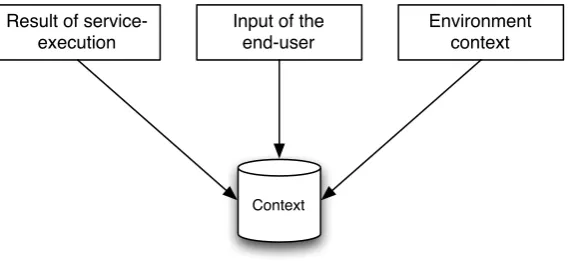
4.3.1 User execution context . . . 41
5 Interaction with DynamiCoS 43 5.1 Context . . . 43
5.1.1 Types of context information . . . 44
5.1.2 Context awareness of the framework . . . 45
5.1.3 Session management . . . 46
5.2 Interaction types . . . 46
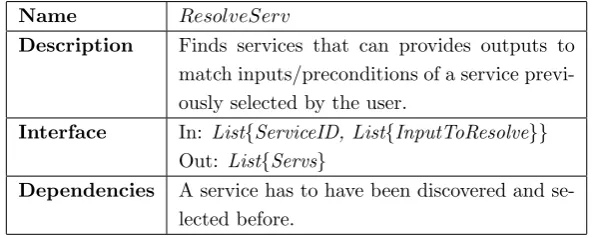
5.2.1 Service discovery . . . 46
5.2.2 Resolve service . . . 47
5.2.3 Select service . . . 48
5.2.4 Validate inputs . . . 49
5.2.5 Execute service . . . 49
5.2.6 Add to context . . . 51
5.2.7 Clean context . . . 51
6 Evaluation of the prototype 55
6.1 Acceptance test . . . 55
6.2 User test . . . 56
6.2.1 Approach . . . 56
6.2.2 Results . . . 57
6.3 Analysis . . . 58
6.3.1 Domain specific user-interfaces . . . 59
6.3.2 Composition process . . . 59
6.3.3 Selecting results . . . 61
7 Final remarks 63 7.1 Conclusions . . . 63
7.2 Further work . . . 65
A Example interactions 67 B Scenarios for acceptance tests 73 B.1 Find an activity . . . 73
B.2 Find a restaurant . . . 73
B.3 Find a hotel . . . 74
B.4 Get directions . . . 74
B.5 Find a restaurant given an activity . . . 74
B.6 Find a hotel given an activity . . . 75
B.7 Find an activity given a hotel . . . 75
B.8 Find an activity given a hotel and a restaurant . . . 76
B.9 Get weather information given an activity . . . 76
B.10 Get directions given a restaurant . . . 77
B.11 Get weather information using an address . . . 77
Introduction
This chapter presents an introduction and the motivation for our research on usage
patterns for user-centric service composition. Furthermore, it presents the approach
taken in this research and the structure of this thesis. This chapter is structured as
follows: section 1.1 contains the motivation for our research; section 1.2 states our
objectives; section 1.3 presents the project research questions; section 1.4 presents the
structure of the thesis.
1.1
Motivation
Internet services are increasingly woven into the daily lives of many people. The range of
services on the Internet is huge and creates many new challenges for software engineers.
Internet-based application services are increasingly being used to support everyday
tasks. This trend is not limited to professional users, but also more and more consumers
are using such services. It is a challenge for software engineers to create user-friendly
services and even more to create services personalized to a wide range of possible target
users.
An approach to simplify access to Internet services (web services) for the end-user
is to reduce the complexity of the user interface. Often this means to focus on solving
a single problem at a time for the end-user. This contrasts with traditional software,
which tends to resolve all requirements of menu end-users in a single software system,
by offering complex user interfaces with too many options. Many companies are very
Google (with GMail [15] and Google Apps [16]), 37signals (with Highrise, Basecamp
and Backpack [1]) and FreshBooks [14].
In the domain of personal digital lifestyle, services are also becoming more and
more important. An example is e-commerce, where more consumers are buying their
goods online, using different services in the purchasing process. Examples of services
are Kelkoo to compare prices, CNET to review products and Google Maps to find the
nearest store. Entertainment and e-health are yet two other domains concerned with
personal digital lifestyle that are taking advantage of Internet services.
As a result from focussing on a single problem at a time, one single service often
does not fulfill all requirements of the end-user. A composition of various services is
often a suitable solution to solve a complex problem of a user. For example, a company
that uses a billing service retrieves client information from its customer relationship
service and the project’s hours from the project management service. The consumer
who wants to buy a new phone can make an assessment based on the price on Kelkoo,
check reviews on CNET and search for the nearest store via Google Maps.
Mashups
Service-Oriented Architectures [13] address the issues around the creation, use and
sharing of services. A popular approach for service composition with focus on the
end-user is to build mashups [8]. In a mashup, it is often the software engineer who decides
which requirements of the end-user he is going to fulfill. Based on these requirements,
he creates a composition of services to be used by end-users. Often the requirements of
an end-user are not completely fulfilled. Furthermore, the number of possible
combi-nations of services is “endless” so that it creates a so-called long tail [3]. When service
composition is able to address the requirements in the long tail, a larger number of
users can be satisfied.
An often used example of a mashup is housingmaps.com [30]. This website is a
combination of Google Maps and Craigslist. Google Maps enables the user to zoom in
on a particular region, and the mashup automatically shows advertisements of houses
for rent in the visible region. This mashup is useful for end-users who wish to find a
flat to rent in a particular city. The usefulness of this solution is quickly limited once
the user adds additional requirements, such as finding a flat in the range of at most 5
Enterprise mashups overcome the major disadvantage of the above described mashups
by empowering business users to combine services [19]. By leveraging peer production
[4] and collaboration, an enterprise mashup is more user-centric than the mashups
de-scribed above. Enterprise mashups primarily focus on business end-users, while service
composition can be applied in domains with very different end-users, so a solution to
service composition that also takes other types of end-users into account is needed.
User-centric service composition
Enterprise mashups are still very dedicated to business experts. Simpler approaches are
needed to make service composition better comply with the requirements of end-users
in other domains. Firstly, the approach should enable an end-user to communicate his
requirements to the system. For example, research on natural language processing and
knowledge representation offer the possibility to convert natural language into machine
readable requirements. Secondly, it is important to allow the user to properly interact
with the system. Services can be applied in different domains, focussing on different
kinds of end-users. Therefore it is plausible to take into account the less skilled users.
There are different types of users. In [10] two factors are identified for defining the
skills of the end-user: the user’s technical knowledge and domain knowledge.
For a proper composition of services, a certain degree of technical knowledge is
required. For example, a user with technical knowledge on service composition may be
able to create a composition in the Business Process Execution Language (BPEL) [29].
On the other hand, a user with little technical knowledge requires a more intuitive and
abstract interface in the process of service composition.
Domain knowledge is required to determine in which way service composition can
be applied within the domain. Service knowledge is a more specific kind of domain
knowledge concerning the knowledge on the services offered in the domain. A user
with little knowledge about available services, needs more support in discovering and
choosing the right services to fulfill his requirements, in contrast with a user with
extensive knowledge of the domain and the services. The domain expert can easily
determine the various services to be combined to fulfill a certain requirement.
In [10] four different types of users are distinguished: layman, domain experts,
technical experts andadvanced users. In this classification, the layman is a user without
knowledge. The type of user influences the patterns of interaction between a user and
the service composition system.
To address the problem of user-centric service composition, the DynamiCoS
frame-work [9, 11] is being developed at the University of Twente. The goal of the frameframe-work
is to satisfy the requirements of different types of users, enabling them to access and
compose services in a user-centric manner. DynamiCoS aims at shielding its users
from the complexity of the service composition process by guiding the user through the
service composition process.
In order to enable user-centric service composition to its full extent, extended
knowl-edge about the domains, types of users and user interaction patterns is required.
Ser-vice composition software with simpler user interfaces allows users, regardless of their
background, to compose services from large sets of available services. With this
em-powerment of the user, service composition and the provided services can get to the
next level of integration into our digital lives.
1.2
Objectives
The main objective of this thesis is to evaluate a user-centric service composition
ap-proach. We take a pragmatic approach to define possible applications of user-centric
service composition in existing realistic software scenarios in different domains. By
applying user-centric service composition to different domains, we can identify usage
patterns.
To achieve this objective, we have designed and developed a prototype to test the
support for service composition and to perform usability tests with end-users. The
prototype consists of a client application, which uses the DynamiCoS framework to
manage the service composition process. The domain of the prototype has to contain
realistic scenarios for service composition. Furthermore, the domain has to contain
users lacking technical knowledge or domain knowledge in order to test the usability of
the prototype for these types of users.
The extended knowledge about usage patterns obtained with the research should
improve the flexibility of the DynamiCoS framework. More flexibility enables a broader
1.3
Research questions
The following questions have been posed in our research:
1. Identify and characterize possible application domains for user-centric service composition. Before we are able to create a prototype for ucentric ser-vice composition and perform tests with end-users, we need to identify suitable
appli-cation domains for user-centric service composition. With a literature study we try to
determine domains that are representative for the application of user-centric service
composition.
2. What are the application scenarios? After identifying domains with realistic scenarios for service composition, we define a set of application scenarios to test the
design procedure and usability of the client application. These scenarios have to reflect
the different types of end-users and should represent user-centric service composition
situations.
3. How should the architecture of the client application look like? The architecture of the client application will be based on a supporting framework providing
service composition functionality. The goal of such a supporting framework is to provide
a generic solution for service composition. The architecture of the client application
should allow the client application to work with such a generic framework and still
provide a domain specific user experience to the end-user.
4. How can the client application interact with the supporting framework? The architecture of the client application defines the interaction patterns between the
client application and a supporting framework. The supporting framework has to
support the interactions performed by the client application.
1.4
Structure
The structure of the thesis resembles the research questions we have answered during
• Chapter 2 gives an overview of possible application domains for user-centric service composition. This overview is used to define a realistic scenario for service
composition and gain more insight in the usage patterns of end-users with the
service composition supporting system;
• Chapter 3 introduces details about the selected domains. The chapter starts with an overview of services and users in the domain. It concludes with scenarios
which the client application should support;
• Chapter 4presents the architecture of the client application we have created to support the scenarios we described in chapter 3. It also presents the DynamiCoS
framework;
• Chapter 5introduces the requirements the DynamiCoS framework should fulfill in order to enable the client application to support its users;
• Chapter 6 contains the evaluation of the client application we have created. The client application has been tested by users in an user test. The evaluation
is based on our experience of developing the client application and the results of
the usability test;
Application domains for
user-centric service composition
Service composition can be applied in many different application domains. Our research
focuses on domains where users with different background knowledge create and use
service compositions, specially at runtime. In order to define a realistic scenario for
service composition and gain more insight in the interaction patterns of users with the
service composition supporting system, we start our research by giving an overview of
possible application domains for user-centric service composition. Section 2.1 contains
the criteria used to assess the domains; section 2.2 describes the application domains;
section 2.3 gives our conclusions on the studied application domains.
2.1
Assessment of domains
We limit our overview to currently relevant domains on which information is publicly
available and domains that contain valuable scenarios for the creation of an
experimen-tal prototype. Valuable scenarios contain different types of users with different domain
and technical knowledge, allowing us to test an user-centric approach for service
com-position.
We will use four criteria for assessing the domains:
• Thetypes of users in the domain: we describe their roles and knowledge in terms
• The types of services in the domain and the possible compositions that can be
made from these services;
• The human-computer interaction between the users of the domain and the
ser-vice composition supporting system. The user deser-vices used in the domain also
influence how the users can interact with the service composition system;
• Theconditions of composition in the domain. The conditions in which a
compo-sition is made can limit the usability of a service compocompo-sition system.
The assessment is accompanied by an example of the application in the domain to
illustrate the usability and interaction patterns.
2.1.1 Types of users
Systems to support service composition fulfill two main tasks: create new compositions
of services and execute a composition of services. Given this, we can distinguish between
two different user roles:
• A user with thecomposer rolecreates a composition of available services in the domain;
• A user with theend-user roleuses service compositions made available by com-posers.
When a service composition is created, the objective is to satisfy a given set of
requirements for a given end-user. In the context of our work we will have users in the
role of composer and users in the end-user role. Any user can play both roles, we will
refer to this user as the ‘user’ of the service composition supporting system.
Another important factor to describe and characterize users is their knowledge. In
[10], three types of knowledge are identified: application domain knowledge, service
knowledge and technical knowledge.
Application domain knowledge This knowledge about the domain is essential in order to define which requirements a service composition should fulfill. Domain
knowledge consists of knowledge of the concepts and tasks in a domain. The knowledge
the domain can improve when the user interacts with software and domain experts in
the domain.
Service knowledge Domain knowledge is general to all activities in the domain and does not imply specific knowledge about the services in a domain. Service knowledge is
the awareness and understanding the user has of the services available in the domain.
Service knowledge is required to select a service for a composition.
Technical knowledge Besides application domain knowledge, a user creating a ser-vice composition needs to have some degree of technical knowledge. Serser-vice composition
techniques are currently mainly used by professionals, leveraging techniques like WSDL
(Web Service Description Language) [6] for service description and BPEL (Business
Process Execution Language) [29] for service composition. However, service
composi-tion should not be limited to users with technical knowledge. Nowadays, the number
of available services is increasing constantly and users may require the composition of
the functionality of several services to realize their objectives. Since not every user is a
professional developer, users without much technical knowledge require simpler, more
abstract, supporting environments.
Based on the domain knowledge, service knowledge and technical knowledge, it is
possible to create a users’ classification, shown in table 2.1. Thelayman is a user with
no domain or technical knowledge, meaning that he needs the most guidance in the
service composition process. On the other hand, the advanced user has both domain
and technical knowledge, meaning that he has knowledge and skills to create a service
composition with almost no guidance.
The domain expert has knowledge about the domain and services, but lacks the
technical knowledge to create the composition. Therefore, he requires some assistance
to be able to create a service composition. Thetechnical experthas technical knowledge
to create a composition, but does not have domain or service knowledge. The users’
classification shows a clear need for certain users to be guided during the composition
Table 2.1: Types of users defined in [10]
Type of End-user Application Domain Knowledge Service Knowledge Technical Knowledge
Layman No No No
Domain expert Yes Yes No
Technical expert No No Yes
Advanced Yes Yes Yes
2.1.2 Services & compositions
For a system to support service composition to be effective in a domain, the domain
should contain services that can be used in compositions. A composition of services
should create value-added functionality for the user. In order to participate in a
com-position the service should have a clearly defined interface.
2.1.3 Human-Computer Interaction
Human-Computer Interaction is the study of interactions between a human and a
com-puter [5]. These interactions often take place through the user interface of a comcom-puter
system. Human-Computer Interaction is an important aspect in user-centric service
composition. In the overview of domains we will take the devices and user interface of
these devices into consideration, because both should support effective service
compo-sition.
Some types of devices can introduce constraints on the way in which compositions
of services can be created and executed. For example, a small screen makes it harder
to use a complex user interface or display large results from services.
2.1.4 Conditions of service composition
We consider the conditions in which the composition of services takes place in the
domain, because it influences the way users create compositions. The conditions include
the available time to create a composition, the available information when a composition
is created and the persistence of compositions.
Time and location aspects Given a user, a list of services and a device in the domain, the time and location aspect can influence the way in which the user interacts
more time to create a complex composition compared to a user walking in a city using
a mobile device.
Another aspect of time is the moment at which a composition is made. This can
either be at design-time or at runtime. Design-time composition takes place before
the composition is executed. Runtime service composition takes place when the user
requires the service for execution.
Information and context aspects From the users’ classification we described ear-lier we concluded that some users need guidance from the system to create a service
composition. This guidance can be provided by the system, but can also be provided
otherwise in the domain. In some domains it can be feasible to take lessons before
using the system or to be assisted by an expert.
Persistence of compositions The combination of the domain, users, services and devices also forces constraints on the persistence of compositions. If the user needs to
put a lot of effort in creating a composition, maybe due to limitations of the device
or complexity of the composition, we expect that the user is not willing to create the
composition over and over again. It is important to meet the expectations of the user
and make it possible to make compositions persistent if requested by the user.
2.2
Domains
Below we discuss domains in which service composition supporting systems can be
applied. For each domain we use the criteria as identified in the previous section to
characterize the supporting system.
2.2.1 Enterprise
The enterprise domain is where Service-Oriented Architectures [13] and service
com-position have been applied most often. The benefits of Service-Oriented Architectures
include cost and time reductions, which allows companies to adapt to changes in their
environment quicker. Originally this only worked for the larger companies, but recently
The proliferation of the Internet and the adoption of Software as a Service (SaaS)
solutions allow smaller companies to make use of their software when and wherever they
want. The accessibility of SaaS is very good, but software offered in this way mostly
focuses on solving one particular problem of a company. This problem can be, for
example, customer relationship management, project management or billing. Service
composition is required in order to create value-added compositions from these services
to support the requirements of small enterprises.
Types of users
The types of users in the enterprise domain vary, because there are a lot of different
enterprises, with employees with different skills. We expect large enterprises to have
employees with domain and technical knowledge, allowing them to create
composi-tions. Small companies, however, have a higher chance of having employees that lack
these specific skills. The lack of technical knowledge will be the largest challenge;
en-trepreneurs will have some degree of domain knowledge or are willing to invest in the
benefits the services can offer them.
In large companies the composer and end-user are more likely to be two different
persons. Users of SaaS solutions in small enterprises will create the composition by
themselves and become the end-user.
Services & compositions
The services in the enterprise domain can be split into two categories:
1. Private services used by large enterprises. These services are implemented based
on explicit requirements to enable proper compositions with existing services.
2. Services offered via the Internet (SaaS applications). The service often starts as
a standalone service offered to entrepreneurs, but grows into a service that needs
to connect with other services. Creating a composition of these kind of services
Human-Computer Interaction
The enterprise domain is often a highly technical domain. The users are used to work
with computers for their daily job, which makes service composition via computers
possible. We see a trend in the usage of mobile devices for enterprise applications.
Using a computer as input and output device does not give restrictions on the way
compositions can be made.
Conditions of service composition
The conditions of service composition in the enterprise domain does not impose
con-straints on how compositions can be created and used. The compositions are normally
created at design-time and are used more than once, allowing the user to invest time
into creating the composition. The domain furthermore enables users to learn about
the service compositions and the available services.
Example composition
A company is using a service for project management and a service for billing. At
the end of the month, the owner of the company wants to generate invoices based on
the hours registered for a certain project. By creating a composition of the project
management service and billing service, he is able to use the registered hours to create
a new invoice in the billing service.
2.2.2 Building automation
Although building automation (domotics) is a known phenomenon in office complexes,
the application in private homes is currently very limited. Home automation is expected
to take a flight in the upcoming years, partially fueled by the need to be sustainable.
Service composition is used to improve the performance and simplicity of home
ap-pliance networks [28]. Building automation is a kind of smart environment, in which
service composition is applied, for example, to facilitate dynamic reconfiguration of
services in the environment [32].
Many different services can be found in this domain, especially in a combination
of sensors, actuators and communication services. The sensors make it possible to,
information devices can be controlled, for example, by turning the heating or the coffee
machine on or off.
Types of users
When we talk about building automation in private housing, most users have little
technical knowledge. Knowledge of the domain and the services will be more present,
but a service composition system will certainly have to give guidance in the composition
process. It is also possible that the composition of services is done by an advanced user
(e.g. an installer), as is more common in consumer electronics.
Services & Compositions
The services in the building automation domain will mainly consist of sensors,
actua-tors and controlling software. Standardization of these sensors and devices is of great
importance and already in full swing. An example is the Open Services Gateway
Ini-tiative (OSGi) [25]. The standardization efforts facilitate the composition of services,
although there are currently many standards for building automation, which causes
harmonization problems during service composition.
Human-Computer Interaction
The interaction of the user with the service composition supporting system can occur
in many ways. The creation of compositions for a building automation system after
installation can be done on a computer. After installation it is possible that simple
compositions are made via a mobile device or via consumer electronics. The complexity
of a composition of services has influence on the devices suitable for creating and
executing these compositions.
Conditions of service composition
In the process of creating service compositions, we can distinguish two scenarios for
which the conditions are also different:
1. The user installs the building automation system by creating compositions of
services at design-time. These compositions will be used more than once, so the
2. Short-term service compositions, for example when a temporary setting for the
heater changes depending on the weather on a given day. This composition should
quickly be made, possibly from a mobile device and at runtime.
Example composition
[32] describes a scenario for service composition in smart environments:
John is coming home from work. At home, he sits down in his living room.
Since he has a music service selected in his personal profile, his favorite
music starts playing when he enters the room. After some time he walks
into the kitchen to prepare some food. The music in the living room stops
playing when John leaves the room. Once he enters the kitchen, his new
location is detected by the eHome and the music service starts playing Johns
music again in his new location using the speakers integrated in the kitchen
wall. The music service resumes playing from the last position where John
was listening in the living room.
2.2.3 E-commerce
Selling over the Internet is a major source of income for many companies. Consumers
are eager to exploit the opportunities to purchase products and services via the Internet.
Examples include the purchase of consumer electronics and the booking of flights and
hotel rooms. E-commerce can be applied in many different domains, including other
domains studied in this chapter.
Currently, services in e-commerce are often only applied in the background and the
user is not able to create compositions. Webshops are using the services of various
providers to enable consumers to easily compare prices or to make one-stop shopping
possible. In [31], two examples of e-commerce solutions in the travel domain based on
service composition are mentioned:
1. A travel arrangement service allows a user to create a reservation for several
transportation means. By combining the various providers in one shop the user
can make use of so called ‘one-stop shopping’. The purchase of multiple items in
2. A flight comparison service gives the user the opportunity to compare flights from
different suppliers. By having a large assortment of flights, the chance the user
can find a flight matching his needs is bigger.
Currently there is almost no use of user-centric service composition in the e-commerce
domain. User-centric service composition would enable the user to perform more
pow-erful and personalized searches over the available information, improving users’ overall
experience.
Types of users
Users in this domain will generally have little knowledge of service composition. This
is probably also the reason why there are so few examples of user-centric service
com-position. Advertisement and previous experiences can increase the domain knowledge
of the user, but there is a strong need for guidance during the composition process.
Technical knowledge may not exist, so it is necessary to offer a simple solution for
creating service compositions in this domain.
Services & Compositions
The range of services in the e-commerce domain varies. Many providers offer closed
interfaces to the information about their products. Their availability is limited and
often not accessible for the user. We think that making services better accessible can
improve the usage of service composition in this domain.
Human-Computer Interaction
E-commerce transactions take place via the Internet, so, any device with access to the
Internet can be used to create service compositions. Traditionally personal computers
are used to buy things on the Internet, but younger generations make increasingly use
of mobile devices to purchase goods.
Conditions of service composition
In the e-commerce domain, a conversion occurs when a customer takes the marketer’s
intended action. E-commerce websites always try to optimize the conversion rate in
because the user lacks domain or technical knowledge to create a service composition.
E-commerce websites are more likely to apply service composition in their websites
when it also improves conversion ratios [22].
In some cases it may be desirable for a composition to be saved, for example, to
compare prices at a later time. We see primarily applications for runtime based service
composition in the e-commerce domain.
Example composition
A user wants to book a holiday. Therefore he first chooses airlines that fly to his
destination and books a flight. He uses the date and time of the flight from the airline
service to compare the prices of car rental services in the neighborhood. Via Google
Maps he plans the route from the airport to a nearby hotel. Through a hotel booking
service he books a room for the first night after arriving at his destination.
2.2.4 Entertainment
We define the entertainment domain as a domain that contains activities that provide
diversion for people in their leisure time. Increasingly more people use computer
sys-tems for entertainment, for example, by using multimedia, gaming, mobile applications
and social networks to entertain themselves. Companies are harvesting from this need
for entertainment by offering paid services, giving the entertainment domain a large
overlap with the e-commerce domain.
For example, within social networks, service composition can be found in the widgets
provided by service providers. These widgets contain information from external services
and are displayed on the profile of the user. The composition of services is unobtrusive
for the user. Widgets do not allow complex compositions in which more than two
services are involved, but we envision how widgets can start combining information
from multiple services into a new service.
Another example of service composition in the entertainment domain is using a
website like TripIt [21] to plan a holiday or a day out. The website uses information
from external services to support the user to fulfill its goals. These types of websites
Types of users
As with the e-commerce domain, the users in the entertainment domain can have very
different background knowledge. Currently service composition is often not done by the
user directly, making the user primarily an utilizer of compositions. Lack of technical
knowledge about service composition is probably the main problem in this domain.
Knowledge about the domain and services in the domain will generally be available.
For example, for users familiar with social networks, social networks have the power to
guide the users in discovering the services a social network is offering.
Services & Compositions
Social networks are offering a lot of services to be used in service compositions. The
services have an open character, allowing developers to work with the services and
create compositions. Currently these compositions are not complex, but we envision
situations where the services become more complex.
Human-Computer Interaction
The users in the entertainment domain will use computers, mobile devices and consumer
electronics to create service composition. Users in the composer role will primarily use
computers for service composition, where the execution of compositions can also take
place through mobile devices.
Conditions of service composition
In the entertainment domain there are a lot of applications for the usage of service
composition. The user has time to create a composition at runtime, but also expects
it to be available after composition. Users in the entertainment domain are easily
influenced by their network and advertisement, making it easy to extend the knowledge
of the user about the available services and the composition process. Most compositions
of services on the entertainment domain are created at runtime.
Example composition
A good example of the application of service composition in the entertainment domain
to find location-based information about events, restaurants and movies. Users can
create real-time compositions of services by talking to the application. Based on the
question of the user, Siri can make recommendations for events in the neighborhood or
can make a table reservation in a restaurant.
2.2.5 E-Health
E-health denotes healthcare practices supported by electronic processes and
communi-cation. E-health is available both for caregivers in the healthcare sector as for patients
and consumers. Prevention of healthcare through the use of smart systems is becoming
more popular, allowing people to get insight in their health and get recommendations on
how to live healthier. An example of recent innovations in healthcare is the Electronic
Patient Dossier in the Netherlands [17].
Service composition in e-health can be compared with building automation.
Care-givers are able to create service compositions, for example, by using sensors on a
pa-tient’s body. The data from these sensors can be used to control actuators. This
enables, for example, caregivers to monitor a patient from a distance.
Types of users
In the healthcare sector, the caregivers will be the primary users of service
compo-sition systems. Other technical innovations have shown that caregivers are reserved
towards changes in their workflow. When introducing service composition this should
be considered. We assume caregivers have knowledge about the domain, but the level
of technical knowledge will differ between the users.
Users of preventive e-health will use service composition for their own good. We
expect that these users may not be fully informed about the possible services in the
domain and the level of technical knowledge is even lower.
Services & Compositions
The services in the e-health domain can be compared to the services in the
build-ing automation domain. Some components of the systems are sensors and actuators.
Like the services in building automation, the services in the e-health domain rely
on standardization in the domain. The compositions can become complex due to the
number of required input parameters of a service.
Human-Computer Interaction
The Human-Computer Interaction in the e-health will primarily take place via
comput-ers or mobile devices. Computcomput-ers are used to create the compositions, whereas mobile
and health-specific devices are used for the execution of the compositions.
Conditions of service composition
The conditions of service composition in the e-health domain are complex, mainly
because critical situations can exist involving patients. We can image this imposes
timing constraints on service composition systems. Caregivers should be able to learn
how to use service composition to complete their tasks. We think it is feasible for
caregivers to learn new techniques like service composition by following courses and
proper training.
Example composition
MobiHealth is a company that offers e-health solutions to caregivers [23]. Via mobile
sensors the caregiver is able to monitor the health conditions of the patient. A
compo-sition of services can be created based on the conditions of the patient and knowledge
of the caregiver about these conditions. For example, the caregiver can create a
compo-sition of the following services: a location-based service that knows the location of the
patient, a mobile sensor that measures the vitals of the patient and a messaging service
for sending notifications to the caregiver. A composition of these services enables the
caregiver to receive a notification if the vital signs of the patient deteriorate and the
patient is not in hospital.
2.3
Conclusions
In this section we select a domain for experimenting with user-centric service
2.3.1 Conclusions on criteria
Types of users The assessment of domains shows that there are different types of users in each domain. Every domain has users lacking technical knowledge, requiring
guidance with service composition. Users lacking domain knowledge are also common
across all studied domains. We consider users in the enterprise and e-health domain to
have the most domain knowledge.
Services & Compositions The availability of services differs per domain. Home automation and e-health can profit from the standardization efforts going on in these
domains. In the enterprise domain, the Software as a Service trend provides in a steady
stream of new services. The e-commerce domain mainly lacks open services.
Human-Computer Interaction Human-Computer Interaction in the domains takes place primarily through personal computers and mobile devices. We expect the building
automation domain and e-health domain to use more consumer electronics or
health-specific devices, but we also see a trend towards using general purpose devices in these
domains. An example is the iPhone or iPad with specialized applications for healthcare.
Conditions of service composition
Time constraints during the composition can make service composition a real challenge.
In some domains the user has limited time to create a composition or learn how to create
a composition. Especially in e-commerce, service compositions should be created and
used very quickly. All studied domains except e-commerce have the benefit that users
are willing to learn about service composition.
The persistence of compositions is a common requirement among all domains. Each
domain has scenarios in which a persistent composition is required.
2.3.2 Selection of domains
Table 2.2 gives an overview of our conclusions about the different domains studied.
For further research in our project we select a domain in which realistic scenarios
for service composition can be devised. Our research concentrates on user-centric
com-position and we want to investigate how different types of users can be supported by a
We have not selected building automation and e-health, because some users in these
domains are technical experts and may be prepared to learn about service composition.
The enterprise domain is not considered because there are no time constraints and
because domain experts should be involved in the composition process in this domain.
This leaves us with the e-commerce and entertainment domain. Both domains have
users with little technical knowledge and little domain knowledge. The e-commerce
domain is always optimizing the conversion rates, therefore the usability of a service
composition solution should be high. We expect that proper application scenarios
for user-centric service composition can be defined by combining the e-commerce and
entertainment domains. We define the application scenarios for the selected domains
User-centric service composition
scenarios
In Chapter 2 we identified e-commerce and entertainment as domains with realistic
scenarios for service composition. Both domains target consumers specially in their
free time. We decided to develop a prototype which enables consumers to plan a day
out using a composition of services. Services to support this goal are available and
compositions of these services improve the ability to satisfy the users’ goals.
This chapter starts with an overview of services in section 3.1 and a description of
the users in the domain in section 3.2. We define scenarios for the prototype in section
3.3.
3.1
Services
For each service we have used in the scenarios and prototype we identify the goals of the
service and the web services that support these goals. We focus on services available
in the Netherlands, because the prototype we want to test will primarily be used by
Dutch people.
The selection of services is primarily based on the availability of open services.
There are many websites offering the information used in our scenarios, but most of
these websites don’t offer the information as a web service. We selected services that
3.1.1 Events & activities: Ikdoe
Ikdoe is a Dutch website offering visitors a broad range of information about activities
and events in the Netherlands. By selecting a region, type of event or period of time,
the website gives suggestions about things to do. The types of activities and events is
very broad. Examples of categories with activities are theatre shows, expositions and
festivals.
The information offered via the website is made available via a web service. The
web service enables external parties to create new events and search events. The event
search operation returns events based on several criteria:
• Location: Given a city and some distance, the search returns events in the
neigh-borhood;
• Date: Given a start and end date, the search returns events for a given period of
time;
• Category: Given a keyword or a category name, the search returns events in a
certain category (e.g., theater shows, exposition or festivals).
The Ikdoe service is able to provide information to fulfill the goal of the user to plan
a day out. With the information about an event or activity from Ikdoe, the user can
start planning the day. Table 3.1 contains the inputs and outputs of the Ikdoe search
operation. Furthermore we describe the type of the input and output parameters in
terms of the “IOTypes” ontology. We will give more details about this ontology in
section 4.1.
3.1.2 Restaurant information: Iens & Seatme
The websites Iens.nl and Seatme.nl have information on a large collection of
restau-rants and reviews of these restaurestau-rants. Visitors of the websites can find restaurestau-rants,
read reviews and make reservations. Iens.nl offers information about restaurants in all
medium and large cities in the Netherlands, whereas Seatme.nl only focuses on cities
like Amsterdam, Rotterdam and The Hague.
Both services provide the user with information about restaurants. Restaurants can
Table 3.1: Inputs and outputs of the Ikdoe search operation
Endpoint http://ikdoe.nl
Input keyword IOTypes.owl:Keyword category IOTypes.owl:ActivityType
start date IOTypes.owl:Date end date IOTypes.owl:Date
city name IOTypes.owl:City
Output category IOTypes.owl:ActivityType location IOTypes.owl:Coordinates
date IOTypes.owl:Date
of kitchen (e.g., Italian or Chinese). Tables 3.2 and 3.3 contain the inputs and outputs
[image:35.595.159.485.416.484.2]of the Iens and Seatme services, respectively.
Table 3.2: Inputs and outputs of the Iens search operation
Endpoint http://iens.nl
Input city IOTypes.owl:City
kitchen IOTypes.owl:KitchenCategory
Output address IOTypes.owl:Address
Table 3.3: Inputs and outputs of the Seatme search operation
Endpoint http://seatme.nl
Input city IOTypes.owl:City
kitchen IOTypes.owl:KitchenCategory
Output address IOTypes.owl:Address
3.1.3 Hotel information: Kayak
Kayak is a travel search site and contains information about flights and hotels. Based
on the location of the user and the date of travel, Kayak can assist the user in finding
[image:35.595.149.490.546.612.2]wants to reserve. The inputs and outputs of the Kayak service are presented in Table
[image:36.595.92.464.206.340.2]3.4.
Table 3.4: Inputs and outputs of the Kayak search operation
Endpoint http://api.kayak.com
Input city IOTypes.owl:City
checkin date IOTypes.owl:Date checkout date IOTypes.owl:Date
guests IOTypes.owl:NumberOfGuests
rooms IOTypes.owl:NumberOfRooms
Output address IOTypes.owl:Address
city IOTypes.owl:City
3.1.4 Weather information: Buienradar
Buienradar.nl is one of the most popular websites with weather information in the
Netherlands. Besides the rain radars, they provide a broad range of weather
informa-tion. The Buienradar API offers an indication of the rainfall on a certain locainforma-tion. The
rainfall is expressed in a graph, therefore this service is only interesting for displaying
purposes and not for forwarding information to other services in a composition. Table
3.5 contains the inputs of the Buienradar service.
Table 3.5: Inputs and outputs of the Buienradar service
Endpoint http://gps.buienradar.nl/getrr.php
Input location IOTypes.owl:Coordinate Output weather information picture
3.1.5 Location: Google Geocoding & Maps
The Google Maps service enables users to view maps and plan routes. Information
about the location of an event and the optimal route to the location are useful when
planning a trip. Google Maps provides several web services, including a geocoding
[image:36.595.128.430.548.599.2]translating coordinates into addresses and cities (Table 3.7) and a directions API for
[image:37.595.150.491.211.262.2]getting driving directions on a map (Table 3.8).
Table 3.6: Inputs and outputs of the Google Geocode service
Endpoint http://maps.google.com/maps/api/geocode/
[image:37.595.148.491.321.372.2]Input address IOTypes.owl:Address Output location IOTypes:owl:Coordinates
Table 3.7: Inputs and outputs of the Google Reverse Geocode service
Endpoint http://maps.google.com/maps/api/geocode/
Input location IOTypes.owl:Coordinates Output address IOTypes:owl:Address
Table 3.8: Inputs and outputs of the Google Directions service
Endpoint http://maps.google.com/maps/api/directions/
Input origin IOTypes.owl:Address destination IOTypes.owl:Address
Output directions textual description
3.2
Users
Users in the entertainment domain are often called consumers. We assume that every
user is able to control the device he is using and is able to use the user interface.
Furthermore we decided to abstract from the technical layer, which implies that the
user does not need any specific technical knowledge to use the service composition
system, except from the ability to use the end-user device.
We will group the users of the prototype in two different categories: layman and
domain expert. Alayman is new to the scenario and has no domain knowledge. The
system should guide this user in fulfilling his goals, for example, by giving suggestions
[image:37.595.145.501.434.500.2]functionality the service can offer and how this functionality can be composed to achieve
his goal. A domain expert has more knowledge about the services in the domain. He
may have gathered this knowledge during previous interactions with the system or
through other means like advertising.
The distinction between layman and domain expert is momentary and relative to
the goal and application domain. A certain user can be a domain expert if he wants
to find a restaurant, but a layman if he wants to plan the route to an event. For each
new goal, the user needs to be classified again. This should be taken into consideration
when presenting user interfaces to users, since the user interface depends on the type
of user.
3.3
Scenarios
Based on the available services and the description of the users in the domain we have
defined eleven scenarios that the prototype should be able to support.
Scenario 1: Find an activity
The user should be able to find an activity in ’Enschede’ in the category
’Educa-tion’ in the Ikdoe database. The activity should take place between 1 August and
10 September 2010. After finding the activity, the user should be able to select
the activity.
Scenario 2: Find a restaurant
The user should be able to find Italian restaurants in ’Enschede’ and select one
of these restaurants.
Scenario 3: Find a hotel
The user should be able to find hotels in ’Amsterdam’ with available double
rooms. The arrival date is 5 September 2010, the duration of the stay is 2 days.
The user should be able to select one of these hotels.
Scenario 4: Get directions
The user should be able to get directions from ’Enschede’ to ’Amsterdam’.
Scenario 5: Find a restaurant given an activity
to attend. The user should be able to use the location of the activity to find
restaurants in the neighborhood of the activity and select one of these restaurants.
Scenario 6: Find a hotel given an activity
The user should be able to find hotels given he already selected a restaurant to
eat. The user should be able to use the location of the restaurant to find hotels
in the neighborhood of the restaurant. The user should be able to use the date
of the activity as the start or end date of his stay at the hotel and select a hotel.
Scenario 7: Find an activity given a hotel
The user should be able to find activities given he already selected a hotel to
sleep. The user should be able to use the location of the hotel to find nearby
activities and select one of these activities.
Scenario 8: Find an activity given a hotel and a restaurant
The user should be able to find activities given he already selected a hotel to stay
and a restaurant to eat. The user should be able to use the location of the hotel
or restaurant to suggest nearby activities and select one of these activities.
Scenario 9: Get weather information given an activity
The user should be able to get weather information given an activity he has
planned. The weather information should be specific for the location of the
ac-tivity.
Scenario 10: Get directions given a restaurant
The user should be able to get directions to or from an already selected restaurant.
The origin or destination of the directions should be based on the location of the
restaurant.
Scenario 11: Get weather information using an address
The user should be able to get weather information. Weather information is
provided based on a coordinate on a map. The user should be able to use a
geocode service to translate an address to a coordinate.
The scenarios will be used to define the architecture of the client application in the
Architecture of the client
application
In this chapter we present the architecture of the client application we have created
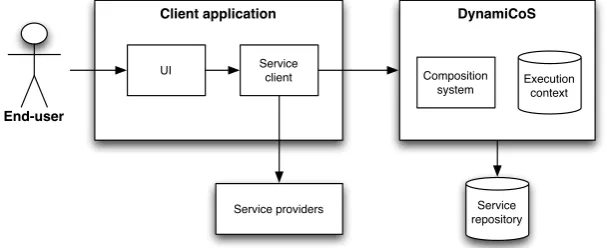
to support the scenarios described in the previous chapter. Figure 4.1 displays the
architecture of the prototype containing the client application.
Client application DynamiCoS
Service repository UI Serviceclient
End-user
Execution context Composition
system
[image:41.595.170.474.442.566.2]Service providers
Figure 4.1: Architecture of the prototype - The architecture containing the client application and DynamiCoS
The prototype contains the client application with a user interface and an interface
to the DynamiCoS framework [9, 11]. The DynamiCoS framework provides support
for dynamic service composition and is accessible as a web service, the framework is
introduced in section 4.1. The interactions between the client application and the
framework are described in Chapter 5.
interfaces for accessing services. The architecture for enabling service composition is
presented in section 4.3.
4.1
DynamiCoS framework
The DynamiCoS framework provides a generic solution for user-centric service
com-position. It’s goal is to support the different stakeholders in the composition process
allowing them to access services capable of satisfying their needs. DynamiCoS can be
accessed as a web service and interaction takes place via predefined types of
interac-tion. The interaction types required to support the client application in the selected
application domain will be presented in Chapter 5.
DynamiCoS has access to a repository of services containing information about all
available services for the composition process. The services are described using SPATEL
[2], which allows to semantically describe services. Each service description contains
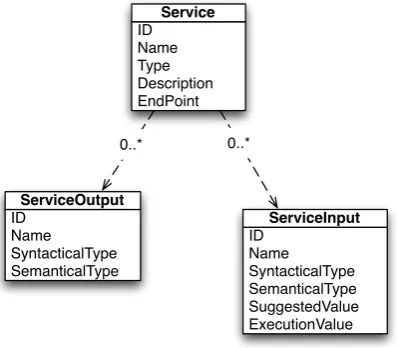
information about input parameters, output parameters and service goals, accompanied
with a semantic type. The semantic type is used in the composition process, but also
provides valuable information for the user interface.
4.2
Domain specific services
The goal of the client application is to use the DynamiCoS framework and present
the generic service composition solution in a user-centric user interface. The semantic
information provided by the DynamiCoS framework should be translated to user
in-terface elements and the input and output of the services. The process of translating
a semantic description to a syntactic value is called grounding, the translation from a
syntactic value to a semantic description is called lifting [26].
In order to make the client application as user-centric as possible, we decided to
handle the grounding and lifting in the client application instead of in the framework.
Grounding and lifting is done in three parts of the client application: when providing
user interface element for the input of a service, when executing the service and when
4.2.1 Domain- & service-specific input
Each service has a certain number of input parameters. The client application is
respon-sible for displaying an appropriate user interface element to allow the user to provide
this input. For example, if a restaurant service requires a ‘type of kitchen’ as input,
the user should be presented with a list of kitchen types instead of an empty text field.
The DynamiCoS framework provides a semantic type for input of a service. By
grounding this semantic type we are able to select an appropriate user interface element.
The mapping below is used to ground the semantic type to an user interface element.
case semantic_type
when "IOTypes.owl#Coordinates"
:map
when "IOTypes.owl#Date"
:date_field
when "IOTypes.owl#KitchenType"
:kitchen_type_selector
when "IOTypes.owl#ActivityType"
:activity_type_selector
else
:text_field
end
4.2.2 Domain-specific execution information
We decided to implement the management of service execution into the client
applica-tion instead of the DynamiCoS framework. There are too many differences between the
used protocols and authentication to make a generic implementation for service
execu-tion in the DynamiCoS framework. Furthermore, much domain-specific knowledge is
required to interpret, ground and lift the input and output parameters of the services.
Protocols
SOAP [37], XML-RPC [35] and REST [33] are three commonly used protocols for
implementing web services. Although the number of protocols is limited, there are a
lot of technical distinctions between services. Implementing the service execution in
Another advantage of keeping the implementation of the service call in the client
application is the use of libraries. For many commonly used web services there are
libraries written in the most popular programming languages. For example, for Ruby
[27], which has been used in the client application, the Google Geocode API is offered
in the Geokit gem [24].
Grounding & lifting
The services used in the client application need appropriate input from the user. The
user provides service inputs via the user interface. Each service input is of a given
se-mantic input. Grounding enables the translation of sese-mantic inputs into an appropriate
input for the service. The grounding is done by the client application. The grounding
process takes also service-specific situations into consideration. An example is an
in-put parameter with semantical type IOTypes.owl:Coordinate. A hlongitude, latitudei
pair is stored within this input parameter. Web services with a coordinate input often
contain two input parameters for the coordinate, namely one for longitude and one for
latitude.
The output of a service is translated to an appropriate semantic description for
interpretation by the composition process, this is called lifting. The result of a web
service contains often more information than expressed in the definition of the service
in the repository, because not all returned information is valuable for the composition
process.
An example result from a service might look like:
<restaurant>
<id>1</id>
<name>My Italian Restaurant</name>
<location>Enschede</location>
<img>http://utwente.nl/my_italian_restaurant.jpg</img>
</restaurant>
In this result, all four properties of a restaurant have different semantic value, but
also different meanings in the composition. The id property can be used to reason
about the entity and thenameandimg property are solely for display purposes. Only
mapping should map the service output to the valuable output parameters in the service
definition.
Result selection
Services can return different types of results. The client application should anticipate
on the type of result and present the user with the results or inform the framework of
the results. We distinguish between three types of values a service can return:
Display-only values: Some services return information which cannot be used in the composition of other services. The result should be displayed to the user, but is
not mapped to any output parameters of the service. Examples of these services are
weather forecasts and driving directions.
Single value: Some values are not directly useful for the user and are therefore not displayed to the user. The value should be mapped to an output of the service in order
to be used in the service composition process. An example of these services is a geocode
service, which translates an address to a coordinate. The coordinate can be used as
input for other services, but the user does not need to select the value nor needs to
view the coordinate.
Set of values: In case the user performs a search action via a service, the service usually returns a set of values. The user should be able to select a value from the set.
After selection, the client application should add the valuable information in the value
to the output parameters of the service.
4.2.3 Domain-specific output
After the execution of a service has been completed, the user is presented with the
results. Only in case of display-only and multiple values the client application should
display the values. The values are service-specific and are therefore implemented for
each service. Examples of service-specific user interfaces are a picture with weather
information or a map with driving directions.
In case the service returns multiple values, the user interface should allow the user
restaurant or hotel locator, the selection of a result might be the result of a reservation
for a restaurant or hotel. We decided to abstract from making reservations and only
allow the user to select a certain result in the client application.
4.3
Service composition
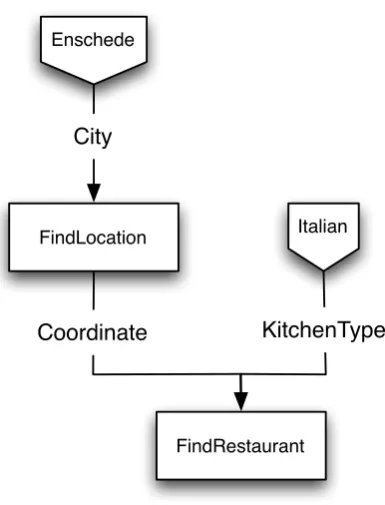
The client application should enable the user to create a composition of services. Figure
4.2 shows a composition of two services: the FindRestaurant service and the
FindLo-cation service. The FindRestaurant service requires a coordinate as input, but the user
does not know the coordinates of his current location. He therefore uses the
FindLoca-tion service to fill in the coordinate input parameter. For the FindLocaFindLoca-tion service to
be executed he needs to fill in a location (typically a city). The output of FindLocation
serves as input for the coordinate input parameter.
FindRestaurant
FindLocation Italian
Coordinate KitchenType
Enschede
[image:46.595.181.374.388.641.2]City
Figure 4.2: Service composition of FindRestaurant and FindLocation
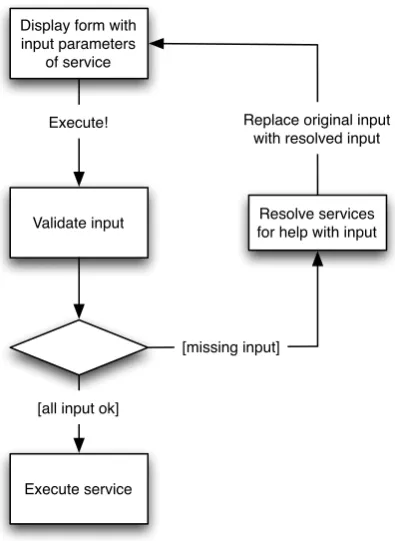
-We identify two methods for service composition. Figure 4.3 shows a full
composi-tionin which the services in the composition are only executed once all input parameters
empty in the initial form and order to execute the service. The service composition
supporting system will respond to this by selecting alternative services which can give
a value for the input parameter, replacing the original input with the input parameters
of the alternative service.
Display form with input parameters
of service
Validate input
Execute service [all input ok]
[missing input] Execute!
Resolve services for help with input Replace original input
[image:47.595.221.419.223.494.2]with resolved input
Figure 4.3: Full service composition- The composition is only executed once all input parameters for all services in the composition are available
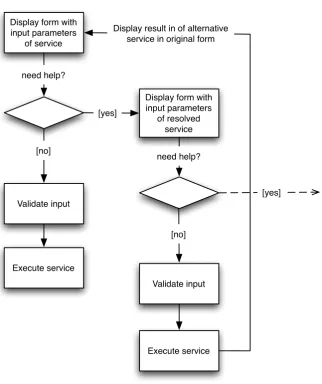
Figure 4.4 displays avirtual composition, which is an alternative composition method.
In virtual composition, the services can be executed intermediately to get a result. The
resolving service for a certain input parameter is executed and the result is displayed
in the original form of the service.
We decided to support virtual service composition in our client application because
it gives the user better feedback and flexibility in the composition process. In the case
of full composition, the user should leave fields empty in the form. We consider this
unnatural and should therefore be explained to the user. With virtual composition,
the user is presented with a button to start resolving the input parameter and find new
Display form with input parameters