Context dependent learning in motor skill acquisition during the
discrete sequential production task
Bachelor Thesis of Annika Rausch
s0180572
University of Twente Faculty of Behavioural Sciences
Psychology
Track Cognition and Media
Supervisors
Marit Ruitenberg, Msc. Dr. Elger Abrahamse
2
Table of contents
Abstract: 3
Introduction: 4
Methods: 8
Participants 8
Apparatus 8
Task and Procedure 8
DSP task 8
Recall task 9
Results: 10
Practice blocks 10
Sequences 10
Learning effect 10
Test blocks 11
Practice effect 11
Recall task 12
Discussion: 13
References: 15
3
Abstract:
4
Introduction:
Everybody has experience with the phenomenon of winning at your home court more often
than winning the game at another court. What is referred to as the overall known home court
advantage is a good example of context dependent effects in skill acquisition. Within this
phenomenon it is the environment which is associated with the task during the training at
home that enhances the players’ performance.
Previous studies were conducted to approve an effect that is referred to as the
context dependent learning effect with regard to the semantic memory. During the most
popular of those studies, divers had to learn as much words as possible from a list. Half of the
participants recalled the list out of the water, whereas the other half had to recall them back in
the water (Godden & Baddeley, 1975). The participants that had learned the list under water
recalled significantly more words in the environment within they had learned the list, than the
participants who tried to recall the list on land after they had learned the words under water.
According to another experiment, word list recall is also better when participants listened to
the same background music as in the learning phase (Smith, 1985). These results additionally
match with studies testing the effects of physiological state and recall (Miles & Hardman,
1998). Subsequently, participants seem to embed the relevant task information into a
particular context. The meta-analysis of Smith and Vela (2001) provides an explanation for
embedding the relevant information (intentional stimulus) into the irrelevant information
(incidental stimulus). According to their research the relevant task stimuli are encoded into
the information of contextual stimuli during task acquisition. The information of the task is
thus more likely to be recalled, when a retrieval cue is provided, namely the specific context
in which the task was learned. Further studies on contextual dependencies were conducted to
test whether those effects for semantic memory tasks also emerge during perceptual motor
task acquisition.
Wright and Shea (1991) conducted experiments including a model where two different
types of stimuli were discriminated. One stimulus served as a task relevant stimulus
(intentional stimulus), which made the stimulus essential for the execution of the task. The
other stimulus served as a task irrelevant stimulus (incidental stimulus), which was not
introduced to the participants as essential for the task execution. The participants had to
respond to three different sequences of successively following intentional key-dependent
stimuli by responding as fast and accurate as possible. Each sequence was provided with a
fixed combination of contextual (incidental) features. In other words, the incidental stimuli
5 different feature dimensions, namely the colour of the display, placeholder shape, the location
of the placeholder and the tone with which the intentional stimulus was presented. First the
participants had to practice the sequences within its fixed combinations. However, after the
incidental stimuli simultaneously had changed the participants’ performance was impaired.
An increase of the reaction time occurred compared with the reaction times the participants
reached before the changes had occurred. In addition, the percentage of erroneous responses
had risen. Further experiments within this study found the changes of the placeholder shape to
impair the performance the most. These results reinforced the assumptions about the existence
of contextual dependencies on motor sequence learning. Yet, the experiment’s property of
co-variation of the incidental stimuli with the sequence allows for a critical view about the
assumption on contextual dependencies. The results could also be explained by the strong
temporal dependency of intentional and incidental stimuli.
More recent experiments try to solve this problem by conducting experiments with a
static environment in the serial reaction time (SRT, Nissen & Bullemer, 1987) task. Within
this task the incidental stimulus is provided as a static feature, which remains the same during
the practice phase (Abrahamse & Verwey, 2008). Within one group (A) a rectangular
placeholder was shown on the top of a grey display, whereas the placeholder was triangular
and at the bottom of a white display within another group (B). After the participants had
practiced the sequence within the static environment, a warning appeared on the screen with
the instructions to continue with the regular task execution, but some feature changes would
occur. After the warning was shown, the experiment continued in group A with the incidental
stimuli of group B and vice versa. The performance of the participants was impaired after the
changes had occurred in both groups. Similar to the experiment of Wright and Shea, further
experiments outlined that the changes in placeholder shape mostly accounted for the impaired
performance.
The work of Hommel et al (2001) explains how perceptual context features are
integrated into our cognitive action (response) codes. He introduced the principle of feature
weighting, based on the idea that every to-be-produced event (action) requires the selection of
relevant environmental features and meanwhile the rejection of irrelevant environmental
features because of perceptual capacity limitations, which are necessary for sufficient action
control (Allport 1987; Neumann 1987; 1990; van der Heijden 1992). A certain feature’s relevance depends on the feature’s goal-directedness. Hence, in an experiment the implicit or
explicit instruction to attend to a specific stimulus within its dimension enhances the
6 principle, the feature dimension of the stimuli that is instructed as relevant to the task
execution will be reinforced and integrated into the action event code. This explains why
people can respond relatively fast to the relevant stimulus, even though other irrelevant
stimuli are present. Furthermore, this also serves partly as an explanation for improved task
performance with practice, because the relevant dimension weight got strengthened during the
training. However, studies of Duncan and Humphreys (1989; 1992) found that similarity of
features can lead to interference between the integration of incidental and intentional stimuli
into the action code. The presence of an incidental stimulus within the dimension of the
intentional stimulus should therefore lead to an integration of the incidental stimulus to the
response code as well.
The experiments on sequence learning of Abrahamse and Verwey (2008) used
incidental stimuli which consisted of the dimensions of display colour, vertical location of the
placeholder and the placeholder shape, whereas the intentional stimuli remained fixed to two
dimensions, namely the feature of a fixed placeholder colour and of the horizontal location
which can switch between four horizontally aligned placeholders. Hence, all of the
manipulations in the mentioned experiments were provided on another dimension than the
intentional stimulus was shown. Therefore, the present study focuses on the question whether
performance within a sequence production task gets impaired after changing the incidental
stimulus when the incidental stimulus is shown on the same dimension as the intentional
stimuli, namely as a second different coloured stimulus in the horizontal location dimension.
In contrast to prior studies using the SRT task as measurement instrument, the discrete
sequential production (DSP) task (Verwey, 1999) represented in recent research an adequate
instrument of measurement for creating automated responses. The DSP task is characterized
by its relatively short key sequences rather than the long sequences in the SRT task. Within
the DSP task paradigm the sequences are presented in a fixed order, while the contextual
changes additionally are a fixed property of each sequence. An interesting feature of the DSP
task is that after extensive practice, the stimuli are no longer essential for sequence execution
(Verwey, 1999). By this means, automated responses are created rapidly. This measure
instrument therefore offers the opportunity to measure the effect of practice on context
dependency during task execution.
To do so, the participants were divided into two practice groups due to test whether
performance gets impaired more by changing the incidental stimulus after a short practice
phase using the DSP task than after a long practice phase. One group executed a long version
7 consisted of two practice blocks and three test blocks afterwards. The participants in the long
version were asked to run six practice blocks with the three test blocks at the end. One test
block is a control block, during another test block the incidental stimulus was provided by a
different sequence than in the practice block and during the third test block no incidental
stimuli were presented.
Based on the above mentioned literature, we can predict the following. First of all,
several studies testing perceptual motor skill acquisition show a gradually developing learning
effect during the practice phase. Subsequently, it was hypothesized that an improvement of
performance would occur in the present study based on the learning effect.
Furthermore, feature similarity of the intentional and incidental stimulus is high.
Thus we predict that the integration of the two stimulus types into one dimension leads to a
clear incongruence of the sequence representation between the practice blocks and the test
blocks. Subsequently, it was hypothesized that reaction times are slower in all test
blocks-except from the control block- compared to the reaction times in the practice blocks.
It was hypothesized that differences would emerge between the group that had
extensive practice and the short practice group. First, for the short practice group it was
predicted that stimulus information remains important for sequence execution. After short
practice a representation is formed that contains both intentional and incidental information.
Subsequently, the congruence of the response code between the practice representation and
the test environment is imperfect for both the removed and changed test phases – hence
predicting impaired performance. Conversely, for the control test block we predict no
impairment.
Second, for the long practice group we predict that stimulus information is no
longer crucial for sequence execution, because the use of the DSP task with extensive practice
leads to automated responses following the first intentional stimulus. Therefore performance
8
Methods:
Participants
The subjects were 50 students of the University of Twente. Most participants received credits
for their participation. Fourteen data sets had to be excluded from the data analysis, because
of an erroneous task instruction before all of those participants’ test blocks, with in total 12
male and 24 female remaining participants between the age of 18 and 27. 32 participants are
right handed, whereas 3 participants were tested to be left handed and one to be ambidexter
according to the results of the Annett Handedness Inventory (Annett, 1970).
Apparatus
The apparatus consisted of a Pentium 4 computer with a 17 inch Philips 107T5 display and
standard keyboard. Eprime 2.0 was used for stimulus presentation and data registration.
Task and Procedure
DSP task
The experiment took place in one of the cubicles of the Cubicus building at the University of
Twente. Before each of the two practice blocks in the short condition or the six practice
blocks in the long condition started, an instruction appeared on the monitor. The participants
were asked to place their left pinkie, ring finger, middle finger and index finger on the keys c,
v, b, n respectively on the keyboard. Four placeholders would successively appear while one
placeholder is coloured red or blue in a counterbalanced order. Four keys represented the
placeholders and the participants had to respond successively to the coloured placeholder with
the respective key. This served as our intentional stimulus. There was also another stimulus
present, the incidental stimulus.
Hence, for half of the participants the intentional sequence was the red and the incidental
stimulus the blue one while the intentional stimulus were provided by a blue sequence once
and the red sequence presented the incidental stimulus in another group. The sequence
production was executed for the duration of two blocks in the short practice group and six
blocks in the long practice group, each containing of two different 7 key sequences with a
fixed respond-to-stimulus-interval (RSI) of 0 ms. Furthermore, not all participants got the
same two sequences within one block, but there were four different key sequences - vnbnvbc,
nvcvncb, bcncbnv and cbvbcvn - which were provided counterbalanced over the participants
as well. However, the participants were told neither that the sequence had a pattern nor that
9 After the practice phase, the participants got the same instructions as in the practice phase
before each of the three test blocks in test phase started. All of the participants had to run the
same test phase both in the long practice group and in the short practice group. One block of
the test phase consisted of the same content as the practice block, this served as our control
block. Another test block consisted of the same intentional stimulus, but a sequence with a
changed stimulus order served as incidental stimulus. The intentional stimulus stayed the
same in the third test block also, but no incidental sequence was present. The three test blocks
were additionally counterbalanced over the participants due to control for order effects.
Recall task
After the participants finished the DSP task their recall of the sequences was tested. The
participants were asked to recall both the intended and the incidental sequences they have
10
Results:
For each analysis an alpha level of 0.05 was used.
Practice blocks
Sequences
The results of the paired samples t-test indicate non-significance between the first and second
sequence of practice block 1 with (M=10,36, SD=36.21, t(34)=1.692 p=0.1), practice block 2
(M=-1.16, SD= 35.30, t(35)=-0.197 p=0.85) practice block 3 (M= 35.86, SD= 8.45, t
(17)=-0.183 p=0,86), practice block 4 (M=-5.67, SD=21,79, t(17)= 1.104 p=0,29), practice block 5
(M=-3.61, SD=16,95, t(17)=-0,903 p=0.38) and practice block 6 (M=-1,47, SD=18,18,
t(17)=-0.344 p=0,74).
Learning effect
A repeated measures ANOVA was run on practice block (1-6) in the long practice group with
the mean reaction time of the two sequences as within subject factor. Maulchy’s test of
sphericity on practice block indicated significance W(14)=.019 p<0.001, whereasthe required
value of the Greenhouse Geisser correction for F showed a main effect for practice block,
F(5,80)=109.11, p<0.001. In Figure 1 the significant result F(1,17)=109.714, p<0.001 of an
repeated measures ANOVA on practice block(1-2) in the short practice group is shown.
11 Test blocks
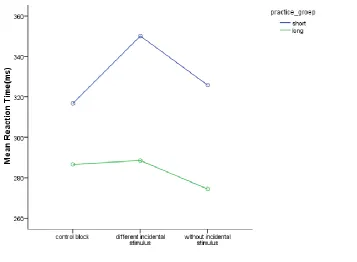
A repeated measures ANOVA with test block (control block, different incidental stimulus,
without incidental stimulus) as within subject factor indicated a significant main effect for
both test block, F(2,68)=4.716, p<0.02, and practice group (short condition, long condition)
as between subjects factor, F(1,34)=4.735, p<0.04, (see Figure 3), while Maulchy’s test of
sphericity showed non-significance for test block (W(2)=0.97, p=0.62). No significant
[image:11.595.114.472.246.508.2]interaction effect has been found between test block and practice group (F(1)=2.126, p=0.15).
Figure 3. Mean reaction times (ms) of sequence 1 and 2 between control block, different incidental stimulus block and without incidental stimulus block.
Practice effect
After separating the data set into two practice groups a repeated measures ANOVA on the
within subjects factor test block indicated non-significance (F(2,34)=1.891 p=0.16) in the
long condition. In contrary, repeated measures ANOVA on the within subjects factor test
block showed a significant main effect for test block F(2,34)=4.532, p=0.018 in the short
condition.
Further analysis on the practice group in the short condition showed that reaction times were
significantly slower in the test block where the incidental stimulus was provided by another
12 stimulus present p=0.036 using Bonferroni adjusted alpha levels of 0.016(0.05/3) per test. The
results of comparison between the control block and the block without incidental stimulus was
non-significant p=1.00.
Recall task
Each correctly recalled sequence (1,2) of both the intentional and incidental sequence was
scored with 1. Thus, if two out of the two sequences of the intentional sequences were
recalled completely a total score of 2 would be the result. The scores of the incidental
stimulus were obtained similarly. The total scores of the intentional (M=1.11, SD=0.854) and
incidental sequence (M=0.22, SD=0.591) were compared with each other and analysis with a
paired samples t-test of the intentional and incidental stimulus showed a significant difference
t(35)=6.011, p<0.001. Total recall scores comparison of the practice groups for the intentional sequence (M=-0.33, t(34)=-1.177, p=0.25), with an assumed equal variance (Levene test
F(34)=1.568, p=0.219) and for the incidental sequence (M=-0.11, t(34)=-0.559, p=0.58) with
an assumed equal variance (Levene test F(34)=1.247, p=0.27) showed non-significance when
compared by an independent samples t-test.
Similarly to the total scores, a paired samples t- test also indicated a significant
difference between the sequences t(34)=8.037, p<0.001, when the correctly recalled elements
of each sequence were compared. Furthermore, non significance also emerged after an
independent samples t-test was executed on the element sequence scores testing differences in
practice groups in the intentional sequence (M=-0.44, t(34)=-0.384, p=0.7), when variance
also was assumed (Levene test F=1.788, p=0.19) and in the incidental sequence (M=-0.02,
t(33)=-0.018, p=0.99) with a non significant result of the Levene test as well (F(33)=0.209,
13
Discussion:
The analysis of the experiment supports the hypothesis on performance impairments while
executing the test phase caused by the conflicting stimulus representation of the practice
blocks towards the presentation from the test blocks. Conformingly, performance during the
test phase was not impaired for the control block. However, only the test condition in which
another sequence served as incidental stimulus confirmed the above mentioned hypothesis,
whereas the absence of the intentional stimulus did not lead to performance impairments.
These findings were not predicted, because the sequence representation of the practice blocks
is also imperfect for the sequence presentation of the test block when the incidental stimulus
is missing. However, information that is in contrast with the earlier learned information is
intuitively harder to ignore than missing information. Another sequence could literally lead to
conflicting mapping, whereas missing information is not in contrast to the earlier learned
sequence. The earlier mentioned attentional-intentional weighting principle additionally partly
supports these findings. After the presentation of another sequence as incidental stimulus
started, the process of attentional-intentional feature weighting could lead to a reorganization
of the encoded intentional stimulus representation. Subsequently, an increase of reaction time
would be shown. In contrast, there would be no attentional- intentional weighting process
necessary to reorganize the sequence representation, when there was no incidental stimulus
present. Thus, the reaction time would not be influenced.
Furthermore, the above mentioned results exclusively emerged within the group with
little practice. The reaction times of the practice group which executed a longer version of the
practice phase were not found to be affected across all test blocks. According to the
hypothesis, when a different sequence in place of the familiar one emerged, it was found to
restrain the reaction times in the short condition, but not in the long condition. One conclusion
can therefore clearly be stated, namely, the amount of practice serves as a strong indicator for
performance on motor skill acquisition. This practice effect could be derived by using the
DSP task, which facilitated an automatic production of the sequence rapidly. The first
stimulus that appears serves as a cue for the remaining part of the short sequence, which is
clustered together to a single motor chunk (Verwey, 1999). A motor chunk is an automatically
produced and successively following representation consisting in the present study’s context
of a few well learned key presses in a strict order. Further information becomes unnecessary,
thus stimulus presentation is no longer influenced by contextual information.
The DSP task consists of short sequences which’s end and beginning is clearly
14 response-to-stimulus-interval of 0 ms was used. As a consequence, participants are
immediately aware of a certain sequential order. Subsequently, the present study tested with a
paper and pencil recall to which extends awareness of the sequences occurred. The findings
show awareness of the sequence in both practice groups, thus the sequences had been learned
explicitly in both conditions, whereas a significant difference between the recall of intentional
and intentional stimulus was found. Two things can be derived by these findings, namely that
performance differences between the two practice groups in the present study can mostly be
based on practice rather than on differences between sensitivity in implicit and explicit
memory to contextual changes as Berry and Dieren (1993) stated. Furthermore, the significant
differences between the awareness of the intentional and incidental sequences could be
explained by Hommel’s (2001) phenomenon of goal-directedness that reinforces an
appropriate attentional- intentional weighting processes. Feature weighting is described by
Hommel (2001) as a process that evaluates the relevance of a stimulus to a particular task,
while the initial instruction to attend to a specific feature plays a significant role. Additionally,
throughout the weighting process participants task performance should improve, which was
confirmed by a significant decrease of reaction time throughout the practice blocks as it was
hypothesized in the present study.
A sceptical view on the paper and pencil recall task leads to the conclusion that the
experiment was not strictly controlled for interference of test block sequences with recall of
the practice block sequences, because the test block sequence which was always presented at
the end of the experiment, could have interfered with the memory of the practice block
sequences. Therefore the conclusions about the awareness results cannot be seen as
scientifically grounded and just serve to make tentative implications on the topic.
Additionally, the findings seem mainly to be in contrast with the assumption of
Vela and Smith (2001) that a retrieval cue is needed to facilitate the retrieval of words. The
results could therefore indicate that further research has to be done on the relationship
between declarative (semantic and episodic) and procedural (motor skills) memory.
Remembering within the declarative memory, which is also referred to as explicit memory,
seems to be facilitated by a retrieval cue, whereas the irrelevant stimulus does not seem to
have such an effect on the explicit sequence representation in our experiment, because
performance in the present study is nether influenced by the presence nor by the absence of
15
References:
Abrahamse, E.L. & Verwey, W.B. (2008). Context dependent learning in the serial RT task. Psychological Research, 4, 397-404.
Annett, M. (1970). A classification of hand preference by association analysis. British J of Psychol, 61, 303-321.
Allport, D. A. (1987) Selection for action: Some behavioral and neurophysiological considerations of attention and action. Perspectives on perception and
action, ed. H. Heuer & F. Sanders.
Berry, D. C., & Dienes, Z. (1993). Implicit learning: Theoretical and empirical issues.
Duncan, J. & Humphreys, G. W. (1989) Visual search and stimulus similarity. Psychological
Review, 96, 433–58.
(1992) Beyond the search surface: Visual search and attentional engagement. Journal of
Experimental Psychology: Human Perception and Performance, 18, 578–88.
Godden, D.R., & Baddeley, A.D. (1975). Context-Dependent Memory in two Natural Environments: on Land and Underwater. British Journal of Psychology, 66(3), 325- 331.
Hommel, B., Müsseler, J., Aschersleben, G., & Prinz, W. (2001). The theory of event coding: A framework for perception and action planning. Behavioral and Brain Sciences, 24, 849-937.
Miles, C., & Hardman, E. (1998). State-Dependent Memory Produced by Aerobic Exercise.
Ergonomics, 40, 20-28.
Neumann, O. (1987) Beyond capacity: A functional view of attention. Perspectives on
perception and action, ed. H. Heuer & A. F. Sanders.
(1990) Visual attention and action. In: Relationships between perception and action: Current
approaches, ed. O. Neumann & W. Prinz. Springer.
Nissen, M.J., & Bullemer, P. (1987). Attentional Requirements of Learning. Evidence from Performance Measures. Cognitive Psychology, 19, 1-32.
Smith, S.M. (1985). Background Music and Context-Dependent Memory. The American
Journal of Psychology, 98, 591-603.
Smith, S. M., & Vela, E. (2001). Environmental context-dependent memory: A review and meta analysis. Psychonomic Bulletin & Review, 8, 203-220.
Van der Heijden, A. H. C. (1992) Selective attention in vision.
16 Wright, D. L., & Shea, C. H. (1991). Contextual dependencies in motor skills. Memory &