Recurrent Neural Network based Rule Sequence Model
for Statistical Machine Translation
Heng Yu, Xuan Zhu
Samsung R&D Institute of China, Beijing, China
{h0517.yu, xuan.zhu}@samsung.com
Abstract
The inability to model long-distance depen-dency has been handicapping SMT for years. Specifically, the context independence as-sumption makes it hard to capture the depen-dency between translation rules. In this paper, we introduce a novel recurrent neural network based rule sequence model to incorporate arbi-trary long contextual information during esti-mating probabilities of rule sequences. More-over, our model frees the translation model from keeping huge and redundant grammars, resulting in more efficient training and de-coding. Experimental results show that our method achieves a 0.9 point BLEU gain over the baseline, and a significant reduction in rule table size for both phrase-based and hierarchi-cal phrase-based systems.
1 Introduction
Modeling long-distance dependency has always been a bottleneck for statistical machine translation (SMT). While lots of efforts have been made in solv-ing long-distance reordersolv-ing (Xiong et al., 2006; Zens and Ney, 2006;Kumar and Byrne, 2005), long-span n-gram matching (Charniak et al., 2003;Shen et al., 2008;Yu et al., 2014), much less attention has been concentrated on capturing translation rule de-pendency, which is not explicitly modeled in most translation systems (Wu et al., 2014).
SMT systems typically model the translation pro-cess as a sequence of translation steps, each of which uses a translation rule. These rules are usually ap-plied independently of each other, which violates the conventional wisdom that translation should be done in context (Gim´enez and M`arquez, 2007). However, it is not an easy task to capture the rule dependency, which entails much longer context and more severe data sparsity. There are two major solutions: the
first one is breaking the rules into bilingual word-pairs and use a n-gram translation model to incorpo-rate lexical dependencies that span rule boundaries (Marino et al., 2006;Durrani et al., 2013). These n-gram models (also known as tuple sequence model) could help phrase-based translation models to over-come the phrasal independence assumption, but they rely on word alignment to extract bilingual tuples, which brings in additional alignment error (Wu et al., 2014). The other direction lies in utilizing the rule Markov model (Vaswani et al., 2011; Quirk and Menezes, 2006), which directly explores depen-dencies in rule derivation history and achieves both good performance and slimmer translation model in syntax-based SMT systems. However, the sparsity of translation rules entails aggressive pruning of the training data and constrains the model from scaling to high order grams, significantly limiting the ability of the model.
In this paper we follow the second line and pro-pose a novel recurrent neural network based rule sequence model (RNN-RSM), which utilizes the representational power of recurrent neural network (RNN) to capture arbitrary distance of contextual in-formation in estimating the probability of rule se-quences, rather than constrained to n-gram local context limited by Markov assumption. Compared with previous studies, our contributions are as fol-lows:
First, we lift the Markov assumption in rule se-quence model and use RNN to capture arbitrary-length of contextual information, which is proven to be more accurate in estimating sequential probabili-ties (Mikolov et al., 2010).
history.
Lastly, we apply our model to both phrase-based and hierarchical phrase-phrase-based (HPB) systems and achieve an average improvement of 0.9 BLEU points with much slimmer translation models in hy-pergraph reranking task (Huang, 2008).
2 Rule Sequence Model
We will first brief our rule sequence model with an example from phrase-based system (Koehn et al., 2007). Consider the following translation from Chi-nese to English:
B`ush´ı
Bush yˇuwith Sh¯al´ongSharon jˇux´ınghold le-ed hu`ıt´anmeeting ‘Bush held a meeting with Sharon’
So one possible rule derivation of the above ex-ample could be:
(0 ) : (s0,“”) (•1 ) : (s1,“Bush”) r1 (• •••6) : (s2,“Bush held talks”) r2 (•••3•••) : (s3,“Bush held talks with Sharon”) r3
r1: B`ush´ı→Bush
r2: jˇux´ıng le hu`ıt´an→held talks r3: yˇu Sh¯al´ong→with Sharon
Each row is a derivation step, where sn denotes a hypothesis with a coverage vector capturing the source language words translated so far, and a •in the coverage vector indicates the source word at this position is “covered”. Each hypothesis sn−1 can
be extended into a longer hypothesis sn by a rule
rn translating an uncovered segment. Note that in phrase-based translation we need to set a distortion limit to prohibit long distance reordering, so the end-ing position of last phrase is maintained (e.g.,1and 6 in the coverage vector).
In our example, translation rulesr1,r2,r3form a
derivation T which leads to a complete translation. So for rule sequence model, the probability of rn depends on its derivation historyH(rn):
P(rn) =P(rn|H(rn)) (1) and the probability of a rule derivationT is
P(T) = Y
ri∈T
P(ri|H(ri)) (2)
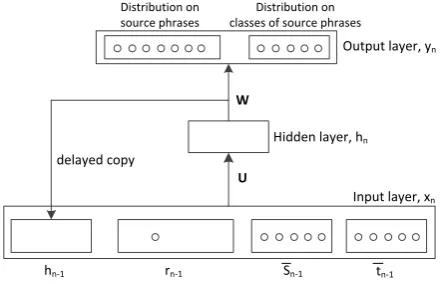
Hidden layer, hn
U W
delayed copy
hn-1 rn-1 Sn-1 tn-1
Output layer, yn
Input layer, xn
Distribution on source phrases
Distribution on classes of source phrases
Figure 1: Factorized recurrent neural network with source and target side phrase embeddings.
So the rule sequence model does not make any con-text independence assumption and generate a rule by looking at a context of previous rules.
2.1 Training
The rule sequence model can then be trained on the path set of rule derivations. To obtain golden deriva-tions of translation rules for each sentence pair, We follow Yu et al. (2013) to utilize force decoding to get golden rule derivations. Specifically, we define a new forced decoding LM which only accepts two consecutive words (denote asp, q) in the reference translation (yi):
Pforced(q |p) =
(
1 if∃j, s.t.p=yj andq=yj+1 0 otherwise
For each hypothesis, we keep the bourndary words as its signiture (only right side for phrase-based model and both sides for HPB). If a boundary word does not occur in the reference, its language model score will be set to−∞; if a boundary word occurs more than once in the reference, the hypothesis is split into multiple hypotheses, one for each index of occurance.
According to the definition, we can see that the rule sequence[r1, r2, r3]in the example could
pro-duce the exact reference translation, which is ideal for the training of rule sequence model.
3 Recurrent Neural Network based Rule Sequence Model
[image:2.595.309.530.84.226.2]to estimate the probabilityP(rn|H(rn)). Our RNN-RSM can potentially capture arbitrary long context rather than n-1 previous rules limited by Markov assumption. Following Mikolov et al. (2010), we adopt the standard RNN architecture: the input layer encodes previous translation rule using one-hot cod-ing, the output layer produces a probability distribu-tion over all transladistribu-tion rules, and the hidden layer maintains a representation of rule derivation history. However, the standard implementation has severe data sparsity problem due to the large size of rule table couple with the limited training data.
3.1 Factorized RNN-RSM
To solve the sparsity problem, we extend the RNN-RSM model with factorizing rules in the input layer, as shown in Figure 1. It con-sists of an input layer x, a hidden layer h (state layer), and an output layer y. The connection weights among layers are denoted by matrixes
U and W respectively. Unlike the RNN-RSM, which predicts probability P(rn|rn−1, H(rn−1)),
the factorized RNN-RSM predicts probability
P(rn|rn−1, H(rn−1),s¯n−1,¯tn−1) to generate
fol-lowing rulern, where¯sn−1/t¯n−1 are the
source/tar-get side of rn−1, However, s¯n−1 andt¯n−1 are still
too sparse considering the huge vocabulary size and the diversity in forming phrases, so here we use re-cursive auto-encoder (Socher et al., 2011;Li et al., 2013) to learn phrase embeddings on both source and target side in an unsupervised mannner, mini-mizing the reconstruction error.
For those rules that are not contained in the train-ing data, the factorized RNN-RSM backs off to the source/target side embedding Esi−1/Eti−1. In the special case that Esi−1 and Eti−1 are dropped, the factorized RNN-RSM goes back to RNN-RSM. Fi-nally, the input layerxnis formed by concatenating the input vectors and hidden layer hn−1 at the
pre-ceding time step, as shown in the following equa-tion.
xn= [vn−u 1, vn−¯s 1, vn−¯t 1, hn−1] (3)
The neurons in the hidden and output layers are computed as follows:
hn=f(U×xn), yn=g(w×hn) (4)
f(z) = 1 +1e−z, g(z) = Pezm
kezk (5)
3.2 Factorized RNN-RSM on source and target phrases
The above factorized RNN-RSM is conditioned on the previous context during computing the probabil-ity of rulern. Sincernmay still suffer from sparsity, we further factorizerninto its source side phrases¯n and target side phrase¯tn. So the probability formula could be rewrite as:
P(rn|H(rn)) =P(sn, tn|H(rn))
=P(sn|H(rn))×P(tn|sn, H(rn)) (6) The first sub-modelP(sn,|H(rn))computes the probability distribution over source phrases. Then the second sub-model P(tn|sn, H(rn)) computes the probability distribution over tn that are trans-lated from sn. The two sub-models are computed with the similar recurrent network shown in Figure 1 except adding the source side information sn of the current rulerninto the input layer. This method share the same spirit with the RNN-based translation model (Sundermeyer et al., 2014;Cho et al., 2014), except that we focus on capturing rule dependencies which has a much small search space. Noted that this new factorize model provides richer information for prediction, and actually is faster to train since the vocabulary of source/target phrases are much small than that of the translation rules.
4 Experiments
4.1 Setup
The training corpus consists of 1M sentence pairs with 25M/21M words of Chinese/English respec-tively. Our development and test set are NIST 2006 and 2008 (newswire portion) respectively.
We obtained alignments by running GIZA++ (Och and Ney, 2004) and used the SRILM toolkit (Stolcke, 2002) to train a 4-gram language model with KN-smoothing on the English side of the train-ing data. Case-insensitive BLEU (Papineni et al., 2002) and MERT (Och, 2003) were used for evalua-tion and tuning.
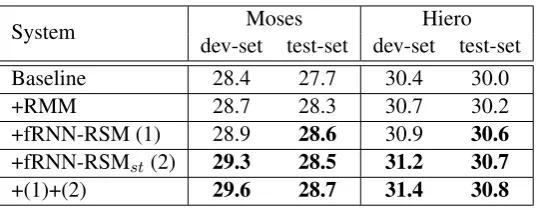
System dev-set test-set dev-set test-setMoses Hiero
Baseline 28.4 27.7 30.4 30.0
+RMM 28.7 28.3 30.7 30.2
+fRNN-RSM (1) 28.9 28.6 30.9 30.6
+fRNN-RSMst(2) 29.3 28.5 31.2 30.7
[image:4.595.163.432.80.185.2]+(1)+(2) 29.6 28.7 31.4 30.8
Table 1: Main results. RMM is the re-implementation ofVaswani et al. (2011), fRNN-RSM denotes for factorized RNN-RSM describe in Section 3.1, fRNN-RSMstdenotes for RNN-RSM factorized by source/target side in Section
3.2. Results in bold mean that the improvements over “Baseline” are statistically significant (p <0.05) (Koehn, 2004).
to 5 for the extraction of both phrase-based rule and SCFG rule, as well as beam size to 100 and distor-tion limit to 7 in decoding.
Since the rule sequence model belongs to the fam-ily of non-local feature (Huang, 2008), traditional testing methods like nbest reranking are not suit-able for our experiments. So we adopt hypergraph reranking(Huang and Chiang, 2007;Huang, 2008), which proves to be effective for integrating nonlo-cal features into dynamic programming. The de-coding process is divided into two passes. In the first pass, only standard features (i.e., standard fea-tures for phrase-based or HPB model) are used to produce a hypergraph. In the second pass, we use the hypergraph reranking algorithm (Huang, 2008) to find promising translations using additional rule sequence feature.
For RNN training, we set the hidden layer size to 512 and classes in the output layer to 256. To obtain phrase-embedding, we use open source tool str2vec1 (Li et al., 2013) to train two autoencoders
on the source and target side of rule-table respec-tively.
4.2 Results
Table 1 presents the main results of our paper. To show the merits of our RNN-RSM, we also re-implement Vaswani et al. (2011)’s work, denote as rule Markov model (RMM). It utilize tri-gram rule derivation history for prediction, whereas our RNN-RSM could capture arbitrary length of contextual in-formation. We can see that RMM provides a mod-est improvement over the baseline, 0.6/0.2 points over Moses/Hiero, thanks to the positive guidance
1https://github.com/pengli09/str2vec
System w/o monotoneMoses Hiero Moses HieroFull
Baseline 27.4 29.8 27.7 30.0
+RMM 27.6 29.9 28.3 30.2
+fRNN-RSM 28.0 30.4 28.6 30.6
+fRNN-RSMst 28.2 30.6 28.5 30.7
Table 2: BLEU score comparison on different rule-set, “w/o monotone” denotes we filter out monotone com-posed rules in both rule table and our RNN-RSM, full denotes we use the total rule-set.
of short-span rule dependency. On the other hand, our factorized RNN-RSM with phrase embeddings (fRNN-RSM) provides a more significant BLEU score improvement (0.9 for Moses, 0.6 for Hiero), which exemplifies that the long-span rule depen-dency captured by RNN could provides additional boost in translation quality. At the same time, fac-torized RNN-RSM on source and target phrases (fRNN-RSMst) alleviate the data sparse problem in RNN training, resulting in slightly better per-formance. Finally, when we combine both factor-ized model, we get the best performance at 28.7 for Moses and 30.8 for Hiero, both significantly better than baseline systems.
Hi-ero and 31% for Moses. The results are shown in Table 2. Interestingly the performance of slimmer translation model with fRNN-RSM exceeds baseline with full rule-table, and catches up with the orig-inal fRNN-RSM. The reason is two-folded: first, deleting monotone composed rules doesn’t effect the overall coverage of the rule-set, making limited harm to the system. Second, with less rules, the data sparse problem of RNN training is further alleviated, resulting in a better fRNN-RSM for probability pre-diction.
5 Related Work
Besides the work ofVaswani et al. (2011) discussed in Section 1, there are several other works using a rule bigram or trigram model in machine translation, Ding and Palmer (2005) use n-gram rule Markov model in the dependency treelet model, Liu and Gildea (2008) applies the same method in a tree-to-string model. Our work is different from theirs in that we lift the Markov assumption and use recur-rent neural network to capture much longer contex-tual information to help probability prediction.
Our work is also in the same spirit with tuple se-quence models (Marino et al., 2006;Durrani et al., 2013; Hui Zhang, 2013; Wu et al., 2014), which break the translation sequence into bilingual tuples and use a Markov model to capture the dependency of tuples. Comparing to them, we take a more di-rect approach to use translation rule dependency to guide translation process, rather than rely on tuples which will be significant affected by word alignment errors.
Outside of machine translation, the idea of weak-ening independence assumption by modeling the derivation history is also found in parsing (Johnson, 1998), where rule probabilities are conditioned on parent and grand-parent nonterminals. Inspired by it, we successfully find a solution for the translation field.
6 Conclusion
In this paper, we have presented a novel recurrent neural network based rule sequence model to esti-mate the probability of translation rule sequences. One of the major advantages of our model is its po-tential to capture long-span dependency compared
with n-gram Markov models. In addition, our factor-ized model with phrase embedding could further al-leviate the data sparse problem in RNN training. Fi-nally we conduct experiments on both phrase-based and hierarchical phrase-based models and get an av-erage improvement of 0.9 BLEU points over the baseline. In the future we will investigate stronger network structure such as LSTM to further improve the prediction power of our model.
References
Eugene Charniak, Kevin Knight, and Kenji Yamada. 2003. Syntax-based language models for statistical machine translation. InProceedings of MT Summit IX, pages 40–46. Citeseer.
David Chiang. 2005. A hierarchical phrase-based model for statistical machine translation. InProceedings of the 43rd ACL, Ann Arbor, MI.
Kyunghyun Cho, Bart van Merrienboer, Caglar Gulcehre, Fethi Bougares, Holger Schwenk, and Yoshua Ben-gio. 2014. Learning phrase representations using rnn encoder-decoder for statistical machine transla-tion.arXiv preprint arXiv:1406.1078.
Yuan Ding and Martha Palmer. 2005. Machine trans-lation using probabilistic synchronous dependency in-sertion grammars. InProceedings of the 43rd Annual Meeting on Association for Computational Linguis-tics, pages 541–548. Association for Computational Linguistics.
Nadir Durrani, Alexander Fraser, Helmut Schmid, Hieu Hoang, and Philipp Koehn. 2013. Can markov models over minimal translation units help phrase-based smt? InACL (2), pages 399–405.
Jes´us Gim´enez and Llu´ıs M`arquez. 2007. Context-aware discriminative phrase selection for statistical machine translation. InProceedings of the Second Workshop on Statistical Machine Translation, pages 159–166. Asso-ciation for Computational Linguistics.
Zhongjun He, Yao Meng, and Hao Yu. 2009. Discarding monotone composed rule for hierarchical phrase-based statistical machine translation. InProceedings of the 3rd International Universal Communication Sympo-sium, pages 25–29. ACM.
Liang Huang and David Chiang. 2007. Forest rescor-ing: Fast decoding with integrated language models. InProceedings of ACL, Prague, Czech Rep., June. Liang Huang. 2008. Forest reranking: Discriminative
Chris Quirk Jianfeng Gao Hui Zhang, Kristina Toutanova. 2013. Beyond left-to-right: Multiple decomposition structures for smt. In
NAACL.
Mark Johnson. 1998. Pcfg models of linguistic tree rep-resentations. Computational Linguistics, 24(4):613– 632.
P. Koehn, H. Hoang, A. Birch, C. Callison-Burch, M. Federico, N. Bertoldi, B. Cowan, W. Shen, C. Moran, R. Zens, C. Dyer, O. Bojar, A. Constantin, and E. Herbst. 2007. Moses: open source toolkit for statistical machine translation. InProceedings of ACL: Demonstrations.
Philipp Koehn. 2004. Statistical significance tests for machine translation evaluation. In EMNLP, pages 388–395. Citeseer.
Shankar Kumar and William Byrne. 2005. Local phrase reordering models for statistical machine translation. InProceedings of the conference on Human Language Technology and Empirical Methods in Natural Lan-guage Processing, pages 161–168. Association for Computational Linguistics.
Peng Li, Yang Liu, and Maosong Sun. 2013. Recursive autoencoders for itg-based translation. In EMNLP, pages 567–577.
Ding Liu and Daniel Gildea. 2008. Improved tree-to-string transducer for machine translation. In Pro-ceedings of the Third Workshop on Statistical Machine Translation, pages 62–69. Association for Computa-tional Linguistics.
Jos´e B Marino, Rafael E Banchs, Josep M Crego, Adria de Gispert, Patrik Lambert, Jos´e AR Fonollosa, and Marta R Costa-Juss`a. 2006. N-gram-based machine translation. Computational Linguistics, 32(4):527– 549.
Tomas Mikolov, Martin Karafi´at, Lukas Burget, Jan Cernock`y, and Sanjeev Khudanpur. 2010. Re-current neural network based language model. In
INTERSPEECH 2010, 11th Annual Conference of the International Speech Communication Association, Makuhari, Chiba, Japan, September 26-30, 2010, pages 1045–1048.
Franz Joseph Och and Hermann Ney. 2004. The align-ment template approach to statistical machine transla-tion.Computational Linguistics, 30:417–449. Franz Joseph Och. 2003. Minimum error rate training in
statistical machine translation. InProceedings of ACL, pages 160–167.
Kishore Papineni, Salim Roukos, Todd Ward, and Wei-Jing Zhu. 2002. Bleu: a method for automatic
evalu-ation of machine translevalu-ation. InProceedings of ACL, pages 311–318, Philadephia, USA, July.
Chris Quirk and Arul Menezes. 2006. Do we need phrases?: challenging the conventional wisdom in sta-tistical machine translation. In Proceedings of the main conference on human language technology con-ference of the north american chapter of the associa-tion of computaassocia-tional linguistics, pages 9–16. Associ-ation for ComputAssoci-ational Linguistics.
Libin Shen, Jinxi Xu, and Ralph M Weischedel. 2008. A new string-to-dependency machine translation algo-rithm with a target dependency language model. In
ACL, pages 577–585.
Richard Socher, Jeffrey Pennington, Eric H Huang, An-drew Y Ng, and Christopher D Manning. 2011. Semi-supervised recursive autoencoders for predicting sen-timent distributions. InProceedings of the Conference on Empirical Methods in Natural Language Process-ing, pages 151–161. Association for Computational Linguistics.
Andreas Stolcke. 2002. Srilm - an extensible lan-guage modeling toolkit. InProceedings of ICSLP, vol-ume 30, pages 901–904.
Martin Sundermeyer, Tamer Alkhouli, Joern Wuebker, and Hermann Ney. 2014. Translation modeling with bidirectional recurrent neural networks. In Proceed-ings of the Conference on Empirical Methods on Nat-ural Language Processing, October.
Ashish Vaswani, Haitao Mi, Liang Huang, and David Chiang. 2011. Rule markov models for fast tree-to-string translation. InProceedings of ACL 2011, Port-land, OR.
Youzheng Wu, Taro Watanabe, and Chiori Hori. 2014. Recurrent neural network-based tuple sequence model for machine translation. In Proc. COLING, pages 1908–1917.
Deyi Xiong, Qun Liu, and Shouxun Lin. 2006. Maxi-mum entropy based phrase reordering model for sta-tistical machine translation. InProceedings of the 21st International Conference on Computational Linguis-tics and the 44th annual meeting of the Association for Computational Linguistics, pages 521–528. Associa-tion for ComputaAssocia-tional Linguistics.
Heng Yu, Liang Huang, Haitao Mi, and Kai Zhao. 2013. Max-violation perceptron and forced decod-ing for scalable mt traindecod-ing. InEMNLP, pages 1112– 1123.
Richard Zens and Hermann Ney. 2006. Discriminative reordering models for statistical machine translation. InProceedings of the Workshop on Statistical Machine