TR9856: A Multi-word Term Relatedness Benchmark
Ran Levy and Liat Ein-Dor and Shay Hummel and Ruty Rinott and Noam Slonim
IBM Haifa Research Lab, Mount Carmel, Haifa, 31905, Israel
{ranl,liate,shayh,rutyr,noams}@il.ibm.com
Abstract
Measuring word relatedness is an impor-tant ingredient of many NLP applications. Several datasets have been developed in order to evaluate such measures. The main drawback of existing datasets is the fo-cus on single words, although natural lan-guage contains a large proportion of multi-word terms. We propose the new TR9856 dataset which focuses on multi-word terms and is significantly larger than existing datasets. The new dataset includes many real world terms such as acronyms and named entities, and further handles term ambiguity by providing topical context for all term pairs. We report baseline results for common relatedness methods over the new data, and exploit its magni-tude to demonstrate that a combination of these methods outperforms each individ-ual method.
1 Introduction
Many NLP applications share the need to deter-mine whether two terms are semantically related, or to quantify their degree of “relatedness”. De-veloping methods to automatically quantify term relatedness naturally requires benchmark data of term pairs with corresponding human relatedness scores. Here, we propose a novel benchmark data for term relatedness, that addresses several chal-lenges which have not been addressed by previ-ously available data. The new benchmark data is the first to consider relatedness between multi– word terms, allowing to gain better insights re-garding the performance of relatedness assessment methods when considering such terms. Second, in contrast to most previous data, the new data pro-vides a context for each pair of terms, allowing to disambiguate terms as needed. Third, we use a
simple systematic process to ensure that the con-structed data is enriched with “related” pairs, be-yond what one would expect to obtain by random sampling. In contrast to previous work, our en-richment process does not rely on a particular re-latedness algorithm or resource such as Wordnet (Fellbaum, 1998), hence the constructed data is less biased in favor of a specific method. Finally, the new data triples the size of the largest previ-ously available data, consisting of9,856pairs of terms. Correspondingly, it is denoted henceforth asTR9856. Each term pair was annotated by 10 human annotators, answering a binary question – related/unrelated. The relatedness score is given as the mean answer of annotators where related= 1
and unrelated= 0.
We report various consistency measures that indicate the validity of TR9856. In addition, we report baseline results over TR9856 for sev-eral methods, commonly used to assess term– relatedness. Furthermore, we demonstrate how the new data can be exploited to train an ensemble– based method, that relies on these methods as un-derlying features. We believe that the new TR9856 benchmark, which is freely available for research purposes, 1 along with the reported results, will contribute to the development of novel term relat-edness methods.
2 Related work
Assessing the relatedness between single words is a well known task which received substantial attention from the scientific community. Corre-spondingly, several benchmark datasets exist. Pre-sumably the most popular among these is the
WordSimilarity-353collection (Finkelstein et al., 2002), covering 353 word pairs, each labeled by
13−16human annotators, that selected a continu-ous relatedness score in the range 0-10. These
hu-1https://www.research.ibm.com/haifa/ dept/vst/mlta_data.shtml
man results were averaged, to obtain a relatedness score for each pair. Other relatively small datasets include (Radinsky et al., 2011; Halawi et al., 2012; Hill et al., 2014).
A larger dataset is Stanford’s Contextual Word Similarities dataset, denotedSCWS(Huang et al., 2012) with 2,003 word pairs, where each word ap-pears in the context of a specific sentence. The au-thors rely on Wordnet (Fellbaum, 1998) for choos-ing a diverse set of words as well as to enrich the dataset with related pairs. A more recent dataset, denoted MEN (Bruni et al., 2014) con-sists of 3,000 word pairs, where a specific relat-edness measure was used to enrich the data with related pairs. Thus, these two larger datasets are potentially biased in favor of the relatedness al-gorithm or lexical resource used in their devel-opment. TR9856 is much larger and potentially less biased than all these previously available data. Hence, it allows to draw more reliable conclu-sions regarding the quality and characteristics of examined methods. Moreover, it opens the door for developing term relatedness methods within the supervised machine learning paradigm as we demonstrate in Section 5.2.
It is also worth mentioning the existence of re-lated datasets, constructed with more specific NLP tasks in mind. For examples, datasets constructed to assess lexical entailment (Mirkin et al., 2009) and lexical substitution (McCarthy and Navigli, 2009; Kremer et al., 2014; Biemann, 2013) meth-ods. However, the focus of the current work is on the more general notion of term–relatedness, which seems to go beyond these more concrete re-lations. For example, the wordswhaleandocean
are related, but are not similar, do not entail one another, and can not properly substitute one an-other in a given text.
3 Dataset generation methodology
In constructing the TR9856 data we aimed to ad-dress the following issues: (i) include terms that involve more than a single word; (ii) disambiguate terms, as needed; (iii) have a relatively high frac-tion of “related” term pairs; (iv) focus on terms that are relatively common as opposed to eso-teric terms; (v) generate a relatively large bench-mark data. To achieve these goals we defined and followed a systematic and reproducible protocol, which is described next. The complete details are included in the data release notes.
3.1 Defining topics and articles of interest
We start by observing that framing the related-ness question within a pre-specified context may simplify the task for humans and machines alike, in particular since the correct sense of ambigu-ous terms can be identified. Correspondingly, we focus on47 topics selected from Debatabase 2. For each topic, 5 human annotators searched Wikipedia for relevant articles as done in (Aharoni et al., 2014). All articles returned by the annota-tors – an average of 21 articles per topic – were considered in the following steps. The expectation was that articles associated with a particular topic will be enriched with terms related to that topic, hence with terms related to one another.
3.2 Identifying dominant terms per topic
In order to create a set of terms related to a topic of interest, we used the Hyper-geometric (HG) test. Specifically, given the number of sentences in the union of articles identified for all topics; the num-ber of sentences in the articles identified for a spe-cific topic, i.e., in thetopic articles; the total num-ber of sentences that include a particular term, t; and the number of sentenceswithin the topic ar-ticles, that include t, denoted x; we use the HG test to assess the probability p, to observe ≥ x
occurrences oftwithin sentences selected at ran-dom out of the total population of sentences. The smallerpis, the higher our confidence thattis re-lated to the examined topic. Using this approach, for each topic we identify alln–gram terms, with
n= 1,2,3, with ap-value≤0.05, after applying Bonfferroni correction. We refer to this collection ofn–gram terms as thetopic lexiconand refer to
n–gram terms asn–terms.
3.3 Selecting pairs for annotation
For each topic, we defineSdef as the set of manu-ally identified terms mentioned in the topic def-inition. E.g., for the topic “The use of per-formance enhancing drugs in professional sports should be permitted”,Sdef ={“performance en-hancing drugs”,“professional sports”}. Given the topic lexicon, we anticipate that terms with a small
p–value will be highly related to terms in Sdef. Hence, we defineStop,n to include the top 10n– terms in the topic lexicon, and add to the dataset all pairs inSdef×Stop,nforn= 1,2,3. Similarly, we defineSmisc,nto include an additional set of10
n–terms, selected at random from the remaining terms in the topic lexicon, and add to the dataset all pairs inSdef×Smisc,n. We expect that the av-erage relatedness observed for these pairs will be somewhat lower. Finally, we add to the dataset
60· |Sdef|pairs – i.e., the same number of pairs selected in the two previous steps – selected at ran-dom from∪n,mStop,n×Smisc,m. We expect that the average relatedness observed for this last set of pairs will be even lower.
3.4 Relatedness labeling guidelines
Each annotator was asked to mark a pair of terms as “related”, if she/he believes there is an imme-diate associative connection between them, and as “unrelated” otherwise. Although “relatedness” is clearly a vague notion, in accord with previous work – e.g., (Finkelstein et al., 2002), we assumed that human judgments relying on simple intuition will nevertheless provide reliable and reproducible estimates. As discussed in section 4, our results confirm this assumption.
The annotators were further instructed to con-sider antonyms as related, and to use resources such as Wikipedia to confirm their understanding regarding terms they are less familiar with. Fi-nally, the annotators were asked to disambiguate terms as needed, based on the pair’s associated topic. The complete labeling guidelines are avail-able as part of the data release.
We note that in previous work, given a pair of words, the annotators were typically asked to de-termine a relatedness score within the range of0
to10. Here, we took a simpler approach, asking the annotators to answer a binary related/unrelated question. To confirm that this approach yields sim-ilar results to previous work we asked10 annota-tors to re-label theWS353 data using our guide-lines – except for the context part. Comparing the mean binary score obtained via this re-labeling to the original scores provided for these data we ob-serve a Spearman correlation of0.87, suggesting that both approaches yield fairly similar results.
4 The TR9856 data – details and validation
The procedure described above led to a collec-tion of9,856pairs of terms, each associated with one out of the 47 examined topics. Out of these pairs,1,489were comprised of single word terms (SWT) and8,367were comprised of at least one
multi-word term (MWT). Each pair was labeled by10annotators that worked independently. The binary answers of the annotators were averaged, yielding a relatedness score between0 to1– de-noted henceforth as thedata score.
Using the notations above, pairs from Sdef ×
Stop,n had an average data score of 0.66; pairs from Sdef ×Smisc,n had an average data score of0.51; and pairs from Stop,n ×Smisc,m had an average relatedness score of 0.41. These results suggest that the intuition behind the pair selection procedure described in Section 3.3 is correct. We further notice that 31% of the labeled pairs had a relatedness score ≥ 0.8, and 33% of the pairs had a relatedness score≤0.2, suggesting the con-structed data indeed includes a relatively high frac-tion of pairs with related terms, as planned.
To evaluate annotator agreement we followed (Halawi et al., 2012; Snow et al., 2008) and di-vided the annotators into two equally sized groups and measured the correlation between the results of each group. The largest subset of pairs for which the same 10 annotators labeled all pairs contained roughly 2,900 pairs. On this subset, we considered all possible splits of the annotators to groups of size5, and for each split measured the correlation of the relatedness scores obtained by the two groups. The average Pearson correlation was 0.80. These results indicate that in spite of the admitted vagueness of the task, the average anno-tation score obtained by different sets of annota-tors is relatively stable and consistent.
Several examples of term pairs and their corre-sponding dataset scores are given in Table 1. Note that the first pair includes an acronym – wipo – which the annotators are expected to resolve to
World Intellectual Property Organization.
4.1 Transitivity analysis
Another way to evaluate the quality and consis-tency of a term relatedness dataset is by measur-ing the transitivity of its relatedness scores. Given a triplet of term pairs(a, b),(b, c)and(a, c), the transitivity rule implies that if a is related to b, andbis related tocthen ais related toc. Using this rule, transitivity can be measured by comput-ing the relative fraction of pair triplets fulfillcomput-ing it. Note that this analysis can be applied only if all the three pairs exist in the data. Here, we used the following intuitive transitivity measure: let(a, b),
Term 1 Term 2 Score
copyright wipo 1.0
grand theft
auto violent videogames 1.0 video games
sales violent videogames 0.7 civil rights affirmative
action 0.6 rights public
prop-erty 0.5
nation of
is-lam affirmativeaction 0.1 racial sex
[image:4.595.92.272.61.257.2]discrimi-nation 0.1
Table 1: Examples of pairs of terms and their as-sociated dataset scores.
dataset, and let R1, R2, andR3 be their
related-ness scores, respectively. Then, for high values of R2, R1 is expected to be close to R3. More
specifically, on average,|R3−R1|is expected to
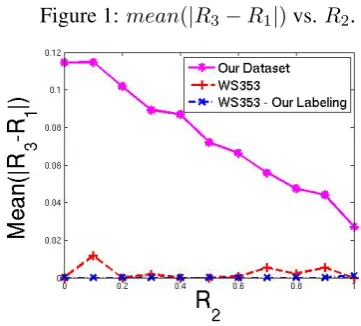
decrease withR2. Figure 1 shows that this
behav-ior indeed takes place in our dataset. The p-value of the correlation betweenmean(|R3−R1|)and R2 is≈ 1e−10. Nevertheless, the curves of the
WS353 data (both with the original labeling and with our labeling) do not show this behavior, prob-ably due to the very few triplet term pairs existing in these data, resulting with a very poor statistics. Besides validating the transitivity behavior, these results emphasize the advantage of the relatively dense TR9856 data, in providing sufficient statis-tics for performing this type of analysis.
Figure 1:mean(|R3−R1|)vs.R2.
5 Results for existing techniques
To demonstrate the usability of the new TR9856 data, we present baseline results of commonly used methods that can be exploited to predict term relatedness, including ESA (Gabrilovich and Markovitch, 2007), Word2Vec (W2V) (Mikolov et al., 2013) and first–order positive PMI (PMI) (Church and Hanks, 1990). To handle MWTs, we used summation on the vector representations of W2V and ESA. For PMI, we tokenized each MWT and averaged the PMI of all possible single–word pairs. For all these methods we used the March 2015 Wikipedia dump and a relatively standard configuration of the relevant parameters. In ad-dition, we report results for an ensemble of these methods using 10-fold cross validation.
5.1 Evaluation measures
Previous experiments on WS353 and other datasets reported Spearman Correlation (ρ) be-tween the algorithm predicted scores and the ground–truth relatedness scores. Here, we also report Pearson Correlation (r) results and demon-strate that the top performing algorithm becomes the worst performing algorithm when switching between these two correlation measures. In ad-dition, we note that a correlation measure gives equal weight to all pairs in the dataset. How-ever, in some NLP applications it is more impor-tant to properly distinguish related pairs from un-related ones. Correspondingly, we also report re-sults when considering the problem as a binary classification problem, aiming to distinguish pairs with a relatedness score≥ 0.8from pairs with a relatedness score≤0.2.
5.2 Correlation results
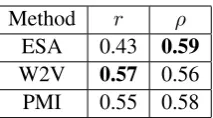
The results of the examined methods are summa-rized in Table 2. Note that these methods are not designed for multi-word terms, and further do not exploit the topic associated with each pair for dis-ambiguation. The results show that all methods are comparable except for ESA in terms of Pear-son correlation, which is much lower. This suggest that ESA scores are not well scaled, a property that might affect applications using ESA as a feature.
[image:4.595.82.263.581.744.2]Method r ρ
ESA 0.43 0.59
[image:5.595.129.236.60.119.2]W2V 0.57 0.56 PMI 0.55 0.58
Table 2: Baseline results for common methods.
length feature, that counts the combined number of tokens per pair, in a 10-fold cross validation setup. The resulting model outperforms all indi-vidual methods, as depicted in Table 3.
Method r ρ
[image:5.595.354.477.124.198.2]ESA 0.43 0.59 W2V 0.57 0.56 PMI 0.55 0.58 Lin. Reg. 0.62 0.63
Table 3: Mean results over 10-fold cross valida-tion.
5.3 Single words vs. multi-words
To better understand the impact of MWTs, we di-vided the data into two subsets. If both terms are SWTs the pair was assigned to the SWP set; otherwise it was assigned to the MWP sub-set. The SWP subset included1,489pairs and the MWP subset comprised of8,367pairs. The ex-periment in subsection 5.2 was repeated for each subset. The results are summarized in Table 4. Ex-cept for the Pearson correlation results of ESA, for all methods we observe lower performance over the MWP subset, suggesting that assessing term– relatedness is indeed more difficult when MWTs are involved.
Method r ρ
[image:5.595.124.239.222.297.2]SWP MWP SWP MWP ESA 0.41 0.43 0.63 0.58 W2V 0.62 0.55 0.58 0.55 PMI 0.63 0.55 0.63 0.59 Table 4: Baseline results for SWP vs. MWP.
5.4 Binary classification results
We turn the task into binary classification task by considering the3,090pairs with a data score
≥ 0.8 as positive examples, and the 3,245 pairs with a data score≤0.2as negative examples. We use a 10-fold cross validation to choose an opti-mal threshold for the baseline methods as well as
to learn a Logistic Regression (LR) classifier, that further used the token length feature. Again, the resulting model outperforms all individual meth-ods, as indicated in Table 5.
Method Mean Error
ESA 0.19
W2V 0.22
PMI 0.21
Log. Reg. 0.18
Table 5: Binary classification results.
6 Discussion
The new TR9856 dataset has several important ad-vantages compared to previous datasets. Most im-portantly – it is the first dataset to consider the re-latedness between multi–word terms; ambiguous terms can be resolved using a pre–specified con-text; and the data itself is much larger than previ-ously available data, enabling to draw more reli-able conclusions, and to develop supervised ma-chine learning methods that exploit parts of the data for training and tuning.
The baseline results reported here for com-monly used techniques provide initial intrigu-ing insights. Table 4 suggests that the perfor-mance of specific methods may change substan-tially when considering pairs composed of uni-grams vs. pairs in which at least one term is a MWT. Finally, our results demonstrate the poten-tial of supervised–learning techniques to outper-form individual methods, by using these methods as underlying features.
In future work we intend to further investigate the notion of term relatedness by manually label-ing the type of the relation identified for highly re-lated pairs. In addition, we intend to develop tech-niques that aim to exploit the context provided for each pair, and to consider the potential of more ad-vanced – and in particular non–linear – supervised learning methods.
Acknowledgments
The authors thank Ido Dagan and Mitesh Khapra for many helpful discussions.
References
[image:5.595.84.279.552.623.2]Gutfre-und, and Noam Slonim. 2014. A benchmark dataset for automatic detection of claims and evidence in the context of controversial topics. ACL 2014, page 64.
Chris Biemann. 2013. Creating a system for lexi-cal substitutions from scratch using crowdsourcing.
Language Resources and Evaluation, 47(1):97–122.
Elia Bruni, Nam-Khanh Tran, and Marco Baroni.
2014. Multimodal distributional semantics. J.
Ar-tif. Intell. Res.(JAIR), 49:1–47.
Kenneth Ward Church and Patrick Hanks. 1990. Word association norms, mutual information, and lexicog-raphy.Computational linguistics, 16(1):22–29.
Christiane Fellbaum. 1998. WordNet. Wiley Online
Library.
Lev Finkelstein, Evgeniy Gabrilovich, Yossi Matias, Ehud Rivlin, Zach Solan, Gadi Wolfman, and Ey-tan Ruppin. 2002. Placing search in context: The
concept revisited. ACM Transactions on
Informa-tion Systems, 20(1):116–131.
Evgeniy Gabrilovich and Shaul Markovitch. 2007. Computing semantic relatedness using
wikipedia-based explicit semantic analysis. In IJCAI,
vol-ume 7, pages 1606–1611.
Guy Halawi, Gideon Dror, Evgeniy Gabrilovich, and Yehuda Koren. 2012. Large-scale learning of word relatedness with constraints. InProceedings of the 18th ACM SIGKDD international conference on Knowledge discovery and data mining, pages 1406– 1414. ACM.
Felix Hill, Roi Reichart, and Anna Korhonen. 2014. Simlex-999: Evaluating semantic models with
(genuine) similarity estimation. arXiv preprint
arXiv:1408.3456.
Eric H. Huang, Richard Socher, Christopher D. Man-ning, and Andrew Y. Ng. 2012. Improving word representations via global context and multiple word
prototypes. In Annual Meeting of the Association
for Computational Linguistics (ACL).
Gerhard Kremer, Katrin Erk, Sebastian Pad´o, and Ste-fan Thater. 2014. What substitutes tell us - anal-ysis of an ”all-words” lexical substitution corpus. InProceedings of the 14th Conference of the Euro-pean Chapter of the Association for Computational Linguistics, pages 540–549, Gothenburg, Sweden, April. Association for Computational Linguistics.
Diana McCarthy and Roberto Navigli. 2009. The en-glish lexical substitution task. Language resources and evaluation, 43(2):139–159.
Tomas Mikolov, Kai Chen, Greg Corrado, and Jef-frey Dean. 2013. Efficient estimation of word
representations in vector space. arXiv preprint
arXiv:1301.3781.
Shachar Mirkin, Ido Dagan, and Eyal Shnarch. 2009. Evaluating the inferential utility of lexical-semantic resources. InProceedings of the 12th Conference of the European Chapter of the Association for Com-putational Linguistics, pages 558–566. Association for Computational Linguistics.
Kira Radinsky, Eugene Agichtein, Evgeniy
Gabrilovich, and Shaul Markovitch. 2011. A word at a time: computing word relatedness using
temporal semantic analysis. In Proceedings of the
20th international conference on World wide web, pages 337–346. ACM.
Rion Snow, Brendan O’Connor, Daniel Jurafsky, and Andrew Y Ng. 2008. Cheap and fast—but is it good?: evaluating non-expert annotations for natu-ral language tasks. InProceedings of the conference on empirical methods in natural language
process-ing, pages 254–263. Association for Computational