170
A Language Model based Evaluator for Sentence Compression
Yang Zhao Zhiyuan Luo
The University of Tokyo 7-3-1 Hongo, Bunkyo-ku, Tokyo
{zhao,zyluo24}@is.s.u-tokyo.ac.jp
Akiko Aizawa
National Institute of Informatics 2-1-2 Hitotsubashi, Chiyoda-ku, Tokyo
Abstract
We herein present a language-model-based evaluator for deletion-language-model-based sen-tence compression, and viewed this task as a series of deletion-and-evaluation op-erations using the evaluator. More specif-ically, the evaluator is a syntactic neural language model that is first built by learn-ing the syntactic and structural collocation among words. Subsequently, a series of trial-and-error deletion operations are con-ducted on the source sentences via a re-inforcement learning framework to obtain the best target compression. An empirical study shows that the proposed model can effectively generate more readable com-pression, comparable or superior to sev-eral strong baselines. Furthermore, we in-troduce a 200-sentence test set for a large-scale dataset, setting a new baseline for the future research.
1 Introduction
Deletion-based sentence compression aims to delete unnecessary words from source sentence to form a short sentence (compression) while re-taining grammatical and faithful to the under-lying meaning of the source sentence. Previ-ous works used either machine-learning-based ap-proach or syntactic-tree-based apap-proaches to yield most readable and informative compression (Jing, 2000; Knight and Marcu, 2000; Clarke and La-pata, 2006; McDonald, 2006; Clarke and La-pata, 2008; Filippova and Strube, 2008; Berg-Kirkpatrick et al., 2011; Filippova et al., 2015; Bingel and Søgaard, 2016; Andor et al., 2016; Zhao et al.,2017;Wang et al.,2017). For example, (Clarke and Lapata, 2008) proposed a syntactic-tree-based method that considers the sentence
compression task as an optimization problem by using integer linear programming, whereas ( Filip-pova et al., 2015) viewed the sentence compres-sion task as a sequence labeling problem using the recurrent neural network (RNN), using max-imum likelihood as the objective function for op-timization. The latter sets a relatively strong base-line by training the model on a large-scale parallel corpus. Although an RNN (e.g., Long short-term memory networks) can implicitly model syntactic information, it still produces ungrammatical sen-tences. We argue that this is because (i) the la-bels (or compressions) are automatically yielded by employing the syntactic-tree-pruning method. It thus contains some errors caused by syntactic tree parsing error, (ii) more importantly, the op-timization objective of an RNN is the likelihood function that is based on individual words instead of readability (or informativeness) of the whole compressed sentence. A gap exists between opti-mization objective and evaluation. As such, we are of great interest that: (i) can we take the readabil-ity of the whole compressed sentence as a learning objective and (ii) can grammar errors be recovered through a language-model-based evaluator to yield compression with better quality?
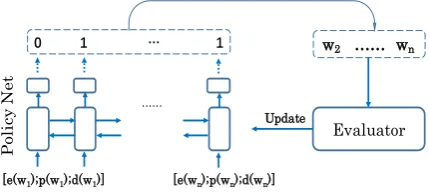
To answer the above questions, a syntax-based neural language model is trained on large-scale datasets as a readability evaluator. The neural language model is supposed to learn the correct word collocations in terms of both syntax and se-mantics. Subsequently, we formulate the deletion-based sentence compression as a series of trial-and-error deletion operations through a reinforce-ment learning framework. The policy network performs either RETAIN or REMOVE action to form a compression, and receives a reward (e.g., readability score) to update the network.
preserve the source sentences, comparable or su-perior to several strong baselines. In short, our contributions are two-fold: (i) an effective syntax-based evaluator is built as a post-hoc checker, yielding compression with better quality based upon the evaluation metrics; (ii) a large scale news dataset with 1.02 million sentence compression pairs are compiled for this task in addition to 200 manually created sentences. We made it publicly available.
2 Methodology
2.1 Task and Framework
Formally, deletion-based sentence compression translates word tokens,(w1, w2, ..., wn)into a
se-ries of ones and zeros, (l1, l2, ..., ln), where n
refers to the length of the original sentence and
li ∈ {0,1}. Here, ”1” refers to RETAIN and
”0” refers to REMOVE. We first converted the word sequence into a dense vector representa-tion through the parameter matrix E. Except for word embedding, (e(w1), e(w2), ..., e(wn)),
we also considered the part-of-speech tag and the dependency relation between wi and its
head word as extra features. Each part-of-speech tag was mapped into a vector represen-tation, (p(w1), p(w2), ..., p(wn)) through the
pa-rameter matrix P, while each dependency re-lation was mapped into a vector representation, (d(w1), d(w2), ..., d(wn)) through the parameter
matrix D. Three vector representations are con-catenated,[e(wi);p(wi);d(wi)]as the input to the
next part, policy network.
Figure 1 shows the graphical illustration of our model. The policy network is a bi-directional RNN that uses the input[e(wi);p(wi);d(wi)]and
yields the hidden states in the forward direction, (hf1, hf2, ..., hfn), and hidden states in the backward direction,(hb1, hb2, ..., hbn). Then, concatenation of hidden states in both directions, [hfi;hbi] are fol-lowed by a nonlinear layer to turn the output into a binary probability distribution,yi=σ(W[hfi;hbi])
whereσ is a nonlinear functionsigmoid, andW
is a parameter matrix.
The policy network continues to sample actions from the binary probability distribution above un-til the whole action sequence is yielded. In this task, binary actions space is {RETAIN, RE-MOVE}. We turn the action sequence into the pre-dicted compression,(w1, w2, ..., wm), by deleting
the words whose current action is REMOVE. Then
[e(w1);p(w1);d(w1)] [e(wn);p(wn);d(wn)]
w2 …… wn
Evaluator
P
ol
ic
y
N
et
[image:2.595.311.526.67.163.2]Update
Figure 1: Graphical illustration of the framework.
the(w1, w2, ..., wm)is fed into a pre-trained
eval-uator which will be described in the next section.
2.2 Syntax-based Evaluator
The syntax-based evaluator should assess the de-gree to which the compressed sentence is gram-matical, through being used as a reward function during the reinforcement learning phase. It needs to satisfy three conditions: (i) grammatical com-pressions should obtain a higher score than un-grammatical compressions, (ii) for two ungram-matical compressions, it should be able to discrim-inate them through the score despite the ungram-maticality, (iii) lack of important parts (such as the primary subject or verb) in the original sentence should receive a greater penalty.
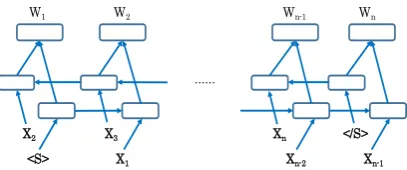
We therefore considered an ad-hoc evaluator, i.e., the syntax-based language model (evaluator-SLM) for these requirements. It integrates the part-of-speech tags and the dependency relations in the input, while the output to be predicted is the next word token. We observed that the pre-diction of the next word could not only be based on the previous word but also the syntactic com-ponents, e.g., for the part-of-speech tag, the noun is often followed by a verb instead of an adjec-tive or adverb and the integration of the part-of-speech tag allows the model to learn such cor-rect word collocations. Figure 2 shows the graphi-cal illustration of the evaluator-SLM where the in-put is xi = [e(wi);p(wi);d(wi)], followed by a
<S> X1 Xn-2 Xn-1
w1 w2 w3 w4 w5
X2 X3 Xn </S>
[image:3.595.80.284.62.147.2]W1 W2 Wn-1 Wn
Figure 2: Graphical illustration of bi-directional recurrent neural network language model.
RSLM(Yb) =e
( 1
| b
Y|
P| b
Y|
t=1logPLM(yt|y0:t−1))
(1)
where RSLM ∈ [0,1] and Yb is the predicted
compression by the policy network.
Further, it is noteworthy that the performance comparison should be based on a similar com-pression rate1 (CR) (Napoles et al., 2011), and a smooth reward functionRCR = (a+b)
(a+b)
aabb xa(1− x)b (both a, b are positive integers; e.g. a = 2,
b = 2 could lead the compression rate to 0.5) is also used to attain a compressed sentence of simi-lar length.
The total reward isR =RSLM +RCR. By
us-ing policy gradient methods (Sutton et al.,2000), the policy network is updated with the following gradient:
∇L(θ) =
|Yb| X
t=1
R(Yb)∇logπθ(at|St) (2)
Whereat ∈ {RETAIN, REMOVE}, is the
ac-tion token by the policy network, andStrefers to
hidden state of the network,[hfi;hbi](section 2.1).
3 Experiments
3.1 Data
As neural network-based methods require a large amount of training data, we for the first time considered using Gigaword2, a news domain cor-pus. More specifically, the first sentence and the headline of each article are extracted. After data cleansing, we finally compiled 1.02 million sen-tence and headline pairs (see details here3). It is noteworthy that the headline is not the extractive
1
compression rate is the length of compression divided by the length of the sentence.
2
https://catalog.ldc.upenn.edu/ldc2011t07
3https://github.com/code4conference/Data
compression. Further, we asked two near native English speakers to create 200 extractive compres-sions for the first 200 sentences of this dataset; us-ing it as the testus-ing set, the first 1,000 sentences (excluding the testing set) is the development set, and the remainder is the training set. To assess the inter-assessor agreements, we computed Cohen ’s unweighted κ. The computed unweightedκ was 0.423, reaching a moderate agreement level4
The second dataset we used was the Google dataset that contains 200,000 sentence compres-sion pairs (Filippova et al.,2015). For the purpose of comparison, we used the very first 1,000 sen-tences as the testing set, the next 1,000 sensen-tences as the development set, and the remainder as the training set.
3.2 Comparison Methods
We choose several strong baselines; the first one is the dependency-tree-based method that considers the sentence compression task as an optimization problem by using integer linear programming5. Inspired by (Filippova and Strube,2008), (Clarke and Lapata,2008), and (Wang et al.,2017), we de-fined some constrains: (1) if a word is retained in the compression, its parent should be also retained. (2) whether a word wi is retained should partly
depend on the word importance score that is the product of the TF-IDF score and headline score
h(wi),tf-idf(wi)·h(wi)whereh(wi)represents
that whether a word (limited to nouns and verbs) is also in the headline. h(wi)=5 ifwiis in the
head-line;h(wi)=1 otherwise. (3) the dependency
rela-tions,ROOT, dobj, nsubj, pobj, should be retained as they are the skeletons of a sentence. (4) the sen-tence length should be over than α but less than
β. (5) the depth of the node (word), λdep(wi),
in the dependency tree. (6) the word with the de-pendency relation amod is to be removed. It is noteworthy that the method is unsupervised.
The second method is the long short-term memory networks (LSTMs) which showed strong promise in sentence compression by (Filippova et al.,2015). The labels were obtained using the dependency tree pruning method (Filippova and Altun,2013) and the LSTMs were applied in a su-pervised manner. Following their works, we also
4(Landis and Koch,1977) characterizeκvalues<0 as no
agreement,0∼0.20as slight,0.21∼0.40as fair,0.41∼
0.60as moderate,0.61∼0.80as substantial, and0.81∼1
as almost perfect agreement.)
Gigaword Dataset Annotator 1 Annotator 2
F1 RASP-F1 F1 RASP-F1 CR
#1 Seq2seq with attention 54.9 60.3 58.6 64.6 0.53 #2 Dependency tree+ILP 58.0 65.1 61.0 70.9 0.55 #3 LSTMs+pseudo label 60.3 64.1 64.1 69.2 0.51
#4 Evaluator-LM 64.5 67.3 66.9 72.2 0.50
[image:4.595.156.442.61.134.2]#5 Evaluator-SLM 65.0 69.6 68.2 73.9 0.51
Table 1:F1and RASP-F1 results for Gigaword dataset.
consider the labels yielded by our dependency-tree-based method as pseudo labels and employ LSTMs as a baseline.
Furthermore, for a comprehensive comparison, we applied the sequence-to-sequence with atten-tion method widely used in abstractive text sum-marization for sentence compression. Previous works such as (Rush et al., 2015; Chopra et al., 2016) have shown promising results with this framework, although the focus was generation-based summarization rather than extractive sum-marization. More specifically, the source sequence of this framework is the original sentence, while the target sequence is a series of zeros and ones (zeros represents REMOVE and ones represents RETAIN). Further, we incorporated dependency labels and part-of-speech tag features in the source side of the sequence-to-sequence method.
3.3 Training
The embedding size for word, part-of-speech tag, and the dependency relation is 128. We employed the vanilla RNN with a hidden size of 512 for both the policy network and neural language model. The mini-batch size was chosen from [5,50,100]. Vocabulary size was 50,000. The learning rate for neural language model is 2.5e-4, and 1e-05 for the policy network. For policy learning, we used the REINFORCE algorithm (Williams, 1992) to update the parameters of the policy network and find an policy that maximizes the reward. Because starting from a random policy is impractical ow-ing to the high variance, we pre-trained the policy network using pseudo labels in a supervised man-ner. For the comparison methods, the hyperparam-eters and were set to 0.4 and 0.7, respectively, and was set to 0.5. For reproduction, we released the source code here6.
6https://github.com/code4conference/code4sc
4 Result and Discussion
This section demonstrates the experimental results on both datasets. As the Gigaword dataset has no ground truth, we evaluated the baseline and our method on the 200-sentence test sets created by two human annotators. For the automatic evalua-tion, we employedF1 and RASP-F1(Briscoe and
Carroll,2002) to measure the performances. The latter compares grammatical relations (such as nc-subj and dobj ) found in the system compressions with those found in the gold standard, providing a means to measure the semantic aspects of the compression quality. For the human evaluation, we asked two near native English speakers to as-sess the quality of 50 compressed sentences out of the 200-sentence test set in terms of readability and informativeness. Here are our observations:
Gigaword Readability Inf ormativeness
$1 LSTMs 3.56 3.10
[image:4.595.304.527.530.593.2]$2 SLM 4.16† 3.16
Table 2: Human Evaluation for Gigaword dataset.
†stands for significant difference with0.95 confi-dence in the column.
Google Dataset F1 RASP-F1 CR
&1 Seq2seq with attention 71.7 63.8 0.34 &2 LSTM (Filippova, 2015) 82.0 - 0.38 &3 LSTMs (our implement) 84.8 81.9 0.40 &4 Evaluator-LM 85.0 82.0 0.41 &5 Evaluator-SLM 85.1 82.3 0.39
Table 3: F1 and RASP-F1 results for Google dataset.
Case study
SENTENCE The Dalian shipyard has built two new huge ships
POS tags DET ADJ NOUN VERB VERB NUM ADJ ADJ NOUN
DEP. rels det compound nsubj aux root nummod amod amod dobj
#1 The Dalian shipyard has built two new huge ships
#2 The Dalian shipyard has built two new huge
#3 The Dalian shipyard has two new huge ships
#4 The Dalian has built two new huge ships
#5 The Dalian has built two ships
#6 The has built two ships
#7 The Dalian shipyard has built two huge ships
#8 The Dalian shipyard has built two ships
#9 The shipyard has built two ships
e-logR
[image:5.595.129.470.65.192.2]59.8 140.5 582.9 1313.5 1244.8 1331.2 46.9 18.2 66.5
Figure 3: Case study for evaluator.
(2) by comparing annotator 1 with annotator 2 in Table 1, we observed different performances for two annotated test sets, showing that compress-ing a text while preservcompress-ing the original sentence is subjective across the annotators.
(3) As for Google news dataset, LSTMs (LSTM+pos+dep) (&3) is a relatively strong base-line, suggesting that incorporating dependency re-lations and part-of-speech tags may help model learn the syntactic relations and thus make a bet-ter prediction. When further applying Evaluator-SLM, only a tiny improvement is observed (&3 vs &4), not comparable to the improvement be-tween #3 and #5. This may be due to the differ-ence in perplexity of the our Evaluator-SLM. For Gigaword dataset with 1.02 million instances, the perplexity of the language model is 20.3, while for the Google news dataset with 0.2 million in-stances, the perplexity is 76.5.
(4) To further explore the degree to which syn-tactic knowledge (dependency relations and part-of-speech tags) is helpful to evaluator (language model), we implemented a naive language model, i.e., Evaluator-LM, which did not include depen-dency relations and part-of-speech tags as input features. The results shows that small improve-ments are observed on two datasets (#4 vs #5; &4 vs &5), suggesting that incorporating syntactic knowledge may help evaluator to encourage more unseen but reasonable word collocations.
4.1 Evaluator Analysis
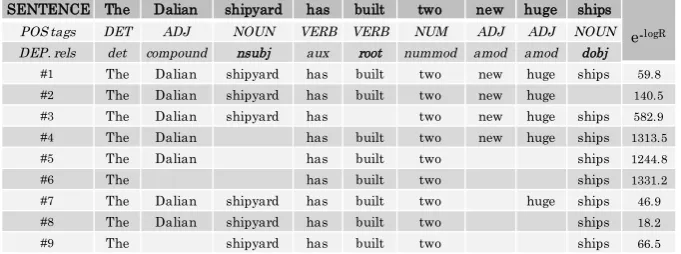
To further analyze the Evaluator-SLM perfor-mance, we used an example sentence, “The Dalian shipyard has built two new huge ships” to observe how a language model scores different word dele-tion operadele-tions. We converted the reward funcdele-tion
RSLM toe−logRSLM for a better observation
(sim-ilar to ”sentence perplexity”, the higher the score is, the worse is the sentence). As shown in Figure 3, deleting the object(#2), verb(#3), or subject(#4) results in a significant increase in ”sentence per-plexity”, implying that the syntax-based language model is highly sensitive to the lack of such syn-tactic components. Interestingly, when deleting words such as new or/and huge, the score be-comes lower, suggesting that the model may pre-fer short sentences, with unnecessary parts such asamod being removed. This property makes it quite suitable for the sentence compression task aiming to shorten sentences by removing unnec-essary words.
5 Conclusion
We presented a syntax-based language model for the sentence compression task. We em-ployed unsupervised methods to yield labels to train a policy network in a supervised man-ner. The experimental results demonstrates that the compression could be further improved by a post-hoc language-model-based evaluator, and our evaluator-enhanced model performs better or com-parable upon the evaluation metrics on two large-scale datasets.
Acknowledgments
References
Daniel Andor, Chris Alberti, David Weiss, Aliaksei Severyn, Alessandro Presta, Kuzman Ganchev, Slav Petrov, and Michael Collins. 2016. Globally nor-malized transition-based neural networks. In Pro-ceedings of the 54th Annual Meeting of the Associa-tion for ComputaAssocia-tional Linguistics (Volume 1: Long Papers). volume 1, pages 2442–2452.
Taylor Berg-Kirkpatrick, Dan Gillick, and Dan Klein. 2011. Jointly learning to extract and compress. In Proceedings of the 49th Annual Meeting of the Asso-ciation for Computational Linguistics: Human Lan-guage Technologies-Volume 1. Association for Com-putational Linguistics, pages 481–490.
Joachim Bingel and Anders Søgaard. 2016. Text sim-plification as tree labeling. In Proceedings of the 54th Annual Meeting of the Association for Compu-tational Linguistics (Volume 2: Short Papers). vol-ume 2, pages 337–343.
Ted Briscoe and John Carroll. 2002. Robust accurate statistical annotation of general text. InProceedings of the Third International Conference on Language Resources and Evaluation (LREC’02).
Sumit Chopra, Michael Auli, and Alexander M Rush. 2016. Abstractive sentence summarization with at-tentive recurrent neural networks. InProceedings of the 2016 Conference of the North American Chap-ter of the Association for Computational Linguistics: Human Language Technologies. pages 93–98.
James Clarke and Mirella Lapata. 2006. Constraint-based sentence compression an integer program-ming approach. In Proceedings of the COL-ING/ACL on Main conference poster sessions. As-sociation for Computational Linguistics, pages 144– 151.
James Clarke and Mirella Lapata. 2008. Global in-ference for sentence compression: An integer linear programming approach. Journal of Artificial Intelli-gence Research31:399–429.
Katja Filippova, Enrique Alfonseca, Carlos A Col-menares, Lukasz Kaiser, and Oriol Vinyals. 2015. Sentence compression by deletion with lstms. In Proceedings of the 2015 Conference on Empirical Methods in Natural Language Processing. pages 360–368.
Katja Filippova and Yasemin Altun. 2013. Overcom-ing the lack of parallel data in sentence compression. In Proceedings of the 2013 Conference on Empiri-cal Methods in Natural Language Processing. pages 1481–1491.
Katja Filippova and Michael Strube. 2008. Depen-dency tree based sentence compression. Fifth Inter-national Natural Language Generation Conference on - INLG ’08page 25.
Hongyan Jing. 2000. Sentence reduction for automatic text summarization. InProceedings of the sixth con-ference on Applied natural language processing. As-sociation for Computational Linguistics, pages 310– 315.
Kevin Knight and Daniel Marcu. 2000. Statistics-based summarization-step one: Sentence compres-sion. In Proceedings of the Seventeenth National Conference on Artificial Intelligence and Twelfth Conference on Innovative Applications of Artificial Intelligence. AAAI Press, pages 703–710.
J Richard Landis and Gary G Koch. 1977. The mea-surement of observer agreement for categorical data. biometricspages 159–174.
Ryan McDonald. 2006. Discriminative sentence com-pression with soft syntactic evidence. In11th Con-ference of the European Chapter of the Association for Computational Linguistics.
Amr Mousa and Bj¨orn Schuller. 2017. Contextual bidi-rectional long short-term memory recurrent neural network language models: A generative approach to sentiment analysis. InProceedings of the 15th Con-ference of the European Chapter of the Association for Computational Linguistics: Volume 1, Long Pa-pers. volume 1, pages 1023–1032.
Courtney Napoles, Benjamin Van Durme, and Chris Callison-Burch. 2011. Evaluating sentence com-pression: Pitfalls and suggested remedies. In Pro-ceedings of the Workshop on Monolingual Text-To-Text Generation. pages 91–97.
Alexander M Rush, Sumit Chopra, and Jason Weston. 2015. A neural attention model for abstractive sen-tence summarization. In Proceedings of the 2015 Conference on Empirical Methods in Natural Lan-guage Processing. pages 379–389.
Richard S Sutton, David A McAllester, Satinder P Singh, and Yishay Mansour. 2000. Policy gradi-ent methods for reinforcemgradi-ent learning with func-tion approximafunc-tion. InAdvances in neural informa-tion processing systems. pages 1057–1063.
Liangguo Wang, Jing Jiang, Hai Leong Chieu, Chen Hui Ong, Dandan Song, and Lejian Liao. 2017. Can syntax help? improving an lstm-based sentence compression model for new domains. In Proceedings of the 55th Annual Meeting of the As-sociation for Computational Linguistics (Volume 1: Long Papers). volume 1, pages 1385–1393.
Ronald J Williams. 1992. Simple statistical gradient-following algorithms for connectionist reinforce-ment learning. In Reinforcement Learning, Springer, pages 5–32.