Proceedings of the 56th Annual Meeting of the Association for Computational Linguistics (Long Papers), pages 2706–2716 2706
Supervised Treebank Conversion: Data and Approaches
Xinzhou Jiang2∗, Bo Zhang2, Zhenghua Li1,2, Min Zhang1,2, Sheng Li3, Luo Si3 1. Institute of Artificial Intelligence, Soochow University, Suzhou, China
2. School of Computer Science and Technology, Soochow University, Suzhou, China {xzjiang, bzhang17}@stu.suda.edu.cn, {zhli13,minzhang}@suda.edu.cn
3. Alibaba Inc., Hangzhou, China {lisheng.ls,luo.si}@alibaba-inc.com
Abstract
Treebank conversion is a straightfor-ward and effective way to exploit vari-ous heterogenevari-ous treebanks for boost-ing parsboost-ing accuracy. However, previ-ous work mainly focuses on unsuper-vised treebank conversion and makes little progress due to the lack of man-ually labeled data where each sentence has two syntactic trees complying with two different guidelines at the same time, referred asbi-tree aligned data. In this work, we for the first time propose the task ofsupervised treebank conversion. First, we manually con-struct a bi-tree aligned dataset contain-ing over ten thousand sentences. Then, we propose two simple yet effective treebank conversion approaches (pat-tern embedding and treeLSTM) based on the state-of-the-art deep biaffine parser. Experimental results show that 1) the two approaches achieve com-parable conversion accuracy, and 2) treebank conversion is superior to the widely used multi-task learning frame-work in multiple treebank exploitation and leads to significantly higher pars-ing accuracy.
1 Introduction
During the past few years, neural network based dependency parsing has achieved sig-nificant progress and outperformed the tra-ditional discrete-feature based parsing (Chen and Manning, 2014; Dyer et al., 2015; Zhou ∗The first two (student) authors make equal contributions to this work. Zhenghua is the correspondence author.
Treebanks #Tok Grammar
Sinica (Chen et al.,2003) 0.36M Case grammar CTB (Xue et al.,2005) 1.62M Phrase structure
TCT (Zhou,2004) 1.00M Phrase structure PCT (Zhan,2012) 0.90M Phrase structure HIT-CDT (Che et al.,2012) 0.90M Dependency structure PKU-CDT (Qiu et al.,2014) 1.40M Dependency structure
Table 1: Large-scale Chinese treebanks (token number in million).
et al., 2015; Andor et al., 2016). Most re-markably,Dozat and Manning(2017) propose a simple yet effective deep biaffine parser that further advances the state-of-the-art accuracy by large margin. As reported, their parser out-performs the state-of-the-art discrete-feature based parser of Bohnet and Nivre (2012) by 0.97 (93.76% − 92.79%) on the English WSJ data and 6.87 (85.38% − 78.51%) on the Chinese CoNLL-2009 data, respectively. Kindly note that all these results are obtained by training parsers on a single treebank.
Meanwhile, motivated by different syntactic theories and practices, major languages in the world often possess multiple large-scale hetero-geneous treebanks, e.g., Tiger (Brants et al.,
2002) and TüBa-D/Z (Telljohann et al.,2004) treebanks for German, Talbanken (Einarsson,
1976) and Syntag (Järborg, 1986) treebanks for Swedish, ISST (Montemagni et al., 2003) and TUT1 treebanks for Italian, etc.
Ta-ble 1 lists several large-scale Chinese tree-banks. In this work, we take HIT-CDT as a case study. Our next-step plan is to annotate bi-tree aligned data for PKU-CDT and then convert PKU-CDT to our guideline. For non-dependency treebanks, the
forward choice is to convert such treebanks to dependency treebanks based on heuris-tic head-finding rules. The second choice is to directly extend our proposed approaches by adapting the patterns and treeLSTMs for non-dependency structures, which should be straightforward as well.
Considering the high cost of treebank con-struction, it has always been an interesting and attractive research direction to exploit various heterogeneous treebanks for boosting parsing performance. Though under different linguistic theories or annotation guidelines, the treebanks are painstakingly developed to capture the syntactic structures of the same language, thereby having a great deal of com-mon grounds.
Previous researchers have proposed two ap-proaches for multi-treebank exploitation. On the one hand, the guiding-feature method projects the knowledge of the source-side tree-bank into the target-side treetree-bank, and uti-lizes extra pattern-based features as guid-ance for the target-side parsing, mainly for the traditional discrete-feature based pars-ing (Li et al., 2012). On the other hand, themulti-task learningmethod simultaneously trains two parsers on two treebanks and uses shared neural network parameters for repre-senting common-ground syntactic knowledge (Guo et al., 2016).2 Regardless of their ef-fectiveness, while the guiding-feature method fails to directly use the source-side treebank as extra training data, the multi-task learning method is incapable of explicitly capturing the structural correspondences between two guidelines. In this sense, we consider both of them as indirect exploitation approaches.
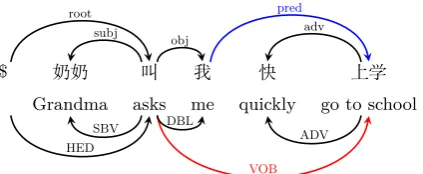
Compared with the indirect approaches, treebank conversion aims to directly convert a source-side treebank into the target-side guideline, and uses the converted treebank as extra labeled data for training the target-side model. Taking the example in Figure 1, the goal of this work is to convert the under tree that follows the HIT-CDT guideline (Che et al., 2012) into the upper one that follows our new guideline. However, due to the lack
2 Johansson (2013) applies the feature-sharing approach of Daumé III (2007) for multiple treebank exploitation, which can be regarded as a simple discrete-feature variant of multi-task learning.
$ 奶奶 叫 我 快 上学
Grandma asks me quickly go to school
subj root
adv obj
pred
HED
SBV ADV
VOB
DBL
Figure 1: Example of treebank conversion from the source-side HIT-CDT tree (under) to the target-side our-CDT tree (upper).
of bi-tree aligned data, in which each sentence has two syntactic trees following the source-side and target-source-side guidelines respectively, most previous studies are based on unsuper-vised treebank conversion (Niu et al.,2009) or pseudo bi-tree aligned data (Zhu et al., 2011;
Li et al.,2013), making very limited progress. In this work, we for the first time propose the task of supervised treebank conversion. The key motivation is to better utilize a large-scale source-side treebank by constructing a small-scale bi-tree aligned data. In summary, we make the following contributions.
(1) We have manually annotated a high-quality bi-tree aligned data containing over ten thousand sentences, by re-annotating the HIT-CDT treebank according to a new guideline.
(2) We propose a pattern embedding conver-sion approach by retrofitting the indirect guiding-feature method ofLi et al.(2012) to the direct conversion scenario, with several substantial extensions.
(3) We propose a treeLSTM conversion ap-proach that encodes the source-side tree at a deeper level than the shallow pattern embedding approach.
[image:2.595.313.525.64.151.2]annotated data inhttp://hlt.suda.edu.cn/ index.php/SUCDT.
2 Annotation of Bi-tree Aligned Data
The key issue for treebank conversion is that sentences in the source-side and target-side treebanks are non-overlapping. In other words, there lacks a bi-tree aligned data in which each sentence has two syntactic trees complying with two guidelines as shown in Figure 1. Consequently, we cannot train a supervised conversion model to directly learn the structural correspondences between the two guidelines. To overcome this obstacle, we construct a bi-tree aligned data of over ten thousand sentences by re-annotating the publicly available dependency-structure HIT-CDT treebank according to a new annotation guideline.
2.1 Data Annotation
Annotation guideline. Unlike phrase-structure treebank construction with very detailed and systematic guidelines (Xue et al., 2005; Zhou, 2004), previous works on Chinese dependency-structure annotation only briefly describe each relation label with a few concrete examples. For example, the HIT-CDT guideline contains14relation labels and illustrates them in a14-page document.
The UD (universal dependencies) project3 releases a more detailed language-generic guideline to facilitate cross-linguistically consistent annotation, containing 37
relation labels. However, after in-depth study, we find that the UD guideline is very useful and comprehensive, but may not be completely compact for realistic annotation of Chinese-specific syntax. After many months’ investigation and trial, we have developed a systematic and detailed annotation guideline for Chinese dependency treebank construction. Our60-page guideline employs 20 relation labels and gives detailed illustrations for annotation, in order to improve consistency and quality.
Please refer to Guo et al. (2018) for the details of our guideline, including detailed discussions on the correspondences and differ-ences between the UD guideline and ours.
3http://universaldependencies.org
Partial annotation. To save annotation effort, we adopt the idea ofLi et al.(2016) and only annotate the most uncertain (difficult) words in a sentence. For simplicity, we directly use their released parser and produce the un-certainty results of all HLT-CDT sentences via two-fold jack-knifing. First, we select 2,000
most difficult sentences of lengths [5,10] for full annotation4. Then, we select 3,000 most
difficult sentences of lengths [10,20] from the remaining data for 50% annotation. Finally, we select 6,000 most difficult sentences of lengths [5,25] for 20% annotation from the remaining data. The difficulty of a sentence is computed as the averaged difficulty of its selected words.
Annotation platform. To guarantee an-notation consistency and data quality, we build an online annotation platform to sup-port strict double annotation and subsequent inconsistency handling. Each sentence is dis-tributed to two random annotators. If the two submissions are not the same (inconsistent dependency or relation label), a third expert annotator will compare them and decide a single answer.
Annotation process. We employ about
20 students in our university as part-time annotators. Before real annotation, we first give a detailed talk on the guideline for about two hours. Then, the annotators spend several days on systematically studying our guideline. Finally, they are required to annotate50 test-ing sentences on the platform. If the submis-sion is different from the correct answer, the annotator receives an instant feedback for self-improvement. Based on their performance, about 10 capable annotators are chosen as experts to deal with inconsistent submissions.
2.2 Statistics and Analysis
Consistency statistics. Compared with the final answers, the overall accuracy of all annotators is 87.6%. Although the overall inter-annotator dependency-wise consistency rate is 76.5%, the sentence-wise consistency rate is only 43.7%. In other words, 56.3% (100−43.7) sentences are further checked by a third expert annotator. This shows how
difficult it is to annotate syntactic structures and how important it is to employ strict double annotation to guarantee data quality.
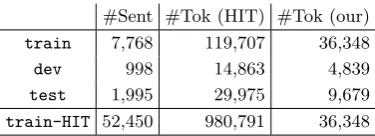
Annotation time analysis. As shown in Table 2, the averaged sentence length is 15.4
words in our annotated data, among which
4.7 words (30%) are partially annotated with their heads. According to the records of our annotation platform, each sentence requires about 3 minutes in average, including the annotation time spent by two annotators and a possible expert. The total cost of our data annotation is about 550 person-hours, which can be completed by 20 full-time annotators within 4 days. The most cost is spent on quality control via two-independent annota-tion and inconsistency handling by experts. This is in order to obtain very high-quality data. The cost is reduced to about 150 person-hours without such strict quality control.
Heterogeneity analysis. In order to un-derstand the heterogeneity between our guide-line and the HIT-CDT guideguide-line, we analyze the 36,348 words with both-side heads in the
train data, as shown in Table 2. The con-sistency ratio of the two guidelines is 81.69% (UAS), without considering relation labels. By mapping each relation label in HIT-CDT (14 in total) to a single label of our guideline (20 in total), the maximum consistency ratio is73.79% (LAS). The statistics are similar for thedev/testdata.
3 Indirect Multi-task Learning
Basic parser. In this work, we build all the approaches over the state-of-the-art deep bi-affine parser proposed by Dozat and Manning
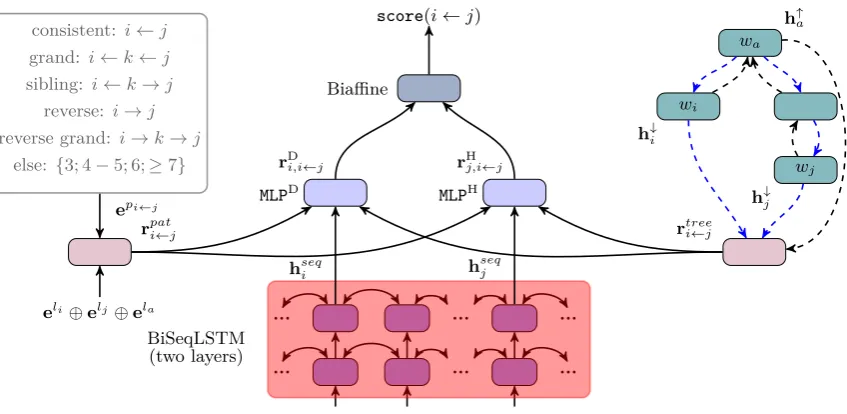
(2017). As a graph-based dependency parser, it employs a deep biaffine neural network to compute the scores of all dependencies, and uses viterbi decoding to find the highest-scoring tree. Figure 2 shows how to score a dependencyi←j.5
First, the biaffine parser applies multi-layer bidirectional sequential LSTMs (biSeqLSTM) to encode the input sentence. The word/tag embeddings ewk and etk are concatenated as the input vector atwk.
5 The score computation of the relation labels is analogous, but due to space limitation, we refer readers toDozat and Manning(2017) for more details.
Then, the output vector of the top-layer biSeqLSTM at wk, denoted as hseqk , is fed into two separate MLPs to get two lower-dimensional representation vectors.
rHk =MLPH(hseqk )
rDk =MLPD(hseqk ) (1)
whererHk is the representation vector ofwk as a head word, and rD
k as a dependent.
Finally, the score of the dependency i← j
is computed via a biaffine operation.
score(i←j) = [
rDi
1 ]T
WbrH
j (2)
During training, the original biaffine parser uses the local softmax loss. For each
wi and its head wj, its loss is defined as −log escore(i←j)
∑
kescore(i←k)
. Since our training data is partially annotated, we follow Li et al.(2016) and employ the global CRF loss (Ma and Hovy,2017) for better utilization of the data, leading to consistent accuracy gain.
Multi-task learning aims to incorporate labeled data of multiple related tasks for im-proving performance (Collobert and Weston,
2008). Guo et al. (2016) apply multi-task learning to multi-treebank exploitation based on the neural transition-based parser of Dyer et al.(2015), and achieve higher improvement than the guiding-feature approach of Li et al.
(2012).
Based on the state-of-the-art biaffine parser, this work makes a straightforward extension to realize multi-task learning. We treat the source-side and target-side parsing as two individual tasks. The two tasks use shared pa-rameters for word/tag embeddings and multi-layer biSeqLSTMs to learn common-ground syntactic knowledge, use separate parameters for the MLP and biaffine layers to learn task-specific information.
4 Direct Treebank Conversion
of dtgt. Specifically, under the biaffine parser framework, the key is to utilize dsrc as guid-ance for better scoring an arbitrary target-side dependencyi←−j.
In this paper, we try to encode the struc-tural information ofiandj indsrc as a dense vector from two representation levels, thus leading to two approaches, i.e., the shallow pattern embedding approach and the deep treeLSTM approach. The dense vectors are then used as extra inputs of the MLP layer to obtain better word representations, as shown in Figure 2.
4.1 The Pattern Embedding Approach
In this subsection, we propose the pattern em-bedding conversion approach by retrofitting the indirect guiding-feature method ofLi et al.
(2012) to the direct conversion scenario, with several substantial extensions.
The basic idea of Li et al. (2012) is to use extra guiding features produced by the source-side parser. First, they train the source parser
P arsersrc on the source-side treebank. Then, they use P arsersrc to parse the target-side treebank, leading to pseudo bi-tree aligned data. Finally, they use the predictions of
P arsersrc as extra pattern-based guiding fea-tures and build a better target-side parser
P arsertgt.
The original method of Li et al. (2012) is proposed for traditional discrete-feature based parsing, and does not consider the relation labels in dsrc. In this work, we make a few useful extensions for more effective utilization of dsrc.
• We further subdivide their “else” pattern into four cases according to the length of the path from wi towj indsrc. The left part of Figure 2shows all 9patterns.
• We use the labels of wi and wj in dsrc, denoted as li and lj.
• Inspired by the treeLSTM approach, we also consider the label of wa, the lowest common ancestor (LCA) of wi and wj, denoted as la.
Our pattern embedding approach works as follows. Given i ← j, we first decide its pattern type according to the structural re-lationship betweenwi andwj indsrc, denoted
as pi←j. For example, if wi and wj are both the children of a third word wk in dsrc, then
pi←j =“sibling”. Figure2shows all9patterns. Then, we embed pi←j into a dense vector
epi←j through a lookup operation in order to fit into the biaffine parser. Similarly, the three labels are also embedded into three dense vectors, i.e.,eli,elj,ela.
The four embeddings are combined as rpati←j
to represent the structural information of wi and wj in dsrc.
rpati←j =epi←j ⊕eli ⊕elj ⊕ela (3)
Finally, the representation vector rpati←j and the top-layer biSeqLSTM outputs are concate-nated as the inputs of the MLP layer.
rDi,i←j =MLPD(rseqi ⊕rpati←j)
rHj,i←j =MLPH(rseqj ⊕rpati←j) (4)
Through rpati←j, the extended word representa-tions, i.e., rD
i,i←j and rHj,i←j, now contain the structural information ofwi and wj indsrc.
The remaining parts of the biaffine parser is unchanged. The extendedrD
i,i←j andrHj,i←jare fed into the biaffine layer to compute a more reliable score of the dependency i ← j, with the help of the guidance ofdsrc.
4.2 The TreeLSTM Approach
Compared with the pattern embedding ap-proach, our second conversion approach em-ploys treeLSTM to obtain a deeper represen-tation of i ← j in the source-side tree dsrc.
Tai et al. (2015) first propose treeLSTM as a generalization of seqLSTM for encoding tree-structured inputs, and show that treeLSTM is more effective than seqLSTM on the semantic relatedness and sentiment classification tasks.
Miwa and Bansal(2016) compare three treeL-STM variants on the relation extraction task and show that the SP-tree (shortest path) treeLSTM is superior to the full-tree and subtree treeLSTMs.
... ... ...
... ... ...
BiSeqLSTM (two layers)
MLPD MLPH
hseq j
hseq i
rD
i,i←j rHj,i←j
Biaffine
score(i←j)
consistent:i←j
grand: i←k←j
sibling: i←k→j
reverse: i→j
reverse grand:i→k→j
else: {3; 4−5; 6;≥7}
epi←j rpat
i←j
eli⊕elj ⊕ela
wa
wi
wj
rtree i←j
h↓i
[image:6.595.82.506.59.266.2]h↓j h↑a
Figure 2: Computation of score(i ← j) in our proposed conversion approaches. Without the source-side tree dsrc, the baseline uses the basic rD
i and rHj (instead of rDi,i←j and rHj,i←j).
Givenwiandwj and their LCAwa, the SP-tree is composed of two paths, i.e., the path fromwa towi and the path fromwa towj, as shown in the right part of Figure2.
Different from the shallow pattern embed-ding approach, the treeLSTM approach runs a bidirectional treeLSTM through the SP-tree, in order to encode the structural information ofwiandwj indsrcat a deeper level. The top-down treeLSTM starts from wa and accumu-lates information untilwi andwj, whereas the bottom-up treeLSTM propagates information in the opposite direction.
FollowingMiwa and Bansal(2016), we stack our treeLSTM on top of the biSeqLSTM layer of the basic biaffine parser, instead of directly using word/tag embeddings as inputs. For example, the input vector forwk in the treeL-STM isxk=hseqk ⊕elk, wherehseqk is the top-level biSeqLSTM output vector at wk, and lk is the label between wk and its head word in
dsrc, andelk is the label embedding.
In the bottom-up treeLSTM, an LSTM node computes a hidden vector based on the com-bination of the input vector and the hidden vectors of its children in the SP-tree. The right part of Figure 2 and Eq. (5) illustrate
the computation at wa.
˜ ha=
∑
k∈C(a)
hk
ia=σ
( U(i)x
a+V(i)h˜a+b(i)
)
fa,k =σ
( U(f)x
a+V(f)hk+b(f)
)
oa=σ
( U(o)x
a+V(o)h˜a+b(o)
)
ua=tanh(U(u)x
a+V(u)h˜a+b(u)
)
ca=ia⊙ua+ ∑
k∈C(a)
fa,k⊙ck
ha=oa⊙tanh
( ca
)
(5)
where C(a) means the children of wa in the SP-tree, and fa,k is the forget vector for wa’s childwk.
The top-down treeLSTM sends information from the root wa to the leaveswi and wj. An LSTM node computes a hidden vector based on the combination of its input vector and the hidden vector of its single preceding (father) node in the SP-tree.
#Sent #Tok (HIT) #Tok (our) train 7,768 119,707 36,348
dev 998 14,863 4,839
test 1,995 29,975 9,679
train-HIT 52,450 980,791 36,348
Table 2: Data statistics. Kindly note that sentences in trainare also intrain-HIT.
in the bottom-up treeLSTM.
rtree
i←j =h↓i ⊕h↓j ⊕h↑a (6)
Similar to Eq. (4) for the pattern embed-ding approach, we concatenate rtree
i←j with the output vectors of the top-layer biSeqLSTM, and feed them into MLPH/D.
5 Experiments
5.1 Experiment Settings
Data. We randomly select 1,000/2,000 sen-tences from our newly annotated data as the dev/test datasets, and the remaining as
train. Table 2shows the data statistics after removing some broken sentences (ungrammat-ical or wrongly segmented) discovered during annotation. The “#tok (our)” column shows the number of tokens annotated according to our guideline. Train-HIT contains all sen-tences in HIT-CDT except those indev/test, among which most sentences only have the HIT-CDT annotations.
Evaluation. We use the standard labeled attachment score (LAS, UAS for unlabeled) to measure the parsing and conversion accuracy.
Implementation. In order to more flexibly realize our ideas, we re-implement the baseline biaffine parser in C++based on the lightweight neural network library of Zhang et al.(2016). On the Chinese CoNLL-2009 data, our parser achieves 85.80% in LAS, whereas the origi-nal tensorflow-based parser6 achieves 85.54% (85.38% reported in their paper) under the same parameter settings and external word embedding.
Hyper-parameters. We follow most pa-rameter settings ofDozat and Manning(2017). The external word embedding dictionary is trained on Chinese Gigaword (LDC2003T09) with GloVe (Pennington et al., 2014). For
6https://github.com/tdozat/Parser-v1
Training data UAS LAS
Multi-task train & train-HIT 79.29 74.51
Pattern train 86.66 82.03
TreeLSTM train 86.69 82.09
[image:7.595.87.275.61.129.2]Combined train 86.66 81.82
Table 3: Conversion accuracy on test data.
efficiency, we use two biSeqLSTM layers in-stead of three, and reduce the biSeqLSTM output dimension (300) and the MLP output dimension (200).
For the conversion approaches, the source-side pattern/label embedding dimensions are
50 (thus |rpati←j| = 200), and the treeLSTM output dimension is100(thus |rtree
i←j|= 300). During training, we use 200 sentences as a data batch, and evaluate the model on thedev
data every50batches (as an epoch). Training stops after the peak LAS on dev does not increase in50 consecutive epochs.
For the multi-task learning approach, we randomly sample100trainsentences and100
train-HITsentences to compose a data batch, for the purpose of corpus weighting.
To fully utilizetrain-HITfor the conversion task, the conversion models are built upon multi-task learning, and directly reuse the embeddings and biSeqLSTMs of the multi-task trained model without fine-tuning.
5.2 Results: Treebank Conversion
Table 3 shows the conversion accuracy on the test data. As a strong baseline for the conversion task, the multi-task trained target-side parser (“multi-task”) does not use
dsrc during both training and evaluation. In contrast, the conversion approaches use both the sentencex anddsrc as inputs.
Compared with “multi-task”, the two pro-posed conversion approaches achieve nearly the same accuracy, and are able to dramat-ically improve the accuracy with the extra guidance of dsrc. The gain is 7.58 (82.09 −
74.51) in LAS for the treeLSTM approach. It is straightforward to combine the two conversion approaches. We simply concate-natehseqi/j with bothrpati←j andrtree
[image:7.595.306.522.61.131.2]ondev ontest
UAS LAS UAS LAS
Pattern (full) 86.73 81.93 86.66 82.03 w/o distance 86.73 81.75 86.57 81.94 w/oli 86.47 80.55 86.47 81.15
w/olj 86.55 81.69 86.45 81.76
w/ola 86.24 81.66 86.17 81.51
[image:8.595.76.281.61.194.2]w/o labels 86.05 79.78 85.93 80.08 TreeLSTM (full) 86.73 81.95 86.69 82.09 w/o labels 86.55 80.32 86.20 80.56
Table 4: Feature ablation for the conversion approaches.
to encode the structural information ofwi and
wj in dsrc from different perspectives, the re-sulted representations are actually overlapping instead of complementary, which is contrary to our intuition that the treeLSTM approach should give better and deeper representations than the shallow pattern embedding approach. We have also tried several straightforward modifications to the standard treeLSTM in Eq. (5), but found no further improvement. We leave further exploration of better treeL-STMs and model combination approaches as future work.
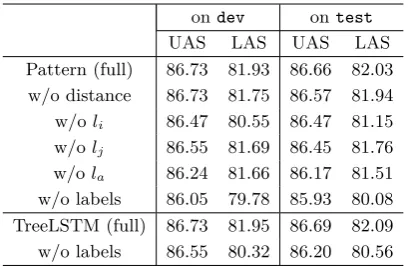
Feature ablation results are presented in Table 4 to gain more insights on the two proposed conversion approaches. In each experiment, we remove a single component from the full model to learn its individual contribution.
For the pattern embedding approach, all proposed extensions to the basic pattern-based approach ofLi et al.(2012) are useful. Among the three labels, the embedding of li is the most useful and its removal leads to the highest LAS drop of 0.88 (82.03 − 81.15). This is reasonable considering that 81.69% dependencies are consistent in the two guide-lines, as discussed in the heterogeneity analysis of Section 2.2. Removing all three labels decreases UAS by0.73(86.66−85.93) and LAS by 1.95 (82.03− 80.08), demonstrating that the source-side labels are highly correlative with the target-side labels, and therefore very helpful for improving LAS.
For the treeLSTM approach, the source-side labels in dsrc are also very useful, improving UAS by0.49 (86.69−86.20) and LAS by1.53
(82.09−80.56).
5.3 Results: Utilizing Converted Data
Another important question to be answered is whether treebank conversion can lead to higher parsing accuracy than multi-task learn-ing. In terms of model simplicity, treebank conversion is better because eventually the target-side parser is trained directly on an enlarged homogeneous treebank unlike the multi-task learning approach that needs to simultaneously train two parsers on two het-erogeneous treebanks.
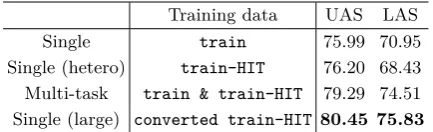
Table 5 shows the empirical results. Please kindly note that the parsing accuracy looks very low, because the test data is partially annotated and only about30% most uncertain (difficult) words are manually labeled with their heads according to our guideline, as discussed in Section2.1.
The first-row, “single” is the baseline target-side parser trained on thetrain data.
The second-row “single (hetero)” refers to the source-side heterogeneous parser trained ontrain-HITand evaluated on the target-side
test data. Since the similarity between the two guidelines is high, as discussed in Section
2.2, the source-side parser achieves even higher UAS by0.21(76.20−75.99) than the baseline target-side parser trained on the small-scale
traindata. The LAS is obtained by mapping the HIT-CDT labels to ours (Section2.2).
In the third row, “multi-task” is the target-side parser trained on train & train-HIT
with the multi-task learning approach. It significantly outperforms the baseline parser by 4.30 (74.51 −70.21) in LAS. This shows that the multi-task learning approach can effectively utilize the large-scaletrain-HITto help the target-side parsing.
In the fourth row, “single (large)” is the ba-sic parser trained on the large-scaleconverted train-HIT (homogeneous). We employ the treeLSTM approach to convert all sentences in train-HIT into our guideline.7 We can see that
Training data UAS LAS
Single train 75.99 70.95
[image:9.595.73.290.62.128.2]Single (hetero) train-HIT 76.20 68.43 Multi-task train & train-HIT 79.29 74.51 Single (large) converted train-HIT 80.45 75.83
Table 5: Parsing accuracy on test data. LAS difference between any two systems is statistically significant (p < 0.005) according to Dan Bikel’s randomized parsing evaluation comparer for significance testNoreen (1989).
Task Training data UAS LAS
Conversion train 93.42 90.49
Parsing (baseline) train 89.66 86.41
Parsing (ours) converted train-HIT 91.16 88.07
Table 6: Results on the fully annotated 372
sentences of thetest data.
the single parser trained on the converted data significantly outperforms the parser in the multi-task learning approach by1.32 (75.83− 74.51) in LAS.
In summary, we can conclude that treebank conversion is superior to multi-task learning in multi-treebank exploitation for its simplicity and better performance.
5.4 Results on fully annotated data
We randomly divided the newly annotated data into train/dev/test, so the test set has a mix of 100%, 50% and 20% annotated sentences. To gain a rough estimation of the performance of different approaches on fully annotated data, we give the results in Table
6. We can see that all the models achieve much higher accuracy on the portion of fully annotated data than on the whole test data as shown in Table3and5, since the dependencies to be evaluated are the most difficult ones in a sentence for the portion of partially annotated data. Moreover, the conversion model can achieve over 90% LAS thanks to the guidance of the source-side HIT-CDT tree. Please also note that there would still be a slight bias, because those fully annotated sentences are chosen as the most difficult ones according to the parsing model but are also very short ([5,10]).
6 Conclusions and Future Work
In this work, we for the first time propose the task of supervised treebank conversion by constructing a bi-tree aligned data of over ten thousand sentences. We design two simple yet effective conversion approaches based on the state-of-the-art deep biaffine parser. Results show that 1) the two approaches achieves nearly the same conversion accuracy; 2) relation labels in the source-side tree are very helpful for both approaches; 3) treebank conversion is more effective in multi-treebank exploitation than multi-task learning, and achieves significantly higher parsing accuracy. In future, we would like to advance this work in two directions: 1) proposing more effective conversion approaches, especially by exploring the potential of treeLSTMs; 2) constructing bi-tree aligned data for other treebanks and exploiting all available single-tree and bi-tree labeled data for better conversion.
Acknowledgments
The authors would like to thank the anony-mous reviewers for the helpful comments. We are greatly grateful to all participants in data annotation for their hard work. We also thank Guodong Zhou and Wenliang Chen for the helpful discussions, and Meishan Zhang for his help on the re-implementation of the Biaffine Parser. This work was supported by National Natural Science Foundation of China (Grant No. 61525205, 61502325 61432013), and was also partially supported by the joint research project of Alibaba and Soochow University.
References
Daniel Andor, Chris Alberti, David Weiss, Aliaksei Severyn, Alessandro Presta, Kuzman Ganchev, Slav Petrov, and Michael Collins. 2016. Globally normalized transition-based neural networks. In
Proceedings of ACL, pages 2442–2452.
Bernd Bohnet and Joakim Nivre. 2012. A transition-based system for joint part-of-speech tagging and labeled non-projective dependency parsing. InProceedings of EMNLP 2012, pages 1455–1465.
Wanxiang Che, Zhenghua Li, and Ting Liu. 2012. Chinese Dependency Treebank 1.0 (LDC2012T05). In Philadelphia: Linguistic Data Consortium.
Danqi Chen and Christopher Manning. 2014. A fast and accurate dependency parser using neural networks. In Proceedings of EMNLP, pages 740–750.
Keh-Jiann Chen, Chi-Ching Luo, Ming-Chung Chang, Feng-Yi Chen, Chao-Jan Chen, Chu-Ren Huang, and Zhao-Ming Gao. 2003. Sinica treebank: Design criteria,representational issues and implementation, chapter 13. Kluwer Aca-demic Publishers.
Ronan Collobert and Jason Weston. 2008. A uni-fied architecture for natural language processing: Deep neural networks with multitask learning. InProceedings of ICML.
Hal Daumé III. 2007. Frustratingly easy domain adaptation. In Proceedings of ACL, pages 256– 263.
Timothy Dozat and Christopher D. Manning. 2017. Deep biaffine attention for neural dependecy parsing. InProceedings of ICLR.
Chris Dyer, Miguel Ballesteros, Wang Ling, Austin Matthews, and Noah A. Smith. 2015. Transition-based dependency parsing with stack long short-term memory. In Proceedings of ACL, pages 334–343.
Jan Einarsson. 1976. Talbankens skriftspråk-skonkordans. Department of Scandinavian Languages, Lund University.
Jiang Guo, Wanxiang Che, Haifeng Wang, and Ting Liu. 2016. A universal framework for inductive transfer parsing across multi-typed treebanks. In Proceedings of COLING, pages 12–22.
Lijuan Guo, Zhenghua Li, Xue Peng, and Min Zhang. 2018. Data annotation guideline of chinese dependency syntax for multi-domain and multi-source texts. Journal of Chinese Information Processing.
Jerker Järborg. 1986. Manual for syntaggning. De-partment of Linguistic Computation, University of Gothenburg.
Richard Johansson. 2013. Training parsers on incompatible treebanks. In Proceedings of NAACL, pages 127–137.
Xiang Li, Wenbin Jiang, Yajuan Lü, and Qun Liu. 2013. Iterative transformation of annotation guidelines for constituency parsing. InProceedings of ACL, pages 591–596.
Zhenghua Li, Wanxiang Che, and Ting Liu. 2012. Exploiting multiple treebanks for parsing with quasisynchronous grammar. In Proceedings of ACL, pages 675–684.
Zhenghua Li, Min Zhang, Yue Zhang, Zhanyi Liu, Wenliang Chen, Hua Wu, and Haifeng Wang. 2016. Active learning for dependency parsing with partial annotation. InProceedings of ACL.
Xuezhe Ma and Eduard Hovy. 2017. Neural probabilistic model for non-projective mst parsing. In Proceedings of IJCNLP, pages 59– 69.
Makoto Miwa and Mohit Bansal. 2016. End-to-end relation extraction using lstms on sequences and tree structures. In Proceedings of ACL, pages 1105–1116.
Simonetta Montemagni, Francesco Barsotti, Marco Battista, Nicoletta Calzolari, Ornella Corazzari, Alessandro Lenci, Antonio Zampolli, Francesca Fanciulli, Maria Massetani, Remo Raffaelli, Roberto Basili, Maria Teresa Pazienza, Dario Saracino, Fabio Zanzotto, Nadia Mana, Fabio Pianesi, and Rodolfo Delmonte. 2003. Building the italian syntactic–
semantic treebank. In Anne Abeille, editor, Building and Using Syntactically Annotated Corpora. Kluwer, Dordrecht.
Zheng-Yu Niu, Haifeng Wang, and Hua Wu. 2009. Exploiting heterogeneous treebanks for parsing. InProceedings of ACL, pages 46–54.
Eric W. Noreen. 1989. Computer-intensive methods for testing hypotheses: An introduction. John Wiley & Sons, Inc., New York.
Jeffrey Pennington, Richard Socher, and Christo-pher D. Manning. 2014. Glove: Global vectors for word representation. In Proceedings of EMNLP, pages 1532–1543.
Likun Qiu, Yue Zhang, Peng Jin, and Houfeng Wang. 2014. Multi-view chinese treebanking. In
Proceedings of COLING, pages 257–268.
Kai Sheng Tai, Richard Socher, and Christo-pher D. Manning. 2015. Improved semantic representations from tree-structured long short-term memory networks. InProceedings of ACL, pages 1556–1566.
Heike Telljohann, Erhard Hinrichs, and Sandra Kbler. 2004. The Tüba-D/Z treebank: Anno-tating German with a context-free backbone. InProceedings of the Fourth International Con-ference on Language Resources and Evaluation (LREC), pages 2229–2235.
Weidong Zhan. 2012. The application of treebank to assist Chinese grammar instruction: a prelim-inary investigation. Journal of Technology and Chinese Language Teaching, 3(2):16–29.
Meishan Zhang, Jie Yang, Zhiyang Teng, and Yue Zhang. 2016. Libn3l:a lightweight package for neural nlp. InProceedings of LREC, pages 225– 229.
Hao Zhou, Yue Zhang, Shujian Huang, and Jiajun Chen. 2015. A neural probabilistic structured-prediction model for transition-based dependency parsing. In Proceedings of ACL, pages 1213–1222.
Qiang Zhou. 2004. Annotation scheme for Chinese treebank. Journal of Chinese Information Processing, 18(4):1–8.