2310
E
3: Entailment-driven Extracting and Editing for Conversational
Machine Reading
Victor Zhong University of Washington [email protected]
Luke Zettlemoyer University of Washington [email protected]
Abstract
Conversational machine reading systems help users answer high-level questions (e.g. deter-mine if they qualify for particular govern-ment benefits) when they do not know the ex-act rules by which the determination is made (e.g. whether they need certain income levels or veteran status). The key challenge is that these rules are only provided in the form of a procedural text (e.g. guidelines from govern-ment website) which the system must read to figure out what to ask the user. We present a new conversational machine reading model that jointly extracts a set of decision rules from the procedural text while reasoning about which are entailed by the conversational his-tory and which still need to be edited to create questions for the user. On the recently intro-duced ShARC conversational machine read-ing dataset, our Entailment-driven Extract and
Edit network (E3) achieves a new
state-of-the-art, outperforming existing systems as well as a new BERT-based baseline. In addition, by explicitly highlighting which information still
needs to be gathered,E3provides a more
ex-plainable alternative to prior work. We release source code for our models and experiments
athttps://github.com/vzhong/e3.
1 Introduction
In conversational machine reading (CMR), a sys-tem must help users answer high-level questions by participating in an information gathering
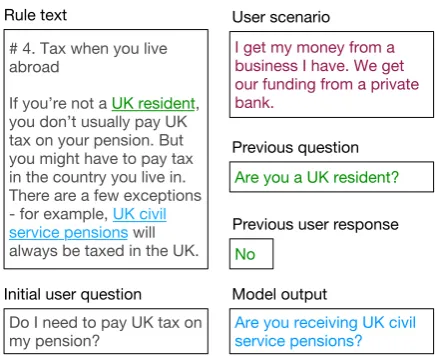
dia-log. For example, in Figure1 the system asks a
series of questions to help the user decide if they need to pay tax on their pension. A key chal-lenge in CMR is that the rules by which the deci-sion is made are only provided in natural language
(e.g. the rule text in Figure1). At every step of the
conversation, the system must read the rules text and reason about what has already been said in to formulate the best next question.
# 4. Tax when you live abroad
If you’re not a UK resident, you don’t usually pay UK tax on your pension. But you might have to pay tax in the country you live in. There are a few exceptions - for example, UK civil service pensions will always be taxed in the UK.
I get my money from a business I have. We get our funding from a private bank.
Rule text User scenario
Do I need to pay UK tax on my pension?
Initial user question
Are you a UK resident?
No
Are you receiving UK civil service pensions? Previous question
Previous user response
[image:1.595.308.526.223.401.2]Model output
Figure 1: A conversational machine reading example. The model is given a rule text document, which con-tains a recipe of implicit rules (underlined) for answer-ing the initial user question. At the start of the conver-sation, the user presents a scenario describing their sit-uation. During each turn, the model can ask the user a follow-up question to inquire about missing
infor-mation, or conclude the dialogue by answering yes,
no, orirrelevant. irrelevantmeans that the
rule text cannot answer the question. We show previ-ous turns as well as the corresponding inquired rules in green. The scenario is shown in red and in this case does not correspond to a rule. The model inquiry for this turn and its corresponding rule are shown in blue.
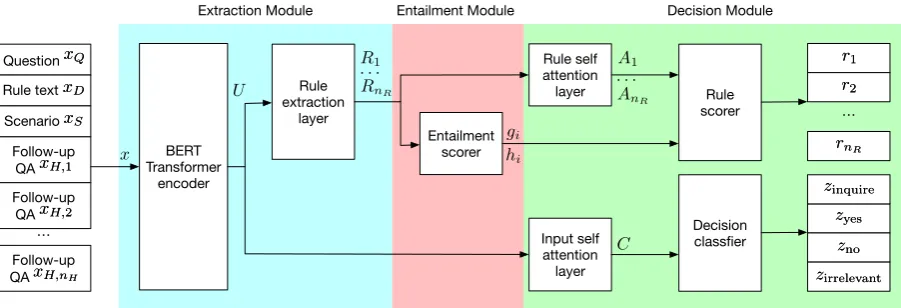
We present a new model that jointly reasons about what rules are present in the text and which are already entailed by the conversational history to improve question generation. More specifically, we propose the Entailment-driven Extract and Edit
network (E3).E3learns to extract implicit rules in
the document, identify which rules are entailed by the conversation history, and edit rules that are not entailed to create follow-up questions to the user.
During each turn,E3parses the rule text to extract
spans in the text that correspond to implicit rules
(underlined in Figure1). Next, the model scores
by the initial user scenario (red in Figure1) and by previous interactions with the user (green in
Fig-ure1). Finally, the model decides on a response by
directly answering the question (yes/no), stating
that the rule text does not contain sufficient infor-mation to answer the question (irrelevant), or asking a follow-up question about an extracted rule that is not entailed but needed to determine the
answer (blue in Figure1). In the case of inquiry,
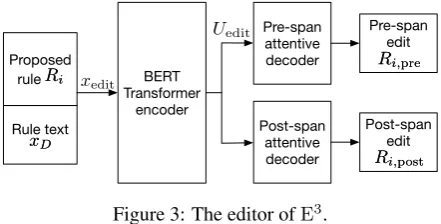
the model edits an extracted rule into a follow-up
question. To our knowledge,E3is the first
extract-and-edit method for conversational dialogue, as well as the first method that jointly infers implicit rules in text, estimates entailment, inquires about missing information, and answers the question.
We compare E3 to the previous-best systems
as well as a new, strong, BERT-based extrac-tive question answering model (BERTQA) on the recently proposed ShARC CMR dataset (Saeidi
et al., 2018). Our results show that E3 is more
accurate in its decisions and generates more
rele-vant inquiries. In particular, E3 outperforms the
previous-best model by 5.7% in micro-averaged decision accuracy and 4.3 in inquiry BLEU4.
Similarly, E3 outperforms the BERTQA
base-line by 4.0% micro-averaged decision accuracy and 2.4 in inquiry BLEU4. In addition to
out-performing previous methods, E3 is explainable
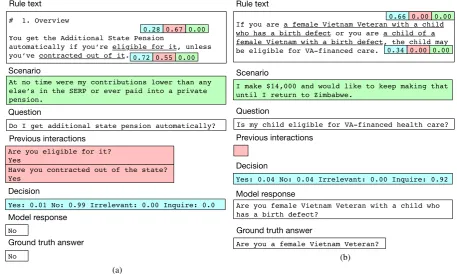
in the sense that one can visualize what rules the model extracted and how previous interactions and inquiries ground to the extracted rules. We
re-lease source code forE3and the BERTQA model
athttps://github.com/vzhong/e3.
2 Related Work
Dialogue tasks. Recently, there has been
grow-ing interest in question answergrow-ing (QA) in a
di-alogue setting (Choi et al., 2018; Reddy et al.,
2019). CMR (Saeidi et al., 2018) differs from
dialogue QA in the domain covered (regulatory text vs Wikipedia). A consequence of this is that CMR requires the interpretation of complex de-cision rules in order to answer high-level ques-tions, whereas dialogue QA typically contains questions whose answers are directly extractable from the text. In addition, CMR requires the fmulation of free-form follow-up questions in or-der to identify whether the user satisfies decision rules, whereas dialogue QA does not. There has also been significant work on task-oriented dia-logue, where the system must inquire about
miss-ing information in order to help the user achieve a
goal (Williams et al.,2013;Henderson et al.,2014;
Mrkˇsi´c et al.,2017;Young et al.,2013). However,
these tasks are typically constrained to a fixed on-tology (e.g. restaurant reservation), instead of a la-tent ontology specified via natural language docu-ments.
Dialogue systems. One traditional approach for
designing dialogue systems divides the task into
language understanding/state-tracking (Mrkˇsi´c
et al.,2017;Zhong et al.,2018), reasoning/policy
learning (Su et al., 2016), and response
gener-ation (Wen et al., 2015). The models for each
of these subtasks are then combined to form a
full dialogue system (Young et al., 2013; Wen
et al., 2017). The previous best system for
ShARC (Saeidi et al., 2018) similarly breaks
the CMR task into subtasks and combines hand-designed sub-models for decision classification, entailment, and follow-up generation. In contrast, the core reasoning (e.g. non-editor) components
of E3 are jointly trained, and does not require
complex hand-designed features.
Extracting latent rules from text. There is a
long history of work on extracting knowledge automatically from text (Moulin and Rousseau, 1992). Relation extraction typically assumes that there is a fixed ontology onto which extracted
knowledge falls (Mintz et al., 2009;Riedel et al.,
2013). Other works forgo the ontology by using, for example, natural language (Angeli and
Man-ning,2014;Angeli et al.,2015). These extractions
from text are subsequently used for inference over
a knowledge base (Bordes et al., 2013;Dettmers
et al., 2018; Lin et al., 2018) and rationalizing
model predictions (Lei et al., 2016). Our work is
more similar with the latter type in which knowl-edge extracted are not confined to a fixed ontology and instead differ on a document basis. In addi-tion, the rules extracted by our model are used for inference over natural language documents. Fi-nally, these rules provide rationalization for the model’s decision making, in the sense that the user can visualize what rules the model extracted and which rules are entailed by previous turns.
3 Entailment-driven Extract and Edit
network