11
A Shared Attention Mechanism for Interpretation
of Neural Automatic Post-Editing Systems
Inigo Jauregi Unanue1,2, Ehsan Zare Borzeshi2, Massimo Piccardi1
1University of Technology Sydney, Sydney, Australia
2 Capital Markets Cooperative Research Centre, Sydney, Australia
{ijauregi,ezborzeshi}@cmcrc.com, [email protected]
Abstract
Automatic post-editing (APE) systems aim to correct the systematic errors made by machine translators. In this paper, we propose a neural APE system that encodes the source (src) and machine translated (mt) sentences with two separate encoders, but leverages a shared attention mecha-nism to better understand how the two in-puts contribute to the generation of the post-edited (pe) sentences. Our empiri-cal observations have showed that when the mt is incorrect, the attention shifts weight toward tokens in thesrc sentence to properly edit the incorrect translation. The model has been trained and evaluated on the official data from the WMT16 and WMT17 APE IT domain English-German shared tasks. Additionally, we have used the extra 500K artificial data provided by the shared task. Our system has been able to reproduce the accuracies of systems trained with the same data, while at the same time providing better interpretability.
1 Introduction
In current professional practice, translators tend to follow a two-step approach: first, they run a ma-chine translator (MT) to obtain a first-cut transla-tion; then, they manually correct the MT output to produce a result of adequate quality. The lat-ter step is commonly known aspost-editing(PE). Stemming from this two-step approach and the re-cent success of deep networks in MT (Sutskever et al., 2014; Bahdanau et al.,2014;Luong et al.,
2015), the MT research community has devoted increasing attention to the task of automatic post-editing (APE) (Bojar et al.,2017).
The rationale of an APE system is to be able to
automatically correct the systematic errors made by the MT and thus dispense with or reduce the work of the human post-editors. The data for train-ing and evaluattrain-ing these systems usually consist of triplets (src, mt, pe), wheresrc is the sentence in the source language, mt is the output of the MT, and pe is the human post-edited sentence. Note that the pe is obtained by correcting the mt, and therefore these two sentences are closely related. An APE system is “monolingual” if it only uses themtto predict the post-edits, or “contextual” if it uses both thesrcand themt as inputs (B´echara et al.,2011).
themtsentence is correct, the model simply learns to pass it on word by word. In Section 4.4, we have plotted the attention weight matrices of sev-eral predictions to visualize this finding.
The model has been trained and evaluated with the official datasets from the WMT16 and WMT17 Information Technology (IT) domain APE English-German (en-de) shared tasks (Bojar et al., 2016, 2017). We have also used the 500K artificial data provided in the shared task for extra training. For some of the predictions in the test set, we have analysed the plots of attention weight matrices to shed light on whether the model relies more on thesrcor themtat each time step. More-over, our model has achieved higher accuracy than previous systems that used the same training set-ting (official datasets + 500K extra artificial data).
2 Related work
In an early work, (Simard et al., 2007) combined a rule-based MT (RBMT) with a statistical MT (SMT) for monolingual post-editing. The reported results outperformed both systems in standalone translation mode. In 2011, (B´echara et al.,2011) proposed the first model based on contextual post-editing, showing improvements over monolingual approaches.
More recently, neural APE systems have at-tracted much attention. (Junczys-Dowmunt and Grundkiewicz, 2016) (the winner of the WMT16 shared task) integrated various neural machine translation (NMT) components in a log-linear model. Moreover, they suggested creating artifi-cial triplets from out-of-domain data to enlarge the training data, which led to a drastic improvement in PE accuracy. Assuming that post-editing is re-versible, (Pal et al.,2017) have proposed an atten-tion mechanism over bidirecatten-tional models, mt→ pe and pe → mt. Several other researchers have proposed using multi-input seq2seq models for contextual APE (B´erard et al., 2017; Libovick`y et al., 2016; Varis and Bojar, 2017; Pal et al.,
2017;Libovick`y and Helcl,2017;Chatterjee et al.,
2017). All these systems employ separate en-coders for the two inputs,srcandmt.
2.1 Attention mechanisms for APE
A key aspect of neural APE systems is the atten-tion mechanism. A convenatten-tional attenatten-tion mech-anism for NMT first learns the alignment scores (eij) with an alignment model (Bahdanau et al.,
2014; Luong et al., 2015) given the j-th hid-den vector of the encoder (hj) and the decoder’s hidden state (si−1) at time i − 1 (Equation 1). Then, Equation2computes the normalized atten-tion weights, withTx the length of the input sen-tence. Finally, the context vector is computed as the sum of the encoder’s hidden vectors weighed by the attention weights (Equation 3). The de-coder uses the computed context vector to predict the output.
eij =aligment model(hj,si−1) (1)
αij = exp(e ij)
PTx
m=1exp(eim)
(2)
ci = Tx X
j=1
αi,jhj (3)
In the APE literature, two recent papers have extended the attention mechanism to contextual APE. (Chatterjee et al., 2017) (the winner of the WMT17 shared task) have proposed a two-encoder system with a separate attention for each encoder. The two attention networks create a con-text vector for each input,csrc andcmt, and con-catenate them using additional, learnable param-eters, Wct andbct, into a merged context vector, cmerge(Equation4).
cimerge= [cisrc;cimt]∗Wct+bct (4)
(Libovick`y and Helcl, 2017) have proposed, among others, an attention strategy named the
flat attention. In this approach, all the attention weights corresponding to the tokens in the two in-puts are computed with a joint soft-max:
αij(k)= exp(e ij (k))
P2 n=1
PTx(n)
m=1exp(eim(n))
(5)
whereeij(k) is the attention energy of thej-th step of thek-th encoder at the i-th decoding step and
Tx(k)is the length of the input sequence of thek-th encoder. Note that because the attention weights are computed jointly over the different encoders, this approach allows observing whether the sys-tem assigns more weight to the tokens of thesrc
ci = N X
k=1 Tx(k) X
j=1
αi,j(k)Uc(k)hj(k) (6)
where hj(k) is the j-th hidden vector from thek
-th encoder, Tx(k) is the number of hidden vectors from thek-th encoder, andUc(k) is the projection matrix for thek-th encoder that projects its hidden vectors to a common-dimensional space. This pa-rameter is also learnable and can further re-weigh the two inputs.
3 The proposed model
The main focus of our paper is on the interpretabil-ity of the predictions made by neural APE sys-tems. To this aim, we have assembled a contex-tual neural model that leverages two encoders and a shared attention mechanism, similarly to theflat attentionof (Libovick`y and Helcl, 2017). To de-scribe it, let us assume thatXsrc ={x1src, ...,xNsrc} is the src sentence and Xmt = {x1mt, ...,xMmt} is themtsentence, whereN andM are their respec-tive numbers of tokens. The two encoders encode the two inputs separately:
hjsrc=encsrc(xjsrc,hj −1
src ) j= 1, ..., N hjmt=encmt(xjmt,h
j−1
mt ) j = 1, ..., M (7)
All the hidden vectors outputs by the two en-coders are then concatenated as if they were com-ing from a scom-ingle encoder:
hjoin={h1src, ...,hsrcN ,h1mt, ...,hMmt} (8)
Then, the attention weights and the context vec-tor at each decoding step are computed from the hidden vectors ofhjoin(Equations9-11):
eij =aligment model(hjjoin,si−1) (9)
αij = exp(e ij)
PN+M
m=1 exp(eim)
(10)
ci= N+M
X
j=1
αi,jhjjoin (11)
whereiis the time step on the decoder side, jis the index of the hidden encoded vector. Given that
theαi,jweights form a normalized probability dis-tribution overj, this model is “forced” to spread the weight between the src and mt inputs. Note that our model differs from that proposed by ( Li-bovick`y and Helcl, 2017) only in that we do not employ the learnable projection matrices, Uc(k). This is done to avoid re-weighing the contribution of the two inputs in the context vectors and, ul-timately, in the predictions. More details of the proposed model and its hyper-parameters are pro-vided in Section4.3.
4 Experiments
4.1 Datasets
For training and evaluation we have used the WMT17 APE1 IT domain English-German dataset. This dataset consists of 11,000 triplets for training, 1,000 for validation and 2,000 for test-ing. The hyper-parameters have been selected us-ing only the validation set and used unchanged on the test set. We have also trained the model with the 12,000 sentences from the previous year (WMT16), for a total of 23,000 training triplets.
4.2 Artificial data
Since the training set provided by the shared task is too small to effectively train neural net-works, (Junczys-Dowmunt and Grundkiewicz,
2016) have proposed a method for creating extra, “artificial” training data using round-trip transla-tions. First, a language model of the target lan-guage (German here) is learned using a mono-lingual dataset. Then, only the sentences from the monolingual dataset that have low perplex-ity are round-trip translated using two off-the-shelf translators (German-English and English-German). The low-perplexity sentences from the monolingual dataset are treated as the pe, the German-English translations as the src, and the English-German back-translations as the mt. Fi-nally, the (src, mt, pe) triplets are filtered to only retain sentences with comparable TER statistics to those of the manually-annotated training data. These artificial data have proved very useful for improving the accuracy of several neural APE systems, and they have therefore been included in the WMT17 APE shared task. In this paper, we have limited ourselves to using 500K artificial triplets as done in (Varis and Bojar,2017;B´erard
# encoders 2
encoder type B-LSTM
encoder layers 2
encoder hidden dim 500
# decoders 1
decoder type LSTM
decoder layers 2
decoder hidden dim 500
word vector dim 300
attention type general
dropout 0.3
[image:4.595.115.252.59.213.2]beam size 5
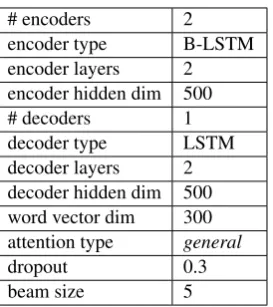
Table 1: The model and its hyper-parameters.
et al., 2017). To balance artificial and manually-annotated data during training, we have resampled the official 23K triplets 10 times.
4.3 Training and hyper-parameters
Hereafter we provide more information about the model’s implementation, its hyper-parameters, the pprocessing and the training to facilitate the re-producibility of our results. We have made our code publicly available2.
To implement the encoder/decoder with sepa-rate encoders for the two inputs (src, mt) and a single attention mechanism, we have modified the open-source OpenNMT code (Klein et al.,2017).
Table 1 lists all hyper-parameters which have all been chosen using only training and validation data. The two encoders have been implemented using a Bidirectional Long Short-Term Memory (B-LSTM) (Hochreiter and Schmidhuber, 1997) while the decoder uses a unidirectional LSTM. Both the encoders and the decoder use two hidden layers. For the attention network, we have used the OpenNMT’sgeneraloption (Luong et al.,2015).
As for the pre-processing, the datasets come al-ready tokenized. Given that German is a mor-phologically rich language, we have learned the subword units using the BPE algorithm (Sennrich et al., 2015) only over the official training sets from the WMT16 and WMT17 IT-domain APE shared task (23,000 sentences). The number of
mergeoperations has been set to 30,000 under the intuition that one or two word splits per sentence could suffice. Three separate vocabularies have been used for the (src,mtandpe) sentences. Each vocabulary contains a maximum of 50,000
most-2https://github.com/ijauregiCMCRC/Shared
Attention for APE
Model TER BLEU
MT (Bojar et al.,2017) 24.48 62.49 SPE (Bojar et al.,2017) 24.69 62.97 (Varis and Bojar,2017) 24.03 64.28 (B´erard et al.,2017) 22.81 65.91
train 11K 41.58 43.05
train 23K 30.23 57.14
train 23K + 500K 22.60 66.21
Table 2: Results on the WMT17 IT domain English-German APE test set.
frequent subword units; the remaining tokens are treated as unknown (<unk>).
As mentioned in Section 4.2, we have trained our model with 500K extra triplets as in (B´erard et al.,2017). We have oversampled the 23K offi-cial triplets 10 times, added the extra 500K, and trained the model for 20 epochs. We have used Stochastic Gradien Descent (SGD) with a learn-ing rate of 1 and a learnlearn-ing rate decay of 0.5. The learning rate decays if there are no improvements on the validation set.
In all cases, we have selected the models and hyper-parameters that have obtained the best re-sults on the validation set (1,000 sentences), and reported the results blindly over the test set (2,000 sentences). The performance has been evaluated in two ways: first, as common for this task, we have reported the accuracy in terms of Translation Error Rate (TER) (Snover et al.,2006) and BLEU score (Papineni et al.,2002). Second, we present an empirical analysis of the attention weight ma-trices for some notable cases.
4.4 Results
[image:4.595.324.511.62.167.2]Figure 1: An example of perfect correction of an
[image:5.595.324.511.69.409.2]mtsentence.
[image:5.595.98.268.425.712.2]Figure 2: Partial improvement of anmtsentence.
Figure 3: Passing on a correctmtsentence.
[image:5.595.320.513.445.709.2]same training settings (500K artificial triplets + 23K manual triplets oversampled 10 times), re-porting a slightly higher accuracy than both (1.43 TER and 1.93 BLEU p.p. over (Varis and Bojar,
2017) and 0.21 TER and 0.30 BLEU p.p. over (B´erard et al.,2017)). Since their models explic-itly predicts edit operations rather than post-edited sentences, we speculate that these two tasks are of comparable intrinsic complexity.
In addition to experimenting with the proposed model (Equation 11), we have also tried to add the projection matrices of the flat attention of ( Li-bovick`y and Helcl,2017) (Equation6). However, the model with these extra parameters showed ev-ident over-fitting, with a lower perplexity on the training set, but unfortunately also a lower BLEU score of 53.59 on the test set. On the other hand, (Chatterjee et al., 2017) and other participants of the WMT 17 APE shared task 3 were able to achieve higher accuracies by using 4 million ar-tificial training triplets. Unfortunately, using such a large dataset sent the computation out of mem-ory on a system with 32 GB of RAM. Nonetheless, our main goal is not to establish the highest pos-sible accuracy, but rather contribute to the inter-pretability of APE predictions while reproducing approximately the same accuracy of current sys-tems trained in a comparable way.
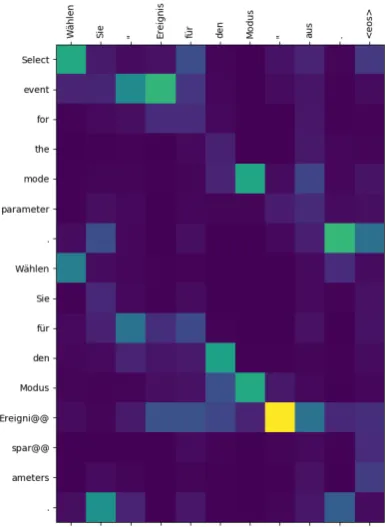
For the analysis of the interpretability of the sys-tem, we have plotted the attention weight matrices for a selection of cases from the test set. These plots aim to show how the shared attention mech-anism shifts the attention weights between the to-kens of the src and mt inputs at each decoding step. In the matrices, the rows are the concatena-tion of thesrcandmtsentences, while the columns are the predictedpesentence. To avoid cluttering, the ground-truthpesentences are not shown in the plots, but they are commented upon in the discus-sion. Figure1shows an example where themt sen-tence is almost correct. In this example, the atten-tion focuses on passing on the correct part. How-ever, the start (W¨ahlen) and end (L¨angsschnitte) of themtsentence are wrong: for these tokens, the model learns to place more weight on the English sentence (clickandSelect Profiles). The predicted
peis eventually identical to the ground truth. Conversely, Figure 2shows an example where the mt sentence is rather incorrect. In this case, the model learns to focus almost completely on
3http://www.statmt.org/wmt17/ape-task.html
Sentence Focus
src 23%
mt 45%
[image:6.595.347.487.62.121.2]Both 31%
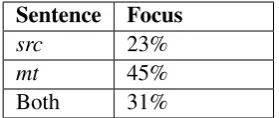
Table 3: Percentage of the decoding steps with marked attention weight on either input (src, mt) or both.
the English sentence, and the prediction is very aligned with it. The predictedpe is not identical to the ground truth, but it is significantly more ac-curate than themt. Figure3shows a case of a per-fectmttranslation where the model simply learns to pass the sentence on word by word. Eventually, Figure4shows an example of a largely incorrect
mtwhere the model has not been able to properly edit the translation. In this case, the attention ma-trix is scattered and defocused.
In addition to the visualizations of the attention weights, we have computed an attention statistic over the test set to quantify the proportions of the two inputs. At each decoding time step, we have added up the attention weights corresponding to the src input (αisrc = PN
j=1αij) and those cor-responding to themt(αimt =PN+M
j=N+1αij). Note that, obviously,αisrc+αimt = 1. Then, we have set an arbitrary threshold,t= 0.6, and counted stepi
to thesrcinput ifαisrc> t. If insteadαisrc <1−t, we counted the step to themtinput. Eventually, if 1−t≤αisrc ≤t, we counted the step to both in-puts. Table3shows this statistic. Overall, we have recorded 23% decoding steps for thesrc, 45% for themtand 31% for both. It is to be expected that the majority of the decoding steps would focus on themt input if it is of sufficient quality. However, the percentage of focus on thesrcinput is signifi-cant, confirming its usefulness.
5 Conclusion
In this paper, we have presented a neural APE sys-tem based on two separate encoders that share a single, joined attention mechanism. The shared attention has proved a key feature for inspecting how the selection shifts on either input, (src and
training triplets). As future work, we plan to con-tinue to explore the interpretability of contempo-rary neural APE architectures.
6 Acknowledgements
We would like to acknowledge the financial sup-port received from the Capital Markets Cooper-ative Research Centre (CMCRC), an applied re-search initiative of the Australian Government.
References
Dzmitry Bahdanau, Kyunghyun Cho, and Yoshua
Ben-gio. 2014. Neural machine translation by jointly
learning to align and translate. arXiv preprint
arXiv:1409.0473.
Hanna B´echara, Yanjun Ma, and Josef van Genabith. 2011. Statistical post-editing for a statistical mt
sys-tem. InMT Summit. volume 13, pages 308–315.
Olivier B´erard, Alexandre Pietquin, and Laurent Be-sacier. 2017. Lig-cristal system for the wmt17
au-tomatic post-editing task. In Proceedings of the
Second Conference on Machine Translation. pages 623–629.
Ondˇrej Bojar, Rajen Chatterjee, Christian Federmann, Yvette Graham, Barry Haddow, Shujian Huang, Matthias Huck, Philipp Koehn, Qun Liu, Varvara Logacheva, Christof Monz, Matteo Negri, Matt Post, Raphael Rubino, Lucia Specia, and Marco Turchi. 2017. Findings of the 2017 conference on
machine translation (wmt17). InProceedings of the
Second Conference on Machine Translation. pages 169–214.
Ondˇrej Bojar, Rajen Chatterjee, Christian Federmann, Yvette Graham, Barry Haddow, Matthias Huck, An-tonio Jimeno Yepes, Philipp Koehn, Varvara Lo-gacheva, Christof Monz, Matteo Negri, Aur´elie N´ev´eol, Mariana Neves, Martin Popel, Matt Post, Raphael Rubino, Carolina Scarton, Lucia Spe-cia, Marco Turchi, Karin Verspoor, and Marcos Zampieri. 2016. Findings of the 2016 conference on machine translation. InProceedings of the First Conference on Machine Translation: Volume 2, Shared Task Papers. volume 2, pages 131–198.
Rajen Chatterjee, M Amin Farajian, Matteo Negri, Marco Turchi, Ankit Srivastava, and Santanu Pal. 2017. Multi-source neural automatic post-editing: Fbks participation in the wmt 2017 ape shared task. In Proceedings of the Second Conference on Ma-chine Translation. pages 630–638.
Sepp Hochreiter and J¨urgen Schmidhuber. 1997.
Long short-term memory. Neural computation
9(8):1735–1780.
Marcin Junczys-Dowmunt and Roman Grundkiewicz. 2016. Log-linear combinations of monolingual and bilingual neural machine translation models for
au-Conference on Machine Translation. pages 751– 558.
Guillaume Klein, Yoon Kim, Yuntian Deng, Jean Senellart, and Alexander M Rush. 2017. Opennmt: Open-source toolkit for neural machine translation.
arXiv preprint arXiv:1701.02810.
Jindˇrich Libovick`y and Jindˇrich Helcl. 2017. Attention strategies for multi-source sequence-to-sequence learning.arXiv preprint arXiv:1704.06567.
Jindˇrich Libovick`y, Jindˇrich Helcl, Marek Tlust`y, Pavel Pecina, and Ondˇrej Bojar. 2016. Cuni system for wmt16 automatic post-editing and multimodal translation tasks. InProceedings of the First Con-ference on Machine Translation.
Minh-Thang Luong, Hieu Pham, and Christopher D Manning. 2015. Effective approaches to
attention-based neural machine translation. arXiv preprint
arXiv:1508.04025.
Santanu Pal, Sudip Kumar Naskar, Mihaela Vela, Qun Liu, and Josef van Genabith. 2017. Neural auto-matic post-editing using prior alignment and
rerank-ing. InProceedings of the 15th Conference of the
European Chapter of the Association for Compu-tational Linguistics: Volume 2, Short Papers. vol-ume 2, pages 349–355.
Kishore Papineni, Salim Roukos, Todd Ward, and Wei-Jing Zhu. 2002. Bleu: a method for automatic
eval-uation of machine translation. In Proceedings of
the 40th annual meeting on association for compu-tational linguistics. Association for Computational Linguistics, pages 311–318.
Rico Sennrich, Barry Haddow, and Alexandra Birch. 2015. Neural machine translation of rare words with
subword units. arXiv preprint arXiv:1508.07909.
Michel Simard, Cyril Goutte, and Pierre Isabelle. 2007.
Statistical phrase-based post-editing. In NAACL
HLT. pages 505–515.
Matthew Snover, Bonnie Dorr, Richard Schwartz, Lin-nea Micciulla, and John Makhoul. 2006. A study of translation edit rate with targeted human annotation. In Proceedings of association for machine transla-tion in the Americas. volume 200.
Ilya Sutskever, Oriol Vinyals, and Quoc V Le. 2014. Sequence to sequence learning with neural
net-works. InAdvances in neural information
process-ing systems. pages 3104–3112.
Dusan Varis and Ondˇrej Bojar. 2017. Cuni system for
wmt17 automatic post-editing task. InProceedings
of the Second Conference on Machine Translation. pages 661–666.
Quan-shi Zhang and Song-Chun Zhu. 2018. Visual in-terpretability for deep learning: a survey. Frontiers of Information Technology & Electronic