Published Online December 2012 in SciRes (http://www.SciRP.org/journal/ce) DOI:10.4236/ce.2012.38b022
Developing Digital Game Based on the Conception of Insects
(DGBI) to Test Elementary Student’s Insect Conceptions
Chow-Chin Lu1, Shu-Li Jeng2
1Department of Science Education, National Taipei University of Education, Taipei 2New Taipei City Jongjen Elementary School
Email: [email protected]
Received 2012
The purpose of this study is to promote elementary school student’s conception and interest of insect. In this study, we device a digital game, which possessed scientific and fun, base on the conception of insects (DGBI), then can use it to test elementary school student’s conception about insect. The DGBI materials creating pattern use as the ADDIE model. First step is to analyze the DGBI materials. We analyze stu-dent’s alternative conceptions of insect and what the teaching staff needs to teach in the section of insect, and then we develop three teaching units, namely the ―Bugs Adventure‖, ―Legs and Wings "and" Mouthparts and feeding habits‖. Second, design the DGBI. Making DGBI has a clear teaching aim, mul-ti-learning strategy like conception puzzle, computer simulation and conception mapping etc, an artistic and convenient operating media interface and a learning content that is easy to understand by the words and video in the DGBI materials. Third, develop the DGBI. Developing DGBI includes making animation component and composing animation component, these animation components makes 94.4% of students prefer to use DGBI materials to learn the conceptions of insect, especially the constructional detail mag-nify function and interactive game design in the teaching materials increase the student’s learning interest. Forth, implement DGBI. We invite Two national college professors and four senior science teachers to use DGBI, and then we interview them to collect the testing amendments, and corrected it.Fifth, evaluate DGBI. We use quasi-experiment design and questionnaire survey to evaluate DGBI. In the qua-si-experiment design, we select 111 students for four classes in an elementary school in New Taipei City and ask them to use DGBI, and then we tested them by the ―Insects Conceptions test‖. We found that after using the DGBI materials, the student's post-test scores (13.64) is higher than the pre-test scores (7.55), and there are significant differences (t = 16.47,p = .00)and helps the student to establish the correct concept of insect.. In the questionnaire survey, we ask 6 elementary school teachers to write down the ―digital materials quality certification evaluation form‖ after using DGBI. The teachers think that DGBI has an organizational integrity of the insect teaching material. When using DGBI, they can teach the insect unit as a game, and student can learn the insect unit on student's own initiative, which allows students to study the conceptions of insect step-by-step.
Keywords: Digital Game Based on Insects (DGBI); ADDIE; Insects Conceptions test; Digital Materials Quality Certification Evaluation Form
Introduction
Rationale and Importance of This Study
Insects has the most widely distributed and the largest num-ber of animals on Earth, even thought students has to learn insects curriculum in schools, but after learning, students are still unfamiliar with insects, and has lots of alternative con-cepts(Zhuang, 2002). Bell & Baker (1982) study elementary school student's insect concept and found that 56.9% of stu-dents do not know that insects have two pairs of wings. Huang (2003) use two-stage diagnostic as research tools to study the insect’s alternative conceptions of elementary school students, and found that 67.5% of fifth grade and sixth grade students thinks that insects feet scattered at different body parts of in-sects. Before student start learning insect curriculum in school, they learn the insect concept from book pictures, picture books or TV media (Lu, Chen, & Chen, 2011), but in order to attract children's interest, most of the books and media often try to make the insect appearance and habits to be anthropomorphic,
which pass on the wrong message to children and will let them prone to have the wrong conceptions. If we don't guide them to have the right conceptions, it might effects their future learning in insects (Lu & Chen, 2008; Lu et al., 2011; Marriott, 2002)
teach the correct insect conception with the right materials and bring out students interested, it will make the learning more effective. In this study, we try to design an interest scientific digital teaching materials to help elementary school student learn the correct insect conception. The insect conception teaching materials use conceptual change teaching strategies to design the it, and wish to build up a materials that can help the students to create right insect conceptions.
Research Objective
This study adopted the systematic design of instruction teaching model (ADDIE) to design a digital game based on the conception of insects (DBGI) teaching material that can detect elementary school student’s insect concept, which are interest-ing and has scientific insect concept in it. In this study we probe five questions: First, how do us analysis the DBGI teaching material base on student alternative conceptions. Second, what kind of DBGI teaching material designing can accomplish our goal? Third, how do we make the DBGI teaching material? Forth, how to implement the DBGI teaching material in teach-ing? Fifth, how do we evaluation the DBGI teaching material?
Literature Review
Using ADDIE Model to Design Digital Teaching Materials
Chuang & Su (1999) use the questionnaire to survey ele-mentary schools student’s insect classification concepts and found that only 13.2% of students say the insect have six legs. Trowbridge & Mintzes (1988) use animal picture cards to sur-vey student’s insect classification concepts and found children
define insect as ―small body type animals.‖ They think ani-mals like centipede, diplopod, earthworm and spiders are in-sects. Shepardson (2002) survey fourth grade elementary school students and found 61.0% students think that insects have only one wind. And 80.0% of students believe that insects are her-bivorous. Huang (2003) discover students know dragonflies
have two pair of wings, but could not identify ladybug and stick insects also have two pair of wings. Chen (2003) survey stu-dent’s aquatic insects concept by questionnaire and found only 62.2% of students can use the characteristic of ―insect have six feet‖ to determine whether it is aquatic insects or not.
Studies of Elementary Schools Student’S Insect Classification Concepts
The ADDIE model is the generic process traditionally used by instructional designers and training developers. The five phases—Analysis, Design, Development, Implementation, and Evaluation—represent a dynamic, flexible guideline for build-ing effective trainbuild-ing and performance support tools (Molenda, 2003). In an abstraction teaching activities or teaching activities require drills and hard to obtain the teaching resources, the digital game-based teaching material, who has good playability and is instructive becomes a good teaching medium and effects student to actively participate in the class and have lots of fun (Squire, 2003). In this research, we try to use the ADDIE as model and develop a digital game-base teaching material to detect student’s alternative conceptions of insect. We classify the game as a puzzle action game and manufacture it with the function to provide practice opportunities. The game not only can effect students visual sensory and stabilizing their cognitive feelings, but also can assess their self-restraint and the ability to use electronic media (Squire, 2003).
Methodology
Research Design
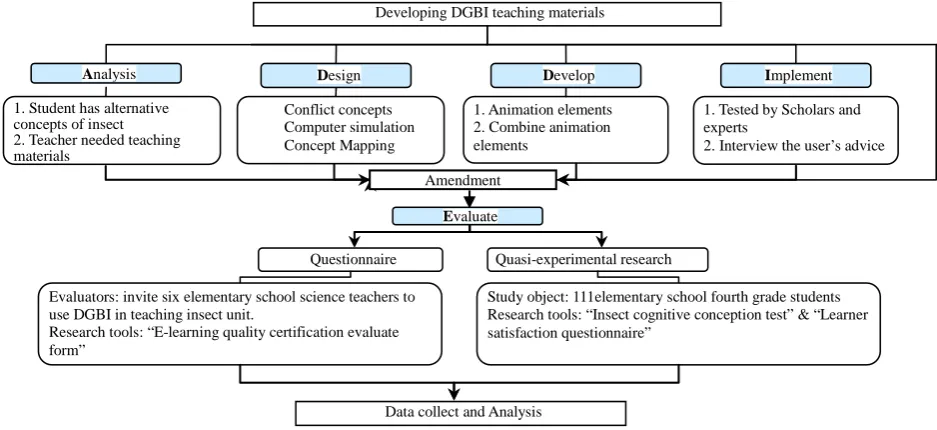
The DGBI teaching materials can divided into two phases: development phase and evaluation phase. In development phase, we design and develop the DGBI teaching materials base on ADDIE systematic design of instruction teaching mode shown in Figure 1. In the evaluation phase, we use questionnaire and quasi-experimental research method to evaluate the feasibility and the effectiveness of establishment children’s correctly in-sects concept of DGBI teaching materials(Figure 1).
1. Animation elements 2. Combine animation elements
1. Tested by Scholars and experts
2. Interview the user’s advice
Analysis Design Develop Implement
Developing DGBI teaching materials
1. Student has alternative concepts of insect 2. Teacher needed teaching materials
Conflict concepts Computer simulation Concept Mapping
Amendment
Questionnaire Quasi-experimental research
Evaluators: invite six elementary school science teachers to use DGBI in teaching insect unit.
Research tools: “E-learning quality certification evaluate form”
Study object: 111elementary school fourth grade students Research tools: “Insect cognitive conception test” & “Learner satisfaction questionnaire”
Data collect and Analysis
[image:2.595.62.531.499.714.2]Evaluate
Figure 1.
Research Tools
E-learning Quality Certification Evaluate Form
In this research, we use the ―E-learning quality certification evaluate form‖, which was develop by Sung, Chang, Lin, Lee, & Chen, (2009). The form has four dimensions, including: content, navigation, instructional design and instructional media. The evaluators will give 0 to 8 point when evaluating the digital teaching design; the maximal score is 104 point. Certification
grade ―A‖ means the teaching materials got 65 to 74 points in the test; if it got grade AA, it means certification grade is over 78 to 90 points; if the certification grade is over 91 point, it can be certificate as AAA grade.
Learner Satisfaction Questionnaire
In this study, we use ―Learner satisfaction questionnaire‖ design by Jeng (2012) to survey student’s satisfaction when using DGBI in their learning. In the questionnaire, we investi-gate their preferences in textbook content and the advantages and disadvantages of DGBI teaching materials. Due to our re-search objects are fourth grade elementary students, we provide answer options for each question in our questionnaire, which students can finish the questionnaire by putting a check mark in the blank. If they want to express their thought, there is also another blank field in the questionnaire, which can let them express themselves to us.
Insect Cognitive Conception Test
In this study, we use “Learner satisfaction questionnaire” de-sign by Jeng (2012) to survey student’s satisfaction when using DGBI in their learning. In the questionnaire, we investigate their preferences in textbook content and the advantages and disadvantages of DGBI teaching materials. Due to our research objects are fourth grade elementary students, we provide an-swer options for each question in our questionnaire, which stu-dents can finish the questionnaire by putting a check mark in the blank. If they want to express their thought, there is also another blank field in the questionnaire, which can let them express themselves to us.
Insect Cognitive Conception Test
In the study, we also use the “Insect cognitive conception test” that was design by Jeng (2012). It has 21 questions in the test, includes seven questions that ask “Identify insects”, seven questions that ask “book the position of insect’s feet and wings” and seven questions ask about “insect’s mouthparts and eating habits”. The Cronbach's α of this test is .708 and show the test has reliability which was capable to use.
Data Collection
In our researcher, we collected both quantitative and qualita-tive data. E-learning quality certifications evaluate form, Learner satisfaction questionnaire and Insect cognitive concep-tion test is our quantitative data. These data present the evalua-tion results of the DGBI teaching materials. It display with statistical average and shows the DGBI teaching materials is validity in improving student’s insect conceptions.
The qualitative data includes DGBI user’s interviewing record, evaluator’s interview record and student’s interviews. We use interpretative analysis to grasp the details suggestion of our users, evaluators and students after using DGBI teaching materials.
Results
Analysis Phase of DGBI Teaching Materials
Integrate information from literature, experiment teaching and teachers whom use DGBI in their teaching, they proposed that student’s alternative conceptions to insect is students will use their intuition to determine if an animal is insect or not. When they have the right intuition to insect and judge the ani-mals by using the numbers of their feet, they can easily decide if it’s an insect or not. But if the students have the wrong intui-tion, students will get the alternative conceptions and consi-dered lots of small animals are insects.
In the part of booking the insect’s feet in the right position, we found that some student’s insect conceptions did effected by modern media and bring out student’s alternative conceptions. In order to attract the children’s attraction, some media often anthropomorphic the insect and put a pair of their legs in the abdomen of the tagma which was the wrong conception.
The relationship of insect’s mouthparts and eating habits is another part that student is confuse about. Due to students doesn’t have the experience of rising or observing lots of insect. Some of the students even think insect’s mouthparts has the same function as human’s teeth.
Designing Phase of DGBI Teaching Materials
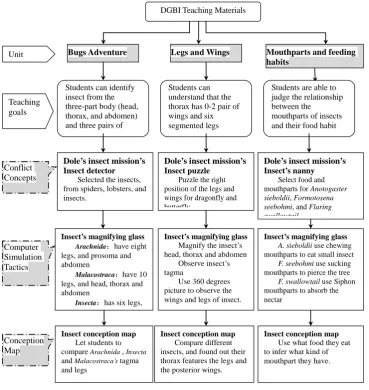
The designing of DGBI teaching materials is using teaching strategies as conflict the concept, computer simulation, and concept mapping strategy. We sort out the name of our unit, our teaching goals and teaching activities into a list, shown as F ig-ure 2.
As we see in Figure 2, the designing concept of “Bugs Ad-venture” is according to understand the basic insect conceptions. “Legs and Wings” in accordance with the concept of identify the right position of insect’s feet. The “Mouthparts and feeding habits” unit comes from the idea of recognize the mouthparts of insect and the relationship between mouthparts and their feed-ing habits.
1) Conflict concepts tactics: In the Legs and Wings puzzle game; we choose to use pictures that often show in cartoons, which their legs and wings were in the wrong position of the insect tagmata as dragonflies, butterflies and beetle. Then, we let students to put the puzzle of three pairs of legs and two pairs of wings in the right tagmata of the insect. In this activities, students has to finish the game by clicking insect’s legs and wings from the computer surface and putting the puzzle in the correct position.
2) Computer simulation tactics: In insect curriculum, teach-ers’ biggest challenge is that it is hard to let students to observe the insect by themselves. In order to solve teachers teaching problems, we use computer simulation tactics. It can show the insect’s entity simulating 3D animation (360 degree rotation), zoom their portion features and emphasis our teaching focus to the students.
3) Mapping concept tactics: In DGBI, we utilize the concept of “filling the concept diagram in the blank” form Tsai (2008) and shows parts of expert’s conception map to students. Then, we ask students to choose the concepts terms at the bottom of the surface and drag and drop it into the concepts space above as Figure 3.
Development Phase of DGBI Teaching Materials
familiar with. We design and process DGBI teaching materials based on the alternative conception data we had have collected
in the analysis stage, and organized it into development phase diagram, shown as Figure 4.
Legs and Wings
Bugs Adventure Mouthparts and feeding habits
Unit
Students can identify insect from the three-part body (head, thorax, and abdomen) and three pairs of j i d l
Students can understand that the thorax has 0-2 pair of wings and six segmented legs
Students are able to judge the relationship between the mouthparts of insects and their food habit
Dole’s insect mission’s
Insect detector
Selected the insects, from spiders, lobsters, and insects.
Dole’s insect mission’s
Insect puzzle
Puzzle the right position of the legs and wings for dragonfly and butterfly
Dole’s insect mission’s
Insect’s nanny
Select food and mouthparts for Anotogaster sieboldii, Formotosena seebohmi, and Flaring swallowtail
Insect’s magnifying glass
Arachnida:have eight legs, and prosoma and abdomen
Malacostraca:have 10 legs, and head, thorax and abdomen
Insecta:has six legs,
Insect’s magnifying glass
Magnify the insect’s head, thorax and abdomen
Observe insect’s tagma
Use 360 degrees picture to observe the wings and legs of insect.
Insect’s magnifying glass A. sieboldii use chewing mouthparts to eat small insect
F. seebohmi use sucking mouthparts to pierce the tree
F. swallowtail use Siphon mouthparts to absorb the nectar
Insect conception map
Let students to compare Arachnida , Insecta and Malacostraca’s tagma and legs
Insect conception map
Compare different insects, and found out their thorax features the legs and the posterior wings.
Insect conception map
Use what food they eat to infer what kind of mouthpart they have. Teaching
goals
Conflict Concepts
Conception Map Computer Simulation Tactics
[image:4.595.114.484.115.506.2] [image:4.595.116.479.529.712.2]DGBI Teaching Materials
Figure 2.
Development phases of DGBI teaching materials.
Figure 3.
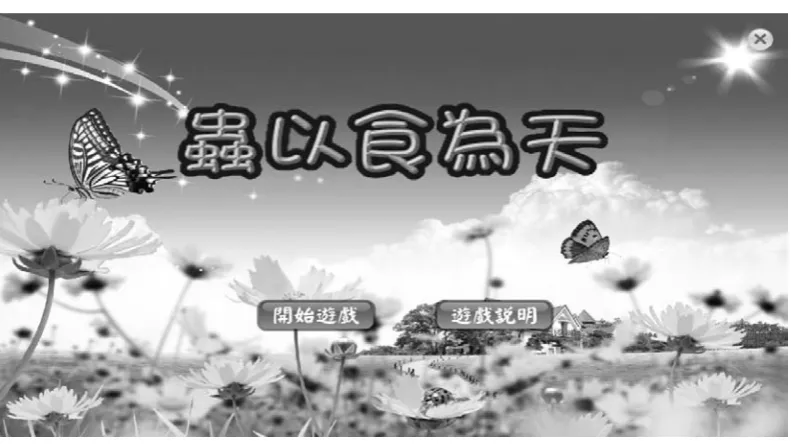
Developing DGBI teaching materials, we use animation soft-ware: Adobe Flash CS4 Professional to make the teaching ma-terials. In the teaching material, we collected the photos (most of them we shot it ourselves), music and picture from the inter-net resources. There are three buttons in the index page for children to choose, includes logout button ( ), start button, and game description. If the student mouse moves to the log out
button, it will show a prompt “don’t want to play anymore”; pressing the logout button, the system will log out DGBI im-mediately. In all the upper right corner of DGBI interface, will apparel this logout button to let learners to choose if they want to leave the teaching material or not (shown in Figure 5). When pressing start button and game description, it will show activi-ties menu and the teaching materials help page.
Dole’s insect mission Dole’s insect mission Dole’s insect mission DGBI teaching materials
correct correct
NO
Insect amusement Animal Classification
correct
Insect amusement Insect Breeder Insect amusement
Finding the Error Legs and Wings
Bugs Adventure Mouthparts and feeding habits
Insect’s 3D Animation Insect’s
Magnifying glass
Insect’s magnifying glass Insect’s magnifying
glass
Conception map Conception map Conception map YES
Insect detector Insect puzzle Insect’s nanny
NO
[image:5.595.102.495.170.476.2]YES YES NO
Figure 4.
Development phase of DGBI teaching materials diagram.
Figure 5.
[image:5.595.101.497.493.715.2]In activities menu, there are six buttons for students to choose, includes three control button: homepage, sound control ( ), logout button ( ) and three activities options “Dole’s insect mission (shown as Figure 6)” “Conception map”, and “Insect amusement”. The background music can enhance stu-dents learning, but it also can caused the interference of learn-ing; therefore, learners might use the sound control buttons ( ) to control if they want to have the music or not. After pressing the mouse button, the button will turn to , which means the learner turn off the music; pressing the button again, it will turn back to , which means the music is on again.
DGBI teaching materials can give different learners different feedbacks. If learners has the wrong options, the DGBI will directed to the prompt page, and shows the appropriate prompt to let student’s to think again about their answers. In the bottom right of the surface, students can press try again to finfish the learning mission. If the learner answers the right answer, then the DGBI will give them a positive feedback and affirm their options.
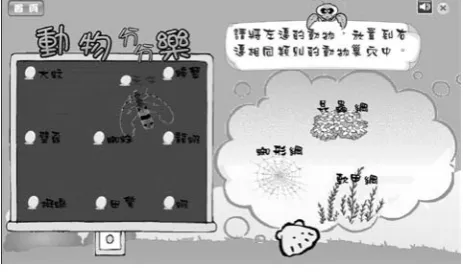
In the insect amusement activities: 1. Animal classification: Student can use the concept of number of animal foot and body parts (head, thorax and abdomen) to classify insect. In the game, learners need to use the mouse and move the animals from the left to the right to accomplish the game (shown as Figure 7). 2. Finding the Error: We applied the conception that insect’s tho-rax features the legs and wings in the activity. In the game, the learners needs to point out wrong position of the legs and wings to accomplish the game (shown as Figure 8). 3. Insect Breeder: Students needs to use the mouthparts structure to determine
what kind of food they eat, and give the food to the right inset. In the game, learner needs to use the keyboard to control the direction and bring the food to the right place (shown in Figure 9).
Testing the DGBI Teaching Materials
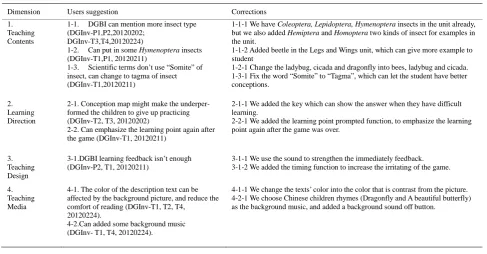
We invite two international professors (specialty in insects, P1-P2), three senior elementary school science teachers (T2-T4) and one elementary school computer teachers (T1) to test DGBI teaching materials and interview them for their suggestions, and use it as the reference when corrected DGBI. We sort out the interview results and the correction as Table 1.
Evaluation Phase of DGBI Teaching Materials
E-learning Quality Certification Evaluate Form
After finishing the DGBI, we ask six evaluators to evaluate the designing results of DGBI, shown in Table 2. The evalua-tors give the DGBI teaching materials the highest certification level: AAA level.
Supplemented with evaluator interview result instruction:
[image:6.595.59.538.405.545.2]● The Digital teaching materials have correct content and clear pictures; the content is interesting and fun, the scientific concepts is express correctly. The organizations of the teaching materials are completely and can gives students appropriate breadth and depth learning step-by-step; there are variety of ways to promote learn-ing in DGBI, as conception map, game assessment, 360 degrees rotation of insects and answer providing etc. (DGA-T1, T4, T5, T6, 20120303).
Figure 6.
The design of “Dole’s insect mission”.
Figure 7.
[image:6.595.56.288.578.714.2]The interface game pictures of insect amusement.
Figure 8.
Figure 9.
The interface game pictures of insect breeder.
● DGBI has integrated framework, clearly divide each units; the content is vivid and lively and the terms is unique in-genuity; the concept map puzzle and game design is a way to practice and assesses students; in the concept map puzzling activity, the design of showing the answer can provide helps when their learning (DGA-T1, T2, T3, T4, 20120303).
● DGBI teaching materials don’t have learning recording function, which can be reinforce; the content in DGBI lay particular stress on the words, if it can added some voice to lead students to read will obtain a better learning results (DGA-T2, T3, T5, 20120303).A-T2, T3, T5, 20120303).
Insect Cognitive Conception Test
[image:7.595.55.543.301.555.2]In the insect cognitive conception test survey, we exclude the error questionnaire sheets and get 107 valid questionnaire sheets. The pre-test and post-test result of insect cognitive con-ception test is shown in Table 3.
Table 1.
Testing results and corrections of DGBI teaching materials.
Dimension Users suggestion Corrections
1. Teaching Contents
1-1. DGBI can mention more insect type (DGInv-P1,P2,20120202;
DGInv-T3,T4,20120224)
1-2. Can put in some Hymenoptera insects (DGInv-T1,P1, 20120211)
1-3. Scientific terms don’t use “Somite” of insect, can change to tagma of insect (DGInv-T1,20120211)
1-1-1 We have Coleoptera, Lepidoptera, Hymenoptera insects in the unit already, but we also added Hemiptera and Homoptera two kinds of insect for examplesin the unit.
1-1-2 Added beetle in the Legs and Wings unit, which can give more example to student
1-2-1 Change the ladybug, cicada and dragonfly into bees, ladybug and cicada. 1-3-1 Fix the word “Somite” to “Tagma”, which can let the student have better conceptions.
2. Learning Direction
2-1. Conception map might make the underper-formed the children to give up practicing (DGInv-T2, T3, 20120202)
2-2. Can emphasize the learning point again after the game (DGInv-T1, 20120211)
2-1-1 We added the key which can show the answer when they have difficult learning.
2-2-1 We added the learning point prompted function, to emphasize the learning point again after the game was over.
3. Teaching Design
3-1.DGBI learning feedback isn’t enough (DGInv-P2, T1, 20120211)
3-1-1 We use the sound to strengthen the immediately feedback. 3-1-2 We added the timing function to increase the irritating of the game.
4. Teaching Media
4-1. The color of the description text can be affected by the background picture, and reduce the comfort of reading (DGInv-T1, T2, T4, 20120224).
4-2.Can added some background music (DGInv- T1, T4, 20120224).
4-1-1 We change the texts’ color into the color that is contrast from the picture. 4-2-1 We choose Chinese children rhymes (Dragonfly and A beautiful butterfly) as the background music, and added a background sound off button.
Table 2.
DGBI teaching materials evaluate result from the E-learning quality certification evaluate form.
Evaluation dimension Mean Standard deviation
1. Teaching Contents (Content, total score 21) 19.6 1.08
2. Learning Directions (Navigation, total score 19) 16.0 2.10
3. Teaching Design (Instructional design, total score 43) 41.3 1.63
4. Teaching Media (Instructional media, total score 21) 19.0 1.10
Total score (Total, total score 104) 95.9 4.37
From Table 3, we can know that students discrepancy be-tween pre-test and post-test results from insect cognitive con-ception test is 6.08; the total score of t-test is 16.47, and the “Insect identification” get’s t = 8.85; the “Position of legs and wings” get’s t = 14.96; the “Mouthparts and feeding habits”
[image:7.595.55.539.583.671.2]high score ranking group, and grouped the bottom 29 students (bottom 27.3%) as low-score group. The other 45.4% of stu-dents became the Middle Score Group. The performance in the “insect cognitive conception test” sort out as Table 4.
We can see in table4 that the high score group, middle score group and lower score group t-test result is t = 7.13, 10.96, 13.53, p = .00. This shows that three groups have significant progress in insect after using DGBI in learning. Especially the lower score group have the most obvious learning effects (Av-erage rating discrepancy = 8.67).
We can see in Table 4 that the high score group, middle score group and lower score group t-test result is t = 7.13, 10.96, 13.53, p = .00. This shows that three groups have significant progress in insect after using DGBI in learning. Especially the lower score group have the most obvious learning effects (Av-
erage rating discrepancy = 8.67).
Learner Satisfaction Questionnaire Sheet
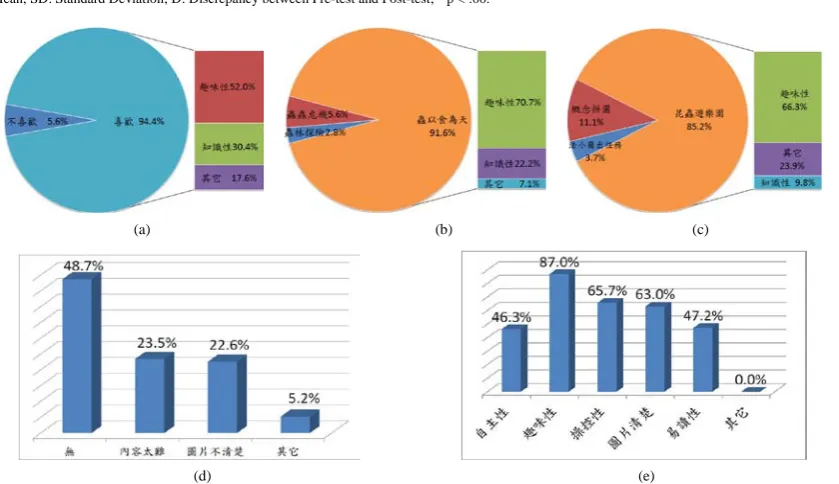
In the questionnaire survey, we exclude 3 error questionnaire sheets and get 108 valid questionnaire sheets. The questionnaire sheet includes three multiple choice questions(Q1、Q2、Q3) and two multiple-choice questions(Q4、Q5). After statistics the data, we sort out all 5 questions and shown as figure 10, which was supplemented with qualitative described data.
[image:8.595.77.520.276.346.2]In Figure 10a, we found out that 94.4% of students like to use computer to learn insect concept. The reason they like to learn by computer, 52.0% of students thinks it fun and interest-ing, 30.4% of students think that they help to understand the conception of insect more effective. The interviews are as fol-lows:
Table 3.
Test performance of forth grade students’ insects cognitive concept.
Conceptual category Pre-test (N = 107) Post-test(N = 107) d t p
M SD M SD
Insect identification 2.30 1.39 3.97 1.76 1.67 8.85 .00**
Position of legs and wings 2.38 1.31 5.66 1.82 3.28 14.96 .00**
Mouthparts and feeding habits 2.87 1.33 4.00 1.32 1.13 7.02 .00**
Total score 7.55 2.53 13.64 3.65 6.08 16.47 .00**
[image:8.595.77.521.392.454.2]M: Mean; SD: Standard Deviation; D: Discrepancy between Pre-test and Post-test; **p < .00.
Table 4.
Different learning achievement performance of forth grade student’s.
Category of learning achieve-ment
Pre-test Post-test
d t p
M SD M S
High Score Group (N = 29) 10.65 1.59 14.86 3.61 4.21 7.13 .00**
Middle Score Group (N = 49) 7.45 .94 13.12 3.67 5.67 10.96 .00**
Low-Score Group (N = 29) 4.62 1.18 13.28 3.48 8.67 13.53 .00**
M: Mean; SD: Standard Deviation; D: Discrepancy between Pre-test and Post-test; **p < .00.
(a) (b) (c)
[image:8.595.91.511.461.703.2]
(d) (e)
Figure 10.
● 52.0% of students think it is fun and interesting: “The in-sect game is fun. I think is fun to learn in games.” (LS-S809、LS-S827,LS-S909,20120508).
● 30.4% of students think that they help to understand the conception of insect more effective: “We can operate by ourselves and can understand the morphological of the insect. This let me know the mouthparts and see the insect clearly. ” (LS-S104、LS-S821, LS-S902, LS-S201, 20120508).
Figure 10b shows students in preference to which teaching unit in DGBI teaching materials, including Bugs Adventure, Legs and Wings and Mouthparts and feeding habits. There are 91.0% of students like the unit “Mouthparts and feeding ha-bits.” In the interview, 50.5% of students think “Mouthparts and feeding habits” is the interesting game in DGBI, it added plentiful educational content, and makes this unit the most pop-ular one. In the interview, student said: “If we can play insect games, then we can learn insect when we were playing, and know what king of mouthparts they got” (LS-S927, LS-S104, LS-S826, 20120508). 32.3% of students think Insect Breeder unit in the insect amusement in “Mouthparts and feeding ha-bits” has design self-challenge checkpoints, can compete with their friends, has the ability to manipulate more, and the speed becomes faster and faster which makes it challenging(LS-S922, LS-S820, LS-S117, LS-S908, 20120507).
From Figure 10c, we can found that students preference of “Dole’s insect mission”, “Conception map” and “Insect amusement”. 85.2% of student like the Insect amusement; the reason is same as Figure 10d.
We can know students idea of DGBI from: 87.0% of student think DGBI is fun to play, 65.7% of students thinks is easy to control, 63.0% of students think that picture in DGBI can let them discern the insect. Figure 10e shows that 48.7% thinks the designing of DGBI is excellent; 23.5% of students thinks the teaching content is too difficult to learn, 22.6% of students thinks that the picture is not clearly enough, another 5.2% of students thinks that we can increase more picture and entomol-ogy in DGBI.
Conclusion
Follow ADDIE Pattern can Develop Good Quality of DGBI Teaching Materials
The DGBI teaching materials develop by following the five step of ADDIE pattern. First, we analysis student’s alternative conception when they identify insects and the appearance structure of insect. Second, we use conflict concepts tactics, computer simulation tactics and mapping concept tactics as foundation to design the whole structure of the DGBI. Then, we collected element that we needed and the use Adobe Flash CS4 to animate DGBI. After testing DGBI, we adopted the expert’s suggestion and three functions: First, we added Hymenoptera insect to increase the richness and completeness of DGBI. Second, we added the function of showing the correct answer and learning key points to let the lower packet of pupils can finish the learning in DGBI. The last but not least, we added the function of strengthen the audio and timing to give the students immediately learning feedback. In the evaluation phase, the DGBI obtain the AAA certification, which display DGBI is an excellent digital teaching materials.
DGBI Teaching Materials can Let Students to Learn Insect Concept Step by Step
DGBI teaching materials have good teaching content, teach-ing goals, learnteach-ing direction and teachteach-ing media, which can help students learning insect concept orderly and gradual. In DGBI, we also provide diverse applications examples to stu-dents. First, we selected the text words and the picture that we use in DGBI to fit the awareness level of the learner; secondly, DGBI has pictures that can turn 360 degrees, zoom up partial features and break through the limit of paper page.
In the learning direction part, DGBI guide the students by a narrative context, leading the students from their original con-cept of cognitive, and let them choice their own learning path. The answer shown function can provide the underperformed children some help before game over.
DGBI Teaching Materials can Improve Students Interested in Learning Insect
Compare to “Bugs Adventure”, “Legs and Wings”, and “Mouthparts and feeding habits” three teaching activities, there’s 91.0% of students likes the “Mouthparts and feeding habits” activities. Compare three teaching activities “Dole’s insect mission”, “Conception map” and “Insect amusement”, 85.2% of students likes the “Insect amusement” activity. Stu-dent thinks the “Mouthparts and feeding habits” unit has rich learning content and exciting game, which has self-challenge design (the speed with become faster and faster) and can com-pare their score with others, and make this unit their favorite one.
DGBI Teaching Materials can Help Students to Build the Right Insect Concepts
According to the pretest and posttest scores in t-test in the “Insect cognitive conception test” , we found that after using DGBI teaching materials, students can have better insect con-cepts, especially in insects cognitive and insect identification, position of the legs and wings, and mouthparts and feeding habits. Among all the conceptions, the position of the legs and wings enhance the most; especially the lower packet of pupils has increase the most in their learning.
Expansion Form Teachers Brings Out the Best DGBI Teaching Effect
DGBI teaching materials emphasized students can learn in-dependently by themselves, but will they have another alterna-tive conception needs more research to test and verify. If teach-ers can explain some concept when using DGBI, it can bring out better effects. From the experimental teaching result, we suggest when teaching insect curriculum, teachers can use DGBI teaching materials as a motivate activity. Then, teachers can ask students to observe the entity insect and write down their discovery. In the end, teacher can let the students to use DGBI teaching materials and discuss and clarify their concep-tions together, this cam exert DGBI teaching material’s max-imize learning benefits in insect teaching.
Recommendations for Digital Teaching Researchers
hard to use and gets difficult in learning. When use DGBI, de-signers and researchers can also study if students reading ability, prior scientific concepts or other reasons will restrict them us-ing DGBI.
Acknowledgements
We appreciated to those who made the completion of this study possible, including: funding supported from the National Science Council Taiwan, R.O.C. (NSC101-2511-S-152-010- MY2), teachers who takes questionnaires, teachers who join focus grouping interview and senior teachers who assist the entire researcher. Last but not less, the supports from our re-search team.
REFERENCES
Bell, B., & Barker, M. (1982). Towards a scientific concept of 'animal'. Journal of Biological Education, 16, 197-200.
Chen, J. Z. (2004). A study of the insect diversity and conservation. In Forestry Bureau, COA (Eds.) Proceedings of the Symposium on In-sect Conservation and Biodiversity, (pp110-126). Taipei, Taiwan. Chen, S. T. (2003). A Study of elementary school students’ cognition
and alternative conception on aquatic insects in Taoyuan. A Master's thesis of Municipal Taipei University of Education
Chuang, C. Y. & Su, Y. J. (1999). A study of the perception selection and conception of animal classification in primary school children. Chinese Journal of Science Education,7(2), 135-156.
Huang, W. C. (2003). A study of elementary school students’ concep-tions and misconcepconcep-tions about insects by two-tier diagnostic in-strument. A Master's thesis of National Taichung University of Edu-cation.
Jeng, S. L. (2012). Develop the digital game based on the conception of
inscets to incrcase the conceptions of elementary school students. A Master's thesis of National Taipei University of Education.
Lu, C. C. & Chen, Y. Y. (2008). Integrating digital storybooks into teaching to promote children’s cognitive concepts of animal growth. Journal of Educational Practice and Research, 21(2), 33-62. Lu, C. C. & Chen, P. J.(2011, April, 23). The development of insect
conception comprehension tests in elementary teachers. Paper pre-sented at Conference on Science Education and Science, Taipei, Taiwan.
Lu, C. C., Chen, Y. Y., & Chen, C. W. (2011). A correlative study of CD-ROM storybooks in classrooms and school children’s formation of descriptive concepts. International Journal of Science and Ma-thematics Education, 9(1), 47-67.
Marriott. S (2002). Red in tooth and claw? Images of nature in modern picture books. Children’s Literature in Education, 33(3), 175-183. Molenda, M. (2003). In search of the elusive ADDIE model.
Perfor-mance improvement 42 (5), 34–37.
Shepardson, D. P. (2002). Bugs, butterflies, and spiders: Children's understandings about insects. Internation Journal of Science Educa-tion, 24(6), 627-643.
Squire, K. (2003). Video games in education. International Journal of Intelligent Simulations and Gaming, 2(1), 49-62.
Sung, Y. T., Chang, K. E., Lin, H. L., Lee, Y. F., & Chen, M. P. (2009). Establishing certification standard for e-learning courseware quality and analyzing its reliabilities. Journal of e-Business, 11(4), 823-846. Trowbridge, J. E., & Mintzes, J. J. (1988). Alternative conceptions in
animal classification: A cross-age study. Journal of Research in Science Teaching, 25, 547-571.
Tsai, H. T. (2008). On the relationships bewteen concept map strate-gies and web search capability: An experiment on sixth grade stu-dents. A Master's thesis of National University of Tainan.