Proceedings of the 55th Annual Meeting of the Association for Computational Linguistics, pages 1095–1104 Proceedings of the 55th Annual Meeting of the Association for Computational Linguistics, pages 1095–1104
Selective Encoding for Abstractive Sentence Summarization
Qingyu Zhou†∗ Nan Yang‡ Furu Wei‡ Ming Zhou‡ †Harbin Institute of Technology, Harbin, China
‡Microsoft Research, Beijing, China
[email protected] {nanya,fuwei,mingzhou}@microsoft.com
Abstract
We propose a selective encoding model to extend the sequence-to-sequence frame-work for abstractive sentence summariza-tion. It consists of a sentence encoder, a selective gate network, and an atttion equipped decoder. The sentence en-coder and deen-coder are built with recur-rent neural networks. The selective gate network constructs a second level sen-tence representation by controlling the in-formation flow from encoder to decoder. The second level representation is tailored for sentence summarization task, which leads to better performance. We evalu-ate our model on the English Gigaword, DUC 2004 and MSR abstractive sentence summarization datasets. The experimen-tal results show that the proposed selective encoding model outperforms the state-of-the-art baseline models.
1 Introduction
Sentence summarization aims to shorten a given sentence and produce a brief summary of it. This is different from document level summarization task since it is hard to apply existing techniques in extractive methods, such as extracting sentence level features and ranking sentences. Early works propose using rule-based methods (Zajic et al., 2007), syntactic tree pruning methods (Knight and Marcu,2002), statistical machine translation tech-niques (Banko et al.,2000) and so on for this task. We focus on abstractive sentence summarization task in this paper.
Recently, neural network models have been ap-plied in this task. Rush et al. (2015) use auto-constructed sentence-headline pairs to train a neu-∗Contribution during internship at Microsoft Research.
ral network summarization model. They use a Convolutional Neural Network (CNN) encoder and feed-forward neural network language model decoder for this task. Chopra et al. (2016) ex-tend their work by replacing the decoder with Re-current Neural Network (RNN). Nallapati et al. (2016) follow this line and change the encoder to RNN to make it a full RNN based sequence-to-sequence model (Sutskever et al.,2014).
the sri lankangovernment on wednesday announced the closureof government schoolswith immediate effectas a military campaignagainst tamil separatists escalatedin the north of the country .
sri lanka closes schools as war escalates
Figure 1: An abstractive sentence summarization system may produce the output summary by dis-tilling the salient information from the highlight to generate a fluent sentence. We model the distilling process with selective encoding.
All the above works fall into the encoding-decoding paradigm, which first encodes the in-put sentence to an abstract representation and then decodes the intended output sentence based on the encoded information. As an extension of the encoding-decoding framework, attention-based approach (Bahdanau et al.,2015) has been broadly used: the encoder produces a list of vec-tors for all tokens in the input, and the decoder uses an attention mechanism to dynamically ex-tract encoded information and align with the out-put tokens. This approach achieves huge success in tasks like machine translation, where alignment between all parts of the input and output are re-quired. However, in abstractive sentence summa-rization, there is no explicit alignment relationship between the input sentence and the summary
cept for the extracted common words. The chal-lenge here is not to infer the alignment, but to se-lect the highlights while filtering out secondary information in the input. A desired work-flow for abstractive sentence summarization is encod-ing, selection, and decoding. After selecting the important information from an encoded sentence, the decoder produces the output summary using the selected information. For example, in Fig-ure 1, given the input sentence, the summariza-tion system first selects the important informasummariza-tion, and then rephrases or paraphrases to produce a well-organized summary. Although this is implic-itly modeled in the encoding-decoding framework, we argue that abstractive sentence summarization shall benefit from explicitly modeling this selec-tion process.
In this paper we proposeSelectiveEncoding for
Abstractive Sentence Summarization (SEASS).
We treat the sentence summarization as a three-phase task: encoding, selection, and decoding. It consists of a sentence encoder, a selective gate net-work, and a summary decoder. First, the sentence encoder reads the input words through an RNN unit to construct the first level sentence represen-tation. Then the selective gate network selects the encoded information to construct the second level sentence representation. The selective mechanism controls the information flow from encoder to de-coder by applying a gate network according to the sentence information, which helps improve en-coding effectiveness and release the burden of the decoder. Finally, the attention-equipped decoder generates the summary using the second level sen-tence representation. We conduct experiments on English Gigaword, DUC 2004 and Microsoft Research Abstractive Text Compression test sets. Our SEASS model achieves 17.54 ROUGE-2 F1,
9.56 ROUGE-2 recall and 10.63 ROUGE-2 F1 on
these test sets respectively, which improves perfor-mance compared to the state-of-the-art methods.
2 Related Work
Abstractive sentence summarization, also known as sentence compression and similar to headline generation, is used to help compress or fuse the selected sentences in extractive document sum-marization systems since they may inadvertently include unnecessary information. The sentence summarization task has been long connected to the headline generation task. There are some previous
methods to solve this task, such as the linguistic rule-based method (Dorr et al.,2003). As for the statistical machine learning based methods,Banko et al. (2000) apply statistical machine translation techniques by modeling headline generation as a translation task and use 8000 article-headline pairs to train the system.
Rush et al.(2015) propose leveraging news data in Annotated English Gigaword (Napoles et al., 2012) corpus to construct large scale parallel data for sentence summarization task. They propose an ABS model, which consists of an attentive Con-volutional Neural Network encoder and an neural network language model (Bengio et al.,2003) de-coder. On this Gigaword test set and DUC 2004 test set, the ABS model produces the state-of-the-art results. Chopra et al.(2016) extend this work, which keeps the CNN encoder but replaces the de-coder with recurrent neural networks. Their exper-iments showes that the CNN encoder with RNN decoder model performs better than Rush et al. (2015). Nallapati et al.(2016) further change the encoder to an RNN encoder, which leads to a full RNN sequence-to-sequence model. Besides, they enrich the encoder with lexical and statistic tures which play important roles in traditional fea-ture based summarization systems, such as NER and POS tags, to improve performance. Experi-ments on the Gigaword and DUC 2004 test sets show that the above models achieve state-of-the-art results.
Gu et al. (2016) and Gulcehre et al. (2016) come up similar ideas that summarization task can benefit from copying words from input sentences. Gu et al. (2016) propose CopyNet to model the copying action in response generation, which also applies for summarization task. Gulcehre et al. (2016) propose a switch gate to control whether to copy from source or generate from decoder vo-cabulary. Zeng et al. (2016) also propose using copy mechanism and add a scalar weight on the gate of GRU/LSTM for this task.Cheng and Lap-ata(2016) use an RNN based encoder-decoder for extractive summarization of documents.
per-forms comparable to the ABS model. Shen et al. (2016) propose to apply Minimum Risk Train-ing (MRT) in neural machine translation to di-rectly optimize the evaluation metrics.Ayana et al. (2016) apply MRT on abstractive sentence sum-marization task and the results show that optimiz-ing for ROUGEimproves the test performance. 3 Problem Formulation
For sentence summarization, given an input sen-tencex = (x1, x2, . . . , xn), where nis the sen-tence length, xi ∈ Vs and Vs is the source vo-cabulary, the system summarizes xby producing y = (y1, y2, . . . , yl), wherel ≤nis the summary length ,yi ∈ VtandVtis the target vocabulary.
If |y| ⊆ |x|, which means all words in sum-maryymust appear in given input, we denote this asextractivesentence summarization. If|y|*|x|, which means not all words in summary come from input sentence, we denote this asabstractive sen-tence summarization. Table1 provides an exam-ple. We focus onabstracivesentence summariza-tion task in this paper.
Input: South Korean President Kim Young-Sam left here Wednesday on a week - long state visit to Russia and Uzbekistan for talks on North Korea ’s nuclear confrontation and ways to strengthen bilateral ties .
Output: Kim leaves for Russia for talks on NKorea nuclear standoff
Table 1: An abstractive sentence summarization example.
4 Model
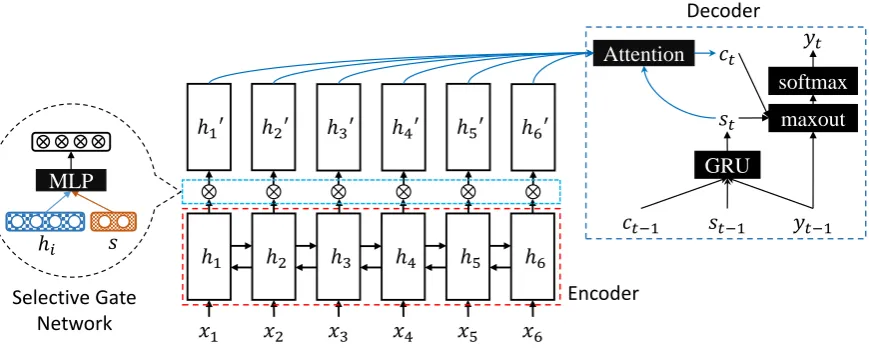
As shown in Figure 2, our model consists of a sentence encoder using the Gated Recurrent Unit (GRU) (Cho et al.,2014), a selective gate network and an attention-equipped GRU decoder. First, the bidirectional GRU encoder reads the input words x= (x1, x2, . . . , xn)and builds its representation
(h1, h2, . . . , hn). Then the selective gate selects and filters the word representations according to the sentence meaning representation to produce a tailored sentence word representation for abstrac-tive sentence summarization task. Lastly, the GRU decoder produces the output summary with atten-tion to the tailored representaatten-tion. In the following sections, we introduce the sentence encoder, the selective mechanism, and the summary decoder respectively.
4.1 Sentence Encoder
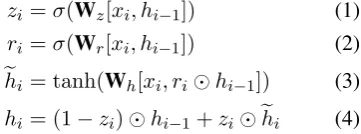
The role of the sentence encoder is to read the in-put sentence and construct the basic sentence rep-resentation. Here we employ a bidirectional GRU (BiGRU) as the recurrent unit, where GRU is de-fined as:
zi =σ(Wz[xi, hi−1]) ri =σ(Wr[xi, hi−1])
ehi = tanh(Wh[xi, rihi−1])
hi = (1−zi)hi−1+ziehi
(1) (2) (3) (4)
whereWz,WrandWhare weight matrices. The BiGRU consists of a forward GRU and a backward GRU. The forward GRU reads the input sentence word embeddings from left to right and gets a sequence of hidden states,(~h1, ~h2, . . . ,~hn). The backward GRU reads the input sentence embeddings reversely, from right to left, and results in another sequence of hidden states,
( ~h1, ~h2, . . . , ~hn):
~hi =GRU(xi, ~hi−1) ~hi =GRU(xi, ~hi+1)
(5) (6)
The initial states of the BiGRU are set to zero vectors, i.e.,~h1 = 0and ~hn= 0. After reading the sentence, the forward and backward hidden states are concatenated, i.e.,hi = [~hi; ~hi], to get the ba-sic sentence representation.
4.2 Selective Mechanism
In the sequence-to-sequence machine translation (MT) model, the encoder and decoder are respon-sible for mapping input sentence information to a list of vectors and decoding the sentence rep-resentation vectors to generate an output sentence (Bahdanau et al.,2015). Some previous works ap-ply this framework to summarization generation tasks (Nallapati et al.,2016;Gu et al.,2016; Gul-cehre et al.,2016). However, abstractive sentence summarization is different from MT in two ways. First, there is no explicit alignment relationship between the input sentence and the output mary except for the common words. Second, sum-marization task needs to keep the highlights and remove the unnecessary information, while MT needs to keep all information literally.
[image:3.595.345.526.162.229.2]𝑥1
ℎ1
𝑥2
ℎ2
𝑥3
ℎ3
𝑥4
ℎ4
𝑥5
ℎ5
𝑥6
ℎ6 ℎ1′ ℎ2′ ℎ3′ ℎ4′ ℎ5′ ℎ6′
ℎ𝑖 𝑠
MLP GRU
Attention
𝑐𝑡−1 𝑠𝑡−1 𝑦𝑡−1 𝑠𝑡
𝑐𝑡
maxout
𝑦𝑡
Selective Gate Network
Encoder
Decoder
[image:4.595.84.519.67.242.2]softmax
Figure 2: Overview of theSelectiveEncoding forAbstractiveSentenceSummarization (SEASS).
extends the sequence-to-sequence model by con-structing a tailored representation for abstractive sentence summarization task. Concretely, the se-lective gate network in our model takes two vector inputs, the sentence word vectorhi and the sen-tence representation vectors. The sentence word vectorhiis the output of the BiGRU encoder and represents the meaning and context information of wordxi. The sentence vectorsis used to represent the meaning of the sentence. For each word xi, the selective gate network generates a gate vector sGateiusinghi ands, then the tailored represen-tation is constructed, i.e.,h0i.
In detail, we concatenate the last forward hid-den state~hnand backward hidden state 1~h as the sentence representations:
s=
"
~h
1 ~hn
#
(7)
For each time stepi, the selective gate takes the sentence representationsand BiGRU hiddenhias inputs to compute the gate vectorsGatei:
sGatei =σ(Wshi+Uss+b) h0i =hisGatei
(8) (9)
where Ws and Us are weight matrices, b is the bias vector, σ denotes sigmoid activation func-tion, andis element-wise multiplication. After the selective gate network, we obtain another se-quence of vectors(h01, h02, . . . , h0n). This new
se-quence is then used as the input sentence represen-tation for the decoder to generate the summary.
4.3 Summary Decoder
On top of the sentence encoder and the selective gate network, we use GRU with attention as the decoder to produce the output summary.
At each decoding time stept, the GRU reads the previous word embeddingwt−1and previous con-text vectorct−1as inputs to compute the new hid-den statest. To initialize the GRU hidden state, we use a linear layer with the last backward encoder hidden state 1~h as input:
st=GRU(wt−1, ct−1, st−1)
s0= tanh(Wd 1~h +b)
(10) (11) whereWd is the weight matrix andbis the bias vector.
The context vector ct for current time steptis computed through the concatenate attention mech-anism (Luong et al., 2015), which matches the current decoder statestwith each encoder hidden state h0i to get an importance score. The impor-tance scores are then normalized to get the current context vector by weighted sum:
et,i=v>a tanh(Wast−1+Uah0i)
αt,i=
exp(et,i)
Pn
i=1exp(et,i)
ct= n
X
i=1 αt,ih0i
(12)
(13)
(14)
next word with a softmax layer over the decoder vocabulary.
rt=Wrwt−1+Urct+Vrst
mt= [max{rt,2j−1, rt,2j}]>j=1,...,d p(yt|y1, . . . , yt−1) =softmax(Womt)
(15) (16) (17) whereWa,Ua,Wr,Ur,VrandWo are weight matrices. Readout state rt is a 2d-dimensional vector, and the maxout layer (Equation16) picks the max value for every two numbers inrtand pro-duces a d-dimensional vectormt.
4.4 Objective Function
Our goal is to maximize the output summary prob-ability given the input sentence. Therefore, we op-timize the negative log-likelihood loss function:
J(θ) =− 1
|D| X
(x,y)∈D
logp(y|x) (18)
where D denotes a set of parallel sentence-summary pairs andθis the model parameter. We use Stochastic Gradient Descent (SGD) with mini-batch to learn the model parameterθ.
5 Experiments
In this section we introduce the dataset we use, the evaluation metric, the implementation details, the baselines we compare to, and the performance of our system.
5.1 Dataset
Training Set For our training set, we use a
par-allel corpus which is constructed from the Anno-tated English Gigaword dataset (Napoles et al., 2012) as mentioned in Rush et al. (2015). The parallel corpus is produced by pairing the first sen-tence and the headline in the news article with some heuristic rules. We use the script1 released
byRush et al.(2015) to pre-process and extract the training and development datasets. The script per-forms various basic text normalization, including PTB tokenization, lower-casing, replacing all digit characters with #, and replacing word types seen less than 5 times withhunki. The extracted corpus
contains about 3.8M sentence-summary pairs for the training set and 189K examples for the devel-opment set.
For our test set, we use the English Gigaword, DUC 2004, and Microsoft Research Abstractive Text Compression test sets.
1https://github.com/facebook/NAMAS
English Gigaword Test Set We randomly
sam-ple 8000 pairs from the extracted development set as our development set since it is relatively large. For the test set, we use the same randomly held-out test set of 2000 sentence-summary pairs as Rush et al.(2015).2
We also find that except for the empty titles, this test set has some invalid lines like the input sen-tence containing only one word. Therefore, we further sample 2000 pairs as our internal test set and release it for future works3.
DUC 2004 Test Set We employ DUC 2004 data
for tasks 1 & 2 (Over et al., 2007) in our experi-ments as one of the test sets since it is too small to train a neural network model on. The dataset pairs each document with 4 different human-written ref-erence summaries which are capped at 75 bytes. It has 500 input sentences with each sentence paired with 4 summaries.
MSR-ATC Test Set Toutanova et al.(2016)
re-lease a new dataset for sentence summarization task by crowdsourcing. This dataset contains ap-proximately 6,000 source text sentences with mul-tiple manually-created summaries (about 26,000 sentence-summary pairs in total).Toutanova et al. (2016) provide a standard split of the data into training, development, and test sets, with 4,936, 448 and 785 input sentences respectively. Since the training set is too small, we only use the test set as one of our test sets. We denote this dataset as MSR-ATC (Microsoft Research Abstractive Text Compression) test set in the following.
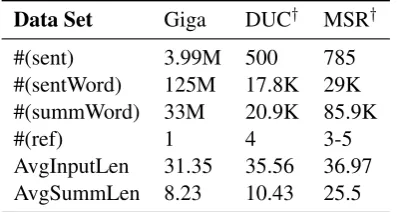
Table2summarizes the statistic information of the three datasets we used.
5.2 Evaluation Metric
We employ ROUGE(Lin,2004) as our evaluation
metric. ROUGEmeasures the quality of summary
by computing overlapping lexical units, such as unigram, bigram, trigram, and longest common subsequence (LCS). It becomes the standard eval-uation metric for DUC shared tasks and popular for summarization evaluation. Following previous work, we use ROUGE-1 (unigram), ROUGE-2
(bi-2Thanks toRush et al.(2015), we acquired the test set they
used. FollowingChopra et al.(2016), we remove pairs with empty titles resulting in slightly different accuracy compared toRush et al.(2015) for their systems. The cleaned test set contains 1951 sentence-summary pairs.
3Our development and test sets can be found athttps:
Data Set Giga DUC† MSR†
#(sent) 3.99M 500 785
#(sentWord) 125M 17.8K 29K
#(summWord) 33M 20.9K 85.9K
#(ref) 1 4 3-5
AvgInputLen 31.35 35.56 36.97
[image:6.595.83.282.63.169.2]AvgSummLen 8.23 10.43 25.5
Table 2: Data statistics for the English Giga-word, DUC 2004 and MSR-ATC datasets. #(x) denotes the number ofx, e.g., #(ref) is the num-ber of reference summaries of an input sentence. AvgInputLen is the average input sentence length and AvgSummLen is the average summary length.
†DUC 2004 and MSR-ATC datasets are for test purpose only.
gram) and ROUGE-L (LCS) as the evaluation
met-rics in the reported experimental results.
5.3 Implementation Details
Model Parameters The input and output
vocab-ularies are collected from the training data, which have 119,504 and 68,883 word types respectively. We set the word embedding size to 300 and all GRU hidden state sizes to 512. We use dropout (Srivastava et al.,2014) with probabilityp= 0.5.
Model Training We initialize model
parame-ters randomly using a Gaussian distribution with Xavier scheme (Glorot and Bengio,2010). We use Adam (Kingma and Ba,2015) as our optimizing algorithm. For the hyperparameters of Adam op-timizer, we set the learning rateα = 0.001, two
momentum parametersβ1 = 0.9andβ2 = 0.999 respectively, and = 10−8. During training, we
test the model performance (ROUGE-2 F1) on
de-velopment set for every 2,000 batches. We halve the Adam learning rateαif the ROUGE-2 F1 score
drops for twelve consecutive tests on development set. We also apply gradient clipping (Pascanu et al.,2013) with range[−5,5]during training. To
both speed up the training and converge quickly, we use mini-batch size 64 by grid search.
Beam Search We use beam search to generate
multiple summary candidates to get better results. To avoid favoring shorter outputs, we average the ranking score along the beam path by dividing it by the number of generated words. To both decode fast and get better results, we set the beam size to
12 in our experiments. 5.4 Baseline
We compare SEASS model with the following state-of-the-art baselines:
ABS Rush et al.(2015) use an attentive CNN en-coder and NNLM deen-coder to do the sentence summarization task. We trained this baseline model with the released code1 and evaluate
it with our internal English Gigaword test set and MSR-ATC test set.
ABS+ Based on ABS model, Rush et al. (2015) further tune their model using DUC 2003 dataset, which leads to improvements on DUC 2004 test set.
CAs2s As an extension of the ABS model,
Chopra et al. (2016) use a convolutional attention-based encoder and RNN decoder, which outperforms the ABS model.
Feats2s Nallapati et al. (2016) use a full
RNN sequence-to-sequence encoder-decoder model and add some features to enhance the encoder, such as POS tag, NER, and so on.
Luong-NMT Neural machine translation model
ofLuong et al.(2015) with two-layer LSTMs for the encoder-decoder with 500 hidden units in each layer implemented in (Chopra et al.,2016).
s2s+att We also implement a
sequence-to-sequence model with attention as our baseline and denote it as “s2s+att”.
5.5 Results
We report ROUGEF1, ROUGErecall and ROUGE
F1 for English Gigaword, DUC 2004 and MSR-ATC test sets respectively. We use the official ROUGE script (version 1.5.5) 4 to evaluate the
summarization quality in our experiments. For English Gigaword5 and MSR-ATC6 test sets, the
outputs have different lengths so we evaluate the system with F1 metric. As for the DUC 2004 test set7, the task requires the system to produce a fixed
length summary (75 bytes), therefore we employ ROUGErecall as the evaluation metric. To satisfy
the length requirement, we decode the output sum-mary to a roughly expected length followingRush et al.(2015).
4http://www.berouge.com/
5The ROUGEevaluation option is the same asRush et al.
(2015), -m -n 2 -w 1.2
English Gigaword We acquire the test set from Rush et al. (2015) so we can make fair compar-isons to the baselines.
Models RG-1 RG-2 RG-L
ABS (beam)‡ 29.55- 11.32- 26.42
-ABS+ (beam)‡ 29.76- 11.88- 26.96
-Feats2s (beam)‡ 32.67- 15.59- 30.64
-CAs2s (greedy)‡ 33.10- 14.45- 30.25
-CAs2s (beam)‡ 33.78- 15.97- 31.15
-Luong-NMT (beam)‡ 33.10- 14.45- 30.71
-s2s+att (greedy) 33.18- 14.79- 30.80
-s2s+att (beam) 34.04- 15.95- 31.68
-SEASS (greedy) 35.48 16.50 32.93
[image:7.595.72.294.116.277.2]SEASS (beam) 36.15 17.54 33.63
Table 3: Full length ROUGEF1 evaluation results
on the English Gigaword test set used by Rush et al. (2015). RG in the Table denotes ROUGE.
Results with‡mark are taken from the
correspond-ing papers. The superscript - indicates that our SEASS model with beam search performs signif-icantly better than it as given by the 95% confi-dence interval in the official ROUGEscript.
Models RG-1 RG-2 RG-L
ABS (beam) 37.41- 15.87- 34.70
-s2s+att (greedy) 42.41- 20.76- 39.84 -s2s+att (beam) 43.76- 22.28- 41.14
-SEASS (greedy) 45.27 22.88 42.20
SEASS (beam) 46.86 24.58 43.53
Table 4: Full length ROUGEF1 evaluation on our
internal English Gigaword test data. The super-script-indicates that our SEASS model performs significantly better than it as given by the 95% confidence interval in the official ROUGEscript.
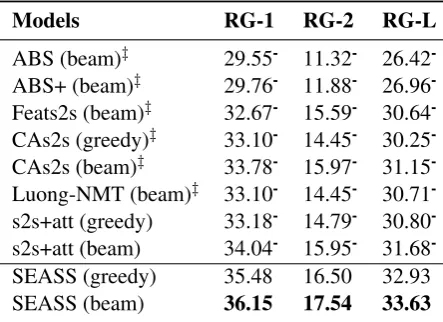
In Table 3, we report the ROUGE F1 score of
our model and the baseline methods. Our SEASS model with beam search outperforms all baseline models by a large margin. Even for greedy search, our model still performs better than other methods which used beam search. For the popular ROUGE
-2 metric, our SEASS model achieves 17.54 F1 score and performs better than the previous works. Compared to the ABS model, our model has a 6.22 ROUGE-2 F1 relative gain. Compared to the
highest CAs2s baseline, our model achieves 1.57
ROUGE-2 F1 improvement and passes the
signifi-cant test according to the official ROUGEscript.
Table4 summarizes our results on our internal test set using ROUGEF1 evaluation metrics. The
performance on our internal test set is compara-ble to our development set, which achieves 24.58 ROUGE-2 F1 and outperforms the baselines.
DUC 2004 We evaluate our model using the
ROUGErecall score since the reference summaries
of the DUC 2004 test set are capped at 75 bytes. Therefore, we decode the summary to a fixed length 18 to ensure that the generated summary satisfies the minimum length requirement. As summarized in Table 5, our SEASS outperforms all the baseline methods and achieves 29.21, 9.56 and 25.51 for ROUGE1, 2 and L recall. Compared
to the ABS+ model which is tuned using DUC 2003 data, our model performs significantly bet-ter by 1.07 ROUGE-2 recall score and is trained
only with English Gigaword sentence-summary data without being tuned using DUC data.
Models RG-1 RG-2 RG-L
ABS (beam)‡ 26.55- 7.06- 22.05
-ABS+ (beam)‡ 28.18- 8.49- 23.81
-Feats2s (beam)‡ 28.35- 9.46 24.59
-CAs2s (greedy)‡ 29.13 7.62- 23.92
-CAs2s (beam)‡ 28.97 8.26- 24.06
-Luong-NMT (beam)‡ 28.55 8.79- 24.43 -s2s+att (greedy) 27.03- 7.89- 23.80
-s2s+att (beam) 28.13 9.25 24.76
SEASS (greedy) 28.68 8.55 25.04
SEASS (beam) 29.21 9.56 25.51
Table 5: ROUGErecall evaluation results on DUC
2004 test set. All these models are tested using beam search. Results with‡mark are taken from
the corresponding papers. The superscript - in-dicates that our SEASS model performs signifi-cantly better than it as given by the 95% confi-dence interval in the official ROUGEscript.
MSR-ATC We report the full length ROUGEF1
score on the MSR-ATC test set in Table6. To the best of our knowledge, this is the first work that reports ROUGE metric scores on the MSR-ATC
dataset. Note that we only compare our model with ABS since the others are not publicly avail-able. Our SEASS achieves 10.63 ROUGE-2 F1 and
[image:7.595.309.524.370.527.2]the council of europe 's human rights commissioner slammed thursday as `` unacceptable '' conditions in france 's overcrowded and dilapidated jails , where some ## inmates have committed suicide this year .
Figure 3: First derivative heat map of the output with respect to the selective gate. The important words are selected in the input sentence, such as “europe”, “slammed” and “unacceptable”. The output summary of our system is “council of europe slams french prison conditions” and the true summary is “council of europe again slams french prison conditions”.
Models RG-1 RG-2 RG-L
ABS (beam) 20.27- 5.26- 17.10
-s2s+att (greedy) 15.15- 4.48- 13.62 -s2s+att (beam) 22.65- 9.61- 21.39
-SEASS (greedy) 19.77 6.44 17.36
[image:8.595.86.505.67.128.2]SEASS (beam) 25.75 10.63 22.90
Table 6: Full length ROUGE F1 evaluation on
MSR-ATC test set. Beam search are used in both the baselines and our method. The superscript -indicates that our SEASS model performs signif-icantly better than it as given by the 95% confi-dence interval in the official ROUGEscript.
6 Discussion
In this section, we first compare the performance of SEASS with the s2s+att baseline model to illus-trate that the proposed method succeeds in select-ing information and buildselect-ing tailored representa-tion for abstractive sentence summarizarepresenta-tion. We then analyze selective encoding by visualizing the heat map.
Effectiveness of Selective Encoding We
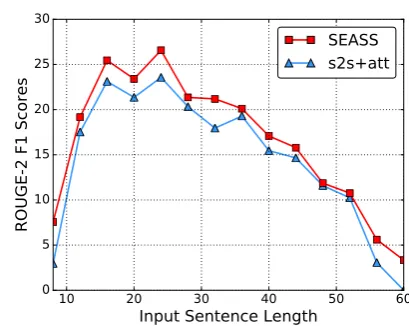
fur-ther test the SEASS model with different sentence lengths on English Gigaword test sets, which are merged from theRush et al.(2015) test set and our internal test set. The length of sentences in the test sets ranges from 10 to 80. We group the sentences with an interval of 4 and get 18 different groups and we draw the first 14 groups. We find that the performance curve of our SEASS model always appears to be on the top of that of s2s+att with a certain margin. For the groups of 16, 20, 24, 32, 56 and 60, the SEASS model obtains big improve-ments compared to the s2s+att model. Overall, these improvements on all groups indicate that the selective encoding method benefits the abstractive sentence summarization task.
10 20 30 40 50 60
Input Sentence Length
05 10 15 20 25 30
ROUGE-2 F1 Scores
SEASS
s2s+att
Figure 4: ROUGE-2 F1 score on different groups
of input sentences in terms of their length for s2s+att baseline and our SEASS model on English Gigaword test sets.
Saliency Heat Map of Selective Gate Since the
output of the selective gate network is a high di-mensional vector, it is hard to visualize all the gate values. We use the method inLi et al. (2016) to visualize the contribution of the selective gate to the final output, which can be approximated by the first derivative. Given sentence wordsxwith asso-ciated output summaryy, the trained model asso-ciates the pair(x, y)with a scoreSy(x). The goal is to decide which gate g associated with a spe-cific word makes the most significant contribution toSy(x). We approximate the Sy(g)by comput-ing the first-order Taylor expansion since the score Sy(x) is a highly non-linear function in the deep
neural network models:
Sy(g)≈w(g)Tg+b (19)
where w(g) is first the derivative of Sy with re-spect to the gateg:
w(g) = ∂(Sy)
[image:8.595.309.514.221.384.2]We then draw the Euclidean norm of the first derivative of the output y with respect to the se-lective gategassociated with each input words.
Figure3shows an example of the first derivative heat map, in which most of the important words are selected by the selective gate such as “eu-rope”, “slammed”, “unacceptable”, “conditions”, and “france”. We can observe that the selective gate determines the importance of each word be-fore decoder, which releases the burden of it by providing tailored sentence encoding.
7 Conclusion
This paper proposes a selective encoding model which extends the sequence-to-sequence model for abstractive sentence summarization task. The selective mechanism mimics one of the human summarizers’ behaviors, selecting important in-formation before writing down the summary. With the proposed selective mechanism, we build an end-to-end neural network summarization model which consists of three phases: encoding, selec-tion, and decoding. Experimental results show that the selective encoding model greatly improves the performance with respect to the state-of-the-art methods on English Gigaword, DUC 2004 and MSR-ATC test sets.
Acknowledgments
We thank Chuanqi Tan, Junwei Bao, Shuangzhi Wu and the anonymous reviewers for their helpful comments. We also thank Alexander M. Rush for providing the dataset for comparison and helpful discussions.
References
Ayana, Shiqi Shen, Zhiyuan Liu, and Maosong Sun. 2016. Neural headline generation with minimum risk training. CoRRabs/1604.01904.
Dzmitry Bahdanau, Kyunghyun Cho, and Yoshua Ben-gio. 2015. Neural machine translation by jointly learning to align and translate. InProceedings of 3rd International Conference for Learning Representa-tions. San Diego.
Michele Banko, Vibhu O Mittal, and Michael J Wit-brock. 2000. Headline generation based on statis-tical translation. In Proceedings of the 38th An-nual Meeting on Association for Computational Lin-guistics. Association for Computational Linguistics, pages 318–325.
Yoshua Bengio, R´ejean Ducharme, Pascal Vincent, and Christian Jauvin. 2003. A neural probabilistic lan-guage model. journal of machine learning research
3(Feb):1137–1155.
Jianpeng Cheng and Mirella Lapata. 2016. Neural summarization by extracting sentences and words. InProceedings of the 54th Annual Meeting of the As-sociation for Computational Linguistics (Volume 1: Long Papers). Association for Computational Lin-guistics, Berlin, Germany, pages 484–494.
Kyunghyun Cho, Bart van Merrienboer, Caglar Gul-cehre, Dzmitry Bahdanau, Fethi Bougares, Holger Schwenk, and Yoshua Bengio. 2014. Learning phrase representations using rnn encoder–decoder for statistical machine translation. InProceedings of the 2014 Conference on Empirical Methods in Nat-ural Language Processing (EMNLP). Association for Computational Linguistics, Doha, Qatar, pages 1724–1734.
Sumit Chopra, Michael Auli, and Alexander M. Rush. 2016. Abstractive sentence summarization with at-tentive recurrent neural networks. InProceedings of the 2016 Conference of the North American Chap-ter of the Association for Computational Linguis-tics: Human Language Technologies. Association for Computational Linguistics, San Diego, Califor-nia, pages 93–98.
Bonnie Dorr, David Zajic, and Richard Schwartz. 2003. Hedge trimmer: A parse-and-trim approach to head-line generation. InProceedings of the HLT-NAACL 03 on Text summarization workshop-Volume 5. As-sociation for Computational Linguistics, pages 1–8.
Xavier Glorot and Yoshua Bengio. 2010. Understand-ing the difficulty of trainUnderstand-ing deep feedforward neural networks. InAistats. volume 9, pages 249–256.
Ian J Goodfellow, David Warde-Farley, Mehdi Mirza, Aaron C Courville, and Yoshua Bengio. 2013. Max-out networks. ICML (3)28:1319–1327.
Jiatao Gu, Zhengdong Lu, Hang Li, and Victor O.K. Li. 2016. Incorporating copying mechanism in sequence-to-sequence learning. In Proceedings of the 54th Annual Meeting of the Association for Com-putational Linguistics (Volume 1: Long Papers). Association for Computational Linguistics, Berlin, Germany, pages 1631–1640.
Caglar Gulcehre, Sungjin Ahn, Ramesh Nallapati, Bowen Zhou, and Yoshua Bengio. 2016. Pointing the unknown words. In Proceedings of the 54th Annual Meeting of the Association for Computa-tional Linguistics (Volume 1: Long Papers). Asso-ciation for Computational Linguistics, Berlin, Ger-many, pages 140–149.
Kevin Knight and Daniel Marcu. 2002. Summariza-tion beyond sentence extracSummariza-tion: A probabilistic ap-proach to sentence compression. Artificial Intelli-gence139(1):91–107.
Jiwei Li, Xinlei Chen, Eduard Hovy, and Dan Juraf-sky. 2016. Visualizing and understanding neural models in nlp. InProceedings of the 2016 Confer-ence of the North American Chapter of the Associ-ation for ComputAssoci-ational Linguistics: Human Lan-guage Technologies. Association for Computational Linguistics, San Diego, California, pages 681–691.
Chin-Yew Lin. 2004. Rouge: A package for auto-matic evaluation of summaries. InText summariza-tion branches out: Proceedings of the ACL-04 work-shop. Barcelona, Spain, volume 8.
Thang Luong, Hieu Pham, and Christopher D. Man-ning. 2015. Effective approaches to attention-based neural machine translation. In Proceedings of the 2015 Conference on Empirical Methods in Natu-ral Language Processing. Association for Compu-tational Linguistics, Lisbon, Portugal, pages 1412– 1421.
Ramesh Nallapati, Bowen Zhou, C¸a glar Gulc¸ehre, and Bing Xiang. 2016. Abstractive text summariza-tion using sequence-to-sequence rnns and beyond. InProceedings of The 20th SIGNLL Conference on Computational Natural Language Learning.
Courtney Napoles, Matthew Gormley, and Benjamin Van Durme. 2012. Annotated gigaword. In Pro-ceedings of the Joint Workshop on Automatic Knowl-edge Base Construction and Web-scale KnowlKnowl-edge Extraction. Association for Computational Linguis-tics, Stroudsburg, PA, USA, AKBC-WEKEX ’12, pages 95–100.
Paul Over, Hoa Dang, and Donna Harman. 2007. Duc in context. Information Processing & Management
43(6):1506–1520.
Razvan Pascanu, Tomas Mikolov, and Yoshua Bengio. 2013. On the difficulty of training recurrent neural networks. ICML (3)28:1310–1318.
Alexander M. Rush, Sumit Chopra, and Jason Weston. 2015. A neural attention model for abstractive sen-tence summarization. In Proceedings of the 2015 Conference on Empirical Methods in Natural Lan-guage Processing. Association for Computational Linguistics, Lisbon, Portugal, pages 379–389.
Shiqi Shen, Yong Cheng, Zhongjun He, Wei He, Hua Wu, Maosong Sun, and Yang Liu. 2016. Minimum risk training for neural machine translation. In Pro-ceedings of the 54th Annual Meeting of the Associa-tion for ComputaAssocia-tional Linguistics (Volume 1: Long Papers). Association for Computational Linguistics, Berlin, Germany, pages 1683–1692.
Nitish Srivastava, Geoffrey E Hinton, Alex Krizhevsky, Ilya Sutskever, and Ruslan Salakhutdinov. 2014. Dropout: a simple way to prevent neural networks
from overfitting. Journal of Machine Learning Re-search15(1):1929–1958.
Ilya Sutskever, Oriol Vinyals, and Quoc V Le. 2014. Sequence to sequence learning with neural net-works. InAdvances in neural information process-ing systems. pages 3104–3112.
Kristina Toutanova, Chris Brockett, Ke M. Tran, and Saleema Amershi. 2016. A dataset and evaluation metrics for abstractive compression of sentences and short paragraphs. InProceedings of the 2016 Con-ference on Empirical Methods in Natural Language Processing. Association for Computational Linguis-tics, Austin, Texas, pages 340–350.
Lei Yu, Jan Buys, and Phil Blunsom. 2016. Online segment to segment neural transduction. In Pro-ceedings of the 2016 Conference on Empirical Meth-ods in Natural Language Processing. Association for Computational Linguistics, Austin, Texas, pages 1307–1316.
David Zajic, Bonnie J Dorr, Jimmy Lin, and Richard Schwartz. 2007. Multi-candidate reduction: Sen-tence compression as a tool for document summa-rization tasks. Information Processing & Manage-ment43(6):1549–1570.