163
Global Encoding for Abstractive Summarization
Junyang Lin, Xu Sun, Shuming Ma, Qi Su
MOE Key Lab of Computational Linguistics, School of EECS, Peking University School of Foreign Languages, Peking University
{linjunyang, xusun, shumingma, sukia}@pku.edu.cn
Abstract
In neural abstractive summarization, the conventional sequence-to-sequence (seq2seq) model often suffers from repetition and semantic irrelevance. To tackle the problem, we propose a global encoding framework, which controls the information flow from the encoder to the decoder based on the global information of the source context. It consists of a convolutional gated unit to perform global encoding to improve the representations of the source-side information. Evalu-ations on the LCSTS and the English Gigaword both demonstrate that our model outperforms the baseline models, and the analysis shows that our model is capable of generating summary of higher quality and reducing repetition1.
1 Introduction
Abstractive summarization can be regarded as a sequence mapping task that the source text should be mapped to the target summary. Therefore, sequence-to-sequence learning can be applied to neural abstractive summarization (Kalchbrenner and Blunsom, 2013; Sutskever et al., 2014; Cho et al.,2014), whose model consists of an encoder and a decoder. Attention mechanism has been broadly used in seq2seq models where the decoder extracts information from the encoder based on the attention scores on the source-side information (Bahdanau et al.,2014;Luong et al.,2015). Many attention-based seq2seq models have been pro-posed for abstractive summarization (Rush et al.,
2015;Chopra et al.,2016;Nallapati et al.,2016), which outperformed the conventional statistical methods.
1The code is available at https://www.github.
com/lancopku/Global-Encoding
Text: the mainstream fatah movement on monday offi-cially chose mahmoud abbas, chairman of the palestine lib-eration organization (plo), as its candidate to run for the presidential election due on jan. #, ####, the official wafa news agency reported.
seq2seq: fatah officially officially elects abbas as
candidate for candidate .
Gold: fatah officially elects abbas as candidate for presi-dential election
Table 1: An example of the summary of the con-ventional attention-based seq2seq model on the Gigaword dataset. The text highlighted indicates repetition, “#” refers to masked number.
However, recent studies show that there are salient problems in the attention mechanism.Zhou et al. (2017) pointed out that there is no obvious alignment relationship between the source text and the target summary, and the encoder outputs con-tain noise for the attention. For example, in the summary generated by the seq2seq in Table1, “of-ficially” is followed by the same word, as the at-tention mechanism still attends to the word with high attention score. Attention-based seq2seq model for abstractive summarization can suffer from repetition and semantic irrelevance, causing grammatical errors and insufficient reflection of the main idea of the source text.
濾濐濄 濾濐濄 濾濐濄 濾濐濆
濾濐濆 濾濐濆
[image:2.595.92.270.61.231.2]濕濴瀆濸 濖瀂瀁濶濴瀇
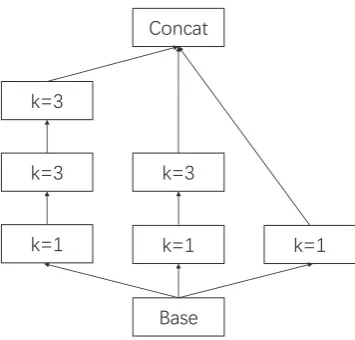
Figure 1: Structure of our proposed Convolu-tional Gated Unit. We implement 1-dimensional convolution with a structure similar to the Incep-tion (Szegedy et al.,2015) over the outputs of the RNN encoder, wherekrefers to the kernel size.
that our model is capable of reducing repetition compared with the seq2seq model.
2 Global Encoding
Our model is based on the seq2seq model with at-tention. For the encoder, we set a convolutional gated unit for global encoding. Based on the out-puts from the RNN encoder, the global encod-ing refines the representation of the source context with a CNN to improve the connection of the word representation with the global context. In the fol-lowing, the techniques are introduced in detail .
2.1 Attention-based seq2seq
The RNN encoder receives the word embedding of each word from the source text sequentially. The final hidden state with the information of the whole source text becomes the initial hidden state of the decoder. Here our encoder is a bidirectional LSTM encoder, where the encoder outputs from both directions at each time step are concatenated (hi= [
− → hi;
←− hi]).
We implement a unidirectional LSTM decoder to read the input words and generate summary word by word, with a fixed target vocabulary embedded in a high-dimensional space Y ∈ R|Y|×dim. At each time step, the decoder gener-ates a summary wordyt by sampling from a
dis-tribution of the target vocabularyPvocabuntil
sam-pling the token representing the end of sentence. The hidden state of the decoder st and the
en-coders outputhi at each time stepiof the
encod-ing process are computed with a weight matrixWa
to obtain the global attentionαt,i and the context
vectorct. It is described below:
Pvocab =sof tmax(g([ct;st])) (1)
st=LST M(yt−1, st−1, Ct−1) (2)
ct= n
X
i=1
αt,ihi (3)
αt,i =
exp(et,i)
Pn
j=1exp(et,j)
(4)
et,i =s>t−1Wahi (5)
whereCrefers to the cell state in the LSTM, and g(·)refers to a non-linear function.
2.2 Convolutional Gated Unit
be-low:
gi =ReLU(W[hi−k/2, ..., hi+k/2] +b) (6)
where ReLU refers to the non-linear activation function Rectified Linear Unit (Nair and Hinton,
2010). Based on the convolution block, we imple-ment a structure similar to inception, as shown in Figure1.
On top of the new representations generated by the CNN module, we further implement self-attention upon these representations so as to dig out the global correlations. Vaswani et al.(2017) pointed out that self-attention encourages the model to learn long-term dependencies and does not create much computational complexity, so we implement its scaled dot-product attention for the connection between the annotation at each time step and the global information:
Attention(Q, K, V) =sof tmax(QK
T
√ dk
)V (7)
where the representations, are computed through the attention mechanism with itself and packed into a matrix. To be specific, we referQ andV to the representation matrix generated by the CNN module, whileK =WattV whereWattis a
learn-able matrix.
A further step is to set a gate based on the gen-eration from the CNN and self-attention module gfor the source representationsh0 from the RNN encoder, where:
˜
h=hσ(g) (8)
Since the CNN module can extract n-gram fea-tures of the whole source text and self-attention learns the long-term dependencies among the components of the input source text, the gate can perform global encoding on the encoder outputs. Based on the output of the CNN and self-attention, the logistic sigmoid function outputs a vector of value between 0 and 1 at each dimension. If the value is close to 0, the gate removes most of the information at the corresponding dimension of the source representation, and if it is close to 1, it re-serves most of the information.
2.3 Training
In the following, we introduce the datasets that we conduct experiments on as well as our experimen-tal settings.
Given the parameters θ and source text x, the models generates a summaryy˜. The learning pro-cess is to minimize the negative log-likelihood be-tween the generated summaryy˜and referencey:
L=−1 N
N X
n=1 T X
t=1
p(yt(n)|y˜<t(n), x(n), θ) (9)
where the loss function is equivalent to maximiz-ing the conditional probability of summaryygiven parametersθand source sequencex.
3 Experiment Setup
In the following, we introduce the datasets that we conduct experiments on and our experiment set-tings as well as the baseline models that we com-pare with.
3.1 Datasets
LCSTS is a large-scale Chinese short text sum-marization dataset collected from Sina Weibo, a famous Chinese social media website (Hu et al.,
2015), consisting of more than 2.4 million text-summary pairs. The original texts are shorter than 140 Chinese characters, and the summaries are created manually. We follow the previous research (Hu et al.,2015) to split the dataset for training, validation and testing, with 2.4M sentence pairs for training, 8K for validation and 0.7K for test-ing.
The English Gigaword is a sentence summa-rization dataset based on Annotated Gigaword (Napoles et al.,2012), a dataset consisting of sen-tence pairs, which are the first sensen-tence of the col-lected news articles and the corresponding head-lines. We use the data preprocessed byRush et al.
(2015) with 3.8M sentence pairs for training, 8K for validation and 2K for testing.
3.2 Experiment Settings
We implement our experiments in PyTorch on an NVIDIA 1080Ti GPU. The word embedding di-mension and the number of hidden units are both 512. In both experiments, the batch size is set to 64. We use Adam optimizer (Kingma and Ba,
2014) with the default setting α = 0.001, β1 = 0.9, β2 = 0.999and = 1×10⁻⁸. The learn-ing rate is halved every epoch. Gradient clipplearn-ing is applied with range [-10, 10].
Model R-1 R-2 R-L
RNN 21.5 8.9 18.6
RNN-context 29.9 17.4 27.2
CopyNet 34.4 21.6 31.3
SRB 33.3 20.0 30.1
DRGD 37.0 24.2 34.2
seq2seq (Our impl.) 33.8 23.1 32.5
[image:4.595.321.513.61.200.2]+CGU 39.4 26.9 36.5
Table 2:F-Score of ROUGE on LCSTS.
calculate the degree of overlapping between gen-erated summary and reference, including the num-ber of n-grams. F1 scores of 1, ROUGE-2 and ROUGE-L are used as the evaluation met-rics.
3.3 Baseline Models
As we compare our results with the results of the baseline models reported in their original papers, the evaluation on the two datasets has different baselines. In the following, we introduce the base-lines for LCSTS and Gigaword respectively.
Baselines for LCSTS are introduced in the fol-lowing. RNN and RNN-context are the RNN-based seq2seq models (Hu et al., 2015), without and with attention mechanism respectively. Copy-Netis the attention-based seq2seq model with the copy mechanism (Gu et al.,2016).SRBis a model that improves semantic relevance between source text and summary (Ma et al.,2017).DRGDis the conventional seq2seq with a deep recurrent gener-ative decoder (Li et al.,2017).
As to the baselines for Gigaword, ABS and ABS+ are the models with local attention and handcrafted features (Rush et al., 2015). Feats is a fully RNN seq2seq model with some spe-cific methods to control the vocabulary size. RAS-LSTMandRAS-Elmanare seq2seq models with a convolutional encoder and an LSTM decoder and an Elman RNN decoder respectively. SEASS is a seq2seq model with a selective gate mecha-nism.DRGDis also a baseline for Gigaword.
Results of our implementation of the conven-tional seq2seq model on both datasets are also used for the evaluation of the improvement of our proposed convolutional gated unit (CGU).
4 Analysis
In the following sections, we report the results of our experiments and analyze the performance of
Model R-1 R-2 R-L
ABS 29.6 11.3 26.4
ABS+ 29.8 11.9 27.0
Feats 32.7 15.6 30.6
RAS-LSTM 32.6 14.7 30.0
RAS-Elman 33.8 16.0 31.2
SEASS 36.2 17.5 33.6
DRGD 36.3 17.6 33.6
seq2seq (Our impl.) 33.6 16.3 31.3
[image:4.595.86.279.61.173.2]+CGU 36.3 18.0 33.8
Table 3:F-Score of ROUGE on Gigaword.
our model on the evaluation of repetition. Also, we provide an example to demonstrate that our model can generate summary that is more seman-tically consistent with the source text.
4.1 Results
In the experiments on the two datasets, our model achieves advantages of ROUGE score over the baselines, and the advantages of ROUGE score on the LCSTS are significant. Table 2 presents the results of our model and the baselines on the LC-STS, and Table2 shows the results of models on the Gigaword. We compare the F1 scores of our model with those of the baseline models (reported in their original articles) and our own implemen-tation of the attention-based seq2seq. Compared with the conventional seq2seq model, our model owns an advantage of ROUGE-2 score 3.7 and 1.5 on the LCSTS and Gigaword respectively.
4.2 Discussion
Source: 较早进入中国市场的星巴克,是不少小资钟
情的品牌。相比在美国的平民形象,星巴克在中国就
显得“高端”得多。用料并无差别的一杯中杯美式咖 啡,在美国仅约合人民币12元,国内要卖21元,相当 于贵了75%。第一财经日报
Starbucks, which entered Chinese market early, is a brand appealing to young people of petit bourgeoisie. Compared with its ordinary image in the United States, Starbucks seems to be of higher class in China. A Tall Americano sells about 12RMB in the United States, but 21RMB in China, which means it is 75% more expensive.
Reference: 媒体称星巴克美式咖啡售价中国比美国 贵75%。
Media report that the price of Starbucks Americano in China is 75% more expensive than that in the United States.
seq2seq:星巴克中国美式咖啡在中国。 Starbucks China Americano in China.
+CGU:星巴克美式咖啡中国贵75%。
Starbucks Americano is 75% more expensive in China.
Table 4: An example of our summarization, com-pared with that of the seq2seq model and the ref-erence.
out the price gap in its generated summary. As “China” appears twice in the source text and it is hard for the baseline model to put it in a less sig-nificant place, but for our model with CGU, it is able to filter the trivial details that are irrelevant to the core meaning of the source text and just fo-cuses on the information that contributes most to the main idea.
As our CGU is responsible for selecting impor-tant information of the outputs from the RNN en-coder to improve the quality of the attention score, it should be able to reduce repetition in the gen-erated summary. We evaluate the degree of repe-tition by calculating the percentage of the dupli-cates at the sentence level. The evaluations on the Gigaword for duplicates of 1-gram to 4 gram prove that our model significantly reduces repeti-tion compared to the convenrepeti-tional seq2seq and its repetition rate is similar to the reference’s. This also shows that our model is able to generate sum-maries of higher diversity with less repetition.
5 Related Work
Researchers developed many statistical methods and linguistic-rule-based methods to study auto-matic summarization (Banko et al., 2000; Dorr et al.,2003;Zajic et al.,2004;Cohn and Lapata,
2008). With the development of Neural Network in NLP, more and more researches have appeared in abstractive summarization since it seems possi-ble that Neural Network can help achieve the two goals. Rush et al.(2015) first applied
sequence-1-gram 2-gram 3-gram 4-gram
0 2 4
%
of
the
duplicates
[image:5.595.311.494.59.213.2]w/o CGU CGU Reference
Figure 2: Percentage of the duplicates at sen-tence level.Evaluated on the Gigaword.
to-sequence model with attention mechanism to abstractive summarization and realized significant achievements. Chopra et al. (2016) changed the ABS model with an RNN decoder and Nallap-ati et al. (2016) changed the system to a fully-RNN sequence-to-sequence model and achieved outstanding performance. Zhou et al.(2017) pro-posed a selective gate mechanism to filter sec-ondary information. Li et al. (2017) proposed a deep recurrent generative decoder to learn latent structure information.Ma et al.(2018) proposed a model that generates words by querying word em-beddings.
6 Conclusion
In this paper, we propose a new model for abstrac-tive summarization. The convolutional gated unit performs global encoding on the source side in-formation so that the core inin-formation can be re-served and the secondary information can be fil-tered. Experiments on the LCSTS and Gigaword show that our model outperforms the baselines, and the analysis shows that it is able to reduce repetition in the generated summaries, and it is more robust to inputs of different lengths, com-pared with the conventional seq2seq model.
Acknowledgements
References
Dzmitry Bahdanau, Kyunghyun Cho, and Yoshua Bengio. 2014. Neural machine translation by jointly learning to align and translate. CoRR, abs/1409.0473.
Michele Banko, Vibhu O Mittal, and Michael J Wit-brock. 2000. Headline generation based on statisti-cal translation. InProceedings of the 38th Annual Meeting on Association for Computational Linguis-tics, pages 318–325. Association for Computational Linguistics.
Kyunghyun Cho, Bart van Merrienboer, C¸ aglar G¨ulc¸ehre, Dzmitry Bahdanau, Fethi Bougares, Hol-ger Schwenk, and Yoshua Bengio. 2014. Learning phrase representations using RNN encoder-decoder for statistical machine translation. InEMNLP 2014, pages 1724–1734.
Sumit Chopra, Michael Auli, and Alexander M. Rush. 2016. Abstractive sentence summarization with at-tentive recurrent neural networks. InConference of the North American Chapter of the Association for Computational Linguistics: Human Language Tech-nologies, pages 93–98.
Trevor Cohn and Mirella Lapata. 2008. Sentence com-pression beyond word deletion. In Proceedings of the 22nd International Conference on Computa-tional Linguistics-Volume 1, pages 137–144. Asso-ciation for Computational Linguistics.
Bonnie Dorr, David Zajic, and Richard Schwartz. 2003. Hedge trimmer: A parse-and-trim approach to headline generation. InProceedings of the HLT-NAACL 03 on Text summarization workshop-Volume 5, pages 1–8. Association for Computational Lin-guistics.
Jiatao Gu, Zhengdong Lu, Hang Li, and Victor O. K. Li. 2016. Incorporating copying mechanism in sequence-to-sequence learning. InACL 2016.
Baotian Hu, Qingcai Chen, and Fangze Zhu. 2015. LC-STS: A large scale chinese short text summarization dataset. InEMNLP 2015, pages 1967–1972.
Nal Kalchbrenner and Phil Blunsom. 2013. Recurrent continuous translation models. In EMNLP 2013, pages 1700–1709.
Diederik P. Kingma and Jimmy Ba. 2014. Adam: A method for stochastic optimization. CoRR, abs/1412.6980.
Piji Li, Wai Lam, Lidong Bing, and Zihao Wang. 2017. Deep recurrent generative decoder for abstractive text summarization. InEMNLP 2017,, pages 2091– 2100.
Chin Yew Lin and Eduard Hovy. 2003. Auto-matic evaluation of summaries using n-gram co-occurrence statistics. In Conference of the North
American Chapter of the Association for Computa-tional Linguistics on Human Language Technology, pages 71–78.
Thang Luong, Hieu Pham, and Christopher D. Man-ning. 2015. Effective approaches to attention-based neural machine translation. InEMNLP 2015, pages 1412–1421.
Shuming Ma, Xu Sun, Wei Li, Sujian Li, Wenjie Li, and Xuancheng Ren. 2018. Query and output: Gen-erating words by querying distributed word repre-sentations for paraphrase generation. In NAACL 2018.
Shuming Ma, Xu Sun, Jingjing Xu, Houfeng Wang, Wenjie Li, and Qi Su. 2017. Improving semantic relevance for sequence-to-sequence learning of chi-nese social media text summarization. InACL 2017, pages 635–640.
Vinod Nair and Geoffrey E. Hinton. 2010. Rectified linear units improve restricted boltzmann machines. InICML 2010, pages 807–814.
Ramesh Nallapati, Bowen Zhou, C´ıcero Nogueira dos Santos, C¸ aglar G¨ulc¸ehre, and Bing Xiang. 2016. Abstractive text summarization using sequence-to-sequence rnns and beyond. InCoNLL 2016, pages 280–290.
Courtney Napoles, Matthew Gormley, and Benjamin Van Durme. 2012. Annotated gigaword. In Pro-ceedings of the Joint Workshop on Automatic Knowl-edge Base Construction and Web-scale KnowlKnowl-edge Extraction, pages 95–100. Association for Compu-tational Linguistics.
Alexander M. Rush, Sumit Chopra, and Jason Weston. 2015. A neural attention model for abstractive sen-tence summarization. InEMNLP 2015, pages 379– 389.
Xu Sun, Bingzhen Wei, Xuancheng Ren, and Shuming Ma. 2017. Label embedding network: Learning la-bel representation for soft training of deep networks. CoRR, abs/1710.10393.
Ilya Sutskever, Oriol Vinyals, and Quoc V. Le. 2014. Sequence to sequence learning with neural net-works. InAdvances in Neural Information Process-ing Systems 27: Annual Conference on Neural Infor-mation Processing Systems 2014, pages 3104–3112.
Christian Szegedy, Vincent Vanhoucke, Sergey Ioffe, Jonathon Shlens, and Zbigniew Wojna. 2015. Re-thinking the inception architecture for computer vi-sion.CoRR, abs/1512.00567.
Ashish Vaswani, Noam Shazeer, Niki Parmar, Jakob Uszkoreit, Llion Jones, Aidan N. Gomez, Lukasz Kaiser, and Illia Polosukhin. 2017. Attention is all you need. InNIPS 2017, pages 6000–6010.
David Zajic, Bonnie Dorr, and Richard Schwartz. 2004. Bbn/umd at duc-2004: Topiary. In Proceedings of the HLT-NAACL 2004 Document Understanding Workshop, Boston, pages 112–119.