Original citation:
Clarke, C. T. and Nudd, G. R. (1994) Highly non-linear encoders for current mode multiple-valued logic. University of Warwick. Department of Computer Science. (Department of Computer Science Research Report). (Unpublished) CS-RR-265
Permanent WRAP url:
http://wrap.warwick.ac.uk/60944
Copyright and reuse:
The Warwick Research Archive Portal (WRAP) makes this work by researchers of the University of Warwick available open access under the following conditions. Copyright © and all moral rights to the version of the paper presented here belong to the individual author(s) and/or other copyright owners. To the extent reasonable and practicable the material made available in WRAP has been checked for eligibility before being made available.
Copies of full items can be used for personal research or study, educational, or not-for-profit purposes without prior permission or charge. Provided that the authors, title and full bibliographic details are credited, a hyperlink and/or URL is given for the original metadata page and the content is not changed in any way.
A note on versions:
The version presented in WRAP is the published version or, version of record, and may be cited as it appears here.For more information, please contact the WRAP Team at:
Highly non-linear encoders for
Current Mode Multiple-Valued
L o g i c
C.T. Clarke and G.R. Nudd
Department of Computer Science University of Warwick
Coventry CV4 7AL United Kingdom
Abstract:
This paper describes the use of highly non-linear encoders to provide low power
Current Mode Multiple Valued Logic (CMMVL) circuits. A maximum function is shown,
that consumes much less power than previously reported circuits. The encoding system is
based upon using a single transistor between the encoder output and ground to provide a
'very negative' signal that overrides any other connection to the output node.
Introduction
Current Mode Multiple Valued Logic (CMMVL) uses the size (and sometimes
sign) of a current to represent the value of a signal. Kirchhoffs current law allows two
currents to be summed on a node, and previously reported applications use this to form
adders [1,2]. It is possible to form other functions such as single digit products [3]. In
this paper the use of highly non-linear current mode encoders is discussed. One possible
output of an encoder is described simply as 'very negative', and can be used as an
overriding signal. The highly non-linear encodings lead to circuits capable of forming any
logical function, and require very low resolution from the fabrication process.
Circuits designed using current mode MVL will only be efficient in terms of time,
area and power if they take full advantage of the summing node. Because of this, any
methodology for current mode MVL design must focus on this. Circuits can have many
manner of the designer's choice so that the decoding logic is simple. Current mode
circuits can generally be decomposed into the free summing function and three distinct
sections: a decoder, binary logic (which is not always present), and an encoder circuit.
This form is shown in figure 1. The inputs to the circuit are summed on the input node
and fed to the decoder. The decoder produces a set of binary signals each of which
indicates whether the input current total was above or below a particular current level.
These signals can then be adapted by the binary circuits to form signals that can correctly
operate the encoders which provide the current mode output signal. This structure has
been shown in Current's Quaternary Full Adder (QFA) [1].
Decode Logic Encode I
n p u t s
[image:3.595.144.501.305.370.2]Output
Figure 1. Decomposition of a current mode circuit.
If a circuit has two input values x and y, and they have been encoded as currents
using the functions A(), and B() respectively, then when they are summed together, the
sum is equal to A(x)+B(y). The functions A() and B() may be linear, and may be the
same as each other. The summed current is then decoded and acted on by the logic,
which can be represented by the function C(). Hence the value that the final encoder
encodes is C(A(x)+B(y)). For a full adder, there are two outputs, and each has its own
function C(). The carry function is in effect a quantised division by four, and the sum
output is a modulo four function.
The "grounded output" encoding
In certain situations, an encoder can be designed so that a negative current does
not have any specified current itself, but instead can sink so much current that the node is
grounded when that encoding is specified. This can be demonstrated by the use of an
for an input value of 3. This means that if the first encoder has a 3 as its input, the output
of the second encoder will flow into the first encoder rather than the decoder. The
decoder input stage is uni-directional, so the current flowing into the first encoder is the
current output by the second encoder. The decoder will detect no current since it all flows
into the first encoder. A 1 unit current source is added to the node unswitched to allow
the circuit to differentiate between and input of 0 on both inputs and an input of 3 on
either. This form of encoding is very simple to produce, as shown in figure 2a. The
n-type transistor must be made large enough that it can sink the maximum output current
from the other encoder, and the 1 unit unswitched current source, with a negligible
voltage drop across it. The n-type transistor does not have to sink current from its own
current sources since it is switched so that only the current source or sink is on at any one
time, and not both.
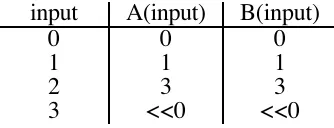
input A(input) B(input)
0 0 0
1 1 1
2 3 3
[image:4.595.229.396.358.422.2]3 <<0 <<0
Table 1. A maximum function encoding that uses a grounding output.
1 2 Vdd >0 >1 >2 Output Gnd I n p u t s 1 2 Vdd >0 >1 >2 Output Gnd I n p u t s a) b)
Figure 2. The encoder for the maximum function. a) normal, b) complemented
The sum of input currents verses the output value required for those inputs is
given in table 2. The maximum current for this encoding is considerably lower than is
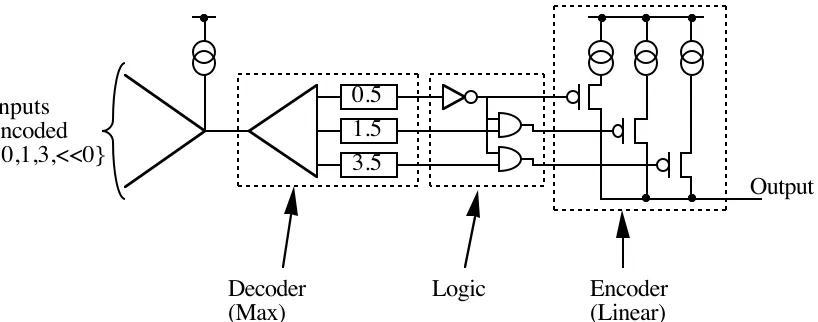
[image:4.595.145.505.469.638.2]1.5, and 3.5 current units. The decoder required for the grounding output encoding of the
maximum function is shown in figure 3.
Max
0 1 2 3
C 0 ✓
u 1 ✓
r 2 ✓
r 3 ✓
e 4 ✓
n 5 ✓
[image:5.595.190.447.118.242.2]t 7 ✓
Table 2. The sum of currents vs. output value for the grounding output encoding (including 1 current unit unswitched source).
0.5 1.5 3.5
Output Inputs
encoded {0,1,3,<<0}
Encoder (Linear) Decoder
(Max)
Logic
Figure 3. The maximum function decoder and logic for use with the grounding output encoders.
The grounding output encoder can only be used with a specific type of function,
because if one encoder grounds the node, there is no way of distinguishing between the
different outputs of the other encoder. Hence the grounding output can only be used if
one particular input value to one of the encoders always results in the same output
regardless of the other encoders input value. In the case of the maximum function, if
either encoder has a 3 input to it, then the output must be a 3, and so the input value 3 can
be used to ground the summing node.
The grounding output is clearly very useful, but there is one disadvantage to this
[image:5.595.123.532.301.462.2]since the current mode mirrors can be made faster if they are biased with a small amount
of current so that they are always conducting.
A current mode MVL logic set
A full set of logical functions can be created from a maximum function so long as
the output can be complemented. The minimum function is used with the maximum
function, but this can be created by inverting the inputs and output of a maximum
function. The grounded output encoding can be complemented as shown in figure 2b.
The inverters may be omitted if n-type transistors can be used as the current switches. In
this case, the complemented encoding would be smaller than the un-complemented
encoding. This is because the grounding transistor must be an n-type transistor and hence
the inverter in the un-complemented encoding shown in figure 2a cannot be removed.
Even using p-type switch transistors, the complemented encoder uses only one more
inverter (i.e. two transistors) than the un-complemented encoder.
The MAX function using optionally complemented grounded output encoders
provides the ability to produce any logical function, with very low resolution
requirements (maximum threshold of 3.5 current units).
Conclusions
The 'grounded output' concept of non-linear current encoding has been developed
in this paper. The concept has been shown to be of use in the creation of maximum
function blocks that can, with complemented outputs be used to produce any logical
function. Hence, there is now the potential for a more efficient implementation of
functions than those previously reported [3].
References
[1] "A CMOS multiple valued logic test chip", K.W. Current, F. Edwards and D.
Freitas, Proceedings IEEE 17th International Symposium on Multiple Valued
[2] "A high-speed compact multiplier based on multiple-valued bi-directional
current-mode circuits", S. Kawahito, M. Kameyama, T. Higuchi and H. Yamada,
Proceedings IEEE 17th International Symposium on Multiple Valued Logic, May
1987, pp. 172-180.
[3] "VLSI Arithmetic With Current Mode Multiple Valued Logic", S. Summerfield,
C.T. Clarke and G.R. Nudd, Proceedings IEEE International Symposium on