University of Warwick institutional repository: http://go.warwick.ac.uk/wrap
This paper is made available online in accordance with
publisher policies. Please scroll down to view the document
itself. Please refer to the repository record for this item and our
policy information available from the repository home page for
further information.
To see the final version of this paper please visit the publisher’s website.
Access to the published version may require a subscription.
Author(s): Alexander I. Bufetov and Caroline Series
Article Title: A pointwise ergodic theorem for Fuchsian groups
Year of publication: 2011
Link to published article:
http://dx.doi.org/10.1017/S0305004111000247
Publisher statement: Bufetov, A. I. and Series, C. (2011). A pointwise
ergodic theorem for Fuchsian groups. Mathematical Proceedings of the
Cambridge Philosophical Society, 151(1), pp. 145-159, doi:
10.1017/S0305004111000247, Copyright © Cambridge Philosophical
Society 2011. To view the published open abstract, go to
doi:10.1017/S0305004111000247
First published online 27 April 2011
145
A pointwise ergodic theorem for Fuchsian groups
BYALEXANDER I. BUFETOV
The Steklov Institute of Mathematics, Russian Academy of Sciences Gubkina Str.8, 119991, Moscow, Russia.
e-mail:[email protected]
ANDCAROLINE SERIES
Mathematics Institute, University of Warwick Coventry CV4 7AL.
e-mail:[email protected]
(Received26October2010;revised4February2011)
Abstract
We use Series’ Markovian coding for words in Fuchsian groups and the Bowen-Series coding of limit sets to prove an ergodic theorem for Ces`aro averages of spherical averages in a Fuchsian group.
1. Introduction
1·1. An ergodic theorem for surface groups
Letg2 and letbe the fundamental group of a surface of genusgendowed with a set of generators
{a1, . . . ,a2g,b1, . . . ,b2g} (1·1)
satisfying the standard commutator relation
2g
i=1
[ai,bi] =1.
Forg∈, let|g|stand for the length of the shortest word in the generators (1·1) repres-entingg. Let
S(n)= {g∈: |g| =n}
be the sphere of radiusnin, and letKn be the cardinality of S(n). A special case of the main result of this note is the following pointwise ergodic theorem for:
THEOREMA. Letact ergodically on a probability space(X, ν)by measure-preserving
transformations, and, for g ∈, let Tg be the corresponding transformation. Then for any ϕ∈L1(X, ν)we have
1
N
N−1
n=0
1
Kn
g∈S(n)
ϕ◦Tg −→
X
ϕdν (1·2)
Our main result, Theorem B, is that a similar ergodic theorem applies much more gener-ally to any finitely generated Fuchsian group with a suitable choice of generating set, see Section 2·5 for a precise statement. For the finite volume cocompact case and functions in
L2, the result is due to Fujiwara and Nevo [8, theorem 4]. For numerous examples of actions
to which this theorem applies, see [9,14]. Theorem B is derived from a pointwise ergodic theorem for free semigroups from [7] whose formulation we shortly recall. For previous literature on pointwise ergodic theorems for actions of various classes of non-amenable dis-crete groups, see for example [4,9,11,12,13,15,16] and also the comprehensive recent survey on free group actions in [1].
1·2. Ergodic theorems for free semigroups
Let (X, ν) be a probability space and let T1, . . . ,Tm: X → X be ν-preserving trans-formations.
Denote byWmthe set of all finite words in the symbols 1, . . . ,m:
Wm= {w=w1· · ·wn, wi ∈ {1, . . . ,m}}.
The length of a wordwis denoted by|w|. For eachw ∈ Wm,w = w1· · ·wn, define the
transformationTwby the formula
Tw=Tw1· · ·Twn.
Now let A be an m ×m-matrix with non-negative entries. For each w ∈ Wm, w = w1· · ·wn, set
A(w)= Aw1w2· · ·Awn−1wn.
Now let ϕ be a measurable function on X and for each n = 0,1, . . ., consider the expression
snAϕ=
|w|=n A(w)ϕ◦Tw
|w|=n A(w)
, (1·3)
where we assume that the denominator does not vanish.
Furthermore, consider Ces`aro averages of the “sphere averages”sA
n and set:
cNA(ϕ)= 1 N
N−1
n=0
snA(ϕ). (1·4)
Definition1. A matrixAwith non-negative entries is called irreducible if for somen>0 all entries of the matrix A+A2+ · · · +An are positive.
Definition2. A matrix A with non-negative entries is called strictly irreducible if Ais irreducible andA AT is irreducible (hereAT stands for the transpose ofA).
A measurable subset Y ⊂ X will be called T1, . . . ,Tm- invariant if its characteristic
function χY satisfies T1χY = · · · = TmχY = χY. Denote by B the σ-algebra of all
T1, . . . ,Tm- invariant subsets of X. Givenϕ ∈ L1(X, ν), denote byE(ϕ|B)the conditional
e−1R R e(R)
e
[image:4.493.114.368.65.154.2]e−1 e−1 e
Fig. 1. Labelling the sides of the fundamental domainR. The labeleappears interior toRon the side of adjacent to the regione−1R.
We now recall [6, corollary 2]:
PROPOSITION1. Let A be a strictly irreducible m×m matrix. Let T1, . . . ,Tmbe
measure-preserving self-maps of a probability space(X, ν). LetBbe theσ-algebra of T1, . . . ,Tm
-invariant measurable sets. Then for eachϕ∈L1(X, ν)we have cNA(T)ϕ→E(ϕ|B)almost
everywhere and in L1(X, ν)as N → ∞.
Theorems A and B will be derived from Proposition 1 using the Markov coding for Fuch-sian groups introduced in [5], see also [17,20].
2. Markov maps for Fuchsian groups
Letbe a finitely generated non-elementary Fuchsian group acting in the hyperbolic disk
D. The Markov coding, originally introduced in [5] to encode limit points of as infinite words in a fixed set of generators, also gives a canonical shortest form for words in . The coding is defined relative to a fixed choice of fundamental domainRfor, which we suppose is a finite sided convex polygon with vertices contained inD∂D, such that the interior angle at each vertex is strictly less thanπ. By asideofRwe mean the closure in
Dof the geodesic arc joining a pair of adjacent vertices. We allow the infinite area case in which some adjacent vertices on∂Dare joined by an arc contained in∂D; we do not count these arcs as sides ofR. We assume that the sides ofRare paired; that is, for each sides
ofRthere is a (unique) elemente ∈ such thate(s)is also a side ofRand such thatR ande(R)are adjacent alonge(s). (Notice that this includes the possibility thate(s)=s, in which caseeis elliptic of order 2 and the sides contains the fixed point ofein its interior. The condition that the vertex angle is strictly less thanπ excludes the possibility that the fixed point ofeis counted as a vertex ofR.)
We denote by ∂R the union of the sides of R, in other words, ∂R is the part of the boundary ofR inside the diskD. Each side of∂Ris assigned two labels, one interior to
Rand one exterior, in such a way that the interior and exterior labels are mutually inverse elements of. We label the sides⊂∂Rinterior toRbyeifecarriessto another sidee(s)
ofR, while we label the same side exterior toRbye−1, see Figure 1. With this convention, Rande−1(R)are adjacent along the side whoseinteriorlabel ise, while the sidee(s)has
interior labele−1.
Let0 be the set of labels of sides ofR. The labelling extends to a-invariant labelling
of all sides of the tessellationT ofDby images ofR. The conventions have been chosen in such a way that if two regionsgR,hRare adjacent along a common sides, thenh−1g∈
0
and the label on s interior to gR is h−1g, while that on the side interior to hR is g−1h.
g O,g∈, which avoids all vertices ofT, passing through in order adjacent regionsR=
g0R,g1R, . . . ,gnR = gR. Then the labels of the sides crossed byγ, read in such a way that ifγ crosses from gi−1Rinto giR we read off the labelei = gi−−11gi of the common side interior togiR, are in ordere1,e2, . . . ,en so thatg= e1e2· · ·en. This proves the well known fact that0generates, see for example [2]. In particular, if we read off labels round
a small loop round vertexvofR, we obtain thevertex cycleatvwith correspondingvertex relation e1e2· · ·en = id. The generating sets implicit in Theorem B are obtained in this way.
Following [5], the fundamental domainR is said to haveeven cornersif for each side
s of R, the complete geodesic inD which extends s is contained in the sides of T. This condition is satisfied for example, by the regular 4g-gon of interior angleπ/2gwhose sides can be paired with the generating set of Theorem A to form a surface of genus g. If the pathγ from O tog O described above is a hyperbolic geodesic andR has even corners, then the corresponding representation ofgby the worde1e2· · ·enis shortest in(, 0), see
[3,20].
Let |∂R| denote the number of sides of R. In [5] we showed that, subject to certain restrictions if|∂R|4, one can associate to any fundamental domain with even corners an alphabetAand a transition matrix P, so thatAis mapped by a finite-to-one mapπ onto 0, in such a way that the obvious extension ofπ to a map from the set of finite sequences
with alphabetAand allowed transitions defined by Pto the groupis surjective. We call this mapπ, thealphabet map. A crucial feature of the alphabet map is that every word in its image is shortest in the word metric on(, 0), see [20] and Theorem 2 below. In particular
πpreserves length, that is, the image underπ of a sequence ofnsymbols inAis an element
g ∈of shortest lengthnrelative to the generators0. Thus to sum overg ∈for which |g| =nas required by Theorems A and B, we need only sum over all allowable finite words of lengthnin the alphabetA.
It follows that in order to apply Proposition 1, we need only check whether the transition matrix P is irreducible and strictly irreducible and that π is, in a precise sense, almost bijective to. Our main work is to show that (subject to some restrictions if|∂R|<5) this is indeed the case, see Propositions 9, 13 and 15.
Notice that the statements of Theorems A and B only involve enumerating words in (, 0)and are independent of the precise geometry ofR. Thus for example one can replace
the regular 4g-gon with any hyperbolic octagon whose interior angles sum to 2π and with generators given by the same combinatorial pattern of side pairings. We elaborate on this observation in Section 2·1·2, where we explain why requiring a generating set which comes from a fundamental domain with even corners is much more general that it appears, leading to the general statement in Theorem B.
2·1. The coding
We briefly review the coding as explained in [20], in which it appears in a simpler and more general form than in the original version [5].
By abuse of notation from now on we think of the tessellationT as the union of its sides, preciselyT = {g(∂R): g ∈}. We assume throughout our discussion thatRhas even corners, so thatT is a union of complete geodesics inD. LetP ⊂ ∂Dbe the collection of endpoints of those geodesics inT which meet∂R(crucially this includes lines which meet ∂Ronly in a vertex ofR). The points ofPpartition∂D−Pinto connected open intervals
Lets =s(e)be the side ofRwhoseexteriorlabel ise. The extension ofsinto a complete geodesic lies inT, separatingDinto two half planes, one of which contains the interior of
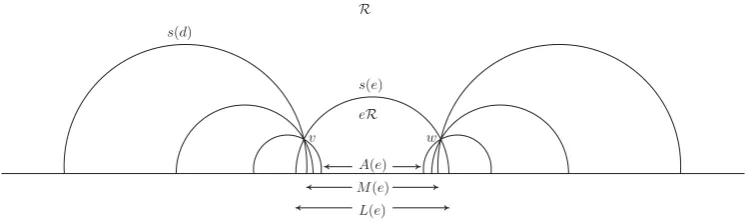
R and one of which contains the interior of eR, see Figure 1. Let L(e) denote the open arc on∂Dbounding the component which containseR, see Figure 3. Each interval I ∈I
is contained in L(e)for at least one and at most two sides of ∂R (see Lemma 5 below for a full justification of this fact). For each I ∈ I, choose e = e(I) ∈ 0 such that I ⊂ L(e). We define a map f : ∂D−P → ∂Dby f(x)= e(I)−1(x)forx ∈ I. Extend f to a (discontinuous) possibly two valued map on P in the obvious way. As observed in [5,20], the map f isMarkov in the sense that for any J ∈ I, f(I) J 6implies that f(I) ⊃ J. To see this, it is clearly sufficient to show that f(P) ⊂ P, independently of which of the possibly two choices we make for f. So supposeξ ∈ P is an endpoint of an interval I ⊂ L(e)and that f(ξ) = e(I)−1(ξ). Writee = e(I). From the definitions,ξ
is an endpoint of a geodesict which meets the closure of the sides =s(e)ofR. From the definition of the labelling,e−1(s(e))= s(e−1)is also a side ofR. Hence f(ξ)= e−1(ξ)is
an endpoint ofe−1(t)ande−1(t)must meet the closure ofs(e−1), hence f(ξ)∈P.
2·1·1. The alphabet map
We define our alphabet by settingA = I, in other words,Ais the collection of all the intervals defined by the subdivision of ∂D by points inP. We define a transition matrix
P=(pI,J)bypI,J =1 if f(I)⊃ Jand pI,J =0 otherwise. LetF denote the set of finite sequences Ii0· · ·Iin with Iir ∈I such that pIir−1,Iir >0 for allr = 0, . . . ,n−1. ThusF
consists of all allowable finite sequences in the subshift on the symbolsI ∈Iwith transition rule specified byP.
Thealphabet mapπ: I→0is the map which associates to eachI ∈Ithe elemente∈
0 corresponding to our choice ofefor whichI ⊂ L(e), equivalently for which f|I =e−1. This extends in an obvious way to a mapπ :F →. Recall that a product ofnelements of0isshortest(with respect to the generators0) if it cannot be expressed as a product of
less thannelements of0. An important feature of the coding is the following result which
follows from [19, theorem 5·10 and corollary 5·11], see also [2, theorem 2·8].
THEOREM2. Suppose thatRhas even corners and that either:
(i) |∂R|5;or
(ii) |∂R| = 4and, if in addition all vertices ofRlie inD, then at least three geodesics inT meet at each vertex;or
(iii) |∂R| =3and at least one vertex ofRis on∂D.
Then the alphabet mapπis surjective to. Moreover every word inπ(F)is shortest with
respect to the geometric generators0associated toRas above, and each element g ∈ has auniquerepresentation inπ(F).
In what follows, we always assume thatRsatisfies one of the hypotheses of Theorem 2. Uniqueness means that any g ∈ has a unique representation as a wordei1· · ·ein in the
image of π; however we may have two distinct sequences Ii1· · ·Iin and Ij1· · ·Ijn with
π(Iir) = π(Ijr) for all r. A key point in the proof of Theorem B is to show that π is
nevertheless almost injective, precisely:
PROPOSITION3. Let g∈. Thenπ−1(g)2and#{g: |g| =n, π−1(g)|>1}/n→0
2·1·2. Ubiquity of even corners
The condition thatRhave even corners may seem very special. However our result de-pends only on the combinatorics of the generating set, so that regions which do not have even corners may still have side pairings which satisfy the required conditions. More precisely, we note the following facts:
(i) many standard fundamental domains, for example the symmetrical 4g-gon for a sur-face of genusg, and the standard fundamental domain for S L(2,Z), do have even corners. Moreover the condition depends only on the geometry ofRand not on the pattern of side pairings, so that for example the symmetrical 4g-gon with opposite sides paired would work equally well;
(ii) a simple observation going back to Koebe shows that the group corresponding to any closed hyperbolic surface has a fundamental domain with even corners. To see this we have only to choose smooth closed geodesics for the sides ofR. This is always possible; see [3] for a picture;
(iii) ifhas no torsion but contains parabolics then one can always choose a fundamental polygon with all vertices on∂D. Such a polygon certainly has even corners (and in factis then a free group);
(iv) we showed in [5] that every finitely generated Fuchsian group is quasiconformally equivalent to one which has a fundamental domain with even corners. The deform-ation can be chosen to preserve the combinatorial pattern of sides and side pairings ofR. Since our results only depend on the group and not on the specific hyperbolic structure, it is sufficient to work with the deformed group for which the fundamental domain does have the even corner property;
(v) we show in [17] that, subject to hypotheses essentially the same as those of Theorem 2, one can always find a partition of∂Dand a map f whose combinatorial properties are identical to those which pertain whenRhas even corners. One could work directly in this setting, but with the disadvantage that without the geometry of
Rat ones disposal it would be much harder to follow what is going on.
(vi) Despite the above comments, one should be clear that our results depend heavily on the choice ofRand the geometrical generating set0.
Remark4. Let denote the space of all infinite sequences Ii0Ii1. . . allowed by the transition matrix P. Let()denote the limit set of . We showed in [17] that, modulo the exceptional cases excluded by Theorem 2, the obvious map defined by “f-expansions” induces a surjectionπ() → ()which is injective except on a countable number of points where it is two-to-one. (The exceptional points are essentially the endpoints of infin-ite special chains, see [17] Proposition 4·6 and Section 2·4 below.)
1 2
3 4
s(e)
1 2
3
v s(d)
[image:8.493.55.427.41.169.2]C(v)
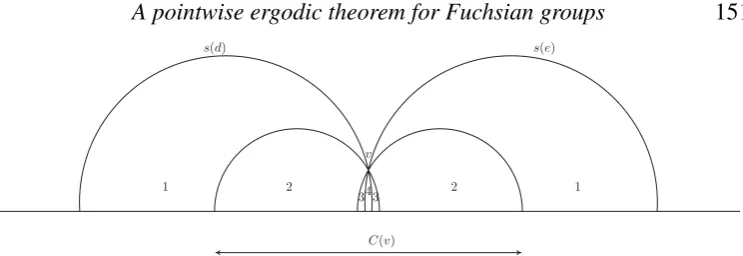
Fig. 2. Intervals round a vertexvofR. In the case shown,n(v) = 4, numbers indicating the levels. All intervals except those of level 0 and 1 are contained inI. The crownC(v)is the union of all intervals of levels 2, . . . ,n(v).
2·2. Irreducibility
In this section we show that the transition matrixPassociated to the map f is irreducible, which unfortunately means delving in some detail into its mechanics. The starting point is the following simple but crucial result which is [4, lemma 2·2].
LEMMA5. Suppose that|∂R|>3. Then any two distinct complete geodesics inT which meet∂Rare either disjoint inD∂D, or intersect in a vertex ofR.
The most interesting case is when linest,t ⊂T meet∂Rin the two vertices at the opposite ends of some side s, neither being coincident withs. The lemma asserts thatt andt are disjoint. Note also that there is a choice in the definition of f only ifL(e)L(d)6. It follows from Lemma 5 that this occurs only ifs(e)ands(d)are adjacent sides ofR.
Now we establish some notation. Let v be a vertex ofR. Let n(v) be the number of geodesics ofT which meet atv(so that 2n(v)copies ofRmeet atv). The endpoints on∂D of then(v)complete geodesics inT which meet atvpartition their complement in∂Dinto 2n(v)open intervals, each of which is (the interior of the closure of) a union of intervals
J ∈ I. We assign to each of these new intervals a level, denoted lev(.), as follows. The intervalL(d)L(e)bounded by the endpoints of the extensions of sidess(d)ands(e)ofR which meet atvhas leveln(v). The interval oppositeL(d)L(e)has level 0. The remaining intervals going round in both directions from 0 ton(v)have in order levels 1,2, . . . ,n(v)−1, see Figure 2. It follows from Lemma 5 that the intervals of all levels except 0 and 1 are also intervals in the set I, and moreover that there is a choice in the definition of f only on intervals of leveln(v). Finally define thecrownofv, denotedC(v), to be the interior of the closure of the union of the intervals of levelsn(v),n(v)−1, . . . ,n(v)−2 atv, see Figure 2. ThusC(v)is an open interval on∂D. Notice that ifv∈∂DthenC(v)=6.
For eache ∈ 0 define∂eto be the two vertices ofRat the ends of the sides(e), and
let C(e) = C(v)C(w) where ∂e = {v, w}. Also let M(e) = L(e)−deL(d)and
A(e) = L(e)−C(∂e), see Figure 3. If|∂R| > 3 then Lemma 5 implies that A(e)6. Note that ifx ∈M(e)then f(x)=e−1(x).
We are finally ready to start our proof that the transition matrixPis irreducible. In what follows we shall say that a constant depends only onR, when we mean that it depends on
Rand the combinatorial pattern of side pairings ofR. We introduce various such constants and denote all of them byK.
LEMMA6. Suppose|∂R|>3. Then there exists K ∈N, depending only onR, such that for any I ∈I, we have fr(I)⊃ A(e)for some r with0r K and some e∈
s(e)
s(d)
v w
A(e)
[image:9.493.67.441.75.185.2]M(e) L(e) eR R
Fig. 3. Intervals subtended by a side ofR. If the vertices ofs(e)arev, wthen A(e)is the subset ofL(e) which is contained in neitherC(v)norC(w), while M(e)consists of all ofL(e)except the ‘ambiguous’ top level intervals at either end ofL(e). Thus f|M(e)= e−1while f|L(e)L(d)can have value eithere−1
ord−1.
Proof. IfIis not already of the formA(e)for somee∈0, then it is in the crown of some
vertexvofR, and hence lev(I)=r >1. Suppose thatI ⊂ L(e)and that f|I =e−1. Then f carriess(e)to the sidee−1(s)=s(e−1), so that f(v)=e−1vis a vertex ofs(e−1). Following
the discussion at the start of Section 2, the cyclic order of labels around the verticesvand
f(v)is the same, and by inspection one sees that f(I)is an interval of levelr −1 ate−1v.
Since the setsA(e)are contained in the union of level 1 sets associated to all vertices ofR, the result follows.
LEMMA7. Let e∈0. Then:
(i) f(M(e))⊃C(v)for any vertexv^∂e−1;
(ii) f(M(e))⊃ A(d)for any de−1.
Proof. By definition, f|M(e)= e−1 so that f carriess(e)tos(e−1). Moreovere−1 carries
L(e)to the complement in∂Dof L(e−1). We need to find the image undere−1of M(e)⊂ L(e). LetV,W denote the endpoints of L(e−1)on∂D and let V
1,W1 denote the points in Padjacent toV,W and outside L(e−1). Thene−1(M(e))is the interval on∂Dbounded by V1,W1 and not containing L(e−1). This covers all of ∂D except for A(e−1) and parts of C(∂e−1).
LEMMA8. Suppose that|∂R|>3. Then there exists K ∈N, depending only onR, such that for any e∈0, and any I ∈Iwhich is contained in M(e), we have fr(A(e))⊃ I for some r K .
Proof. By definition, f|A(e) =e−1, ande−1mapseR(which is the copy ofRadjacent to
Ralongs =s(e)) toR. The endpoints of A(e)are the endpoints on∂Dof the extensions of the sides ofeRadjacent tos, see Figure 3. Thus the endpoints of f(A(e))are the endpoints on∂Dof the extensions of the sides of Radjacent toe−1(s) = s(e−1). If these sides are s(d),s(d), then provided thatee−1, we see that f(A(e))is the complement in∂Dof L(e−1)L(d)L(d). This gives the result (withr =1)in the case in whichs(e)is neither
equal to nor adjacent tos(e−1). Since in both of the exceptional caseseis necessarily elliptic,
this in particular proves the result wheneveris torsion free.
Now suppose thats(e)ands(e−1)are adjacent with common vertexv ∈ D, so thateis
elliptic with fixed pointv. Reasoning as above, we see that f(A(e))coversM(x)for any side
Since by our assumption s(e)ands(e−1)are adjacent, we havex e,e−1. By Lemma 7
(i), f(M(x))covers all crowns exceptC(w)forw∈∂x−1. In particular, f(M(x))⊃C(v).
LetI ∈Ibe the level 2 interval contained inC(v)L(e). Then f(I)is the level 1 interval inC(v)L(e), which is equal toL(e)−C(v). Thus suitable powers of f applied toC(v)
cover all ofL(e)⊃ M(e)which gives the result.
Now consider the casee = e−1. First assume that∂R has at least 5 sides. (Remember
we count the edge containing the fixed point of e as one side.) In this case, there exist
x,y, distinct from each other and frome, such that f(A(e))covers M(x)and M(y). Now
f(M(x))covers A(e)sinceex−1. In addition, f(M(x))and f(M(y))together cover all
crowns except for those crownsC(w)withw∈∂x−1∂y−1. This implies that f(M(x)) f(M(y))coversC(v)forv∈∂e, which gives the result.
Finally, suppose that∂Rhas 4 sides. In this case, f(A(e))only covers M(x)forx the side opposite e. As usual, f(M(x))covers A(e). If x = x−1 then f(M(x))covers M(e).
Otherwise,x−1is adjacent toeand f(M(x))coversM(y)where yis the fourth side of∂R
(oppositex−1). In this case we havey= y−1. Lettingv, wbe the vertices ofs(e)adjacent to s(x−1)ands(y)respectively, we see that f(M(y))coversC(v)and f(M(x))coversC(w).
The result follows.
PROPOSITION9. The Markov chain P is irreducible.
Proof. We have to show that there exists K, depending only on R, such that for any
I,J ∈I, we have fr(I)⊃ Jfor some 0r K.
Assume first that|∂R|>3. By Lemma 6, we may as well assume thatI = A(e)for some
e∈0. By Lemma 8, it will be enough to show that images ofM(e)cover∂D. By Lemma 7, f(M(e))covers all crowns exceptC(∂e−1)and all setsA(x)withxe−1. Since|∂R|>3
we may choose x,y distinct from each other and from e ande−1 such that f(M(e)) ⊃ A(x)A(y). By Lemmas 7 and 8, there existsr < K such that fr(A(x))coversA(e−1)and
all crowns exceptC(∂x−1). Likewise fs(A(y))covers all crowns exceptC(∂y−1)for some s < K. Now by choicex,yandeare distinct and soC(∂x−1)C(∂y−1)C(∂e−1)=6.
The result follows.
Finally, we have to consider the case in which|∂R| =3. Notice that this is the only case in which it is possible that A(e) = 6. By hypothesis, at least one vertex of Ris on∂D. There are only three possible cases:
(i) Rhas three vertices on∂D;
(ii) Rhas two verticesv, won∂D. The side joiningv, wis paired to itself by an order two ellipticx; the remaining two sides are paired to each other by an ellipticewith fixed point at the third (finite) vertexu;
(iii) Rhas one vertexvon∂D. The two sides meeting atvare paired to each other bye, the third side is paired to itself by an order two ellipticx.
Case (ii). Set B(e±) = L(e±)−C(u). Note that f(B(e±)) = L(x) and f(L(x)) = ∂D− L(x). Furthermore, for each I ⊂ C(u) it is clear that fr(I) = (B(e±))for some
r n(u). This proves the result.
Case (iii). Let u be the finite endpoint of side e and let J(u) = C(u)− L(e). Define
J(w)similarly relative towthe finite endpoint ofe−1. Note that f(J(u)) ⊃ A(e−1)and f(J(w)) ⊃ A(e). It follows that the image of every interval inC(u)C(v)eventually covers either A(e)or A(e−1). Further, a bounded image ofA(e)covers L(e)J(u)and a
bounded image of A(e−1)coversL(e−1)J(w). The result follows.
2·3. Strict irreducibility
We now investigate strict irreducibility of the transition matrix P. It is well known and easy to see that P is strictly irreducible if the equivalence relation∼ onI generated byI ∼ J if f(I) f(J)6has just one equivalence class. We show that if|∂R| > 4 then f is always strictly irreducible, while if|∂R|4 the map f may or may not be strictly irreducible depending on the precise arrangement ofRand its side pairings. In particular, the continued fraction map associated to the standard fundamental domain forS L(2,Z)is
notstrictly irreducible.
LEMMA10. The Markov chain associated to any choice of Markov map f for the funda-mental domain|z|>1,−1/2<Rz<1/2is not strictly irreducible.
Proof. The continuations of the sides of∂Rthrough the two vertices at(1±√3i)/2 meet the real axisRin the 7 points−2,−1,−1/2,0,1/2,1,2 which partitionRinto 8 intervals which we number 1,2, . . . ,8in order from left to right, thus for example 3 denotes the interval(−1,−1/2). The map f is defined as:
f(x)=x+1 for x ∈12,
f(x)= −1/x for x∈3456,
f(x)=x−1 for x ∈78.
There is a choice for f on the overlap regions4and5: for definiteness we have taken the usual choice f(x)= −1/xforx∈45which is associated to the continued fraction map. It is easy to write down the transition matrix P for f. We find1 → 12,2 → 34,
3→7,4→8,5→1,6→2,7→56, and8→78. From this we easily see that there are four equivalence classes under∼:{3,4,8},{5,6,1},{2}and{7}. This gives the result. We remark that even had we made the other choice for f on either of3and6, then there are still at least two equivalence classes.
Remark11. Even though strict irreducibility of Pfails in this case, it is still possible to prove the required convergence of Ces`aro averages. Combine the above intervals into four larger ones: J1 = 12, J2 = 34, J3 = 56 and J4 = 78. The map f is still
Markov with respect to the new partitionJ= {Ji}and the alphabet mapπ factors through the obvious map fromItoJ. The transition matrix forJis again irreducible but not strictly irreducible. However it is easily seen to be aperiodic and this is enough for Proposition 1, see [6, proposition 1].
The alphabet mapπ(J1)= S−1, π(J2)= π(J3)= Q, π(J4) = Sgives the well-known
representation of words inP S L(2,Z)in the form· · ·SniQ S−ni+1Q Sni+2Q· · · wheren i >0 for alli and the sequence may begin and end in any of the 3 symbolsS±,Q. The coding has to divide Q into two states J2,J3 in order to prevent transitions of the form S Q Sor S−1Q S−1.
Another interesting example is furnished by the group = a,b,c : a2 = b2 = c2
whereRis the ideal triangle with vertices 0,1,∞anda,b,c ∈ P S L(2,Z)are elliptics of order two with fixed points ati,(1+i)/2 and 1+i respectively. In this case one checks that
f isstrictly irreducible.
LEMMA12. Suppose that there exists a family of open intervals J0, . . . ,Jm ∈ I such
that:
(i) mi=0f(Ji)covers∂D−P;
(ii) f(Ji) f(Ji+1)6for i =0, . . . ,m−1.
Then the Markov chain associated to the Markov map f is strictly irreducible.
Proof. By assumption (i), every intervalI ∈I is equivalent to at least one of theJi. By assumption (ii),Ji ∼ Ji+1for all 0i <m. The result follows.
PROPOSITION13. Suppose that |∂R| 5. Then the Markov chain associated to the
Markov map f is strictly irreducible.
Proof. We show the sets A(e),e ∈ 0, satisfy the requirements of Lemma 12. Suppose
that the extensions of the sides of R adjacent to e−1 meet ∂D in points V andW. Then f(A(e))is the interval betweenV andW and not containingL(e−1). Since|∂R| 5, this
set of intervals overlaps round∂Din the required manner.
If|∂R| =4, then f may or may not be strictly irreducible. For example, suppose thatR has two opposite verticesv, w∈∂Dwhile the other opposite pair are inD. Suppose the sides adjacent tov are paired, and equally the sides adjacent tow. Then one can verify directly that∼has two equivalence classes. The idea is that the pointsvandwdivide∂Dinto two halvesEandFsay. One checks easily that the image of every intervalI is contained either completely inE, or completely in F, so the intervals whose images fall in these two halves cannot be equivalent.
On the other hand, ifRhas 4 sides all of which lie inD, then by hypothesis we assume that at least three geodesics inT meet at each vertex. One can check that the images of the level one intervals at each vertex cover∂Din the manner required by Lemma 12.
We have already studied similar phenomena when|∂R| =3.
2·4. The alphabet map
Finally we prove Proposition 3. We begin by recalling some further terminology from [3,
5,20].
Letei0· · ·ein be a word in the generators0. Since0consists of side pairing
transform-ations ofR, the regionsRandeirR, and more generallyei0· · ·eir−1Randei0· · ·eirR for
0<r <n, have a common side. The wordei0· · ·einis called acycleif in the tesselation of
Dby images ofR, the regionsR,ei0R,ei0ei1R, . . . ,ei0· · ·einRare arranged in order round
a common vertexv∈D, see Section 2. (According to this definition, a single lettereis al-ways a cycle provided that at least one of the vertices∂eis inD.) Cyclesei0· · ·eis,ej0· · ·ejt
are calledconsecutiveif there existse ∈ 0 such thatei0· · ·eiseande
−1e
j0· · ·ejt are both
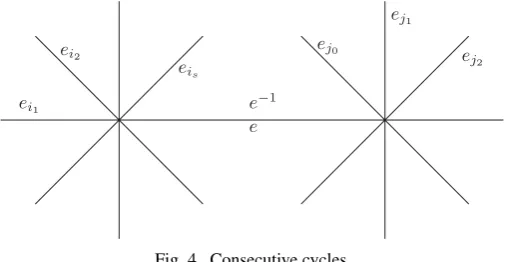
cycles, see [3] for more details. This means thatei0· · ·eis is a cycle atvand thatej0· · ·ejt is
a cycle with the same orientation atw, wherevandware the endpoints of the sidee−1 of R, see Figure 4.
The wordei0· · ·eiN is called a special chainif it consists of a sequence of consecutive
e−1 e eis ei2
ei1
ej0
ej1
[image:13.493.127.382.60.191.2]ej2
Fig. 4. Consecutive cycles.
Remark14. Special chains are intimately connected to the solution of the word problem for Fuchsian groups given in [3,17,19]. Special chains are shortest words and two shortest wordsV =ei0· · ·eiN andW =ej0· · ·ejN witheirejr for allrrepresent the same element
ofonly if either bothV andW are single cycles of lengthn(v), or are both sequences of consecutive cycles of lengthsn(v1)−1,n(v2)−1, . . . ,n(vn−1)−1,n(vn)andn(v1),n(v2)−
1, . . . ,n(vn−1)−1,n(vn)−1 respectively. In the latter case, the sequences of copies ofR corresponding to the words ei0· · ·eiN and ej0· · ·ejN meet along a common line in T. A
special chainis any sequence of the above form.
PROPOSITION15. Letπ : → be the alphabet map. Thenπ−1(ei0. . .eiN)2with
equality if and only if ei0· · ·eiN ends in a special chain.
Proof of Proposition3. This is an immediate corollary of Proposition 15. Notice that a special chain is completely specified by its initial two letters (which determine the direction of the cycle at the first vertex) and the length of the initial cycle. It follows that there exists a constant K depending only onR such that the total number of special chains of length exactlynis bounded byK, independent ofn. Since the total number of words inof length
ngrows exponentially withn, and since a special chain can be continued to arbitrary length, the result follows.
We establish several lemmas before proving Proposition 15.
LEMMA16. Suppose thatπ(Ii0· · ·Iin)=π(Ij0· · ·Ijm). Then n=m andπ(Iir)=π(Ijr)
for r =0, . . . ,n. Moreover if IikIjk for some k then IirIjr for any r>k.
Proof. Suppose thatπ(Ii0· · ·Iin)=π(Ij0· · ·Ijm). Since the images of both sequences are
shortest,n=m. Moreover because of unique representation inby sequences in the image ofπ, see Theorem 2, we haveπ(Iir)=π(Ijr)forr =0, . . . ,n.
Now suppose that IikIjk. By definition, f|I =π(I)−
1. Sinceπ(I
ik)= π(Ijk), we see
that f is injective on Iik Ijk and the result follows.
LEMMA17. Suppose thatπ(Ii0· · ·Iin)= π(Ij0· · ·Ijn)with Ii0Ij0, and suppose that 0r <n. Then:
(i) if Iir ⊂C(v)L(e)for e∈0andv∈∂e, then;either Ijr ⊂C(v)or Ijr = A(e);
(ii) if Iir = A(e)for e∈0then Ijr is adjacent to A(e);
(iii) if Iir,Ijr ⊂ C(v) L(e) for e ∈ 0 and some vertex v ∈ ∂e, and if lev(Ijr) <
lev(Iir)=k and r+k n, then f
k−1(I
Proof.
Assertion (i). Let w be the other vertex in ∂e. If the result is false, then Ijr ⊂ C(w)
L(e). Lets(x)ands(y)be the sides ofRadjacent tos(e−1). Note that f|
Ijr =e−1so that
f(C(v)L(e))⊂ L(x), say, and f(C(w)L(e))⊂L(y).
By the hypotheses of Theorem 2 either|∂R| >3 orRhas a vertex at∞. In both cases
L(x)andL(y)are disjoint. In the first case this is clear by Lemma 5. For the second, observe that we may assume that both vertices in∂e−1are inD, since otherwise at least one ofC(v)
andC(w)is empty and there is nothing to prove. This forcesπ(Iir+1)π(Ijr+1)contrary to hypothesis, which gives the result.
Assertion(ii). Suppose first thatee−1. Observe that the image undere−1of any interval in I ⊂ L(e) but not adjacent to A(e)is contained in C(∂e−1) and is thus contained in L(e−1)L(x)L(y)where as aboves(x),s(y)are the two sides ofRadjacent tos(e−1). On
the other hand, the image undere−1ofA(e)is outsideL(e−1)L(x)L(y). Thus provided L(x)andL(y)are disjoint,π(J)^{e,x,y}for any J ∈Icontained in f(A(e)). The result follows as above if|∂R|>3. The special case|∂R| =3 is easily treated separately.
Finally suppose thate = e−1. If I ⊂ C(∂e)then f(I)⊂ C(∂e)but f(A(e))isoutside L(e)which is impossible.
Assertion(iii). The map f decreases level and at each stage witht <k,Iir+t andIjr+t are in
the crown of a common vertex. At stepk−1,Iir+k−1has level 1 so that by (i),Iir+k−1= A(d) for somed∈0.
Proof of Proposition15. Suppose that
π(Ii0· · ·Iin)=π(Ij0· · ·Ijn).
Without loss of generality we may as well assume thatIi0Ij0. By Lemma 16,IirIjr for
anyr >0.
Suppose first thatr < n and that Iir ⊂ C(v)L(e)has levelk > 1 in the clockwise
direction starting at the highest level interval at vertexv. (The proof if the interval is in the anticlockwise direction is similar; obviously the direction of all cycles are then reversed.) Then Iir+1 has levelk−1 at vertexe−
1vand is outside L(e−1). Thus f(I
ir) ⊂ L(e)where
s(e)is the side ofRadjacent tos(e−1)in clockwise order round∂R. Thereforee−1e −1 =
π(Iir)π(Iir+1)is an anticlockwise cycle ate−
1v.
Inductively, it follows thatπ(Iir)π(Iir+1)· · ·π(Iir+k−1)is an anticlockwise cycle. Further, by Lemma 17 (iii) we see that Iir+k−1 = A(d)for somed ∈0 and thatIjr+k−1 is adjacent to
Iir+k−1, whered−
1 =π(I
ir+k−1).
Let the sides of∂Rin clockwise order froms(d)bes(d),s(c),s(b)(so that the interior labels of sides in clockwise order ared−1,c−1,b−1). Letvbe the common vertex ofs(d)
ands(c)and letwbe the common vertex ofs(c)ands(b). From the proof of Lemma 17 (ii), it follows thatIjr+k is necessarily the highest level interval atv, and thatπ(Ijr+k)=c.
Now π(Iir+k−1)π(Ijr+k) = d
−1c is an anticlockwise cycle at v, hence so also is
π(Iir)π(Iir+1) . . . π(Iir+k−1)c. Furthermorec−
1π(I
jr+k) = c−
1b is an anticlockwise cycle at
w. This means the cycles
π(Iir)π(Iir+1)· · ·π(Iir+k−1) and π(Ijr+k)=π(Jjr+k)
are consecutive. MoreoverIir+k andIjr+k are both contained in the crown atw, in factIir+k is
Now the first part of the argument repeats so that π(Ijr+k)is (assumingn is sufficiently
large) the first term in an anticlockwise cycle of length of lengthn(w)−1. A similar argu-ment in the caseIi0= A(e)completes the proof.
2·5. An ergodic theorem for Fuchsian groups
As before, let be a finitely generated non-elementary Fuchsian group acting in the hyperbolic disk D, and assume that a fundamental domainRfor has even corners and satisfies|∂R| 5. As before, let0be the generating set corresponding toR. Forg ∈,
let|g|be the length of the shortest word in0representing, and forn∈N, let
S(n)= {g∈: |g| =n}
be the sphere of radius n in . Finally, let Kn be the cardinality of S(n). Observe that
Kn grows exponentially and so, by the Borel–Cantelli Lemma, the contribution of “non-injective” elements of Proposition 3 to the spherical averages is negligible. Propositions 1, 3 and 13 now imply
THEOREMB. Letact ergodically on a probability space(X, ν)by measure-preserving
transformations, and, for g∈, let Tgbe the corresponding transformation. Suppose0is a geometric set of generators associated to a Markov partition as in Section2, and suppose either that|∂R|5, or, if|∂R|<5, that the associated transition matrix is strictly irredu-cible. Then, measuring word length with respect to the generators0, for anyϕ∈L1(X, ν) we have
1
N
N−1
n=0
1
Kn
g∈S(n)
ϕ◦Tg −→
X
ϕdν (2·1)
bothν-almost surely and in L1(X, ν)as N → ∞.
Theorem B implies as a special case Theorem A.
In special cases, the averages for groups for which the transition matrix is not strictly irreducible may also converge, see Remark 11.
Acknowledgments. A.I.B. is an Alfred P. Sloan Research Fellow. During work on this project, he was supported in part by Grant MK-4893.2010.1 of the President of the Russian Federation, by the Programme on Mathematical Control Theory of the Presidium of the Russian Academy of Sciences, by the Programme 2.1.1/5328 of the Russian Ministry of Education and Research, by the Edgar Odell Lovett Fund at Rice University, by the National Science Foundation under grant DMS 0604386, and by the RFBR-CNRS grant 10-01-93115.
REFERENCES
[1] C. ANANTHARAMAN ET AL.Th´eor`emes ergodiques pour les actions de groupes.Monographie41de L’ Enseignment Math´ematique (Gen`eve, 2010).
[2] A. BEARDON. An introduction to hyperbolic geometry.Ergodic Theory and Symbolic Dynamics in Hyperbolic Spaces, T. Bedford, M. Keane and C. Series eds.(Oxford University Press, 1991). [3] J. BIRMANand C. SERIES. Dehn’s algorithm revisited, with application to simple curves on surfaces.
Combinatorial Group Theory and Topology, S. Gersten and J. Stallings eds. Ann. of Math. Studies III (PrincetonUniversity Press, 1987), 451–478.
[4] L. BOWEN. Invariant measures on the space of horofunctions of a word hyperbolic group.Ergodic Theory Dynam. Syst.30(2010), 97–129.
[6] A. I. BUFETOV. Convergence of spherical averages for actions of free groups.Ann. of Math.(2),155
(2002), 929–944.
[7] A. I. BUFETOV. Markov averaging and ergodic theorems for several operators.Topology, ergodic theory, real algebraic geometry,39–50,Amer. Math. Soc. Transl. Ser.2202(Amer. Math. Soc., 2001).
[8] K. FUJIWARAand A. NEVO. Maximal and pointwise ergodic theorems for word-hyperbolic groups. Ergodic Theory Dynam. Syst. 18(1998), 843–858.
[9] A. GORODNIKand A. NEVO. The ergodic theory of lattice subgroups.Ann. of Math. Stud.172 (Prin-ceton University Press, 2010).
[10] R. I. GRIGORCHUK. Ergodic theorems for the actions of a free group and a free semigroup. (Russian) Mat. Zametki65(1999), 779–783 (English trans:Math. Notes65(1999), 654–657).
[11] R. I. GRIGORCHUK. An ergodic theorem for actions of a free semigroup. (Russian)Tr. Mat. Inst. Steklova231(2000), Din. Sist., Avtom. i Beskon. Gruppy, 119–133 (English trans:Proc. Steklov Inst. Math.2000231, 113–127).
[12] G. A. MARGULIS, A. NEVOand E. M. STEIN. Analogs of Wiener’s ergodic theorems for semisimple Lie groups. II.Duke Math. J. 103(2000), 233–259.
[13] A. NEVO. Harmonic analysis and pointwise ergodic theorems for noncommuting transformations. J. Amer. Math. Soc. 7(1994), 875–902.
[14] A. NEVO. Pointwise ergodic theorems for actions of groups. Handbook of dynamical systems. Vol.1B, 871–982 (Elsevier, Amsterdam, 2006).
[15] A. NEVOand E. M. STEIN. A generalization of Birkhoff’s pointwise ergodic theorem.Acta Math.
173(1994), 135–154.
[16] A. NEVOand E. M. STEIN. Analogs of Wiener’s ergodic theorems for semisimple groups. I.Ann. of Math.2145(1997), 565–595.
[17] C. SERIES. The infinite word problem and limit sets in Fuchsian groups.Ergodic Theory Dynam. Syst.
1(1981), 337–360.
[18] C. SERIES. Martin boundaries of random walks on Fuchsian groups.Israel J. Math.44(1983), 221– 240.
[19] C. SERIES. Geometrical Markov coding of geodesics on surfaces of constant negative curvature. Ergodic Theory Dynam. Syst.6(1986), 601–625.