Concept
Design for a
Virtual Training
Simulation with
Game Elements
Ruben van Dijk s1492349
Bachelor Assignment Industrial Design Author:
Institution:
Client:
UT supervisor: Supervisor client:
Date:
Amount of pages:
Amount of pages appendix:
Ruben van Dijk s1492349
[email protected] University of Twente
Faculty of Engineering Technology
Serious VR
M. H. Tromplaan 52
7513 AB Enschede, Overijssel, The Netherlands
Alberto Martinetti Marjo Nieuwenhuijse
06 July 2016
Preface
This report of a bachelor assignment describes the process in which a design for a serious game is made. It is done for Serious VR, a starting company providing training simulations for production companies. The game has been built after researching virtual realities, serious games and trainings. This is used to create concepts.
I want to thank Marjo Nieuwenhuijse and Ton Kuper for sharing their passion for their new company with me. They gave me the possibility to throw myself into the virtual world and get to know the increasing number of possibilities there are for virtual reality. It was inspir-ing to see a company beinspir-ing built up and promoted and opened my eyes for entrepreneurship. Next to that I want to thank my supervisor from the University of Twente, Alberto Martinetti, for the support during my assignment to make this assignment work out the way it did.
Summary
In this report a design is made to train new employees in a production company using virtual reality. This assignment is for the company Serious VR in Enschede. This company offers virtual reality trainings for employees along the production line. They develop the training simulation and offer the product. Within this project a concept design is made for a virtual training simulation game which transfers the knowledge of the machines from the old employees to the new employees. To improve the transfer of information, game elements are added.
Firstly the possibilities of virtual reality and other kinds of virtual reality have been researched in this report. From there, there is searched for the best possibility to transmit the information through one of these possibilities. Virtual reality proved to be the most logical solution to apply in a training game, since the employees learn to work in the same environment, without them making mistakes with bad consequences. Next to research of virtual reality, serious gaming has been researched. Here simulation proved to be the best for a training for the same reason why virtual reality worked best.
Next to the research about virtual reality and gaming, there is a research about how
trainings are performed now and how people learn the most effective way. To make learning the most effective, the model of Kolb is used. Within this the following steps are defined: Do, Review, Learn and Apply. These steps have to be present and optimised. The elements of the ARCS model (Attention, Relevence,Confidence, Satisfaction) help to keep the player motivat-ed and stimulate the learning.
During the idea generation, different ideas have been made to fill in the game elements with which a game is built. Also there have been ideas forged to fill in the ARCS model. This lead to three concepts which have been developed further. These three concepts focus on different aspects in the learning process.
In dit verslag wordt een ontwerp gemaakt om nieuwe werknemers in een productiebedrijf te trainen met behulp van virtual reality. Deze opdracht is voor het bedrijf Serious VR in Enschede. Dit bedrijf biedt virtual reality trainingen aan voor werknemers langs de productielijn. Het ontwikkelt de training simulatie en biedt het product aan. Binnen dit project wordt een concept gemaakt voor een virtueel training simulatie spel waarbij de informatie over de machines van de oude werknemers wordt overgebracht naar de nieuwe werknemers. Om de informatie overdracht te verbeteren worden spelelementen toegevoegd. Eerst is er in dit project onderzoek gedaan naar de mogelijkheden van virtual reality en andere soorten virtual reality. Daaruit is gezocht naar de beste mogelijkheid om informatie over te brengen via een van deze mogelijkheden. Daarbij blijkt virtual reality het meest logisch te zijn om toe te passen bij een trainingsgame, zodat de werknemers leren werken in de omgeving, zonder dat ze fouten maken die ernstige gevolgen hebben. Naast onderzoek naar virtual reality is ook serious gaming onderzocht. Hierbij bleek dat een simulatie het beste werkt voor een training om dezelfde reden als waarvoor virtual reality het beste werkte. Naast onderzoek over virtual reality en gaming, is er ook onderzocht hoe trainingen nu worden uitgevoerd en hoe mensen het meest effectief leren. Om het leren het meest effectief te maken, wordt het model van Kolb gebruikt. Hierin zijn de stappen: Doen, Controleren, Leren en Toepassen. Deze stappen moeten present zijn en worden geoptimaliseerd. De game elementen die hierbij van waarde zijn, zijn Vrijheid en Controle voor de speler, Uitdaging tijdens het spelen en Verrassingen voor meer uitdaging. Daarbij werkten de elementen van het ARCS model (Attentie, Relevantie, Zelfvertrouwen, Voldoening) om de speler te blijven motiveren en het leren te stimuleren.
Tijdens de ideegeneratie zijn verschillende ideeën bedacht om de spelelementen in te vullen waaruit een spel bestaat. Ook zijn er ideeën verzonnen om het ARCS model in te vullen. Dit leidde tot drie concepten die verder uitgewerkt zijn. Deze concepten focussen op verschil-lende aspecten van het leerproces.
Hierna zijn de beste onderdelen uit de concepten gehaald en is daarmee een nieuw concept gemaakt. Bij dit concept is het volledige proces beschreven. De meeste onderdelen van het leerproces van Kolb zijn hierin geoptimaliseerd, zodat de nieuwe werknemers het beste worden ingewerkt. Uiteindelijk is geadviseerd om het ontwerp te testen met nieuwe werkne-mers in het bedrijf. Daarbij kunnen snel fouten gevonden worden. Dit zal niet meer in het kader van dit verslag worden uitgevoerd. Daarnaast is het advies voor de test dit ontwerp te bespreken met een professionele trainer om de beste punten aan te wijzen. Serious VR zal de ideeën die uit dit verslag gekomen zijn, gebruiken bij het ontwerpen van een trainingssimu-latie in productiebedrijven.
Table of Contents
Concept Design for a Virtual TrainingSimulation with Game Elements 1 Preface 4 Summary 5 Samenvatting 6
Table of Contents 7
1. Introduction 12
1.1 Problem 13
1.2 Plan of Approach 14
1.3 Method 15
1.4 Definition list 16
1.5 Abbreviation list 16
2. Virtuality and Serious Games 17
2.1 Virtuality 18
2.2 Virtuality in the manufacturing industry 19
2.3 Virtuality Headsets 22
2.4 Serious Games 26
2.5 Creating a virtual environment 28 2.6 First outline Serious VR Game 30
3. Training Analysis 33
3.1 How people learn 34
3.2 How people learn most effective 35 3.3 Young and Adult Learners 36
3.4 Design of Training Programmes 36 3.6 Training on the work floor 38
4. Idea Generation 40
4.1 Game characteristics Serious VR 41
5. Concepts 42
5.1 Concept Doing 43
5.2 Concept Choosing 44
5.3 Concept Understanding 45 5.4 Differences concepts 46 5.5 Integration learning process 47
5.7 Conclusion 48
6. Final Concept 49
6.1 Gameplay 50
6.2 Effective learning 52
7. Conclusion and recommendations 53
7.1 Conclusion 54
7.2 Recommendations 54
7.3 Future Research 55
8. Literature list 56
8.1 Images list 60
9. Appendix 61
1. Introduction
The client for this bachelor assignment is Serious VR, a company that aims to train employees in production com-panies by training them in a virtual environment to get them ready for the job. The following chapter will explain the assignment from Serious VR and how the assignment will be dealt with.1.1 Problem
The coming years, many experienced machine operators retire due to the ageing problem in the Netherlands and this will create a shortage of experienced employees in the field. [1] To keep the experience in the company, it is important that the new personnel is trained and prepared to handle the unpredictable scenarios that cause failures in the machine and production line.
Actor Analysis
Serious VR
Serious VR is a company that trains machine operators in a virtual environment to learn non-automatable processes by combining serious gaming, blended learning, virtual reality and augmented reality. Serious VR is the company that is designing the virtual learning environment for the new personnel. They sell this product to the companies, to educate new personnel in the virtual space. Serious VR has ties with C4Real, which gives Serious VR the expertise to create virtual environments and use augmented reality. They have the expertise to create a game and a virtual environment that can be used for the distributed product. Serious VR is the company that produces and sells this training simulation.
Production companies
The production companies that Serious VR is designing for, are the customers of Serious VR. They aim for companies like Vredestein, where products are
manufactured. Due to the ageing problem in the Netherlands, the experienced employees are retiring in the coming years. This means that the experience they have, is lost for the company. The learning environment would educate the new personnel with
the knowledge the experienced employees left behind. The production companies have the knowledge about the machines and production lines and want a way to distribute this knowledge.
Experienced machine operators
The experienced employees that retire have knowledge and skills about the
production machines in the companies. The experienced personnel knows the ins and outs of the machines or production line and knows what to do when an error occurs. This knowledge is valuable for the production companies. When the new employees are well-educated, the old employees can leave the company without loss of knowledge. This knowledge has to be put in the virtual learning environment.
New personnel
The new personnel has no knowledge about the production machines yet. These employees require training to use them and get to know what to do when errors occur. These are the main users of the product as the virtual environment is designed to educate them.
Project Framework
Due to the ageing problem in the Netherlands, a great deal of experienced employees are retiring. For production companies this means that they are
The goal is to find the most efficient way to translate the scenarios into a virtual environment and to find the most efficient way to educate the new employees.
This is researched by analysing ways to translate a scenario into the virtual environment. Then the process of learning will be analysed to see which way of education suits the target group of LBO and MBO level employees best. The results will be translated into gaming elements in a virtual environment and this will be tested to see whether the education works. Eventually this will result in a plan for a simulation training with game elements for the translation of knowledge to new employees. These steps will be executed within three months.
Goals and Deliverables
The goal of the project is to find the most efficient way to translate the scenarios into a virtual environment and to find the most efficient way to educate the new employees. At the end of the bachelor assignment a plan for translating the knowledge will be delivered and a concept for a serious game that has the best way of providing knowledge. This concept will contain the gaming elements that are implemented in the game and an explanation of the way the game is played. The plan for translating the knowledge will tell how the information and scenarios are translated into the game with which the new employee learns best.
to fill the knowledge gap by training the new personnel using the knowledge of the experienced employees. For this knowledge transfer there are two steps: get the knowledge out of the experienced employees and put the knowledge in the new employees.
Serious VR wants to create a virtual place in which new personnel can freely be trained and mistakes are made without consequences. Serious VR thinks the training is improved and quicker when the training takes place in a virtual environment, because the trainees can practice in a different reality which is a mirror of the production line or machine itself. In this virtual environment, the training takes place in a game, which educates the players. Serious VR uses the game elements to motivate the new personnel and decrease the time needed for education.
In this bachelor assignment the second step of the knowledge
transmission is analysed. The focus will be on the transmission of knowledge on the new employees and the game elements that contribute to the distribution of knowledge.
1.2 Plan of Approach Research purpose
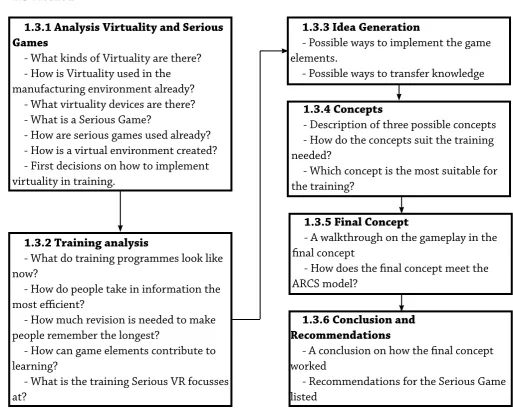
1.3 Method
1.3.1 Analysis Virtuality and Serious Games
- What kinds of Virtuality are there? - How is Virtuality used in the manufacturing environment already?
- What virtuality devices are there? - What is a Serious Game?
- How are serious games used already? - How is a virtual environment created? - First decisions on how to implement virtuality in training.
1.3.2 Training analysis
- What do training programmes look like now?
- How do people take in information the most efficient?
- How much revision is needed to make people remember the longest?
- How can game elements contribute to learning?
- What is the training Serious VR focusses at?
1.3.3 Idea Generation
- Possible ways to implement the game elements.
- Possible ways to transfer knowledge
1.3.6 Conclusion and Recommendations
- A conclusion on how the final concept worked
- Recommendations for the Serious Game listed
1.3.4 Concepts
- Description of three possible concepts - How do the concepts suit the training needed?
- Which concept is the most suitable for the training?
1.3.5 Final Concept
- A walkthrough on the gameplay in the final concept
[image:11.595.37.551.109.528.2]- How does the final concept meet the ARCS model?
1.4 Definition list
The new employee = a new employee with LBO or MBO level education that has to be trained
The retiring employee = the employee that has all the knowledge about the machines and is leaving the company.
The target group = the companies who need a way to transfer their knowledge to the new employees
The knowledge to transfer = knowledge and skills about regular usage of the
machines in production companies and when uncommon errors occur
Serious game = a game through which the knowledge is distributed to the new employee
Virtuality = the different kinds of a seperate reality. Virtual Reality, Augmented Reality and Mixed Reality under one name
VR technology = technology used to create a virtual depiction of the reality in the company
Virtual environment = the environment in the production company simulated in a virtual environment. This environment is where the training takes place
The final users of the product = the new personnel that has to be trained to use the machines
2. Virtuality and
Serious Games
There are different types of virtuality: virtual reality, aug-mented reality and mixed reality. Virtual reality can fully immerse the user, whereas augmented reality transports virtual aspects in the real world. This chapter will look at these different uses, how they are already used in manu-facturing and how virtual worlds are built. Next to that, serious games will be analyzed, from the definition of a game to how serious games improve learning.
2.1 Virtuality
Virtuality is the umbrella term used in this report for Virtual Reality, Augmented Reality and Mixed Reality. All create a virtual environment, but they differ in how much immersion they allow the user. All do make use of virtual elements in an environment.
Virtual Reality
Virtual Reality (VR) is a depiction of a world that allows the user the feeling of presence in that world and in which he can interact with objects and people in that world. It is a virtual environment (VE) created to simulate this world that people have come up with. The ability to interact in this virtual environment makes the user a part of that world and he becomes immersed in it. [2]
An important part of a realistic VE is to create the feeling of presence. Presence can be perceived by the user when the environment is realistic enough, when it allows the user to have the feeling he is completely present and his actions change the environment. According to Steuer, presence can be created by providing the user with interactivity and the vividness of the virtual environment. These are
important to provide the user with presence. There are different types of virtual
environments which differ mostly in how immersive they are. The least immersive is the world in which the user is not simulated, but merely transported through words. In these text-based virtual realities, the user is writing his own world and this world can be shared. In this environment multiple users can take part and a forum can be built to contribute in it. In these worlds only text is used to describe the actions and the world around it. An example of this text-based
reality is the game Colossal Cave Adventure
designed by Will Crowther [3].
Virtual realities in which the user is fully transported to the VE, (immersive) virtual reality, are the most immersive. Here the user sees around him only the virtual reality and the user’s interactions all have influences in that reality. This virtual reality can be seen all around the user by wearing a head-mounted display. When the user then looks around, the VE turns as well. This way the user can view the world all around him as if he were present in this world. This is less the case with on-screen VR, since the user has to turn the camera by for example pressing a button. The actions are displayed in this world, but not literally.
An example of this immersive virtual reality is for example the training simulation in the army RE-liON is working on [4]. The user is wearing a Blacksuit and is completely equipped with sensors, so the movements are literally translated into the game. VR glasses are placed in from of the eyes to show the user what is happening in the virtual world in which his movements are simulated. Even the gun contains sensors to allow the user to shoot in the game and simulate the aim of the user. This way the user is fully transported into the virtual world and all movements are simulated.
Augmented Reality
glasses or another camera. This way digital information about the world around you can be shown as if it were there.
Augmented Reality has been explored by Google when they were working on Google Glass. With this glass, they added digital information to the real world. With Google Glass, the user is able to scan locations he is looking at to see what the location is, advertisements can be scanned and immediately results can be found on the internet to get more information and movies can be watched any time. The glasses also gave the user possibilities like watching a movie and filming the environment at all times. These options made the Glass also an alternative for a camera or smartphone. [5]
Mixed Reality
There is also a combination of VR and AR which is called Mixed Reality (MR), which combines the advantages of both kinds of virtual environments. In this type, objects and complete virtual environments are shown in the world around you. The user acts in the real world, but interaction is possible in the virtual objects that are presented through the virtual world. The user is here wearing a head-mounted display too, but the difference between this one and the Virtual Reality display is that the real world is still shown with the addition of the virtual elements. It goes further than Augmented Reality, because there is more physical interaction possible with the virtual objects. [6]
An example of this Mixed Reality is the new Minecraft game that is planned to release in 2016 [7]. Minecraft is working on a new version of the game where the created world in Minecraft is transported on a table. Through a HoloLens the Minecraft world is displayed and you can move the world
around and interact in it. You even see the interaction other players in the world have and see their avatars moving around. 2.2 Virtuality in the manufacturing industry
The manufacturing industry has a lot to gain from virtual reality. There are multiple implementations of virtuality used for training, manuals or engineering. Listed below are a few examples of applications.
EYESIM
EYESIM creates an immersive VE of a power plant in which the user is placed. The user is depicted in this environment as a player of a game. The simulation is still an on-screen virtual environment. In this simulation, errors occur and the player has to fix the errors accordingly, so the error is fixed and the power plant can continue working. In the virtual environment, possibilities for interaction are lit up to attract the player’s attention. This shows the player what his possibilities are to fix the problem in the virtual reality. The interactions are in this game not visualised, only the possibility to interact. The player does have the feeling he is the character in the game. [8]
COMOS
something through which you follow an instruction guide and does not allow the player to find out how it works on their own. They do have the possibility to make wrong choices though. The actions that are done are simulated by the sim. This differs from EYESIM, where you do not see the character you are and the actions are not shown. COMOS does allow the player to work together with his colleagues. [9]
ESI
IC.IDO is the 3D Immersive Product Experience developed by ESI. This creates realistic virtual depictions of objects and the user can interact with these objects. Because of this technology, there is less need for prototypes, since the prototypes can be made virtually and the parts can virtually be assembled to see whether it will work or fit. This reduces the time needed to create a prototype and a lot of information about the feasibility is gained. To use this technology, the user wears glasses which follow the gaze of the user and a remote which is used for the interaction with the environment. [10]
EquipCodes
Augmented Reality is applied in the maintenance application of EquipCodes. A tablet is used to look at an object and on the screen of the tablet a depiction of the product is shown with information about the product and what actions should be done to fix it. This technology really helps during the maintenance and shows the user what has to be done and in which order. It does not necessarily train the user, but it equips the user with the knowledge that he needs for the action. The interactivity with the virtual environment is very low, since there is not really a VE created. [11]
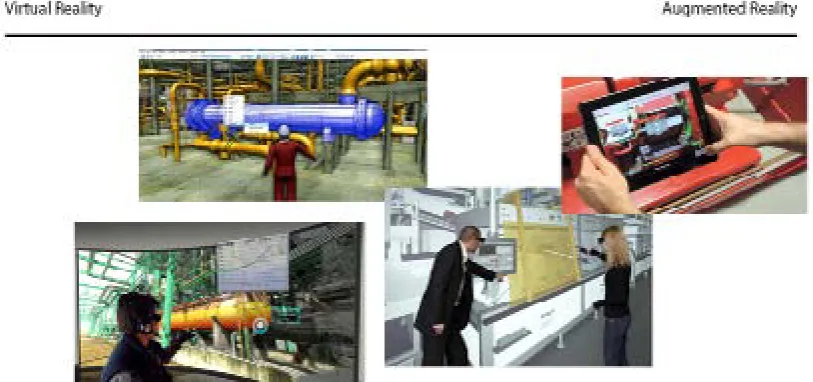
[image:16.595.97.504.537.728.2]These are just a few examples of VR used in the manufacturing industry. In figure 02 the examples have been ordered from virtual reality to augmented reality. Serious VR aims to be on the left side of this chart. These examples show how it can be used differently for training and as a support while working at the assembly, reparation or production. Augmented reality and virtual reality are both used for the training, but virtual reality has only been used on-screen. There is space for virtual reality to be used for training.
Why is Virtual Reality useful? Virtual Reality can become very useful when used as a tool for training. It has the ability to be used to transport people in an environment and give the impression of being there. VR is very effective in gaining experience and creating situation awareness. The added aspect of VR is that the user can train in the environment, while not being there. To achieve this, the user has to feel present in the VE. Situation awareness is defined by “(I) experiencing the plant and its units, (II) comprehending their meaning and purpose and (III) learning how to project the current status in the near future.” [12]. Using VR, people are looking at the environment before even working in the real factory and they get to know the place and its possibilities before working there. This way, employees are already familiar in the environment and they do not have to discover it, which makes working more efficient from the start. It also raises their confidence, since they already have experience in the factory [13]. In this study, 100% of the users felt an increase in confidence and 55% even felt a strong increase.
The employees get to know the factory this way but also gain more understanding of the consequences their action have. By trying out possibilities, they see the consequences their actions have. Furthermore, the
trainee can increase their skills without decreasing the production or damaging the real environment. This also increases their understanding about the machines and gives them insight in their actions [12]. By gaining this knowledge about the maintenance, it is better understood and can be done more accurately, which decreases the incidents in the factory. Also the safety in the factory
becomes better organised, since in the virtual environment danger to the human safety can be depicted, which teaches the employee about his own safety, without real danger being present. This is good for the company, since less errors result in higher production and increased safety results in less employees at home due to accidents. And human errors are one of the most common causes of incidents, accidents or dangerous situation [12].
The understanding of faults educates the employees about the faults, but also how to recognise the faults in the future. This is the main task of a VR training, because this is one of the unique things VR training can offer. This creates knowledge the users can use to reduce the risk of the fault in the future, because, when they see a sign, they can interpret it as a signal that something could go wrong.
2.3 Virtuality Headsets
As VR becomes more present in the world and the use of virtual reality becomes more apparent, the market for VR headsets becomes larger. There are now multiple VR glasses on the market or soon being implemented. Below are the most
HTC Vive [15]
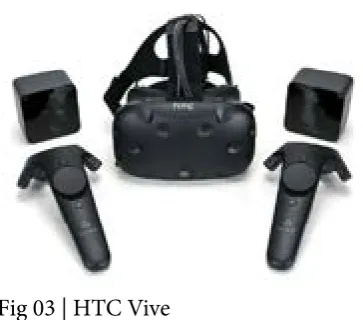
The HTC Vive, by HTC and Steam, is a very immersive headset and it tracks the user very well. Not only the movement of the head is followed, but also the position in the chamber is followed by the position trackers that are placed in the room. The HTC Vive also has two controllers with it that allow actions to be done and tracks the movement of the hands. The refresh rate of the HTC Vive is 90 Hz, which is enough to extinguish motion sickness. A disadvantage of the HTC Vive is that the headset always has to be connected to a computer and the sensors have to be placed in the room, but the successful room tracking makes up for it.
Oculus Rift [16]
The Oculus Rift started as a Kickstarter and it was at the base of the enthusiasm for VR headsets. The Oculus provides the user with positional tracking and therefore the possibility to move around. It is also connected to a computer and late 2016 controllers for the Oculus are coming on the market. The refresh rate is 90 Hz, which makes it as good as the HTC Vive. The connection to the PC makes the vividness of the game very high. The Oculus works with two screens, one for each eye, which are slightly different to create depth.
important ones listed. They are divided in headsets, which are devices that transport the user to a VR environment, mobile headsets, which can only be used by attaching a mobile phone to it, and augmented headsets, which show the real world with virtual elements.
[image:18.595.56.238.331.491.2]Headsets
PlayStation VR [17]
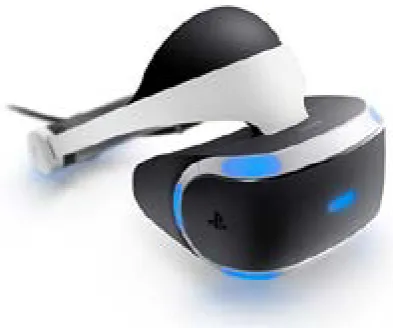
Sony will release the PlayStation VR at the end of 2016. It is connected to a PlayStation and also provides two controllers to let the user interact in the game. The sound system of this VR headset will be better than others, so it could provide more vividness to the world. To do away with motion sickness, the refresh rate of the PlayStation VR is 120Hz which provides a very lively image. The connection to a PlayStation 4 instead of a PC makes it necessary for this headset to provide this refresh rate. The positional tracking is made possible by the 9 LED’s on the headset.
FOVE VR [18]
The FOVE VR headset is unique to the headsets, because it has eye-tracking
[image:19.595.47.244.304.468.2]implemented. An infra-red sensor tracks the eye movement and makes the image the eye looks at more realistic than what is around it. This makes the eyesight in the FOVE also more realistic and it claims to be coming with positional tracking as well. FOVE is not yet on the market.
[image:19.595.328.533.340.466.2]Samsung Gear VR [19]
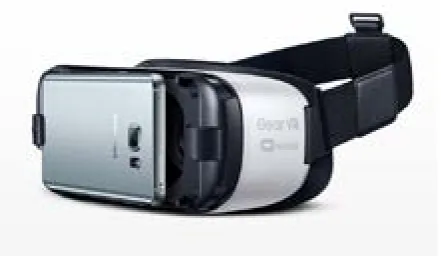
The Samsung Gear VR is a headset in which the Samsung Galaxy is placed. It is merely a case for the mobile phone. Because this headset is powered by the Samsung Galaxy mobile phone and not a PC, the quality of the screen is only as good as the Samsung Galaxy. The advantage is that it is a cheap alternative for the expensive VR headsets. Another good thing about the headset is that it has buttons on the sides to adjust sound and brightness.
Google Cardboard [20]
Google bought a very cheap alternative for VR headsets on the market with their
Google Cardboard. The Cardboard is a foldable VR headset made of cardboard and can even be made yourself. It basically only contains a mobile phone and has two holes in it to look at. The screen is split in two, slightly different images to make the 3D experience. Unlike the Gear VR, the Cardboard does not provide any other functions. The mobile phone already has the technology to make rotational tracking possible. The most important advantage of the Google Cardboard is the price.
[image:20.595.332.545.334.466.2]Mobile Headsets
[image:20.595.51.272.338.466.2]Microsoft HoloLens [21]
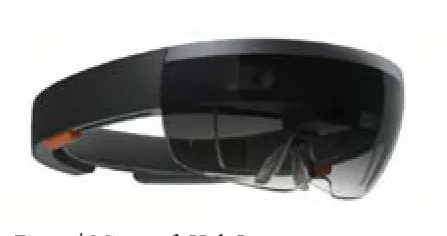
The Microsoft HoloLens is developed by Microsoft and currently only available for developers in the United States for $3000. The HoloLens creates new possibilities in the real world, like a new TV screen, interactive Skype and games. The difference is that the feeling of presence does not really have to be created, since you are interacting in the real world and there are only extras added. These extras are placed in a way that they could be realistic in the world around you. The HoloLens recognises hand commands. The unique thing about the HoloLens is that it is a fully independent Windows 10 PC and there is no connection to a PC needed.
In figure 10 the different headsets are shown in a chart and they are measured to see how they position themselves on the line between virtual reality and augmented reality.
[image:21.595.42.266.343.461.2]Augmented Headsets
At the start of this chapter, examples of virtual trainings in the manufacturing industry have been shown. These virtual trainings look already a lot like games. In the following part, the definition of a game will be described and what a serious game is, a game with which someone is trained. 2.4 Serious Games
Games designed to improve an aspect of learning are called serious games. This is an application of games and simulations to a non-entertainment domain. This way the game is mainly used for another purpose than entertainment, since it also educates players. To fulfil this educational and entertaining part of a serious game, the game designer always has to keep the result of the game in mind. The main focus of a serious game is education, but since play is an important aspect in learning and developing yourself, this is included to improve the education. And this inclusion is the difference with a game, which does not add an intent to learn something to use in real life.
A game is not so different from learning, say Salen and Zimmerman [22]. They mention that a game is like a logically designed and meaningful play, which is very much like learning. Meaningful play is what they say happens when the interaction between actions and consequences is
implemented in the complete game. This shows the player the results of their actions and teaches the player that actions are not without consequences. The study of Mary Jo Dondlinger shows that games do motivate players to spend time on mastering the skill that is being trained [23]. For some learning outcomes, adding design elements even seems necessary to reach the desired
education.
What kind of serious games are there?
Edugames or edutainment are games that try to send knowledge through a ludic game style. A small game is made and during the game, ludic information is transported to the player that teaches about the topic of the game. Often these games have an arcade-like feeling around it. An example of an edugame is EcoQuest, this is a point-and-click game in which the child Adam meets sick animals, who tell him about what happened to them due to littering people. The player gets to know things about the animals and about the effects littering have on the environment. [25] [26] [27]
Advergames
Advergames are created around a movie or product that is being advertised in the game. This is done by creating a game with for example the main character of the movie as the playable character of the game or showing the characters in the setting of the game. A product can be used as the prize in the game, which makes the product look as something worth winning. An example of this type of game is America’s Army. This game is a shooter game in which the player is a character in the US army. The player does not only get to know the army and be triggered by that, the US government also recruits some of the best players in its army. This makes the game far more than a tactical shooter. Besides teaching the players about the army, there could even be other real-life consequences.
Activism games
real life nowadays, the player takes a critical look on the solutions that are implemented today or at his own regard towards the problem. Nowadays a good topic in the activism game would be a refugee camp just outside of Syria. By creating a game about this, the fear and current organisation in the camp can be shown, which might change the way citizens look at incoming refugees in their home country.
Edumarket games
Edumarket games have as their main focus to distribute the message of a certain company and to convince the player the company is doing great work. This makes edumarket games a combination of, for example, advergames and edutainment. Lots of aspects are added in this game to show the meaning of the company and what is stands for. An example of this game is Food Force
in which the player runs the organisation United Nation in 6 mini-games. The goal of this game is to tell the people about what the UN does and to let them know it is important. This makes the UN a more respectable and understandable company.
In a simulation game, the real environment is mimicked very precise. This way players can train in the situation that is being simulated and the player gets to know the situation and understand its meaning. An example is Flight Simulator, where the player is flying a plane and learns how to take off, fly and land all in just a simulation. In this game there is a lot of freedom, like in the real world, and there is no clear objective stated.
Some of the serious game categories listed above do not have added value when it happens in an immersive virtual environment. Advergames could gain value because the immersion can make people even more excited about for example the
Fig 11 | The serious games mentioned ordered along a line of VR usefulness. From left to right: Edu-game (EcoQuest), Edumarket Edu-game (Food Force), Activism Edu-game (Darfur is Dying), AdverEdu-game (America’s Army) and Simulation game (Flight Simulator).
2.5 Creating a virtual environment The virtual environment that is created for a training simulation has to represent the real working environment. This can be created in a CAD program to illustrate the world in a 3D way. This environment is better when it is built as a high-realism environment [30]. The users have a better feeling of being present in the world. Using high-realism does require a stronger PC to run it properly though. To make up for the high-realism interaction environment, the background can be made less realistic. The user does not have to interact with this, he just has to feel present in the world. High-realistic products in the world were preferred by the users in the research of Thalen,
because those products provided more feedback and the users knew better what the product was and how it should work
and what interactions were possible. In this research, users were arranging a print shop using virtual reality. A difficult part of this is to add behaviour in the world.
As in Thalen’s research, the retiring employees could here help in the design of the game. When in the world, they could demonstrate the interactions and these can be saved. However, the research also mentioned that it is difficult to implement behaviour while being in a virtual
this information in a game.
To make a virtual environment for a training simulation, 3D objects have to be implemented, which have a mass, are realistic, moveable or adjustable and have interaction possibilities. These are the core of the training, since the trainee has to learn to use these objects and how to control them. This is the biggest part of the virtual environment, the creation of the objects in the environment. The objects need to be built realistic, so that the user learns the ins and outs of the object. And to make this happen, the object also needs to have all interaction possibilities the real object has. All moveable parts in the object, have to be translated into the virtual world. Constraints have to be added, to make the adjustments as realistic as possible. This requires a lot of insight in the object, so the object has to be studied carefully before rebuilding it. Sometimes there is already a 3D visualisation available of the product, which would make the creation of the virtual environment a lot easier.
Next to the object, there are other things that have to be added in the virtual world. Tools can be added, so the trainee knows what tools are needed to perform his actions. In reality he then knows what tools are needed, to get the required result. Also sound, surroundings of the workplace in the environment, other employees. These things help to make the space realistic and give the user an idea of what to expect in the environment. The surroundings could be less realistic, because they are not what the focus is on, but to add them would be a good addition.
And an additional aspect of the virtual reality simulation could be the results of actions. When the trainee executes an
2.6 First outline Serious VR Game Virtuality choice
Virtual Reality or Augmented Reality For a training programme there should be looked at both virtual reality and augmented reality. Both allow the player to learn
working with the machines. However, there is a big difference between them. Augmented reality focuses more on guiding the user. The user wears his augmented reality glasses and sees the normal world and is guided in this world by for example arrows. The user follows the instructions given by the glasses and then completes his job. Virtual reality can also give the user instructions to let him complete a job, even though this does not happen in the real world. But in the case of VR, the user learns how to do the job and still has to do this in the real world. AR makes sure the job is immediately completed, VR needs more time to be
effective in the company.
Even though AR gives immediate results, this is not necessarily the better solution. The user is guided by AR, but can also
become dependent on it. This does not teach the user how to work with the product, but only follows its instructions. This means AR can hinder the user to become an expert, because he has no understanding about what he does. VR gives this expertise. In a virtual environment, the user can make all the mistakes and has full control over his actions, within the limitations of the VE. By making mistakes and seeing the results of them, more understanding of the environment is created. Though the training takes more time, the user knows what he does when he has finished his training.
Also the employee is challenged when working in the company after a VR training. The employee tries to use the knowledge
he has acquired and implement it. When AR is used in the field, the employee has no challenge when working and is just following orders. He could also become bored when doing this and this results in a less productive employee. So for Serious VR, virtual reality is more suitable.
The VR device
The VR training of Serious VR should use the HTC Vive. The quality of the graphics of the Vive is just less than the quality of the Oculus Rift. But the quality of the images is not the most important aspect of a training, so therefore this can be a little less. This is because in Thalen’s research, it was not the most important to have the highest realism, just high enough to create the feeling of being present. The quality the Vive has is still very high. And the Vive makes up for this with its very good positional tracking. Positional tracking is an important part of the training, because the training should be done like it is done in the real world. Because the machines are big, it is important that movement is well tracked. Above that the hand movements also have to be tracked precisely. The Oculus does the tracking now still without controllers, which makes the coordination more natural, but the tracking with the controllers of the Vive more accurate. Also the controller might not allow the user to do the handling like it would be done in the real world, but the gross movement is shown and the user already knows how to grip a handle or hold a screwdriver. Therefore there will not be much education lost when using controllers.
When using the HTC Vive and Oculus Rift, there is also a difference in realistic manoeuvring. When trying to grab
in the Oculus, like you have to move too far to finally reach something. The movements seem to be restricted when doing them. This feels more natural in the Vive, where the actions feel more similar to actions taken in the real world. This also makes the Vive more suitable, since in the training there is a lot of interactions needed and these have to feel realistic for the user, to also create a feeling of presence in the user.
The PlayStation VR has an even higher refresh rate at 120 Hz, where the Vive has it at 90 Hz, which makes the view even more vivid. As mentioned with the Oculus, the view does not have to be very vivid, but the tracking of the movements is more important. Therefore the Vive is more useful. The FOVE also has this problem and does not even provide positional tracking.
The mobile headsets are by far not as useful in professional use as the Vive and Oculus. These devices are useful when used by consumers who want to experience VR for a cheap price. They do not provide positional tracking, only rotational tracking. And above that, movements cannot be mirrored in the virtual world, because there is no hand tracking to follow the movements. The mobile headsets are not useful for this training simulation.
The augmented headset Microsoft HoloLens is useful when the user needs to be guided. But the training here should train the users to work in the company, without having to guide them all the time.
Even though the devices mentioned here are working with controllers to track the movements and interactions of the hands, the training will not lose its purpose. The training is focussing on the trainees’ knowledge about the machines and how to interact with it, but for this purpose, the
complete translation of hand movements is not necessary. It does contribute to the immersive feeling in the simulation. There is a possibility to switch to this in the future, when this is cheaper and better worked out. Manus VR is already working on such a glove to support the HTC Vive [32]. Gest is also creating a device that tracks hand movements and translates these into actions [33].
Virtual Reality test
During a test with people who were trying out the Samsung VR, a few troubles came up. This test was during the event The Future of High Tech and people had the chance to try out the Samsung VR and look around in the virtual environment. They donned a Samsung VR glasses and a headset to fully immerse in the virtual experience. The users could look around 360 degrees, but there was no possibility to move around. In the virtual environment, the players were starting outside an elevator. After the intro talk, they moved inside and the elevator went up. The walls disappeared and the user saw three different environments on three different floors, respectively, grasslands with a farm, the inside of a futuristic apartment and a harbour. In these environments, diagrams appeared all around to explain what was could be improved inside the area.
it is to explain what the possibilities are, so the user experiences it fully. Besides that, there were some people who wandered off, not because they thought they could walk, but because they went off track while turning around. Overall most people put a hand on the table, to orient themselves. Because the environment is shifting and the user himself is standing still, this lead to some people feeling like they were moving as well.
The difficulty with the balance is already mostly gone in the HTC Vive. The main reason is that the movements of the user are mirrored in the virtual world, so when the user is moving in the real world, he is also moving in the virtual world. The trouble with the people who did not know what they could expect and that they could move around, can also easily be done away with by giving sufficient information before the simulation starts.
3. Training Analysis
People learn the best by doing while they are learning, especially when they have to learn a skill. By doing and receiving feedback on how they did, they learn to improve themselves and apply this knowledge to do better the next time. In this chapter the most effective learning process will be investigated and what additions of game elements contribute to the learning process. In the end, a pro-gramme of requirements will be made.3.1 How people learn
There are different types of learning that are present. [34] There is learning to do on the one hand, just mimicking what you are told and not understanding why the actions are needed. And on the opposite there is learning to understand, knowing what to do on which moment and being able to predict what the consequences are. For these different types of learning, there are different styles to achieve this. Learning to do can be easily achieved compared to learning to understand. For that you only need to mimic what you see and it is not important what the reactions are. To learn to understand, there is more time needed, because there is also more knowledge that needs to be gained. The process to gain knowledge is an interaction between the teacher and the learner using a teaching-learning process. This interaction in a certain environment leads to an outcome.
Learning can be achieved through an active approach in which the student actively tries to gain knowledge by actively reflect and do, instead of passive learning and only reading to understand. The active approach is more in line with the learning to understand. The user tries and afterwards sees the results. This is in contrast to passive learning, which gives hardly opportunity for fully realising what effects the actions have.
Learning to understand takes more time to accomplish. This is also shown in the case study by Truscott. [35] The students wrote a text and the text of one group revised and they were allowed to write it again. After the revision, these students made less mistakes than the time before. However, when both groups had to write a text again a few weeks later, they made the same amount of mistakes again. This shows that the first
time, the students were just mimicking the things they had seen, which resulted in less mistakes. But the knowledge was not gained with an active approach by reviewing what has happened, which resulted in these students only learning something for the short-term.
The view on learning by Kolb’s figure shows that learning is a very active approach. [34] In this learning cycle, there are four stages. Do, review, learn and apply. After the application of the knowledge, the knowledge can be used in the real life, but when it is used, the student does again and can then review what is happening too. The active approach is also supported by looking at the tips and tricks [29] [30]. These are mostly tips that focus on doing and reviewing what you have to do and why you have to do it. There is also focus on making the student aware of the importance to learn. This changes the orientation in learning, which makes the learning a positive pattern. [34] On the contrary, a negative learning attitude can be gained by only learning because a student wants to pass a test.
The importance of looking and analysing what you are about to learn and creating awareness, becomes clear in the hacks that help you memorise things quickly. [36]
Kolb’s figure shows the four stages of the learning cycle: Do, Review, Learn and Apply. Within these stages there are 4
different types of students, namely Activists, Reflectors, Theorists and Pragmatists.
different insights in what effects the actions have. Theorists analyse what has happened and they use theories and facts to come up with a solution. Lastly, pragmatists try out ideas to see whether the solution is working by applying whatever solution there is to see if it works. Their approach is a more trial and error approach. These four roles are different roles and a student mostly has a few of these roles in him/her. The best student takes on all these roles to come up with a solution.
This active approach by Kolb makes sure the student learns and ultimately understands. By doing, reviewing and theorising what is happening, the student is getting knowledge about the effects his actions have.
The teachers’ perspective to learning also plays a role. When the teacher only wants to transmit knowledge to the student, the student gets the knowledge in a straight-forward way, but it does not invite the student to understand what he learns. The teachers should teach with the goal to change a students’ idea about the topic. This will give more depth to the education.
Unlearning is a difficult part of learning where the student has to learn not to do something. Unlearning can be a long process, as the person already has an integrated idea in his mind on what he should do. To unlearn something, the idea of the action should change, the habit of the action should be taken out of the system. Trying to unlearn habits, can make the student feel unnatural, since he has to change the actions that defined him. Therefore, this should be done early in the process, so habits are not yet formed and the student is still learning to form his own identity in the place he is taught to fit in.
For a learner to take information in, it is the most useful for them to take it in small and easy bits. By starting with the basics and upgrade the basics by making the information more challenging. By asking to do tasks that the user mostly knows and implementing small parts that the player has to learn, he can increase the knowledge he knows and does not feel like he does not know anything. This way the student also knows the context of the knowledge he gains and where this can be used. [37]
3.2 How people learn most effective To see whether the learning is effective, it is necessary to see what the goals of the learning is. Questions like “What should it be effective for?” and “When should it be effective?” should be asked. These questions shape the context in which the learning should be successful. In Watkins’ article [34], there are four themes of learning cycles that promote effective learning. These themes are Active learning, Collaborative learning, Learner responsibility and Learning about learning.
- Active learning exists of an interaction between the student and material and persons, by active reflection, enquiry and sense-making. The reflection part is important, because otherwise there would be less learning to understand.
Students rate research, group work, practical work and discussions as twice as effective as copying, answering questions and dictation.
you think and by looking at the problems together from different points of view.
- In learning responsibility, the students are aware of their role in their learning. They know why what they learn is important and this makes them more engaged. The responsibility increases how much they like the learning and the motivation and effort they put in it.
- Finally, learning to learn is when the student looks at what knowledge they gain and in which way they gained it. The learning becomes more reflective and strategic and there is more improvement in the way they learn, which results in more effective and personalised learning next time.
These elements or themes can be used in the learning cycle on their own, but if the learning becomes the most optimal, then all elements are present. This results in the most effective learning to understand and results in an education for an expert. 3.3 Young and Adult Learners
There are a few crucial differences in learning styles between a young person and an adult. Adults want to have more power when they are learning. They want to have a say in what they are taught and in what way they learn this information. A reason for this could be that they have life experience already and have learned things before. Therefore, they have an idea what works for them and what knowledge they lack in the world. Young people have this goal oriented learning less. They see learning more as a process in which they are told what to do. They need to be disciplined by a teacher, whereas an adult disciplines himself. They
want to have fun during learning, so they keep motivated. Since young learners also do not see the goal they are working on as clear, they need motivation to stay focused and learn.
Both young and adult become motivated when they know the information they receive is relevant in the real world. Knowing that they can use the information in the future and being taught in the environment where they can use this knowledge, increases their motivation. And building further on that, they both learn best through experimenting with the knowledge they gain and using this in the environment. Also group activities stimulate the learning, since the learners are forced to think about the information they receive and how it is suitable for them.
In this report, the focus will be on young employees. In the most production companies, experienced personnel works already for a longer time there. They occasionally need training as well, but to limit the focus in this report, the focus will be on young employees. These need to learn everything, from the basics to the understanding, so the training has to cover all this.
the groups are divided to do the safety talk in smaller groups. Showing an instruction video is a passive way of distributing information and they try to make up for this by doing the safety talks, where they ask questions to the group, which forces the group to participate actively.
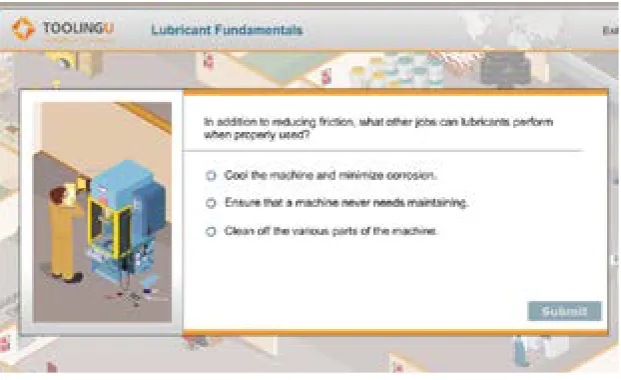
Tooling U-SME creates trainings for how to behave and what to do on the job. [39] They have a few samples to show what kind of trainings they offer. There are differences in freedom and storytelling and the game methods differ. The first sample is a storytelling training, where the player is asked questions about what decisions he should make during his job. The questions are replies to a certain situation he has to deal with at work. After choosing a reply, the player gets feedback on whether he made a right choice. The second sample is a training in a production company as shown in figure 12. There is a tutorial on lubricants, a certain topic the trainee still has to learn about. The player is given an avatar, a new employee in the factory and receives his training in the factory. The trainee now sees the work floor, while he is asked questions about the topic he now has to learn about. There is more freedom in this sample, since the player can move around to answer questions about different machines. The last sample gives the player full freedom. The player can use all the buttons on an interface. In the sample it is not clear what the player has to do, but when a goal has been set, this could provide the player with a lot of new ideas. The feedback also is not sufficient now, since it only shows whether the player pressed the right button or not. There is no feedback on what happens when you press the button you just pressed.
The lack of freedom in the first simulation
by Tooling U-SME, in which the player has to answer questions multiple-choice, is not a problem. The situation has been sketched properly, so the player knows what he has to do. The trainee has to think about the actions he has to take and is forced to think about this by choosing an answer. More freedom might lower the motivation of the trainee, since he has to think too carefully on how he reacts in the situation. Because the training is for such a specific situation, this training seems appropriate. The training about the topics, where the player is an avatar in the world, gives the player more freedom. Now the player can walk around and learn about the topic from all perspectives.
The Training Requirements document from OSHA shows what a new trainee has to know about. [40] OSHA is an agency that focusses on the legislation for safety on the job and provides training frames for safety. The topics in the document have been listed according to the type of factory it is for. The topics range from exit routes to toxic substances. This gives an overview on what a training programme has to include, besides training the new employee to do his job. These safety measures are secondary to the general training the employees receive, but have to be included to make the training sufficient and to teach the trainee about safety on the site. [41]
training programmes train people to do the general actions and can teach people what to do when a dangerous situation occurs.
3.6 Training on the work floor
Serious VR aims to provide training in production companies. In these companies, the new employees have to work with new machinery they have not seen before. To train them now, the new employee is put in a group that works with the machinery already. In this group, the new employee is taught what actions to do by his fellow employees, since they are experienced in the use of those machines already. By being told what to do and trying out the interactions, the trainee is taught what to do. The new employee is ready to work in the group after one week. Then he understands what his role is in the group and can work with them. However, an employee is an expert in the field after 4 more years. Then they have experienced everything and know how to react in every situation.
To help the workers, there is an
instruction paper or booklet next to the machine. If anything is unclear, they can look at the instruction to see what needs to be done. However, this is merely a summary of the interactions that have to be done and in what order. There is no explanation on what the machine does and what the important parts of the machine are. These basic actions are also easily learned. This is also what the trainees learn first during their training. But learning what actions are the most efficient, making the right choices and seeing the problems in a machine, there is more experience needed. This also requires a more detailed virtual environment for the players. The problems have to be constructed in a way that the employee can recognise the problems also in the real world. These details are important for the training, because otherwise there is only a basic employee trained and not the start of an expert.
In the environment there are four types of scenarios which are to be trained:
[image:34.595.143.454.524.714.2]- Operational training. This is the training which consists of the basic
interactions in the environment. These are the regular interactions needed to keep the machine working and doing its everyday routine. It is also the perfect scenario, because in this case, nothing goes wrong.
Operational training is now done by putting the trainee in a group that teaches him all the basics on the job. The instruction paper provides also information for the training.
- Operational incident training. This training focuses on a problem that occurs in the machine or around it. Something goes wrong and action is needed to make sure the machine can continue to run again. It is important that this is done quickly, so the production time does not go down.
Operational incident training is also done in the group. When something occurs, they are taught by the experienced employees what to do, since they know what is happening.
- Maintenance. Every now and then the machines have to be checked. Since they are put under harsh circumstances, extreme heat and pressure, the machines need to have regular maintenance. This maintenance is done to prevent the machines from
breaking down or repair them when they are broken down.
Maintenance is now trained by teaching the people about the machine through education and a manual.
- Safety. This is done to prevent the employees from getting in dangerous situations. When there is a fire for example, the employees are taught what to do in dangerous situations.
Mostly the employees are told what to do by speech and they do not have a training of some kind. A few times a year, they have a walkthrough in the factory and are told what
4. Idea Generation
The game characteritics which are used to create a game have been explained. Important characteristics which help in teaching the player and keeping the player motivated have been shown. Also the elements which keep a player attracted to the game have been mentioned with certain possibilities. From these ideas, the concept are shaped. The different ways to transfer the knowledge into the game have also been shown.4.1 Game characteristics Serious VR Game elements have been used and the view that could be held regarding the game element. There has been made a distinction between elements that are important for Serious VR and that are not. Some are important, because they have the most influence on the learning process. They are needed to have the player understand what they are learning and for what purpose they perform certain actions. This idea generation is not included due to confidentiality.
Unlearn actions
Within the working environment there are limits to what an employee is allowed to do. Around machines there are safety measures to assure the safety of the employees. For example when employees cannot get too close to a machine to prevent him from getting hurt. Within the game this can be done by adding game elements to teach these rules. There can be game punishments added to unlearn these actions.
The three examples above are very game based punishments. They have a lot of focus on the game and not necessarily aim to teach the player. The punishment does not allow them to better their actions. The restart scene does allow them to retry, but it is not focussed on learning that particular action, but rather on punishing the player for a wrong action. This does however teach the
trainee that there is a punishment for the action and punishments help to unlearn an action [45]. When the focus is on winning the game, they will unlearn these actions to get the best results.
The examples in the lower row of table 01 are more focussed on making the trainee understand what they do wrong. They get the chance to redo their actions and this way they immediately know what they could have improved on their performance. Instead of having to do the whole scene again, they get the chance to improve at once. When they get the chance to improve immediately, the effect of learning could be less, because when corrected, they can very fast continue and do not have to dwell and reflect on what went wrong. It is better for the trainees to understand what they are doing though. When given feedback on their actions and given the chance to improve, they get the feeling they are improving on the spot.
Push back Retry
action Shaking Red screen -1 Life -10 seconds restart scene
5
5. Concepts
5.1 Concept Doing
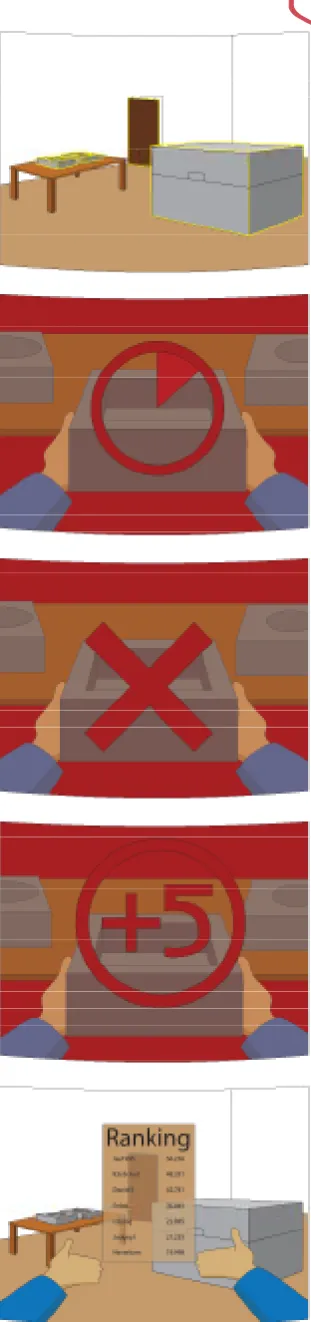
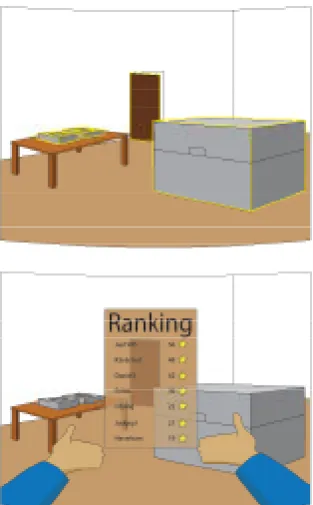
This concept is oriented on the way people learn to do. Certain parts of the concept are depicted in figure 13 and the gameplay is explained in the flow chart shown in figure 18. The goal of this training is to create employees who know what to do at which moment, but who do not yet fully understand the impact of the actions they take. They will learn to understand later during their working hours, but during the training they do learn how to react in certain situations and what their regular working activities are. They are trained on their regular actions and learn the order, there is less freedom to choose what action to perform.
In this concept the world is consisting of the environment, in which small levels are available to play. In these small levels, a specific part of the world is depicted and a training scenario in there is the level to complete. The environment is divided in small areas, in which different kinds of trainings are available, like the regular trainings about their everyday actions and safety trainings like a fire escape. While playing these levels, they unlock new difficulties for these levels and they unlock new scenarios to play in these areas of the environment. By completing a game, points are rewarded. The rewards are higher as the levels become more difficult and advanced. Through a score table, the players can
measure their scores to other players and try to keep up with their opponents.
By using this score table to motivate players, the players are focussed on the fundamental part of the training, doing the actions right and in the right order. Whether these actions are the most beneficial does
[image:39.595.361.517.43.706.2]actions well enough to get their points. They are already awarded for just doing simple actions, which leads to a higher score.
In this concept, rules are very important for guiding the players through the game. The players are simply performing actions in order and need to be taught the order by not allowing other interactions. This is the only important rule, to do the actions one after each other. These are the limits the players have. When they perform actions in a wrong order, they get a punishment. To guide the players through the game and to show the possibilities they have, the options for interactions are highlighted. This way they still have to look for the right order and what to do, but they are guided in the world. It creates the basic knowledge the new employees need in the world, so they know what interactions are possible and in what order they have to be done.
5.2 Concept Choosing
[image:40.595.363.520.419.672.2]The second concept is a step further than the first concept in a way of understanding what the player learns. The first is mostly focussed on just teaching the new employees to do their activities in the correct order whereas the third concept has a focus on the choices that are made within those actions. The goal of this training is to create employees who know what actions are needed at a certain time, but who do not have to understand the full impact on their actions in the environment. This is a step further than only training what to do at which moment, because the actions are checked not only if performed correctly. Figure 14 shows some of the ideas from Concept Choosing.
Fig 15 | Ideas from Concept Un-derstanding pictured in screen-shots.
5.3 Concept Understanding