Master thesis
A case study linking individual and team ambidexterity
Master of Science in Business Administration
Track: Innovation and Entrepreneurshiop
Lisa Meijer
S1085115
First supervisor: Dr. ir. S.J.A. Löwik
Second supervisor: Dr. M. de Visser
Abstract
This study seeks to link individual ambidexterity and team ambidexterity, and explores if every NPD team member should act ambidextrous to reach team ambidexterity. This study assumes that not every NPD team member has a personal disposition towards both
exploration and exploitation, and it will be challenging for an explorative NPD team member to perform exploitative activities, and visa-versa. However, since the NPD process consists of multiple stages with distinct needs for exploitation and exploitation, it is assumed that it is not a necessity that every team acts ambidextrous to reach team ambidexterity. Further, it is assumed that the fit between personal disposition (potential ambidexterity) and their activities performed (actual ambidexterity) impacts team ambidexterity and therefore project
performance. To test the hypotheses, a case study is performed and both quantitative and qualitative data is gathered. The investigation has shown that the majority of the investigated team members do have a personal disposition towards exploration or exploitation, and not potential and actual ambidextrous. Further, it turned out that a fit between the potential ambidexterity and actual ambidexterity is more important during the first stages of the NPD process than at the end. This study extends the emerging innovation literature on team ambidexterity by exploring in-depth the role of the individual ambidexterity of the team members in relation to team ambidexterity. The study provides practitioners new insights into how to design ambidextrous NPD teams.
Table of contents
1. Introduction 4
2. Theoretical background 6
2.1 Organizational ambidexterity 6
2.2 Team ambidexterity 7
2.2.1 Ambidexterity at NPD teams 8
2.2 Individual ambidexterity 9
2.2.1 Actual and potential ambidexterity 10
2.3 Conclusions drawn from the theoretical background 10
3. Research method and design 13
3.1 Research design 13
3.2 Data collection 15
Ambidexterity and performance – team level 15
Potential ambidexterity – individual level 15
Control variables 16
3.3 Data analysis 18
4. Results 18
4.1 Team ambidexterity, performance, and context 19
4.2 Potential ambidexterity – Personal disposition of NPD team members 19
4.3 Within case analysis 21
4.3.1 Potential ambidexterity and actual ambidexterity per project phase 21
4.4 Cross-‐case analysis 32
5. Conclusion 37
6. References 40
1. Introduction
In many organizations, teams are the building blocks of an organization, responsible for acquiring new knowledge, insights and opportunities to generate new products, develop new technologies, and adding value to customers in novel ways—exploration (Haas, 2010). Besides, such teams also face time and cost constraints, requiring them to refine, recombine and implement existing knowledge to secure efficiency—exploitation (Liu & Leitner, 2012).
Previous research has shown that the ability to explore and exploit simultaneously in a team – referred to as team ambidexterity – may lead to higher team performance and
effectiveness (Gibson & Birkinshaw, 2004; He & Wong, 2000; Li, Chu & Lin, 2010; Haas, 2010). But, pursuing exploratory activities and exploitative activities simultaneously creates paradoxical challenges and brings along tensions. Whereas the search for new possibilities requires risk taking, experimentation, thinking out-of-the-box, and flexibility, the exploitation of existing knowledge is rooted in efficiency, execution, implementation, and following routines (March, 1991). The opposing learning activities require different structures, cultures and competencies, and compete for scarce resources (March, 1991; He & Wong, 2004; Gilson & Birkinshaw, 2004).
Although ambidexterity has initially been developed as an organizational capability, many researchers consider it a multi-level phenomenon. There is a need across all levels of the organization to manage contradictions and to address tensions between exploration and exploitation – at the organizational, team, and individual level. Although many studies addressed ambidexterity at the organizational and the individual level, little attention is paid on how to achieve ambidexterity at the team level in practice and the role of individual team members (Jansen, Kostopoulos & Paplexandris, 2016). This is remarkable since teams are the building blocks of organizations; they define and develop new products of the organization, which determines the organization’s competitive advantage.
Only scholars interested in contextual ambidexterity seem to address the role of individual team members, and argue that to reach team ambidexterity individuals who participate in the (NPD) team should be able to act ambidextrous (Andriopoulos and Lewis, 2009; Tempelaar, 2010). Jansen et al. (2016) argues that team members need to identify and interpret distinct, and contradicting learning activities into collective actions, and that the ability of team members to deal with these contradictions is crucial to achieve team
ambidexterity. Also, Gibson & Birkinshaw (2004) argue that by creating an organizational context that supports individuals to perform both explorative and exploitative activities, team ambidexterity can be achieved.
Yet, previous literature on individual ambidexterity has shown it is challenging for individuals to be confronted with paradoxical thinking and that certain personality traits enable or hinder an individuals’ ability to act ambidextrous. Further, scholars argue that individuals may have a personal disposition towards exploratory activities or exploitative activities, and engagement in one of the two task types is accompanied by decreased engagement in the other task type (March, 1991; Keller & Weibler, 2014).
Besides the fact that previous literature mentions it is challenging for individuals to act ambidextrous, it is questionable if every individual should be able to act ambidextrous, or if explorative tasks can be separated from exploitative tasks during a NPD process.
Therefore, this study examines the need for and ability of individuals to act
ambidextrous to reach team ambidexterity high project performance. The results of this study, contributes to both existing literature and practitioners, since it links individual ambidexterity and team ambidexterity. As far as the author knows, no scholars examined the ability of and the need for individuals to act ambidextrous to reach team ambidexterity and high project performance. Research into this subject provides valuable new insights into how teams can reach team ambidexterity in practice, if team leaders should create a context to stimulate individual ambidexterity, if it is even possible for every individual to act ambidextrous, and if only ambidextrous team members are valuable, or if team members with a personal
disposition towards exploration or exploitation can also be of great value to achieve team ambidexterity.
Key terms
Team ambidexterity is defined as the ability of (NPD) teams to engage in exploration and exploitation simultaneously.
NPD team is defined as a group of people that are temporarily or permanently assigned to develop new products.
Individuals are defined as employees who actually work on the design and development of the new product.
Ambidextrous individuals are defined as individuals who are able to both excel at exploratory activities, and exploitative activities.
2. Theoretical background
The following chapter is a literature review and covers the concept of ambidexterity at the organization, team and individual level. Based on this review, a research framework is presented at the end of the chapter.
2.1 Organizational ambidexterity
Organizational ambidexterity is defined as the ability to both explore new possibilities for long-term innovation and to exploit current competencies to secure short-term efficiency benefits (Levinthal & March, 1993; March, 1991). Exploration is rooted in discovery, search, risk taking, flexibility, variation, experimentation and innovation. Whereas exploitation is rooted in execution, choice, refinement, selection, efficiency and implementation (March, 1991). In order to achieve sustained performance, it is critical for an organization to act ambidextrous. Balancing exploration and exploitation is challenging, because both learning activities are contradictory to one another and require different organizational architectures, processes, competencies and logic (Smith & Tushman, 2005), and compete for scarce resources (March, 1991). In recent literature, solutions for the organizational exploration-exploitation dilemma have been found in structural separation, temporal ambidexterity and contextual ambidexterity.
Structural separation
might be focused squarely on exploration, adopt an organic organizational structure, and rely on horizontal coordination. In contrast, an organization’s production unit might be focused squarely on exploitation, operate in a mechanistic organizational structure, be hierarchical, and have a centralized decision-making authority. Ambidexterity requires the separated business units to effectively integrate exploration and exploitation (Gupta et al., 2006).
Sequential ambidexterity
An alternative to structural separation is to temporally separate activities of exploration and exploitation within a single unit or team. Sequential ambidexterity is based on a general pattern by which organizations alternate between periods of incremental change that are dominant, and only temporarily periods of radical change (Duncan, 1976) to seek a balance between exploitation and exploration (Gibson & Birkinshaw, 2004).
Contextual ambidexterity
Gibson and Birkinshaw (2004) subsequently channelled our attention to the individual level underpinning the organizational level. They reasoned that organizations can manage the performance of both exploration and exploitation and an appropriate balance between them, by creating an organizational context that supports individuals to perform both explorative and exploitative behaviours, and maintain an appropriate balance between the two (Gibson & Birkinshaw, 2004). Gibson & Birkinshaw (2004) have termed this approach ‘contextual ambidexterity’. Thereby, they opened up the opportunity to stimulate individual ambidexterity in order to achieve organizational ambidexterity through the context. Contextual
ambidexterity is achieved through empowering individuals to decide on the time spent on exploration activities or exploitation activities, and therefore individuals need to be able to act ambidextrous Gibson and Birkinshaw, 2004).
2.2 Team ambidexterity
ambidexterity, contrary to the predictions from literature on organizational ambidexterity. Besides, they found that project context has an impact on team ambidexterity and project performance. However, a large-scale infrastructure project was studied, where team members worked co-located and work packages were separated and performed by different teams. With regard to NPD project teams, Jansen et al. (2016) was one of the first linking individual ambidexterity to team ambidexterity. Assuming that every team member should be able to be ambidextrous – excel at explorative activities as well as exploitative activities. They state that team members have to resolve paradoxical challenges and combine both learning efforts. Prior research argues that team cohesion and supportive leadership may contribute in facilitating the emergence of team ambidexterity, and allow team members to engage in contradicting learning activities – exploration and exploitation (Jansen et al., 2016).
2.2.1 Ambidexterity at NPD teams
To achieve ambidexterity at the NPD team level, similar challenges exist as at the organizational and team level. A key distinction is that NPD projects are bounded by constraints (scope, time, and cost), progress in phases, and address unique needs (Liu & Leitner, 2012). Uniqueness of a project requires customization; exploring and developing unique solutions for problems—exploration, while time and cost constraints require
efficiency; using repeat processes and off-the-shelf solutions—exploitation (Liu & Leitner, 2012).
The NPD process typically consists of a series of phases, such as (1) Idea generation, (2) Concept development, (3) Preliminary design, (4) Detail-level design and (5) Testing and validation (Cooper, 2001). These distinct phases have distinct objectives, challenges,
which is particularly important in NPD projects, since they are constrained by time and cost (Li et al. 2010).
2.2 Individual ambidexterity
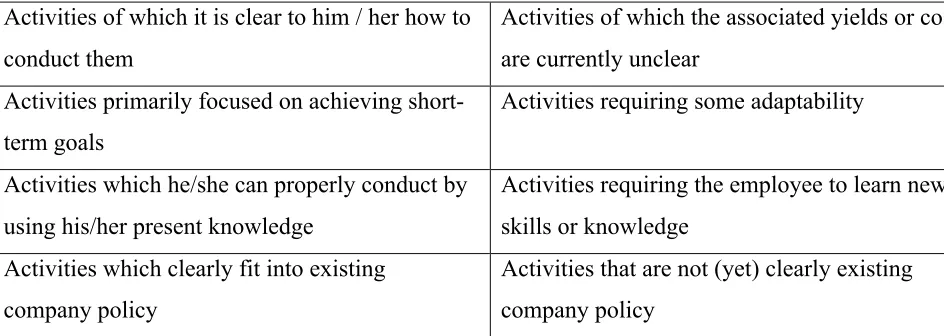
Individual ambidexterity can be defined as the ability of an individual to pursue both exploratory and exploitative activities. Based on the study of March (1991), Mom et al. (2009) defined explorative and exploitative activities, which are shown in table 1. The discussion of whether exploration and exploitation are distinct patterns of human behaviour, or if both cover the ends of one and the same continuum, is still a lively discussion in exploration and exploitation research (Keller and Weibler, 2014). Laureiro-Marínnez et al. (2010) argue that exploration and exploitation can be associated with different cognitive processes, and individuals can not simultaneously execute exploratory and exploitative
activities, therefore, ambidextrous individuals need the flexibility to switch between these two types of activities. Hence, Keller and Weibler (2014) argue that engagement in both activities is challenging for the individual manager, and state that increased engagement in one of the two task types is accompanied by decreased engagement in the other task type. They found that engagement in exploration and exploitation tasks is related to the individuals’ personality. Managers who are highly open to experiences are more engaged in exploration tasks, while conscientious managers are significantly more engaged in exploitation tasks. They conclude that because of their personal disposition towards new learning experiences, changing or breaking up current routines, challenging the status quo, and experimenting with new ideas, managers with a high score on openness to experience prefer the novel character of
exploration tasks. Exploitation tasks have a more common character and follow a clear structure. Thus, these tasks match with conscientious managers’ personal disposition for accuracy and predictability (Keller and Weibler, 2014).
Exploitative activities Exploratory activities
Activities of which a lot of experience has been accumulated by him/her
Searching for new possibilities with respect to products / services, processes or markets Carrying out activities as if it were routine Evaluating diverse options with respect to
products/services, processes or markets Activities which serve existing (internal)
customers with existing services/products
Activities of which it is clear to him / her how to conduct them
Activities of which the associated yields or costs are currently unclear
Activities primarily focused on achieving short-term goals
Activities requiring some adaptability
Activities which he/she can properly conduct by using his/her present knowledge
Activities requiring the employee to learn new skills or knowledge
Activities which clearly fit into existing company policy
[image:10.595.69.541.70.238.2]Activities that are not (yet) clearly existing company policy
Table 1: an overview of exploitative and explorative activities, adapted from Mom et al. (2009)
2.2.1 Actual and potential ambidexterity
In this study, a distinction is made between potential and actual ambidexterity. Whereas, potential ambidexterity is referred to as the personal disposition of team members towards exploration and/or exploitation – to what extent do they like to perform exploitative and explorative activities, based on the scale of Mom et al. (see table 1). And, actual
ambidexterity is defined as the extent to which team members perform exploitative and explorative activities in practice, also based on the scale of Mom et al.
2.3 Conclusions drawn from the theoretical background
Balancing exploration and exploitation is challenging, because they are contradictory learning strategies, requiring different cultures and structures. Literature addressing the exploitation-exploration dilemma at the organizational level, discusses three solutions: contextual ambidexterity, temporal separation and structural ambidexterity.
At the NPD team level, existing research has shown that both exploratory and
exploitive learning positively affects team performance. Exploratory activities contribute to a products’ innovativeness, and exploitative activities increase efficiency in the NPD process. Based on literature, it can be assumed that the need for exploration and exploitation differs during the NPD process. In the first phases, the focus is on exploring novel opportunities to resolve technical problems that lack a well-defined solution. As the project processes, the focus lies on efficiency by combining and refining existing knowledge to reduce mistakes and errors.
scholars interested in contextual ambidexterity seem to address this subject, and argue that to reach team ambidexterity individuals who participate in the (NPD) team should be able to act ambidextrous (Jansen, Kostopoulos & Paplexandris, 2016, Andriopoulos and Lewis, 2009, Tempelaar, 2010).
Based on the literature review, four hypotheses will be further investigated in order to
broaden theory. As mentioned in the theoretical background, engagement in both explorative and exploitative activities is challenging for individuals, and both activities require different personality traits. Therefore, the first hypothesis is:
H1: Not every team member of a NPD team has a personal disposition towards both exploration and exploitation (potential ambidexterity).
And, since exploration and exploitation activities are conflicting and contradicting activities:
H2: It will be challenging for an explorative team member to perform exploitative activities, and visa-versa (actual ambidexterity).
However, the NPD process consists of multiple stages with distinct challenges, objectives and a different need for exploration and exploitation. In the first phases, the need for exploration is very high and the need for exploitation very low, and vice versa. It can be assumed, that:
H3: There is no need for every team member to act ambidextrous to reach team ambidexterity.
But, to achieve ambidexterity, both exploration and exploitation is needed. Since, the author assumes that not all team members are ambidextrous, and it’s challenging for explorative team members to perform exploitative activities, and vice versa:
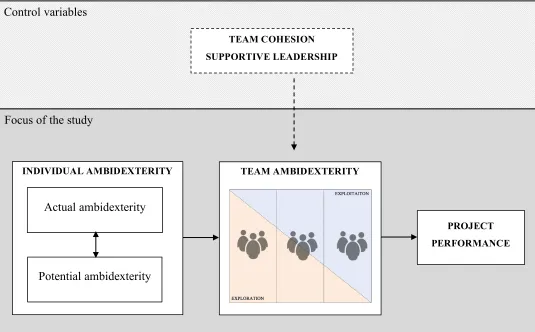
Figure 1: Basic conceptual model
TEAM AMBIDEXTERITY
PROJECT PERFORMANCE TEAM COHESION
SUPPORTIVE LEADERSHIP
INDIVIDUAL AMBIDEXTERITY
Potential ambidexterity Actual ambidexterity Focus of the study
3. Research method and design
The study is a combination of literature synthesis, and an embedded multiple case study to examine how team ambidexterity can be achieved in (NPD) teams. First, a theoretical framework is developed, based on literature on organizational, team and individual
ambidexterity, and NPD projects. Second, the empirical part concerned an embedded case study at a steel processing machinery manufacturer, where four NPD teams were studied. Third, the results of the empirical cases were analysed.
3.1 Research design
To study how to reach team ambidexterity in practice; and if every team members is and should be able to act ambidextrous, an embedded case study design was chosen. It offers an opportunity to explore, in depth, the nature of successful and unsuccessful NPD teams through an inductive lens while also applying quantitative measures to
researcher misses certain patters or identifying patterns that don’t exist (Yin, 2008). In this study, the researcher bias had been reduced by taking field notes and thematic coding of the data.
3.1.1 Case study organization and (NPD) teams
The research setting is the R&D business unit of a steel processing machinery manufacturer. It’s a family business whose headquarter is located at the Netherlands and with international subsidiaries responsible for sales and service located in the USA, Germany, Russia, France, UK, Australia and India. They have about 150 people employed and a turnover on a yearly basis over 100 million euro. According to the management, the organization is one of the global leaders in manufacturing steel processing machines in the global market.
Since the organization is a global market leader it’s crucial that the equipment range develops continually to keep them at the forefront of the technology and the market. The R&D department, with approximately 40 employees, bear a large share of responsibility to reach competitive advantage by developing new machines. The NPD project teams should explore new possibilities for long-term innovation and secure competiveness in the future, but also exploit current competencies to secure short-term efficiency benefits. The NPD project teams followed a NPD process, which was documented in the shared hard drive of the business unit and consisted of 5 stages: 1) idea generation phase, 2) concept development phase, 3) preliminary phase, 4) detail design phase, and 5) test and refinement phase. Based on literature, it can be assumed that the balance between exploration and exploitation differs in the distinct phases and that in the first two stages exploratory activities are more performed, while in the latter phases exploitative activities are more common. To perform all tasks
adequately the team needs to be ambidextrous.
3.1.2 Case selection
Given the limited time, only a limited number of cases can be studied. Therefore, random selection of the cases is not preferable. For our study, it’s of importance that the project teams studied reached high ambidexterity in their projects, since the aim of the study is to show how project teams can achieve team ambidexterity in practice. Furthermore, it’s important that the projects are similar in terms of complexity, risk and length to compare them properly.
achieved, but since time is limited the number of cases was planned beforehand. There is no perfect number of cases, but usually four to ten cases are suitable (Eisenhardt, 1989). When you have less than four cases, empirical grounding is not convincing and complexity lacks (Eisenhardt, 1989). If you select too many cases, the amount of data gathered is too much and it’s too complex to process the data well (Eisenhardt, 1989).
3.2 Data collection
In this study, a qualitative research method is used. Data was mainly collected by conducting semi-structured interviews to get in-depth information about how the team achieved
ambidexterity. Besides, also questionnaires were conducted to measure the personal disposition, cognitive style, and personality traits of the team members. Further,
questionnaires were conducted to determine team ambidexterity and project success and control variables; team cohesion and supportive leadership. There was a time-lag of 13 weeks between conducting the questionnaire and conducting the interviews, so the respondents were not able to remember their answers filled in the questionnaire. There was also an interval of 12 weeks between the first and second questionnaire. The data is also supplemented with project documents and reports describing which tasks had been performed by who, showing the various concepts delivered, and notes about the project progress. This triangulation of data will strengthen the findings.
Ambidexterity and performance – team level
In order to measure for team ambidexterity, the Manager Engineering was asked to assess the team’s extent of exploratory and exploitative learning of all four projects using the scale developed by Kostopoulos and Bozionelos (2011). To measure project performance, the scale from Hoegl et al. (2004) was adopted.
Potential ambidexterity – individual level
Since the goal of the study is to determine whether all engineers should act ambidextrous to reach team ambidexterity, first questionnaires were conducted to determine the personal disposition, personality traits, and cognitive style of the team members.
measure this, the operationalization of Mom et al. (2009) individual ambidexterity, was adjusted. Instead of asking to what extent they performed these activities, it was asked to what extent they like doing such activities. Of course, the items were randomized, so the engineers wouldn’t see a pattern. To measure the internal consistency of the used scales a Cronbach’s alpha test was computed. Acceptable Cronbach alpha’s (0.767 and 0,762) showing that the scale is reliable.
Control variables
Team members rated their perceptions of their team-level cohesion and supportive leadership.
Team cohesion
To capture team cohesion two scales were used. One four item scale referring to team-level cohesion which reflects trust, mutual liking among team member and solidarity (O’Reilly et al., 1989; Wong, 2004). Further, a five-item scale from Edmondson (1999) was used to measure efficacy. Team members were asked to conduct them.
Supportive leadership
The team members assessed the level of supportive leadership by conducting a six-item scale of Carmeli et al. (2010). Supportive leadership can be described as the extent to which management encourages initiatives, providing clear performance evaluation feedback, emphasizing task orientation and clarifies individual responsibilities.
3.2.1 Questionnaires
The online questionnaire about their personal disposition, cognitive style, personality traits, were filled in by all the 11 mechanical engineers of the studied teams (see Appendices I). Besides, they conducted a questionnaire to assess the supportive leadership and team
cohesion. The Manager Engineering conduct the questionnaire about project performance and team ambidexterity to avoid socially desirable answers.
To measure the internal consistency of the used scales a Cronbach’s alpha test was computed.
3.2.1 (Dis)advantages questionnaire
be misinterpreted by the researcher. The results are objective data and can be compared easily. On the other hand, an important disadvantage of questionnaires is the fact that you might get social desirable answers.
3.2.2 Reliability and validity
In this study, the potential danger of self-reporting biases – individuals overrating themselves or providing social desirable answers – has been reduced by collecting additional data and convincing the respondents that their answers are confidential and wouldn’t be shared within the organization. Further, we enhanced validity by using only existing measurements scales. The items of the scales were based on literature and had also been tested by acknowledged researchers by conducting interviews and a test version to experts to identify ambiguous or missing items, and indicate the relevance of items. The items were randomized in the
questionnaire, so the respondents didn’t see any kind of pattern. To enhance reliability of the scales a Cronbach’s alpha test was computed. Acceptable Cronbach alphas showed that the scale is reliable.
3.2.2 Semi-‐structured interviews
3.2.3 (Dis)advantages of semi-‐structured interviews
By conducting interviews, the researcher is able to collect in-depth data about a subject, and get access to the individual’s interpretations and views of events and actions (Walsham, 1995). By using semi-structured interviews, the researcher is able to maintain some structures in the data collection process. But, there is also room for the researcher to ask supplementary questions.
3.2.3 Reliability and validity
To increase the reliability and validity, a similar list of questions with as much details as possible, was conducted to all individuals. In this way, all planned questions were answered. Further, notes were taken at the interviews, and the interviews were recorded. To avoid social desired answers, before the interviews were conducted, the researcher emphasized that the records will only be used by the researcher, and that the results were discussed anonymous in the research paper.
3.3 Data analysis
Since large volumes of in-depth data was collected from the interviews, the data was analyzed by coding the transcribed interviews. The researcher categorized all the activities and tasks based on the definitions of explorative and exploitative activities from Mom et al. (2009). First, the researcher became familiar with the case as a stand-alone entity, by writing a narrative for each case, which included the personal disposition of the different team
members, and their activities and tasks per phase. After the within-case analysis, a cross-case data analysis was done to search for similarities and differences between the cases
(Eisenhardt, 1989).
The data collected from the questionnaires were transferred to SPSS to compute a Cronbach alpha test and it was checked if reliability would be higher when one of the items would be deleted.
4. Results
personality traits. In chapter 4.3, the potential ambidexterity is compared with the actual ambidexterity performed during the projects using a within case analysis. In chapter 4.4 a cross-case analysis is performed to determine patterns.
4.1 Team ambidexterity, performance, and context
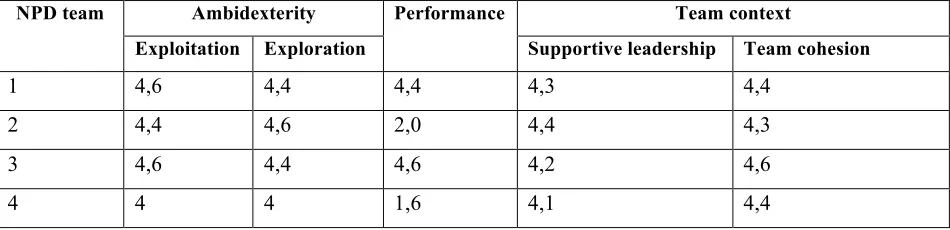
A summary of the findings is shown in table 2. The results show that all NPD teams reached high levels of ambidexterity. Further, project 1 and 3 can be considered as successful, while project 2 and 4 are not. With regard to the team context all four projects scored relatively high, and there are no substantial differences between the scores between the NPD teams.
NPD team Ambidexterity Performance Team context
Exploitation Exploration Supportive leadership Team cohesion
1 4,6 4,4 4,4 4,3 4,4
2 4,4 4,6 2,0 4,4 4,3
3 4,6 4,4 4,6 4,2 4,6
[image:19.595.67.542.281.396.2]4 4 4 1,6 4,1 4,4
Table 2: Team ambidexterity, performance and context per NPD team
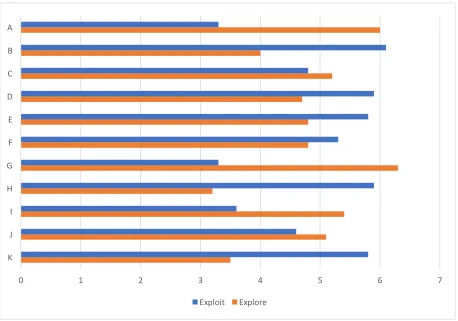
4.2 Potential ambidexterity – Personal disposition of NPD team members
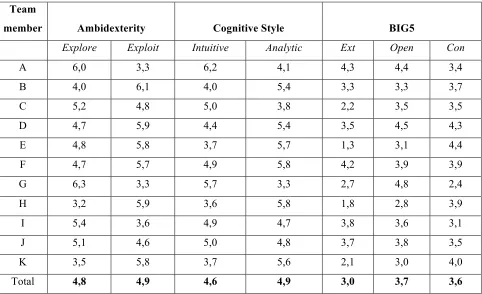
Table 3: Team members scores on exploitation and exploration based on Mom et al.’s (2010) scale
Besides, measuring personal disposition of team members, cognitive style and personality traits were measured. As shown in table 4, the expected relations, described in the theoretical framework seem to be present: 1) team members with a personal disposition towards
exploration score higher on intuitive cognitive style, and team members with a personal disposition towards exploitation score higher on analytic cognitive style, 2) team members with a personal disposition towards exploration score higher on extraversion and openness to new experiences, and team members with a personal disposition towards exploitation score higher on consciousness. Only the results of team member D did not really add up, with a personal disposition towards exploitation, but relatively high score on openness to new experiences.
0 1 2 3 4 5 6 7
K J I H G F E D C B A
Team
member Ambidexterity Cognitive Style BIG5
Explore Exploit Intuitive Analytic Ext Open Con
A 6,0 3,3 6,2 4,1 4,3 4,4 3,4
B 4,0 6,1 4,0 5,4 3,3 3,3 3,7
C 5,2 4,8 5,0 3,8 2,2 3,5 3,5
D 4,7 5,9 4,4 5,4 3,5 4,5 4,3
E 4,8 5,8 3,7 5,7 1,3 3,1 4,4
F 4,7 5,7 4,9 5,8 4,2 3,9 3,9
G 6,3 3,3 5,7 3,3 2,7 4,8 2,4
H 3,2 5,9 3,6 5,8 1,8 2,8 3,9
I 5,4 3,6 4,9 4,7 3,8 3,6 3,1
J 5,1 4,6 5,0 4,8 3,7 3,8 3,5
K 3,5 5,8 3,7 5,6 2,1 3,0 4,0
[image:21.595.69.551.69.363.2]Total 4,8 4,9 4,6 4,9 3,0 3,7 3,6
Table 4: Main results on personal disposition, cognitive style and personality traits of team members
4.3 Within case analysis
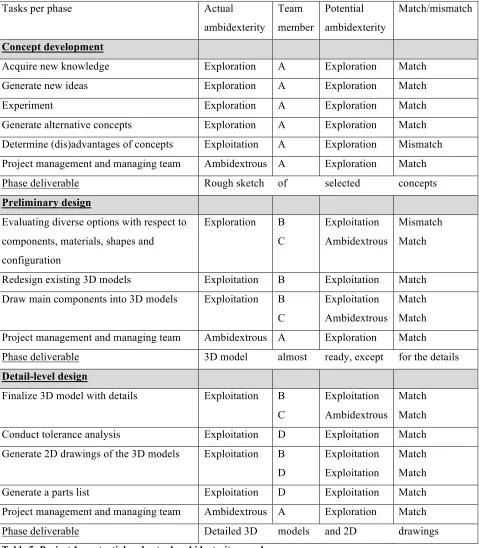
The NPD process consists of five phases, namely ‘idea generation’, ‘concept development’, ‘preliminary design’, ‘detail-level design’ and ‘test and refinement’. The ‘idea generation’ takes place at management level and the ‘test and refinement’ phase is performed by test engineers, which are not part of the NPD team and are therefore excluded from this study. The balance between exploration and exploitation differs during the distinct phases of the NPD process. From the NPD process description and semi-structured interviews, an overview is provided, describing which tasks are performed, the nature of the tasks, and which team members performed the tasks. These overviews are shown for each project and can be found in the next section; Potential ambidexterity and actual ambidexterity per project phase.
4.3.1 Potential ambidexterity and actual ambidexterity per project phase
Project 1
Team ambidexterity – high (team exploratory learning: 4,6; team exploitative learning: 4,4) Successful – yes (4,4 out of 5)
Team size: 4
Project length: 15 months
Project goal: develop a plate processing machine based on given specifications
Tasks per phase Actual
ambidexterity Team member Potential ambidexterity Match/mismatch Concept development
Acquire new knowledge Exploration A Exploration Match
Generate new ideas Exploration A Exploration Match
Experiment Exploration A Exploration Match
Generate alternative concepts Exploration A Exploration Match
Determine (dis)advantages of concepts Exploitation A Exploration Mismatch
Project management and managing team Ambidextrous A Exploration Match
Phase deliverable Rough sketch of selected concepts
Preliminary design
Evaluating diverse options with respect to components, materials, shapes and configuration
Exploration B
C
Exploitation Ambidextrous
Mismatch Match
Redesign existing 3D models Exploitation B Exploitation Match
Draw main components into 3D models Exploitation B
C
Exploitation Ambidextrous
Match Match
Project management and managing team Ambidextrous A Exploration Match
Phase deliverable 3D model almost ready, except for the details
Detail-level design
Finalize 3D model with details Exploitation B
C
Exploitation Ambidextrous
Match Match
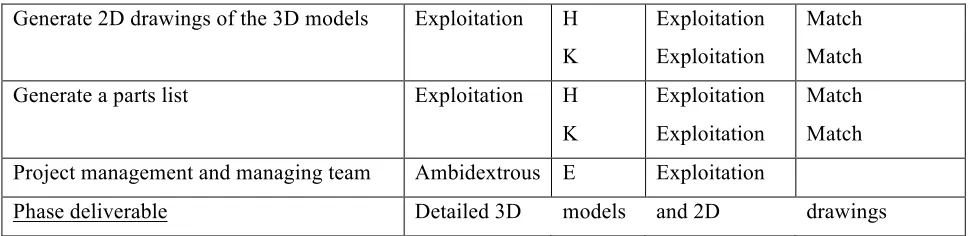
Conduct tolerance analysis Exploitation D Exploitation Match
Generate 2D drawings of the 3D models Exploitation B
D
Exploitation Exploitation
Match Match
Generate a parts list Exploitation D Exploitation Match
Project management and managing team Ambidextrous A Exploration Match
[image:22.595.69.548.132.680.2]Phase deliverable Detailed 3D models and 2D drawings
Table 5: Project 1 – potential and actual ambidexterity per phase
Concept development
(including the team members). Moreover, team member A, consulted online technical forums and literature. After acquiring new knowledge and insights, he started sketching. During the concept development phase, most time was spent on sketching. For every functionality of the machine, he thought of alternative possibilities on how to design it: ‘The machine needs to be able to transport a plate. There are many ways to do this; with a magnet, using vacuum technology, by jamming, using water or even by using an airplane. I try not to limit the possibilities to how we transported the plate in the past, or how competitors do, but I really try to think out-of-the-box’. He did this for every functionality. After he came up with various alternatives, he determined the advantages and disadvantages of each option to design the functionality. At the end of the concept development phase, team member A, demonstrated six different concepts to management. The concepts were not worked out in detail: ‘The six final concepts I only roughly sketched on a piece of paper. The concepts only consist of the main compartments of the machine. It’s absolutely not detailed, even the measurements aren’t precise’. About performing the exploitative task – determine and report advantages and disadvantages of each concept, team member A states: ‘This only a very small part of my job. The disadvantages and advantages are already in my head. I only have to put them in an overview for management. It would take more time if another team member had to make this overview, since he doesn’t have this knowledge’.
Preliminary design
doesn’t. Since, team member A, was only for a few months in the organization, he had a different view of the design process. In the beginning of the project, some of the solutions I designed, were too conservative in his eyes, and I had to change some parts of the design. To avoid that this would happen again, we hold regular consultations. That worked very well’. To team member C, a rough sketch was enough to get started. He stated: ‘I like to have some kind of framework to work with, but on the other hand, I like to have a lot of freedom to decide how to fill it in. Team member A and I did not have regular consultations, but if I had some sort of question or I stranded, I consulted him and/or other colleagues’. ‘This resulted in solutions I wouldn’t have think of’, mentioned team member A.
Team member B, enjoys the exploitative tasks more than team member C, but according to team member A, both team members were able to perform the tasks very well: ‘but as I mentioned before, team member C, I needed to slow down sometimes, since he likes to
demonstrate his creative abilities. But when he knows he’s on a time table, there no problem’.
Detail-level design
Team member B and D were responsible for the detail-level design. During this phase, activities progressed according to plan. However, team member B, mentioned: ‘I enjoyed finishing the 3D model where I work on during the preliminary design phase. Turning them into 2D drawings is not my favorite occupation, but it’s part of the job. Besides, the machine had to be finished in a certain time schedule, so it’s our responsibility as a team to complete it in time. But, if my job existed only consisted of these activities, I would quit my job’. Whereas team member D, really enjoys these tasks: ‘I like to participate in the detail-level design phase, since this is the phase were the 3D and 2D are finalized. That’s very satisfying.’
Conclusion
Project 2
Team ambidexterity – high (team exploratory learning: 4,4; team exploitative learning: 4) Successful – no (2,0 out of 5)
Team size: 3
Team members: B, E, F Project length: 18 months
[image:25.595.68.550.247.731.2]Project goal: develop a flat and angle processing machine based on given specifications
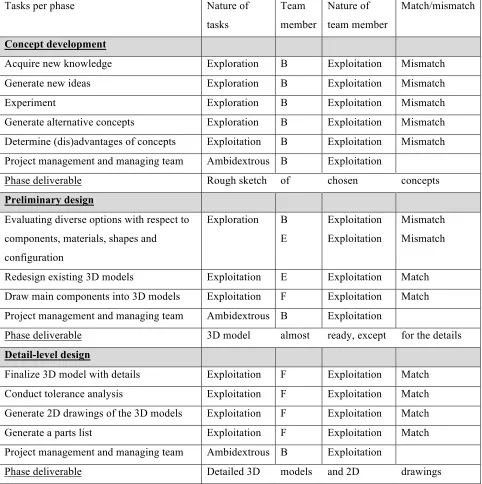
Table 6: Project 2 – potential and actual ambidexterity per phase
Tasks per phase Nature of
tasks Team member Nature of team member Match/mismatch Concept development
Acquire new knowledge Exploration B Exploitation Mismatch
Generate new ideas Exploration B Exploitation Mismatch
Experiment Exploration B Exploitation Mismatch
Generate alternative concepts Exploration B Exploitation Mismatch
Determine (dis)advantages of concepts Exploitation B Exploitation Mismatch
Project management and managing team Ambidextrous B Exploitation
Phase deliverable Rough sketch of chosen concepts
Preliminary design
Evaluating diverse options with respect to components, materials, shapes and configuration
Exploration B
E
Exploitation Exploitation
Mismatch Mismatch
Redesign existing 3D models Exploitation E Exploitation Match
Draw main components into 3D models Exploitation F Exploitation Match
Project management and managing team Ambidextrous B Exploitation
Phase deliverable 3D model almost ready, except for the details
Detail-level design
Finalize 3D model with details Exploitation F Exploitation Match
Conduct tolerance analysis Exploitation F Exploitation Match
Generate 2D drawings of the 3D models Exploitation F Exploitation Match
Generate a parts list Exploitation F Exploitation Match
Project management and managing team Ambidextrous B Exploitation
Concept development
In the concept development phase, team member B, had to deliver different concepts of the machine design. To come up with new ideas he consulted many colleagues from all different departments in the organization; salesman to explore the market developments, the customer requirements and competitor’s technology, but also (after) service engineers to discover the problems they and the customers face during installing and maintaining with current machines of the organization. Besides, team member B, looked at the website of competitors and at attended several trade exhibitions to see which kind of techniques they apply. ‘After acquiring all that information, I started thinking of various concepts for each function, mainly based on common sense and creativity. Because of years of experience, you develop some kind of gut feeling. During this process, I consulted many colleagues, in fact short one-on-one
brainstorm sessions’. At the end of the phase, two to three concepts were created in 3D CAD software.
Preliminary design
About allocating the tasks between the team members, team member B, mentioned: ‘team member F is not capable of performing activities asking for creativity and evaluating diverse options. He prefers activities of which it is clear to him how to conduct them. Therefore, team member E and I dealt with developing the selected (new) concepts into 3D models. Another component of the machine, the loading and unloading of the materials, is very common, and also used for other machines in the organization. And I already worked this part out in some detail, more than the other concepts. Therefore, I let team member F develop this component’. Further, every team member drew the main components of their own developed component into 3D models, which went well.
Detail-level design
The detail-level design was done by team member F and went according schedule. About performing exploitative tasks, team member F said: ‘I enjoy detailed work. I see it as a challenge to work as accurate as possible’.
Conclusion
disposition of the team members, the team was able to reach high levels of team exploratory learning. The Manager Engineering explained that there were a lot of new techniques
explored and implemented in the design, but eventually it turned out that the machine did not work well. During the detail-level design phase, the personal disposition of the team members matched the nature of tasks.
Project 3
Team ambidexterity – high (team exploratory learning: 4,6; team exploitative learning: 4,4) Successful – yes (4,6 out of 5)
Team size: 6
Team members: G, C, I, F, H, A Project length: 10 months
Project goal: develop a flat and angle processing machine based on given specifications
Tasks per phase Nature of
tasks
Team member
Nature of team member
Match/mismatch
Concept development
Acquire new knowledge Exploration G Exploration Match
Generate new ideas Exploration G Exploration Match
Experiment Exploration G Exploration Match
Generate alternative concepts Exploration G Exploration Match
Determine (dis)advantages of concepts Exploitation G Exploration Mismatch
Project management and managing team Ambidextrous G Exploration
Phase deliverable Rough sketch of chosen concepts
Preliminary design
Evaluating diverse options with respect to components, materials, shapes and configuration
Exploration C
I
Ambidextrous Exploration
Match Match
Redesign existing 3D models Exploitation F Exploitation Match
Draw main components into 3D models Exploitation F Exploitation Match
Project management and managing team Ambidextrous G Exploration Match
Phase deliverable 3D model almost ready, except for the details
Detail-level design
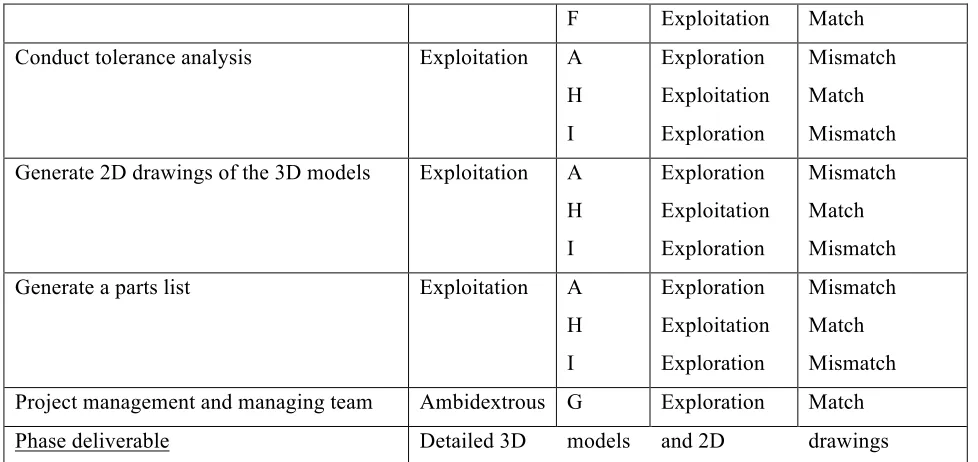
Table 7: Project 3 – potential and actual ambidexterity per phase
Concept development
As shown in table 7 team member G developed the concepts of the machine. To come up with ideas for the concepts of the various parts of the machine, team member B, consulted many experts from outside the organization. ‘I acquired a lot of new information from our current suppliers, but also contacted suppliers of other techniques and experts in the field to broaden my knowledge’. Besides, he watched many videos from machines of their competitors, searched for patents, and consulted many colleagues. After he acquired this information, he locked himself in a meeting room with a stack of paper and started sketching.
During the process, he brought in colleagues and team members to bounce some ideas off and get the creative juices flowing. ‘The number of concepts varied between the parts, for some parts I made about 4 concepts and others, the more complex parts, I made like 10 concepts’.
Preliminary design
During the preliminary design phase, team member C, I, F and G were active. Team member F participated in the more exploitative activities. Team member G said about team member F ‘as long as it is something what already exists and he is familiar with, and only small
adjustments have to be made, and I look over his shoulder during the process, it works well’. ‘Team members C and I are more independent concerning the more explorative activities, and they have more creative ideas’.
F Exploitation Match
Conduct tolerance analysis Exploitation A
H I Exploration Exploitation Exploration Mismatch Match Mismatch
Generate 2D drawings of the 3D models Exploitation A
H I Exploration Exploitation Exploration Mismatch Match Mismatch
Generate a parts list Exploitation A
H I Exploration Exploitation Exploration Mismatch Match Mismatch
Project management and managing team Ambidextrous G Exploration Match
Detail-level design
Since there was a strict timetable, four team members worked on the details of the 3D models, the tolerance analysis, 2D drawings and the parts list, namely engineer A, F, H and I.
‘Everyone available participated in the detail-level design phase’. According to team member G, there were no problems with team member F and H during this phase. However, it was noticed that team member I came up with a lot of alternative ways to set up the design. Team member G mentioned: ‘The priority in the detail-level design phase is to finish the 3D models and 2D drawings in time. Especially, during this project, we did not have a lot of time left. Therefore, it is not desirable that the team members think of improvements and alternatives. They just need to finish the designs created in the former phase… In the ideal situation, team member A and I, should not be deployed during this phase… Also, for their own good. They don’t get much satisfaction of these activities’. This applies even more to team member A. During the detail-level design he had many conflicts with team member G. Team member G mentioned: ‘I know that team member A, does not prefer these kinds of activities. But I wouldn’t have thought that it would lead to so many conflicts, as it did. He just did not meet appointments we made and he ignored deadlines. And, even if he worked on the project, he came with so many improvements and things that were not right according to him, that it was very time consuming. I have spoken several times to him about it, and told him that he should just add details to the existing design instead of adjusting it… I am never going to let him participate in the detail-level design phase again. It’s far more efficient to deploy another team member. Besides, both engineers (A and I) are far less accurate and more mistakes are made’.
Conclusion
Project 3 was very successful, and high levels of team ambidexterity were reached, although no ambidextrous team members participated in the project. It is noticeable, that during the concept development phase and the preliminary design phase there’s a match between the personal disposition of the team members and the nature of tasks performed. However, during the detail-level design phase, there was a mismatch, since team member A and I have a personal disposition towards exploration, while the activities in the detail-level design are very exploitative in nature. As mentioned, this resulted in conflicts and was inefficient, since the team members did not just do, what they were asked, but came with potential
lot of satisfaction from the activities. Despite of the mismatch and time delay during the last phase, the project was considered successful.
Project 4
Team ambidexterity – high (team exploratory learning: 4; team exploitative learning: 4) Successful – no (1,6 out of 5)
Team size: 4
Team members: E, J, H, K Project length: 13 months
Project goal: develop a beam sawing machine based on given specifications
Tasks per phase Nature of
tasks Team member Nature of team member Match/mismatch Concept development
Acquire new knowledge Exploration E Exploitation Mismatch
Generate new ideas Exploration E Exploitation Mismatch
Experiment Exploration E Exploitation Mismatch
Generate alternative concepts Exploration E Exploitation Mismatch
Determine (dis)advantages of concepts Exploitation E Exploitation Mismatch
Project management and managing team Ambidextrous E Exploitation
Phase deliverable Rough sketch of chosen concepts
Preliminary design
Evaluating diverse options with respect to components, materials, shapes and configuration
Exploration E, J Exploration
Ambidexterity
Match
Redesign existing 3D models Exploitation J Ambidexterity Match
Draw main components into 3D models Exploitation E Exploitation Match
Project management and managing team Ambidextrous E Exploration
Phase deliverable 3D model almost ready, except for the details
Detail-level design
Finalize 3D model with details Exploitation H
K
Exploitation Exploitation
Match Match
Conduct tolerance analysis Exploitation H
K
Exploitation Exploitation
Table 8: Project 4 – potential and actual ambidexterity per phase
Concept development
The tasks during the concept development phase were performed by team member E. To acquire new knowledge, team member E, searched for information on online forums and literature, and experimented with several techniques in the working place. About acquiring knowledge from competitors, he mentions: ‘if you look at machines from competitors, you already have a certain idea in your about how the new machine should be designed, and you can’t get that idea out of your head, so it works only against you’. After acquiring
information, he started making concepts using 3D model software. Once, he determined which components and parts he needed, he called their current suppliers to consult which components to use.
Preliminary design
During the preliminary design, first team member E, made decisions about the main
components and integrated them in the 3D model. Next, team member J, continued working on the concept, since team member E had to work on another project. Team member
mentioned: ‘unfortunately, I had to work on another project. I really like to develop the concept into a detailed design.’ For team member J, there were still a lot decisions to made about the configuration and smaller components. Besides, a lot of details had to be included in the design. Team member J, mentions: ‘it went very well, the configuration of the components went fast and was efficient. Since team member E’s workplace was next to mine, we were in a good position to cooperate and I could easily ask for feedback’.
Detail-level design
Team members H and K worked on the latest details of the design, the 2D drawings and the parts list. Both, team member H and K have a personal disposition towards exploitation. This phase of the project was very effective and efficient. Besides, both team members stated that
Generate 2D drawings of the 3D models Exploitation H
K
Exploitation Exploitation
Match Match
Generate a parts list Exploitation H
K
Exploitation Exploitation
Match Match
Project management and managing team Ambidextrous E Exploitation
they really like the activities in this phase. ‘The activities are repetitive, but it’s a challenge to work as accurate, but at the same time, as quick as possible’.
Conclusion
The fourth project cannot be considered successful. The project goals were not achieved. After the machine was designed and built and tested, it turned out that the main component of the machine, the saw, did not work well. Since the technology was so deeply integrated in the machine, the team was not able to fix it. It can be noticed that during the concept development there was a mismatch between the nature of tasks and the team member’s personal
disposition. At the end, it turned out that the chosen concept was inadequate to reach the determined specifications. The engineer responsible for the preliminary design is
ambidextrous. Since the preliminary design includes as well exploratory activities as exploitative activities, it can be considered a good match. Further, during the detail-level design two exploitative engineers were responsible. These phases went very smoothly.
4.4 Cross-‐case analysis
All four projects reached high levels of team ambidexterity. This, despite not every team member is ambidextrous – far from it, as shown in chapter 4.1. Since, the NPD projects consists of different phases with different goals and activities and nature of tasks,
ambidextrous team members as well as exploratory and exploitative team members are very useful.
Concept development
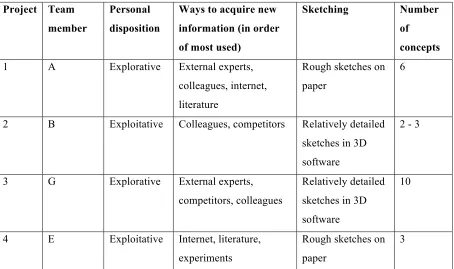
As shown in the former paragraph, the tasks in the concept development phase are mostly explorative. During project 2 and 4 an exploitative team member performed these tasks, and during project 1 and 3 an explorative team member. The way the different team members performed their tasks is different, as shown in table 9. It’s noticeable that:
• explorative team members rely more on external experts to acquire new information, while exploitative team members are more internally focused, and acquire more information from behind their desks. They don’t consult external experts.
• explorative team members make rough sketching on paper, while exploitative team members design their concepts using 3D software.
• The concepts of exploitative team members are far more detailed than the sketches of explorative team members.
Project Team member
Personal disposition
Ways to acquire new information (in order of most used)
Sketching Number of concepts
1 A Explorative External experts,
colleagues, internet, literature
Rough sketches on paper
6
2 B Exploitative Colleagues, competitors Relatively detailed
sketches in 3D software
2 - 3
3 G Explorative External experts,
competitors, colleagues
Relatively detailed sketches in 3D software
10
4 E Exploitative Internet, literature,
experiments
Rough sketches on paper
[image:33.595.68.522.132.401.2]3
Table 9: Actual ambidexterity per team member of the concept development phase
Preliminary design
During the preliminary design, at first, team members have to evaluate diverse options with respect to components, materials, shapes and configuration. This can be considered
explorative, but there’s already a framework to work from (the concept). Therefore, it’s less explorative than the concept development phase. The other tasks are exploitative. As shown in table 10, as well exploitative, ambidextrous and explorative team members worked on the preliminary phase. The following observations are noticeable:
• Ambidextrous team members are able to perform both explorative and exploitative tasks during the preliminary phase.
• Some exploitative team members are able to perform explorative tasks during the preliminary phase after clear instructions and more support.
• Very exploitative team members are not able to perform explorative tasks, even if they get clear instructions and more support.
• Explorative team members need a strict timetable, otherwise they design too many options, criticize the existing concepts, suggest many improvements, while there is no time for this during the preliminary design phase.
Project Team member
Personal disposition
Nature of tasks
1 B Exploitative Both Needed a strict time table
performing explorative tasks – otherwise too creative and too much critiques on the concept. Exploitative tasks went very well.
C Ambidextrous Both Needed a strict timetable with
both explorative and
exploitative tasks – otherwise to creative.
2 B Exploitative Exploration Was able to work out concepts
created by him in more detail.
E Exploitative Both Needed clear instructions and
more support to perform explorative tasks. Exploitative tasks went very well.
F Exploitative Exploitation Not capable to perform
explorative tasks. Exploitative tasks went very well.
3 C Ambidextrous Exploration Went very well.
I Explorative Exploration Needed a strict time table –
otherwise too creative and too much critiques on the concept.
F Exploitative Exploitation Not capable to perform
explorative tasks. Exploitative tasks went very well.
4 E Exploitative Both Was able to work out concepts
J Ambidextrous Both No problems with performing both explorative and
[image:35.595.55.523.70.129.2]exploitative tasks. Table 10: Actual ambidexterity per team member of the preliminary design phase
Detail-level design
• Exploratory team members criticize the existing design, came with a lot of suggestions to improve. Because of the strict time table during this phase, this is not desirable, and it delayed the process.
• Very exploratory team members don’t enjoy the tasks, and are not good in it / not accurate. Besides, they came with way too many improvements and wouldn’t let go of it. He did not concentrate on the job. Conflicts.
• Very exploitative team members enjoy the exploitative tasks and see it as a challenge to work as accurate as possible, and they’re good in it. Little to no errors are made.
• Ambidextrous team members don’t see the very exploitative tasks as their favorite part of their job, but they can perform exploitative tasks reasonable well. They made a slightly more errors than (very) exploitative team members.
Project Team member
Personal disposition
Nature of tasks
1 B Exploitation Exploitation Went reasonable well; slightly
more errors. Not his favorite part of the job.
D Exploitation Exploitation Went very well. Little to no
errors. Enjoys exploitative tasks.
C Ambidextrous Exploitation Went reasonable well; slightly
more errors. Not his favorite part of the job.
2 F Exploitation Exploitation Went very well. Little to no
errors. Enjoys exploitative tasks.
3 I Exploration Exploitation Criticism on existing design.
process.
F Exploitation Exploitation Went very well. Little to no
errors. Enjoys exploitative tasks.
A Exploration Exploitation Criticism on existing design.
Suggested many, undesirable, improvements. Resulted in many conflicts and arguments. Just did not do the job / made quite some mistakes. Delayed the process.
H Exploitation Exploitation Went very well. Little to no
errors. Enjoys exploitative tasks.
4 H Exploitation Exploitation Went very well. Little to no
errors. Enjoys exploitative tasks.
K Exploitation Exploitation Went very well. Little to no
[image:36.595.65.522.68.451.2]errors. Enjoys exploitative tasks.
Table 11: Actual ambidexterity per team member of the detail-level design phase
In fact, based on the researched projects and team members, it turned out that very
exploratory team members perform better during the concept development phase than both ambidextrous and exploitative team members. This also applies to the detail-level design phase; very exploitative team members perform better than ambidextrous team members. Based on the interviews and surveys, it appears that research ambidextrous team members are not outstanding in exploratory as well as exploitative activities, but that the performance on both activities is average.
Based on the four researched projects, it is noticeable that during the concept developments phase of the successful project, there was a match between the nature of the tasks and the personal disposition of the team members, while during this phase of the unsuccessful
during the successful projects, and a match during the unsuccessful projects. Therefore, it would appear that a match during the concept development is more important than a match during the preliminary design and detail-level design phase.
Mismatch in detail-level design results in delay, but mismatch in the concept development phase leads to a wrong design of the machine.
Concept development Preliminary design Detail-level design Successful?
Project 1 Mismatch Match Match No
Project 2 Match Mismatch Mismatch Yes
Project 3 Match Mismatch Mismatch Yes
Table 12: (Mis)matches per project and phase
5. Conclusion
5.1 Results and discussion
The ability to explore and exploit simultaneously is crucial for NPD teams and leads to higher performance and effectiveness. Existing literature on how team ambidexterity is achieved in practice, is scarce. In particular, research linking individual and team
ambidexterity. Only scholars interested in contextual ambidexterity seem to address this subject, and argue that to reach team ambidexterity individuals who participate in the (NPD) team should be able to act ambidextrous (Jansen, Kostopoulos & Paplexandris, 2016,
Andriopoulos and Lewis, 2009, Tempelaar, 2010). Research into this subject is necessary though in order to understand team ambidexterity and how it can be achieved, since a team is always a collection of individuals.
The research presented in this thesis has addressed this research gap by examining the need for and ability of individuals to act ambidextrous to reach team ambidexterity and high project performance during a NPD process.
[image:37.595.63.542.215.296.2]This applies in particular to team members with a very strong personal disposition towards exploration or exploitation. However, team members with a moderate personal disposition towards exploration, were able to perform exploitative activities well, but only if the team leader if the team leader slows them down and make them aware of the strict time schedule. Also, team members with a moderate personal disposition towards exploitation, were able to perform explorative activities, but only after clear instructions and a little more support from the team leaders or team members. Further, results showed that no ambidextrous team member was responsible for the concept development phase. It turned out, that both
ambidextrous team members were thought incapable of performing very explorative activities by the Manager Engineering. With regard to ambidextrous team members performing
exploitative activities, the same issues occurred as for moderate explorative team members; they made slightly more errors than exploitative team members. However, during the preliminary design phase, with moderate explorative and exploitative activities, they
performed very well. Therefore, it seems that ambidextrous team members don’t excel at both very explorative and very exploitative activities, but perform really well during moderate explorative and exploitative activities. Whereas, (very) explorative team members excel at the explorative activities, and (very) exploitative team members excel at exploitative activities.
Despite, not all team were ambidextrous, team ambidexterity has been reached in all four projects, supporting hypothesis 3. Because of changing need for exploration and exploitation during the multiple NPD stages, tasks can generally be divided in explorative and exploitative activities, meaning not every team member needs to be ambidextrous. However, in practice it occurs that team members have to perform tasks that are different from their personal
disposition, for example because it is linked to their activities, or because of
underemployment or approaching deadlines. It appears that team members can compensate in some way for each other. For example, if an exploitative team member has to perform
moderate explorative activities during the preliminary phase, the team member responsible for the concept, can work the concept out in slight more details, so the degree of exploration in the preliminary phase declines.
relationship between the fit between potential ambidexterity and actual activities
ambidexterity and project performance. Further, it appears that a mismatch between the nature of tasks and the personal disposition of team members during the concept development phase has a much higher impact on the project performance than a mismatch during the detail-level design phase. That makes sense, because a mismatch in the detail-level design results in a delay, while a mismatch in the concept developed phase leads to a wrong design.
All in all, based on the results of this study, non-ambidextrous team members are very useful in a NPD team to reach team ambidexterity.
5.2 Theoretical relevance
This study contributes in the development of current literature on team ambidexterity towards a better understanding and a multi-level view. First, this study responds to recent calls for research into understanding how to reach team ambidexterity in practice (Haas, 2010), and the role of individual ambidexterity in contributing to team ambidexterity (Jansen et al. 2015). Despite the fact that research has shown the importance of team ambidexterity, the focus of the majority of the studies on team ambidexterity have been on top-down supportive
behaviours in understanding team ambidexterity instead of bottom-up effects. This is one of the few studies linking individual and team ambidexterity by looking in to the relationship between ambidexterity of team members, team ambidexterity and project performance. In recent literature, often researchers assume that (NPD) team members have to be able to act ambidextrous to reach team ambidexterity. By determining the potential and actual of team members and team ambidexterity, it found that it is not necessary for a team member to act ambidextrous. This study is a first attempt to develop better insights into the role of team members in reaching team ambidexterity.
5.3 Practical relevance
This study does not only contribute to theory, but the findings also have important