PROFESSIONAL DEVELOPMENT TRAINING:
WILL IT BLEND?
HOW TO OFFER BLENDED LEARNING
Abstract: Technological innovation in education give rise to new and more efficient possibilities for developing employees through professional development training. Because of increasing technological possibilities, researchers keep referring to the subject of blended learning. Despite elaborate coverage in literature, little literature exists on how blended learning can be applied in a business setting. This study analyses how an organisation, who markets professional development training, can offer blended learning. Blended learning, a thoughtful combination of educational experiences delivered through face-to-face and online activities, is a challenge for organisations who wish to professionally develop their employees through this type of training. In this comparative case study, it is analysed how professional development training can be offered through the use of blended learning. The data is based on interviews with six blended learning experts and theoretically grounded in a conceptual model with theoretical propositions. The central result of this study is that the learner is the most important element of the learning experience. As such, the central recommendations focus on the learner—individual learning styles and learner control have to be facilitated in creating a blended learning environment. Only then a blend will be successful. Furthermore, the case study showed that collaboration is important in blended learning. Collaboration is straightforward to accommodate in face-to-face learning, however, in online learning social cohesion has to be formed face-to-face so that the threshold to collaborating online is lowered. Finally, no optimal blend is possible in practice, because of the fact that every learning situation is different. The recommendations given in this study on how blended learning can be offered in a professional development training setting, contributes to the literature of blended learning by providing empirical evidence on how blended learning is used in a business setting.
Keywords: blended learning, professional development training, facto-face learning, e-learning, flipped e-learning, blended learning experts.
Master thesis MSc International Business Administration University of Twente
Joost de Graaf – s1661116
2
COLOPHON
AUTHOR
Name J. de Graaf (Joost)
Address Richtersweg 94b, 7521 BX, Enschede
Email [email protected]
Telephone number +31 (0) 6 53 97 09 25
Student number s1661116
SUPERVISORY COMMITTEE
First supervisor (University of Twente) DR.IR. A.A.M. Spil (Ton)
Email [email protected]
Telephone number +31 53 489 3497
Second supervisor (University of Twente) MSc BA R.A. Oude Vrielink (Rudy)
Email [email protected]
Telephone number +31 53 489) 6988
External supervisor (ExplainIt) MSc L.A.J IJland (Luuk)
Email [email protected]
Telephone 088 – 122 55 88
PROJECT INFORMATION
Organisation ExplainiT B.V.
Address J.M. Keynesstraat 351, 7550 AT, Hengelo
Telephone number 088 - 122 55 88
Website http://www.explainit.nl/
University University of Twente
Address Drienerlolaan 5, 7522NB, Enschede
3
TABLE OF CONTENTS
1 Introduction ... 5
1.1 The need for empirical research on blended learning ... 5
1.2 Research goal ... 6
1.3 Research strategy... 6
1.4 ExplainiT ... 7
1.5 Scientific and practical relevance ... 8
2 Theory ... 9
2.1 What is blended learning? ... 10
2.2 Blended learning educational models ... 10
Blended learning models... 11
Improving the effectiveness of classrooms ... 12
2.3 Blended learning in business environments ... 13
2.4 Benefits and challenges of blended learning ... 14
3 Operationalization of concepts ... 16
3.1 Conceptual framework ... 16
Technology ... 17
Place ... 17
Design ... 18
3.2 Theorethical propositions ... 18
4 Methods ... 19
4.1 Case selection ... 19
4.2 Data collection... 19
4.3 Data analysis ... 21
Validity and reliability ... 21
5 Empirical case study ... 22
5.1 Blended learning in general... 22
5.2 Technology ... 23
5.3 Place ... 24
5.4 Design... 25
5.5 Getting the right blend... 26
4
6 Analysis ... 28
7 Discussion & conclusion ... 30
7.1 Discussion ... 30
Appropriateness of conceptual frameworks... 33
7.2 Conclusion ... 34
7.3 Future research ... 35
8 Bibliography ... 36
Appendix A: Interview protocol ... 39
Appendix B: Interview matrix ... 40
5
1
INTRODUCTION
This introduction first identifies the problem in this study, explaining why this study matters. After the problem identification, the main research question is presented along with the strategy to answer the main research question, explaining how this study is designed. The subject of the study, ExplainiT, is described next. Finally, the scientific and practical relevance of this study is presented, highlighting what the impact is of this study.
1.1
THE NEED FOR EMPIRICAL RESEARCH ON BLENDED
LEARNING
The need for research on blended learning (hereafter abbreviated as: BL) is twofold: 1. There is little consensus in literature on what it exactly is (Arbaugh, 2014), 2. Not a lot of research has been performed on how BL can foster professional development in business environments (Halverson, Graham, Spring, Drysdale, & Henrie, 2014). What is clear, is that BL is an educational method that combines face-to-face learning and online learning. The ever-increasing technological possibilities stimulates the research into BL. When new technological possibilities are added to the possible mix of BL, it is encountered as a new concept in literature (Halverson et al., 2014). Meanwhile, BL has been analysed for over thirty years now (Sharpe, Benfield, Roberts, & Francis, 2006). In this timespan, it has been named many different things, such as distance learning and mixed mode learning (Picciano, 2014). Due to the confusion to what BL exactly is, no uniform definition exists.
6
1.2
RESEARCH GOAL
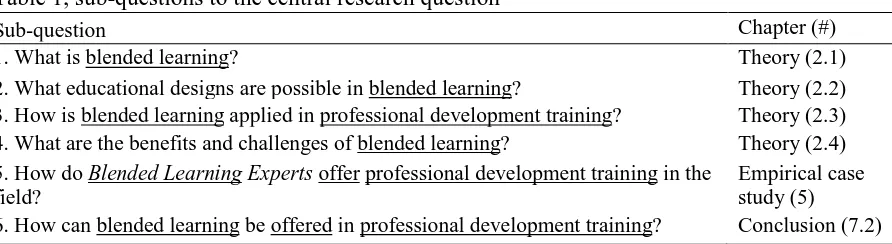
The goal of the research is to produce information relating to BL in professional development training with the ultimate goal of understanding how BL can be offered in this sense. The central research question with accommodating sub-questions for this study:
[image:6.595.79.525.225.347.2]How can an organisation who markets professional development training offer
blended learning?
Table 1, sub-questions to the central research question
Sub-question Chapter (#)
1. What is blended learning? Theory (2.1)
2. What educational designs are possible in blended learning? Theory (2.2) 3. How is blended learning applied in professional development training? Theory (2.3) 4. What are the benefits and challenges of blended learning? Theory (2.4) 5. How do Blended Learning Experts offer professional development training in the
field?
Empirical case study (5)
6. How can blended learning be offered in professional development training? Conclusion (7.2)
1.3
RESEARCH STRATEGY
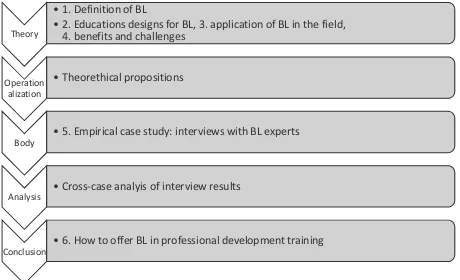
7 Figure 1 shows the chosen strategy in writing this research paper. The arrows show the flow of subjects throughout this research paper. The block Theory comprises of the first four sub questions. Concepts from the theory are then operationalized by means of theoretical propositions and incorporated into interview questions. The body of this research paper presents the results of the empirical case study, in which the BL experts were interviewed. The BL Experts are professional development experts who apply BL at their company. The results from the empirical research study are then analysed by means of a cross-case analysis. This analysis, combined with the outcome of the empirical case study were then used to conclude upon the central research question. Figure 1, research strategy
1.4
EXPLAINIT
This thesis was written in cooperation with Explainit. Explainit sees itself as a partner for organisations who want to train their employees in their professional development. Throughout the Netherlands there are eighteen locations where the training can be organized, the trainings can be organized in-house too. There are several ways in which trainings can be delivered. Examples are group trainings, one-on-one coaching sessions, and e-learning. Explainit employs account managers who connect training needs of organisations with applicable trainings and accommodating trainers. Every account manager is responsible for approximately one hundred accounts. Next to the sales function of Explainit, there is operations. The function of operations entails marketing, business development, CRM, and other tasks to keep processes running efficiently. The operations function is managed by the director of operations. This study is
Theory
• 1. Definition of BL
• 2. Educations designs for BL, 3. application of BL in the field, 4. benefits and challenges
Operation alization
• Theorethical propositions
Body
• 5. Empirical case study: interviews with BL experts
Analysis
• Cross-case analyis of interview results
Conclusion
8 performed for the operations side of Explainit, since they want to investigate the premise of BL in professional development training.
The assortment of trainings by Explainit are in the fields of management, communication, and IT. The trainings can be placed under nine themes. Some training themes have grown so specialized, which called for specialized account teams. For this goal, different brands were set up called ‘Academy4-xyz’, herein the ‘xyz’ is the name of the theme. Some brands have been launched already, wherein one brand is backed up by a full account team. This brand is Academy4-OR, and can be considered a subsidiary to Explainit. This academy is specialized in trainings for increasing skills of corporate councils and employee participation group members. The other brands focus on the topics of dealing with aggression, Microsoft Sharepoint, and migrating through versions of Microsoft Office/Windows.
1.5
SCIENTIFIC AND PRACTICAL RELEVANCE
Going through literature the notion formed there has not been a lot of peer reviewed research on BL in a professional development setting. Literature reviews on BL confirm this notion (Arbaugh, 2014; Halverson, Graham, Spring, Drysdale, & Henrie, 2014; Drysdale, Graham, Spring, & Halverson, 2013). Researchers seem to be in agreement that a lack of reports from the business world stems from the lack of interest to share knowledge; creating knowledge takes time, creating reports even more. This study takes the theoretical background of BL into account and tests its propositions in a field study, thereby creating insight in how BL is viewed upon in a professional development setting, and therefore in a business setting.
9
2
THEORY
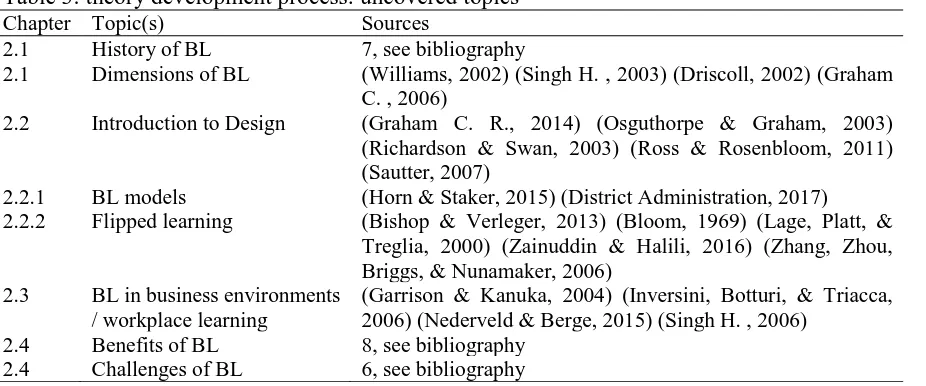
This literature review is conducted according to the grounded theory method. The method provides a five-stage process (define, search, select, analyse, and present) which aid in structuring the process of writing a literature review. (Wolfswinkel, Furtmueller, & Wilderom, 2013). Articles were queried using Google Scholar for initial search, and Web of Science for more detailed follow up research. The first step in gathering theory was looking for literature reviews using the keyword ‘blended learning’. The best fit for this study was the field encompassing literature study by Arbaugh (2014). This particular article was used to find further articles. The most heavily consulted articles can be found in table 2, all follow up research was based on these articles.
Table 2, theory development process: heavily consulted sources
Source Type of article, and title
(Arbaugh, 2014) Review: What might online delivery teach us about blended management education? Prior perspectives and future directions.
(Halverson, et al., 2014) Overview: A thematic analysis of the most highly cited scholarship in the first decade of blended learning research.
(Bishop & Verleger, 2013) Survey: The flipped classroom: A survey of the research.
(Zainuddin & Halili, 2016) Review: Flipped Classroom Research and Trends from Different Fields of Study.
(Nederveld & Berge, 2015) Summary: Flipped learning in the workplace
[image:9.595.74.537.474.667.2]The handbook of blended learning: Global perspectives, local designs by Graham (2006) put forward the dimensions for BL used in this study. Additionally, the article by Arbaugh (2014) was analysed and provides the rough outline for the topics in this literature review. The synthesized topics can be found in table 3.
Table 3: theory development process: uncovered topics
Chapter Topic(s) Sources
2.1 History of BL 7, see bibliography
2.1 Dimensions of BL (Williams, 2002) (Singh H. , 2003) (Driscoll, 2002) (Graham C. , 2006)
2.2 Introduction to Design (Graham C. R., 2014) (Osguthorpe & Graham, 2003) (Richardson & Swan, 2003) (Ross & Rosenbloom, 2011) (Sautter, 2007)
2.2.1 BL models (Horn & Staker, 2015) (District Administration, 2017) 2.2.2 Flipped learning (Bishop & Verleger, 2013) (Bloom, 1969) (Lage, Platt, &
Treglia, 2000) (Zainuddin & Halili, 2016) (Zhang, Zhou, Briggs, & Nunamaker, 2006)
2.3 BL in business environments / workplace learning
(Garrison & Kanuka, 2004) (Inversini, Botturi, & Triacca, 2006) (Nederveld & Berge, 2015) (Singh H. , 2006)
2.4 Benefits of BL 8, see bibliography
10
2.1
WHAT IS BLENDED LEARNING?
Blended leaning (BL) is a concept that has been around since a long time. The term has its roots in the organisational training and development literature (Oliver & Trigwell, 2005). In traditional education, BL was considered a ‘buzz’ word (Sharpe, Benfield, Roberts, & Francis, 2006). Some researchers maintain that research in BL is a rather new topic (Halverson, Graham, Spring, Drysdale, & Henrie, 2014), however, research in the field of management education literature has been going on for a long time (Arbaugh, 2014). At the time Sharpe et al. (2006) discussed BL, they stated that the term has been in use for almost twenty years, which means the term has been in use for thirty years now. During this time the definition of BL, and even its name, has been constantly changing. The problem of a changing definition is that there is no consensus in the scientific field. This led professionals to using different definitions like ‘hybrid learning’ or ‘mixed-mode learning’ (Picciano, 2014). At the moment of writing this study, there is still no consensus on the definition of BL, leading to difficulties in finding appropriate definitions, models, and frameworks on BL.
Defining what exactly constitutes a BL environment has been a challenge. There are criticisms that dominant definitions focus more on instruction than on learning (Oliver & Trigwell, 2005). The major research in BL was performed during the start of the last decade, in that timeframe three definitions of BL competed with each other, each definition pertaining to a different dimension inherent to BL:
Place: Combining online and face-to-face instruction (Williams, 2002); Technology: Combining instructional delivery media (Singh H. , 2003); Design: Combining instructional methods (Driscoll, 2002).
These different definitions exist, since BL is not just implementing technology into a training, and be done with it. There is a need of rethinking the educational design and/or teaching (Bleed, 2001;Vaughan, 2007). The technology point of view is mainly used in the world of business. The third definition is used rarely in research (Graham, 2014). However, in his literature review, Arbaugh (2014) has constructed a more encompassing definition on BL: educational experiences delivered through the thoughtful combination of face-to-face and online activities. This is the leading definition of BL in this study as it combines all three dimensions of BL: the concepts face-to-face and online activities cover the dimensions of Technology and Place, where the concept thoughful covers the dimension of Design.
2.2
BLENDED LEARNING EDUCATIONAL MODELS
11 BL aims to create the right blend in educational experiences, therefore a careful consideration must be taken in the Design phase of a BL training. Sautter (2007) provided some guidelines for determining whether particular educational activities should be conducted online or in a classroom. She argues that activities that require learner control should be conducted online, whereas activities that require skills in active listening, oral communication, and/or out of the box thinking were better served by a classroom setting. Learner control is the extent to which the learner has influence over the way he/she can go about the learning. This research was reflected upon by a study of Ross & Rosenbloom (2011), wherein they strived to redesign an undergraduate management strategy course for blended delivery. They discovered that creating a sense of social presence early in the course was particularly important for holding the two learning environments together. Social presence is defined as the extent to which participants are socially and emotionally connected to each other (Richardson & Swan, 2003). This stress on connection between learners suggests that activities not directly related to educational content are important at the beginning of the training.
BLENDED LEARNING MODELS
As the term says, BL is about creating a blend in education. In their book, Horn & Staker (2015) build on several educational theories and BL research. They developed a model with different blends in educational techniques and delivery:
1. Rotation models, a course or subject wherein learners rotate on a fixed schedule between different learning stations (physical location where learning takes place), one of which is online learning.
2. Flex model, learners are moving flexibly through different learning stations, based on what they need when they need it. There are no time constraints because learners are not forced to spend a given amount of time in a learning station.
3. Self-blending model, learners take some courses online (off-site) and others face-to-face in a classroom.
4. Enriched virtual model, a course or subject in which learners have required face-to-face learning sessions with their teacher and then are free to complete their remaining coursework remote from the face-to-face teacher. Many Enriched Virtual programs began as e-learning platforms and then developed blended programs to provide learners with face-to-face experiences.
12 IMPROVING THE EFFECTIVENESS OF CLASSROOMS
The focus of research in BL is mainly on the virtual side of the blend. Influental researchers in BL such as Garrisson, Bonk, Dziuban and Graham (2006) have, as a majority, an educational technology and/or an online teaching background (Halverson, Graham, Spring, Drysdale, & Henrie, 2014). These researchers tend to focus more on the e-learning side of the blend. Since BL focuses on mixing online with face-to-face learning, research in face-to-face learning needs to be addressed as well. Arbaugh (2014) points out that classroom-based researchers may actually be studying the theme of BL under the term of ‘flipped classrooms’ or ‘flipped learning’. Flipped learning builds on the notion that video lectures are as effective as in-person lectures at conveying basic information (Zhang, Zhou, Briggs, & Nunamaker, 2006). In this sense, using learner and instructor time for lectures is inefficient. Consequently, pre-recorded lectures can be assigned to the learner as homework, leaving class time open for interactive learning activities that cannot be automated or computerized (Bishop & Verleger, 2013). Recent studies show that flipped learning is changing the way educators look at learning. There has been a shift going on from ‘lecturer-centered’ to ‘learner-‘lecturer-centered’ teaching (Zainuddin & Halili, 2016). BL has the opportunity to improve in-classroom learning. Basically, flipped learning means that events that traditionally took place inside the classroom now take place outside the classroom, and vice versa (Lage, Platt, & Treglia, 2000). This definition supports the name ‘flipped’, although it is considered incomplete, as this description only implies a new combination of the dimension of Place; a rearranging of face-to-face and online. Zainuddin & Halili (2016) define flipped learning as a form of BL, wherein both face-to-face learning through group dicussion and online distance learning outside of the class, by watching video lessons and online collaboration, are integrated. To this extent, this definition is almost exactly the same one of the definitions for BL, the only difference being a clear description of activities that should take place.
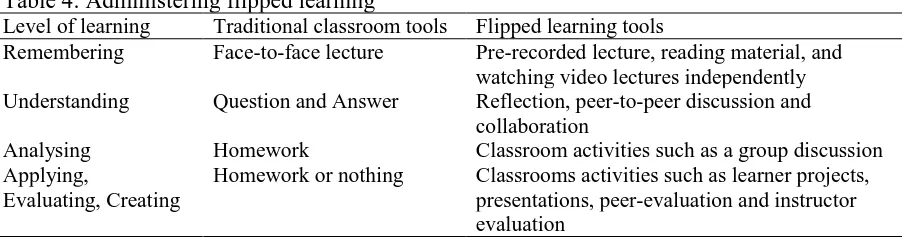
The basis for the flipped learning model is the idea that individuals have individual learning styles. Taking into account that learners have individual learning styles make a thoughtful Design of BL possible. The underlying theory to flipped learning is Bloom’s ‘revised taxonomy of cognitive domain’. In his taxonomy (or categorization) Bloom (1969) established six levels of learning (from lowest to highest level): Remembering, Understanding, Applying, Analysing, Evaluating, and Creating. In the last stage, Creating, learners are able to design, construct and produce something new from what
13 Table 4: Administering flipped learning
Level of learning Traditional classroom tools Flipped learning tools
Remembering Face-to-face lecture Pre-recorded lecture, reading material, and watching video lectures independently Understanding Question and Answer Reflection, peer-to-peer discussion and
collaboration
Analysing Homework Classroom activities such as a group discussion
Applying,
Evaluating, Creating
Homework or nothing Classrooms activities such as learner projects, presentations, peer-evaluation and instructor evaluation
Zainuddin and Halili (2016)
In order to reach higher learning levels, it is critical to have face-to-face activities in educational experiences. Only administering theory and practices through online platforms (e-learning) is simply not enough (Bishop & Verleger, 2013). Consequently, using a mix of face-to-face and online learning Technologies, improves learner experience. In flipped learning, activities such as practice exercises, group-based meetings, and Q&A sessions occur during face-to-face learning activities. Video lectures, individual quizzes, and practice exercises take place outside of class, usually accessed via some type of online platform (Bishop & Verleger, 2013). The justification for using flipped learning is not using classroom time to deliver lectures, but to introduce a different kind of teaching. Flipped learning relates to the Place and Design elements of the definition of BL. In short, interactive group learning is performed in the classroom, whereas learning theory and practice are performed outside the classroom. See table 5 below for an overview of the activities.
2.3
BLENDED LEARNING IN BUSINESS ENVIRONMENTS
BL was coined as a promising idea in organisational professional development training since it can reduce costs while still delivering high educational quality. Driscoll (2002) states that in the corporate world BL was first used to refer to educational experiences which allowed for workers to both continue in their workplace and study. BL was initially adopted in business environments as a cost saving measure. In addition, Garrison & Kanuka (2004) propose that the delivery of BL experiences involves a move of a significant portion of the learning activities online. A blend of traditional methods (i.e. face-to-face classroom teaching), with technology-based instruction, including online communication, activities and delivery, entails significant changes in Place and Technology to the educational delivery; for example, leading to shorter ‘seat-time’. This lowered seat time is the reason why BL is so attractive to commercial organisations, as their employees are removed from their workplaces for a reduced amount of time from what they previously were. Professional development training is also termed as workplace learning in literature. Recent workplace learning trends show a favour for flipped learning, which is a flavour of BL (Arbaugh, 2014). Benefits of using flipped learning in a business setting are reduced travel costs, reduced
Table 5: Activities in flipped classrooms
Inside Class Outside Class
Questions & Answers Video Lectures
Group-Based/Open-Ended Problem Solving Closed-Ended Quizzes & Practice Exercises
14 opportunity costs and increased practice time. Additionally, both employees and managers may see a return on investment during the trainings if they solve a real company problem during the training (Nederveld & Berge, 2015). Since the inception of e-learning, there has been a notion that it could rid organisational need for additional face-to-face trainings. According to Singh (2006), a mistake organisation made was to deliver too much e-learning to their employees. In the past organisations dumped hundreds or even thousands of trainings into a LMS (learning management system), and rely on it too much. A LMS is a software system that delivers courseware plus e-tutoring over the internet (Inversini, Botturi, & Triacca, 2006). Managers expected learners to investigate and find the relevant trainings suited to their work. In many cases, just completing a training through e-learning is not enough to learn task specific requirements. This is where BL proves resourceful, as it involves face-to-face learning. In face-to-face activities learners can put theory into practice by having discussions or performing job specific tasks.
2.4
BENEFITS AND CHALLENGES OF BLENDED LEARNING
The literature outlines different benefits and challenges to BL. First theoretical benefits are outlined. It has been coined that BL combines the best of the teacher with the best of the technology. In this way BL delivers improved learning outcomes (Graham, 2006). On the other hand, when there is no thought-through pedagogical relation between parts of the blend, the educational experience will lack coherence (Sharma, 2010). In other words, just because the option of BL is available, does not immediately mean it is wise to use it, a thoughtful Design must lay at BL its foundation. Examples of benefits from blended education in management studies include: increased confidence when working in virtual project teams, increased learner control of the educational experience, and enhanced dialogue skill development (Arbaugh, 2014). Furthermore, BL allows for instructors to change how class time is used to better tailor opportunities for learning and provide learners with increased control over their learning experience by allowing them to decide what material they will study and how they will study it (Osguthorpe & Graham, 2003). Given the different types of learning activities possible in BL, it accommodates individual learning styles learners have, due the fact that learners can choose how they want to learn (Zainuddin & Halili, 2016). In their comparative analysis between traditional and fully online graduate courses, Rovai & Jordan (2004) found evidence which suggest that blended educational experiences produce a stronger sense of community among learners than either traditional or fully online educational experiences. Benson, Anderson, & Ooms (2011) add to this by suggesting that BL produced a stronger sense of community among learners than traditional face-to-face or online learning combined. A stronger sense of community aides in increasing learner satisfaction. Furthermore, BL introduces more effective use of face-to-face time, since theory is covered through e-learning (Bishop & Verleger, 2013). In summary, it can combine the best of online and face-to-face teaching, it introduces more effective use of face-to-face-to-face-to-face time, it allows for learners to learn according to their individual learning styles, learners have increased control over their learning experience, and given the flexible nature of BL is can reduce seat time.
16
3
OPERATIONALIZATION OF CONCEPTS
The aim of this chapter is to operationalize the concepts uncovered in the literature review. First the conceptual frameworks are constructed, after which the inherent concepts are discussed in depth. From the concepts, theoretical propositions are coined which are used for structuring the interviews with the BL Experts.
3.1
CONCEPTUAL FRAMEWORK
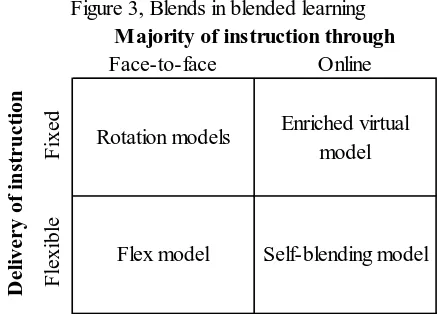
Figure 3 displays the different concepts of the BL models introduced in chapter 2.2.1, it serves as an aide to gauge which models the BL Experts use in practise. The upper side of the matrix relates to the dimension of Place and Technology. The left side of the matrix relates to the Design of the training. Fixed and flexible delivery of instruction is the matter in which timeframe the instructional methods are provided, thus this dimension can also be explained as Time in this figure. In the flexible approach learners can follow the
instructions at their own pace, whereas the learning timeframe is prescribed in the fixed delivery type. With the proposed framework, organisations who want to introduce BL into their trainings can choose for a blend in their instruction. The prerequisite needs for the training must first be analysed, after which the model can be used to select the right blend. The literature speaks of the possibility of an ‘optimal blend’, but does not conclude on it actually existing. This study tries to answer, through interviews, if the BL Experts think it exists.
Next to trying to find whether an optimal blend exists, the interviews in this case studies are structured according to the dimensions of BL found in this chapter. As an aid, a conceptual framework is drawn up, depicted in figure 4. In the model Technology and Place are placed above the learning environments, since they both cover the distinction of face-to-face and online learning; Technology covers the instructional delivery media and Place covers the instructional location. The two dimensions overlap in learning environment, but their inherent concepts do not. Design is placed below the learning environments, since it introduces the supporting elements influencing both learning environments. The concepts in each dimension are enumerated upon in the next three subchapters. Face-to-face relates to learning activities which happen in the physical world. Examples of such activities are classroom and workplace learning. Either of these Places allow for professional development training. The online environment relates to learning activities which can be performed online, examples of such activities are e-learning, practice exercises/quizzes, and online collaboration. Where the two environments overlap, BL is taking place. The Design dimension influences in which environment the learning takes places. Additionally, Design provides the methodological backbone to the blend in that it binds the two learning environments together.
Face-to-face Online
F
ix
ed
Rotation models Enriched virtual model F le x ib le
Flex model Self-blending model
[image:16.595.308.527.314.471.2]D el iv er y o f in st ru ct io n
Figure 3, Blends in blended learning
17 TECHNOLOGY
Technology is the combination of instructional delivery media (Singh H. , 2003). In BL, there are two types of delivery media: Face-to-face and online. Online media are platforms through which instructions and information are provided. Through online delivery different instructional media can be used: pre-recorded lectures, reading material, and video lectures. Additionally, learners can communicate with other learners in the online environment so that they can reflect, discuss with their peers, and collaborate with them. Face-to-face activities make use of traditional instructional media such as classroom activities and workplace learning. The activities in the face-to-face environment support interactive activities such as: group discussion, presentations, peer-evaluation, and instructor evaluation (Zainuddin & Halili, 2016). BL builds on the fact that face-to-face activities are needed in educational experiences, online activities in itself are useful, but are on its own not enough to get a good learning result. Bishop & Verleger (2013) propose that administiring theory and practices only through online platforms is not enough, face-to-face learning is needed. In this way the two environments are bound together as shown in the above conceptual framework.
PLACE
18 DESIGN
Design is the combination of instructional methods (Driscoll, 2002). Design decisions influence the outcome of the blend. The Design can be seen as the foundation of BL and is therefore placed beneath the two learning environments in the conceptual framework. Design underlines the use of accommodating individual learning styles (Zainuddin & Halili, 2016), providing learner control (Sautter, 2007), and creating flexibility (Nederveld & Berge, 2015), which all contribute to the effectiveness and results of BL. Initial face-to-face activities are useful for creating social presence. Social presence is useful in fusing the two learning environments together (Ross & Rosenbloom, 2011). Designing educational experiences in a thoughtful way can help learners to use according to their own learning style. Individual learning styles require learners to have control over their learning experience, moving a part of the educational experiences online helps learners in doing so.
3.2
THEORETHICAL PROPOSITIONS
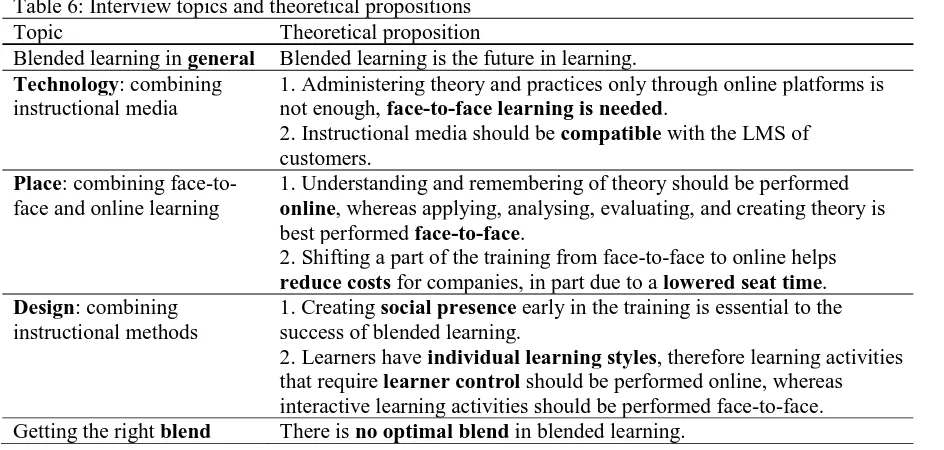
[image:18.595.69.541.456.681.2]The interviews in this study provide more information on how BL Experts apply BL in the field. By means of the conceptual framework, different concepts are defined. These concepts are operationalized into variables by means of theoretical propositions (TP’s), see table 6. In the table, the concepts are displayed in bold. The TP’s are a guideline to gauge whether the theory is in line with the real world, in this way empirical evidence for the theory can be gathered. For each TP specific questions are formulated, these can be found in Appendix A: Interview questions. There is one TP which is not grounded by theory: Technology 2: instructional media should be compatible with the LMS of customers. The questions behind the TP deal with requirements of a LMS, since Explainit wants to learn from these questions the proposition is introduced here.
Table 6: Interview topics and theoretical propositions
Topic Theoretical proposition
Blended learning in general Blended learning is the future in learning.
Technology: combining
instructional media
1. Administering theory and practices only through online platforms is not enough, face-to-face learning is needed.
2. Instructional media should be compatible with the LMS of
customers.
Place: combining
face-to-face and online learning
1. Understanding and remembering of theory should be performed
online, whereas applying, analysing, evaluating, and creating theory is
best performed face-to-face.
2. Shifting a part of the training from face-to-face to online helps
reduce costs for companies, in part due to a lowered seat time. Design: combining
instructional methods
1. Creating social presence early in the training is essential to the success of blended learning.
19
4
METHODS
This chapter describes the methodology with which the research is performed. First, case selection is described after which the data collection methodology is presented. The final part of the methodology clarifies how the collected data is analysed.
4.1
CASE SELECTION
Different types of case study designs exist. There are single-case and multiple-case designs on the one hand, and holistic or embedded designs on the other (Yin, 2009, p. 46). Mixing these two designs up makes for a possible of four types of case study designs. In order to be able to select cases, different decisions have to be taken. In this study, Explainit indicated it wants to know the opinion of organisations on the topic of BL. This automatically leads to the introduction of multiple cases—analysis of one case (in this case: one organisation) is not what Explainit desires. Scientifically, multiple-case studies are more convincing, than single-case studies, as their evidence is regarded as more robust (Herriot & Firestone, 1983). The application of a holistic design is called single method, whereas studies with an embedded design are called mixed method: more than one method of research is used (Yin, 2009, p. 62). This study applies a single method approach, through the use of interviews. The interview method needs a case to build itself on, in this way it is important to specify which cases are to be studied. Figure 5 aids in selecting a data collection source.
Information is needed on how an organisation works with BL, and why it works this way. As figure 5 shows, the data should then be collected from an individual in an organisation. As a result, the case study design is complete: Cases are about an organisation, with data extracted from an individual in that organisation.
4.2
DATA COLLECTION
20 information calls for a different type of data collection procedures. However, in every data collection method some principles are important: to use multiple sources of information, to keep a case study database, and constructing a chain of evidence in the data (Yin, 2009, pp. 98-125). This study makes use of qualitative interviews to extract information from the BL Experts.
The qualitative interview is based on a set of topics to be discussed in depth rather than based on the use of standardized questions (Babbie, 2014, p. 318). Since patterns need to be drawn from the questions, some sort of standardization has to take place in order to have some kind of control in this study. RAND distinguishes three types of interviews (from low to high control): unstructured, semi-structured, and structured (RAND Corporation, 2009). In this study, the interviews are used for delving information on what BL Experts think of BL. For this purpose, semi-structured interviews are the best fit. In semi-structured interviews a guide is used, which outlines which topics have to be covered. The questions herein are standardized, wherein standard follow up questions are inventoried before the interview, to apply structure. The follow up questions allows for the interviewee to give the needed information, if the information is not retrieved through the original question. For the semi-structured interviews, a protocol was constructed, which led the conversation in the interviews. The interview protocol can be found in Appendix A.
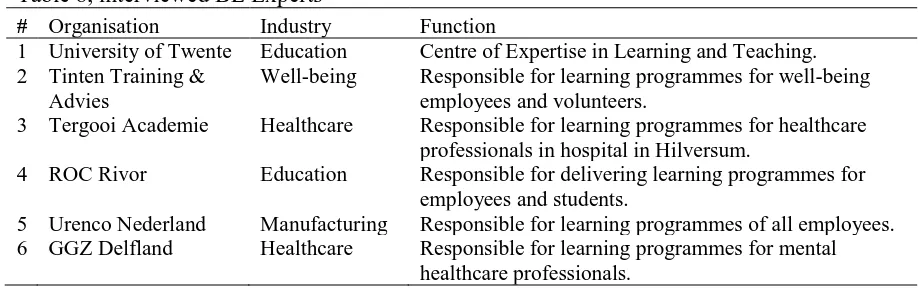
[image:20.595.67.526.575.720.2]A total of six BL Experts were interviewed, which are shown in table 8 below. Guest, Bunce & Johnson outlined considerations on deciding how many interviews a researcher needs. The first consideration is interview structure. The more structured the interview is, less interview are needed than with an unstructured interview. The second consideration is the heterogeneity of a group, the more heterogeneous a group is, the more interviews are needed (Guest, Bunce, & Johnson, 2006). The interviews in this research are semi-structured with interviewees being a homogenous group. The BL experts are all employing BL in practise with the goal of professionally developing employees. The only heterogeneity between the BL experts is the type of organization they work for. Additionally, after four interviews, patterns from the interviews emerged to a point the researcher could guess in the following interviews how the interviewees would respond. This phenomenon is called ‘theoretical saturation’ (Glaser & Strauss, 1967). Given the resources available to the researcher, no more further interviews were planned after theoretical saturation was reached. Due to the above considerations, six interviews proved to be sufficient in answering the central research question.
Table 8, interviewed BL Experts
# Organisation Industry Function
1 University of Twente Education Centre of Expertise in Learning and Teaching. 2 Tinten Training &
Advies
Well-being Responsible for learning programmes for well-being employees and volunteers.
3 Tergooi Academie Healthcare Responsible for learning programmes for healthcare professionals in hospital in Hilversum.
4 ROC Rivor Education Responsible for delivering learning programmes for employees and students.
5 Urenco Nederland Manufacturing Responsible for learning programmes of all employees. 6 GGZ Delfland Healthcare Responsible for learning programmes for mental
21
4.3
DATA ANALYSIS
The following subchapters describe how the semi-structured interviews are analysed. Additionally, the validity and reliability of this study are addressed. Five techniques are available in case study analysis: pattern matching, explanation building, time-series analysis, logic models, and cross-case synthesis. Of these techniques pattern matching is considered the most desirable, since it strengthens the internal validity of a study (Yin, 2009, p. 136). In pattern matching, patterns are first predicted from theory after which they are tested in practice. Chapter 3.1 (conceptual framework) provides the theoretical concepts of this study, which are worked out into TP’s in chapter 3.2. The analysis consists of analysing whether the theoretical predictions are confirmed in practice by the BL Experts. Additionally, the responses of the BL Experts were analysed by summarizing them into a cross case analysis in chapter 6: Analysis. The primary output of the interviews was collected through voice recordings of the interview itself. After administering the interview, the voice recordings were transcribed to text. The text was then structured by putting the relevant excerpts in a matrix. The upper side of the matrix contains the accounts and the left side the interview questions (see Appendix B for the matrix). The topics of the interview questions are the same topics presented in chapter 3.2 ‘theoretical propositions’.
VALIDITY AND RELIABILITY
For this research to have impact, careful consideration is given to validity and reliability. In social research, there are different kinds of design tests to be considered for the design to have a high quality: validity and reliability.
The different kinds of validity were taken into account. Validity addresses how well a measure reflects what it is supposed to measure (Dooley, 2001, p. 88). There are different kinds of validity:
• Construct validity, addresses whether the correct operational measures have been established for the concepts that are being studied. In this study, construct validity is taken into account by using multiple cases of evidence and establishing a chain of evidence by using tables.
• Internal validity, controls whether a causal relationship has been established. In this study, internal validity is guaranteed by using pattern matching through cross-case analysis (chapter 6.2) and searching for negative cases wherein alternative explanations are accounted for.
• External validity, proves that the domain of a case study can be generalized. In this study, external validity is addressed by an in-depth explanation of the research design (chapters 1.2, 1.3, and 4.2). By presenting an extensive research design, this research can be reproduced, thus improving external validity.
22
5
EMPIRICAL CASE STUDY
This chapter presents the results of the empirical case study. The chapter is structured according to the uncovered concepts set out in chapter 3 (operationalization of concepts). The goal of the case study was to discover patterns throughout the interviewed BL Experts. The results of the interviews are presented by giving the relevant excerpts in a matrix. The interview matrix can be found in Appendix B ‘Interview matrix’, the interview protocol can be found in Appendix A. The left-hand side of the interview matrix contains the (coded) interview questions per topic; the upper side the BL Experts. The interview questions rely on TP’s, the results are compared to the TP’s with the BL Experts in the next chapter. Patterns are then summarized by means of a cross-case analysis in Chapter 6: Analysis.
5.1
BLENDED LEARNING IN GENERAL
The first topic consists of two questions about BL in general as well as a statement with which the BL Experts can relate with or not. The underlying TP is general in nature. The results on this topic are interpreted by means of the TP in the next chapter.
The BL Experts all have affinity with BL. Most BL Experts are responsible for the learning and development of employees for their respective organisations, except for the University of Twente (UT). The goals of these departments are to train their own employees, Tinten Training & Advies (TTA), GGZ Delfland (GGZ), and UT serve and additional purpose—their training programmes are also open to healthcare professionals outside of their organisation. The Centre of Expertise in Learning and Teaching at the UT focuses on both students of the university and professionals, and develops programmes for these target groups. The department has experience with flipping classrooms (shorts blends) and longer blends. Examples of such blends are a specialist international blended educational experience on rural energy planning (ICREP), and different Massive Open Online Courses (MOOCs). Interesting first remarks came from the Tergooi Academie (TA) and GGZ. TA said they experienced pure face-to-face learning took too much time and did not deliver. They tried pure e-learning after, but found out soon enough this was not the answer to their learning question either. As a result, they switched to BL—BL enables for educational experiences to be delivered in small chunks. GGZ mentioned that, although BL is considered a new trend in the field of professional training, a lot of these methods have been used for a long time. Perhaps a new thing that BL brings is that you can now first cover theory by yourself after which practice is performed face-to-face.
23 When asked whether BL combines the best of the teacher with the best of technology, all BL Experts, except one, agree. They did place some comments on the statement, BL can combine the best of the teacher and the classroom on a few conditions: 1. You must acknowledge that every educational situation is different, 2. The online environment must be interactive, 3. You need to really understand which knowledge needs to be transferred, cut out all the rest, 4. Workplace learning must be involved, 5. Classrooms must be used to go in more depth than the online environment. Urenco Nederland (Urenco) does not agree with the statement. They mention the learner determines the yield of the process of learning, therefore the learner is the most important element of BL.
5.2
TECHNOLOGY
The topic of Technology consists of four questions and one statement, the questions have two separate TP’s. The underlying TP’s address classroom usage and the LMS. After the results on this topic have been presented the TP’s are interpreted in the next chapter, a conclusion is then drawn whether there is a match.
All BL Experts have experience with e-learning, varying from little to expert experience. The UT and TTA mention that e-learning should be interactive, in that learners are able to collaborate with each other. TA, ROC Rivor (ROC), and GGZ use external e-learning platforms to teach their employees in soft skills. Soft skills train personal attributes that improves ones’ functioning. GGZ says they have good results with e-learning, only due to work-pressure (being a given in the healthcare industry) employees indicate they cannot really find the time to do it. Additionally, GGZ make use of thirty to forty healthcare specific trainings through e-learning through GGZ Ecedemy, a country wide initiative of GGZ. ROC mentions their LMS is used to put in all the educational materials by five dedicated employees, the LMS is effectively used as a container of information. TA mentions it is paramount that modules in e-learning should be short. Urenco comments they have both good and bad experiences with e-learning. They acknowledge Virtual Reality (VR) has great potentials, in the future a part of the practise, which is at the moment performed in class, could shift to an online VR environment. There were also cases where Urenco encountered badly designed e-learning modules, from these cases sprung considerable trust issues from within the employee base. In later stages when new e-learning modules was introduced, considerable effort was needed to convince employees of the benefit of e-learning.
24 When asked whether trainers are the most important part of technology in BL the UT, TTA, TA and ROC agreed. For this agreement, different arguments were given: 1. The teacher/trainer should oversee the learning process, answers questions, and facilitate discussion (also in the online environment), 2. Learners need practise activities to retain what was learned, a trainer facilitates this, and 3. The trainer is there to enthuse and inspire the learner. In summary, the trainer becomes a facilitator of learning in BL. Urenco and GGZ disagreed. Urenco stipulates that not the teacher, but the learner is most important element of BL.
The next topic in Technology is the requirements of the LMS. All BL Experts gave comparable answers, for clarity all requirements are summed up. The LMS should:
- Be as simple and clear as possible (user friendly);
- Have personalized dashboards which tells uses what is available (and how much time it will take), what has been done, and what the results were;
- Promote collaboration and exchanges between knowledge groups who normally do not have contact in the workplace;
- Be highly customizable and flexible for an admin, allowing to bind the online and offline environments together;
With regards to the compatibility of a possible BL system the company may want to introduce, the BL Experts all said it should be compatible, except for the UT. However, the UT mentioned that learning management systems all run on universal languages such as LTI or SCORM, so there is always a possibility for organisations who have an LMS to read out information from other systems. Urenco is a unique outsider in this category since their processes are confidential—they enrich uranium. Given the fact they have confidentiality rules, it would be unwise to link external systems to their system.
5.3
PLACE
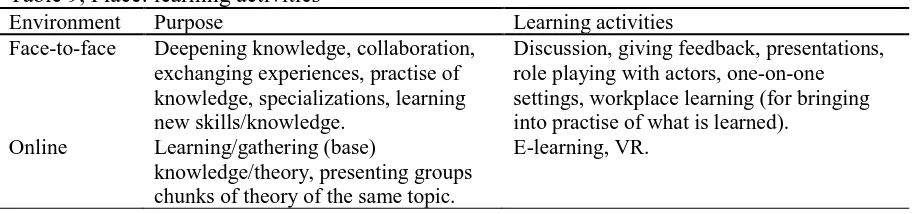
The topic of Place consists of three questions, the questions have two separate TP’s. The underlying TP’s address the concept of where learners learn best based on Bloom’s taxonomy, and the concept of reduced seat time. After the results on this topic have been presented the TP’s are interpreted in the next chapter, a conclusion is then drawn whether there is a match.
25 On the statement whether BL can reduce organisational costs, the BL Experts are divided. The BL Experts that do agree give different arguments. TTA mention they have to book less classroom time in BL, which saves money, and are subsequently more flexible in their schooling budget. ROC and GGZ say the benefits of BL will appear over time. ROC mentions that their employees still have to get used to BL. On the other hand, GGZ mentions that BL is easier to organize, additionally employees are away for shorter times from their workplace which is efficient. The BL Experts that disagree with the statement too have varying arguments. Urenco mention they miss out on the scalability efficiency of BL, given the fact that they have a relatively low number of employees (260). The UT mentions there is a misconception on the process of designing an educational experience. After compilating setting up, it will still need work in the future. In this way BL is more time consuming to manage than either classroom or online learning. TA mentions that, compared to the previous situation (classroom learning), costs now shift to other functions of the organisation. TA does experience that BL is more time efficient for their employees.
5.4
DESIGN
The topic of Design consists of two questions and one statement, the questions have two separate TP’s. The underlying TP’s address the concepts social presence and learning styles. After the results on this topic have been presented the TP’s are interpreted in the next chapter, a conclusion is then drawn whether there is a match.
The BL Experts were first questioned whether they thought it important to plan activities at the beginning of a BL training which are not directly related to the educational content. TTA, TA, and Urenco said they do not do this, the main reason for not doing so is work related time pressures. The UT, ROC, and GGZ all propose that learners need to see each other face-to-face to create social cohesion. This social cohesion lowers the threshold in the online environment to ask questions and work together. The UT and ROC add to this by stating that collaboration in learning is needed in order to get a good learning experience. GGZ mentions that in most cases, already some social cohesion is present, since learners are most of the times colleagues who regularly work together.
[image:25.595.71.527.132.239.2]When asked which activities require learner control, two different patterns emerge. TA, TOC, Urenco, and GGZ mentioned learners should have the freedom to learn in the way they want to, because learners have individual learner styles. Urenco added to this by mentioning that learners should be aware of the fact that they have ownership over their own learning process, and should
Table 9, Place: learning activities
Environment Purpose Learning activities
Face-to-face Deepening knowledge, collaboration, exchanging experiences, practise of knowledge, specializations, learning new skills/knowledge.
Discussion, giving feedback, presentations, role playing with actors, one-on-one settings, workplace learning (for bringing into practise of what is learned).
Online Learning/gathering (base)
knowledge/theory, presenting groups chunks of theory of the same topic.
26 be facilitated as such. The UT went for an abstract approach for this question. They make a distinction between asynchronous and synchronous activities. Asynchronous activities can all be done in learners’ their own time, and therefore learner control is possible. Asynchronous activities are reading an article, doing a quiz, watching a (interactive) video, and doing games. These activities allow for learning to gain a deeper insight and reflect on what was learned, the disadvantage is that these activities do not allow for collaboration. Synchronous meeting, meetings in real-time, do allow for this, and are useful for deeper learning.
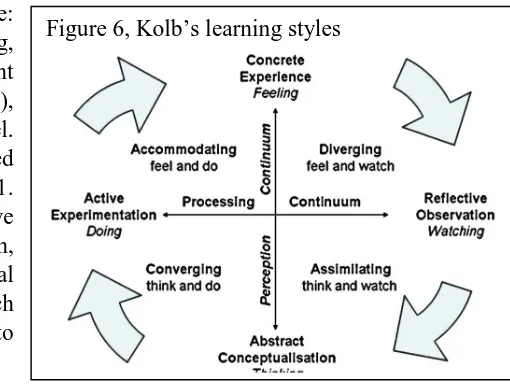
All BL Experts agree with the statement if learner control increases results in learning. The UT and Urenco mention that a heightened level of autonomy in the learning process produces better results. GGZ mentions learners who take responsibility and are motivated is key. TTA mentions that mandatory learning does not work for their employees, the more they say learners need to do something, the more likely they will not do it. Therefore, they experience better results when learners have greater autonomy over their learning process. ROC mentions that Kolb (2005) identifies four different individual learning styles, for clarity these learning styles are presented in this section. The styles are:
Accommodating, Diverging, Assimilating, and Converging—see figure 6 to the right (Kolb, 2000). In his model Kolb (2000), builds on his experiential learning model. The experiential learning cycle is presented as the outer rim in figure 6, the steps are: 1. Concrete Experience, 2. Reflective Experience, 3. Abstract Conceptualisation, 4. Active Experimentation. The individual learning style addresses in which experiential stage a learner should begin to get an optimal learning results.
5.5
GETTING THE RIGHT BLEND
[image:26.595.268.523.317.510.2]The topic of getting the right blend consists of three questions, the questions is backed by one TP: there is no optimal blend in blended learning. After the results on this topic have been presented the TP is interpreted in the next chapter, a conclusion is then drawn whether there is a match. The first question revolved around the model figure 3: ‘blends in blended learning’. BL Experts were asked which blend they prefer in their organisation. Almost all BL Experts mention that the model does not work in their organisation, they give two reasons for this. First, every learning situation is different, therefore they cannot say which strategy fits for all their educational needs. Second, face-to-face training is fixed, with a little bit flex, since most of the time employees can choose which timeslot they want to attend. For organisations, the online environment is always flexible. This is because a learner can choose when to do a training, there is no fixed time set for this. Generally, organisations want to provide their trainings as flexible as possible. Again, both sides of the model do not line up for every situation. The BL Experts that eventually did indicate
27 which strategy they use mention they use face-to-face instruction in majority, with a flexible part of e-learning.
The second questions revolve around figure 2: Bloom’s taxonomy in flipped learning. All BL experts had some level of affinity with Bloom’s taxonomy. The BL Experts were asked whether they think flipped learning is applicable to professional development training. Overall, the BL Experts are positive about flipped learning in the workplace, where some are quite enthusiastic about the learning model. They all employ the first two stages of Bloom (Remembering and Understanding) through an online environment. TA and Urenco mentioned that for the higher stages (Evaluating and Creating) classrooms are not suitable, but workplace learning is more applicable. Urenco mentions they place workplace learning on top of in-class activities in Bloom’s taxonomy. In the workplace learners apply their newly gained knowledge, which in the end they innovate—the Creating phase in Bloom’s taxonomy. Urenco notes that doing practise exercises in the classroom cannot be considered as ‘the real thing’, since the classroom is a safe and controlled environment; it does not reflect the real world. Still, there are challenges to introducing flipped learning in the workplace. The UT says that for it to work, the face-to-face activities must stand in connection to the online environment. TTA and TA both mention their employees need to adjust to working with BL through flipped learning, they are both convinced the new way of learning is something everybody can learn. TA herein makes a distinction between ‘young’ and ‘old’ employees, wherein young employees mostly do the first two stages of Bloom by looking everything up on a digital device, older employees still have to get used to this idea of learning theory on your own. ROC says that when you introduce flipped learning in BL, you should keep in mind that everybody learns differently, therefore learners should have the freedom to pick a way that is closest to them. GGZ mentions they let employees teach other in the workplace, most of the times there are hierarchical differences, which leads to employees taking the typical leading role. They conclude that there should be collaboration for learning to take place, so they try to educate their employees as such and minimize the typical teacher role.
When asked whether an optimal blend in BL exists the answer is unanimously no. The UT, TA, and Urenco herein argue that no optimal blend is possible since every learning situation askes for a different solution. Additionally, the UT mentions that BL lies in the domain of the social sciences, for this reason there is always debate whether something works or not. TTA and ROC again mention that people have individual learning styles, if BL is to work, these learning styles have to be accommodated as such. Finally, GGZ mentions the possibility of there being optimal blends per training theme, however, the success factor ultimately lies with the learner. The learner really has to be activated in that they get into the learning mode, this is key for any learning situation.
5.6
CLOSING REMARKS
28 role in the training needs of these organisations. ROC and Urenco mention that the desired topic for BL depends on the theme, it can either go specialist or general. General skills do fit BL, since general knowledge can be made scalable through e-learning. The final question of the interview revolves around the fact whether all types of trainings can be delivered through BL. Overall the BL Experts agree that all trainings can be instructed through BL, however, just because it can be done does not mean it should be done. For example, the UT and TTA mention that there are some things you can only learn by doing (art), consequently there are some topics which work better instructed purely online (software skills). ROC and Urenco mention that the learner should be accommodated at all times, taking into account their individual learning style, only then can BL work.
6
ANALYSIS
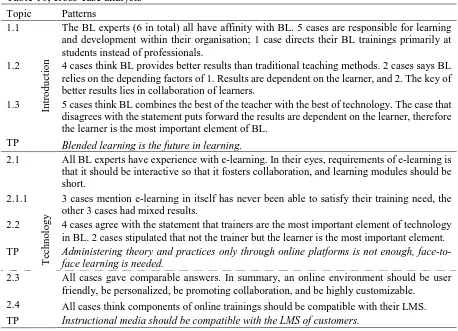
[image:28.595.69.527.378.709.2]This subchapter serves as a recap of what was said by the BL Experts during the interviews. Table 10 ‘cross-case analysis’ displays the resulting pattern(s) per question. The questions of the interview serve as a means of testing the theoretical propositions, which are shown above each set of supporting questions in the table.
Table 10, cross-case analysis
Topic Patterns 1.1
In
tr
o
d
u
ct
io
n
The BL experts (6 in total) all have affinity with BL. 5 cases are responsible for learning and development within their organisation; 1 case directs their BL trainings primarily at students instead of professionals.
1.2 4 cases think BL provides better results than traditional teaching methods. 2 cases says BL relies on the depending factors of 1. Results are dependent on the learner, and 2. The key of better results lies in collaboration of learners.
1.3 5 cases think BL combines the best of the teacher with the best of technology. The case that disagrees with the statement puts forward the results are dependent on the learner, therefore the learner is the most important element of BL.
TP Blended learning is the future in learning.
2.1
T
ec
h
n
o
lo
g
y
All BL experts have experience with e-learning. In their eyes, requirements of e-learning is that it should be interactive so that it fosters collaboration, and learning modules should be short.
2.1.1 3 cases mention e-learning in itself has never been able to satisfy their training need, the other 3 cases had mixed results.
2.2 4 cases agree with the statement that trainers are the most important element of technology in BL. 2 cases stipulated that not the trainer but the learner is the most important element.
TP Administering theory and practices only through online platforms is not enough,
face-to-face learning is needed.
2.3 All cases gave comparable answers. In summary, an online environment should be user friendly, be personalized, be promoting collaboration, and be highly customizable.
2.4 All cases think components of online trainings should be compatible with their LMS.
29
Topic Patterns 3.1
P
la
ce
Cases responded unanimously: face-to-face meetings should be used for interactive learning. 2 cases put forward the classroom should not be used to give lectures on theory. 3.2 Cases responded unanimously: the lower stages of Bloom’s Taxonomy can be performed
online.
TP Understanding and remembering of theory should be performed online, whereas applying,
analysing, evaluating, and creating theory is best performed face-to-face.
3.3 3 cases agree and 3 cases disagree. On the one hand, BL is more difficult to organize than regular teaching in classrooms, therefore more knowledgeable learning professionals are needed, this increases costs. On the other hand, BL is leads to more flexible use of professional development training by employees, which is the ultimate goal.
TP Shifting a part of the training from face-to-face to online helps reduce costs for companies,
in part due to a lowered seat time. 4.1
D
es
ig
n
3 cases do organize activities not related to the content of the training in order to create social cohesion between learners. The 3 cases that do not organize such activities mention it being not possible due to work related time pressures of their employees.
TP Creating social presence early in the training is essential to the success of blended
learning.
4.2 5 cases put forward learners should have freedom in how they want to learn because they have individual learning styles. 1 case made the distinction between synchronous and asynchronous learning activities, wherein asynchronous learning activities enables learner control.
4.3 All cases agree with the statement.
TP Learners have individual learning styles, therefore learning activities that require learner
control should be performed online, whereas interactive learning activities should be performed face-to-face.
5.1
B
le
n
d
The cases mentioned that the sides of the model do not line up. Generally the BL experts go for the most flexible solution possible in the blend.
5.2 Overall the cases are positive about flipped learning in the workplace. All cases administer the first two stages of Bloom’s Taxonomy through an online environment.
5.2.1 For higher stages of learning workplace learning is needed, the online environment must stand in connection to the face-to-face environment, and learners should be able to choose to learn in such a way that fits their learning style.
5.3 All cases state there is no optimal blend in BL possible. Per training theme an optimal blend might be possible, but there is no optimal blend possible since every learning situation is different.
TP There is no optimal blend in blended learning.
C.1
C
lo
si
n
g
4 cases mention they prefer specialist topics, specialist topics are more concrete in nature and allow for learning of deep knowledge trough BL. The other 2 cases mention that it depends on the theme of the topic—general topics do fit in BL since these topics are scalable to large audiences through e-learning.