Aligning the value-in-use of B2B and B2G
segments with a fitting value proposition from a
Service-Dominant Logic perspective
ABSTRACT,
A shift from the Goods-Dominant logic to an Service-Dominant logic within
marketing practices is perceived within literature. With this comes a changing
understanding of value creation as well as a changing perception of the role of
the customer. The focus of tangible products and the creation of value in-house
has transitioned towards a perspective of emphasizing operant resources and
co-creating value together with customers. This implies the need of involving
customers within a firm’s value proposition in which the firm is able to better
fulfil customer needs and thus, creates a competitive advantage in the long run.
This paper aims to fill this research gap by means of a single case study,
conducted within the high-tech defense industry, which shall provide further
empirical evidence on how value propositions of different customer segments
particularly B2B and B2G customer segments are created from a
Service-Dominant logic perspective. By analyzing and comparing the current way of
offering a product with the fit of customer needs and as a result, proposing a
possible future state, insights are gained on how to align the value-in-use of
different customer segments with a fitting value proposition based on this new
evolving logic. The key contribution of this study resides in providing new
perspectives on how this change can be realized for the B2B and B2G customer
segments within an high-tech defense company.
Supervisors: Dr. R.P.A. Loohuis, MBA
Ir. B. Kijl
Y. Sahhar M.Sc. (external expert)
Keywords
Service-Dominant Logic, Goods-Dominant Logic, Value Proposition, Value-in-use, High-Tech Defense Industry, Case Study
Permission to make digital or hard copies of all or part of this work for personal or classroom use is granted without fee provided that copies are not made or distributed for profit or commercial advantage and that copies bear this notice and the full citation on the first page. To copy otherwise, or republish, to post on servers or to redistribute to lists, requires prior specific permission and/or a fee.
9th IBA Bachelor Thesis Conference, July 5th , 2017, Enschede, The Netherlands.
1.
INTRODUCTION
The Service-Dominant Logic (hereafter S-D logic) is an evolving topic gaining more and more attention these days. The concept is developed and based on the article Evolving to a New Dominant Logic for Marketing by Steven L. Vargo and Robert F. Lusch (2004).
In order to remain competitive, manufacturers started in the late 20th century to bundle their equipment offerings with support services, which is commonly referred to as servitization (Vandermerwe & Rada, 1988). The term servitization refers to added services tightly coupled to their “body of product-centric knowledge” (Ng et al., 2012, p. 417) in manufacturing & engineering. As proposed by Ng et al. (2012) this concept evolved “due to a long history of industrial era” (p.417) in which the focus was placed on exchanging value by producing excessive amount of goods in order to export them. Thus, the production unit is considered inherently valuable, the actual utilization of products is only of secondary importance. Such a perspective is designated as a Goods-Dominant Logic (hereafter G-D logic).
Recently, however, a shift from the G-D logic to an S-D logic can be perceived and is expected to continue over the next years. With this comes a transition from being product-focused and creating value-in-exchange to a more service-centered view, in which the definition of how value is created is re-evaluated and implemented in the concept of value-in-use (Grönroos & Voima, 2013). Accordingly value is now created during the usage by the customer of a product or service which automatically makes the customer to a co-creator of value (Grönroos & Voima, 2013).
Along with this shift in logic, also comes a change in the role of the customer. Traditionally, companies and customers had autonomous roles of production and consumption, however, this distinction disappears as consumers gain more access to information, and therefore, become more knowledgeable, connected and active (Prahalad & Ramaswamy, 2004). Thus, it becomes crucial for organizations to involve customers in the processes of both defining and creating value in order to open a new set of possibilities to market their products (Vargo & Lusch, 2008; Kowalkowski, 2011). Different customers have different needs and desires and therefore, need to be targeted differently (Skålén & Edvardsson, 2015). Thus, it is important to create a value proposition that aligns with these various demands of the different customer segments an organization has. This point has not yet received a lot of attention in S-D logic literature. Additionally, scientific research has up to now primarily focused on case studies within manufacturing companies (Ng et al., 2012). However, looking into other industries could open new perspectives on the S-D logic and its value creation respectively. Regarding the subject of this paper, the core driver for high-tech firms is developing new forms of technology, which also represents their major concern. Most firms in this industry still follow the prevailing paradigm of the G-D logic because their focus lies primarily on ‘pushing’ products in-house and developing products based on their own knowledge and know-how. Also within the defense market, research and development are critical factors for success. The traditional market is undergoing through a rapid change due to several impacts which involve digital transformation, the associated changing customer requirements and as well as shrinking government budgets (Starr & Garg, 2017). This poses new challenges to the defense sector and therefore, now in particular it becomes crucial for organizations to develop distinctive value propositions that clearly stand out from those of its competitors.
New insights from an S-D logic perspective and its influence on the value propositions of particular customer segments could open new possibilities in providing their customers a redefined value proposition which enables the firm to better fulfil customer needs that create competitive advantage in the long run (Vargo & Lusch, 2004).
Hence, this study aims to fill this research gap by means of a single case study to provide further empirical evidence on how value proposition of different customer segments in particular business (henceforth B2B) and business-to-government (henceforth B2G) is created from an S-D logic perspective within the high-tech defense industry. The case study is based on a high-tech multinational that operates in different business sectors. The focus of this thesis lies on the defense market and in order to ensure a clear and sharp outcome, this study assesses one offering out of the whole product portfolio of the company. Furthermore, implications are derived from the role of the case organization as a focal company within its strategic network.
2.
THEORETICAL FRAMEWORK
The following section reviews relevant literature on the different theories used in this research. First, the transition from the G-D logic to the S-D logic is further elaborated along with its key differences. The traditional viewed G-D logic is outlined but more particularly the new emerging S-D logic. Secondly, the identified foundational premises by Vargo and Lusch relevant to this research are reviewed including the concept of value-in-use as well as the concept of value proposition. In the latter, the differences between value propositions following G-D and S-G-D logic are depicted. Lastly, literature on characteristics and trends of firms in the high-tech defense industry are outlined.
2.1
Shift in Dominant Logic
The notion of a dominant logic in strategic management was first defined by Prahalad and Bettis in 1986 as a shared mental map among the dominant coalition of managers of a firm. The concept reflects the view of how business is done, how firms “conceptualize the business and make critical resource allocation decisions” (p.490) based on a common mindset developed over time. In nowadays world, the G-D logic still forms the prevailing logic in marketing practice. The traditional viewed G-D logic is based on tangible products, so-called operand resources (Vargo & Lusch, 2004). The value is embedded in the goods and is created by the exchange of the product (Vargo & Lusch, 2004). The relationship with customers does not play a central role within this logic as value is created internally within the organization and is communicated by standardized offerings to its various customer groups (Frow & Payne, 2011).
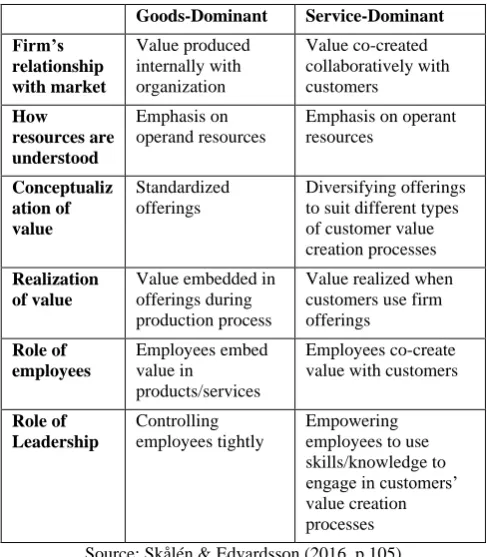
Lusch, 2004, p. 1) can be perceived. This new evolving S-D logic is based on the underlying assumption that humans apply their competences to benefit others and reciprocally benefit from others’ applied competences through service-for-service exchange (Vargo & Lusch, 2004). Service is viewed as the fundamental basis of exchange and states that value is co-created by multiple actors, always including the beneficiary (Vargo & Lusch, 2016). Key aspects in service are operand resources such as intangibility, exchange processes, and relationships (Vargo & Lusch, 2008). The focus on operant resources also implies the fact that employees are encouraged to use these skills and abilities to further engage in customer’s value creation processes in order to co-create value together with customers (Skålén et al, 2015). To conclude, a summary of the key differences between a G-D and S-D logic is given in Table 1.
Table 1. Key differences between G-D and S-D logic
Goods-Dominant Service-Dominant
Firm’s relationship with market Value produced internally with organization Value co-created collaboratively with customers How resources are understood Emphasis on operand resources
Emphasis on operant resources Conceptualiz ation of value Standardized offerings Diversifying offerings to suit different types of customer value creation processes Realization
of value
Value embedded in offerings during production process
Value realized when customers use firm offerings Role of employees Employees embed value in products/services Employees co-create value with customers
Role of Leadership
Controlling employees tightly
Empowering employees to use skills/knowledge to engage in customers’ value creation processes Source: Skålén & Edvardsson (2016, p.105)
Throughout their research, Vargo and Lusch introduced eleven Foundational Premises (FPs) in order to create a general and transcending theoretical framework for the S-D logic. These FPs have been reduced to five axioms of the overall S-D logic from which again other FPs can be derived (Vargo & Lusch, 2016). The axioms have been introduced in order to provide “a more pantronimious framework” (Vargo & Lusch, 2014, p.14) outlining the main aspects of the emerging logic.
The initial axiom sets service as the fundamental basis of exchange (Vargo & Lusch, 2011). Services defined as operant resources involving knowledge and skills are exchanged between actors rather than the outcomes of these services. The second axiom rejects the traditional idea of separating producer and customer, but rather proposes a relational system between the actors where value is created through the integration of their resources (Vargo & Lusch, 2011). Value is created interactional between the different actors involved, therefore the customer is simultaneously also always co-creator of value (Vargo & Lusch, 2008).
Within the third axiom, the role of resource integration is conceptualized. All social and economic actors are considered resource integrators as “it is not simply acquiring services from suppliers but rather integrating these services with internal resources and public resources to create a market offering that reflects a compelling value proposition” (Vargo & Lusch, 2014, p.77).
Axiom four states that value is uniquely and phenomenologically determined by the beneficiary as every resource (service) exchange differentiates and is taking place in unique settings (Vargo & Lusch, 2014). Value is here defined as “idiosyncratic, experimental, contextual, and meaning laden” (Vargo & Lusch, 2008, p.7).
The final and fifth axiom covers the role of institutions in marketing. It is stated that institutions and institutional arrangements coordinate and help actors to engage in service exchange and co-creation among different parties as they form the “keys to understanding the structure and functioning of service ecosystems […] keys to understanding human systems and social activity, such as value cocreation, in general” (Vargo & Lusch, 2016, p. 11).
[image:3.595.305.548.354.620.2]To give an overview, a table with all five axioms and the derived FPs is given below (Table 2.)
Table 2. Overview Axioms and FPs of S-D logic
Axiom 1/ FP1 Service is the fundamental basis of
exchange.
FP2 Indirect exchange masks the fundamental basis of exchange.
FP3 Goods are a distribution mechanism for service provision.
FP4 Operant resources are the fundamental source of strategic benefit.
FP5 All economies are service economies.
Axiom 2/ FP6 Value is co-created by multiple actors,
always including the beneficiary. FP7 Actors cannot deliver value but can
participate in the creation and offering of value propositions.
FP8 A service-centered view is inherently customer oriented and relational.
Axiom 3/ FP9 All social and economic actors are resource
integrators.
Axiom 4/ FP10 Value is always uniquely and
phenomenological determined by the beneficiary.
Axiom 5/ FP11 Value co-creation is coordinated through
actor-generated institutions and institutional arrangements
Source: Vargo & Lusch (2016, p.8)
In the following, relevant FPs/axioms on value realization and on the concept of value propositions are further highlighted. Critical aspects for this study involve axioms one and two and the derived foundational premises. Value propositions are particularly assessed in order to understand the differences between offerings following a G-D paradigm and S-D logic perspective.
2.2
Value-in-use
“a customer’s outcome, purpose or objective that is achieved through service” (Macdonald et al, 2011, p. 671). The term value-in-use developed through the rise of the S-D logic. With this new perspective emerging, the definition of how value is created has also shifted. From the traditional thinking that indicates that the producer’s responsibility of value creation ends upon transfer of ownership to a new definition that says value is created by customers in use of these goods (Grönroos, 2013).Until this point of value realization, the usage, the offer is only potentially valuable (Vargo & Lusch, 2011).
Thus, as yet, it has to be noted that the changing view of an offering as a manufactured good towards an offering that integrates value-in-use, challenges a change in mind-set (Ng et al., 2012).
Furthermore, as stated in Ng et al. (2012) “focusing on value-in-use activities results in the understanding of how to adapt, modify and enhance the firm’s value proposition for greater effectiveness and efficiency” (p. 432), the concept of value-in-use emphasizes potential positive effects on value propositions of firms. The latter is discussed in the following paragraph.
2.3
Value Proposition
A value proposition is a widely used concept aiding firms in conveying their “promises of potential value” (Grönroos, 2011, p. 245) to future customers. Even though the notion is frequently used within firms, only little has been researched about this phenomena. Its conceptualization is surrounded by limited agreement and ambiguity as most information is relied upon practical experiences (Frow et al., 2014).
One of the most referenced books in value proposition literature is the Value Proposition Design by Osterwalder et al. (2014), in which a value mapping methodology is provided, necessary to create a fitting value proposition for a company. Osterwalder (2014) sets up a so-called canvas, in which the products and services currently offered by an organization and how these try to satisfy current market needs are outlined. This information is compared against the perceptions of the customer in order to gain insights on where the customer sees actual value in service. This canvas can be developed by means of different workshops, which then can be followed by creating a new value proposition that is redefined accordingly.
In providing an offering that matches market needs by incorporating the core competences a firm has to offer to its customers (Frow & Payne, 2011), value propositions give rise to competitive advantage. Thus, this concept of identifying a value proposition that translates your core values and skills towards the customer, should be of high importance to organizations.
Value propositions however, are not only communicated in a unidirectional way but can also be reciprocally/mutually offered together with the customer. This implies several advantages which are discussed in the following section when comparing value propositions following a G-D and S-D logic.
2.3.1
Value Proposition according to G-D logic
Value propositions following a G-D logic are defined as a “clear, simple statement of the benefits, both tangible and intangible that the company will provide, along with the approximate price it will charge each customer” (Lanning & Michaels, 1988). This approach is considered as a so-called internal value delivery system which involves three different steps: choosing the value, providing the value and communicating the value (Lanning & Michaels, 1988). According to Frow and Payne (2011) this way of communicating value is considered supplier-led. The marketingoffer is communicated unidirectional from one party to another, in hope of being accepted by the other party. This has been resulted from the focus within G-D logic on exchange of manufactured goods and operand resources (Solomon et al. 1985; Bitner et al., 1997).
2.3.2
Value Proposition according to S-D logic
In contrast to the G-D logic-informed value proposition, value propositions following an S-D logic perspective incorporate value depending on the interaction and the customer context (Skålén et al, 2015). Nevertheless, despite insufficient research done in this area of value propositions, several scholars have already conducted research on value propositions within S-D logic and as a result, the need of transitioning from a supplier-led towards a more interchangeable nature between actors as both participant and initiator has been recognized (Kowalkowski, 2011; Skålén et al., 2015; Truong et al., 2012). This issue is also emphasized within the key foundational premises in S-D logic (Vargo & Lusch, 2006). As stated in FP 7 of Vargo & Lusch (2016), customers do not make purchases for the sake of making a purchase. They seek a value proposition, which they perceive to be potentially valuable and the value of the service is only realized within the customer’s context (Ng et al, 2012).Thus, a value proposition has to be regarded as “reciprocal promises of value […] operating to and from suppliers and customers seeking an equitable exchange. Therefore, value propositions are always two-way, quid pro quo.” (Ballantyne et al., 2006, pp. 344-345). Ballantyne and Varey (2008) argue that “there can be no satisfactory relationship development unless exchange participants reciprocally determine their sense of what is of value, and begin this process with the development of reciprocal value propositions” (p.48).
Furthermore, this also emphasizes that the customer is not solely regarded as a product user and value enabler, but also as pointed out by Vargo and Lusch (2008) “a customer is always a co-creator of value” (p.8). Customers integrate resources in the form of knowledge and skills in order to create value. This implies the importance of involving customers in the process of creating value for and together with the customer as this process is interactional. In doing so, the various needs of customer groups can be taken into account when identifying a value proposition along with being able to offer diversified types of customers’ value creation processes (Skålén & Edvardsson, 2015).
In order to analyze how organizations try to fulfill their value propositions, value creation practices are proposed. These practices indicate routine activities and sense making frameworks “used to integrate resources into value propositions” (Skålén et al., 2015, p. 144) that benefit the customer’s value creation.
Skålén et al. (2015) identified different value creation practices which are grouped into three aggregates: provision practices, representational practices, and management and organizational practices.
value-in-use emerges for the customer, according to the firm’s promise” (Skålén et al, 2015, p. 144).
The second aggregate, representational practices, enables the communication between different parties in order to collaboratively integrate resources. Naming and labeling practices describe “the activities of the value proposition and their fulfillment” (Skålén et al, 2015, p. 144). The structure of the value proposition is constructed within the modeling practices. Lastly, interaction practices facilitate the communication between the customer and the organization and thus, allows to communicate and co-create value propositions. Accordingly, representational practices answer the following question: “How is the value proposition communicated, and what does it mean?” (Skålén et al., 2015, p. 144)
Consisting of four different sub-practices, the final and third aggregate, management and organizational practices, provides a basis for provision and representational practices, “these practices align, as well as organize, provision and representational practices, and the resources that these practices integrate” (Skålén et al., 2015, p. 144). This forms also the core of the organizing practices. Staffing and team building practices create workgroups and allocate people in order to “provide and communicate service” (Skålén et al, 2015, p. 144). Within networking practices, it is described how firms involve their network in order to create, deliver and negotiate value propositions. The last practice of this aggregate compromises the distribution of knowledge and competencies throughout the firm in order to realize the value proposition. This is realized by means of training, best practice sharing and interaction. In order to further investigate on this practice, the subsequent question is tried to be answered: “How does the firm fulfill its part of the proposed value?” (Skålén et al., 2015, p. 144).
2.4
High-Tech Defense Industry
The high-tech industry is defined by the Oslo Manual (2005) as companies in this particular field, which during a given period (often three years) introduce at least one technical innovation or improvement into the market. Trends visible in the high-tech industry consist of intense R&D expenditure, a high level of innovativeness and high level of employment of scientific and technical personnel (Zakrzewska-Bielawska, 2010). Likewise, Varga (in Steenhuis & Bruijn, 2006) connects high technology with high-technology intensity and innovation. It can therefore be reasonably argued that the main focus of high-tech companies primarily lies on developing new technologies. With particular focus on the defense industry which is a major industrial sector characterized by high innovation and high-end engineering and technologies. The defense industry is defined as a traditional market that operates in a stable market environment. However, also the traditional market is undergoing a change and faces new and unforeseen challenges emerging through factors such as digital transformation which comes along with the automation of jobs, shrinking crew sizes and the continuation of smaller defense budgets (Starr & Garg, 2017).Hence, it becomes critical to organizations to recognize this imminent change and to redefine tasks and re-evaluate market strategies.
In order to stay competitive and be able to provide their customers a more specialized, customized offering, however, it is vital for high-tech defense companies’ success to start acknowledging the critical endeavor of the S-D logic in marketing. This in turn highlights the importance on further investigating this particular industry.
3.
RESEARCH QUESTION
From the above reviewed literature and the analyzed gap, the following research question is concluded:
“How does the S-D logic perspective on customer value affect the value proposition of B2B and B2G customer segments in the High-Tech Defense Industry?”
And the following sub-research question:
“What are the implications for the customer approach for a focal company?”
4.
METHODOLOGY
This study presents an exploratory, single case study conducted for the purpose of aligning the value-in-use of different customer segments with a fitting value proposition from an S-D logic point of view. Herein insights can be gained on how to enrich a goods-dominant value proposition for standard solution in the key defense market by means of the S-D logic. The analysis is based on qualitative research focusing on one product offering of the case organization. The organization operates in different market segments, within this study the focus lies on the defense branch.
4.1
Approach
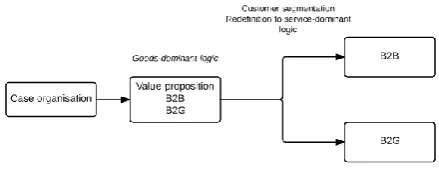
[image:5.595.316.536.448.535.2]Regarding the approach of the research, a model is identified that can guide through the process of answering the research question (see Figure 1). The G-D logic represents the current state of the organization as this is still the prevailing paradigm. The focus here lies on value-in-exchange along with the fact that the value proposition of the different products do not reflect the different needs of the various customer groups. The desired state however, takes these differences into account and divides customers into different segments (for B2B and B2G markets) and simultaneously redefines value in terms of the S-D logic.
Figure 1. Research Approach
In the upcoming part, an elaboration of the data collection process is provided. In which three different aspects are addressed, namely the objects for study, the data collection method, and the type or rather the process of analysis.
4.2
Subjects of Study
Sales managers are chosen on the basis of their relevance to my research subject and their position within the firm, which means determining factors for the selection are the years of experience in their position and with a particular customer as well as the degree of interaction with this customer. As customer needs are represented through the eyes of these managers, their personal beliefs and assumptions can influence the outcomes which in turn can lead to biased results.
4.3
Data Collection Methods
In order to get most suitable answers to the given research problem different data collection methods are used.
To begin with, data is collected by desk-research and by studying organizational documents such as administrative, financial documents and contracts of the particular product in order to identify relevant data that provides a basis to outline the current state of the firm’s value definition and creation processes.
Secondly, qualitative research, in terms of interviews, is chosen to gather the needed data. Interviews can aid in gaining more information about the value proposition of the specified product as well as identifying potential opportunities from viewing it from an S-D logic perspective. Two different rounds of interviews are conducted. In order to ensure consistency that every possible fact is included in the data collection, semi-structured interviews are chosen for both interview rounds. In which the interviewer is able to guide the interview towards other relevant topics so qualitative textual data which could include facts, opinions and unexpected insights, can be gathered. The five interviews lasted between 30 and 60 minutes. Additionally, field notes are taken during the interviews, a few are transcribed verbally after being conducted. In order to create a general understanding of the organization, the product, the role of the interviewee as well as the customer, the first round of interviews is conducted with different functional managers such as product manager, service manager and sales manager. Also different sets of questions are used as the managers can provide different background information on their particular domain. The questions were based on the article by Aarikaa-Stenroos and Jaakkola (2012). Appendix A includes the interview guide used for the first round of interviews.
For the second round of interviews, the goal is to gather the data needed from the second subject of study, the customers. As mentioned above, due to lack of time and access this is done by means of the sales managers of the case firm. In order to represent an entire population through a smaller group of individuals, selected from this population (Veaux, Velleman, & Bock, 2012) sample interviews are conducted among representatives of particular customer groups. Several interviews are conducted with sales managers responsible for different countries, in each interview focusing on either B2B or B2G market in that particular country. In total nine interviews are conducted either focusing on the end-user of the product, the B2G entity, so-called defense force or the constructing and mostly also buying party, the B2B entity, the platform. All representatives get the same set of questions, in order to ensure the reliability of this research. Reliability reflects “the extent to which a measure reflects some consistent aspect of people or events rather than random error” (Dooley, 2000, p. 93). In Appendix B the question guide for the second round of data-gathering is to be found, the questions were based on the trigger questions used for Osterwalder’s Value Proposition Design (2014).
In addition to the interviews with various sales managers, a workshop dealing with the topic of identifying the value proposition of the product solution was joined and observed.
Herein insights were gained into both the customer and the company profile.
4.4
Process of Analysis
The analysis of the collected data is conducted via a content analysis. A content analysis is defined as a research technique that makes “replicable and valid inferences from texts (or other meaningful matter) to the contexts of their use” (Krippendorff, 2003, p. 18). Furthermore, it follows three different purposes: the classification, summarization and tabulation of the data (Hsieh & Shannon, 2005). The data is classified, summarized, and tabulated according to the framework of Skålén et al. (2015). The results of the first data collection round which created a general understanding of the current state are sorted across the different practices. In doing so, the current value creation practices used by the case organization can be evaluated. Additionally, it can be observed to what extent G-D logic and the concept of value-in-exchange are still employed within the organization. From which in turn can be concluded how the firm’s value proposition is developed. After taking into account the second round of interviews and the resulting customer needs, as well as the previous literature review, the framework of Skålén et al. (2015) is applied again in order to propose refined value creation practices according to the theory of the S-D logic and the concept of value-in-use. Hence, a value proposition based on the desired future state can be recommended.
5.
RESULTS
The following section describes the outcomes gathered through the different data collection methods. In the first stage it is studied how value is currently interpreted, created and achieved in use and exchange. Secondly, the customer insights gained from the interviews with sales managers are taken into account. The third and final stage constructs a different view on the value proposition. With the aid of these newly gained insights of the customer needs and the previous literature review, a value proposition redefined according to the S-D logic and the concept of value-in-use can be proposed. Within the last two years the organization has undergone restructuring efforts aiming for the right allocation of skills, the introduction of lean principles, and less hierarchical working methods internally. Only last year, a marketing department was introduced within this branch of the organization. This emphasizes the increasing importance of taking marketing and strategy into account and the growing awareness of it within the company.
The product offering, under consideration within the context of this research, is regarded as a full solution containing products and services. The solution is used for a mission in the defense sector. The assets are made up of different equipment systems used for defending purposes, the services involve trainings, reparations, and maintenance. The product solution was first pitched four years ago in order to work more efficiently internally as well as externally. It combines a set of individual assets into one standard configuration within this standard configuration only about 30% is later modified to the specific requirements of the customer. Overall, this standardization saves time not only in the proposal phase when specifying the technical and financial terms but also helps in increasing the responsiveness to customers.
5.1
Current State
5.1.1
How is the organization currently offering its
product solution?
documents, contracts as well as presentations. These data gave insight in the currently used marketing efforts and value creation practices respectively. The case organization presents its product solution within its value proposition as a “turnkey solution for warfare and [...] security” which delivers guaranteed value to its end-users by means of digital innovation for combat operations, full operational delivery at lowest risk, full lifetime support as well as local partnerships.
The organization offers its product solution to B2B and B2G customer segments, in new-built products both parties are involved. The current marketing efforts and value proposition are based on the end-users value creation processes, so the defense force’s needs within the B2G market segment. These marketing efforts are mainly also used within the B2B customer segment.
5.1.2
How are value creation practices followed?
Taking into account the different practices retrieved from the literature review and applying these to the data collected, several aspects concerning how the value proposition is constituted and fulfilled can be noted.First, looking at the provisional practices, more particularly, the factors aiming to optimize the way of working, the operating practices. The company is trying to facilitate value to its customers by means of several services offered. Trainings as well as other support services such as maintenance and repairs are provided to customers in order to use the product solution more optimally and efficiently. These services are offered before and after the delivery of the product solution and are provided throughout the lifetime of the platform as integration and in-service support services. Additionally, user days are initiated with members of the defense force such as higher ranked officers in order to exchange experiences and practices. These meetings are aimed for B2G customers. Hence, the operating practice of the product solution, and the related activities such as discussing, exchanging practices, and repairing, integrate operant (staff knowledge, skills, experiences) and operand resources (spare parts, man-hour) in order to support the customer’s value creation.
In order to identify customer problems and needs, the case organization has to continuously build and maintain relationships with its customers. This is done by means of meetings with customers. Every sales manager interviewed is visiting its responsible country or region approximately every second month, in order to plan meetings, presentations with high ranked officers within the defense force. With B2B customers, the approach looks different as contact is mostly only existing when a contract is concluded. Meeting face-to-face enables the company to directly asking questions and discussing issues in order to identify problems. In this way, the competence of the personnel and the technical resources are integrated into problem-finding practices and become part of the value proposition which is in turn also being backed up by the feedback of the customers. Furthermore, workshops are organized to define the value proposition of the product solution. During these workshops, customer jobs are identified including pains and gains encountered. These outcomes are compared against the product solution and its pain relievers and gain creators according to Osterwalder’s Value Proposition Design (2014). On basis of these outcomes, the company tries to formulate and integrate resources in such a way that customers are offered a value proposition that meets their needs.
These identified problems are solved by the case organization using different approaches. For daily operational problems encountered by the customer, the local industry is in some
regions involved to be able to quickly react to these problems. However, in other countries the organization follows a rather reactive approach in order to solve these kind of problems. For new projects and products, so-called problem development contracts exist. These help in solving problems directly together with the customer. Within these contracts, both parties collaboratively design and introduce a solution which is immediately adjusted to the customer requirements. This way a win-win situation is created for both parties involved. However, these contracts are increasingly more difficult to get. Whereas for B2B customers, there is no collaborative approach. The representational practices include methods and aspects such as business models, concepts, and structures behind the value proposition as well as the interaction processes used to communicate this potential value promise to its customers. The marketing efforts are based on the key competences of the organization which include its experience, its extensive network, as well as its proof in the market in which the company has still a much respected name for supplying superior electronic defense equipment. In addition, are services offered throughout the lifetime of the platform which indicates the high level of support provided by the company.
The interaction with customers is strongly emphasized within the B2G entity. By means of user meetings, frequent customer visits as well as the newly introduced customer days in which the most important customers from different defense forces are invited to a special set-up event, the organization tries to build and maintain its relationships with the customers. Thus, in doing so, also tries to exert influence on the end-user and as well as influential party in decision making. Regarding the B2B entity, mostly no contact is existing until the contract is concluded, however, no additional meetings or presentations are being conducted especially for customers in this market segment.
The final aggregate management and organizational practices constitutes of four sub-practices involving organizing, staffing and team building, networking and knowledge-sharing practices. Regarding the organizing and staffing/team building practices, the firm holds strategy meetings on a structural basis in order to provide a direction to its employees and to guide them within the customer approaches. Additionally, sales teams are made up of interdisciplinary teams. These customer account teams are responsible for both B2G and B2B customers in a particular country or region. The network is built upon and maintained by the contacts within the B2G entity and friends within that industry.
In addition, trainings on dealing with customers are based on a so-called student coach concept, which implies learning from senior sales managers.
importance. This in turn, indicates that value is still incorporated within the product or service. The customer is not fully regarded as a co-creator. Approaches exist on involving the customer in order to co-create value, however, this is mostly done by means of higher officers and not actual end-users on the platform itself. Furthermore, this value proposition is offered generically to both customer segments B2G as well as B2B. It can be noted that the marketing efforts are more developed and aimed towards the end-user, the defense force. However, the B2B customers also play a critical role and should be approached more extensively.
Therefore, it can be concluded that the organization is utilizing a value proposition dominated by the traditional G-D paradigm. Nevertheless, in several aspects especially within interaction practices, the concept of value-in-use and as well as the S-D logic is approached.
5.2
Customer Needs
By means of the second round of interviews and the observations of the value proposition workshop, several insights could be gained on the customer profile and their value creation processes respectively. Based on these outcomes, the customer needs of B2B and B2G entities could be elaborated.
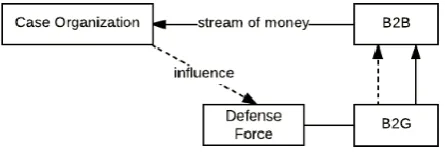
[image:8.595.58.281.505.582.2]The B2G and B2B customers operate on the market in different ways in pursuit of different objectives. The B2G customer is involved in the decision making process on budgets and procurement orders of defense equipment as well as represents the end-user in form of the defense force. Furthermore, this market segment is mostly able to exert influences on the buying behavior of the B2B segment. The B2B customer segment is primarily the buying and integrating party, as the case organization is mostly regarded as a subcontractor to the B2B customer. Hence, the two customer groups do not solely differ in objectives but also perform different jobs with the procured product solution. As the defense force represents the end-user, this particular customer is of vital importance to the case organization, therefore, almost all marketing and relational efforts are aimed to meet the needs of that particular customer. The relationship between the case organization, the B2B and B2G customer segment according to a new built project is illustrated in Figure 2.
Figure 2. Relationship among different actors
During the interviews, a distinction between the different customer groups was tried to be made.
Considering the end-user, the defense force which is regarded as part of the B2G customer segment, different needs are identified. The main priority for the defense force is to resolve security issues and to safely carry out its missions. For this to be achieved the end-user needs to be aware of its surroundings in order to protect and defend against threats. Furthermore, it is important to have a certain commonality between systems in order to operate them more efficiently and as a consequence less training is needed. Another aspect is the NATO-interoperability which constitutes another customer requirement along with the fact to be able to represent its state as a defense force. Valueis created when the defense force is being able to operate its systems in order to achieve its goal of detecting or
rather defending against enemies and additionally when its surroundings and people are secured. In a broader sense, taking into account the role of the government, the objective lies primarily in smoothly executing the various defense projects. Moreover, the government manages political expectations and defines the resulting requirements for planned defense projects. Further, governments are aiming for creating a self-sustained local industry in order to construct hard- and software mainly in-country and thus, preventing to rely on imports.
The B2B market or else the platform is on the other hand facing different needs. Number one priority is to integrate the product solution systems within the overall product. Therefore, the platform entity requires specific instruction manuals and product specifications. Additionally, the quality of the products are of high importance as well as the price as fast integration leads to a fast delivery and as well as a higher margin for the B2B customer itself considering the role of the case organization as a subcontractor. For the B2B market, the actual value creation takes place when the platform is working efficiently and is smoothly transferred to its end-customer. The objective lies in optimizing the ways of integrating the equipment and systems. By doing so, one allows a smooth workflow and an on-time delivery along with the fact that a high quality product is created for its end-customer. Key aspects herein are standardization, simple modular, and easy product handling.
5.3
Forming the Desired State
Comparing the insights acquired from the literature review to the findings on the current value proposition and customer needs, a new redefined value proposition according to S-D logic and the concept of value-in-use can be proposed. This is done by applying the framework of Skålén et al. (2015) a second time in order to point out on which practices it has to be improved according to the S-D logic.
order to create a value proposition that is based on the needs of the B2B customer.
Within the representational practices, communication is enabled between the different parties involved in the value creation process. Herein, concepts, structures and activities that form the value proposition are assessed in such a way that they fit a common language in order to effectively communicate the value proposition to its customers. The organization understands the need to invest in marketing and relation management and not solely to rely on the currently well-established reputation in the market. However, the firm is still primarily relying on its technological developments and is not effectively approaching the customer. This is reflected within the marketing approaches used for the different customers. Presentations are based on the end-user and do not reflect the needs of all customer segments which further implies that a different language needs to be adapted in terms of technical and cultural aspects focusing on a particular customer. This would also lead to an improved communication of its services offered. As the company has customers worldwide, these technical and cultural aspects vary greatly. Furthermore, the organization has recognized the need to build and work towards a long-term relationship with the end-user, however, a similar approach is also needed within the B2B customer segment. The B2B customer segment differs in terms of being commercialized and therefore, cannot be approached the same way. Nevertheless, the interaction should be based on a more proactive approach and aimed towards creating a relation that offers feedback to both parties involved for the purpose of reciprocally create the value proposition. In order to facilitate communication and transmission of the potential value towards the customer, the case organization shall involve into creating a direct product experience for its customers. In giving customers the possibility to directly seeing production processes as well as experiencing the product first-hand ,e.g. at the production site, a different perception of the product is created. This, as a consequence, evokes enthusiasm for the product or service.
The last aggregate, management and organizational practices, provides the baseline for provisional and representational practices through network building, knowledge sharing and team building practices. Networks are created within the organization through frequent meetings with end-customers, herein presentations and workshops are given in order to teach and influence the customer. These visits take place on a frequent basis, mostly every second month. This provides insights into the customer problems and needs and helps in solving these accordingly. However, here as well the problem is that no visits are taking place with the B2B customers, hence important information on their value creation processes is unknown. Moreover, networks shall be initiated among the users of the systems. By creating a (online) platform, on which users can exchange their testing experiences, best practices, the organization enhances the value creation processes of these customers in a quick and simple manner.
Best practices and knowledge should be exchanged on a regular basis. This is especially critical for customer groups that share the same characteristics. This in turn helps in improving the customer approach and to better understand what the customer actually wants.
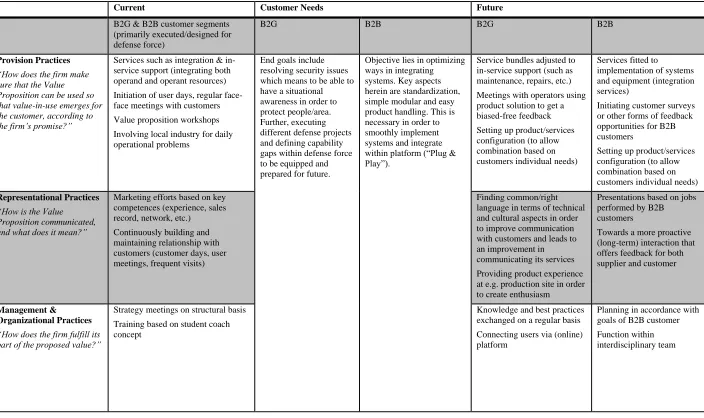
An overview of the findings involving the current and future state and as well as the customer needs is given in the Table 3 in Appendix C.
6.
DISCUSSION
After analyzing and illustrating the value propositions of B2B and B2G customer segments on the current as well as desired
state, conclusions can be drawn from this. This case study is based on a traditional market setting and thus, gives proof on the stated and abovementioned trends taking place within the high-tech defense industry. The focus within this market segment is still lying on pushing technology developments in order to create high end products, however, one realizes that the understanding of investing in strategic marketing has been recognized within traditional markets such as the high-tech defense industry.
The value creation practices used to compare the value propositions are based on two key differences between G-D and S-D logic: co-creation and resource integration. Co-creation according to S-D logic implies that value propositions as “value creation promises created either by the firm independently or together with customer and other actors through resource integration based on knowledge and competencies” (Skålén et al., 2015, p. 139). The other aspect differentiating S-D logic from G-D logic distinguishes between operant and operand resources.
Against this background, the alignment between the concept of value-in-use of the different customer segments and a fitting value proposition based on S-D logic was made. The analysis reveals that the organization still has different perceptions on resources. While operand resources are regarded important on the one hand, an approach to increasingly value customer relationships as well as the role of the customer in co-creating value is starting to emerge on the other hand. The various opinions on the notion resources also implies the need to recognize the imminent change taking place within people’s mindsets. As recognized by Ng et al. (2012), the transition from viewing an offering as a manufactured good towards an offering that integrates value-in-use, challenges a change in mind-set. This requires to unlearn old ways of thinking and to relearn and adapt a new dominant logic. As derived from the previous sections, the emphasis is still put on internal defined standards, nevertheless, the need of change has been recognized within the organization. This becomes apparent in the increased efforts of networking with its customers without direct profit intentions through events such as the customer days. Thus, the ground for a way of working and doing business together and aimed towards the customer’s value creation processes has been prepared and envisioned within the employee’s mindset. In order to make the transition complete, employees need to view customer co-creation as a natural process. This engagement needs to be embedded within the leadership style in order to convey it also to new employees and thus, implement it within the organizational culture.
Passed research has already shown how value propositions aid in communicating a firm’s potential value towards its customer. However, ambiguity is still surrounding the topic of composing value propositions based on an S-D logic perspective. Researchers such as Skålén et al. (2015) as well as Frow and Payne (2011) propose value creation practices which outline how value propositions can be built and based upon this new evolving perspective. This study further contributes in providing a visualization on how these value creation practices are created within G-D logic and S-D logic. Applying the practices from two perspectives, aids in illustrating how a change can be realized within an organization. Hence, a key contribution made by this study, entails new perspectives gained on the S-D logic and its value creation respectively regarding the high-tech defense industry.
6.1
Implications for a Focal Company
to guide business transactions and to govern over other actors involved (Cavusgil, Knight, & Riesenberger, 2008). Along with the fact to provide direct contact to the end-customer.
In view of the role the case organization has, as a company enabling business transactions among different actors, initiating network building, and providing a financial framework, implications for focal companies can be derived. In order for focal firms to recognize and understand its customer’s value creation processes and value-in-use respectively, several aspects have to be considered. First, it is necessary to actively engage in customer contact and relation building activities. In particular, with users in order to be able to identify end-goals of the customer as well as receive relevant information on how to improve products or services. By doing so, value-in-use of customers can be recognized and further integrated within the firm’s value proposition. In addition, it is crucial to discover the underlying aspect of S-D logic as it builds the foundation for co-creation with customers. Communicating these aspects with every actor involved in the business transactions and value creation processes, is necessary in order to provide an understanding of the end-goals and needs of the customer. This, in turn, also helps to increase the understanding of customer’s value-in-use within the overall network of a focal company.
7.
CONCLUSION
In the beginning of this study it was argued that a shift from the traditional G-D logic towards the new S-D paradigm is taking place and with it comes a change in the understanding of value creation and the role of the customer. The following research question was investigated: How does the S-D logic perspective on customer value affect the value proposition of B2B and B2G customer segments in the High-Tech Defense Industry?
After analyzing the case organization’s current value creation processes based on a G-D logic and later proposing improvements based on the S-D paradigm, it can be observed that a major difference between the two dominant logics lies in the customer approach. Whereas within the G-D logic a more generic value proposition is offered to all its customer segments, the perspective of the S-D logic differentiates and takes the individual needs of its various customer groups into account. On basis of this, flexible value propositions can be created that meet the customer demands. Further, it becomes apparent that the way how value propositions are constructed is affected by viewing customer value from an S-D logic point of view. Customer value indicates the difference between the perceived benefit of a product and the required cost in order to get it. Hence, a customer decides to purchase a product or service based on cost, and the received benefit. However, viewing it from an S-D logic point of view, customer value holds that the perceived value is not primarily relying on cost and benefits rather on the value facilitation within the usage of a product or service. Hence, one requires a value propositions that enhances these value facilitation factors.
Moreover, this can also be conveyed to the focal industry and shows the need in interacting with the end-users in order to better understand its value-in-use, as well as the importance of sharing these within the overall network. Which answers the question “What are the implications for the customer approach for a focal company?” raised within this research.
8.
LIMITATIONS AND FURTHER
RESEARCH
The goal of this research was to align the concept of value-in-use for different customer segments with a fitting value
proposition from the S-D logic point of view based on a case study. The focus of this case requires however, further empirical evidence. The conducted study is limited to a specific market and company, therefore it is necessary to gather further research to identify a significant sample to generate a possible model and to ensure a greater reliability and validity of the data. Furthermore, due to the lack of access to relevant information from the customer groups, the outcomes have to be relied upon subjective views of the sales managers of the case firm which therefore, might lead to biased results and conclusion. Another limitation implies the limited amount of information collected for the second customer group the B2B entity. As all sales managers are in personal contact with the end-users, the B2G entity, more information was retrieved about this market
segment.
Further research involves more empirical evidence in this particular market segment, as well as actual insights from the customer perspective as this research was only relied on assumptions and beliefs of customer contact persons (sales managers as mentioned above). Additionally, another potential field of research lies in investigating the topic from a more quantitative research approach in order to gain further insights on the effect of S-D logic on value propositions.
9.
MANAGERIAL IMPLICATIONS
10.
REFERENCES
Aarikka-Stenroos, L., & Jaakkola, E. (2012). Value co-creation in knowledge intensive business services: A dyadic perspective on the joint problem solving process. Industrial Marketing Management, 15-26.
Ballantyne, D. (2004). Dialouge and its role in the development of relationship specific knowledge. Journal of Business and Industrial Marketing, 19(2), 114-123.
Ballantyne, D., Frow, P., Varey, R. J., & Payne, A. (2011). Value propositions as communication practice: Taking a wider view. Industrial Marketing Management, 40(2), 202-210.
Ballantyne, D., Varey, R. J., Frow, P., & Payne, A. (2008). Service-dominant logic and value propositions: Re-examining our mental models. Otage Forum.
Bitner, M. J., Faranda, W. T., Hubbert, A. R., & Zeithaml, V. A. (1997). Customer Contributions and roles in service delivery. International Journal of Service Industry Management, 8(3), 193-205.
Cavusgil, S., Knight, G., & Riesenberger, J. R. (2008). International Business: Stretagy Management, and the New Realities. Management International Review , 48(6), pp. 793-798.
Chandler, J. D., & Lusch, R. F. (2015). Service Systems: A Broadened Framework and Research Agenda on Value Propositions, Engagement, and Service Experience. Journal of Service Research, 18(1), 6-22.
Dooley, D. (2000). Social Research Methods. London: Pearson.
European Commission. (2005). Proposed Guidelines for Collecting and Interpreting Technological Innovation Data.
Frow, P., McColl-Kennedy, J. R., Hilton, T., Davidson, A., Payne, A., & Brozovic, D. (2014). Value propositions: A service ecosystems perspective. Marketing Theory, 14(3), 327-351.
Grönroos, C. (1994). From Marketing Mix to Relationship Marketing: Towards a Paradigm Shift in Marketing. Management Decision, 32(2), 4-20.
Grönroos, C. (2011). A service perspective on business relationships: The value creation, interaction and marketing interface. Industrial Marketing Management, 40, 240-247.
Grönroos, C., & Voima, P. (2013). Critical service logic: making sense of value creation and co-creation. Journal of the Academy of marketing Science, 41(2), 133-150.
Hsieh, H.-F., & Shannon, S. E. (2005). Three Approaches to Qualitative Content Analysis. SAGE Journals, 15(9), pp. 1277-1288. Kowalkowski, C. (2011). Dynamics of value propositions: insights from service-dominant logic. European Journal of Marketing,
45(1), 277-294.
Lanning, M. J., & Michaels, E. G. (1988). A Business is a Value Delivery System. McKinsey Staff Paper, No. 41.
Lusch, R. F., & Vargo, S. L. (2006). Service-dominant logic: reactions, reflections and refinements. Marketing Theory, 6(3), 281-288. Lusch, R. F., & Vargo, S. L. (2014). Service-Dominant Logic: Premisses, Perspectives, Possibilities. Cambridge University Press . Macdonald, E. K., Wilson, H., Martinez, V., & Toossi, A. (2011). Assessing value-in-use: A conceptual framework and exploratory
study. Industrial Marketing Management, 40(1), 671-682.
Ng, I., Parry, G., Smith, L., Maull, R., & Briscoe, G. (2012). Transitioning from a goods-dominant to a service-dominant logic. Journal of Service Management, 23(3), 416-439.
Osterwalder, A., Pigneur, Y., Bernarda, G., & Smith, A. (2014). Value Proposition Design: How to Create Products and Services Customers Want. John Wiley & Sons.
Prahalad, C. K., & Bettis, R. A. (1986). The Dominant Logic: a New Linkage Between Diversity and Performance. Strategic Management Journal, 7, 485-501.
Prahalad, C., & Ramaswamy, V. (2004). Co-creation experiences: The next practice in value creation. Journal of Interactive Marketing, 18(3), 5-14.
Skålén, P., & Edvardsson, B. (2016). Transforming from the goods to the service-dominant logic. Marketing Theory, 16(1), 101-121. Skålén, P., Gummerus, J., von Koskull, C., & Magnusson, P. (2015). Exploring value propositios and service innovation: a
service-dominant logic study. Journal of the Academy of Marketing Science, 43(2), 137-158.
Solomon, M. R., Surprenant, C., Czepiel, J. A., & Gutman, E. G. (1985). A role theory perspective on dyadic interactions: the service encounter. Journal of Marketing, 49, 99-111.
Starr, R., & Garg, A. (2017). Aerospace and Defense Trends. Retrieved from Strategy&: https://www.strategyand.pwc.com/media/file/2017-Aerospace-and-Defense-Trends.pdf
Steenhuis, H.-J., & Bruijn, E. (2006). High Technology revisited:definition and position . Management of Innovation and Technology. Truong, Y., Simmons, G., & Palmer, M. (2012). Reciprocal value propositions in practice: Constraints in digital markets. Industrial
Marketing Management, 41(1), 197-206.
Vandermerwe, S., & Rada, J. (1988). Servitization of business: Adding value by adding services. European Management Journal, 6(4), 314-324.
Vargo, S. L., & Lusch, R. F. (2008). Service-dominant logic: continuing the evolution. Journal of the Academy of Marketing Science, 36, 1-10.
Vargo, S. L., & Lusch, R. F. (2016). Institutions and axioms: an extension and update of service-dominant logic. Journal of the Academy of Marketing Science, 37(3), 5-23.
Vargo, S. L., & Vargo, R. F. (2011). It's all B2B...and beyond: Toward a systems perspective of the market. Industrial Marketing Management, 40, 181-187.
Veaux, R. D., Velleman, P. F., & Bock, D. E. (2012). Stats: data and models. Pearson: London.
11.
APPENDIX
Appendix A
Interview Guide on current state/offering of product solution 1. Background interviewee
Title of the interviewee, interviewee’s role in the organization 2. Description/Background Case Firm & Product
What are the individual assets of the product solution?
What are the main services offered by the product solution?
o Integration services
o Life-Time services
What are the firm’s main target groups/customer segments? 3. How does the firm create its services?
How does the firm interact with its customers in the sales process of the product solution?
What kinds of problems are solved for the customers? What kinds of needs do customers have? (considering differences between B2B and B2G)
Describe the service and the elements that are customized? How far does customization go?
o What are the optional services offered? Which services are included in the “standard package”?
o Which combinations of services are possible?
o What are most chosen/sold options?
4. How does the customer participate in the service/problem solving process?
How do customers contribute, what kind of resources are needed from the customer?
How do customers view the firm’s solution versus other options?
Why do customers choose for the firm? What are the benefits over competitors?
5. What kind of challenges and difficulties is the company facing with its product solution value proposition?
What problems is the firm facing with its product solution’s value proposition?
Who are the major competitors? What kind of position does the firm have in the market?
Appendix B
Interview Guide on Customer Profile 1. Background Interviewee 2. Background Customer
3. Customer Jobs (describe what customers are trying to get done in their work and lives)
What are the jobs customer performs when procured with your product solution equipment?
o What are the end goals of the customer, what do they want to achieve?
o How are these end goals accommodated in the value proposition?
o How does the product create value for them? Or how can they create value for them by means of the product?
What are the most important jobs that customer is trying to accomplish with product and least important ones? What are services that the customer needs in order to accomplish job?
For what services is customer willing to pay and for which ones not?
What are jobs offered by your firm that can also be done by the customer itself?
What is the emotional need that the customer is trying to satisfy? How does the customer want to be perceived by others? (such as competent, status, power)
What are the different contexts that the customer might be in? How do activities and goals change according to these different contexts?
4. Customer Gains (describes outcomes customers want to achieve or concrete benefits they are seeking)
What do they value about your product solution?
What are the basic features the customer requires when purchasing it?
What (service) advantages is customer looking for?
Is your firm considered a partner or sub-contractor?
What financial gains is the customer looking for?
What are the motives of the customer when negotiating the contract? Most important to customer?
What would increase likelihood of adopting product solution?
5. Customer Pains (describe bad outcomes, risks and obstacles related to customer job)
What are the biggest frustrations for the customer? What are the biggest risks for the customer when purchasing your product solution?
What are possible social pains?
6. Product Solution (how is your firm trying to satisfy these needs?)
Which services of the product solution are not purchased by customer but would be of high value for them?
How do you think value of these features could be more understood by the customer?
How is your firm offering product solution to its customers?
o Communication?
How is your firm accommodating these end-goals in their value proposition?
Which jobs are according to you not fully satisfying for the customer?