Consistent Induction Motor Parameters for the
Calculation of Partial Load Efficiencies
C. Kral, A. Haumer, and C. Grabner
Abstract—From the rating plate data of an induction motor
the nominal efficiency can be determined. Without detailed knowledge of equivalent circuit parameters, partial load behavior cannot be computed. Therefore, a combined calculation and estimation scheme is presented, where the consistent parameters of an equivalent circuit are elaborated, exactly matching the nominal operating point. From these parameters part load efficiencies can be determined.
Index Terms—Induction motor, consistent parameters, partial
load efficiency
I. INTRODUCTION
T
HE parameter identification and estimation of permanent magnet or [1], [2] electric excited synchronous motors [3], [4], switched reluctance motors [5], [6] and induction mo-tors [7] is essential for various applications. For a controlled drive the performance is very much related with the accuracy of the determined motor parameters [8]–[20], e.g., in energy efficient drives [21], [22]. Another field of applications which may rely on properly determined parameters is condition monitoring and fault diagnosis of electric motors [23]–[25].For an induction motor, operated at nominal voltage and frequency, and loaded by nominal mechanical power, the current and power factor indicated on the rating plate show certain deviations of the quantities obtained by measurements. The rating plate data are usually rounded and subject to certain tolerances. Deviations of the measured data from the data stated on the rating plate are therefore not surprising.
For the determination of partial load efficiencies of an induction motor, various methods can be applied. One method would be the direct measurement of the electrical and the mechanical power. A second method applies the principle of loss separation; in this case the power balance according to Fig. 2 can be applied. For this purpose it is also required to identify the required motor parameters.
Under some circumstances, it is demanded to determine the partial load efficiency of an induction motor with little or literally no knowledge about the motor. This is a very challenging task, since the full parameter set of an equivalent circuit cannot be computed consistently from the name plate data without further assumptions or knowledge. Practically, one would identify the parameters of the induction motor through several test methods. Thorough investigations of tech-niques for the determination of induction motor efficiencies are presented in [26], [27]. In the presented cases the actual efficiency is analyzed more or less independent of the rating plate data.
In this paper a method for the determination of the con-sistent parameters of the equivalent circuit of an induction
Manuscript received April 8, 2009.
C. Kral, A. Haumer and C. Grabner are with the Austrian Institute of Technology (AIT), business unit Electric Drive Technologies, Giefinggasse 2, 1210 Vienna, Austria (corresponding author to provide phone: +43(5)0550– 6219, fax: +43(5)0550–6595, e-mail: [email protected]).
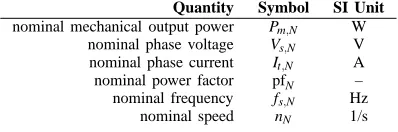
[image:1.595.329.528.272.338.2]motor is proposed. In this context it is very important to understand, that the proposed approach does not estimate the parameters of a real induction motor. In this sense, consistent parameters mean, that the determined parameters exactly model the specified operating point specified by the rating plate data summarized in Tab. I.
Table I
RATING PLATE DATA OF INDUCTION MOTOR
Quantity Symbol SI Unit
nominal mechanical output power Pm,N W nominal phase voltage Vs,N V nominal phase current It,N A nominal power factor pfN – nominal frequency fs,N Hz
nominal speed nN 1/s
The estimation of motor parameters from name plate data [28]–[30] is thus not sufficient, since the parameters are not implicitly consistent. This means, that the nominal efficiency computed by means of estimated parameters does not exactly compute the nominal operating point.
There are two cases where the determination of consistent parameters is useful. First, a real motor should be investigated, from which, more or less, only the rating plate data are known. Yet partial load efficiencies should be computed for certain operating conditions. Second, the simulation model of an electric drive, which neither has been designed nor built, needs to be parametrized. In such cases, very often only the specification of the nominal operating point is known.
In this paper a calculation for the determination of con-sistent parameters is proposed. The applied model takes stator and rotor ohmic losses, core losses, friction losses and stray-load losses into account, while exactly modeling the specified nominal operating conditions. Some of the required parameters can either be measured, others may be estimated through growth relationships. Due to implicit consistency restrictions, the remaining parameters are solely determined by mathematical equations.
II. POWER ANDTORQUEBALANCE
For the presented power balance and equivalent circuit the following assumptions apply:
• Only three phase induction motors (motor operation) are investigated.
• The motor and the voltage supply are fully symmetrical. • The voltages and currents are solely steady state and of
sinusoidal waveform.
• Only fundamental wave effects of the electromagnetic field are investigated.
• Non-linearities such as saturation and the deep bar effect are not considered.
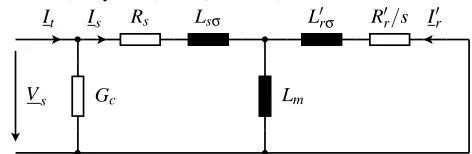
The algorithm presented in this paper relies on the single phase equivalent circuit depicted in Fig. 1. This equivalent
I′
r
It Is Rs Lsσ L′rσ R′r/s
Lm
Gc
[image:2.595.46.282.37.114.2]Vs
Figure 1. Equivalent circuit of the induction motor
circuit considers stator and rotor ohmic losses as well as core losses, which is why the phasors of the terminal current It and the stator current Is have to be distinguished.
In order to simplify the explicit calculation of the equivalent circuit parameters, the conductor, representing core losses, is connected directly to the stator terminals. In this approach, stator and rotor core losses
Pc=3GcVs2 (1)
are modeled together, where Gc represents the total core
conductance.
Due to the modeling topology of the equivalent circuit, stator and rotor ohmic losses are
PCus = 3RsIs2, (2)
PCur = 3R′rIr′2. (3)
The rotor parameters of the equivalent circuit are transformed to the stator side, and thus indicated by the superscript′.
The inner (electromagnetic) power of the motor is deter-mined by
Pi=R′r
1−s
s I
′2
r . (4)
Friction and stray-load losses are not considered in the power balance of the equivalent circuit. Nevertheless, these effects have to be taken into account independently.
Pc PCus PCur Pf Pstray
Ps P
g Pi
[image:2.595.42.256.489.619.2]Pm
Figure 2. Power balance of the the induction motor
In Fig. 2 the total power balance of the motor is depicted. In this balance, the total electrical input power is Ps, and the
air gap power is
Pg=Ps−Pc−PCus. (5)
The inner power
Pi=Pg−PCur (6)
is computed from the inner power and the copper heat losses. Mechanical output (shaft) power
Pm=Pi−Pf−Pstray (7)
is determined from inner power, Pi, friction losses, Pf, and
stray-load losses, Pstray.
Instead of the power balance (7) an equivalent torque balance
τm=τi−τf−τstray, (8)
can be considered. In this context, mechanical output (shaft) torque,τm, is associated with the left side of (7), and the inner
(electromagnetic) torque, τi, is associated with the left side
of (6), etc. Each of these torque terms can be multiplied with the mechanical angular rotor velocityΩm, to obtain equivalent
power terms according to (7).
III. CORE, FRICTION ANDSTRAY-LOADLOSSES
A. Core Losses
For the core loss model hysteresis and eddy current losses have to be taken into account [31]. In a certain operating point the total core losses Pc,ref are known. This operating point refers to a reference voltage Vs,refand the reference frequency fs,ref. Under these conditions a reference conductance can be computed according to
Gc,ref= Pc,ref 3V2
s,ref
. (9)
The ratio of hysteresis losses with respect to the total core losses – with respect to this reference operating point – is ah.
For any other operating point indicated by the actual phase voltage Vs and frequency fs, the total core losses can then be
expressed by
Pc=Pc,ref ah
fs,ref fs
Vs2 V2
s,ref
+ (1−ah)
Vs2 V2
s,ref
!
. (10)
From this relationship the total conductance of the equivalent circuit – as a function of Vs and fs – can be determined:
Gc=Gc,ref
ah
fs,ref fs
+1−ah
(11)
Based on the experience of the authors, it is proposed to set ah≈0.75, if no other estimation is available. In Fig. 3 the
impact of the ratio ahon the total core losses is depicted. The
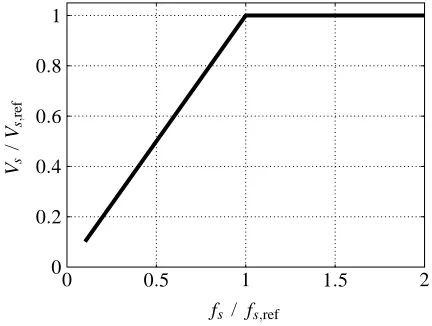
presented curves are computed for a constant ratio Vs
fs (in the range fs<fs,ref) and constant voltage (in the flux weakening range for fs≥fs,ref) as depicted in Fig. 4.
0 0.5 1 1.5 2
0 0.2 0.4 0.6 0.8 1
fs / fs,ref Pc
/
Pc,
re
f
ah= 0
ah= 0.25
ah= 0.5
ah= 0.75
ah= 1
Figure 3. Total core losses versus frequency; constant Vs
[image:2.595.303.516.585.749.2]0 0.5 1 1.5 2 0
0.2 0.4 0.6 0.8 1
fs / fs,ref Vs
/
Vs,
re
[image:3.595.40.256.47.210.2]f
Figure 4. Voltage versus frequency for inverter operation
B. Friction Losses
The friction losses are modeled by
Pf
Pf,ref =
Ω
m Ωm,ref
af+1
, (12)
(forΩm≥0). In this equation Pf,refandΩm,refare the friction losses and the mechanical angular rotor velocity with respect to a reference operating point, respectively. For axial or forced ventilation af ≈1.5 can be used and radial ventilation can be
modeled by af ≈2.
C. Stray-Load Losses
The stray-load losses are defined as the portion of the total losses in a motor that do not account for stator and rotor ohmic losses, core and friction losses. These losses thus indicate the portion of the losses which can not be calculated. According to the IEEE Standard 112 [32] the percentages astray of the stray-load losses with respect to the nominal output power for the nominal operating point are summarized in Tab. II.
Table II
STRAY-LOAD PERCENTAGES ACCORDING TOIEEE STANDARD112
nominal output power [kW] percentage astray
1–90 0.018
91–375 0.015
376–1850 0.012
greater than 1850 0.009
From the actual terminal current It and the no load terminal
current It,0, the approximated rotor current can be calculated by
I2=
q
I2
t −It2,0. (13)
In the IEEE Standard 112, the stray-load losses are consid-ered by a quadratic dependency of (13). Since the standard does not take any variable frequency dependencies into ac-count, the stray-load loss are proposed to be approximated by
Pstray=astrayPm,N
It2−It2,0
I2
t,N−It2,0
Ω
m Ωm,N
2
, (14)
which can be considered as an extension to the standard [33]. In [34], the stray-load losses are considered as an equivalent resistor in the equivalent circuit. Since the voltage drop across such a resistor has no physical background, the stray-load losses are modeled differently in this paper: the stray-load
losses are inherently taken into account by an equivalent breaking torque,
τstray=astrayPm,N
I2
t −It2,0 It2,N−It2,0
Ωm Ω2
m,N
, (15)
according to (8).
IV. SPACEPHASOREQUATIONS
The space phasor equations of electric machines can be derived based on the definitions of [35]. With respect to the equivalent circuit of Fig. 1, the stator voltage and terminal current space phasor (with respect to the stator fixed reference) frame are
Vss = 2
3(vs,1+e j2π/3v
s,2+e−j2π/3vs,3), (16)
Ist = 2
3(it,1+e j2π/3i
t,2+e−j2π/3it,3), (17)
where vs,1, vs,2 and vs,3 are the stator phase voltages, and it,1, it,2 and it,3 are the terminal phase currents, respectively. These space phasors can be transformed into a synchronous reference frame; the angular velocity of this reference frame is
ωs=2πfs. (18)
The reference frame of the transformed stator voltage and terminal current is indicated by a superscript index:
Vsf = Vsse−j(ωst−ϕf) (19)
Itf = Itse−j(ωst−ϕf) (20)
The electrical rotor speed is
ωm=pΩm, (21)
since space phasor theory relies on an equivalent two pole induction motor. The voltage equations with respect to Fig. 1 are
Vsf
0 Vsf
=
0 Rs+jωsLs jωsLm
0 jωrLm Rr+jωrLr
1/Gc −1/Gc 0
Itf Isf
Irf
,
(22) where
ωr=ωs−ωm. (23)
The rotor leakage and main field inductances of the equiv-alent circuit in Fig. 1 and the rotor resistance cannot be determined independently [36]. It is thus useful to introduce the stray factor
σ=1− L
2
m
LsL′r
, (24)
and the ratio of stator to rotor inductance
σsr=
Ls
L′
r
, (25)
as well as the terms
as =
ωsLs
Rs
, (26)
ar = ωr
L′
r
R′
r
. (27)
The linear set of equations (22) has the solutions
Isf = Vsf as(1+jar)
ωsLs[1−σasar+j(as+ar)]
, (28)
Irf = Vsf −j
√
1−σ√σsrasar ωsLs[1−σasar+j(as+ar)]
, (29)
according to [37]. The inner torque yields:
τi=
3p 2
Vs2
ω2
sLs
(1−σ)a2
sar
(1−σasar)2+ (as+ar)2
(30)
It is obvious that (28) and (30) are independent of σsr.
This is an important result, which refutes the myth that for a squirrel cage induction motor the inductance L′
r can be
determined without further assumptions. Yet, the rotor current (29) is certainly dependent on σsr. For the assignment of
specific values to the parameters Lm, L′r and R′r and for the
calculation of the rotor current the arbitrary factorσsr has to
be chosen according to
1−σ≤σsr≤
1
1−σ. (31)
V. DETERMINATION OFPARAMETERS
In the following a combination of parameter calculations and estimations, based on empirical data, is presented. The presented results all refer to empirical data obtained from 50 Hz standard motors. Unfortunately the empiric data cannot be revealed in this paper. Nevertheless the applied mathemati-cal approach for the estimation is presented. For motors with a certain mechanical power and number of pole pairs empirical data can be approximated with good accuracy.
The determination of the equivalent circuit parameters is, however, based on the rating plate data of the motor (Tab. I). From these data the nominal electrical input power
Ps,N=3Vs,NIt,NpfN (32)
and the nominal angular rotor velocity
Ωm,N=2πnN (33)
can be computed.
A. Measurement or Estimation of Core Losses
If measurement results are obtained from a real motor, the core losses can be determined according to IEEE Standard 122 [32], by separating core and friction losses. The no load core losses, Pc,0, refer to the nominal voltage and nominal frequency. It is assumed that the no load test is performed at synchronous speed (s=0),
Ωm,0= 2πfs,N
p . (34)
In case measurement results are not available, the no load friction losses, for a motor with a certain nominal mechanical output power, Pm,N, and a certain number of pole pairs, p, can
be estimated from empirical data by
log10
P
c,0 P′
c
=kc[p]log10
P
m,N
P′
m
+dc[p]. (35)
In this equation, Pc′and Pm′ are arbitrary reference power terms to normalize the argument of the logarithm. The parameters kc[p] and dc[p] are obtained from the empiric data and
par-ticularly refer to a specific number of pole pairs. From the
estimated or measured no load core losses the reference core conductance can be derived according to (9),
Gc,ref= Pc,0 3Vs,N
. (36)
B. Measurement or Estimation of Friction Losses
From a no load test (s=0) the friction losses, Pf,0, of a particular real motor can also be determined. In case no measurements are available, the no load friction losses can be estimated from empirical data,
log10 Pf,0 P′
f !
=kf[p]log10
P
m,N
P′
m
+df[p]. (37)
In this equation P′
f and Pm′ are some arbitrary reference
power terms, and kf[p] and df[p] are empiric parameters corresponding for a certain number of pole pairs. According to (12), the no load friction losses Pf,0=Pf,refare corresponding withΩm,0=Ωm,ref .
C. Calculation of Stray-Load Losses
The nominal stray load losses can be derived from
Pstray,N=astrayPm,N, (38)
and parameter astray can be obtained by Tab. II.
D. Estimation of Stator Resistance
The stator resistance can be estimated applying the power balance of Fig. 2 with respect to the nominal operation point. From the nominal mechanical output power, Pm,N, the nominal
friction losses
Pf,N=Pf,0
Ω
m,N Ωm,0
af+1
(39)
and the nominal stray-load losses (38), the nominal inner power
Pi,N=Pm,N−Pf,N−Pstray,N (40)
can be calculated. The air gap power can be determined from the nominal inner power and nominal slip, sN [37]:
Pg,N=
Pi,N
1−sN
(41)
The stator copper losses can then be obtained by the power balance (5), applied to the nominal operating point,
PCus,N=Ps,N−Pg,N−Pc,N. (42)
Since the core loss conductor is connected to the terminals in Fig. 1, the core losses with respect to the nominal and no load operating point are equal,
Pc,N=Pc,0. (43)
From the the nominal stator phase current, and the nom-inal stator copper losses (42) consistent stator resistance are determined by
Rs=
PCu,s,N
3I2
s,N
. (44)
In this equation the nominal stator current, Is,N has to be
determined from (22).
derived through a numeric iteration. In other words: there are two options on how the stator resistance and the core losses can be determined. Either the stator resistance or the core losses have to be measured or estimated, and the remaining quantity can then be computed by (40)–(44).
E. Measurement or Estimation of No Load Current
In the following space phasor calculations are applied to the nominal operating conditions. The phase angle ϕf of
synchronous reference is chosen such way that the imaginary part of the stator voltage space phasor
Vsf,N=Vsx,N+jVsy,N (45)
is zero,
Vsx,N = √
2Vs,N (46)
Vsy,N = 0. (47)
If the no load terminal current
Itf,0=Itx,0+jIty,0 (48)
has not been obtained by measurement results, the reactive component has to be estimated. This can be performed by
log10 Ity,0 I′
ty,0
!
=k0[p]log10
P
m,N
P′
m
+d0[p], (49)
where I′
ty,0 and Pm′ are an arbitrary reference current and
power term. The parameters k0[p]and d0[p]are estimated from empiric data with respect to a certain number of pole pairs. Then the imaginary part of the stator current space phasor can be derived by
Isy,0=Ity,0, (50)
according to (48) and (22). Once all the parameters of the motor are determined, the consistent no load current It,0 can be determined from the equivalent circuit, evaluating (14).
F. Determination of Stator Inductance
The rotor current space phasor diminishes under no load conditions, and thus the stator current equation of (22) yields:
√
2Vs,N = RsIsx,0−ωsLsIyx,0 (51) 0 = ωsLsIsx,0+RsIsy,0 (52)
By eliminating the real part, Isx,0, in these equations, the re-maining equation for the imaginary part, considering Isy,0<0, can be used to determine the stator inductance
Ls=−
Vsx,N+ q
Vsx2,N−4R2
sIsy2,0 2ωsIsy,0
. (53)
G. Determination of Stray Factor and Rotor Time Constant
The components of the nominal terminal current space phasor are
Itf,N=Itx,N+jIty,N (54)
From the components of the terminal current
Itx,N = +It,NpfN, (55)
Ity,N = −It,N q
1−pf2N, (56)
the components of the stator current space phasor can be derived:
Isx,N = Itx,N− √
2GcVs,N, (57)
Isy,N = Ity,N. (58)
The real and the imaginary part of (28) yields:
Vsx,N
Rs
= (1−σasar)Isx,N−(as+ar)Isy,N (59)
ar
as
Vsx,N
Rs
= (as+ar)Isx,N+ (1−σasar)Isy,N (60)
From these two equations the two unknown parameters
ar =
asRsIs2,N+Isy,NVsx,N
Isx,NVsx,N−RsIs2,N
, (61)
σ = (2Isx,N−asIsy,N)Vsx,N−RsI 2
s,N− V2
sx,N
Rs as(asRsIs2,N+Isy,NVsx,N)
, (62)
can be obtained. The rotor time constant is the ratio of the rotor inductance and the rotor resistance and can be expressed in terms of known parameters, utilizing (27),
Tr=
ar ωr,N
, (63)
whereωr,N refers to the nominal operating point. From (61)–
(63) it can be seen that the rotor time constant and the leakage factor are independent of the particular choice of σsr.
H. Determining Magnetizing Inductance, Rotor Inductance and Rotor Resistance
From the leakage factors σ and σsr, and the stator
in-ductance Ls, utilizing (31), the following equations can be
derived:
Lm = Ls
√
1−σ
√σ sr
(64)
L′r = σLs
sr
(65)
From (63) and (65) the rotor resistance can be computed.
R′r=L ′
r
Tr
. (66)
The quantities determined in this subsection are fully depen-dent on the particular choice ofσsr.
VI. MEASUREMENT ANDCALCULATIONRESULTS
Table III
RATING PLATE OF18.5KWMOTOR
Quantity Value
nominal mechanical output power Pm,N=18.5 kW nominal phase voltage Vs,N=400 V
nominal phase current It,N=18.9 A nominal power factor pfN=0.9
nominal frequency fs,N=50 Hz nominal speed nN=1460 rpm
Table IV
PARAMETERS OF18.5KWMOTOR
Parameter Value
stator resistance Rs=0.4784Ω stator inductance Ls=0.2755 H stray factor σ=0.05683 magnetizing inductance Lm=0.2676 H
rotor inductance Lr=0.2755 H rotor resistance Rr=0.5625Ω core conductance Gc,0=0.0007539 S no load friction losses Pf,0=211.4 W nominal stray-load losses Pstray,N=333.0 W
A. Investigation of a 18.5 kW Motor
A detailed comparison of calculation and measurement results is presented for a 18.5 kW four pole induction motor. In Tab. III the rating plate data of the induction motor are summarized. The investigations are performed for the motor operated at nominal voltage and frequency. Core and friction losses are known from a no load test. The stray load losses are determined according to Tab. II. For this motor the consistent parameters are calculated and summarized in Tab. IV with
[image:6.595.319.538.67.235.2]σsr=1, ah=0.75, af =1.5, and astray=0.018. The losses corresponding with the nominal operating point are calculated (Tab. V).
Table V
CALCULATED POWER AND LOSSES FOR NOMINAL OPERATION OF
18.5KWMOTOR
parameter value
electrical input power Ps,N=20412 W core losses Pc,N=361.9 W stator ohmic losses PCus,N=498.1 W rotor ohmic losses PCur,N=521.4 W friction losses Pf,N=197.6 W stray-load losses Pstray,N=333.0 W mechanical output power Pm,N=18500 W
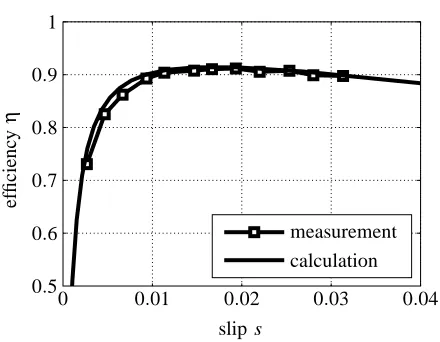
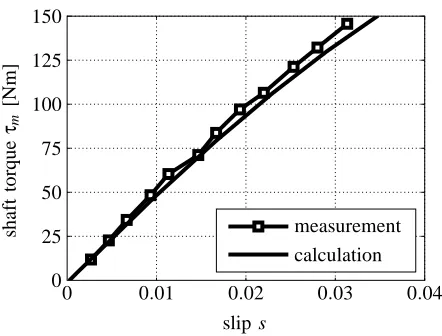
In Fig. 5 and 6 the measurement and calculation results of the electrical input and the mechanical output power are compared. The efficiency
η=Pm Ps
(67)
and the power factor are depicted in Fig. 7 and 8. The stator current and the mechanical output torque are shown in Fig. 9 and 10. The validity and usability of the proposed calculation algorithm is demonstrated by the presented measurement and calculation results.
Since the computation of the consistent parameters is based on the rating plate data of the motor, it is not surprising that the nominal operating point (specified by the rating plate) and the measurement results do not exactly coincide. Instead, a higher goal is achieved: the calculations exactly match the specified nominal operating point.
B. Investigation of Motors based on Manufacturer Data
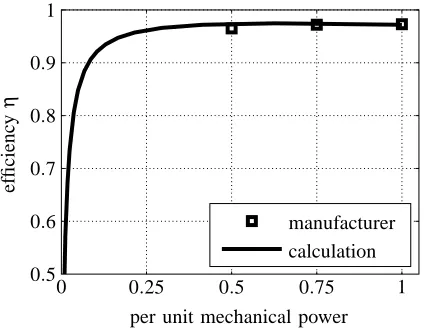
The series of 1.1 kW, 11 kW, 110 kW and 1000 kW induc-tion motors is also investigated in this paper. For each power rating, manufacturer data of motors for p=1, p=2 and p=3 are compared with calculations (and estimations, respec-tively). Apart from the nominal operating point, manufacturer data provide additionally the efficiencies for 75% and 50% of the nominal mechanical output power. In Fig. 11–22 the catalog based manufacturer data and the results obtained from calculations are compared.
0 0.01 0.02 0.03 0.04 0
5 10 15 20 25 30
slip s
el
ec
tr
ic
al
p
o
w
er
Ps
[k
W
]
[image:6.595.86.249.72.168.2]measurement calculation
Figure 5. Electrical input power versus slip of a four pole induction motor with 18.5 kW; measurement and calculation
0 0.01 0.02 0.03 0.04 0
5 10 15 20 25 30
slip s
m
ec
h
an
ic
al
p
o
w
er
Pm
[k
W
]
measurement calculation
Figure 6. Mechanical output power versus slip of a four pole induction motor with 18.5 kW; measurement and calculation
0 0.01 0.02 0.03 0.04 0.5
0.6 0.7 0.8 0.9 1
slip s
ef
fi
ci
en
cy
η
measurement calculation
[image:6.595.319.535.319.486.2] [image:6.595.318.538.567.738.2]0 0.01 0.02 0.03 0.04 0
0.2 0.4 0.6 0.8 1
slip s
p
o
w
er
fa
ct
o
r
p
f
[image:7.595.322.533.63.225.2]measurement calculation
Figure 8. Power factor versus slip of a four pole induction motor with 18.5 kW; measurement and calculation
0 0.01 0.02 0.03 0.04 0
5 10 15 20 25 30
slip s
te
rm
in
al
cu
rr
en
t
It
[A
]
[image:7.595.56.278.69.234.2]measurement calculation
Figure 9. Terminal current versus slip of a four pole induction motor with 18.5 kW; measurement and calculation
0 0.01 0.02 0.03 0.04 0
25 50 75 100 125 150
slip s
sh
af
t
to
rq
u
e
τm
[N
m
]
measurement calculation
Figure 10. Mechanical output torque versus slip of a four pole induction motor with 18.5 kW; measurement and calculation
0 0.25 0.5 0.75 1
0.5 0.6 0.7 0.8 0.9 1
per unit mechanical power
ef
fi
ci
en
cy
η
[image:7.595.322.532.315.480.2]manufacturer calculation
Figure 11. Efficiency versus per unit mechanical output power for a two pole induction motor with Pm,N=1.1 kW, Vs,N=400 V, Is,N=1.34 A, pfN=0.86,
fs,N=50 Hz and nN=2810 rpm; manufacturer data and calculation
0 0.25 0.5 0.75 1
0.5 0.6 0.7 0.8 0.9 1
per unit mechanical power
ef
fi
ci
en
cy
η
[image:7.595.59.274.319.486.2]manufacturer calculation
Figure 12. Efficiency versus per unit mechanical output power for a four pole induction motor with Pm,N=1.1 kW, Vs,N=400 V, Is,N=1.48 A, pfN=0.769,
fs,N=50 Hz and nN=1446 rpm; manufacturer data and calculation
0 0.25 0.5 0.75 1
0.5 0.6 0.7 0.8 0.9 1
per unit mechanical power
ef
fi
ci
en
cy
η
manufacturer calculation
Figure 13. Efficiency versus per unit mechanical output power for a six pole induction motor with Pm,N=1.1 kW, Vs,N=400 V, Is,N=1.66 A, pfN=0.75,
fs,N=50 Hz and nN=918 rpm; manufacturer data and calculation
[image:7.595.322.534.566.731.2] [image:7.595.56.277.569.737.2]0 0.25 0.5 0.75 1 0.5
0.6 0.7 0.8 0.9 1
per unit mechanical power
ef
fi
ci
en
cy
η
[image:8.595.322.534.62.226.2]manufacturer calculation
Figure 14. Efficiency versus per unit mechanical output power for a two pole induction motor with Pm,N=11 kW, Vs,N=400 V, Is,N=11.4 A, pfN=0.89,
fs,N=50 Hz and nN=2967 rpm; manufacturer data and calculation
0 0.25 0.5 0.75 1
0.5 0.6 0.7 0.8 0.9 1
per unit mechanical power
ef
fi
ci
en
cy
η
[image:8.595.62.276.65.226.2]manufacturer calculation
Figure 15. Efficiency versus per unit mechanical output power for a four pole induction motor with Pm,N=11 kW, Vs,N=400 V, Is,N=12.1 A, pfN=0.84,
fs,N=50 Hz and nN=1488 rpm; manufacturer data and calculation
0 0.25 0.5 0.75 1
0.5 0.6 0.7 0.8 0.9 1
per unit mechanical power
ef
fi
ci
en
cy
η
manufacturer calculation
Figure 16. Efficiency versus per unit mechanical output power for a six pole induction motor with Pm,N=11 kW, Vs,N=400 V, Is,N=13.2 A, pfN=0.79,
fs,N=50 Hz and nN=876 rpm
0 0.25 0.5 0.75 1
0.5 0.6 0.7 0.8 0.9 1
per unit mechanical power
ef
fi
ci
en
cy
η
[image:8.595.323.532.314.481.2]manufacturer calculation
Figure 17. Efficiency versus per unit mechanical output power for a two pole induction motor with Pm,N=110 kW, Vs,N=400 V, Is,N=107 A, pfN=0.90,
fs,N=50 Hz and nN=2976 rpm; manufacturer data and calculation
0 0.25 0.5 0.75 1
0.5 0.6 0.7 0.8 0.9 1
per unit mechanical power
ef
fi
ci
en
cy
η
[image:8.595.62.273.315.480.2]manufacturer calculation
Figure 18. Efficiency versus per unit mechanical output power for a four pole induction motor with Pm,N=110 kW, Vs,N=400 V, Is,N=110.3 A, pfN= 0.88, fs,N=50 Hz and nN=1485 rpm; manufacturer data and calculation
0 0.25 0.5 0.75 1
0.5 0.6 0.7 0.8 0.9 1
per unit mechanical power
ef
fi
ci
en
cy
η
manufacturer calculation
Figure 19. Efficiency versus per unit mechanical output power for a six pole induction motor with Pm,N=110 kW, Vs,N=400 V, Is,N=116 A, pfN=0.84,
[image:8.595.63.276.565.732.2] [image:8.595.323.534.565.732.2]0 0.25 0.5 0.75 1 0.5
0.6 0.7 0.8 0.9 1
per unit mechanical power
ef
fi
ci
en
cy
η
[image:9.595.62.275.64.228.2]manufacturer calculation
Figure 20. Efficiency versus per unit mechanical output power a for two pole induction motor with Pm,N=1000 kW, Vs,N=3464 V, Is,N=109 A, pfN= 0.91, fs,N=50 Hz and nN=2988 rpm; manufacturer data and calculation
0 0.25 0.5 0.75 1
0.5 0.6 0.7 0.8 0.9 1
per unit mechanical power
ef
fi
ci
en
cy
η
[image:9.595.62.275.310.481.2]manufacturer calculation
Figure 21. Efficiency versus per unit mechanical output power for a four pole induction motor with Pm,N=1000 kW, Vs,N=3464 V, Is,N=114 A, pfN= 0.87, fs,N=50 Hz and nN=1494 rpm; manufacturer data and calculation
0 0.25 0.5 0.75 1
0.5 0.6 0.7 0.8 0.9 1
per unit mechanical power
ef
fi
ci
en
cy
η
manufacturer calculation
Figure 22. Efficiency versus per unit mechanical output power for a six pole induction motor with Pm,N=1000 kW, Vs,N=3464 V, Is,N=113 A, pfN= 0.88, fs,N=50 Hz and nN=996 rpm; manufacturer data and calculation
VII. CONCLUSIONS
The intention of this paper was the calculation of the consistent parameters of an induction motor. In this context it is important to know that the proposed approach does not model the real motor behavior, but exactly models the nominal operating point, specified by the rating plate. In the presented model ohmic losses, core losses, friction losses and stray-load losses are considered. Mathematical algorithms and estimations – where necessary – are presented. For an investigated four pole 18.5 kW induction motor, measurement and calculation results are compared, revealing well matching results and thus proving the applicability of the presented calculations. Additionally, the manufacturer data of a series of two, four and six pole motors in the range of 1.1 kW to 1000 kW are compared with calculations. Even for these mo-tors the obtained manufacturer data show that the calculations are very well matching.
APPENDIX
NOMENCLATURE Variables
a abbreviation; factor d term of approximation
ϕ phase angle
G reluctance
i instantaneous current
I RMS current
I current phasor k term of approximation
L inductance
p number of pole pairs P power, losses pf power factor
Ψ flux linkage
Ψ flux linkage phasor
R resistance
σ leakage factor
s slip
T time constant
τ torque
v instantaneous voltage
V RMS voltage
V voltage phasor
ω electrical angular velocity
Ω mechanical angular velocity
Indexes
0 no load operation 1,2,3 phase indexes
c core
Cu copper
e eddy current losses f friction losses
g air gap
h hysteresis losses
i inner
m magnetizing; mechanical (rotor) N nominal operation
[image:9.595.63.274.566.732.2]r rotor
s stator
sr stator and rotor stray stray-load losses
t terminal
x real part, with respect to a synchronous ref-erence frame
y imaginary part, with respect to a synchronous reference frame
Superscripts
f synchronous reference frame s stator fixed reference frame
∗ conjugate complex
′ with respect to the stator side; reference
REFERENCES
[1] J.-Y. Lee, S.-H. Lee, G.-H. Lee, J.-P. Hong, and J. Hur, “Determination of parameters considering magnetic nonlinearity in an interior perma-nent magnet synchronous motor,” IEEE Transactions on Magnetics, vol. 42, no. 4, pp. 1303–1306, April 2006.
[2] M. Kondo, “Parameter measurements for permanent magnet syn-chronous machines,” Transactions on Electrical and Electronic
Engi-neering IEEJ Trans 2007, vol. 109-117, 2007.
[3] M. Burth, G. C. Verghese, and M. Velez-Reyes, “Subset selection for improved parameter estiamtion on on-line identification on a syn-chronous generator,” IEEE Transactions on Power Systems, vol. 14, no. 1, pp. 218–225, 1999.
[4] E. Kyriakides, G. Heydt, and V. Vittal, “Online parameter estimation of round rotor synchronous generators including magnetic saturation,”
IEEE Transactions on Energy Conversion, vol. 20, no. 3, pp. 529–537,
Sept. 2005.
[5] S. Ichikawa, M. Tomita, S. Doki, and S. Okuma, “Sensorless control of synchronous reluctance motors based on extended emf models considering magnetic saturation with online parameter identification,”
IEEE Transactions on Industry Applications, vol. 42, no. 5, pp. 1264–
1274, Sept.-Oct. 2006.
[6] P. Niazi and H. A. Toliyat, “Online parameter estimation of permanent-magnet assisted synchronous reluctance motor,” IEEE Transactions on
Industry Applications, vol. 43, no. 2, pp. 609–615, March-april 2007.
[7] R. Babau, I. Boldea, T. J. E. Miller, and N. Muntean, “Complete parameter identification of large induction machines from no-load acceleration–deceleration tests,” IEEE Transactions on Industrial
Elec-tronics, vol. 54, no. 4, pp. 1962–1972, Aug. 2007.
[8] R. F. F. Koning, C. T. Chou, M. H. G. Verhaegen, J. B. Klaassens, and J. R. Uittenbogaart, “A novel approach on parameter identification for inverter driven induction machines,” IEEE Transactions on Control
Systems Technology, vol. 8, 6, pp. 873–882, 2000.
[9] J.-K. Seok and S.-K. Sul, “Induction motor parameter tuning for high-performance drives,” IEEE Transactions on Industry Applications, vol. 37, no. 1, pp. 35–41, 2001.
[10] H. Tajima, G. Guidi, and H. Umida, “Consideration about problems and solutions of speed estimation method and parameter tuning for speed-sensorless vector control of induction motor drives,” IEEE Transactions
on Industry Applications, vol. 38, No. 5, pp. 1282–1289, 2002.
[11] C. Grantham and D. J. McKinnon, “Rapid parameter determination for induction motor analysis and control,” IEEE Transactions on Industry
Applications, vol. 39, no. 4, pp. 1014–1020, July-August 2003.
[12] R. Wamkeue, I. Kamwa, and M. Chacha, “Unbalanced transients-based maximum likelihood identification of induction machine parameters,”
IEEE Transactions on Energy Conversion, vol. 18, no. 1, pp. 33–40,
March 2003.
[13] H. A. Toliyat, E. Levi, and M. Raina, “A review of rfo induction motor parameter estimation techniques,” IEEE Transactions on Energy
Conversion, vol. 18, no. 2, pp. 271–283, June 2003.
[14] M. Cirrincione, M. Pucci, G. Cirrincione, and G.-A. Capolino, “A new experimental application of least-squares techniques for the estimation of the induction motor parameters,” IEEE Transactions on Industry
Applications, vol. 39, No. 5, pp. 1247–1256, 2003.
[15] ——, “Constrained minimization for parameter estimation of induction motors in saturated and unsaturated conditions,” IEEE Transactions on
Industrial Electronics, vol. 52, no. 5, pp. 1391–1402, Oct. 2005.
[16] A. Boglietti, A. Cavagnino, and M. Lazzari, “Experimental high-frequency parameter identification of ac electrical motors,” IEEE
Trans-actions on Industry Applications, vol. 43, no. 1, pp. 23–29, Jan.-feb.
2007.
[17] H. Kobayashi, S. Katsura, and K. Ohnishi, “An analysis of parameter variations of disturbance observer for motion control,” IEEE
Transac-tions on Industrial Electronics, vol. 54, no. 6, pp. 3413–3421, Dec.
2007.
[18] A. B. Proca and A. Keyhani, “Sliding-mode flux observer with online rotor parameter estimation for induction motors,” IEEE Transactions on
Industrial Electronics, vol. 54, no. 2, pp. 716–723, April 2007.
[19] D. P. Marcetic and S. N. Vukosavic, “Speed-sensorless ac drives with the rotor time constant parameter update,” IEEE Transactions on Industrial
Electronics, vol. 54, no. 5, pp. 2618–2625, Oct. 2007.
[20] S. Maiti, C. Chakraborty, Y. Hori, and M. C. Ta, “Model reference adap-tive controller-based rotor resistance and speed estimation techniques for vector controlled induction motor drive utilizing reactive power,”
IEEE Transactions on Industrial Electronics, vol. 55, no. 2, pp. 594–
601, Feb. 2008.
[21] A. Mirecki, X. Roboam, and F. Richardeau, “Architecture complexity and energy efficiency of small wind turbines,” IEEE Transactions on
Industrial Electronics, vol. 54, no. 1, pp. 660–670, Feb. 2007.
[22] D. de Almeida Souza, W. C. P. de Aragao Filho, and G. C. D. Sousa, “Adaptive fuzzy controller for efficiency optimization of induction motors,” IEEE Transactions on Industrial Electronics, vol. 54, no. 4, pp. 2157–2164, Aug. 2007.
[23] X.-Q. Liu, H.-Y. Zhang, J. Liu, and J. Yang, “Fault detection and diagnosis of permanent-magnet dc motor based on parameter estimation and neural network,” IEEE Transactions on Industrial Electronics, vol. 47, no. 5, pp. 1021–1030, Oct. 2000.
[24] C. Kral, R. Wieser, F. Pirker, and M. Schagginger, “Sequences of field-oriented control for the detection of faulty rotor bars in induc-tion machines—the vienna monitoring method,” IEEE Transacinduc-tions on
Industrial Electronics, vol. 47, no. 5, pp. 1042–1050, October 2000.
[25] S. Bachir, S. Tnani, J. C. Trigeassou, and G. Champenois, “Diagnosis by parameter estimation of stator and rotor faults occurring in induction machines,” IEEE Transactions on Industrial Electronics, vol. 53, no. 3, pp. 963–973, June 2006.
[26] J. Hsu, J. Kueck, M. Olszewski, D. Casada, P. Otaduy, and L. Tolbert, “Comparison of induction motor field efficiency evaluation methods,”
IEEE Transactions on Industry Applications, vol. 34, no. 1, pp. 117–
125, Jan.-Feb. 1998.
[27] B. Lu, T. Habetler, and R. Harley, “A survey of efficiency-estimation methods for in-service induction motors,” IEEE Transactions on
Indus-try Applications, vol. 42, no. 4, pp. 924–933, July-August 2006.
[28] H. König, “Ermittlung der Parameter der Drehstrom-Asynchronmaschine vorwiegend aus den Typenschildangaben,”
Elektrie, vol. 6, pp. 220–220, 1988.
[29] J. Pedra and F. Corcoles, “Estimation of induction motor double-cage model parameters from manufacturer data,” IEEE Transactions
on Energy Conversion, vol. 19, no. 2, pp. 310–317, June 2004.
[30] K. Davey, “Predicting induction motor circuit parameters,” IEEE
Trans-actions on Magnetics, vol. 38, no. 4, pp. 1774–1779, July 2002.
[31] D. Lin, P. Zhou, W. Fu, Z. Badics, and Z. Cendes, “A dynamic core loss model for soft ferromagnetic and power ferrite materials in transient finite element analysis,” Conference Proceedings COMPUMAG, 2003. [32] “IEEE standard test procedures for polyphase induction motors and
generators,” IEEE Standard 112, 2004.
[33] W. Lang, “Über die Bemessung verlustarmer Asynchronmotoren mit Käfigläufer für Pulsumrichterspeisung,” Ph.D. dissertation, Technische Universität Wien, 1984.
[34] P. Pillay, V. Levin, P. Otaduy, and J. Kueck, “In-situ induction motor ef-ficiency determination using the genetic algorithm,” IEEE Transactions
on Energy Conversion, vol. 13, no. 4, pp. 326–333, Dec. 1998.
[35] P. K. Kovacs, Transient Phenomena in Electrical Machines. Budapest: Akademiai Kiado Verlag, 1984.
[36] H. Kleinrath, “Ersatzschaltbilder für Transformatoren und Asynchron-maschinen,” e&i, vol. 110, pp. 68–74, 1993.