64
Towards Annotating and Creating Sub-Sentence Summary Highlights
Kristjan Arumae♠, Parminder Bhatia♦, Fei Liu♠
♠Computer Science Department, University of Central Florida ♦
Amazon, USA
{arumae,parmib}@amazon.com [email protected]
Abstract
Highlighting is a powerful tool to pick out im-portant content and emphasize. Creating sum-mary highlights at the sub-sentence level is particularly desirable, because sub-sentences are more concise than whole sentences. They are also better suited than individual words and phrases that can potentially lead to disfluent, fragmented summaries. In this paper we seek to generate summary highlights by annotating summary-worthy sub-sentences and teaching classifiers to do the same. We frame the task as jointly selecting important sentences and identifying a single most informative textual unit from each sentence. This formulation dra-matically reduces the task complexity involved in sentence compression. Our study provides new benchmarks and baselines for generating highlights at the sub-sentence level.
1 Introduction
Highlighting at an appropriate level of granularity is important to emphasize salient content in an un-obtrusive manner. A small collection of keywords may be insufficient to deliver the main points of an article, while highlighting whole sentences often provide superfluous information. In domains such as newswire, scholarly publications, legal and pol-icy documents (Kim et al., 2010; Sadeh et al.,
2013;Hasan and Ng, 2014), people are tempted
to write long and complicated sentences. It is par-ticularly desirable to pick out onlyimportant sen-tence partsas opposed to whole sentences.
Generating highlights at the sub-sentence level has not been thoroughly investigated in the past. A related thread of research is extractive and com-pressive summarization (Daum´e III and Marcu,
2002; Zajic et al., 2007; Martins and Smith,
2009; Filippova, 2010; Berg-Kirkpatrick et al.,
2011;Thadani and McKeown,2013;Wang et al.,
2013;Li et al.,2013,2014;Durrett et al.,2016).
The methods select representative sentences from source documents, then delete nonessential words and constituents to form compressed summaries. Nonetheless, making multiple interdependent de-cisions on word deletion can render summaries un-grammatical and fragmented. In this paper, we in-vestigate an alternative formulation that can dra-matically reduce the task complexity involved in sentence compression.
We frame the task as jointly selecting represen-tative sentences from a document and identifying a single most informative textual unit from each sentence to create sub-sentence highlights. This formulation is inspired by rhetorical structure the-ory (RST; Mann and Thompson, 1988) where sub-sentence highlights resemble thenucleiwhich are text spans essential to express the writer’s purpose. The formulation also mimics human behavior on picking out important content. If multiple parts of a sentence are important, a human uses a single stroke to highlight them all, up to the whole sen-tence. If only a part of the sentence is relevant, she only picks out that particular sentence part.
Generating sub-sentence highlights is advanta-geous over abstraction (See et al.,2017;Chen and
Bansal, 2018; Gehrmann et al., 2018; Lebanoff
et al.,2018;Celikyilmaz et al.,2018) in several
as-pects. The highlights can be overlaid on the source document, allowing them to be interpreted in con-text. The number of highlights is controllable by limiting sentence selection. In contrast, adjusting summary length in an end-to-end, abstractive sys-tem can be difficult. Further, highlights are guar-anteed to be true-to-the-original, while system ab-stracts can sometimes “hallucinate” facts and dis-tort the original meaning. Our contributions in this work include the following:
(i): marseille , france -lrb- cnn -rrb- the french prosecutor leading an investigation into the crash of germanwings flight 9525 insisted wednesday that he was not aware of any video footage from on board the plane .
(ii): marseille , france -lrb- cnn -rrb- the french prosecutor leading an investigation into the crash of germanwings flight 9525 insisted wednesday that he was not aware of any video footage from on board the plane .
(iii):
8
marseille , france -lrb- cnn -rrb- the french prosecutor leading an investigation into the crash of germanwings flight 9525 insisted
22
[image:2.595.83.511.62.146.2]wednesday that he was not aware of any video footage from on board the plane .
Figure 1: An illustration of label smoothing. Words aligned to the abstract are coloredorange; gap words are coloredturquoise.
an annotation scheme to obtain binary sentence labels for extraction, as well as start and end in-dices to mark the most important textual unit of a positively labeled sentence;
• we examine the feasibility of using neural ex-tractive summarization with a multi-termed ob-jective to identify summary sentences and their most informative sub-sentence units. Our study provides new benchmarks and baselines for highlighting at the sub-sentence level.
2 Annotating Sub-Sentence Highlights
We propose to derive gold-standard sub-sentence highlights from human-written abstracts that often accompany the documents (Hermann et al.,2015). However, the challenge still exists, because ab-stracts are very loosely aligned with source docu-ments and they contain unseen words and phrases. We definea summary-worthy sub-sentence unitas the longest consecutive subsequence that contains content of the abstract. We obtain gold-standard labels for sub-sentence units by first establishing word alignments between the document and ab-stract, then smoothing word labels to generate sub-sentence labels.
Word Alignment The attention matrix of neural sequence-to-sequence models provides a powerful and flexible mechanism for word alignment. Let
S={wi}Mi=1 be a sequence of words denoting the
document, andT={wt}Nt=1 denoting the abstract.
The attention weight αt,i indicates the amount of
attention received by thei-th document word in or-der to generate thet-th abstract word. All attention values (α) can be automatically learned from par-allel training data. After the model is trained, we identifya single document wordthat receives the most attention for generating each abstract word, as denoted in Eq. (1) and illustrated by Figure1
(i). This step produces a set of source words con-taining the content of the abstract but possibly with
distinct word forms.1
wi(t) = arg max i∈M
αt,i ∀t (1)
Smoothing Our goal is to identify sub-sentence units containing content of the abstract by smooth-ing word labels obtained in the previous step. We extract a single most informative textual unit from a sentence. As a first attempt, we obtain start and end indices of sub-sentence units using heuristics, which are described as follows:
• connecting two selected words if there is a small gap (<5 words) between them. For example, in Figure 1 (ii), the gap between “crash” and “germanwings” is bridged by labelling all gap words as selected;
• the longest consecutive subsequence after filling gaps is chosen as the most important unit of the sentence. In Figure1(iii), we select the longest segment containing 22 words. When a tie oc-curs, we choose the segment appearing first; • creating gold-standard labels for sentences and
sub-sentence units. If a segment is the most informative, i.e., longest subsequence of a sen-tence and>5 words, we record its start and end indices. If a segment is selected, its containing sentence is labelled as 1, otherwise 0.
2.1 Dataset and Statistics
We conduct experiments on the CNN/DM dataset released by See et al. (2017) containing news arti-cles and human abstracts. We choose the pointer-generator networks described in the same work to obtain attention matrices used for word alignment. The model was trained on the training split of CNN/DM, then applied to all train/valid/test splits to generate gold-standard sub-sentence highlights. At test time, we compare system highlights with
1Aligning multiple document words with a single abstract
Sentences Gold-Standard Highlights Human Abstracts
#TotalSents %PosSents #Sents #Tokens %CompR #Sents #Tokens
Train 5,312,010 24.42 4.51 51.46 0.47 3.68 56.47
Valid 211,022 30.85 4.87 57.11 0.47 4.00 62.73
[image:3.595.73.526.62.123.2]Test 182,663 29.63 4.72 54.47 0.46 3.79 59.56
Table 1: Data statistics are broken into three categories. Sentencesindicate the number of total sentences as well as the rate of positive labels. Gold-Standard Highlightsreflect document-level details of our new ground truth labels. Compression rate (“CompR”) indicates the percentage of a positive labeled sentence was covered by the segment. FinallyHuman Abstracts provides a comparison against CNN/DailyMail ground truth summaries.
gold-standard highlights and human abstracts, re-spectively, to validate system performance.
In Table1, we present data statistics of the gold-standard sub-sentence highlights. We observe that gold-standard highlights and human abstracts are of comparable length in terms of tokens. On av-erage, 28% of document sentences are labelled as positive. Among these, 47% of the words belong to gold-standard sub-sentence highlights. In our processed dataset we retain important document level information such as original sentence place-ment and docuplace-ment ID. We consider each docu-ment sentence as a data instance, and introduce a neural model to predict (i) a binary sentence level label, and (ii) start and end indices of a consecu-tive subsequence for a posiconsecu-tive sentence. We are particularly interested in predicting start and end indices to encourage sub-sentence segments to re-main self-contained. Finally, we leverage the doc-ument ID to re-combine model output to still gen-erate summaries at the document level.
3 Models
We provide initial modeling for our data with a single state-of-the-art architecture. The purpose is to build meaningful representations that allow for joint prediction of summary-worthy sentences and their sub-sentence units. Our model receives an input sequence as an individualized sentence de-noted asS={ws
i}Mi=1, wheresdenotes the sentence
index in the original document. The model learns to predict the sentence label and start/end index of a sub-sentence unit based on contextualized repre-sentations.
For each tokenwsi we leverage a combined rep-resentationEtok,Es-pos, andEd-pos, i.e., a token em-bedding, sentence level positional emem-bedding, and a document level positional embedding. Here s-posdenotes the token position in a sentence,d-pos
denotes the sentence position in a document, and
E(wis) ∈ Rd. We justify the last embedding by
noting that the sentence position within that docu-ment plays an important role since generally there is a higher probability of positive labels towards the beginning. The final input representation is an element-wise addition of all embeddings (Eq. (2)). This input is encoded using a bi-directional trans-former (Vaswani et al.,2017;Devlin et al.,2018), denoted ash.
E(wis) :=Etok(wis)+Es-pos(wsi)+Ed-pos(wsi) (2)
3.1 Objectives
We use the transformer output to generate three la-bels: sentence, start and end positions of the sub-sentence unit. First we obtain the sequence rep-resentation via the[CLS]token.2 We apply a linear
transformation to this vector and a softmax layer to obtain a binary label for the entire sentence.
For the indexing objective we transform the en-coder output,h, to account for start and end index classification.a=MLPstart/end(h)∈RM×2. Again
we make use of a single linear transformation, here it is applied across the encoder temporally giving each time-step two channels. The two channels are individually passed through a softmax layer to produce two distributions, for the start and end in-dex. Finally we use a combined loss term which is trained end-to-end using a cross entropy objective:
L=λ(Lstart+Lend) +Lsent. (3)
For negatively labeled sentencesLstartandLendare not utilized during training. λis a coefficient bal-ancing between two task objectives.
3.2 Experimental Setup
The encoder hidden state dimension is set at768, with12layers and12attention heads (BERTBASE
uncased). We utilize dropout (Srivastava et al.,
2014) withp= 0.1, andλis empirically set to0.1.
2
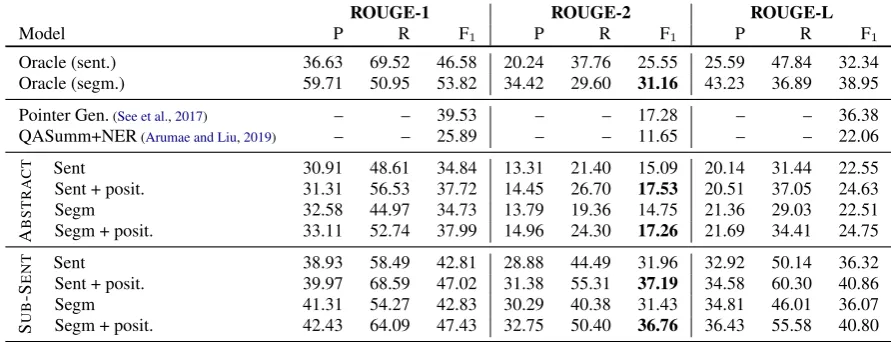
ROUGE-1 ROUGE-2 ROUGE-L
Model P R F1 P R F1 P R F1
Oracle (sent.) 36.63 69.52 46.58 20.24 37.76 25.55 25.59 47.84 32.34 Oracle (segm.) 59.71 50.95 53.82 34.42 29.60 31.16 43.23 36.89 38.95
Pointer Gen.(See et al.,2017) – – 39.53 – – 17.28 – – 36.38 QASumm+NER(Arumae and Liu,2019) – – 25.89 – – 11.65 – – 22.06
A
B
S
T
R
A
C
T Sent 30.91 48.61 34.84 13.31 21.40 15.09 20.14 31.44 22.55 Sent + posit. 31.31 56.53 37.72 14.45 26.70 17.53 20.51 37.05 24.63 Segm 32.58 44.97 34.73 13.79 19.36 14.75 21.36 29.03 22.51 Segm + posit. 33.11 52.74 37.99 14.96 24.30 17.26 21.69 34.41 24.75
S
U
B
-S
E
N
[image:4.595.73.519.61.232.2]T Sent 38.93 58.49 42.81 28.88 44.49 31.96 32.92 50.14 36.32 Sent + posit. 39.97 68.59 47.02 31.38 55.31 37.19 34.58 60.30 40.86 Segm 41.31 54.27 42.83 30.29 40.38 31.43 34.81 46.01 36.07 Segm + posit. 42.43 64.09 47.43 32.75 50.40 36.76 36.43 55.58 40.80
Table 2: ROUGE results on CNN/DM test set at both sentence and sub-sentence level. The top two rows test gold-standard sentences and sub-sentences against human abstracts. Additionally we show results of an abstractive (See et al.,2017) and an extractive summarizer (Arumae and Liu,2019) whose CNN/DM results are macro-averaged. The bottom two sections showcase our models. We report results at sentence and sub-sentence level and report those with and withoutEd-posembeddings (+posit.). These results are further broken down to reflect evaluation against human abstracts and our own gold standard segments.
We use Adam (Kingma and Ba,2014) as our opti-mizer with a learning rate of3e−5, and implement early stopping against the validation split. Devlin et al. (2018) suggest that fine-tuning takes only a few epochs with large datasets. Training was con-ducted on a GeForce GTX 1080 Ti GPU, and each model took at most three days to converge with a maximum epoch time of 12 hours.
At inference time we only extract start and end indices when the sentence label is positive. Addi-tionally if the system produced an end index oc-curring before the start index we ignore it and se-lect the argmax of the distribution for end indexes which are located after the start index.
4 Results
In Table2 we report results on the CNN/DM test set evaluated by ROUGE (Lin,2004). We examine to what extent our summary sentences and sub-sentence highlights, annotated using the strategy presented in§2, have matched the content of hu-man abstracts. These are theoracleresults for sen-tences and segments, respectively. Despite that ab-stracts can contain unseen words, we observe that 70% of the abstract words are covered by gold-standard sentences, and 51% of abstract words are included in sub-sentence units, suggesting the ef-fectiveness of our annotation method on capturing summary-worthy content.
We proceed by evaluating our method against state-of-the-art extractive and abstractive summa-rization systems. Arumae and Liu (2019) present an approach to extract summary segments using
question-answering as supervision signal, assum-ing a high quality summary can serve as document surrogate to answer questions. See et al. (2017) present pointer-generator networks, an abstractive summarization model and a reliable baseline for being both state-of-the-art, and also a vital tool for guiding our data creation. We show that the per-formance of oracle summaries is superior to these baselines in terms of R-2, with sub-sentence high-lights achieving the highest R-2 F-score of 31%, suggesting extracting sub-sentence highlights is a promising direction moving forward.
4.1 Modeling
Our models are shown in the bottom two sections of Table2. We obtain system-predicted whole sen-tences (Sent) and sub-sentence segments (Segm); then evaluate them against both human abstracts (ABSTRACT) and gold-standard highlights (SUB-SENT). We test the efficacy of document positional embeddings (Eq. (2)), denoted as+posit.
Our model (+posit) positively labeled22.27%
of sentences, with an average summary length of
3.54sentences. The segment model crops selected sentences, exhibiting a compression ratio of0.77. Comparing to gold-standard ratio of0.47, there is a67.4%increase, pointing to future work on high-lighting sub-sentence segments.
5 Conclusion
We introduced a new task and dataset to study sub-sentence highlight extraction. We have shown the dataset provides a new upper bound for evaluation metrics, and that the use of sub-sentence segments provides more concise summaries over full sen-tences. Furthermore, we evaluated our data using a state-of-the-art neural architecture to show the modeling capabilities using this data.
Acknowledgments
We thank the anonymous reviewers for their valu-able suggestions. This research was supported in part by the National Science Foundation grant IIS-1909603.
References
Kristjan Arumae and Fei Liu. 2019. Guiding ex-tractive summarization with question-answering re-wards. InProceedings of the North American Chap-ter of the Association for Computational Linguistics (NAACL).
Taylor Berg-Kirkpatrick, Dan Gillick, and Dan Klein. 2011. Jointly learning to extract and compress. In Proceedings of the Annual Meeting of the Associa-tion for ComputaAssocia-tional Linguistics (ACL).
Asli Celikyilmaz, Antoine Bosselut, Xiaodong He, and Yejin Choi. 2018. Deep communicating agents for abstractive summarization. In Proceedings of the North American Chapter of the Association for Computational Linguistics (NAACL).
Yen-Chun Chen and Mohit Bansal. 2018. Fast ab-stractive summarization with reinforce-selected sen-tence rewriting. InProceedings of the Annual Meet-ing of the Association for Computational LMeet-inguistics (ACL).
Jianpeng Cheng and Mirella Lapata. 2016. Neural summarization by extracting sentences and words. In Proceedings of the 54th Annual Meeting of the Association for Computational Linguistics (Volume 1: Long Papers), volume 1, pages 484–494.
Hal Daum´e III and Daniel Marcu. 2002. A noisy-channel model for document compression. In Pro-ceedings of the Annual Meeting of the Association for Computational Linguistics (ACL).
Jacob Devlin, Ming-Wei Chang, Kenton Lee, and Kristina Toutanova. 2018. Bert: Pre-training of deep bidirectional transformers for language understand-ing.arXiv preprint arXiv:1810.04805.
Greg Durrett, Taylor Berg-Kirkpatrick, and Dan Klein. 2016. Learning-based single-document summariza-tion with compression and anaphoricity constraints. InProceedings of the Association for Computational Linguistics (ACL).
Katja Filippova. 2010. Multi-sentence compression: Finding shortest paths in word graphs. In Proceed-ings of the International Conference on Computa-tional Linguistics (COLING).
Sebastian Gehrmann, Yuntian Deng, and Alexander M. Rush. 2018. Bottom-up abstractive summariza-tion. In Proceedings of the Conference on Em-pirical Methods in Natural Language Processing (EMNLP).
Kazi Saidul Hasan and Vincent Ng. 2014. Automatic keyphrase extraction: A survey of the state of the art. In Proceedings of the Annual Meeting of the Association for Computational Linguistics (ACL).
Karl Moritz Hermann, Tomas Kocisky, Edward Grefenstette, Lasse Espeholt, Will Kay, Mustafa Su-leyman, and Phil Blunsom. 2015. Teaching ma-chines to read and comprehend. InProceedings of Neural Information Processing Systems (NIPS).
Su Nam Kim, Olena Medelyan, Min-Yen Kan, and Timothy Baldwin. 2010. SemEval-2010 task 5: Au-tomatic keyphrase extraction from scientific articles. InProceedings of the 5th International Workshop on Semantic Evaluation.
Diederik P Kingma and Jimmy Ba. 2014. Adam: A method for stochastic optimization. arXiv preprint arXiv:1412.6980.
Logan Lebanoff, Kaiqiang Song, and Fei Liu. 2018. Adapting the neural encoder-decoder framework from single to multi-document summarization. In Proceedings of the Conference on Empirical Meth-ods in Natural Language Processing (EMNLP).
Chen Li, Fei Liu, Fuliang Weng, and Yang Liu. 2013. Document summarization via guided sentence com-pression. InProceedings of the 2013 Conference on Empirical Methods in Natural Language Processing (EMNLP).
Chen Li, Yang Liu, Fei Liu, Lin Zhao, and Fuliang Weng. 2014. Improving multi-document summa-rization by sentence compression based on expanded constituent parse tree. In Proceedings of the Con-ference on Empirical Methods on Natural Language Processing (EMNLP).
William C. Mann and Sandra A. Thompson. 1988. Rhetorical structure theory: Toward a functional the-ory of text organization. Text, 8(3):243–281.
Andre F. T. Martins and Noah A. Smith. 2009. Sum-marization with a joint model for sentence extrac-tion and compression. InProceedings of the ACL Workshop on Integer Linear Programming for Natu-ral Language Processing.
Norman Sadeh, Alessandro Acquisti, Travis Breaux, Lorrie Cranor, Aleecia McDonald, Joel Reiden-berg, Noah Smith, Fei Liu, Cameron Russel, Flo-rian Schaub, and Shomir Wilson. 2013. The usable privacy policy project: Combining crowdsourcing, machine learning and natural language processing to semi-automatically answer those privacy questions users care about. Technical Report CMU-ISR-13-119, Carnegie Mellon University.
Abigail See, Peter J. Liu, and Christopher D. Manning. 2017.Get to the point: Summarization with pointer-generator networks. InProceedings of the Annual Meeting of the Association for Computational Lin-guistics (ACL).
Nitish Srivastava, Geoffrey Hinton, Alex Krizhevsky, Ilya Sutskever, and Ruslan Salakhutdinov. 2014. Dropout: a simple way to prevent neural networks from overfitting. The Journal of Machine Learning Research, 15(1):1929–1958.
Kapil Thadani and Kathleen McKeown. 2013. Sen-tence compression with joint structural inference. In Proceedings of CoNLL.
Ashish Vaswani, Noam Shazeer, Niki Parmar, Jakob Uszkoreit, Llion Jones, Aidan N Gomez, Ł ukasz Kaiser, and Illia Polosukhin. 2017. Attention is all you need. In I. Guyon, U. V. Luxburg, S. Bengio, H. Wallach, R. Fergus, S. Vishwanathan, and R. Gar-nett, editors, Advances in Neural Information Pro-cessing Systems 30, pages 5998–6008. Curran As-sociates, Inc.
Lu Wang, Hema Raghavan, Vittorio Castelli, Radu Flo-rian, and Claire Cardie. 2013. A sentence com-pression based framework to query-focused multi-document summarization. InProceedings of ACL.