Correcting Grammatical Verb Errors
Alla Rozovskaya Columbia University New York, NY 10115
Dan Roth University of Illinois
Urbana, IL 61801
Vivek Srikumar Stanford University Stanford, CA 94305
Abstract
Verb errors are some of the most com-mon mistakes made by non-native writers of English but some of the least studied. The reason is that dealing with verb er-rors requires a new paradigm; essentially all research done on correcting grammat-ical errors assumes a closed set of trig-gers – e.g., correcting the use of prepo-sitions or articles – but identifying mis-takes in verbs necessitates identifying po-tentially ambiguous triggers first, and then determining the type of mistake made and correcting it. Moreover, once the verb is identified, modeling verb errors is chal-lenging because verbs fulfill many gram-matical functions, resulting in a variety of mistakes. Consequently, the little earlier work done on verb errors assumed that the error type is known in advance.
We propose a linguistically-motivated ap-proach to verb error correction that makes use of the notion ofverb finitenessto iden-tify triggers and types of mistakes, before using a statistical machine learning ap-proach to correct these mistakes. We show that the linguistically-informed model sig-nificantly improves the accuracy of the verb correction approach.
1 Introduction
We address the problem of correcting grammati-cal verb mistakes made by English as a Second Language (ESL) learners. Recent work in ESL er-ror correction has focused on erer-rors in article and preposition usage (Han et al., 2006; Felice and Pulman, 2008; Gamon et al., 2008; Tetreault et
al., 2010; Gamon, 2010; Rozovskaya and Roth, 2010b; Dahlmeier and Ng, 2011).
While verb errors occur as often as article and preposition mistakes, with a few exceptions (Lee and Seneff, 2008; Gamon et al., 2009; Tajiri et al., 2012), there has been little work on verbs. There are two reasons for why it is difficult to deal with verb mistakes. First, in contrast to articles and prepositions, verbs are more difficult to identify in text, as they can often be confused with other parts of speech, and processing tools are known to make more errors on noisy ESL data (Nagata et al., 2011). Second, verbs are more complex linguisti-cally: they fulfill several grammatical functions, and these different roles imply different types of errors.
These difficulties have led all previous work on verb mistakes to assume prior knowledge of the mistake type; however, identifying the specific category of a verb error is nontrivial, since the sur-face form of the verb may be ambiguous, espe-cially when that verb is used incorrectly. Consider the following examples of verb mistakes:
1. “Wediscusses*/discussthis every time.”
2. “I will be lucky if I{will find}*/find something that fits.”
3. “They wanted to visit many places without spend*/spendinga lot of money.”
4. “They arrived early to organized*/organize every-thing”.
These examples illustrate three grammatical verb properties: Agreement,Tense, and non-finite Form choice that encompass the most common grammatical verb problems for ESL learners. The first two examples show mistakes on verbs that function as main verbs in a clause: sentence (1) shows an example of subject-verbAgreement er-ror; (2) is an example of a Tense mistake where the ambiguity is between{will find}(Future tense)
andfind(Present tense). Examples (3) and (4) dis-play Formmistakes: confusing the infinitive and gerund forms in (3) and including an inflection on an infinitive verb in (4).
This paper addresses the specific challenges of verb error correction that have not been addressed previously – identifying candidates for mistakes and determining which class of errors is present, before proceeding to correct the error. The ex-perimental results show that our linguistically-motivated approach benefits verb error correction. In particular, in order to determine the error type, we build on the notion ofverb finitenessto distin-guish betweenfiniteandnon-finiteverbs (Quirk et al., 1985), that correspond toAgreementandTense mistakes (examples (1) and (2) above) and Form mistakes (examples (3) and (4) above), respec-tively (see Sec. 3). The approach presented in this work was evaluated empirically and competitively in the context of the CoNLL shared task on error correction (Ng et al., 2013) where it was imple-mented as part of the highest-scoring University of Illinois system (Rozovskaya et al., 2013) and demonstrated superior performance on the verb er-ror correction sub-task.
This paper makes the following contributions:
•We present a holistic, linguistically-motivated framework for correcting grammatical verb mis-takes; our approach “starts from scratch” with-out any knowledge of which mistakes should be corrected or of the mistake type; in doing that we show that the specific challenges of verb error correction are better addressed by first identifying thefinitenessof the verb in the error identification stage.
• Within the proposed model, we describe and evaluate several methods ofselecting verb candi-dates, an algorithm fordetermining the verb type, and a type-drivenverb error correction system.
•We annotate a subset of the FCE data set with gold verb candidates and gold verb type.1
2 Related Work
Earlier work in ESL error correction follows the methodology of thecontext-sensitive spelling cor-rection task (Golding and Roth, 1996; Golding and Roth, 1999; Banko and Brill, 2001; Carlson et al., 2001; Carlson and Fette, 2007). Most of the effort in ESL error correction so far has been 1The annotation is available at http://cogcomp.cs.illinois.
edu/page/publication view/743
on article and preposition usage errors, as these are some of the most common mistakes among non-native English speakers (Dalgish, 1985; Lea-cock et al., 2010). These phenomena are generally modeled as multiclass classification problems: a single classifier is trained for a given error type where the set of classes includes all articles or the top n most frequent English prepositions (Izumi et al., 2003; Han et al., 2006; Felice and Pul-man, 2008; Gamon et al., 2008; Tetreault et al., 2010; Rozovskaya and Roth, 2010b; Rozovskaya and Roth, 2011; Dahlmeier and Ng, 2011).
Mistakes on verbs have attracted significantly less attention in the error correction literature. Moreover, the little earlier work done on verb er-rors only considered subsets of these erer-rors and assumed the error sub-type is known in advance. Gamon et al. (2009) mentioned a model for learn-ing gerund/infinitive confusions and auxiliary verb presence/choice. Lee and Seneff (2008) proposed an approach based on pattern matching on trees combined with word n-gram counts for correcting agreement misuse and some types of verb form errors. However, they excluded tense mistakes, which is the most common error category for ESL learners (40% of all verb errors, Sec. 3). Tajiri et al. (2012) considered only tense mistakes. In the above studies, it was assumed that the type of mistake that needs to be corrected is known, and irrelevant verb errors were excluded (e.g., Tajiri et al. (2012) addressed only tense mistakes and excluded from the evaluation other kinds of verb errors). In other words, it was assumed that part of the task was solved. But, unlike in article and preposition error correction where the type of mis-take is known based on the surface form of the word, in verb error correction, it is not obvious.
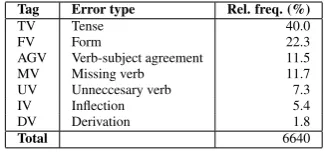
Tag Error type Rel. freq. (%)
TV Tense 40.0
FV Form 22.3
AGV Verb-subject agreement 11.5 MV Missing verb 11.7 UV Unneccesary verb 7.3
IV Inflection 5.4
DV Derivation 1.8
[image:3.595.99.262.62.138.2]Total 6640
Table 1:Grammatical verb errors in FCE.
all teams used similar resources (Ng et al., 2013). 3 Verb Errors in ESL Writing
Verb-related errors are very prominent among non-native English speakers: grammatical mis-use of verbs constitutes one of the most com-mon errors in several learner corpora, including those previously used (Izumi et al., 2003; Lee and Seneff, 2008) and the one employed in this work. We study verb errors using the FCE cor-pus (Yannakoudakis et al., 2011). The corcor-pus possesses several desirable characteristics: it is large (500,000 words), has been annotated by na-tive English speakers, and contains data by learn-ers of multiple first-language backgrounds. The FCE corpus contains 5056 determiner errors, 5347 preposition errors, and 6640 grammatical verb mistakes (Table 1).
3.1 Verb Finiteness
There are many grammatical categories for which English verbs can be marked. The linguistic no-tion ofverb finitenessorverb type(Radford, 1988; Quirk et al., 1985) distinguishes between verbs that function on their own in a clause as main verbs (finite) and those that do not (non-finite). Gram-matical properties associated with each group are mutually exclusive: tense and agreement markers, for example, do not apply to finite verbs; non-finite verbs are not marked for many grammatical functions but may appear in several forms.
The most common verb problems for ESL learners – Tense, Agreement, non-finite Form – involve verbs both in finite and non-finite roles. Table 2 illustrates contexts that license finite and non-finite verbs.
Our intuition is that, because properties associ-ated with each verb type are mutually exclusive, verb finiteness should benefit verb error correc-tion models: an observed verb error may be due to several grammatical phenomena, and knowing which phenomena are active depends on the func-tion of the verb in the current context. Note that Agreement, Tense, and Form errors account for
Category Agreement Kappa Random
[image:3.595.325.501.62.88.2]Correct verbs 0.97 0.95 0.51 Erroneous verbs 0.88 0.81 0.41
Table 3: Inter-annotator agreementbased on 250 verb errors and 250 correct verbs, randomly selected.
about 74% of all grammatical verb errors in Ta-ble 1 but the finiteness distinction applies to all English verbs – every verb is either finite or non-finite in a specific syntactic context – and is also relevant for the remaining mistakes not addressed here.2
4 Annotation for Verb Finiteness
In order to evaluate the quality of the algorithm for verb finitenessand of the candidate selection methods, we annotated all verbs – correct and er-roneous – in a random set of 124 documents from our corpus with the information about verb finite-ness. We refer to these 124 documents asgold sub-set. We also annotated erroneous verbs in the re-maining 1120 documents of the corpus. The anno-tation was performed by two students with back-ground in Linguistics. The inter-annotator agree-ment is shown in Table 3 and is high.
Annotating Verb ErrorsFor each verb error that was tagged asTense(TV),Agreement(AGV), and Form(FV), the annotators marked verb finiteness. Additionally, the annotators also specified the type of error (Tense, Agreement, or Form) (Table 4), since the FCE tags do not always correspond to the three error types we study here. For exam-ple, the FV tag may mark errors on finite verbs. Overall, about 7% of verb errors have to do with phenomena different from the three verb proper-ties considered in this work and thus are excluded from the present study.
Annotating Correct Verbs Correct verbs were
identified in text using an automated proce-dure that relies on part-of-speech information (Sec. 5.1). Valid candidates were specified for verb finiteness. The candidates that were iden-tified incorrectly due to mistakes by the part-of-speech tagger were marked as invalid.
5 The Computational Model
The verb error correction problem is formulated as a classification task in the spirit of the learn-2For instance, the missing verb errors (MV, 11.7%)
Verb type Example Verb properties Agreement Tense Form
Finite “He“Hediscusseddiscussesthis with me every week.”this with me last week” 3rd person,Sing.- Past SimplePresent Simple -
[image:4.595.128.467.61.122.2]-Non-finite “He left without“They let himdiscussdiscussingthis with me.”it with me.” -- -- GerundInfinitive “To discussthis now would be ill-advised.” - - to-Infinitive
Table 2:Contexts that license finite and non-finite verbs and the corresponding active properties.
Error on Verb Type Subcategory Example
Finite (67.7%) Agreement (20%)Tense (80%) “We“If you buy something, youdiscusses*/discussthis every time.”{would be}*/{will be}happy.”
Non-finite (25.3%) “If one is famous he has to accept the disadvantages ofglad{for receiving}*/{to receive}it.” be*/beingfamous.” “I am very “They arrived early toorganized*/organizeeverything.”
Other errors (7.0%) Passive/Active(42.3%)Compound (40.7%) “Our end-of-conference party“You ask me for someinformations*/information{is included}*/includes- heredinner and dancing.”they*/it are*/is.” Other (16.8%) “Nobody{has to be}*/{should be}late.”
Table 4:Verb error classificationbased on 4864 mistakes marked as TV, AGV, and FV errors in the FCE corpus.
ing paradigm commonly used for correcting other ESL errors (Sec. 2), with the exception that the verb model includes additional components. All of the components are listed below:
1. Candidate selection (5.1) 2. Verb finiteness prediction (5.2) 3. Feature generation (5.3) 4. Error identification (5.4) 5. Error correction (5.5)
After verb candidates are selected, verb finite-ness is determined and features are generated for each candidate. The finitenessprediction is used in the error identification component. Given the output of the error identification stage, the corre-sponding classifiers for each error type are invoked to propose an appropriate correction.
We split the corpus documents into two equal parts – training and test. We chose a train-test split and not cross-validation, since the FCE data set is quite large to allow for such a split. The training data is also used to develop the components for candidate selection and verb finiteness prediction.
5.1 Candidate Selection
This stage selects the set of verb instances that are presented as input to the classifier. Averb in-stancerefers to the verb, including its auxiliaries or the infinitive marker (e.g. “found”, “will find”, “to find”). Candidate selection is a crucial step for models that correct mistakes on open-class words because those errors that are missed at this stage have no chance of being detected. We implement four candidate selection methods. Method (1) ex-tracts all verbs heading a verb phrase, as identi-fied by a shallow parser (Punyakanok and Roth,
2001).3 Method (2) also includes words tagged
with one of the verb tags: {VB, VBN, VBG, VBD, VBP, VBZ}predicted by the POS tagger.4
However, relying on the POS information is not good enough, since the POS tagger performance on ESL data is known to be suboptimal (Nagata et al., 2011). For example, verbs lacking agreement markers are likely to be mistagged as nouns (Lee and Seneff, 2008). Methods (3) and (4) address the problem of pre-processing errors. Method (3) adds words that are on the list of valid English verb lemmas; the lemma list is constructed us-ing a POS-tagged version of the NYT section of the Gigaword corpus and contains about 2,600 of frequently-occurring words tagged asVB; for ex-ample, (3) will addshopbut notshopping, but (4) will add both.
For methods (3) and (4), we developed verb-Morph,5a tool that performs morphological
anal-ysis on verbs and is used to lemmatize verbs and to generate morphological variants. The module makes uses of (1) the verb lemma list and (2) a list of irregular English verbs.
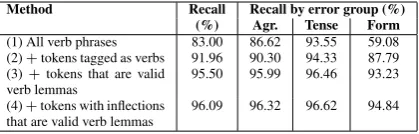
The quality of the candidate selection methods is evaluated in Table 5 on the gold subset by com-puting the recall, i.e. the percentage of erroneous verbs that have been selected as candidates. Meth-ods that address pre-processing mistakes are able to recover more erroneous verb candidates in text. It is also interesting to note that across all methods, the highest recall is obtained for tense errors. This suggests that the POS tagger is more prone to
fail-3http://cogcomp.cs.illinois.edu/demo/shallowparse 4http://cogcomp.cs.illinois.edu/page/software view/POS 5The tool and more detail about it can be found at
Method Recall Recall by error group (%) (%) Agr. Tense Form
(1) All verb phrases 83.00 86.62 93.55 59.08 (2)+tokens tagged as verbs 91.96 90.30 94.33 87.79 (3)+tokens that are valid
verb lemmas 95.50 95.99 96.46 93.23 (4)+tokens with inflections
[image:5.595.78.288.62.129.2]that are valid verb lemmas 96.09 96.32 96.62 94.84
Table 5:Candidate selection methods performance.
ure due to errors in agreement and form. The eval-uation in Table 5 uses recall, as the goal is to assess the ability of the methods to select erroneous verbs as candidates. In Sec. 6.1, the contribution of each method to error identification is evaluated.
5.2 Predicting Verb Finiteness
Predicting verb finiteness is not trivial, as almost all English verbs can occur in both finite and non-finite form and the surface forms of a verb in non-finite and non-finite form may be the same (see Table 2). While we cannot learn verb type automatically due to lack of annotation, we show, however, that, for the majority of verbs, finiteness can be reliably predicted using linguistic knowledge. We imple-ment a decision-list classifier that makes use of linguistically-motivated rules (Table 6). The algo-rithm covers about 92% of all verb candidates, ab-staining on the remaining highly-ambiguous 8%.
The evaluation of the method on the gold sub-set (last column in Table 6) shows that despite its simplicity, this method is highly effective: 98% on correct verbs and over 89% on errors.
5.3 Features
The baselinefeatures are word n-grams in the 4-word window around the verb instance. Addi-tional features are intended to characterize a given error type and are selected based on previous stud-ies: for Agreement and Form errors, we use a parser (Klein and Manning, 2003) and define fea-tures that reflect dependency relations between the verb and its neighbors. We denote these features by syntax. Syntactic knowledge via tree patterns has been shown useful for Agreement mistakes (Lee and Seneff, 2008). Features for Tense in-clude temporal adverbs in the sentence and tenses of other verbs in the sentence and are similar to the features used in other verb classification tasks (Reichart and Rappoport, 2010; Lee, 2011; Tajiri et al., 2012). The features are shown in Table 7.
5.4 Error Identification
The goal of this stage is to identify errors and to predict their type. We define a linear model where, given a verb, a weight vector w assigns a score to each label in the label space {Correct, Form, Agreement, Tense}. The prediction of the classi-fier is the label with the highest score.
The baseline error identification model, called combined, is agnostic to the type of the verb. In thecombinedmodel, for each verbv and labell, we generate a feature vector, φ(v, l) and the best label is predicted as
arg max
l w
Tφ(v, l).
The combinedmodel makes use ofall the fea-tures we have defined earlier for each verb.
The type-based model uses the verb finiteness prediction made by the verb finiteness classifier. A soft way to use the finiteness prediction is to add the predicted finiteness value as a feature. The other – hard-decision approach – is to use only a subset of the features depending on the pre-dicted finiteness: Agreement andTensefor the fi-nite verbs, and Formfeatures for non-finite. The hard-decisiontype-drivenapproach defines a fea-ture vector for a verb based on its type. Thus, given the verb v and its type t, we define fea-turesφ(v, t, l) for each labell. Thus, the label is predicted as
arg max
l w
Tφ(v, t, l).
5.5 Error Correction
The correction module consists of three compo-nents, one for each type of mistake. Given the output of the error identification model, the ap-propriate correction component is run for each in-stance predicted to be a mistake.6 The verb
finite-ness prediction is used to select finite instances for training theAgreementandTensecomponents and non-finite – for the Form component. The label space for Tense specifies tense and aspect prop-erties of the English verbs (see Tajiri et al., 2012 for more detail), theAgreement component spec-ifies the person and number properties, while the Formcomponent includes the commonly confus-able non-finite English forms (see Tconfus-able 2). These components are trained as multiclass classifiers.
6We assume that each verb contains at most one mistake.
A verb is Non-Finite if any of the following hold: A verb is Finite if any of the following hold Accuracy on Correct Erroneous
verbs verbs
(1) All verbs identified by shallow parser
98.01 89.4 (1)[numT okens= 2]∧[firstT oken=to] (2)can;could
(2)firstT oken=be (3)[numT okens= 1]∧[pos∈ {V BD, V BP, V BZ}]
(3)[numT okens= 1]∧[pos=V BG] (4)[numT okens= 2]∧[firstT oken! =to]
[image:6.595.70.529.61.126.2](5)numT okens >2
Table 6: Algorithm for determining verb type.numTokensdenotes the number of tokens in the verb instance, e.g., for the verb instance “to go”,numT okens= 2. Verbs not covered by the rules, e.g. those that are not tagged with a verb-related POS in methods (3) and (4), are not assigned any verb type. The last column shows algorithm accuracy on the gold subset separately for correct and incorrect verbs.
Agreement Description
(1) subjHead, subjPOS The surface form and the POS tag of the subject head (2) subjDet{those,this,..} Determiner of the subject phrase
(3) subjDistance Distance between the verb and the subject head
(4) subjNumber{Sing, Pl} Sing– singular pronouns and nouns;Pl– plural pronouns and nouns
(5) subjPerson{3rdSing, Not3rdSing, 1stSing} 3rdSing– she,he,it,singular nouns;Not3rdSing– we,you,they, plural nouns;1stSing– “I” (6) conjunctions (1)&(3);(4)&(5)
Tense Description
(1) verb phrase (VP) verb lemma, negation, surface forms and POS tags of all words in the verb phrase (2) verbs in sentence(4 features) tenses and lemmas of the finite verbs preceding and following the verb instance (3) time adverbs (2 features) temporal adverb before and after the verb instance
(4) bag-of-words (BOW) (8 features) Includes the following words in the sentence:{if, when, since, then, wish, hope, when, since, after}
Form Description
(1) closest word surface form, lemma, POS tag, and distance of the closest open-class word to the left of the verb
(2) governor surface form, POS tag and dependency type of the target
(3) preposition if the verb is preceded by a preposition: preposition itself and the surface form, POS tag and dependency of the governor of the preposition
(4) pos and lemma POS tag and lemma of the verb and their conjunctions with features in (2) and (3) and word ngrams
Table 7:Features used, grouped by error type.
6 Experiments
The main goal of this work is to propose a uni-fied framework for correcting verb mistakes and to address the specific challenges of the problem. We thus do not focus on features or on the spe-cific learning algorithm. Our experimental study addresses the following research questions:
I. Linguistic questions: (i) candidate selection methods; (ii) verb finiteness contribution to error identification
II. Computational Framework: error identifi-cation vs. correction
III. Gold annotation: (i) using gold candidates and verb type vs. automatic; (ii) performance comparison by error type
Learning Framework There is a lot of
under-standing for which algorithmic methods work best for ESL correction tasks, how they compare among themselves, and how they compare to n-gram based methods. Specifically, despite their in-tuitive appeal, language models were shown to not work well on these tasks, while the discriminative learning framework has been shown to be superior to other approaches and thus is commonly used for error correction tasks (see Sec. 2). Since we
do not address the algorithmic aspect of the prob-lem, we refer the reader to Rozovskaya and Roth (2011) for a discussion of these issues. We train all our models with the SVM learning algorithm implemented in JLIS (Chang et al., 2010).
Evaluation We report both Precision/Recall
curves and AAUC (as a summary). Error cor-rection is generally evaluated using F1 (Dale et al., 2012); Precision and Recall (Gamon, 2010; Tajiri et al., 2012); or Average Area Under Curve (AAUC) (Rozovskaya and Roth, 2011). For a dis-cussion on these metrics with respect to error cor-rection tasks, we refer the reader to Rozovskaya (2013). AAUC (Hanley and McNeil, 1983)) is a measure commonly used to generate a summary statistic, computed as an average precision value over a range of recall points. In this paper, AAUC is computed over the first 15 recall points:
AAUC = 151 ·X15
i=1
P recision(i).
6.1 Linguistic Questions
Candidate Selection Methods The contribution
Recall of candidate AAUC selection method (%) Combined Type-based
(1) (83.00) 73.38 79.49 (2) (91.96) 80.36 86.48 (3) (95.50) 81.39 87.05
[image:7.595.352.472.61.187.2](4) (96.09) 81.27 86.81
Table 8:Impact of candidate selection methods on error identification performance.The first column shows the per-centage of erroneous verbs selected by each method. Type-basedmodels are discussed in Sec. 6.1.
Correct verbs Erroneous verbs Error rate
Training 41721 1981 4.75%
Test 41836 2014 4.81%
Table 9: Training and test data statistics.Candidates are selected using method (3).
better performance is achieved by methods with higher recall, with the exception of method (4); its performance on error identification is behind that of method (3), perhaps due to the amount of noise that is also added. While the difference is small, method (3) is also simpler than method (4). We thus use method (3) in the rest of the paper. Table 9 shows the number of verb instances in training and test selected with this method.
[image:7.595.97.265.62.112.2]Verb Finiteness Sec. 5.4 presented two ways of adding verb finiteness: (1) adding the predicted verb type as a feature and (2) selecting only the relevant features depending on the finiteness of the verb. Table 10 shows the results of using verb type in the error identification stage. While the first approach does not provide improvement over the combined model, the second method is very ef-fective. We conjecture that because verb type pre-diction is quite accurate, the second, hard-decision approach is preferred, as it provides knowledge in a direct way. Henceforth, we will use the second method in thetype-basedmodel.
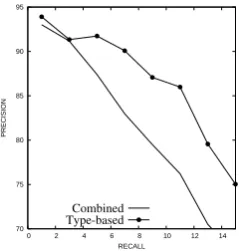
Fig. 1 compares the performance of the com-bined and the hard-decision type-based models shown in Table 10. Precision/Recall curves are generated by varying the threshold on the confi-dence of the classifier. This graph reveals the be-havior of the systems at multiple recall points: we observe that at every recall point the type-based classifier has higher precision.
So far, the models used all features defined in Sec. 5.3. Table 11 reveals that the type-driven
Model AAUC
[image:7.595.79.276.166.192.2]Combined 81.39 Type-based I (soft) 81.11 Type-based II (hard) 87.05
Table 10: Verb finiteness contribution to error identifi-cation.
70 75 80 85 90 95
0 2 4 6 8 10 12 14
PRECISION
RECALL
[image:7.595.344.486.268.308.2]Combined Type-based
Figure 1: Verb finiteness contribution to error identifi-cation: key result. AAUC shown in Table 10. Thecombined model uses no verb type information. In the hard-decision type-basedmodel, each verb uses the features according to its finiteness. The differences are statistically significant (Mc-Nemar’s test,p <0.0001).
Feature set AAUC
Combined Type-based
Baseline 46.62 49.72 All−Syntax 79.47 84.88 Full feature set 81.39 87.05
Table 11: Verb finiteness contribution to error identifi-cation for different features.
approach is superior to the combined approach across different feature sets, and the performance gap increases with more sophisticated feature sets, which is to be expected, since more complex fea-tures are tailored toward relevant verb errors. Fur-thermore, adding features specific to each error type significantly improves the performance over the word n-gram features. The rest of the experi-ments use all features (denotedFullfeature set).
6.2 Identification vs. Correction
After running the error identification component, we apply the appropriate correction models to those instances identified as errors. The results for identification and correction are shown in Ta-ble 12. The correction models are also finiteness-aware models trained on the relevant verb in-stances (finite or non-finite), as predicted by the verb finiteness classifier.
We evaluate the correction components by fix-ing a recall point in the error identification stage.7
We observe the relatively low recall obtained by the models. Error correction models tend to have low recall (see, for example, the recent shared tasks on ESL error correction (Dale and Kilgar-riff, 2011; Dale et al., 2012; Ng et al., 2013)). The key reason for the low recall is the error sparsity: over 95% of verbs are correct, as shown in Table 9. 7We can increase recall using a different threshold but
[image:7.595.130.231.695.731.2]Error type Correction Identification
P R F1 P R F1
[image:8.595.327.507.61.120.2]Agreement 90.62 9.70 17.52 90.62 9.70 17.52 Tense 60.51 7.47 13.31 86.62 10.70 19.05 Form 81.82 16.34 27.24 83.47 16.67 27.79 Total 71.94 10.24 17.94 85.81 12.22 21.20 Table 12: Performance of the complete model after the correction stage.The results onAgreementmistakes are the same, sinceAgreementerrors are always binary decisions, unlikeTenseandFormmistakes.
The only way to improve over this 95% baseline is by forcing the system to have very good precision (at the expense of recall). The performance shown in Table 12 corresponds to an accuracy of 95.60% in identification (error reduction of 8.7%) and 95.40% in correction (error reduction of 4.5%) over the baseline of 95.19%.
6.3 Analysis on Gold Data
To further study the impact of each step of the sys-tem, we analyze our model on the gold subset of the data. The gold subset contains two additional pieces of information not available for the rest of the corpus: gold verb candidates and gold verb finiteness (Sec. 4). The set contains 7784 gold verbs, including 464 errors. Experiments are run in 10-fold cross-validation where on each run 90% of the documents are used for training and the re-maining 10% are used for evaluation. The gold annotation can be used instead of automatic pre-dictions in two system components: (1) candidate selection and (2) verb finiteness.
Table 13 shows the performance on error identi-fication when gold vs. automatic settings are used. As expected, using the gold verb type is more ef-fective than using the automatic one, both with au-tomatic and gold candidates. The same is true for candidate selection. For instance, the combined model improves by 14 AAUC points (from 55.90 to 69.86) with gold candidates. These results indi-cate that candidate selection is an important com-ponent of the verb error correction system.
Note that compared to the performance on the entire data set (Table 10), the performance of the models shown here that use automatic components is lower, since the training size is smaller. On the other hand, because of the smaller training size, the gain due to the type-based approach is larger on the gold subset (19 vs. 6 AAUC points).
Finally, in Table 14, we evaluate the contribu-tion of verb finiteness to error identificacontribu-tion by er-ror type. While performance varies by erer-ror, it is clear that all errors benefit from verb typing.
Candidate selection Verb type prediction AAUC
Automatic NoneAutomatic 55.9074.72
Gold 89.45
Gold NoneAutomatic 69.8690.89
[image:8.595.78.288.61.115.2]Gold 96.42
Table 13:Gold subset: error identification with gold vs. automatic candidates and finiteness information. Value Nonefor verb type prediction denotes thecombinedmodel.
Error type AAUC
Combined Type-based Type-based Automatic Gold
Agreement 86.80 88.43 89.21
Tense 18.07 25.62 26.87
[image:8.595.323.510.174.222.2]Form 97.08 98.23 98.36
Table 14:Gold subset: gold vs. automatic finiteness con-tribution to error identification by error type.
7 Conclusion
Verb errors are commonly made by ESL writers but difficult to address due to to their diversity and the fact that identifying verbs in (noisy) text may itself be difficult. We develop a linguistically-inspired approach that first identifies verb candi-dates in noisy learner text and then makes use ofverb finitenessto identify errors and character-ize the type of mistake. This is important, since most errors made by non-native speakers cannot be identified by considering only closed classes (e.g., prepositions and articles). Our model inte-grates a statistical machine learning approach with a rule-based system that encodes linguistic knowl-edge to yield the first general correction approach to verb errors (that is, one that does not assume prior knowledge of which mistake was made). This work thus provides a first step in consider-ing more general algorithmic paradigms for cor-recting grammatical errors and paves the way for developing models to address other “open-class” mistakes.
Acknowledgments
References
M. Banko and E. Brill. 2001. Scaling to very very large corpora for natural language disambiguation. InProceedings of 39th Annual Meeting of the Asso-ciation for Computational Linguistics, pages 26–33, Toulouse, France, July.
A. Carlson and I. Fette. 2007. Memory-based context-sensitive spelling correction at web scale. In Pro-ceedings of the IEEE International Conference on Machine Learning and Applications (ICMLA). A. Carlson, J. Rosen, and D. Roth. 2001. Scaling up
context sensitive text correction. InProceedings of the National Conference on Innovative Applications of Artificial Intelligence (IAAI), pages 45–50. M. Chang, V. Srikumar, D. Goldwasser, and D. Roth.
2010. Structured output learning with indirect su-pervision. InProc. of the International Conference on Machine Learning (ICML).
D. Dahlmeier and H. T. Ng. 2011. Grammatical er-ror correction with alternating structure optimiza-tion. InProceedings of the 49th Annual Meeting of the Association for Computational Linguistics: Hu-man Language Technologies, pages 915–923, Port-land, Oregon, USA, June. Association for Computa-tional Linguistics.
R. Dale and A. Kilgarriff. 2011. Helping Our Own: The HOO 2011 pilot shared task. InProceedings of the 13th European Workshop on Natural Language Generation.
R. Dale, I. Anisimoff, and G. Narroway. 2012. A report on the preposition and determiner error cor-rection shared task. In Proc. of the NAACL HLT 2012 Seventh Workshop on Innovative Use of NLP for Building Educational Applications, Montreal, Canada, June. Association for Computational Lin-guistics.
G. Dalgish. 1985. Computer-assisted ESL research.
CALICO Journal, 2(2).
R. De Felice and S. Pulman. 2008. A classifier-based approach to preposition and determiner error correc-tion in L2 English. InProceedings of the 22nd In-ternational Conference on Computational Linguis-tics (Coling 2008), pages 169–176, Manchester, UK, August.
M. Gamon, J. Gao, C. Brockett, A. Klementiev, W. Dolan, D. Belenko, and L. Vanderwende. 2008. Using contextual speller techniques and language modeling for ESL error correction. InProceedings of IJCNLP.
M. Gamon, C. Leacock, C. Brockett, W. B. Dolan, J. Gao, D. Belenko, and A. Klementiev. 2009. Us-ing statistical techniques and web search to correct ESL errors. CALICO Journal, Special Issue on Au-tomatic Analysis of Learner Language, 26(3):491– 511.
M. Gamon. 2010. Using mostly native data to correct errors in learners’ writing. InNAACL, pages 163– 171, Los Angeles, California, June.
A. R. Golding and D. Roth. 1996. Applying Winnow to context-sensitive spelling correction. InProc. of the International Conference on Machine Learning (ICML), pages 182–190.
A. R. Golding and D. Roth. 1999. A Winnow based approach to context-sensitive spelling correc-tion. Machine Learning, 34(1-3):107–130.
N. Han, M. Chodorow, and C. Leacock. 2006. De-tecting errors in English article usage by non-native speakers. Journal of Natural Language Engineer-ing, 12(2):115–129.
J. Hanley and B. McNeil. 1983. A method of com-paring the areas under receiver operating character-istic curves derived from the same cases.Radiology, 148(3):839–843.
E. Izumi, K. Uchimoto, T. Saiga, T. Supnithi, and H. Isahara. 2003. Automatic error detection in the Japanese learners’ English spoken data. InThe Companion Volume to the Proceedings of 41st An-nual Meeting of the Association for Computational Linguistics, pages 145–148, Sapporo, Japan, July. T.-H. Kao, Y.-W. Chang, H. w. Chiu, T-.H. Yen, J.
Bois-son, J. c. Wu, and J.S. Chang. 2013. Conll-2013 shared task: Grammatical error correction nthu sys-tem description. InProceedings of the Seventeenth Conference on Computational Natural Language Learning: Shared Task, pages 20–25, Sofia, Bul-garia, August. Association for Computational Lin-guistics.
D. Klein and C. D. Manning. 2003. Fast exact in-ference with a factored model for natural language parsing. In Advances in Neural Information Pro-cessing Systems 15 NIPS, pages 3–10. MIT Press. C. Leacock, M. Chodorow, M. Gamon, and J. Tetreault.
2010. Automated Grammatical Error Detection for Language Learners. Morgan and Claypool Publish-ers.
J. Lee and S. Seneff. 2008. Correcting misuse of verb forms. InACL, pages 174–182, Columbus, Ohio, June. Association for Computational Linguistics. J. Lee. 2011. Verb tense generation. Social and
Be-havioral Sciences, 27:122–130.
R. Nagata, E. Whittaker, and V. Sheinman. 2011. Cre-ating a manually error-tagged and shallow-parsed learner corpus. InACL, pages 1210–1219, Portland, Oregon, USA, June. Association for Computational Linguistics.
Language Learning.Association for Computational Linguistics.
V. Punyakanok and D. Roth. 2001. The use of classi-fiers in sequential inference. InThe Conference on Advances in Neural Information Processing Systems (NIPS), pages 995–1001. MIT Press.
R. Quirk, S. Greenbaum, G. Leech, and J. Svartvik. 1985. A Comprehensive Grammar of the English Language. Longman, New York.
A. Radford. 1988. Transformational Grammar. Cam-bridge University Press.
R. Reichart and A. Rappoport. 2010. Tense sense disambiguation: A new syntactic polysemy task. In Proceedings of the 2010 Conference on Empiri-cal Methods in Natural Language Processing, pages 325–334, Cambridge, MA, October. Association for Computational Linguistics.
A. Rozovskaya and D. Roth. 2010a. Annotating ESL errors: Challenges and rewards. InProceedings of the NAACL Workshop on Innovative Use of NLP for Building Educational Applications.
A. Rozovskaya and D. Roth. 2010b. Training paradigms for correcting errors in grammar and us-age. InProceedings of the NAACL-HLT.
A. Rozovskaya and D. Roth. 2011. Algorithm selec-tion and model adaptaselec-tion for esl correcselec-tion tasks. InACL, Portland, Oregon, 6. Association for Com-putational Linguistics.
A. Rozovskaya, K.-W. Chang, M. Sammons, and D. Roth. 2013. The University of Illinois system in the CoNLL-2013 shared task. InCoNLL Shared Task.
A. Rozovskaya. 2013. Automated Methods for Text Correction. Ph.D. thesis.
T. Tajiri, M. Komachi, and Y. Matsumoto. 2012. Tense and aspect error correction for esl learners using global context. InProceedings of the 50th Annual Meeting of the Association for Computational Lin-guistics (Volume 2: Short Papers), pages 198–202, Jeju Island, Korea, July. Association for Computa-tional Linguistics.
J. Tetreault, J. Foster, and M. Chodorow. 2010. Us-ing parse features for preposition selection and error detection. InACL.