Proceedings of the 2019 Conference on Empirical Methods in Natural Language Processing and the 9th International Joint Conference on Natural Language Processing, pages 4260–4270,
4260
Parallel Iterative Edit Models for Local Sequence Transduction
Abhijeet Awasthi∗, Sunita Sarawagi , Rasna Goyal , Sabyasachi Ghosh , Vihari Piratla Department of Computer Science and Engineering, IIT Bombay
Abstract
We present a Parallel Iterative Edit (PIE) model for the problem of local sequence trans-duction arising in tasks like Grammatical er-ror correction (GEC). Recent approaches are based on the popular encoder-decoder (ED) model for sequence to sequence learning. The ED model auto-regressively captures full de-pendency among output tokens but is slow due to sequential decoding. The PIE model does parallel decoding, giving up the advan-tage of modelling full dependency in the out-put, yet it achieves accuracy competitive with the ED model for four reasons: 1. predict-ing edits instead of tokens, 2. labelpredict-ing se-quences instead of generating sese-quences, 3. it-eratively refining predictions to capture de-pendencies, and 4. factorizing logits over ed-its and their token argument to harness pre-trained language models like BERT. Experi-ments on tasks spanning GEC, OCR correc-tion and spell correccorrec-tion demonstrate that the PIE model is an accurate and significantly faster alternative for local sequence transduc-tion. The code and pre-trained models for GEC are available at https://github. com/awasthiabhijeet/PIE.
1 Introduction
In local sequence transduction (LST) an input se-quencex1, . . . , xn needs to be mapped to an
out-put sequence y1, . . . , ym where the x and y
se-quences differ only in a few positions,mis close ton, andxi, yjcome from the same vocabularyΣ.
An important application of local sequence trans-duction that we focus on in this paper is Gram-matical error correction (GEC). We contrast lo-cal transduction with more general sequence trans-duction tasks like translation and paraphrasing which might entail different input-output vocab-ulary and non-local alignments. The general
se-∗
Correspondence to:[email protected]
quence transduction task is cast as sequence to sequence (seq2seq) learning and modeled popu-larly using an attentional encoder-decoder (ED) model. The ED model auto-regressively produces each tokenyt in the output sequence conditioned
on all previous tokens y1, . . . , yt−1. Owing to the remarkable success of this model in challeng-ing tasks like translation, almost all state-of-the-art neural models for GEC use it (Zhao et al.,2019; Lichtarge et al., 2019; Ge et al., 2018b; Chol-lampatt and Ng,2018b;Junczys-Dowmunt et al., 2018).
We take a fresh look at local sequence trans-duction tasks and present a new parallel-iterative-edit (PIE) architecture. Unlike the prevalent ED model that is constrained to sequentially generat-ing the tokens in the output, the PIE model gener-ates the output in parallel, thereby substantially re-ducing the latency of sequential decoding on long inputs. However, matching the accuracy of exist-ing ED models without the luxury of conditional generation is highly challenging. Recently, paral-lel models have also been explored in tasks like translation (Stern et al.,2018;Lee et al.,2018;Gu et al., 2018;Kaiser et al.,2018) and speech syn-thesis (van den Oord et al.,2018), but their accu-racy is significantly lower than corresponding ED models. The PIE model incorporates the follow-ing four ideas to achieve comparable accuracy on tasks like GEC in spite of parallel decoding.
would predict the edits {Capitalize token 1, Append(the) to token 2, Copy token 3}.
2. Sequence labeling instead of sequence gener-ation: Second we perform in-place edits on the source tokens and formulate local sequence trans-duction aslabelingthe input tokens with edit com-mands, rather than solving the much harder whole
sequence generationtask involving a separate de-coder and attention module. Since input and out-put lengths are different in general such formu-lation is non-trivial, particularly due to edits that insert words. We create special compounds edits that merge token inserts with preceding edits that yield higher accuracy than earlier methods of inde-pendently predicting inserts (Ribeiro et al.,2018; Lee et al.,2018).
3. Iterative refinement: Third, we increase the inference capacity of the parallel model by iter-atively inputting the model’s own output for fur-ther refinement. This handles dependencies im-plicitly, in a way reminiscent of Iterative Condi-tional Modes (ICM) fitting in graphical model in-ference (Koller and Friedman, 2009). Lichtarge et al.(2019) andGe et al.(2018b) also refine iter-atively but with ED models.
4. Factorize pre-trained bidirectional LMs:
Finally, we adapt recent pre-trained bidirectional models like BERT (Devlin et al.,2018) by factor-izing the logit layer over edit commands and their token argument. Existing GEC systems typically rely on conventional forward directional LM to pretrain their decoder, whereas we show how to use a bi-directional LM in the encoder, and that too to predict edits.
Novel contributions of our work are as follows:
• Recognizing GEC as a local sequence trans-duction (LST) problem, rather than machine translation. We then cast LST as a fast non-autoregressive, sequence labeling model as against existing auto-regressive encoder-decoder model.
• Our method of reducing LST to non-autoregressive sequence labeling has many novel elements: outputting edit operations instead of tokens, append operations instead of insertions in the edit space, and replacements along with custom transformations.
• We show how to effectively harness a
pre-trained language model like BERT using our factorized logit architecture with edit-specific attention masks.
• The parallel inference in PIE is 5 to 15 times faster than a competitive ED based GEC model like (Lichtarge et al.,2019) which performs se-quential decoding using beam-search. PIE also attains close to state of the art performance on standard GEC datasets. On two other local transduction tasks, viz., OCR and spell correc-tions the PIE model is fast and accurate w.r.t. other existing models developed specifically for local sequence transduction.
2 Our Method
We assume a fully supervised training setup where we are given a parallel dataset of incorrect, correct sequence pairs:D={(xi,yi) :i= 1. . . N}, and an optional large corpus of unmatched correct se-quencesL={y˜1, . . . ,y˜U}. In GEC, this could be
a corpus of grammatically correct sentences used to pre-train a language model.
Background: existing ED model Existing
seq2seq ED models factorizePr(y|x) to capture the full dependency between a yt and all
previ-ous y<t = y1, . . . , yt−1 as
Qm
t=1Pr(yt|y<t,x).
An encoder converts input tokens x1, . . . , xn to
contextual states h1, . . . ,hn and a decoder
sum-marizes y<t to a state st. An attention
distribu-tion over contextual states computed fromst
deter-mines the relevant input contextctand the output
token distribution is calculated asPr(yt|y<t,x) = Pr(yt|ct,st). Decoding is done sequentially
us-ing beam-search. When a correct sequence cor-pus L is available, the decoder is pre-trained on a next-token prediction loss and/or a trained LM is used to re-rank the beam-search outputs (Zhao et al.,2019;Chollampatt and Ng,2018a; Junczys-Dowmunt et al.,2018).
2.1 Overview of the PIE model
We move from generating tokens in the output se-quenceyusing a separate decoder, to labelling the input sequence x1, . . . , xn with edits e1, . . . , en.
For this we need to design a function Seq2Edits that takes as input an(x,y)pair inDand outputs a sequenceeof edits from an edit spaceEwheree
Training: We invoke Seq2Edits onDand learn the parameters of a probabilistic modelPr(e|x, θ)
to assign a distribution over the edit labels on to-kens of the input sequence. In Section2.3we de-scribe the PIE architecture in more detail. The cor-rect corpusL, when available, is used to pre-train the encoder to predict an arbitrarily masked token
ytin a sequenceyinL, much like in BERT.
Un-like in existing seq2seq systems whereL is used to pre-train the decoder that only captures forward dependencies, in our pre-training the predicted to-kenytis dependent on both forward and backward
contexts. This is particularly useful for GEC-type tasks where future contextyt+1. . . ymcan be
ap-proximated byxt+1, . . . , xn.
Inference: Given an inputx, the trained model predicts the edit distribution for each input to-ken independent of others, that is Pr(e|x, θ) = Qn
t=1Pr(et|x, t, θ), and thus does not entail the
latency of sequential token generation of the ED model. We output the most probable edits eˆ =
argmaxePr(e|x, θ). Edits are designed so that we can easily get the edited sequenceyˆafterapplying
ˆ
eon x. yˆ is further refined by iteratively apply-ing the model on the generated outputsyˆuntil we get a sequence identical to one of the previous se-quences upto a maximum number of iterationsI.
2.2 The Seq2Edits Function
Given a x = x1, . . . , xn and y = y1, . . . , ym
where m may not be equal to n, our goal is to obtain a sequence of edit operations e = (e1, . . . , en) :ei ∈ E such that applying editeion
the input tokenxi at each positionireconstructs
the output sequencey. Invoking an off-the-shelf edit distance algorithm betweenxandycan give us a sequence of copy, delete, replace, and insert operations of arbitrary length. The main difficulty is converting the insert operations into in-place ed-its at eachxi. Other parallel models (Ribeiro et al.,
2018;Lee et al.,2018) have used methods like pre-dicting insertion slots in a pre-processing step, or predicting zero or more tokens in-between any two tokens inx. We will see in Section3.1.4that these options do not perform well. Hence we design an alternative edit space E that merges inserts with preceding edit operations creating compound ap-pend or replace operations. Further, we create a dictionaryΣaof common q-gram insertions or
re-placements observed in the training data.
Our edit space (E) comprises of copy (C)xi, delete
Require: x= (x1, . . . , xn),y= (y1, . . . , ym)andT :List
of Transformations
diffs←LEVENSHTEIN-DIST(x,y)with modified cost. diffs←In diffs break substitutions, merge inserts into q-grams
Σa←Mmost common inserts in training data e←EMPTYARRAY(n)
fort←1toLENGTH(diffs)do ifdiffs[t] = (C, xi)or(D, xi)then
ei←diffs[t].op
else ifdiffs[t] = (I, xi, w)then ifei=Dthen
if(xi, w)match transformation T∈ T then
ei←T else
ei←R(w)ifw∈ΣaelseC else ifei=Cthen
[image:3.595.311.526.66.248.2]ei←A(w)ifw∈ΣaelseC returne
Figure 1: The Seq2Edits function used to convert a se-quence pairx,yinto in-place edits.
(D)xi, append (A) a q-gramw ∈ Σa after
copy-ingxi, replace (R)xiwith a q-gramw ∈Σa. For
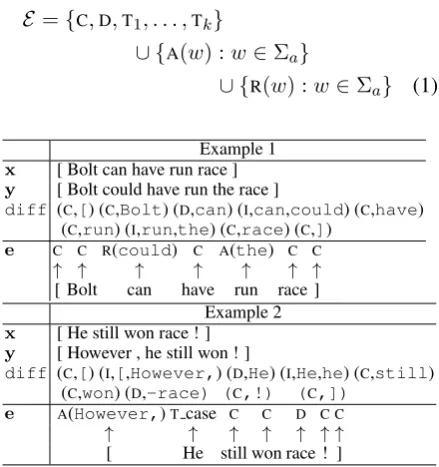
GEC, we additionally use transformations denoted asT1, . . . ,Tkwhich perform word-inflection (e.g. arrivetoarrival). The space of all edits is thus:
E ={C,D,T1, . . . ,Tk}
∪ {A(w) :w∈Σa}
∪ {R(w) :w∈Σa} (1)
Example 1 x [ Bolt can have run race ] y [ Bolt could have run the race ]
diff (C,[) (C,Bolt) (D,can) (I,can,could) (C,have) (C,run) (I,run,the) (C,race) (C,])
e C C R(could) C A(the) C C
↑ ↑ ↑ ↑ ↑ ↑ ↑
[ Bolt can have run race ] Example 2 x [ He still won race ! ]
y [ However , he still won ! ]
diff (C,[) (I,[,However,) (D,He) (I,He,he) (C,still) (C,won) (D,-race) (C,!) (C,])
e A(However,)Tcase C C D C C
↑ ↑ ↑ ↑ ↑ ↑ ↑
[ He still won race ! ]
Table 1: Two example sentence pairs converted into respective edit sequences.
We present our algorithm for converting a se-quencexandyinto in-place edits onxusing the above edit space in Figure1. Table1gives exam-ples of converting (x,y) pairs to edit sequences. We first invoke the Levenshtein distance algorithm (Levenshtein, 1966) to obtain diff between x
[image:3.595.306.526.394.628.2]with a modified substitution cost to favor match-ing of related words. We detail this modified cost in the Appendix and show an example of how this modification leads to more sensible edits. The
diff is post-processed to convert substitutions into deletes followed by inserts, and consecutive inserts are merged into a q-gram. We then create a dictionaryΣaof the M most frequent q-gram in-serts in the training set. Thereafter, we scan the
diff left to right: a copy atxi makesei = C, a
delete atxi makesei =D, an insertwatxiand a ei =Cflips theei into aei =A(w)ifwis inΣa,
else it is dropped, an insertwatxi and aei = D
flips theeiinto aei=T(w)if a match found, else
a replaceR(w)ifwis inΣa, else it is dropped. The above algorithm does not guarantee that when eis applied onx we will recovery for all sequences in the training data. This is because we limit Σa to include only the M most frequently inserted q-grams. For local sequence transduction tasks, we expect a long chain of consecutive in-serts to be rare, hence our experiments were per-formed with q = 2. For example, in NUCLE dataset (Ng et al.,2014) which has roughly 57.1K sentences, less than 3% sentences have three or more consecutive inserts.
2.3 The Parallel Edit Prediction Model
We next describe our model for predicting editse: e1, . . . , en on an input sequence x : x1, . . . , xn.
We use a bidirectional encoder to provide a con-textual encoding of each xi. This can either be
multiple layers of bidirectional RNNs, CNNs or deep bidirectional transformers. We adopt the deep bidirectional transformer architecture since it encodes the input in parallel. We pre-train the model using L much like in BERT pre-training recently proposed for language modeling(Devlin et al.,2018). We first give an overview of BERT and then describe our model.
Background: BERT The input is token embed-dingxi and positional embeddingpi for each
to-ken xi in the sequence x. Call these jointly as
h0i = [xi,pi]. Each layer`produces ah`i at each
[image:4.595.309.526.59.187.2]positionias a function ofh`i−1 and self-attention over allh`j−1,j ∈[1, n]. The BERT model is pre-trained by masking out a small fraction of the in-put tokens by a special MASK, and predicting the masked word from its bidirectional context cap-tured as the last layer output:h1, . . . ,hn.
Figure 2: A Parallel Edit Architecture based on a 2-layer bidirectional transformer. Input sequence length is 3. Arrows indicate attention mask for computation ofhl
i,rli,aliat position i for layer l.
2.3.1 A Default use of BERT
Since we have cast our task as a sequence labeling task, a default output layer would be to compute
Pr(ei|x) as a softmax over the space of edits E
from eachhi. IfWedenotes the softmax
parame-ter for edite, we get:
Pr(ei=e|x) =softmax(We|hi) (2)
The softmax parameters, We in Equation2, have
to be trained from scratch. We propose a method to exploit token embeddings of the pre-trained lan-guage model to warm-start the training of edits like appends and replaces which are associated with a token argument. Furthermore, for appends and replaces, we provide a new method of com-puting the hidden layer output via alternative in-put positional embeddings and self-attention. We do so without introducing any new parameters in the hidden layers of BERT.
2.3.2 An Edit-factorized BERT Architecture
We adapt a pre-trained BERT-like bidirectional language model to learn to predict edits as follows. For suitably capturing the contexts for replace ed-its, for each positioniwe create an additional in-put comprising ofr0i = [M,pi]whereMis the
em-bedding forMASKtoken in the LM. Likewise for a potential insert betweeniandi+ 1we create an inputa0i = [M,pi+pi+1
2 ]where the second compo-nent is the average of the position embedding of theith andi+ 1th position. As shown in Figure2, at each layer` we compute self-attention for the
ith replace unitr`
i overh`j for allj 6=iand itself.
Likewise, for the append unita`i the self-attention is over allh`
j for alljs and itself. At the last layer
we have h1, . . . ,hn,r1, . . . ,rn,a1, . . . ,an.
and their token argument. For an edite∈ E at po-sition i, let wdenote the argument of the edit (if any). As mentioned earlier,wcan be a q-gram for append and replace edits. Embedding of w, rep-resented by φ(w) is obtained by summing up in-dividual output embeddings of tokens inw. Addi-tionally, in the outer layer we allocate edit-specific parametersθ corresponding to each distinct com-mand in E. Using these, various edit logits are computed as follows:
Pr(ei|x) =softmax(logit(ei|x)) where
logit(ei|x) = (3)
θ|Chi+φ(xi)|hi+ 0 ifei =C
θ|A(w)hi+φ(xi)|hi+φ(w)|ai ifei =A(w)
θ|R(w)hi+ 0 + (φ(w)−φ(xi))|ri ifei =R(w)
θ|Dhi+ 0 + 0 ifei =D θT|
khi+φ(xi)
|h
i+ 0 ifei =Tk
The first term in the RHS of above equations captures edit specific score. The second term cap-tures the score for copying the current wordxi to
the output. The third term models the influence of a new incoming token in the output obtained by a replace or append edit. For replace edits, score of the replaced word is subtracted from score of the incoming word. For transformation we add the copy score because they typically modify only the word forms, hence we do not expect meaning of the transformed word to change significantly.
The above equation provides insights on why predicting independent edits is easier than predict-ing independent tokens. Consider the append edit (A(w)). Instead of independently predictingxiati
andwati+1, we jointly predict the tokens in these two slots and contrast it with not inserting any new
wafterxiin a single softmax. We will show
em-pirically (Sec 3.1.4) that such selective joint pre-diction is key to obtaining high accuracy in spite of parallel decoding.
Finally, loss for a training example (e,x) is ob-tained by summing up the cross-entropy associ-ated with predicting editeiat each tokenxi.
L(e,x) =−Σilog(Pr(ei|x)) (4)
3 Experiments
We compare our parallel iterative edit (PIE) model with state-of-the-art GEC models that are all based on attentional encoder-decoder architectures. In
Section3.2we show that the PIE model is also ef-fective on two other local sequence transduction tasks: spell and OCR corrections. Hyperparam-eters for all the experiments are provided in Ta-ble12,13of the Appendix.
3.1 Grammatical error correction (GEC)
We use Lang-8 (Mizumoto et al., 2011), NU-CLE (Ng et al., 2014) and FCE (Yannakoudakis et al., 2011) corpora, which jointly comprise 1.2 million sentence pairs in English. The valida-tion dataset comprises of 1381 sentence pairs from CoNLL-13 (Ng et al.,2013) test set. We initialize our GEC model with the publicly available BERT-LARGE1model that was pre-trained on Wikipedia (2500M words) and Book corpus (Zhu et al.,2015) (800M words) to predict 15% randomly masked words using its deep bidirectional context. Next, we perform 2 epochs of training on a syntheti-cally perturbed version of the One-Billion-word corpus (Chelba et al., 2013). We refer to this as synthetic training. Details of how we create the synthetic corpus appear in SectionA.3 of the ap-pendix. Finally we fine-tune on the real GEC training corpus for 2 epochs. We use a batch size of 64 and learning rate 2e-5.
The edit space consists of copy, delete,1000 ap-pends, 1000replaces and29 transformations and their inverse. Arguments of Append and Replace operations mostly comprise punctuations, articles, pronouns, prepositions, conjunctions and verbs. Transformations perform inflections like add suf-fix s, d, es, ing, ed or replace suffix s to ing, d to s, etc. These transformations were chosen out of common replaces in the train-ing data such that many replace edits map to only a few transformation edits, in order to help the model better generalize replaces across different words. In Section 3.1.4we see that transforma-tions increase the model’s recall. The complete list of transformations appears in Table10of the Appendix. We evaluate onF0.5 score over span-level corrections from the MaxMatch (M2) scorer (Dahlmeier and Ng, 2012) on CONLL-2014-test. Like most existing GEC systems, we invoke a spell-checker on the test sentences before apply-ing our model. We also report GLEU+ (Napoles et al., 2016) scores on JFLEG corpus (Napoles et al.,2017) to evaluate fluency.
1https://github.com/google-research/
Work CONLL-14 JFLEG P R F0.5 GLEU+
Zhao et al.(2019) 67.7 40.6 59.8
-Lichtarge et al.(2019) 65.5 37.1 56.8 61.6
Chollampatt and Ng
(2018a)
69.9 23.7 46.4 51.3
[image:6.595.309.517.61.236.2]PIE (This work) 66.1 43.0 59.7 60.3
Table 2: Comparison of non-ensemble model numbers for various GEC models. Best non-ensemble results are reported for each model.
3.1.1 Overall Results
Table3 compares ensemble model results of PIE and other state of the art models, which all hap-pen to be seq2seq ED models and also use en-semble decoding. For PIE, we simply average the probability distribution over edits from 5 in-dependent ensembles. In Table-2 we compare non-ensemble numbers of PIE with the best avail-able non-ensemble numbers of competing meth-ods. On CoNLL-14 test-set our results are very close to the highest reported byZhao et al.(2019). These results show that our parallel prediction model is competitive without incurring the over-heads of beam-search and slow decoding of se-quential models. GLEU+score, that rewards flu-ency, is somewhat lower for our model on the JF-LEG test set because of parallel predictions. We do not finetune our model on the JFLEG dev set. We expect these to improve with re-ranking using a LM. All subsequent ablations and timing mea-surements are reported for non-ensemble models.
3.1.2 Running Time Comparison
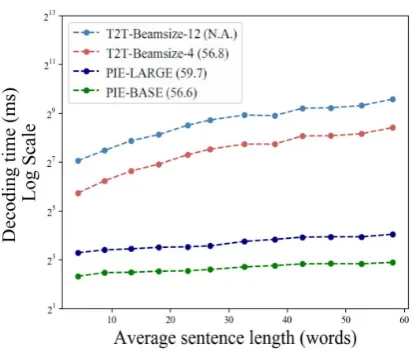
Parallel decoding enables PIE models to be con-siderably faster than ED models. In Figure 3 we compare wall-clock decoding time of PIE with 24 encoder layers (PIE-LARGE, F0.5 =
59.7), PIE with 12 encoder layers (PIE-BASE,
F0.5 = 56.6) and competitive ED architecture by Lichtarge et al.(2019) with 6 encoder and 6 de-coder layers (T2T, F0.5 = 56.8 ) on CoNLL-14 test set. All decoding experiments were run and measured on a n1-standard-22 VM instance with a single TPU shard (v-2.8). We observe that even PIE-LARGE is between a factor of 5 to 15 faster than an equivalent transformer-based ED model (T2T) with beam-size 4. The running time of
2https://cloud.google.com/compute/
docs/machine-types#standard_machine_ types
Figure 3: Comparing average decoding time in mil-liseconds (log scale) of PIE Vs transformer based ED model with two beam widths. Numbers in legend de-note M2 score.
PIE-LARGE increases sub-linearly with sentence length whereas the ED model’s decoding time in-creases linearly.
3.1.3 Impact of Iterative Refinement
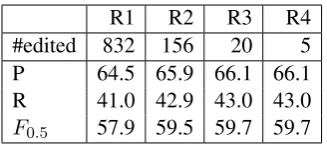
We next evaluate the impact of iterative refine-ments on accuracy in Table4. Out of 1312 sen-tences in the test set, only 832 sensen-tences changed in the first round which were then fed to the sec-ond round where only 156 sentences changed, etc. The average number of refinement rounds per ex-ample was 2.7. In contrast, a sequential model on this dataset would require 23.2 steps correspond-ing to the average number of tokens in a sentence. The F0.5 score increases from 57.9 to 59.5 at the end of the second iteration.
Table 5 presents some sentences corrected by PIE. We see that PIE makes multiple parallel edits in a round if needed. Also, we see how refinement over successive iterations captures output space dependency. For example, in the second sentence
interactgets converted to interacted fol-lowed by insertion ofhavein the next round.
3.1.4 Ablation study on the PIE Architecture
In this section we perform ablation studies to un-derstand the importance of individual features of the PIE model.
Synthetic Training We evaluate the impact of training on the artifically generated GEC corpus in row 2 of Table 6. We find that without it the
F0.5 score is 3.4 points lower.
[image:6.595.73.292.61.160.2]Work Method CONLL-14 JFLEG P R F0.5 GLEU+
Zhao et al.(2019) Transformer + Pre-training + LM
+ Spellcheck + Ensemble Decoding (4) 71.6 38.7 61.2 61.0
Lichtarge et al.(2019) Transformer + Pre-training
+ Iterative refinement + Ensemble Decoding (8) 66.7 43.9 60.4 63.3
Grundkiewicz and
Junczys-Dowmunt
(2018)
SMT + NMT (Bi-GRU) + LM
+ Ensemble Decoding (4) + Spellcheck 66.8 34.5 56.3 61.5
Chollampatt and Ng
(2018a)
CNN + LM + Ensemble Decoding (4) + Spellcheck 65.5 33.1 54.8 57.5
PIE (This work) Transformer + LM + Pre-training + Spellcheck
[image:7.595.76.524.61.251.2]+ Iterative refinement + Ensembles (5) 68.3 43.2 61.2 61.0
Table 3: Comparison of recent GEC models trained using publicly available corpus. All the methods here except ours perform sequential decoding. Precision and Recall are represented by P and R respectively.
R1 R2 R3 R4 #edited 832 156 20 5 P 64.5 65.9 66.1 66.1 R 41.0 42.9 43.0 43.0
[image:7.595.100.264.300.373.2]F0.5 57.9 59.5 59.7 59.7
Table 4: Statistics on successive rounds of iterative re-finement. First row denotes number changed sentences (out of 1312) with each round on CONLL-14 (test).
our edit-factorized BERT model (Section 2.3.2) over the default BERT model (Section 2.3.1). In Table6(row 3) we show that compared to the fac-torized model (row 2) we get a 1.2 point drop in
F0.5 score in absence of factorization.
Inserts as Appends on the preceding word was another important design choice. The alternative of predictinginsertindependently at each gap with a null token added to Σa performs 2.7 F0.5 points poorly (Table6row 4 vs row 2).
Transformation edits are significant as we ob-serve a 6.3 drop in recall without them (row 5).
Impact of Language ModelWe evaluate the ben-efit of starting from BERT’s pre-trained LM by reporting accuracy from an un-initialized network (row 6). We observe a 20 points drop inF0.5 es-tablishing the importance of LMs in GEC.
Impact of Network Size We train the BERT-Base model with one-third fewer parameters than BERT-LARGE. From Table6(row 7 vs 1) we see once again that size matters in deep learning!
x I started invoving into Facebook one years ago . PIE1 I startedinvolving inFacebook oneyearago . PIE2 I startedinvolvedin Facebook one year ago . PIE3 I startedgettinginvolved in Facebook one year
ago .
x Since ancient times , human interact with others face by face .
PIE1 Since ancient times , humansinteractedwith oth-ers facetoface .
PIE2 Since ancient times , humans have interacted with others face to face .
x However , there are two sides of stories always . PIE1 However , there arealwaystwo sidestostories
always.
PIE2 However , there are always two sides tothe sto-ries .
PIE3 However , there are always two sides to thestory .
Table 5: Parallel and Iterative edits done by PIE.
3.2 More Sequence Transduction Tasks
We demonstrate the effectiveness of PIE model on two additional local sequence transduction tasks recently used in (Ribeiro et al.,2018).
Spell Correction We use the twitter spell cor-rection dataset (Aramaki, 2010) which con-sists of 39172 pairs of original and corrected words obtained from twitter. We use the same train-dev-valid split as (Ribeiro et al., 2018) (31172/4000/4000). We tokenize on characters, and our vocabulary Σ and Σa comprises the 26
lower cased letters of English.
Correcting OCR errors We use the Finnish OCR data set3 by (Silfverberg et al., 2016)
comprising words extracted from Early Modern
[image:7.595.305.522.300.485.2]# Methods P R F0.5 1 PIE 66.1 43.0 59.7 2 −Synthetic training 67.2 34.2 56.3 3 −Factorized-logits 66.4 32.8 55.1 4 −Append +Inserts 57.4 42.5 53.6 5 −Transformations 63.6 27.9 50.6 6 −LM Pre-init 48.8 18.3 36.6 7 PIE on BERT-Base 67.8 34.0 56.6
Table 6: Ablation study on the PIE model.
Methods Spell OCR
Seq2Seq (Soft, lstm) 46.3 79.9 Seq2Seq (Hard,lstm) 52.2 58.4 Seq2Seq (Soft-T2T) 67.6 84.5 Ribeiro2018 (best model) 54.1 81.8
[image:8.595.85.277.205.291.2]PIE 67.0 87.6
Table 7: Comparing PIE with Seq2Seq models (top-part) and Ribeiro’s parallel model on two other local sequence transduction tasks.
Finnish corpus of OCR processed newspaper text. We use the same train-dev-test splits as provided by (Silfverberg et al.,2016). We tokenize on char-acters in the word. For a particular split, our vo-cabularyΣandΣacomprises of all the characters seen in the training data of the split.
Architecture For all the tasks in this section, PIE is a 4 layer self-attention transformer with 200 hidden units, 400 intermediate units and 4 atten-tion heads. NoLpre-initialization is done. Also, number of iterations of refinements is set to 1.
Results Table 7presents whole-word 0/1 accu-racy for these tasks on PIE and the following methods: Ribeiro et al. (2018)’s local transduc-tion model (described in Sectransduc-tion 4), and LSTM based ED models with hard monotonic attention (Aharoni and Goldberg, 2017) and soft-attention (Bahdanau et al., 2015) as reported in (Ribeiro et al.,2018). In addition, for a fair decoding time comparison, we also train a transformer-based ED model referred as Soft-T2T with 2 encoder, 2 de-coder layers for spell-correction and 2 ende-coder, 1
[image:8.595.123.239.685.730.2]PIE Soft-T2T Spell 80.43 36.62 OCR 65.44 43.02
Table 8: Wall-clock decoding speed in words/second of PIE and a comparable Seq2Seq T2T model.
decoder layer for OCR correction. We observe that PIE’s accuracy is comparable with ED mod-els in both the tasks. Table 8 compares decod-ing speed of PIE with Soft-T2T in words/second. Since more than 90% of words have fewer than 9 tokens and the token vocabulary Σ is small, de-coding speed-ups of PIE over ED model on these tasks is modest compared to GEC.
4 Related Work
Grammar Error Correction (GEC) is an ex-tensively researched area in NLP. See Ng et al. (2013) and Ng et al. (2014) for past shared tasks on GEC, and this4 website for current progress. Approaches attempted so far in-clude rules (Felice et al., 2014), classifiers (Ro-zovskaya and Roth, 2016), statistical machine translation (SMT) (Junczys-Dowmunt and Grund-kiewicz, 2016), neural ED models (Chollampatt and Ng, 2018a; Junczys-Dowmunt et al., 2018; Ge et al., 2018a), and hybrids (Grundkiewicz and Junczys-Dowmunt, 2018). All recent neu-ral approaches are sequential ED models that pre-dict either word sequences (Zhao et al., 2019; Lichtarge et al.,2019) or character sequences (Xie et al., 2016) using either multi-layer RNNs (Ji et al.,2017;Grundkiewicz and Junczys-Dowmunt, 2018) or CNNs(Chollampatt and Ng, 2018a;Ge et al.,2018a) or Transformers (Junczys-Dowmunt et al.,2018;Lichtarge et al.,2019). Our sequence labeling formulation is similar to (Yannakoudakis et al., 2017) and (Kaili et al., 2018) but the for-mer uses it to only detect errors and the latter only corrects five error-types using separate classifiers. Edits have been exploited in earlier GEC systems too but very unlike our method of re-architecting the core model to label input sequence with ed-its. Schmaltz et al.(2017) interleave edit tags in target tokens but use seq2seq learning to predict the output sequence.Chollampatt and Ng(2018a) use edits as features for rescoring seq2seq pre-dictions. Junczys-Dowmunt et al.(2018) use an edit-weighted MLE objective to emphasise correc-tive edits during seq2seq learning.Stahlberg et al. (2019) use finite state transducers, whose state transitions denote possible edits, built from an un-labeled corpus to constrain the output of a neural beam decoder to a small GEC-feasible space.
4https://nlpprogress.com/english/
Parallel decoding in neural machine transla-tion Kaiser et al. (2018) achieve partial paral-lelism by first generating latent variables sequen-tially to model dependency. Stern et al. (2018) use a parallel generate-and-test method with mod-est speed-up. Gu et al.(2018) generate all tokens in parallel but initialize decoder states using latent fertility variables to determine number of repli-cas of an encoder state. We achieve the effect of fertility using delete and append edits. Lee et al. (2018) generate target sequences iteratively but re-quire the target sequence length to be predicted at start. In contrast our in-place edit model allows target sequence length to change with appends.
Local Sequence Transduction is handled in Ribeiro et al.(2018) by first predicting insert slots inxusing learned insertion patterns and then us-ing a sequence labelus-ing task to output tokens in
x or a special token delete. Instead, we out-put edit operations including word transforma-tions. Their pattern-based insert pre-slotting is unlikely to work for more challenging tasks like GEC. Koide et al. (2018) design a special edit-invariant neural network for being robust to small edit changes in input biological sequences. This is a different task than ours of edit prediction. Yin et al.(2019) is about neural representation of edits specifically for structured objects like source code. This is again a different problem than ours.
5 Conclusion
We presented a parallel iterative edit (PIE) model for local sequence transduction with a focus on the GEC task. Compared to the popular encoder-decoder models that perform sequential decoding, parallel decoding in the PIE model yields a fac-tor of 5 to 15 reduction in decoding time. The PIE model employs a number of ideas to match the accuracy of sequential models in spite of par-allel decoding: it predicts in-place edits using a carefully designed edit space, iteratively refines its own predictions, and effectively reuses state-of-the-art pre-trained bidrectional language models. In the future we plan to apply the PIE model to more ambitious transduction tasks like translation.
Acknowledgements This research was partly sponsored by a Google India AI/ML Research Award and Google PhD Fellowship in Machine Learning. We gratefully acknowledge Google’s TFRC program for providing us Cloud-TPUs. We
thank Varun Patil for helping us improve the speed of pre-processing and synthetic-data generation pipelines.
References
Roee Aharoni and Yoav Goldberg. 2017. Morphologi-cal inflection generation with hard monotonic atten-tion. InProceedings of the 55th Annual Meeting of the Association for Computational Linguistics, ACL 2017, Vancouver, Canada, July 30 - August 4, Vol-ume 1: Long Papers, pages 2004–2015.
Eiji Aramaki. 2010. Typo corpus. http:// luululu.com/tweet/.
Dzmitry Bahdanau, Kyunghyun Cho, and Yoshua Ben-gio. 2015. Neural machine translation by jointly learning to align and translate.ICLR.
Ciprian Chelba, Tomas Mikolov, Mike Schuster, Qi Ge, Thorsten Brants, Phillipp Koehn, and Tony Robin-son. 2013. One billion word benchmark for measur-ing progress in statistical language modelmeasur-ing. arXiv preprint arXiv:1312.3005.
Shamil Chollampatt and Hwee Tou Ng. 2018a. A mul-tilayer convolutional encoder-decoder neural net-work for grammatical error correction. In Proceed-ings of the Thirty-Second AAAI Conference on Arti-ficial Intelligence.
Shamil Chollampatt and Hwee Tou Ng. 2018b. Neural quality estimation of grammatical error correction. In Proceedings of the 2018 Conference on Empiri-cal Methods in Natural Language Processing, pages 2528–2539.
Daniel Dahlmeier and Hwee Tou Ng. 2012. Better evaluation for grammatical error correction. In Pro-ceedings of the 2012 Conference of the North Amer-ican Chapter of the Association for Computational Linguistics: Human Language Technologies, pages 568–572. Association for Computational Linguis-tics.
Jacob Devlin, Ming-Wei Chang, Kenton Lee, and Kristina Toutanova. 2018. Bert: Pre-training of deep bidirectional transformers for language understand-ing.arXiv preprint arXiv:1810.04805.
Mariano Felice, Zheng Yuan, Øistein E Andersen, He-len Yannakoudakis, and Ekaterina Kochmar. 2014. Grammatical error correction using hybrid systems and type filtering. In Proceedings of the Eigh-teenth Conference on Computational Natural Lan-guage Learning: Shared Task, pages 15–24.
Tao Ge, Furu Wei, and Ming Zhou. 2018b. Reaching human-level performance in automatic grammatical error correction: An empirical study. arXiv preprint arXiv:1807.01270.
Roman Grundkiewicz and Marcin Junczys-Dowmunt. 2018. Near human-level performance in grammati-cal error correction with hybrid machine translation. InProceedings of the 2018 Conference of the North American Chapter of the Association for Computa-tional Linguistics: Human Language Technologies, Volume 2 (Short Papers), pages 284–290.
Jiatao Gu, James Bradbury, Caiming Xiong, Vic-tor O.K. Li, and Richard Socher. 2018. Non-autoregressive neural machine translation. In Inter-national Conference on Learning Representations (ICLR).
Jianshu Ji, Qinlong Wang, Kristina Toutanova, Yongen Gong, Steven Truong, and Jianfeng Gao. 2017. A nested attention neural hybrid model for grammati-cal error correction. InProceedings of the 55th An-nual Meeting of the Association for Computational Linguistics (Volume 1: Long Papers), pages 753– 762, Vancouver, Canada. Association for Computa-tional Linguistics.
Marcin Junczys-Dowmunt and Roman Grundkiewicz. 2016. Phrase-based machine translation is state-of-the-art for automatic grammatical error correction. In Proceedings of the 2016 Conference on Empiri-cal Methods in Natural Language Processing, pages 1546–1556.
Marcin Junczys-Dowmunt, Roman Grundkiewicz, Shubha Guha, and Kenneth Heafield. 2018. Ap-proaching neural grammatical error correction as a low-resource machine translation task. In Proceed-ings of the 2018 Conference of the North American Chapter of the Association for Computational Lin-guistics: Human Language Technologies, Volume 1 (Long Papers), volume 1, pages 595–606.
Zhu Kaili, Chuan Wang, Ruobing Li, Yang Liu, Tian-lei Hu, and Hui Lin. 2018. A simple but effective classification model for grammatical error correc-tion. arXiv preprint arXiv:1807.00488.
Lukasz Kaiser, Samy Bengio, Aurko Roy, Ashish Vaswani, Niki Parmar, Jakob Uszkoreit, and Noam Shazeer. 2018. Fast decoding in sequence models using discrete latent variables. InProceedings of the 35th International Conference on Machine Learn-ing, pages 2390–2399.
Satoshi Koide, Keisuke Kawano, and Takuro Kutsuna. 2018. Neural edit operations for biological se-quences. In Advances in Neural Information Pro-cessing Systems 31.
D. Koller and N. Friedman. 2009.Probabilistic Graph-ical Models: Principles and Techniques. MIT Press.
Jason Lee, Elman Mansimov, and Kyunghyun Cho. 2018. Deterministic non-autoregressive neural se-quence modeling by iterative refinement. In Pro-ceedings of the 2018 Conference on Empirical Meth-ods in Natural Language Processing.
Vladimir I Levenshtein. 1966. Binary codes capable of correcting deletions, insertions, and reversals. In Soviet physics doklady, volume 10, pages 707–710.
Jared Lichtarge, Chris Alberti, Shankar Kumar, Noam Shazeer, Niki Parmar, and Simon Tong. 2019. Cor-pora generation for grammatical error correction. arXiv preprint arXiv:1904.05780.
Tomoya Mizumoto, Mamoru Komachi, Masaaki Na-gata, and Yuji Matsumoto. 2011. Mining revision log of language learning sns for automated japanese error correction of second language learners. In Pro-ceedings of 5th International Joint Conference on Natural Language Processing, pages 147–155.
Courtney Napoles, Keisuke Sakaguchi, Matt Post, and Joel Tetreault. 2016. Gleu without tuning. arXiv preprint arXiv:1605.02592.
Courtney Napoles, Keisuke Sakaguchi, and Joel Tetreault. 2017. Jfleg: A fluency corpus and bench-mark for grammatical error correction. In Proceed-ings of the 15th Conference of the European Chap-ter of the Association for Computational Linguistics: Volume 2, Short Papers, pages 229–234, Valencia, Spain. Association for Computational Linguistics.
Hwee Tou Ng, Siew Mei Wu, Ted Briscoe, Christian Hadiwinoto, Raymond Hendy Susanto, and Christo-pher Bryant. 2014. The CoNLL-2014 shared task on grammatical error correction. InProceedings of the Eighteenth Conference on Computational Natu-ral Language Learning: Shared Task, pages 1–14.
Hwee Tou Ng, Siew Mei Wu, Yuanbin Wu, Christian Hadiwinoto, and Joel Tetreault. 2013. The conll-2013 shared task on grammatical error correction. In Proceedings of the Seventeenth Conference on Computational Natural Language Learning: Shared Task, pages 1–12, Sofia, Bulgaria. Association for Computational Linguistics.
Aaron van den Oord, Yazhe Li, Igor Babuschkin, Karen Simonyan, Oriol Vinyals, Koray Kavukcuoglu, George van den Driessche, Edward Lockhart, Luis Cobo, Florian Stimberg, Norman Casagrande, Do-minik Grewe, Seb Noury, Sander Dieleman, Erich Elsen, Nal Kalchbrenner, Heiga Zen, Alex Graves, Helen King, Tom Walters, Dan Belov, and Demis Hassabis. 2018. Parallel WaveNet: Fast high-fidelity speech synthesis. In Proceedings of the 35th International Conference on Machine Learn-ing, pages 3918–3926.
Alla Rozovskaya and Dan Roth. 2016. Grammatical error correction: Machine translation and classifiers. In Proceedings of the 54th Annual Meeting of the Association for Computational Linguistics (Volume 1: Long Papers), volume 1, pages 2205–2215.
Allen Schmaltz, Yoon Kim, Alexander M. Rush, and Stuart M. Shieber. 2017. Adapting sequence models for sentence correction. In EMNLP, pages 2807– 2813.
Miikka Silfverberg, Pekka Kauppinen, Krister Lind´en, et al. 2016. Data-driven spelling correction using weighted finite-state methods. InThe 54th Annual Meeting of the Association for Computational Lin-guistics Proceedings of the SIGFSM Workshop on Statistical NLP and Weighted Automata. ACL.
Felix Stahlberg, Christopher Bryant, and Bill Byrne. 2019. Neural grammatical error correction with finite state transducers. arXiv preprint arXiv:1903.10625.
Mitchell Stern, Noam Shazeer, and Jakob Uszkoreit. 2018. Blockwise parallel decoding for deep autore-gressive models. InAdvances in Neural Information Processing Systems 31.
Ziang Xie, Anand Avati, Naveen Arivazhagan, Dan Ju-rafsky, and Andrew Y. Ng. 2016. Neural language correction with character-based attention. CoRR, abs/1603.09727.
Helen Yannakoudakis, Ted Briscoe, and Ben Medlock. 2011. A new dataset and method for automatically grading esol texts. InProceedings of the 49th An-nual Meeting of the Association for Computational Linguistics: Human Language Technologies-Volume 1, pages 180–189. Association for Computational Linguistics.
Helen Yannakoudakis, Marek Rei, Øistein E Ander-sen, and Zheng Yuan. 2017. Neural sequence-labelling models for grammatical error correction. InEMNLP, pages 2795–2806.
Pengcheng Yin, Graham Neubig, Miltiadis Allamanis, Marc Brockschmidt, and Alexander L. Gaunt. 2019. Learning to represent edits. InInternational Confer-ence on Learning Representations.
Wei Zhao, Liang Wang, Kewei Shen, Ruoyu Jia, and Jingming Liu. 2019. Improving grammatical er-ror correction via pre-training a copy-augmented architecture with unlabeled data. arXiv preprint arXiv:1903.00138.