1267
WiC: the Word-in-Context Dataset
for Evaluating Context-Sensitive Meaning Representations
Mohammad Taher Pilehvar1,2 and Jose Camacho-Collados3
1DTAL, University of Cambridge, UK
2Tehran Institute for Advanced Studies (TeIAS), Tehran, Iran 3School of Computer Science and Informatics, Cardiff University, UK
[email protected], [email protected]
Abstract
By design, word embeddings are unable to model the dynamic nature of words’ seman-tics, i.e., the property of words to correspond to potentially different meanings. To address this limitation, dozens of specialized mean-ing representation techniques such as sense or contextualized embeddings have been pro-posed. However, despite the popularity of research on this topic, very few evaluation benchmarks exist that specifically focus on the dynamic semantics of words. In this paper we show that existing models have surpassed the performance ceiling of the standard evaluation dataset for the purpose, i.e., Stanford Contex-tual Word Similarity, and highlight its short-comings. To address the lack of a suitable benchmark, we put forward a large-scale Word in Context dataset, called WiC, based on anno-tations curated by experts, for generic evalua-tion of context-sensitive representaevalua-tions. WiC is released inhttps://pilehvar.github.io/wic/.
1 Introduction
One of the main limitations of mainstream word embeddings lies in their static nature, i.e., a word is associated with the same embedding, indepen-dently from the context in which it appears. There-fore, these embeddings are unable to reflect the dynamic nature of ambiguous words1, in that they can correspond to different (potentially unrelated) meanings depending on their usage in context (Camacho-Collados and Pilehvar, 2018). To get around this limitation dozens of proposals have been put forward, mainly in two categories: multi-prototype embeddings (Reisinger and Mooney,
2010; Neelakantan et al., 2014; Pelevina et al.,
2016), which usually leverage context clustering in order to learn distinct representations for in-dividual meanings of words, and contextualized
1Ambiguous words are important as they constitute the most frequent words in a natural language (Zipf,1949).
word embeddings (Melamud et al., 2016;Peters et al.,2018), which instead compute a single dy-namic embedding for a given word which can adapt itself to arbitrary contexts for the word.
Despite the popularity of research on these spe-cialised embeddings, very few benchmarks ex-ist for their evaluation. Most works in this do-main either perform evaluations on word similar-ity datasets (in which words are presented in isola-tion; hence, they are not suitable for verifying the dynamic nature of word semantics) or carry out impact analysis in downstream NLP applications (usually, by taking word embeddings as baseline). Despite providing a suitable means of verifying the effectiveness of the embeddings, the down-stream evaluation cannot replace generic evalua-tions as it is difficult to isolate the impact of em-beddings from many other factors involved, in-cluding the algorithmic configuration and param-eter setting of the system. To our knowledge, the Stanford Contextual Word Similarity (SCWS) dataset (Huang et al., 2012) is the only existing benchmark that specifically focuses on the dy-namic nature of word semantics.2 In Section4we will explain the limitations of this dataset for the evaluation of recent work in the literature.
In this paper we propose WiC, a novel dataset that provides a high-quality benchmark for the evaluation of context-sensitive word embeddings. WiC provides multiple interesting characteristics: (1) it is suitable for evaluating a wide range of techniques, including contextualized word and sense representation and word sense disambigua-tion; (2) it is framed as a binary classification dataset, in which, unlike SCWS, identical words are paired with each other (in different
F There’s a lot of trash on thebedof the river — I keep a glass of water next to mybedwhen I sleep
F Justifythe margins — The endjustifiesthe means
T Airpollution — Open a window and let in someair
T The expanded window will give us time to catch the thieves — You have a two-hourwindowof clear weather to finish working on the lawn
Table 1: Sample positive (T) and negative (F) pairs from the WiC dataset (target word initalics).
texts); hence, a context-insensitive word embed-ding model would perform similarly to a random baseline; and (3) it is constructed using high qual-ity annotations curated by experts.
2 WiC: the Word-in-Context dataset
We frame the task as binary classification. Each instancein WiC has a target wordw, either a verb or a noun, for which two contexts, c1 andc2, are
provided. Each of these contexts triggers a specific meaning ofw. The task is to identify if the occur-rences of win c1 andc2 correspond to the same
meaning or not. Table1lists some examples from the dataset. In what follows in this section, we de-scribe the construction procedure of the dataset.
2.1 Construction
Contextual sentences in WiC were extracted from example usages provided for words in three lexi-cal resources: (1) WordNet (Fellbaum,1998), the standard English lexicographic resource; (2) Verb-Net (Kipper-Schuler, 2005), the largest domain-independent verb-based resource; and (3) Wik-tionary3, a large collaborative-constructed online dictionary. We used WordNet as our core re-source, exploiting BabelNet’s mappings (Navigli and Ponzetto, 2012) as a bridge between Wik-tionary and VerbNet to WordNet. Lexicographer examples constitute a reliable base for the con-struction of the dataset, as they are curated in a way to be clearly distinguishable across different senses of a word.
2.1.1 Compilation
As explained above, the dataset is composed of in-stances, each of which contain a target word and two examples containing the target word. An in-stance can be either positive or negative, depend-ing on whether the corresponddepend-ing c1 and c2 are
listed for the same sense of w in the target re-source. In order to compile the dataset, we first
3https://www.wiktionary.org/
obtained all the possible positive and negative in-stances from all resources, with the only condi-tion of the surface word form occurring in both c1 and c2.4 The total number of initial
exam-ples extracted from all resources at this stage were 23,949, 10,564 and 636 for WordNet, Wiktionary and VerbNet, respectively. We first compiled the test and development sets with two constraints: (1) not having more than three instances for the same target word, and (2) not having repeated contex-tual sentences across instances. These constraints were enforced to have a diverse and balanced set which covers as many unique words as possible. With all these constraints in mind, we set apart 1,600 and 800 instances for the test and develop-ment sets, respectively. We ensured that all the splits were balanced for their positive and nega-tive examples. The remaining instances whose ex-amples did not overlap with test and development formed our initial training dataset.
Semi-automatic check. Even though very few in number, all resources (even exprt-based ones) contain errors such as incorrect part-of-speech tags or ill-formed examples. Moreover, the ex-traction of examples and the mappings across re-sources were not always accurate. In order to have as few resource-specific and mapping er-rors as possible, all training, development and test sets were semi-automatically post-processed, ei-ther with small fixes whenever possible or by re-moving problematic instances otherwise.
2.1.2 Pruning
WordNet is known to be a fine-grained resource (Navigli, 2006). Often, different senses of the same word are hardly distinguishable from one an-other even for humans. For example, more than 40 senses are listed for the verb run, with many of them corresponding to similar concepts, e.g., “move fast”, “travel rapidly”, and “run with the ball”. In order to avoid this high-granularity, we performed an automatic pruning of the resource, removing instances with subtle sense distinctions. Sense clustering is not a very well-defined prob-lem (McCarthy et al., 2016) and there are dif-ferent strategies to perform this sense distinction (Snow et al.,2007;Pilehvar et al.,2013;Mancini et al., 2017). We adopted a simple strategy and
removed all pairs whose senses were first degree connections in the WordNet semantic graph, in-cluding sister senses, and those which belonged to the same supersense, i.e. sense clusters from the Wordnet lexicographer files5. There are a total of 44 supersenses in WordNet, comprising seman-tic categories such as shape, substanceor event. This coarsening of the WordNet sense inventory has been shown particularly useful in downstream applications (R¨ud et al., 2011; Severyn et al.,
2013;Flekova and Gurevych,2016;Pilehvar et al.,
2017). In the next section we show that the prun-ing resulted in a significant boost in the clarity of the dataset.
2.2 Quality check
To verify the quality and the difficulty of the dataset and to estimate the human-level perfor-mance upperbound, we randomly sampled four sets of 100 instances from the test set, with an overlap of 50 instances between two of the anno-tators. Each set was assigned to an annotator who was asked to label each instance based on whether they thought the two occurrences of the word re-ferred to the same meaning or not.6 The annotators were not provided with knowledge from any ex-ternal lexical resource (such as WordNet). Specif-ically, the number of senses and the sense distinc-tions of the word (in the target sense inventory) were unknown to the annotators.
We found the average human accuracy on the dataset to be 80.0% (individual scores of 79%, 79%, 80% and 82%). We take this as an estima-tion of the human-level performance upperbound of the dataset. For the overlapping section, we computed the agreement between the two anno-tators to be 80%. Note that the annoanno-tators were not provided with sense distinctions to resemble the more difficult scenario for unsupervised mod-els (which do not benefit from sense-based knowl-edge resources). Having access to sense defini-tions/distinctions would have substantially raised the performance bar.
Impact of pruning. To check the effectiveness of our pruning strategy, we also sampled a set of 100 instances from the batch of instances that were pruned from the dataset. Similarly, the annotators
5
wordnet.princeton.edu/documentation/lexnames5wn 6Annotators were not lexicographers. To make the task more understandable, they were asked if in their opinion the two words would belong to the same dictionary entry or not.
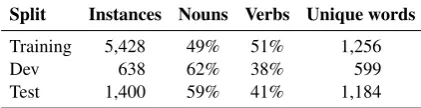
Split Instances Nouns Verbs Unique words
Training 5,428 49% 51% 1,256
Dev 638 62% 38% 599
[image:3.595.309.520.64.118.2]Test 1,400 59% 41% 1,184
Table 2: Statistics of different splits of WiC.
were asked to independently label instances in the set. We computed the average accuracy on this set to be 57% (56% and 58%), which is substantially lower than that for the final pruned set (i.e. 80%). This indicates the success of our pruning strategy in improving the semantic clarity of the dataset.
2.3 Statistics
Table2 shows the statistics of the different splits of WiC. The test set contains a large number of unique target words (1,256), reflecting the variety of the dataset. The large training split of 5,428 in-stances makes the dataset suitable for various su-pervised algorithms, including deep learning mod-els. Only 36% of the target words in the test split overlap with those in the training, with no overlap of contextual sentences across the splits. This makes WiC extremely challenging for sys-tems that heavily rely on pattern matching.
3 Experiments
We experimented with recent multi-prototype and contextualized word embedding techniques. Eval-uation of other embedding models as well as word sense disambiguation systems is left for future work.
Contextualized word embeddings. One of the pioneering contextualized word embedding mod-els isContext2Vec(Melamud et al.,2016), which computes the embedding for a word in context us-ing a multi-layer perceptron which is built on top of a bidirectional LSTM (Hochreiter and Schmid-huber,1997) language model. We used the 600-d UkWac pre-trained models7.ELMo(Peters et al.,
2018) is a character-based model which learns dy-namic word embeddings that can change depend-ing on the context. ELMo embedddepend-ings are essen-tially the internal states of a deep LSTM-based language model, pre-trained on a large text cor-pus. We used the 1024-dpre-trained models8for two configurations: ELMo1, the first LSTM
hid-den state, and ELMo3, the weighted sum of the
7
https://github.com/orenmel/context2vec
3 layers of LSTM. A more recent contextualized model isBERT (Devlin et al.,2019). The tech-nique is built upon earlier contextual representa-tions, including ELMo, but differs in the fact that, unlike those models which are mainly unidirec-tional, BERT is bidirecunidirec-tional, i.e., it considers con-texts on both sides of the target word during repre-sentation. We experimented with two pre-trained BERT models: base (768 dimensions, 12 layer, 110M parameters) andlarge(1024 dimensions, 24 layer, 340M parameters).9 Around 22% of the pairs in the test set had at least one of their tar-get words not covered by these models. For such out-of-vocabulary cases, we used BERT’s default tokenizer to split the unknown word to subwords and computed its embedding as the centroid of the corresponding subwords’ embeddings.
Multi-prototype embeddings. We experiment with three recent techniques that release 300-d pre-trained multi-prototype embeddings10. JBT11
(Pelevina et al.,2016) induces different senses by clustering graphs constructed using word embed-dings and computes embedding for each cluster (sense). DeConf12 (Pilehvar and Collier, 2016) exploits the knowledge encoded in WordNet. For each sense, it extracts from the resource the set of semantically related words, called sense biasing words, which are in turn used to compute the sense embedding. SW2V13 (Mancini et al.,2017) is an extension of Word2Vec (Mikolov et al.,2013a) for jointly learning word and sense embeddings, pro-ducing a shared vector space of words and senses as a result. For these three methods we follow the disambiguation strategy suggested by Pelev-ina et al. (2016): for each example we retrieve the closest sense embedding to the context vec-tor, which is computed by averaging its contained words’ embeddings.
Sentence-level baselines. We also report results for two baseline models which view the task as context (sentence) similarity. The BoW system views the sentence as a bag of words and com-putes a simple embedding as average of its words. The system makes use of Word2vec (Mikolov et al., 2013b) 300-d embeddings pre-trained
9
https://github.com/google-research/bert/blob/master/ 10
Multi-prototypeembeddings are also referred to assense embeddings in the literature.
11
https://github.com/uhh-lt/sensegram 12
https://pilehvar.github.io/deconf/ 13http://lcl.uniroma1.it/sw2v
MLP Threshold
Contextualized word-based models
Context2vec 57.9±0.9 59.7
ElMo1 56.4±0.6 57.1
ElMo3 57.2±0.8 56.3
BERTlarge 57.4±1.0 63.8
BERTbase 60.2±0.4 63.6
Multi-prototype models
DeConf* 52.4±0.8 62.1
SW2V* 54.1±0.5 59.1
JBT 54.1±0.6 54.5
Sentence-level baselines
BoW 54.2±1.3 61.0
Sentence LSTM 53.1±0.9
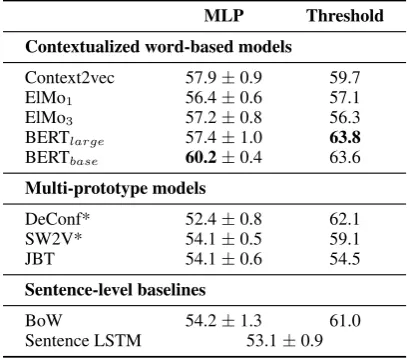
Table 3: Accuracy % performance of different mod-els on the WiC dataset. The estimated (human-level) performance is 80.0 (cf. Section 2.2) and a random baseline would perform at 50.0. Systems marked with * make use of external lexical resources.
on the Google News corpus. Sentence LSTM
is another baseline, which differently from the other models, does not obtain explicit encoded representations of the target word or sentence. The system has two LSTM layers with 50 units, one for each context side, which concatenates the outputs and passes that to a feedforward layer with 64 neurons, followed by a dropout layer at rate 0.5, and a final one-neuron output layer of sigmoid activation.
We used two simple binary classifiers in our ex-periments on top of all comparison systems (ex-cept for the LSTM baseline). MLP: a simple dense network with 100 hidden neurons (ReLU activation), and one output neuron (sigmoid acti-vation), tuned on the development set (batch size: 32; optimizer: Adam; loss: binary crossentropy). Given the stochasticity of the network optimizer, we report average results for five runs (±standard deviation). Threshold: a simple threshold-based classifier based on the cosine distance of the two input vectors, tuned with step size 0.02 on the de-velopment set.
3.1 Results
Table3shows the results on WiC. In general, the dataset proves to be very difficult for all the tech-niques, with the best model, i.e., BERTlarge,
[image:4.595.308.512.63.242.2]the cosine distance between the two encodings, proves to be more efficient than the MLP network which might not be suitable for this setting with small amount of training data. The 16.2% ab-solute accuracy difference between human-level upperbound and state-of-the-art performance sug-gests, however, a challenging dataset and encour-ages future research in context-sensitive word em-beddings to leverage WiC in their evaluations.
Among the contextualized word-based models, after BERT, Context2vec provides more compet-itive results on the dataset. However, surpris-ingly, neither ELMo nor Context2vec are able to improve over the simple sentence BoW baseline (which also outperforms the sentence LSTM base-line) using the threshold strategy. This raises a question about the ability of these models in cap-turing fine-grained semantics of words in vari-ous contexts. Finally, as far as multi-prototype techniques are concerned, DeConf is the best per-former. We note that DeConf indirectly benefits from sense-level information from WordNet en-coded in its embeddings. The same applies to SW2V, which leverages knowledge from a signifi-cantly larger lexical resource, i.e., BabelNet ( Nav-igli and Ponzetto,2012).
4 Related work
The Stanford Contextual Word Similarity (SCWS) dataset (Huang et al.,2012) comprises 2003 word pairs and is analogous to standard word similarity datasets, such as RG-65 (Rubenstein and Goode-nough, 1965) and SimLex (Hill et al., 2015), in which the task is to automatically estimate the se-mantic similarity of word pairs. Ideally, the es-timated similarity scores should have high cor-relation with those given by human annotators. However, there is a fundamental difference be-tween SCWS and other word similarity datasets: each word in SCWS is associated with a context which triggers a specific meaning of the word. The unique property of the dataset makes it a suitable benchmark for multi-prototype and contextualized word embeddings. However, in the following, we highlight some of the limitations of the dataset which hinder its suitability for evaluating existing techniques.
Inter-rater agreement (IRA) is widely accepted as a metric to assess the annotation quality of a dataset. The metric reflects the homogeneity of ratings which is expected to be high for a
well-defined task and a qualified set of annotators. For each word pair in SCWS ten scores were obtained through crowdsourcing. We computed the pair-wise IRA to be 0.35 (in terms of Spearmanρ cor-relation) which is a very low figure. The mean IRA (between each annotator and the average of others), which can be taken as a human-level per-formance upperbound, is 0.52. Moreover, most of the instances in SCWS have context pairs with dif-ferent target words.14 This makes it possible to
test context-independent models, which only con-siders word pairs in isolation, on the dataset. Im-portantly, such a context-independent model can easily surpass the human-level performance up-perbound. For instance, we computed the perfor-mance of the Google News Word2vec pre-trained word embeddings (Mikolov et al.,2013b) on the dataset to be 0.65 (ρ), which is significantly higher than the optimistic IRA for the dataset. In fact,
Dubossarsky et al. (2018) showed how the re-ported high performance of multi-prototype tech-niques in this dataset was not due to an accurate sense representation, but rather to a subsampling effect, which had not been controlled for in sim-ilarity datasets. In contrast, a context-insensitive word embedding model would perform no better than a random baseline on our dataset.
5 Conclusions
In this paper we have presented a benchmark for evaluating context-sensitive word representations. The proposed dataset, WiC, is based on lexico-graphic examples, which constitute a reliable basis to validate different models in their ability to per-ceive and discern different meanings of words. We tested some of the recent state-of-the-art contextu-alized and multi-prototype embedding models on our dataset. The considerable gap between the per-formance of these models and the human-level up-perbound suggests ample room for future work on modeling the semantics of words in context.
Acknowledgments
We would like to thank Luis Espinosa-Anke and Carla P´erez-Almendros for their help with the manual evaluation and Kiamehr Rezaee for run-ning the BERT experiments.
References
Jose Camacho-Collados and Taher Pilehvar. 2018. From word to sense embeddings: A survey on vec-tor representations of meaning. Journal of Artificial Intelligence Research, 63:743–788.
Jacob Devlin, Ming-Wei Chang, Kenton Lee, and Kristina Toutanova. 2019. BERT: Pre-training of deep bidirectional transformers for language under-standing. InProceedings of NAACL, Minneapolis, United States.
Haim Dubossarsky, Eitan Grossman, and Daphna Weinshall. 2018. Coming to your senses: on con-trols and evaluation sets in polysemy research. In
Proceedings of the 2018 Conference on Empirical Methods in Natural Language Processing, pages 1732–1740, Brussels, Belgium.
Christiane Fellbaum, editor. 1998. WordNet: An Elec-tronic Database. MIT Press, Cambridge, MA.
Lucie Flekova and Iryna Gurevych. 2016. Supersense embeddings: A unified model for supersense inter-pretation, prediction, and utilization. InProceedings of ACL.
Felix Hill, Roi Reichart, and Anna Korhonen. 2015. Simlex-999: Evaluating semantic models with (gen-uine) similarity estimation. Computational Linguis-tics.
Sepp Hochreiter and J¨urgen Schmidhuber. 1997. Long short-term memory. Neural computation, 9(8):1735–1780.
Eric H. Huang, Richard Socher, Christopher D. Man-ning, and Andrew Y. Ng. 2012. Improving word representations via global context and multiple word prototypes. InProceedings of ACL, pages 873–882, Jeju Island, Korea.
Karin Kipper-Schuler. 2005. VerbNet: A broad-coverage, comprehensive verb lexicon. Ph.D. the-sis.
Massimiliano Mancini, Jose Camacho-Collados, Igna-cio Iacobacci, and Roberto Navigli. 2017. Embed-ding words and senses together via joint knowledge-enhanced training. InProceedings of CoNLL, pages 100–111, Vancouver, Canada.
Diana McCarthy, Marianna Apidianaki, and Katrin Erk. 2016. Word sense clustering and clusterability.
Computational Linguistics.
Oren Melamud, Jacob Goldberger, and Ido Dagan. 2016. context2vec: Learning generic context em-bedding with bidirectional lstm. In Proceedings of The 20th SIGNLL Conference on Computational Natural Language Learning, pages 51–61, Berlin, Germany.
Tomas Mikolov, Kai Chen, Greg Corrado, and Jeffrey Dean. 2013a. Efficient estimation of word represen-tations in vector space.CoRR, abs/1301.3781.
Tomas Mikolov, Ilya Sutskever, Kai Chen, Greg S Cor-rado, and Jeff Dean. 2013b. Distributed representa-tions of words and phrases and their compositional-ity. InAdvances in neural information processing systems, pages 3111–3119.
Roberto Navigli. 2006. Meaningful clustering of senses helps boost Word Sense Disambiguation per-formance. InProceedings of COLING-ACL, pages 105–112, Sydney, Australia.
Roberto Navigli and Simone Paolo Ponzetto. 2012. BabelNet: The automatic construction, evaluation and application of a wide-coverage multilingual se-mantic network. Artificial Intelligence, 193:217– 250.
Arvind Neelakantan, Jeevan Shankar, Alexandre Pas-sos, and Andrew McCallum. 2014. Efficient non-parametric estimation of multiple embeddings per word in vector space. In Proceedings of EMNLP, pages 1059–1069, Doha, Qatar.
Maria Pelevina, Nikolay Arefyev, Chris Biemann, and Alexander Panchenko. 2016. Making sense of word embeddings. InProceedings of the 1st Workshop on Representation Learning for NLP, pages 174–183.
M. E. Peters, M. Neumann, M. Iyyer, M. Gardner, C. Clark, K. Lee, and L. Zettlemoyer. 2018. Deep contextualized word representations. In Proceed-ings of NAACL, New Orleans, LA, USA.
Mohammad Taher Pilehvar, Jose Camacho-Collados, Roberto Navigli, and Nigel Collier. 2017. Towards a Seamless Integration of Word Senses into Down-stream NLP Applications. InProceedings of ACL, Vancouver, Canada.
Mohammad Taher Pilehvar and Nigel Collier. 2016. De-conflated semantic representations. In Proceed-ings of EMNLP, pages 1680–1690, Austin, TX.
Mohammad Taher Pilehvar, David Jurgens, and Roberto Navigli. 2013. Align, Disambiguate and Walk: a Unified Approach for Measuring Seman-tic Similarity. In Proceedings of the 51st Annual Meeting of the Association for Computational Lin-guistics, pages 1341–1351, Sofia, Bulgaria.
Joseph Reisinger and Raymond J. Mooney. 2010. Multi-prototype vector-space models of word mean-ing. InProceedings of ACL, pages 109–117.
Herbert Rubenstein and John B. Goodenough. 1965. Contextual correlates of synonymy. Communica-tions of the ACM, 8(10):627–633.
Aliaksei Severyn, Massimo Nicosia, and Alessandro Moschitti. 2013. Learning semantic textual similar-ity with structural representations. InProceedings of ACL (2), pages 714–718, Sofia, Bulgaria.
Rion Snow, Sushant Prakash, Daniel Jurafsky, and Andrew Y. Ng. 2007. Learning to merge word senses. In Proceedings of EMNLP, pages 1005– 1014, Prague, Czech Republic.
Yogarshi Vyas and Marine Carpuat. 2017. Detecting asymmetric semantic relations in context: A case-study on hypernymy detection. In Proceedings of the 6th Joint Conference on Lexical and Computa-tional Semantics (*SEM 2017), pages 33–43. Asso-ciation for Computational Linguistics.