Language Model Rest Costs and Space-Efficient Storage
Kenneth Heafield∗,† Philipp Koehn† Alon Lavie∗ ∗
Language Technologies Institute Carnegie Mellon University
5000 Forbes Avenue Pittsburgh, PA 15213, USA {heafield,alavie}@cs.cmu.edu
†
School of Informatics University of Edinburgh
10 Crichton Street Edinburgh EH8 9AB, UK [email protected]
Abstract
Approximate search algorithms, such as cube pruning in syntactic machine translation, rely on the language model to estimate probabili-ties of sentence fragments. We contribute two changes that trade between accuracy of these estimates and memory, holding sentence-level scores constant. Common practice uses lower-order entries in an N-gram model to score the first few words of a fragment; this vio-lates assumptions made by common smooth-ing strategies, includsmooth-ing Kneser-Ney. Instead, we use a unigram model to score the first word, a bigram for the second, etc. This im-proves search at the expense of memory. Con-versely, we show how to save memory by col-lapsing probability and backoff into a single value without changing sentence-level scores, at the expense of less accurate estimates for sentence fragments. These changes can be stacked, achieving better estimates with un-changed memory usage. In order to interpret changes in search accuracy, we adjust the pop limit so that accuracy is unchanged and re-port the change in CPU time. In a German-English Moses system with target-side syntax, improved estimates yielded a 63% reduction in CPU time; for a Hiero-style version, the reduction is 21%. The compressed language model uses 26% less RAM while equivalent search quality takes 27% more CPU. Source code is released as part of KenLM.
1 Introduction
Language model storage is typically evaluated in terms of speed, space, and accuracy. We introduce
a fourth dimension, rest cost quality, that captures how well the model scores sentence fragments for purposes of approximate search. Rest cost quality is distinct from accuracy in the sense that the score of a complete sentence is held constant. We first show how to improve rest cost quality over standard prac-tice by using additional space. Then, conversely, we show how to compress the language model by mak-ing a pessimistic rest cost assumption1.
Language models are designed to assign probabil-ity to sentences. However, approximate search algo-rithms use estimates for sentence fragments. If the language model has order N (an N-gram model), then the firstN −1words of the fragment have in-complete context and the lastN −1words have not been completely used as context. Our baseline is common practice (Koehn et al., 2007; Dyer et al., 2010; Li et al., 2009) that uses lower-order entries from the language model for the first words in the fragment and no rest cost adjustment for the last few words. Formally, the baseline estimate for sentence fragmentwk1 is
N−1 Y
n=1
pN(wn|wn1−1) ! k
Y
n=N
pN(wn|wnn−1−N+1) !
where eachwnis a word andpN is anN-gram lan-guage model.
The problem with the baseline estimate lies in lower order entriespN(wn|wn1−1). Commonly used Kneser-Ney (Kneser and Ney, 1995) smoothing,
1
Here, the term rest cost means an adjustment to the score of a sentence fragment but not to whole sentences. The adjustment may be good or bad for approximate search.
including the modified version (Chen and Good-man, 1998), assumes that a lower-order entry will only be used because a longer match could not be found2. Formally, these entries actually eval-uate pN(wn|w1n−1,did not findwn0). For purposes of scoring sentence fragments, additional context is simply indeterminate, and the assumption may not hold.
As an example, we built 5-gram and unigram lan-guage models with Kneser-Ney smoothing on the same data. Sentence fragments frequently begin with “the”. Using a lower-order entry from the 5-gram model, log10p5(the) = −2.49417. The uni-gram model does not condition on backing off, as-signinglog10p1(the) = −1.28504. Intuitively, the 5-gram model is surprised, by more than an order of magnitude, to see “the” without matching words that precede it.
To remedy the situation, we train N language models on the same data. Each modelpn is an n
-gram model (it has order n). We then use pn to
score the nth word of a sentence fragment. Thus, a unigram model scores the first word of a sentence fragment, a bigram model scores the second word, and so on until either then-gram is not present in the model or the firstN−1words have been scored. Storing probabilities from these models requires one additional value pern-gram in the model, except for
N-grams where this probability is already stored. Conversely, we can lower memory consumption relative to the baseline at the expense of poorer rest costs. Baseline models store two entries pern-gram: probability and backoff. We will show that the prob-ability and backoff values in a language model can be collapsed into a single value for each n-gram without changing sentence probability. This trans-formation saves memory by halving the number of values stored per entry, but it makes rest cost esti-mates worse. Specifically, the rest cost pessimisti-cally assumes that the model will back off to uni-grams immediately following the sentence fragment. The two modifications can be used independently or simultaneously. To measure the impact of their different rest costs, we experiment with cube prun-ing (Chiang, 2007) in syntactic machine
transla-2Other smoothing techniques, including Witten-Bell (Witten and Bell, 1991), do not make this assumption.
tion. Cube pruning’s goal is to find high-scoring sentence fragments for the root non-terminal in the parse tree. It does so by going bottom-up in the parse tree, searching for high-scoring sentence fragments for each non-terminal. Within each non-terminal, it generates a fixed number of high-scoring sentence fragments; this is known as thepop limit. Increasing the pop limit therefore makes search more accurate but costs more time. By moderating the pop limit, improved accuracy can be interpreted as a reduction in CPU time and vice-versa.
2 Related Work
Vilar and Ney (2011) study several modifications to cube pruning and cube growing (Huang and Chiang, 2007). Most relevant is their use of a class-based language model for the first of two decoding passes. This first pass is cheaper because translation alter-natives are likely to fall into the same class. Entries are scored with the maximum probability over class members (thereby making them no longer normal-ized). Thus, paths that score highly in this first pass may contain high-scoring paths under the lexicalized language model, so the second pass more fully ex-plores these options. The rest cost estimates we de-scribe here could be applied in both passes, so our work is largely orthogonal.
Zens and Ney (2008) present rest costs for phrase-based translation. These rest costs are phrase-based on fac-tors external to the sentence fragment, namely out-put that the decoder may generate in the future. Our rest costs examine words internal to the sentence fragment, namely the first and last few words. We also differ by focusing on syntactic translation.
purposes. Our compression technique reduces stor-age from two values, probability and backoff, to one value, theoretically halving the bits per value (ex-ceptN-grams which all have backoff 1). This makes the storage requirement for higher-quality modified Kneser-Ney smoothing comparable to stupid back-off (Brants et al., 2007). Whether to use one smooth-ing technique or the other then becomes largely an issue of training costs and quality after quantization.
3 Contribution
3.1 Better Rest Costs
As alluded to in the introduction, the first few words of a sentence fragment are typically scored us-ing lower-order entries from an N-gram language model. However, Kneser-Ney smoothing (Kneser and Ney, 1995) conditions lower-order probabilities on backing off. Specifically, lower-order counts are adjusted to represent the number of unique exten-sions ann-gram has:
a(wn1) = (
|{w0 :c(w0n)>0}| ifn < N
c(w1n) ifn=N
wherec(wn
1) is the number of timesw1nappears in the training data3. This adjustment is also performed for modified Kneser-Ney smoothing. The intuition is based on the fact that the language model will base its probability on the longest possible match. If anN-gram was seen in the training data, the model will match it fully and use the smoothed count. Oth-erwise, the full N-gram was not seen in the train-ing data and the model resorts to a shortern-gram match. Probability of this shorter match is based on how often then-gram is seen in different contexts. Thus, these shortern-gram probabilities are not rep-resentative of cases where context is short simply because additional context is unknown at the time of scoring.
In some cases, we are able to determine that the model will back off and therefore the lower-order probability makes the appropriate assumption. Specifically, ifvwn1 does not appear in the model for any word v, then computingp(wn|vwn1−1) will
al-3Counts are not modified forn-grams bound to the begin-ning of sentence, namely those withw1=<s>.
ways back off tow1n−1or fewer words4. This crite-rion is the same as used to minimize the length of left language model state (Li and Khudanpur, 2008) and can be retrieved for eachn-gram without using addi-tional memory in common data structures (Heafield et al., 2011).
Where it is unknown if the model will back off, we use a language model of the same order to pro-duce a rest cost. Specifically, there areN language models, one of each order from1 toN. The mod-els are trained on the same corpus with the same smoothing parameters to the extent that they apply. We then compile these into one data structure where eachn-gram record has three values:
1. Probability pn from the n-gram language
model
2. Probability pN from the N-gram language model
3. Backoffbfrom theN-gram language model
ForN-grams, the two probabilities are the same and backoff is always 1, so only one value is stored. Without pruning, the n-gram model contains the same n-grams as the N-gram model. With prun-ing, the two sets may be different, so we query the
n-gram model in the normal way to score everyn -gram in theN-gram model. The idea is thatpnis the
average conditional probability that will be encoun-tered once additional context becomes known. We also tried more complicated estimates by addition-ally interpolating upper bound, lower bound, andpN
with weights trained on cube pruning logs; none of these improved results in any meaningful way.
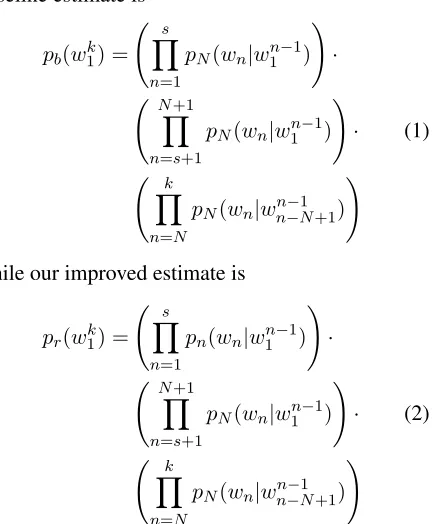
Formalizing the above, letwk1 be a sentence frag-ment. Choose the largests so thatvws1 appears in the model for some v; equivalently w1s is the left state described in Li and Khudanpur (2008). The
4
Usually, this happens becausew1ndoes not appear, though
it can also happen thatw1nappears but allvwn1 were removed
baseline estimate is
pb(wk1) =
s
Y
n=1
pN(wn|wn1−1) !
·
N+1 Y
n=s+1
pN(wn|wn1−1) !
· (1)
k
Y
n=N
pN(wn|wnn−1−N+1) !
while our improved estimate is
pr(wk1) =
s
Y
n=1
pn(wn|wn1−1) !
·
N+1 Y
n=s+1
pN(wn|wn1−1) !
· (2)
k
Y
n=N
pN(wn|wnn−1−N+1) !
The difference between these equations is thatpnis used for words in the left state i.e. 1 ≤ n ≤ s. We have also abused notation by usingpN to denote
both probabilities stored explicitly in the model and the model’s backoff-smoothed probabilities when not present. It is not necessary to store backoffs for
pn because s was chosen such that all queried n -grams appear in the model.
This modification to the language model improves rest costs (and therefore quality or CPU time) at the expense of using more memory to store pn. In the next section, we do the opposite: make rest costs worse to reduce storage size.
3.2 Less Memory
Many language model smoothing strategies, includ-ing modified Kneser-Ney smoothinclud-ing, use the back-off algorithm shown in Figure 1. Given ann-gram
wn1, the backoff algorithm bases probability on as much context as possible. Equivalently, it finds the minimum f so that wfn is in the model then uses p(wn|wnf−1) as a basis. Backoff penalties b
are charged because a longer match was not found, forming the product
p(wn|w1n−1) =p(wn|wnf−1) f−1 Y
j=1
b(wjn−1) (3)
Notably, the backoff penalties{b(wjn−1)}nj=1−1are in-dependent ofwn, though which backoff penalties are
charged depends onfand thereforewn.
backoff←1
forf = 1→ndo
ifwn
f is in the modelthen
return p(wn|wnf−1)·backoff
else
ifwnf−1is in the modelthen
backoff←backoff·b(wfn−1)
[image:4.612.84.300.68.330.2]end if end if end for
Figure 1: The baseline backoff algorithm to com-putep(wn|w1n−1). It always terminates with a prob-ability because even unknown words are treated as a unigram.
forf = 1→ndo
ifwfnis in the modelthen return q(wn|wnf−1)
end if end for
Figure 2: The run-time pessimistic backoff algo-rithm to findq(wn|wn1−1). It assumes thatqhas been computed at model building time.
In order to save memory, we propose to account for backoff in a different way, definingq
q(wn|wn1−1) = p(wn|w
n−1
f )
Qn
j=fb(wjn)
Qn−1
j=f b(w n−1
j )
Proposition 1. The terms ofq telescope. Formally, letwk1 be a sentence fragment andf take the mini-mum value so thatwk
f is in the model. Then,
q(w1k) =p(w1k)
k
Y
j=f b(wjk)
Proof. By induction onk. Whenk= 1,f = 1since the wordw1is either in the vocabulary or mapped to
<unk>and treated like a unigram.
q(w1) = p(w1) Q1
j=1b(w1j)
Q0
j=1b(w0j)
=p(w1)b(w1)
Fork >1,
q(w1k) =q(w1k−1)q(wk|wk1−1)
= q(w
k−1
1 )p(wk|wfk−1)Qkj=fb(wkj)
Qk−1
j=fb(w k−1
j )
wheref has the lowest value such thatwkf is in the model. Applying the inductive hypothesis to expand
q(wk1−1), we obtain
p(w1k−1)
Qk−1
j=eb(wk
−1
j )
p(wk|wkf−1)Qk
j=fb(wkj)
Qk−1
j=fb(wk
−1
j )
whereehas the lowest value such thatwke−1is in the model. The backoff terms cancel to yield
p(w1k−1)
f−1 Y
j=e
b(wjk−1)
p(wk|wfk−1)
k
Y
j=f b(wkj)
By construction ofe,wkj−1is not in the model for all
j < e. Hence,b(wkj−1) = 1implicitly for allj < e. Multiplying by1,
p(w1k−1)
f−1 Y
j=1
b(wjk−1)
p(wk|wk −1
f ) k
Y
j=f b(wkj)
Recognizing the backoff equation (3) to simplify,
p(w1k−1)p(wk|w1k−1)
k
Y
j=f b(wkj)
Finally, the conditional probability folds as desired
q(w1k) =p(wk1)
k
Y
j=f b(wkj)
We note that entries ending in </s> have back-off1, so it follows from Proposition 1 that sentence-level scores are unchanged.
q(<s> wk1 </s>) =p(<s> wk1 </s>)
Proposition 1 characterizesqas a pessimistic rest cost on sentence fragments that scores sentences in exactly the same way as the baseline using p and
b. To save memory, we simply store q in lieu of
p and b. Compared with the baseline, this halves number of values from two to one float pern-gram, except N-grams that already have one value. The impact of this reduction is substantial, as seen in Section 4.3. Run-time scoring is also simplified as shown in Figure 2 since the language model lo-cates the longest match wn
f then returns the value q(wn|w1n−1) = q(wn|wnf−1) without any calcula-tion or addicalcula-tional lookup. Baseline language mod-els either retrieve backoffs values with additional lookups (Stolcke, 2002; Federico et al., 2008) or modify the decoder to annotate sentence fragments with backoff information (Heafield, 2011); we have effectively moved this step to preprocessing. The disadvantage is thatqis not a proper probability and it produces worse rest costs than does the baseline.
3.3 Combined Scheme
Our two language model modifications can be triv-ially combined by using lower-order probabilities on the left of a fragment and by charging all backoff penalties on the right of a fragment. The net result is a language model that uses the same memory as the baseline but has better rest cost estimates.
4 Experiments
To measure the impact of different rest costs, we use the Moses chart decoder (Koehn et al., 2007) for the WMT 2011 German-English translation task (Callison-Burch et al., 2011). Using the Moses pipeline, we trained two syntactic German-English systems, one with target-side syntax and the other hierarchical with unlabeled grammar rules (Chiang, 2007). Grammar rules were extracted from Europarl (Koehn, 2005) using the Collins parser (Collins, 1999) for syntax on the English side. The language model interpolates, on the WMT 2010 test set, sep-arate models built on Europarl, news commentary, and the WMT news data for each year. Models were built and interpolated using SRILM (Stolcke, 2002) with modified Kneser-Ney smoothing (Kneser and Ney, 1995; Chen and Goodman, 1998) and the de-fault pruning settings. In all scenarios, the primary language model has order 5. For lower-order rest costs, we also built models with orders 1 through 4 then used then-gram model to scoren-grams in the 5-gram model. Feature weights were trained with MERT (Och, 2003) on the baseline using a pop limit of 1000 and 100-best output. Since final feature val-ues are unchanged, we did not re-run MERT in each condition. Measurements were collected by running the decoder on the 3003-sentence test set.
4.1 Rest Costs as Prediction
Scoring the first few words of a sentence fragment is a prediction task. The goal is to predict what the probability will be when more context becomes known. In order to measure performance on this task, we ran the decoder on the hierarchical system with a pop limit of 1000. Every time more context became known, we logged5the prediction error (es-timated log probability minus updated log
probabil-5
Logging was only enabled for this experiment.
Lower Baseline
nMean Bias MSE Var Bias MSE Var
[image:6.612.320.536.56.138.2]1 -3.21 .10 .84 .83 -.12 .87 .86 2 -2.27 .04 .18 .17 -.14 .23 .24 3 -1.80 .02 .07 .07 -.09 .10 .09 4 -1.29 .01 .04 .04 -.10 .09 .08
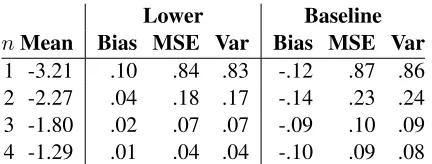
Table 1: Bias (mean error), mean squared error, and variance (of the error) for the lower-order rest cost and the baseline. Error is the estimated log prob-ability minus the final probprob-ability. Statistics were computed separately for the first word of a fragment (n = 1), the second word (n= 2), etc. The lower-order estimates are better across the board, reducing error in cube pruning. All numbers are in log base ten, as is standard for ARPA-format language mod-els. Statistics were only collected for words with incomplete context.
ity) for both lower-order rest costs and the baseline. Table 1 shows the results.
Cube pruning uses relative scores, so bias mat-ters less, though positive bias will favor rules with more arity. Variance matters the most because lower variance means cube pruning’s relative rankings are more accurate. Our lower-order rest costs are bet-ter across the board in bet-terms of absolute bias, mean squared error, and variance.
4.2 Pop Limit Trade-Offs
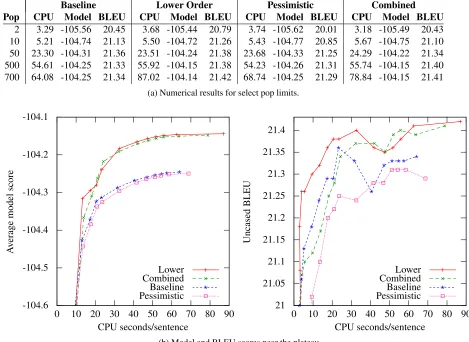
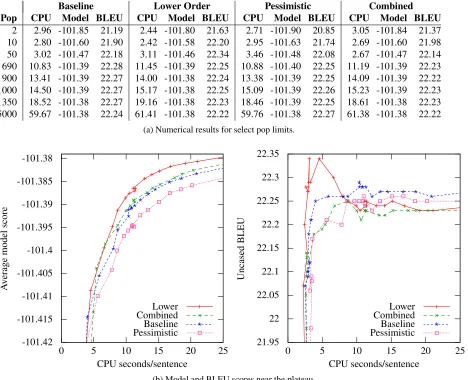
The cube pruning pop limit is a trade-off between search accuracy and CPU time. Here, we mea-sure how our rest costs improve (or degrade) that trade-off. Search accuracy is measured by the aver-age model score of single-best translations. Model scores are scale-invariant and include a large con-stant factor; higher is better. We also measure over-all performance with uncased BLEU (Papineni et al., 2002). CPU time is the sum of user and system time used by Moses divided by the number of sentences (3003). Timing includes time to load, though files were forced into the disk cache in advance. Our test machine has 64 GB of RAM and 32 cores. Results are shown in Figures 3 and 4.
tar-Baseline Lower Order Pessimistic Combined Pop CPU Model BLEU CPU Model BLEU CPU Model BLEU CPU Model BLEU
2 3.29 -105.56 20.45 3.68 -105.44 20.79 3.74 -105.62 20.01 3.18 -105.49 20.43 10 5.21 -104.74 21.13 5.50 -104.72 21.26 5.43 -104.77 20.85 5.67 -104.75 21.10 50 23.30 -104.31 21.36 23.51 -104.24 21.38 23.68 -104.33 21.25 24.29 -104.22 21.34 500 54.61 -104.25 21.33 55.92 -104.15 21.38 54.23 -104.26 21.31 55.74 -104.15 21.40 700 64.08 -104.25 21.34 87.02 -104.14 21.42 68.74 -104.25 21.29 78.84 -104.15 21.41
(a) Numerical results for select pop limits.
-104.6 -104.5 -104.4 -104.3 -104.2 -104.1
0 10 20 30 40 50 60 70 80 90
A
v
erage
model
score
CPU seconds/sentence Lower Combined Baseline Pessimistic
21 21.05 21.1 21.15 21.2 21.25 21.3 21.35 21.4
0 10 20 30 40 50 60 70 80 90
Uncased
BLEU
CPU seconds/sentence Lower Combined Baseline Pessimistic
[image:7.612.69.538.58.400.2](b) Model and BLEU scores near the plateau.
Figure 3: Target-syntax performance. CPU time and model score are averaged over 3003 sentences.
get syntax, where a pop limit of 50 outperforms the baseline with pop limit 700. CPU time per sen-tence is reduced to 23.5 seconds from 64.0 seconds, a 63.3% reduction. The combined setting, using the same memory as the baseline, shows a similar 62.1% reduction in CPU time. We attribute this differ-ence to improved grammar rule scoring that impacts pruning and sorting. In the target syntax model, the grammar is not saturated (i.e. less pruning will still improve scores) but we nonetheless prune for tractability reasons. The lower-order rest costs are particularly useful for grammar pruning because lex-ical items are typlex-ically less than five words long (and frequently only word).
The hierarchical grammar is nearly saturated with respect to grammar pruning, so improvement there is due mostly to better search. In the hierarchical sys-tem, peak BLEU 22.34 is achieved under the lower-order condition with pop limits 50 and 200, while
other scenarios are still climbing to the plateau. With a pop limit of 1000, the baseline’s average model score is -101.3867. Better average models scores are obtained from the lower-order model with pop limit 690 using 79% of baseline CPU, the combined model with pop limit 900 using 97% CPU, and the pessimistic model with pop limit 1350 using 127% CPU.
Pessimistic compression does worsen search, re-quiring 27% more CPU in the hierarchical system to achieve the same quality. This is worthwhile to fit large-scale language models in memory, especially if the alternative is a remote language model.
4.3 Memory Usage
Baseline Lower Order Pessimistic Combined Pop CPU Model BLEU CPU Model BLEU CPU Model BLEU CPU Model BLEU
2 2.96 -101.85 21.19 2.44 -101.80 21.63 2.71 -101.90 20.85 3.05 -101.84 21.37 10 2.80 -101.60 21.90 2.42 -101.58 22.20 2.95 -101.63 21.74 2.69 -101.60 21.98 50 3.02 -101.47 22.18 3.11 -101.46 22.34 3.46 -101.48 22.08 2.67 -101.47 22.14 690 10.83 -101.39 22.28 11.45 -101.39 22.25 10.88 -101.40 22.25 11.19 -101.39 22.23 900 13.41 -101.39 22.27 14.00 -101.38 22.24 13.38 -101.39 22.25 14.09 -101.39 22.22 1000 14.50 -101.39 22.27 15.17 -101.38 22.25 15.09 -101.39 22.26 15.23 -101.39 22.23 1350 18.52 -101.38 22.27 19.16 -101.38 22.23 18.46 -101.39 22.25 18.61 -101.38 22.23 5000 59.67 -101.38 22.24 61.41 -101.38 22.22 59.76 -101.38 22.27 61.38 -101.38 22.22
(a) Numerical results for select pop limits.
-101.42 -101.415 -101.41 -101.405 -101.4 -101.395 -101.39 -101.385 -101.38
0 5 10 15 20 25
A
v
erage
model
score
CPU seconds/sentence Lower Combined Baseline Pessimistic
21.95 22 22.05 22.1 22.15 22.2 22.25 22.3 22.35
0 5 10 15 20 25
Uncased
BLEU
CPU seconds/sentence Lower Combined Baseline Pessimistic
(b) Model and BLEU scores near the plateau.
Figure 4: Hierarchical system performance. All values are averaged over 3003 sentences.
and removes another, so it uses the same memory as the baseline. The memory footprint of adding or removing a value depends on the number of suchn -grams, the underlying data structure, and the extent of quantization. Our test language model has 135 millionn-grams forn < 5and 56 million5-grams. Memory usage was measured for KenLM data struc-tures (Heafield, 2011) and minimal perfect hashing (Guthrie and Hepple, 2010). For minimal perfect hashing, we assume the Compress, Hash and Dis-place algorithm (Belazzougui et al., 2008) with 8-bit signatures and 8-bit quantization. Table 2 shows the results. Storage size of the smallest model is reduced by 26%, bringing higher-quality smoothed models in line with stupid backoff models that also store one value pern-gram.
Structure Baseline Change %
Probing 4,072 517 13%
Trie 2,647 506 19%
[image:8.612.75.543.57.437.2]8-bit quantized trie 1,236 140 11% 8-bit minimal perfect hash 540 140 26%
5 Conclusion
Our techniques reach plateau-level BLEU scores with less time or less memory. Efficiently stor-ing lower-order probabilities and usstor-ing them as rest costs improves both cube pruning (21% CPU reduc-tion in a hierarchical system) and model filtering (net 63% CPU time reduction with target syntax) at the expense of 13-26% more RAM for the language model. This model filtering improvement is surpris-ing both in the impact relative to changsurpris-ing the pop limit and simplicity of implementation, since it can be done offline. Compressing the language model to halve the number of values per n-gram (except N -grams) results in a 13-26% reduction in RAM with 26% over the smallest model, costing 27% more CPU and leaving overall sentence scores unchanged. This compression technique is likely to have more general application outside of machine translation, especially where only sentence-level scores are re-quired. Source code is being released6 under the LGPL as part of KenLM (Heafield, 2011).
Acknowledgements
This work was supported by the National Sci-ence Foundation under grants DGE-0750271, IIS-0713402, and IIS-0915327; by the EuroMatrixPlus project funded by the European Commission (7th Framework Programme), and by the DARPA GALE program. Benchmarks were run on Trestles at the San Diego Supercomputer Center under allocation TG-CCR110017. Trestles is part of the Extreme Science and Engineering Discovery Environment (XSEDE), which is supported by National Science Foundation grant number OCI-1053575.
References
Djamal Belazzougui, Fabiano C. Botelho, and Martin Di-etzfelbinger. 2008. Hash, displace, and compress. In Proceedings of the 35th international colloquium on Automata, Languages and Programming (ICALP ’08), pages 385–396.
Thorsten Brants, Ashok C. Popat, Peng Xu, Franz J. Och, and Jeffrey Dean. 2007. Large language mod-els in machine translation. InProceedings of the 2007 Joint Conference on Empirical Methods in Natural
6
http://kheafield.com/code/kenlm/
Language Processing and Computational Language Learning, pages 858–867, June.
Chris Callison-Burch, Philipp Koehn, Christof Monz, and Omar Zaidan. 2011. Findings of the 2011 work-shop on statistical machine translation. InProceedings of the Sixth Workshop on Statistical Machine Transla-tion, pages 22–64, Edinburgh, Scotland, July. Associ-ation for ComputAssoci-ational Linguistics.
Stanley Chen and Joshua Goodman. 1998. An empirical study of smoothing techniques for language modeling. Technical Report TR-10-98, Harvard University, Au-gust.
David Chiang. 2007. Hierarchical phrase-based transla-tion. Computational Linguistics, 33:201–228, June. Michael Collins. 1999. Head-Driven Statistical Models
for Natural Language Parsing. Ph.D. thesis, Univer-sity of Pennsylvania.
Chris Dyer, Adam Lopez, Juri Ganitkevitch, Johnathan Weese, Ferhan Ture, Phil Blunsom, Hendra Setiawan, Vladimir Eidelman, and Philip Resnik. 2010. cdec: A decoder, alignment, and learning framework for finite-state and context-free translation models. In Proceedings of the ACL 2010 System Demonstrations, ACLDemos ’10, pages 7–12.
Marcello Federico and Nicola Bertoldi. 2006. How many bits are needed to store probabilities for phrase-based translation? InProceedings of the Workshop on Statistical Machine Translation, pages 94–101, New York City, June.
Marcello Federico, Nicola Bertoldi, and Mauro Cettolo. 2008. IRSTLM: an open source toolkit for handling large scale language models. InProceedings of Inter-speech, Brisbane, Australia.
David Guthrie and Mark Hepple. 2010. Storing the web in memory: Space efficient language models with con-stant time retrieval. InProceedings of EMNLP 2010, Los Angeles, CA.
Kenneth Heafield, Hieu Hoang, Philipp Koehn, Tetsuo Kiso, and Marcello Federico. 2011. Left language model state for syntactic machine translation. In Pro-ceedings of the International Workshop on Spoken Language Translation, San Francisco, CA, USA, De-cember.
Kenneth Heafield. 2011. KenLM: Faster and smaller language model queries. InProceedings of the Sixth Workshop on Statistical Machine Translation, Edin-burgh, UK, July. Association for Computational Lin-guistics.
Reinhard Kneser and Hermann Ney. 1995. Improved backing-off for m-gram language modeling. In Pro-ceedings of the IEEE International Conference on Acoustics, Speech and Signal Processing, pages 181– 184.
Philipp Koehn, Hieu Hoang, Alexandra Birch, Chris Callison-Burch, Marcello Federico, Nicola Bertoldi, Brooke Cowan, Wade Shen, Christine Moran, Richard Zens, Chris Dyer, Ondrej Bojar, Alexandra Con-stantin, and Evan Herbst. 2007. Moses: Open source toolkit for statistical machine translation. In Annual Meeting of the Association for Computational Linguis-tics (ACL), Prague, Czech Republic, June.
Philipp Koehn. 2005. Europarl: A parallel corpus for statistical machine translation. InProceedings of MT Summit.
Zhifei Li and Sanjeev Khudanpur. 2008. A scalable decoder for parsing-based machine translation with equivalent language model state maintenance. In Pro-ceedings of the Second ACL Workshop on Syntax and Structure in Statistical Translation (SSST-2), pages 10–18, Columbus, Ohio, June.
Zhifei Li, Chris Callison-Burch, Chris Dyer, Sanjeev Khudanpur, Lane Schwartz, Wren Thornton, Jonathan Weese, and Omar Zaidan. 2009. Joshua: An open source toolkit for parsing-based machine translation. In Proceedings of the Fourth Workshop on Statistical Machine Translation, pages 135–139, Athens, Greece, March. Association for Computational Linguistics. Franz Josef Och. 2003. Minimum error rate training
in statistical machine translation. In ACL ’03: Pro-ceedings of the 41st Annual Meeting on Association for Computational Linguistics, pages 160–167, Mor-ristown, NJ, USA. Association for Computational Lin-guistics.
Kishore Papineni, Salim Roukos, Todd Ward, and Wei-Jing Zhu. 2002. BLEU: A method for automatic evalution of machine translation. InProceedings 40th Annual Meeting of the Association for Computational Linguistics, pages 311–318, Philadelphia, PA, July. Bhiksha Raj and Ed Whittaker. 2003. Lossless
compres-sion of language model structure and word identifiers. In Proceedings of IEEE International Conference on Acoustics, Speech and Signal Processing, pages 388– 391.
Andreas Stolcke. 2002. SRILM - an extensible language modeling toolkit. InProceedings of the Seventh Inter-national Conference on Spoken Language Processing, pages 901–904.
David Talbot and Miles Osborne. 2007. Randomised language modelling for statistical machine translation. InProceedings of ACL, pages 512–519, Prague, Czech Republic.
David Vilar and Hermann Ney. 2011. Cardinality prun-ing and language model heuristics for hierarchical phrase-based translation. Machine Translation, pages 1–38, November. DOI 10.1007/s10590-011-9119-4. Ed Whittaker and Bhiksha Raj. 2001.
Quantization-based language model compression. In Proceedings of EUROSPEECH, pages 33–36, September.
Ian H. Witten and Timothy C. Bell. 1991. The zero-frequency problem: Estimating the probabilities of novel events in adaptive text compression. IEEE Transactions on Information Theory, 37(4):1085– 1094.