Multi-way Relation Classification:
Application to Protein-Protein Interactions
Barbara Rosario
SIMS UC Berkeley Berkeley, CA 94720
Marti A. Hearst
SIMS UC Berkeley Berkeley, CA 94720
Abstract
We address the problem of multi-way re-lation classification, applied to identifica-tion of the interacidentifica-tions between proteins in bioscience text. A major impediment to such work is the acquisition of appro-priately labeled training data; for our ex-periments we have identified a database that serves as a proxy for training data. We use two graphical models and a neu-ral net for the classification of the inter-actions, achieving an accuracy of 64% for a 10-way distinction between relation types. We also provide evidence that the exploitation of the sentences surrounding a citation to a paper can yield higher accu-racy than other sentences.
1 Introduction
Identifying the interactions between proteins is one of the most important challenges in modern ge-nomics, with applications throughout cell biology, including expression analysis, signaling, and ratio-nal drug design. Most biomedical research and new discoveries are available electronically but only in free text format, so automatic mechanisms are needed to convert text into more structured forms. The goal of this paper is to address this difficult and important task, the extraction of the interactions between proteins from free text. We use graphical models and a neural net that were found to achieve high accuracy in the related task of extracting the
re-lation types might hold between the entities “treat-ment” and “disease” (Rosario and Hearst, 2004).
Labeling training and test data is time-consuming and subjective. Here we report on results using an existing curated database, the HIV-1 Human Protein Interaction Database1, to train and test the classifica-tion system. The accuracies obtained by the classi-fication models proposed are quite high, confirming the validity of the approach. We also find support for the hypothesis that the sentences surrounding ci-tations are useful for extraction of key information from technical articles (Nakov et al., 2004).
In the remainder of this paper we discuss related work, describe the dataset, and show the results of the algorithm on documents and sentences.
2 Related work
There has been little work in general NLP on trying to identify different relations between entities. Many papers that claim to be doing relationship recogni-tion in actuality address the task of role extracrecogni-tion: (usually two) entities are identified and the relation-ship is implied by the co-occurrence of these enti-ties or by some linguistic expression (Agichtein and Gravano, 2000; Zelenko et al., 2002).
The ACE competition2 has a relation recognition subtask, but assumes a particular type of relation holds between particular entity types (e.g., if the two entities in question are an EMP and an ORG, then an employment relation holds between them; which type of employment relation depends on the type of entity, e.g., staff person vs partner).
1
www.ncbi.nlm.nih.gov/RefSeq/HIVInteractions/index.html
2http://www.itl.nist.gov/iaui/894.01/tests/ace/
In the BioNLP literature there have recently been a number of attempts to automatically extract protein-protein interactions from PubMed abstracts. Some approaches simply report that a relation exists between two proteins but do not determine which relation holds (Bunescu et al., 2005; Marcotte et al., 2001; Ramani et al., 2005), while most others start with a list of interaction verbs and label only those sentences that contain these trigger words (Blaschke and Valencia, 2002; Blaschke et al., 1999; Rind-flesch et al., 1999; Thomas et al., 2000; Sekimizu et al., 1998; Ahmed et al., 2005; Phuong et al., 2003; Pustejovsky et al., 2002). However, as Marcotte et al. (2001) note, “... searches for abstracts contain-ing relevant keywords, such as interact*, poorly dis-criminate true hits from abstracts using the words in alternate senses and miss abstracts using different language to describe the interactions.”
Most of the existing methods also suffer from low recall because they use hand-built specialized tem-plates or patterns (Ono et al., 2001; Corney et al., 2004). Some systems use link grammars in conjunc-tion with trigger verbs instead of templates (Ahmed et al., 2005; Phuong et al., 2003). Every paper eval-uates on a different test set, and so it is quite difficult to compare systems.
In this paper, we use state-of-the-art machine learning methods to determine the interaction types and to extract the proteins involved. We do not use trigger words, templates, or dictionaries.
3 Data
We use the information from a domain-specific database to gather labeled data for the task of classi-fying the interactions between proteins in text. The manually-curated HIV-1 Human Protein Interaction Database provides a summary of documented inter-actions between HIV-1 proteins and host cell pro-teins, other HIV-1 propro-teins, or proteins from disease organisms associated with HIV or AIDS. We use this database also because it contains information about the type of interactions, as opposed to other protein interaction databases (BIND, MINT, DIP, for exam-ple3) that list the protein pairs interacting, without
3DIP lists only the protein pairs, BIND has only some
in-formation about the method used to provide evidence for the interaction, and MIND does have interaction type information but the vast majority of the entries (99.9% of the 47,000 pairs)
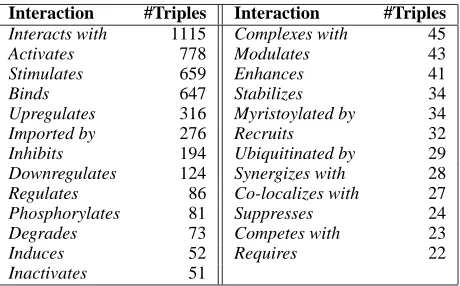
Interaction #Triples Interaction #Triples
Interacts with 1115 Complexes with 45
Activates 778 Modulates 43
Stimulates 659 Enhances 41
Binds 647 Stabilizes 34
Upregulates 316 Myristoylated by 34
Imported by 276 Recruits 32
Inhibits 194 Ubiquitinated by 29
Downregulates 124 Synergizes with 28
Regulates 86 Co-localizes with 27
Phosphorylates 81 Suppresses 24
Degrades 73 Competes with 23
Induces 52 Requires 22
[image:2.612.315.545.54.197.2]Inactivates 51
Table 1: Number of triples for the most common interactions of the HIV-1 database, after removing the distinction in directionality and the triples with more than one interaction.
specifying the type of interactions.
In this database, the definitions of the interactions depend on the proteins involved and the articles de-scribing the interactions; thus there are several def-initions for each interaction type. For the interac-tion bind and the proteins ANT and Vpr, we find (among others) the definition “Interaction of HIV-1 Vpr with human adenine nucleotide translocator (ANT) is presumed based on a specific binding in-teraction between Vpr and rat ANT.”
The database contains 65 types of interactions and 809 proteins for which there is interaction informa-tion, for a total of 2224 pairs of interacting proteins. For each documented protein-protein interaction the database includes information about:
A pair of proteins (PP),
The interaction type(s) between them (I), and PubMed identification numbers of the journal article(s) describing the interaction(s) (A).
A protein pair
can have multiple interactions (for example, AIP1 binds to HIV-1 p6 and also is in-corporated into it) for an average of 1.9 interactions per
and a maximum of 23 interactions for the pair CDK9 and tat p14.
We refer to the combination of a protein pair
and an article as a “triple.” Our goal is to
au-tomatically associate to each triple an interaction
type. For the example above, the triple “AIP1 HIV-1-p6 14519844” is assigned the interaction binds (14519844 being the PubMed number of the paper providing evidence for this interaction)4.
Journal articles can contain evidence for multi-ple interactions: there are 984 journal articles in the database and on average each article is reported to contain evidence for 5.9 triples (with a maximum number of 90 triples).
In some cases the database reports multiple dif-ferent interactions for a given triple. There are 5369 unique triples in the database and of these 414 (7.7%) have multiple interactions. We exclude these triples from our analysis; however, we do include ar-ticles and
s with multiple interactions. In other words, we tackle cases such as the example above of the pair AIP1, HIV-1-p6 (that can both bind and incorporate) as long as the evidence for the different interactions is given by two different articles.
Some of the interactions differ only in the direc-tionality (e.g., regulates and regulated by, inhibits and inhibited by, etc.); we collapsed these pairs of related interactions into one5. Table 1 shows the list of the 25 interactions of the HIV-1 database for which there are more than 10 triples.
For these interactions and for a random subset of the protein pairs
(around 45% of the total pairs in the database), we downloaded the corresponding full-text papers. From these, we extracted all and only those sentences that contain both proteins from the indicated protein pair. We assigned each of these sentences the corresponding interaction from the
database (“papers”).
Nakov et al. (2004) argue that the sentences sur-rounding citations to related work, or citances, are a useful resource for bioNLP. Building on that work, we use citances as an additional form of evidence to determine protein-protein interaction types. For a given database entry containing PubMed article ,
4To be precise, there are for this
(as there are often)
multiple articles (three in this case) describing the interaction
binds, thus we have the following three triples to which we
associate binds: “AIP1 HIV-1-p6 14519844,” “AIP1 HIV-1-p6 14505570” and “AIP1 HIV-1-p6 14505569.”
5
We collapsed these pairs because the directionality of the interactions was not always reliable in the database. This im-plies that for some interactions, we are not able to infer the
dif-ferent roles of the two proteins; we considered only the pair
“prot1 prot2” or “prot2 prot1,” not both. However, our algo-rithm can detect which proteins are involved in the interactions.
protein pair , and interaction type , we
down-loaded a subset of the papers that cite . From these
citing papers, we extracted all and only those sen-tences that mention explicitly; we further filtered
these to include all and only the sentences that con-tain
. We labeled each of these sentences with interaction type (“citances”).
There are often many different names for the same protein. We use LocusLink6 protein identification numbers and synonym names for each protein, and extract the sentences that contain an exact match for (some synonym of) each protein. By being conser-vative with protein name matching, and by not doing co-reference analysis, we miss many candidate sen-tences; however this method is very precise.
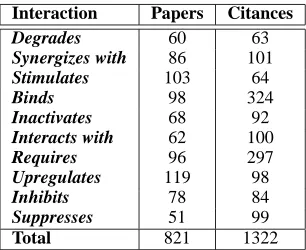
On average, for “papers,” we extracted 0.5 tences per triple (maximum of 79) and 50.6 sen-tences per interaction (maximum of 119); for “ci-tances” we extracted 0.4 sentences per triple (with a maximum of 105) and 49.2 sentences per interaction (162 maximum). We required a minimum number (40) of sentences for each interaction type for both “papers” and “citances”; the 10 interactions of Table 2 met this requirement. We used these sentences to train and test the models described below7.
Since all the sentences extracted from one triple are assigned the same interaction, we ensured that sentences from the same triple did not appear in both the testing and the training sets. Roughly 75% of the data were used for training and the rest for testing.
As mentioned above the goal is to automatically associate to each triple an interaction type. The task tackled here is actually slightly more difficult: given some sentences extracted from article , assign to
an interaction type and extract the proteins
involved. In other words, for the purpose of clas-sification, we act as if we do not have information about the proteins that interact. However, given the way the sentence extraction was done, all the sen-tences extracted from contain the
.
6
LocusLink was recently integrated into En-trez Gene, a unified query environment for genes (http://www.ncbi.nlm.nih.gov/entrez/query.fcgi?db=gene).
7
We also looked at larger chunks of text, in particular, we extracted the sentence containing the along with the
pre-vious and the following sentences, and the three consecutive sentences that contained the (the proteins could appear in
Interaction Papers Citances
Degrades 60 63
Synergizes with 86 101
Stimulates 103 64
Binds 98 324
Inactivates 68 92
Interacts with 62 100
Requires 96 297
Upregulates 119 98
Inhibits 78 84
Suppresses 51 99
[image:4.612.108.261.53.178.2]Total 821 1322
Table 2: Number of interaction sentences extracted.
f1
Role
f2 . . . fn f1
Role
f2 . . . fn f1
Role
f2 . . . fn
Inter.
Figure 1: Dynamic graphical model (DM) for pro-tein interaction classification (and role extraction).
A hand-assessment of the individual sentences shows that not every sentence that mentions the tar-get proteins
actually describes the interaction
(see Section 5.4). Thus the evaluation on the test set is done at the document level (to determine if the algorithm can predict the interaction that a curator would assign to a document as a whole given the protein pair).
Note that we assume here that the papers that pro-vide the epro-vidence for the interactions are given – an assumption not usually true in practice.
4 Models
For assigning interactions, we used two generative graphical models and a discriminative model. Fig-ure 1 shows the generative dynamic model, based on previous work on role and relation extraction (Rosario and Hearst, 2004) where the task was to ex-tract the entities TREATMENT and DISEASE and the relationships between them. The nodes labeled “Role” represent the entities (in this case the choices are PROTEIN and NULL); the children of the role nodes are the words (which act as features), thus there are as many role states as there are words in the sentence; this model consists of a Markov sequence of states where each state generates one or multiple
observations. This model makes the additional as-sumption that there is an interaction present in the sentence (represented by the node “Inter.”) that gen-erates the role sequence and the observations. (We assume here that there is a single interaction for each sentence.) The “Role” nodes can be observed or hidden. The results reported here were obtained us-ing only the words as features (i.e., in the dynamic model of Figure 1 there is only one feature node per role) and with the “Role” nodes hidden (i.e., we had no information regarding which proteins were involved). Inference is performed with the junction tree algorithm8.
We used a second type of graphical model, a sim-ple Naive Bayes, in which the node representing the interaction generates the observable features (all the words in the sentence). We did not include role in-formation in this model.
We defined joint probability distributions over these models, estimated using maximum likelihood on the training set with a simple absolute discount-ing smoothdiscount-ing method. We performed 10-fold cross validation on the training set and we chose the smoothing parameters for which we obtained the best classification accuracies (averaged over the ten runs) on the training data; the results reported here were obtained using these parameters on the held-out test sets9.
In addition to these two generative models, we also used a discriminative model, a neural network. We used the Matlab package to train a feed-forward network with conjugate gradient descent. The net-work has one hidden layer, with a hyperbolic tangent function, and an output layer representing the rela-tionships. A logistic sigmoid function is used in the output layer. The network was trained for several choices of numbers of hidden units; we chose the best-performing networks based on training set er-ror. We then tested these networks on held-out test-ing data. The features were words, the same as those used for the graphical models.
8Using Kevin Murphy’s BNT package:
http://www.cs.ubc.ca/˜murphyk/Software/BNT/bnt.html.
9
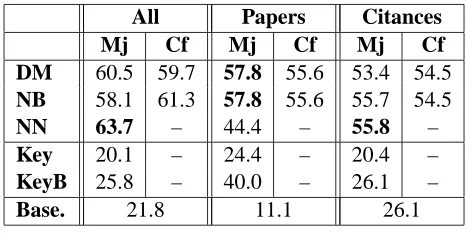
[image:4.612.79.283.223.293.2]All Papers Citances
Mj Cf Mj Cf Mj Cf
DM 60.5 59.7 57.8 55.6 53.4 54.5
NB 58.1 61.3 57.8 55.6 55.7 54.5
NN 63.7 – 44.4 – 55.8 –
Key 20.1 – 24.4 – 20.4 –
KeyB 25.8 – 40.0 – 26.1 –
Base. 21.8 11.1 26.1
Table 3: Accuracies for classification of the 10 protein-protein interactions of Table 2. DM: dy-namic model, NB: Naive Bayes, NN: neural net-work. Baselines: Key: trigger word approach, KeyB: trigger word with backoff, Base: the accu-racy of choosing the most frequent interaction.
The task is the following: given a triple consist-ing of a
and an article, extract the sentences from the article that contain both proteins. Then, predict for the entire document one of the interac-tions of Table 2 given the sentences extracted for that triple. This is a 10-way classification problem, which is significantly more complex than much of the related work in which the task is to make the bi-nary prediction (see Section 2).
5 Results
The evaluation was done on a document-by-document basis. During testing, we choose the inter-action using the following aggregate measures that use the constraint that all sentences coming from the same triple are assigned the same interaction.
Mj: For each triple, for each sentence of the triple, find the interaction that maximizes the posterior probability of the interaction given the features; then assign to all sentences of this triple the most frequent interaction among those predicted for the individual sentences.
Cf: Retain all the conditional probabilities (do not choose an interaction per sentence), then, for each triple, choose the interaction that max-imizes the sum over all the triple’s sentences.
Table 3 reports the results in terms of classifi-cation accuracies averaged across all interactions, for the cases “all” (sentences from “papers” and
“citances” together), only “papers” and only “ci-tances”. The accuracies are quite high; the dy-namic model achieves around 60% for “all,” 58% for “papers” and 54% for “citances.” The neural net achieves the best results for “all” with around 64% accuracy. From these results we can make the following observations: all models greatly outper-form the baselines; the peroutper-formances of the dynamic model DM, the Naive Bayes NB and the NN are very similar; for “papers” the best results were obtained with the graphical models; for “all” and “citances” the neural net did best. The use of “citances” al-lowed the gathering of additional data (and therefore a larger training set) that lead to higher accuracies (see “papers” versus “all”).
In the confusion matrix in Table 5 we can see the accuracies for the individual interactions for the dy-namic model DM, using “all” and “Mj.” For three interactions this model achieves perfect accuracy.
5.1 Hiding the protein names
In order to ensure that the algorithm was not over-fitting on the protein names, we ran an experiment in which we replaced the protein names in all sen-tences with the token “PROT NAME.” For example, the sentence: “Selective CXCR4 antagonism by Tat” became: “Selective PROT NAME2 antagonism by PROT NAME1.”
Table 5.1 shows the results of running the mod-els on this data. For “papers” and “citances” there is always a decrease in the classification accuracy when we remove the protein names, showing that the protein names do help the classification. The differences in accuracy in the two cases using “ci-tances” are much smaller than the differences using “papers” at least for the graphical models. This sug-gests that citation sentences may be more robust for some language processing tasks and that the models that use “citances” learn better the linguistic context of the interactions. Note how in this case the graph-ical models always outperform the neural network.
5.2 Using a “trigger word” approach
[image:5.612.70.303.54.171.2]repre-Prediction Acc.
Truth D SyW St B Ina IW R Up Inh Su (%)
Degrades (D) 5 0 0 0 0 0 0 0 0 0 100.0
Synergizes with (SyW) 0 1 0 0 0 1 0 3 3 0 12.5
Stimulates (St) 0 0 4 0 0 0 6 0 1 0 36.4
Binds (B) 0 0 0 18 0 4 1 1 3 0 66.7
Inactivates (Ina) 0 0 0 0 9 0 0 0 0 0 100.0
Interacts with (IW) 0 0 4 3 0 5 1 0 1 2 31.2
Requires (R) 0 0 0 0 0 3 3 0 1 1 37.5
Upregulates (Up) 0 0 0 2 1 0 0 12 2 0 70.6
Inhibits (Inh) 0 0 0 3 0 0 1 1 12 0 70.6
[image:6.612.129.485.53.177.2]Suppresses (Su) 0 0 0 0 0 0 0 0 0 6 100.0
Table 4: Confusion matrix for the dynamic model DM for “all,” “Mj.” The overall accuracy is 60.5%. The numbers indicate the number of articles (each paper has several relevant sentences).
All Papers Citances
Mj Cf Diff Mj Cf Diff Mj Cf Diff DM 60.5 60.5 0.7% 44.4 40.0 -25.6% 52.3 53.4 -2.0%
NB 59.7 59.7 0.1% 46.7 51.1 -11.7% 53.4 53.4 -3.1% NN 51.6 -18.9% 44.4 0% 50.0 -10.4%
Table 5: Accuracies for the classification of the 10 protein-protein interactions of Table 2 with the protein names removed. Columns marked Diff show the difference in accuracy (in percentages) with respect to the original case of Table 3, averaged over all evaluation methods.
sentative of the 10 interactions. For example, for the interaction degrade some of the keywords are “degradation,” “degrade,” for inhibit we have “inhib-ited,” “inhibitor,” “inhibitory” and others. We then checked whether a sentence contained such key-words. If it did, we assigned to the sentence the corresponding interaction. If it contained more than one keyword corresponding to multiple interactions consisting of the generic interact with plus a more specific one, we assigned the more specific interac-tion; if the two predicted interactions did not include interact with but two more specific interactions, we did not assign an interaction, since we wouldn’t know how to choose between them. Similarly, we assigned no interaction if there were more than two predicted interactions or no keywords present in the sentence. The results are shown in the rows labeled “Key” and “KeyB” in Table 3. Case “KeyB” is the “Key” method with back-off: when no interaction was predicted, we assigned to the sentence the most frequent interaction in the training data. As before, we calculated the accuracy when we force all the sentences from one triple to be assign to the most frequent interaction among those predicted for the individual sentences.
KeyB is more accurate than Key and although
the KeyB accuracies are higher than the other base-lines, they are significantly lower than those ob-tained with the trained models. The low accuracies of the trigger-word based methods show that the re-lation classification task is nontrivial, in the sense that not all the sentences contain the most obvious word for the interactions, and suggests that the trig-ger word approach is insufficient.
5.3 Protein extraction
The dynamic model of Figure 1 has the appealing property of simultaneously performing interaction recognition and protein name tagging (also known as role extraction): the task consists of identifying all the proteins present in the sentence, given a se-quence of words. We assessed a slightly different task: the identification of all (and only) the proteins present in the sentence that are involved in the inter-action.
The F-measure10 achieved by this model for this task is 0.79 for “all,” 0.67 for “papers” and 0.79 for “citances”; again, the model parameters were cho-sen with cross validation on the training set, and
“ci-10The F-measure is a weighted combination of precision and
recall. Here, precision and recall are given equal weight, that is,
[image:6.612.149.463.225.280.2]tances” had superior performance. Note that we did not use a dictionary: the system learned to recog-nize the protein names using only the training data. Moreover, our role evaluation is quite strict: every token is assessed and we do not assign partial credit for constituents for which only some of the words are correctly labeled. We also did not use the in-formation that all the sentences extracted from one triple contain the same proteins.
Given these strong results (both F-measure and classification accuracies), we believe that the dy-namic model of Figure 1 is a good model for per-forming both name tagging and interaction classifi-cation simultaneously, or either of these task alone.
5.4 Sentence-level evaluation
In addition to assigning interactions to protein pairs, we are interested in sentence-level semantics, that is, in determining the interactions that are actually expressed in the sentence. To test whether the infor-mation assigned to the entire document by the HIV-1 database record can be used to infer information at the sentence level, an annotator with biological expertise hand-annotated the sentences from the ex-periments. The annotator was instructed to assign to each sentence one of the interactions of Table 2, “not interacting,” or “other” (if the interaction be-tween the two proteins was not one of Table 2).
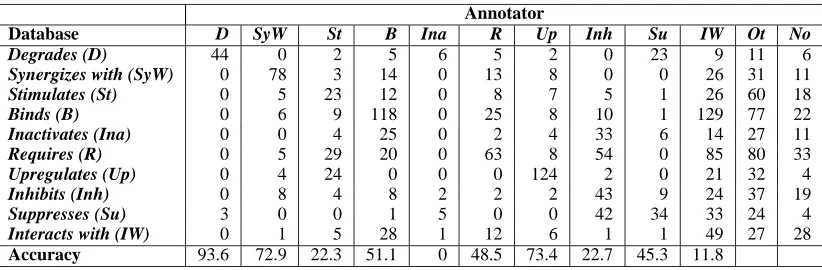
Of the 2114 sentences that were hand-labeled, 68.3% of them disagreed with the HIV-1 database la-bel, 28.4% agreed with the database lala-bel, and 3.3% were found to contain multiple interactions between the proteins. Among the 68.3% of the sentences for which the labels did not agree, 17.4% had the vague interact with relation, 7.4% did not contain any interaction and 43.5% had an interaction differ-ent from that specified by the triple11. In Table 6 we report the mismatch between the two sets of la-bels. The total accuracy of 38.9%12provides a use-ful baseline for using a database for the labeling at the sentence level. It may be the case that certain interactions tend to be biologically related and thus
11For 28% of the triples, none of the sentences extracted from
the target paper were found by the annotator to contain the in-teraction given by the database. We read four of these papers and found sentences containing that interaction, but our system had failed to extract them.
12The accuracy without the vague interact with is 49.4%.
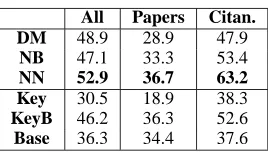
[image:7.612.360.494.51.127.2]All Papers Citan. DM 48.9 28.9 47.9 NB 47.1 33.3 53.4 NN 52.9 36.7 63.2 Key 30.5 18.9 38.3 KeyB 46.2 36.3 52.6 Base 36.3 34.4 37.6
Table 7: Classification accuracies when the models are trained and tested on the hand labeled sentences.
tend to co-occur (upregulate and stimulate or inacti-vate and inhibit, for example).
We investigated a few of the cases in which the labels were “suspiciously” different, for example a case in which the database interaction was stimulate but the annotator found the same proteins to be re-lated by inhibit as well. It turned out that the authors of the article assigned stimulate found little evidence for this interaction (in favor of inhibit), suggesting an error in the database. In another case the database interaction was require but the authors of the article, while supporting this, found that under certain con-ditions (when a protein is too abundant) the interac-tion changes to one of inhibit. Thus we were able to find controversial facts about protein interactions just by looking at the confusion matrix of Table 6.
We trained the models using these hand-labeled sentences in order to determine the interaction ex-pressed for each sentence (as opposed to for each document). This is a difficult task; for some sen-tences it took the annotator several minutes to un-derstand them and decide which interaction applied. Table 7 shows the results on running the classi-fication models on the six interactions for which there were more than 40 examples in the training sets. Again, the sentences from “papers” are espe-cially difficult to classify; the best result for “papers” is 36.7% accuracy versus 63.2% accuracy for “ci-tances.” In this case the difference in performance of “papers” and “citances” is larger than for the pre-vious task of document-level relation classification.
6 Conclusions
Annotator
Database D SyW St B Ina R Up Inh Su IW Ot No
Degrades (D) 44 0 2 5 6 5 2 0 23 9 11 6
Synergizes with (SyW) 0 78 3 14 0 13 8 0 0 26 31 11
Stimulates (St) 0 5 23 12 0 8 7 5 1 26 60 18
Binds (B) 0 6 9 118 0 25 8 10 1 129 77 22
Inactivates (Ina) 0 0 4 25 0 2 4 33 6 14 27 11
Requires (R) 0 5 29 20 0 63 8 54 0 85 80 33
Upregulates (Up) 0 4 24 0 0 0 124 2 0 21 32 4
Inhibits (Inh) 0 8 4 8 2 2 2 43 9 24 37 19
Suppresses (Su) 3 0 0 1 5 0 0 42 34 33 24 4
Interacts with (IW) 0 1 5 28 1 12 6 1 1 49 27 28
[image:8.612.100.511.53.188.2]Accuracy 93.6 72.9 22.3 51.1 0 48.5 73.4 22.7 45.3 11.8
Table 6: Confusion matrix comparing the hand-assigned interactions and those extracted from the HIV-1 database. Ot: sentences for which the annotator found an interaction different from those in Table 2. No: sentences for which the annotator found no interaction. The bottom row shows the accuracy of using the database to label the individual sentences.
database to automatically gather labeled data for this task, and implemented graphical models that can simultaneously perform protein name tagging and relation identification, achieving high accuracy on both problems. We also found evidence support-ing the hypothesis that citation sentences are a good source of training data, most likely because they pro-vide a concise and precise way of summarizing facts in the bioscience literature.
Acknowledgments. We thank Janice Hamer for her help in labeling examples and other biological in-sights. This research was supported by a grant from NSF DBI-0317510 and a gift from Genentech.
References
E. Agichtein and L. Gravano. 2000. Snowball: Extracting rela-tions from large plain-text collecrela-tions. Proc. of DL ’00.
S. Ahmed, D. Chidambaram, H. Davulcu, and C. Baral. 2005. Intex: A syntactic role driven protein-protein interaction ex-tractor for bio-medical text. In Proceedings ISMB/ACL
Bi-olink 2005.
C. Blaschke and A. Valencia. 2002. The frame-based module of the suiseki information extraction system. IEEE
Intelli-gent Systems, 17(2).
C. Blaschke, M.A. Andrade, C. Ouzounis, and A. Valencia. 1999. Automatic extraction of biological information from scientific text: Protein-protein interactions. Proc. of ISMB.
R. Bunescu, R. Ge, R. Kate, E. Marcotte, R. J. Mooney, A. K. Ramani, and Y. W. Wong. 2005. Comparative experiments on learning information extractors for protiens and their in-teractions. Artificial Intelligence in Medicine, 33(2).
D. Corney, B. Buxton, W. Langdon, and D. Jones. 2004. Bio-rat: extracting biological information from full-length pa-pers. Bioinformatics, 20(17).
E. Marcotte, I. Xenarios, and D. Eisenberg. 2001. Mining liter-ature for protein-protein interactions. Bioinformatics, 17(4).
P. Nakov, A. Schwartz, and M. Hearst. 2004. Citances: Cita-tion sentences for semantic analysis of bioscience text. In
Proceedings of the SIGIR’04 workshop on Search and Dis-covery in Bioinformatics.
T. Ono, H. Hishigaki, A. Tanigami, and T. Takagi. 2001. Auto-mated extraction of information on protein-protein interac-tions from the biological literature. Bioinformatics, 17(1).
T. Phuong, D. Lee, and K-H. Lee. 2003. Learning rules to ex-tract protein interactions from biomedical text. In PAKDD.
J. Pustejovsky, J. Castano, and J. Zhang. 2002. Robust rela-tional parsing over biomedical literature: Extracting inhibit relations. Proc. of Pac Symp Biocomputing.
C. Ramani, E. Marcotte, R. Bunescu, and R. Mooney. 2005. Using biomedical literature mining to consolidate the set of known human protein-protein interactions. In Proceedings
ISMB/ACL Biolink 2005.
T. Rindflesch, L. Hunter, and L. Aronson. 1999. Mining molec-ular binding terminology from biomedical text. Proceedings
of the AMIA Symposium.
Barbara Rosario and Marti A. Hearst. 2004. Classifying se-mantic relations in bioscience texts. In Proc. of ACL 2004.
T. Sekimizu, H.S. Park, and J. Tsujii. 1998. Identifying the interaction between genes and gene products based on fre-quently seen verbs in medline abstracts. Gen. Informat., 9.
J. Thomas, D. Milward, C. Ouzounis, and S. Pulman. 2000. Automatic extraction of protein interactions from scientific abstracts. Proceedings of the Pac Symp Biocomput.