Proceedings of the 2011 Conference on Empirical Methods in Natural Language Processing, pages 183–192,
Training a Parser for Machine Translation Reordering
Jason Katz-Brown Slav Petrov Ryan McDonald Franz Och David Talbot Hiroshi Ichikawa Masakazu Seno Hideto Kazawa
{jasonkb|slav|ryanmcd|och|talbot|ichikawa|seno|kazawa}@google.com
Abstract
We propose a simple training regime that can improve the extrinsic performance of a parser, given only a corpus of sentences and a way to automatically evaluate the extrinsic quality of a candidate parse. We apply our method to train parsers that excel when used as part of a reordering component in a statistical ma-chine translation system. We use a corpus of weakly-labeled reference reorderings to guide parser training. Our best parsers contribute significant improvements in subjective trans-lation quality while their intrinsic attachment scores typically regress.
1 Introduction
The field of syntactic parsing has received a great deal of attention and progress since the creation of the Penn Treebank (Marcus et al., 1993; Collins, 1997; Charniak, 2000; McDonald et al., 2005; Petrov et al., 2006; Nivre, 2008). A common— and valid—criticism, however, is that parsers typi-cally get evaluated only on Section 23 of the Wall Street Journal portion of the Penn Treebank. This is problematic for many reasons. As previously ob-served, this test set comes from a very narrow do-main that does not necessarily reflect parser perfor-mance on text coming from more varied domains (Gildea, 2001), especially web text (Foster, 2010). There is also evidence that after so much repeated testing, parsers are indirectly over-fitting to this set (Petrov and Klein, 2007). Furthermore, parsing was never meant as a stand-alone task, but is rather a
means to an end, towards the goal of building sys-tems that can process natural language input.
This is not to say that parsers are not used in larger systems. All to the contrary, as parsing technology has become more mature, parsers have become ef-ficient and accurate enough to be useful in many natural language processing systems, most notably in machine translation (Yamada and Knight, 2001; Galley et al., 2004; Xu et al., 2009). While it has been repeatedly shown that using a parser can bring net gains on downstream application quality, it is of-ten unclear how much intrinsic parsing accuracy ac-tually matters.
In this paper we try to shed some light on this is-sue by comparing different parsers in the context of machine translation (MT). We present experiments on translation from English to three Subject-Object-Verb (SOV) languages,1 because those require
ex-tensive syntactic reordering to produce grammatical translations. We evaluate parse quality on a num-ber of extrinsic metrics, including word reordering accuracy, BLEU score and a human evaluation of fi-nal translation quality. We show that while there is a good correlation between those extrinsic metrics, parsing quality as measured on the Penn Treebank is not a good indicator of the final downstream ap-plication quality. Since the word reordering metric can be computed efficiently offline (i.e. without the use of the final MT system), we then propose to tune parsers specifically for that metric, with the goal of improving the performance of the overall system.
To this end we propose a simple training regime
1We experiment with Japanese, Korean and Turkish, but there is nothing language specific in our approach.
which we refer to as targeted self-training (Sec-tion 2). Similar to self-training, a baseline model is used to produce predictions on an unlabeled data set. However, rather than directly training on the output of the baseline model, we generate a list of hypotheses and use an external signal to select the best candidate. The selected parse trees are added to the training data and the model is then retrained. The experiments in Section 5 show that this simple procedure noticeably improves our parsers for the task at hand, resulting in significant improvements in downstream translation quality, as measured in a human evaluation on web text.
This idea is similar in vein to McClosky. et al. (2006) and Petrov et al. (2010), except that we use an extrinsic quality metric instead of a second parsing model for making the selection. It is also similar to Burkett and Klein (2008) and Burkett et al. (2010), but again avoiding the added complexity introduced by the use of additional (bilingual) models for can-didate selection.
It should be noted that our extrinsic metric is com-puted from data that has been manually annotated with reference word reorderings. Details of the re-ordering metric and the annotated data we used are given in Sections 3 and 4. While this annotation re-quires some effort, such annotations are much easier to obtain than full parse trees. In our experiments in Section 6 we show that we can obtain similar improvements on downstream translation quality by targeted self-training with weakly labeled data (in form of word reorderings), as with training on the fully labeled data (with full syntactic parse trees).
2 Targeted Self-Training
Our technique for retraining a baseline parser is an extension of training. In standard parser self-training, one uses the baseline parsing model to parse a corpus of sentences, and then adds the1-best
output of the baseline parser to the training data. To target the self-training, we introduce an additional step, given as Algorithm 1. Instead of taking the1
-best parse, we produce a rankedn-best list of predic-tions and select the parser which gives the best score according to an external evaluation function. That is, instead of relying on the intrinsic model score, we use an extrinsic score to select the parse towards
Algorithm 1Select parse that maximizes an extrin-sic metric.
Input: baseline parserB
Input: sentenceS
Input: function COMPUTEEXTRINSIC(parseP)
Output: a parse for the input sentence
Pn={P1, . . . , Pn} ←n-best parses ofSbyB
maxScore =0
bestParse =∅
fork=1tondo
extrinsicScore = COMPUTEEXTRINSIC(Pk)
ifextrinsicScore>maxScorethen
maxScore = extrinsicScore bestParse =Pk
end if end for
return bestParse
which to update. In the case of a tie, we prefer the parse ranked most highly in then-best list.
The motivation of this selection step is that good performance on the downstream external task, mea-sured by the extrinsic metric, should be predictive of an intrinsically good parse. At the very least, even if the selected parse is not syntactically cor-rect, or even if it goes against the original treebank-ing guidelines, it results in a higher extrinsic score and should therefore be preferred.
One could imagine extending this framework by repeatedly running self-training on successively im-proving parsers in an EM-style algorithm. A recent work by Hall et al. (2011) on training a parser with multiple objective functions investigates a similar idea in the context of online learning.
3 The MT Reordering Task
Determining appropriate target language word or-der for a translation is a fundamental problem in MT. When translating between languages with sig-nificantly different word order such as English and Japanese, it has been shown that metrics which ex-plicitly account for word-order are much better cor-related with human judgments of translation qual-ity than those that give more weight to word choice, like BLEU (Lavie and Denkowski, 2009; Isozaki et al., 2010a; Birch and Osborne, 2010). This demon-strates the importance of getting reordering right.
3.1 Reordering as a separately evaluable component
One way to break down the problem of translat-ing between languages with different word order is to handle reordering and translation separately: first reorder source-language sentences into target-language word order in a preprocessing step, and then translate the reordered sentences. It has been shown that good results can be achieved by reorder-ing each input sentence usreorder-ing a series of tree trans-formations on its parse tree. The rules for tree transformation can be manually written (Collins et al., 2005; Wang, 2007; Xu et al., 2009) or auto-matically learned (Xia and McCord, 2004; Habash, 2007; Genzel, 2010).
Doing reordering as a preprocessing step, sepa-rately from translation, makes it easy to evaluate re-ordering performance independently from the MT system. Accordingly, Talbot et al. (2011) present a framework for evaluating the quality of reordering separately from the lexical choice involved in trans-lation. They propose a simple reordering metric
based on METEOR’s reordering penalty (Lavie and Denkowski, 2009). This metric is computed solely on the source language side. To compute it, one takes the candidate reordering of the input sentence and partitions it into a set C of contiguous spans whose content appears contiguously in the same or-der in the reference. The reoror-dering score is then computed as
ρ(esys,eref) = 1−|C| − 1
|e| −1.
This metric assigns a score between0and1where1
indicates that the candidate reordering is identical to the reference and0indicates that no two words that are contiguous in the candidate reordering are con-tiguous in the reference. For example, if a reference reordering isA B C D E, candidate reordering A B E C Dwould get score1−(3−1)/(5−1) = 0.5.
Talbot et al. (2011) show that this reordering score is strongly correlated with human judgment of trans-lation quality. Furthermore, they propose to evalu-ate the reordering quality of an MT system by com-puting its reordering score on a test set consisting of source language sentences and their reference re-orderings. In this paper, we take the same approach for evaluation, and in addition, we use corpora of source language sentences and their reference re-orderings for training the system, not just testing it. We describe in more detail how the reference re-ordering data was prepared in Section 4.1.
3.2 Reordering quality as predictor of parse quality
Figure 1 gives concrete examples of good and bad reorderings of an English sentence into Japanese word order. It shows that a bad parse leads to a bad reordering (lacking inversion of verb “wear” and ob-ject “sunscreen”) and a low reordering score. Could we flip this causality around, and perhaps try to iden-tify a good parse tree based on its reordering score? With the experiments in this paper, we show that in-deed a high reordering score is predictive of the un-derlying parse tree that was used to generate the re-ordering being a good parse (or, at least, being good enough for our purpose).
4 Experimental Setup
4.1 Treebank data
In our experiments the baseline training corpus is the Wall Street Journal (WSJ) section of the Penn Treebank (Marcus et al., 1993) using standard train-ing/development/testing splits. We converted the treebank to match the tokenization expected by our MT system. In particular, we split tokens containing hyphens into multiple tokens and, somewhat sim-plistically, gave the original token’s part-of-speech tag to all newly created tokens. In Section 6 we make also use of the Question Treebank (QTB) (Judge et al., 2006), as a source of syntactically an-notated out-of-domain data. Though we experiment with both dependency parsers and phrase structure parsers, our MT system assumes dependency parses as input. We use the Stanford converter (de Marneffe et al., 2006) to convert phrase structure parse trees to dependency parse trees (for both treebank trees and predicted trees).
4.2 Reference reordering data
We aim to build an MT system that can accurately translate typical English text that one finds on the Internet to SOV langauges. To this end, we ran-domly sampled 13595 English sentences from the web and created Japanese-word-order reference re-orderings for them. We split the sentences arbitrarily into a 6268-sentence Web-Train corpus and a 7327-sentence Web-Test corpus.
To make the reference alignments we used the technique suggested by Talbot et al. (2011): ask annotators to translate each English sentence to Japanese extremely literally and annotate which En-glish words align to which Japanese words. Golden reference reorderings can be made programmati-cally from these annotations. Creating a large set of reference reorderings is straightforward because annotators need little special background or train-ing, as long as they can speak both the source and target languages. We chose Japanese as the target language through which to create the English refer-ence reorderings because we had access to bilingual annotators fluent in English and Japanese.
Good parse
Reordered:
15 or greater of an SPF has that sunscreen Wear Reordering score:1.0(matches reference)
Bad parse
Reordered:
[image:4.612.310.538.70.272.2]15 or greater of an SPF has that Wear sunscreen Reordering score:0.78(“Wear” is out of place)
Figure 1: Examples of good and bad parses and cor-responding reorderings for translation from English to Japanese. The good parse correctly identifies “Wear” as the main verb and moves it to the end of the sentence; the bad parse analyses “Wear sunscreen” as a noun phrase and does not reorder it. This example was one of the wins in the human evaluation of Section 5.2.
4.3 Parsers
The core dependency parser we use is an implemen-tation of a transition-based dependency parser using an arc-eager transition strategy (Nivre, 2008). The parser is trained using the averaged perceptron algo-rithm with an early update strategy as described in Zhang and Clark (2008). The parser uses the fol-lowing features: word identity of the first two words on the buffer, the top word on the stack and the head of the top word on the stack (if available); part-of-speech identities of the first four words on the buffer and top two words on the stack; dependency arc la-bel identities for the top word on the stack, the left and rightmost modifier of the top word on the stack, and the leftmost modifier of the first word in the buffer. We also include conjunctions over all non-lexical features.
We also give results for the latent variable parser (a.k.a. BerkeleyParser) of Petrov et al. (2006). We convert the constituency trees output by the Berke-leyParser to labeled dependency trees using the same procedure that is applied to the treebanks.
with a separate POS tagger. We use the TnT tag-ger (Brants, 2000) in our experiments, because of its efficiency and ease of use. Tagger and parser are always trained on the same data.
For all parsers, we lowercase the input at train and test time. We found that this improves performance in parsing web text. In addition to general upper-case/lowercase noisiness of the web text negatively impacting scores, we found that the baseline case-sensitive parsers are especially bad at parsing imper-ative sentences, as discussed in Section 5.3.2.
4.4 Reordering rules
In this paper we focus on English to Japanese, Ko-rean, and Turkish translation. We use a superset of the reordering rules proposed by Xu et al. (2009), which flatten a dependency tree into SOV word or-der that is suitable for all three languages. The rules define a precedence order for the dependents of each part of speech. For example, a slightly simplified version of the precedence order of child labels for a verbal head HEADVERB is: advcl, nsubj, prep,
[other children], dobj, prt, aux, neg, HEADVERB,
mark, ref, compl.
Alternatively, we could have used an automatic reordering-rule learning framework like that of Gen-zel (2010). Because the reordering accuracy met-ric can be computed for any source/target language pair, this would have made our approach language completely independent and applicable to any lan-guage pair. We chose to use manually written rules to eliminate the variance induced by the automatic reordering-rule learning framework.
4.5 MT system
We carried out all our translation experiments on a state-of-the-art phrase-based statistical MT system. During both training and testing, the system reorders source-language sentences in a preprocessing step using the above-mentioned rules. During decoding, we used an allowed jump width of4words. In
ad-dition to the regular distance distortion model, we incorporate a maximum entropy based lexicalized phrase reordering model (Zens and Ney, 2006) as a feature used in decoding.
Overall for decoding, we use between 20 to 30 features, whose weights are optimized using MERT (Och, 2003). All experiments for a given
lan-guage pair use the same set of MERT weights tuned on a system using a separate parser (that is neither the baseline nor the experiment parser). This po-tentially underestimates the improvements that can be obtained, but also eliminates MERT as a pos-sible source of improvement, allowing us to trace back improvements in translation quality directly to parser changes.2
For parallel training data, we use a custom collec-tion of parallel documents. They come from vari-ous sources with a substantial portion coming from the web after using simple heuristics to identify po-tential document pairs. For all language pairs, we trained on approximately 300 million source words each.
5 Experiments Reordering Web Text
We experimented with parsers trained in three dif-ferent ways:
1. Baseline: trained only on WSJ-Train.
2. Standard self-training: trained on WSJ-Train and1-best parse of the Web-Train set by
base-line parser.
3. Targeted self-training: trained on WSJ-Train and, for each sentence in Web-Train, the parse from the baseline parser’s 512-best list that
when reordered gives the highest reordering score.3
5.1 Standard self-training vs targeted self-training
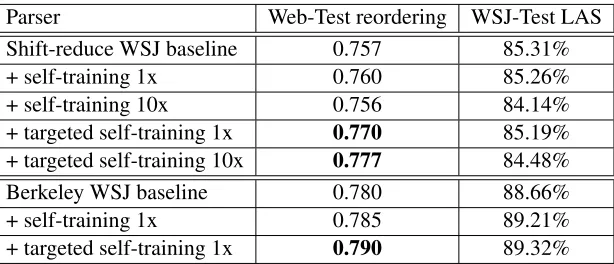
Table 1 shows that targeted self-training on Web-Train significantly improves Web-Test reordering score more than standard self-training for both the shift-reduce parser and for the BerkeleyParser. The reordering score is generally divorced from the at-tachment scores measured on the WSJ-Test tree-bank: for the shift-reduce parser, Web-Test reorder-ing score and WSJ-Test labeled attachment score
2We also ran MERT on all systems and the pattern of im-provement is consistent, but sometimes the imim-provement is big-ger or smaller after MERT. For instance, the BLEU delta for Japanese is +0.0030 with MERT on both sides as opposed to +0.0025 with no MERT.
Parser Web-Test reordering WSJ-Test LAS Shift-reduce WSJ baseline 0.757 85.31% + self-training 1x 0.760 85.26% + self-training 10x 0.756 84.14% + targeted self-training 1x 0.770 85.19% + targeted self-training 10x 0.777 84.48% Berkeley WSJ baseline 0.780 88.66% + self-training 1x 0.785 89.21% + targeted self-training 1x 0.790 89.32%
Table 1: English→Japanese reordering scores on Web-Test for standard self-training and targeted self-training on Web-Train. Label “10x” indicates that the self-training data was weighted 10x relative to the WSJ training data. Bolded reordering scores are different from WSJ-only baseline with 95% confidence but are not significantly different from each other within the same group.
[image:6.612.154.461.70.202.2]English to BLEU Human evaluation (scores range 0 to 6) WSJ-only Targeted WSJ-only Targeted Sig. difference? Japanese 0.1777 0.1802 2.56 2.69 yes (at 95% level) Korean 0.3229 0.3259 2.61 2.70 yes (at 90% level) Turkish 0.1344 0.1370 2.10 2.20 yes (at 95% level)
Table 2: BLEU scores and human evaluation results for translation between three language pairs, varying only the parser between systems. “WSJ-only” corresponds to the baseline WSJ-only shift-reduce parser; “Targeted” corre-sponds to the Web-Train targeted self-training 10x shift-reduce parser.
(LAS) are anti-correlated, but for BerkeleyParser they are correlated. Interestingly, weighting the self-training data more seems to have a negative effect on both metrics.4
One explanation for the drops in LAS is that some parts of the parse tree are important for downstream reordering quality while others are not (or only to a lesser extent). Some distinctions between labels become less important; for example, arcs labeled “amod” and “advmod” are transformed identically by the reordering rules. Some semantic distinctions also become less important; for example, any sane interpretation of “red hot car” would be reordered the same, that is, not at all.
5.2 Translation quality improvement
To put the improvement of the MT system in terms of BLEU score (Papineni et al., 2002), a widely used metric for automatic MT evaluation, we took 5000 sentences from Web-Test and had humans gener-ate reference translations into Japanese, Korean, and
4We did not attempt this experiment for the BerkeleyParser since training was too slow.
Turkish. We then trained MT systems varying only the parser used for reordering in training and decod-ing. Table 2 shows that targeted self-training data increases BLEU score for translation into all three languages.
In addition to BLEU increase, a side-by-side hu-man evaluation on 500 sentences (sampled from the 5000 used to compute BLEU scores) showed a statistically significant improvement for all three languages (see again Table 2). For each sen-tence, we asked annotators to simultaneously score both translations from 0 to 6, with guidelines that 6=“Perfect”, 4=“Most Meaning/Grammar”, 2=“Some Meaning/Grammar”, 0=“Nonsense”. We computed confidence intervals for the average score difference using bootstrap resampling; a difference is significant if the two-sided confidence interval does not include0.
5.3 Analysis
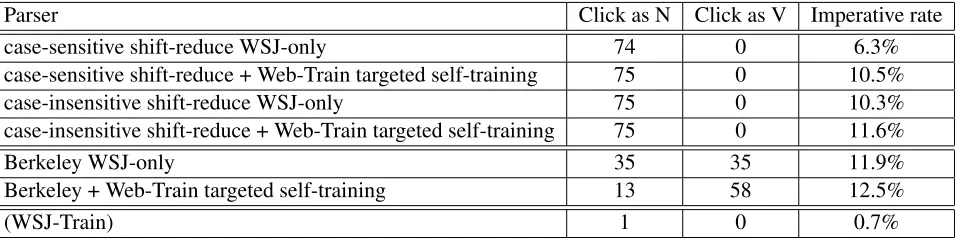
Parser Click as N Click as V Imperative rate case-sensitive shift-reduce WSJ-only 74 0 6.3% case-sensitive shift-reduce + Web-Train targeted self-training 75 0 10.5% case-insensitive shift-reduce WSJ-only 75 0 10.3% case-insensitive shift-reduce + Web-Train targeted self-training 75 0 11.6%
Berkeley WSJ-only 35 35 11.9%
Berkeley + Web-Train targeted self-training 13 58 12.5%
[image:7.612.76.556.71.191.2](WSJ-Train) 1 0 0.7%
Table 3: Counts on Web-Test of “click” tagged as a noun and verb and percentage of sentences parsed imperatively.
poses very different challenges compared to parsing newswire. We show how our method improves pars-ing performance and reorderpars-ing performance on two examples: the trendy word “click” and imperative sentences.
5.3.1 Click
The word “click” appears only once in the train-ing portion of the WSJ (as a noun), but appears many times in our Web test data. Table 3 shows the distri-bution of part-of-speech tags that different parsers assign to “click”. The WSJ-only parsers tag “click” as a noun far too frequently. The WSJ-only shift-reduce parser refuses to tag “click” as a verb even with targeted self-training, but BerkeleyParser does learn to tag “click” more often as a verb.
It turns out that the shift-reduce parser’s stub-bornness is not due to a fundamental problem of the parser, but due to an artifact in TnT. To in-crease speed, TnT restricts the choices of tags for known words to previously-seen tags. This causes the parser’sn-best lists to never hypothesize “click”
as a verb, and self-training doesn’t click no matter how targeted it is. This shows that the targeted self-training approach heavily relies on the diversity of the baseline parser’sn-best lists.
It should be noted here that it would be easy to combine our approach with theuptrainingapproach of Petrov et al. (2010). The idea would be to use the BerkeleyParser to generate then-best lists; perhaps
we could call thistargeted uptraining. This way, the shift-reduce parser could benefit both from the gen-erally higher quality of the parse trees produced by the BerkeleyParser, as well as from the information provided by the extrinsic scoring function.
5.3.2 Imperatives
As Table 3 shows, the WSJ training set contains only 0.7% imperative sentences.5 In contrast, our
test sentences from the web contain approximately 10% imperatives. As a result, parsers trained exclu-sively on the WSJ underproduce imperative parses, especially a case-sensitive version of the baseline. Targeted self-training helps the parsers to predict im-perative parses more often.
Targeted self-training works well for generating training data with correctly-annotated imperative constructions because the reordering of main sub-jects and verbs in an SOV language like Japanese is very distinct: main subjects stay at the begin-ning of the sentence, and main verbs are reordered to the end of the sentence. It is thus especially easy to know whether an imperative parse is correct or not by looking at the reference reordering. Figure 1 gives an example: the bad (WSJ-only) parse doesn’t catch on to the imperativeness and gets a low re-ordering score.
6 Targeted Self-Training vs Training on Treebanks for Domain Adaptation
If task-specific annotation is cheap, then it is rea-sonable to consider whether we could use targeted self-training to adapt a parser to a new domain as a cheaper alternative to making new treebanks. For example, if we want to build a parser that can reorder question sentences better than our baseline WSJ-only parser, we have these two options:
1. Manually construct PTB-style trees for 2000
questions and train on the resulting treebank. 2. Create reference reorderings for 2000 questions
and then do targeted self-training.
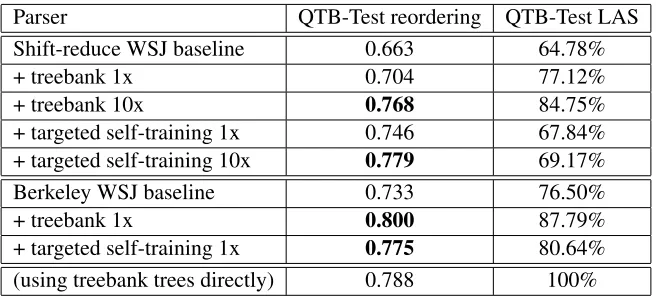
To compare these approaches, we created reference reordering data for our train (2000 sentences) and test (1000 sentences) splits of the Question Tree-bank (Judge et al., 2006). Table 4 shows that both ways of training on QTB-Train sentences give sim-ilarly large improvements in reordering score on QTB-Test. Table 5 confirms that this corresponds to very large increases in English→Japanese BLEU
score and subjective translation quality. In the hu-man side-by-side comparison, the baseline transla-tions achieved an average score of 2.12, while the targeted self-training translations received a score of 2.94, where a score of 2 corresponds to “some ing/grammar” and “4” corresponds to “most mean-ing/grammar”.
But which of the two approaches is better? In the shift-reduce parser, targeted self-training gives higher reordering scores than training on the tree-bank, and in BerkeleyParser, the opposite is true. Thus both approaches produce similarly good re-sults. From a practical perspective, the advantage of targeted self-training depends on whether the extrin-sic metric is cheaper to calculate than treebanking. For MT reordering, making reference reorderings is cheap, so targeted self-training is relatively advanta-geous.
As before, we can examine whether labeled at-tachment score measured on the test set of the QTB is predictive of reordering quality. Table 4 shows that targeted self-training raises LAS from 64.78→69.17%. But adding the treebank leads to much larger increases, resulting in an LAS of 84.75%, without giving higher reordering score. We can conclude that high LAS is not necessary to achieve top reordering scores.
Perhaps our reordering rules are somehow defi-cient when it comes to reordering correctly-parsed questions, and as a result the targeted self-training process steers the parser towards producing patho-logical trees with little intrinsic meaning. To explore this possibility, we computed reordering scores after reordering the QTB-Test treebank trees directly. Ta-ble 4 shows that this gives reordering scores similar to those of our best parsers. Therefore it is at least
possible that the targeted self-training process could have resulted in a parser that achieves high reorder-ing score by producreorder-ing parses that look like those in the QuestionBank.
7 Related Work
Our approach to training parsers for reordering is closely related to self/up-training (McClosky. et al., 2006; Petrov et al., 2010). However, unlike uptrain-ing, our method does not use only the1-best output
of the first-stage parser, but has access to then-best list. This makes it similar to the work of McClosky. et al. (2006), except that we use an extrinsic metric (MT reordering score) to select a high quality parse tree, rather than a second, reranking model that has access to additional features.
Targeted self-training is also similar to the re-training of Burkett et al. (2010) in which they jointly parse unannotated bilingual text using a mul-tiview learning objective, then retrain the monolin-gual parser models to include each side of the jointly parsed bitext as monolingual training data. Our ap-proach is different in that it doesn’t use a second parser and bitext to guide the creation of new train-ing data, and instead relies on n-best lists and an
extrinsic metric.
per-Parser QTB-Test reordering QTB-Test LAS Shift-reduce WSJ baseline 0.663 64.78%
+ treebank 1x 0.704 77.12%
+ treebank 10x 0.768 84.75%
+ targeted self-training 1x 0.746 67.84% + targeted self-training 10x 0.779 69.17% Berkeley WSJ baseline 0.733 76.50%
+ treebank 1x 0.800 87.79%
+ targeted self-training 1x 0.775 80.64% (using treebank trees directly) 0.788 100%
Table 4: Reordering and labeled attachment scores on QTB-Test for treebank training and targeted self-training on QTB-Train.
[image:9.612.143.471.70.218.2]English to QTB-Test BLEU Human evaluation (scores range 0 to 6) WSJ-only Targeted WSJ-only Targeted Sig. difference? Japanese 0.2379 0.2615 2.12 2.94 yes (at 95% level)
Table 5: BLEU scores and human evaluation results for English→Japanese translation of the QTB-Test corpus, varying only the parser between systems between the WSJ-only shift-reduce parser and the QTB-Train targeted self-training 10x shift-reduce parser.
ceptron model for an end-to-end MT system where the alignment parameters are updated based on se-lecting an alignment from an-best list that leads to
highest BLEU score. As mentioned earlier, this also makes our work similar to Hall et al. (2011) who train a perceptron algorithm on multiple objective functions with the goal of producing parsers that are optimized for extrinsic metrics.
It has previously been observed that parsers of-ten perform differently for downstream applications. Miyao et al. (2008) compared parser quality in the biomedical domain using a protein-protein interac-tion (PPI) identificainterac-tion accuracy metric. This al-lowed them to compare the utility of extant depen-dency parsers, phrase structure parsers, and deep structure parsers for the PPI identification task. One could apply the targeted self-training technique we describe to optimize any of these parsers for the PPI task, similar to how we have optimized our parser for the MT reordering task.
8 Conclusion
We introduced a variant of self-training that targets parser training towards an extrinsic evaluation met-ric. We use this targeted self-training approach to train parsers that improve the accuracy of the word
reordering component of a machine translation sys-tem. This significantly improves the subjective qual-ity of the system’s translations from English into three SOV languages. While the new parsers give improvements in these external evaluations, their in-trinsic attachment scores go down overall compared to baseline parsers trained only on treebanks. We conclude that when using a parser as a component of a larger external system, it can be advantageous to incorporate an extrinsic metric into parser train-ing and evaluation, and that targeted self-traintrain-ing is an effective technique for incorporating an extrinsic metric into parser training.
References
A. Birch and M. Osborne. 2010. LRscore for evaluating lexical and reordering quality in MT. In ACL-2010 WMT.
T. Brants. 2000. TnT – a statistical part-of-speech tagger. InANLP ’00.
D. Burkett and D. Klein. 2008. Two languages are better than one (for syntactic parsing). InEMNLP ’08. D. Burkett, S. Petrov, J. Blitzer, and D. Klein. 2010.
M. Chang, L. Ratinov, and D. Roth. 2007. Guiding semi-supervision with constraint-driven learning. In ACL ’07.
M. Chang, D. Goldwasser, D. Roth, and V. Srikumar. 2010. Structured output learning with indirect super-vision. InICML ’10.
E. Charniak. 2000. A maximum–entropy–inspired parser. InNAACL ’00.
J. Clarke, D. Goldwasser, M. Chang, and D. Roth. 2010. Driving semantic parsing from the world’s response. InCoNLL ’10.
M. Collins, P. Koehn, and I. Kuˇcerov´a. 2005. Clause re-structuring for statistical machine translation. InACL ’05.
M. Collins. 1997. Three generative, lexicalised models for statistical parsing. InACL ’97.
M.-C. de Marneffe, B. MacCartney, and C. Manning. 2006. Generating typed dependency parses from phrase structure parses. InLREC ’06.
J. Foster. 2010. “cba to check the spelling”: Investigat-ing parser performance on discussion forum posts. In NAACL ’10.
M. Galley, M. Hopkins, K. Knight, and D. Marcu. 2004. What’s in a translation rule? InHLT-NAACL ’04. K. Ganchev, J. Grac¸a, J. Gillenwater, and B. Taskar.
2010. Posterior regularization for structured latent variable models. Journal of Machine Learning Re-search.
D. Genzel. 2010. Automatically learning source-side re-ordering rules for large scale machine translation. In COLING ’10.
D. Gildea. 2001. Corpus variation and parser perfor-mance. InEMNLP ’01.
N. Habash. 2007. Syntactic preprocessing for statistical machine translation. InMTS ’07.
K. Hall, R. McDonald, J. Katz-Brown, and M. Ringgaard. 2011. Training dependency parsers by jointly optimiz-ing multiple objectives. InEMNLP ’11.
H. Isozaki, T. Hirao, K. Duh, K. Sudoh, and H. Tsukada. 2010a. Automatic evaluation of translation quality for distant language pairs. InEMNLP ’10.
H. Isozaki, K. Sudoh, H. Tsukada, and K. Duh. 2010b. Head finalization: A simple reordering rule for SOV languages. InACL-2010 WMT.
J. Judge, A. Cahill, and J. v. Genabith. 2006. Question-Bank: creating a corpus of parse-annotated questions. InACL ’06.
A. Lavie and M. Denkowski. 2009. The Meteor metric for automatic evaluation of machine translation. Ma-chine Translation, 23(2-3).
P. Liang, A. Bouchard-Cˆot´e, D. Klein, and B. Taskar. 2006. An end-to-end discriminative approach to ma-chine translation. InACL ’06.
M. Marcus, B. Santorini, and M. Marcinkiewicz. 1993. Building a large annotated corpus of English: The Penn Treebank. InComputational Linguistics. D. McClosky., E. Charniak, and M. Johnson. 2006.
Ef-fective self-training for parsing. InNAACL ’06. R. McDonald, K. Crammer, and F. Pereira. 2005. Online
large-margin training of dependency parsers. InACL ’05.
Y. Miyao, R. Sætre, K. Sagae, T. Matsuzaki, and J. Tsu-jii. 2008. Task-oriented evaluation of syntactic parsers and their representations. InACL ’08.
J. Nivre. 2008. Algorithms for deterministic incremen-tal dependency parsing. Computational Linguistics, 34(4).
F. Och. 2003. Minimum error rate training in statistical machine translation. InACL ’03.
K. Papineni, S. Roukos, T. Ward, and W. Zhu. 2002. BLEU: a method for automatic evaluation of machine translation. InACL ’02.
S. Petrov and D. Klein. 2007. Improved inference for unlexicalized parsing. InNAACL ’07.
S. Petrov, L. Barrett, R. Thibaux, and D. Klein. 2006. Learning accurate, compact, and interpretable tree an-notation. InACL ’06.
S. Petrov, P. Chang, and M. Ringgaard H. Alshawi. 2010. Uptraining for accurate deterministic question parsing. InEMNLP ’10.
D. Talbot, H. Kazawa, H. Ichikawa, J. Katz-Brown, M. Seno, and F. Och. 2011. A lightweight evalua-tion framework for machine translaevalua-tion reordering. In EMNLP-2011 WMT.
C. Wang. 2007. Chinese syntactic reordering for statisti-cal machine translation. InEMNLP ’07.
F. Xia and M. McCord. 2004. Improving a statistical MT system with automatically learned rewrite patterns. In Coling ’04.
P. Xu, J. Kang, M. Ringgaard, and F. Och. 2009. Using a dependency parser to improve SMT for subject-object-verb languages. InNAACL-HLT ’09.
K. Yamada and K. Knight. 2001. A syntax-based statis-tical translation model. InACL ’01.
R. Zens and H. Ney. 2006. Discriminative reordering models for statistical machine translation. In NAACL-06 WMT.