An Implementation of a Pairing-Based Anonymous
Credential System with Constant Complexity
Amang Sudarsono, Toru Nakanishi, Nobuo Funabiki
∗Abstract—An anonymous credential system allows the user to convince a verifier of the possession of a certificate issued by the issuing authority anonymously. One of the applications is the privacy-enhancing electronic ID (eID). A previously proposed anonymous credential system achieves the constant complexity for the number of user’s attributes. However, due to the use of RSA-based cryptography, it still suffers from a high cost computation. Recently, we proposed an anonymous credential system with the constant complexity using a pairing-based accumulator, where more efficient ECC (Elliptic Curve Cryptography) can be used instead of the RSA. In this paper, we present an implementation of the anonymous credential system in the application to the eID. We show the practicality of the system from experimental results that the processing times are constantly less than a second.
Index Terms—Authentications, privacy, anonymous creden-tials, electronic ID, pairings
I. INTRODUCTION
A. Backgrounds
Electronic identification have been widely applied to ac-cess to buildings, use of facilities, Web services, etc. Cur-rently, electronic identity (eID) such as eID card is often used for the identification. The eID is issued by a trusted organization such as the government, company, or university, and used for services provided by the organization. On the other hand, such a trusted ID is very attractive for secondary use in commercial services. The eID includes attributes of the user such as name, address, gender, occupation, date of birth. In commercial cases, instead of the identification, the attribute-based authentication is desired. For example, a service provider can refuse the access from kids, by checking the age in the eID.
One of serious issues in the existing eID systems is user’s privacy. In the systems, the eID reveals the user’s identity. Thus, the service provider can collect the use history of each user. Furthermore, part of attributes are a high privacy-sensitive, and only the selected attributes should be disclosed. Anonymous credential systems [1], [2], [3], [4] are one of the solutions.
Anonymous credential systems allow an issuer to issue a certificate to a user. Each certificate is a proof of membership, qualification or privilege, and it contains user’s attributes. The user can anonymously convince a verifier of the posses-sion of the certificate, where the selected attributes can be disclosed without revealing any other information about the user’s privacy. The user can prove complex relations on the attributes using AND and OR relations. AND relation is used when proving the possession of all of the multiple attributes. For example, the user can prove that he is a student, he has
∗ Dept. of Communication Network Engineering, Okayama University, 3-1-1 Tsushima-naka, Okayama, 700-8530 Japan
Email:[email protected]
a valid student card, and this card has not yet expired, when entering the faculty building. OR relation represents the proof for possession of one of multiple attributes. For example, he can prove that he is either a staff or a teacher when using a copy machine in the office.
B. Related Works
In [1], Camenisch and Lysyanskaya firstly proposed an anonymous credential system based on RSA. Unfortunately, it suffers from a linear complexity in the number of user’s attributes in proving AND and OR relations. Hence, this system is not suitable for small devices such as smart cards. In [3], Camenisch and Groß extended the system to solve the drawback, where the attributes are encoded into prime numbers. Then, the AND and OR relations are proven with the constant complexity w.r.t. the number of attributes using zero-knowledge proofs of integer relations on prime numbers. However, due to the use of RSA-based cryptography, it still suffers from a high cost computation.
An implementation of eID on a standard Java card using the systems of [1], [3] is shown in [5].
C. Our Contributions
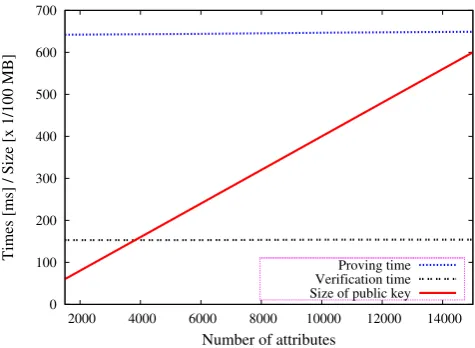
In [4], we proposed a pairing-based anonymous credential system with the constant complexity. The use of pairings allows us to apply ECC (Elliptic Curve Cryptography) in-stead of RSA. Thus, due to the shorter key size, we expect light computations. In this paper, to show the practicality of the proposed system, we present the implementation and evaluate it from experiments. For the implementation, we suppose an eID application over Web services for mobile environments. In the prototype system, the computation time of the prover (user) and the verifier (server) are relatively constant of only 640 ms and 153 ms when proving the AND relation. They are only 630 ms and 152 ms for the OR relation. Unfortunately, as the compensation, the size of the public key depends on the number of attributes. It varies from601 kB to 6MB when the number of attributes increases from 1,500 to 15,000. In the current mobile PC environments, the data size is sufficiently practical, since the public key is not changed after it is distributed in the user registration.
II. IMPLEMENTEDANONYMOUSCREDENTIALSYSTEM
A. Model
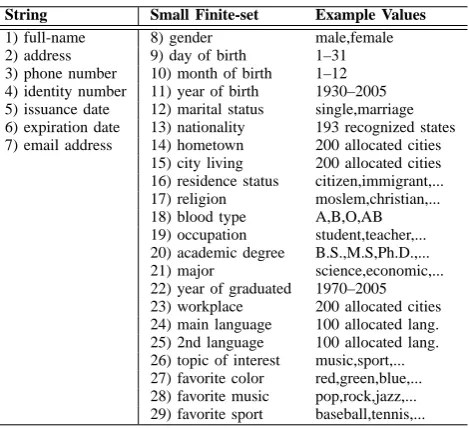
occupation. Another type is a string attribute such as the full-name or the address. The example of those attributes used in the eID is depicted in TABLE I. The anonymous credential system consists of three protocols: KeyGen, ObtainCert, and ProveCert.
TABLE I
EXAMPLE OF STRING AND SMALL FINITE-SET ATTRIBUTES.
String Small Finite-set Example Values
1) full-name 8) gender male,female
2) address 9) day of birth 1–31 3) phone number 10) month of birth 1–12 4) identity number 11) year of birth 1930–2005 5) issuance date 12) marital status single,marriage 6) expiration date 13) nationality 193 recognized states 7) email address 14) hometown 200 allocated cities
15) city living 200 allocated cities 16) residence status citizen,immigrant,... 17) religion moslem,christian,... 18) blood type A,B,O,AB 19) occupation student,teacher,... 20) academic degree B.S.,M.S,Ph.D.,... 21) major science,economic,... 22) year of graduated 1970–2005 23) workplace 200 allocated cities 24) main language 100 allocated lang. 25) 2nd language 100 allocated lang. 26) topic of interest music,sport,... 27) favorite color red,green,blue,... 28) favorite music pop,rock,jazz,... 29) favorite sport baseball,tennis,...
• KeyGen: This is a probabilistic key generation
algo-rithm for the issuer, on the input security parameter 1L and the maximum numbers of string and finite-set
attributes n, ℓ, outputs the issuer’s public key ipk and the issuer’s secret keyisk.
• ObtainCert: This is an interactive protocol between
a probabilistic algorithm User of user with IDi and
a probabilistic algorithm Issuer. The common input of this protocol are ipk and (SAi, FAi) that are sets
of string attributes and finite-set attributes of the user, respectively. In addition, the input for Issuer is isk. The output of User is the certificate cert[i] ensuring the attributes (SAi, FAi).
• ProveCert: This is an interactive protocol between the
user and the verifier. The common inputs are ipk, and (TSA, TFA) are subsets of string attributes and finite-set attributes respectively, and user’s secret inputs are cert[i]and (SAi, FAi).
(1) By using the string attributes, it is proven that a part of attributes TSA⊆SAi is all certified
bycert[i].
(2) For the finite-set attributes, we have two op-tions:
(a) the AND relation proves that all of the attribute sets TFA are certified by cert[i], or
(b) the OR relation proves that one of the attribute sets TFA is certified bycert[i]. The security requirements of the anonymous credential system are as follows:
• Unforgeability: Only the user with the certificate
certi-fying the proved relation is accepted by the verifier in
ProveCert protocol.
• Anonymity: Any verifiers cannot identify the user from ProveCert protocol.
• Unlinkability: Any verifiers cannot determine whether
any pair of ProveCert protocols were conducted by the same user or not.
The unlinkability is a stronger anonymity. In linkable anonymous setting, the verifier can collect the use history of an anonymous user, since the verifier can determine the sameness of the prover. Then, the history may de-anonymize the prover by relating the dates or frequency. Also, if one transaction is de-anonymized by some other method, all the transactions of the prover are de-anonymized. Therefore, the unlinkability is needed.
B. Outline of Cryptographic Construction
Generally, anonymous credential system can be con-structed as follows. The certificate is a cryptographic digital signature, where multiple attribute values are signed. The signature is denoted as Sign(a1, a2, . . . , ak) that is signing
function on attribute valuesa1, a2, . . . , ak. By using a
zero-knowledge proof technique, the user can prove only the knowledge that he owns Sign(a1, a2, . . . , ak), where parts
of the attributes can be secret.
In [6], using a bilinear map called pairings instead of RSA cryptography, a short certificate with the zero-knowledge proof is proposed. However, in the pairing-based certificate, each attribute value is expressed as an exponent on a base assigned to the attribute type. Hence, proving the knowledge of the certificate needs the cost depending on the number of attribute types.
In the implemented system, a pairing-based accumulator [2] is used for expressing the finite-set attributes (for the string type, it still use the exponent). The accumulator, given multiple inputs {gi1, . . . , giℓ} ⊆ {g1, . . . , gk}, outputs a
single valueacc=f(gi1, . . . , giℓ). In addition, we can prove
the validity of the accumulation with the constant cost. In our anonymous credential system, each attribute valueai is
assigned togi. Then, the accumulated valueaccis signed by
an extended signature scheme for the certificate. Thus, by the zero-knowledge proofs thatgiis accumulated toaccand that accis signed, the user can prove that an attribute valueaiis
certified with the constant complexity. In proving AND rela-tion ofai1∧ · · · ∧aiℓ′, we require the zero-knowledge proof
that everygij is accumulated intoacc. The bilinear property
of the pairing allows us to unify the pairing computations of the accumulators into a single pairing computation. Thus, we can achieve the constant complexity. In OR relation of ai1 ∨ · · · ∨aiℓ′, we can use another accumulator to prove
some aij s.t. aij ∈ {ai1,· · · , aiℓ′}. The zero-knowledge
proof needs only the constant cost, and thus the total cost is also constant.
The demerit of using the accumulator is that we need the number of input values of the accumulator is the number of all attribute values. Since the input values have to be included in the public keyipk, the size ofipk increases in proportion to the number of attribute values.
C. Utilized Pairing Library
underlying ECC operations. We utilize the library based on “Cross-twistedχ-based Ate (Xt-Xate) pairing” [7] with254 -bit group order and the embedding degree is12. The security level is equivalent to the 3000-bit RSA. The library is based on the GMP library and implemented by C language due to the pursuit of the fastness.
Fig. 1. System model.
III. DESIGN OFPROTOCOLS
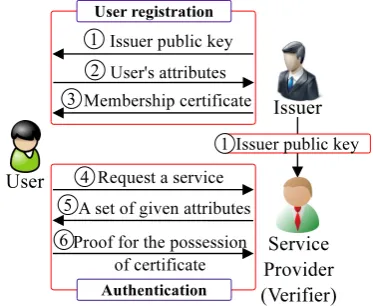
The system model of the eID application is shown in Fig. 1. At first, the issuer publishes its public keyipk. Then, the user registers himself along with particular attributes (SAi, FAi) to the issuer for certification by using ObtainCert
protocol via a secure channel (①∼③). Based on the issued certificate, he requests a service to the Service Provider (SP) (④). Then, the SP specifies attributes that the SP wants to know (⑤). This specification forms AND or OR relation, depending on the SP’s requirement. Then, the user generates a proof for the possession of certificate w.r.t. the specified attribute(s) and shows it to the SP (verifier) anonymously by using ProveCert protocol (⑥). If only if the verification of user’s proof is valid, the SP grants the user to access a requested service. In this scenario, we can consider that the number of finite-set attribute values is at least1,500, due to the involvement of the nationality, city, language, and other categories as shown in TABLE I.
We design our protocols: user registration and authentica-tion as follows.
A. User Registration
Fig. 2 shows the user registration protocol. This protocol comprises the following two steps. In advance, the user has to fetch the issuer public key ipk, for example by downloading it from the official web-site of issuer. We assume that there is an existing access control application (e.g., based on username and password) to permit the user to use a communication channel (which is out of scope of this paper). Then, he can use such channel to perform
ObtainCert protocol together with the issuer.
(1) Registration of user’s attributes.
The user requests the registration. He sends his attributes for certification (①∼③).
(2) Issuing the certificate.
Fig. 2. User registration protocol.
(a) The issuer computes the accumulator, certifies it into certificate cert and sends cert to the user (③∼⑤).
(b) The user checks the validity ofcertto ensure whethercertwas sent by the legitimate issuer or not. If it is valid, he embeds his secret keys into the cert and outputs the user certificate cert[i](⑥∼⑦).
B. Authentication
The authentication mechanism is performed by using a
ProveCert protocol. Fig. 3 shows the authentication process
[image:3.595.75.262.140.293.2]to allow the user to access the service provided by an SP through wireless networks. This protocol comprises the following two steps. In this protocol, the user can prove his possession of particular attributes into two ways, AND relation proving and OR relation proving.
Fig. 3. Authentication protocol.
(1) Generation and transmission of a proof for posses-sion of certificate.
(a) The user requests a service to the SP. Then, the SP provides him a set of specified at-tributes. Depending on the SP’s requirement, there are two options, multiple selection and one selection of a set of specified attributes (①∼②).
[image:3.595.311.545.444.616.2]such selected attribute(s) is(are) included in the certificate. Then, he shows the proof to the SP (③∼④).
(2) Verification of a proof for possession of certificate.
(a) The SP verifies the proof. If it is valid, the SP grants the user to access the service (resp. reject the service) (⑤∼⑥).
(b) The verification result is displayed in the web browser of the user which indicates either accept or reject to access the service (⑦).
IV. IMPLEMENTATION
We basically implemented our system using Java through the Java GUI and Java applet at the user and Java servlet at the Servide Provider (SP) and the issuer, since the Java applet and Java servlet communications are useful to implement the web-based applications. The communication between the user and the servers (i.e., the issuer and SP) is over http connections. The cryptographic processes in the anonymous credential system are implemented by C language as the middle-ware, since we need the fast computations as well as the underlying pairing library. As the interface between C and Java, we use Java Native Interface (JNI).
Pre-computation process. To reduce the computation
time in the authentication protocol, we pre-compute the fixed value components (e.g., the pairing calculations of fixed values of public key components). This pre-computed data are used to generate or verify the proof, where the computation times of generating and verifying the proof are reduced to about 51% and 30%, respectively.
Reply attack protection. An attacker may duplicate some
[image:4.595.304.548.210.398.2]valid transcript of the authentication to use for another session. To protect this, we use a random nonce. The nonce is computed by the hash function from the user’s defined mes-sage (this can be any mesmes-sages including random numbers) and timestamps.
Fig. 4. Implementation of user registration protocol.
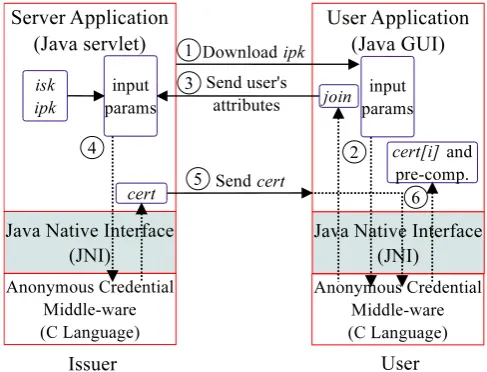
The implementation of user registration protocol is de-picted from Fig. 4. In this implementation, there are three steps:
1) Step 1: By using theipk, he executes the registration process of the middle-ware through JNI. Then, he sends the issuer his attributes (①∼③).
2) Step 2: User’s attributes, ipk, and issuer secret key iskare the input parameters for generating user mem-bership certificate cert provided by the middle-ware (④∼⑤).
[image:4.595.47.291.523.709.2]3) Step 3: Upon receivingcert, the user embeds his secret to the cert and outputs the user certificate cert[i]. Then, he executes a pre-computation process to provide a pre-computed data to be used later in generating the proof (⑥).
Fig. 5. Implementation of authentication protocol.
The implementation of authentication protocol is depicted from Fig. 5. In this implementation, there are two main processes; user’s proof generation and verification. At first, the SP needs to download the ipk from the issuer and executes the pre-computation process from the middle-ware to obtain pre-computed data.
1) User’s proof generation: The selected attribute(s),ipk, cert[i], and user’s pre-computed data are used as the input parameters for generating the proof. This is performed by using the proving function in the middle-ware. The function provides AND and OR relations proving. The proof is based on the random nonce generated from the hash function. The Java applet is embedded into local web page to interact with Java servlet at the SP’s web server (①∼④).
2) Verification: At the SP side, the received proof, ipk, and the SP’s pre-computed data are used as the input parameters to verify the proof. This is done by execut-ing the verification function in the middle-ware. This function also provides AND and OR relations. The correctness of the nonce is also checked. The output of this function is valid or invalid (resp. accept or reject) (⑤∼⑥).
V. EXPERIMENTALRESULTS
A. Test Bed
Fig. 6. Experimental environment.
[image:5.595.310.547.58.229.2]system to confirm the practicality. Fig. 6 shows the exper-imental environment of our proposed system. The devices and software specifications used in this test bed are shown in TABLE II.
TABLE II
SPECIFICATION OF DEVICES IN EXPERIMENTS.
Intel Core2Duo 3GHz, 4GB RAM Verifier/ Ubuntu Linux 9.10 kernel-2.6.31 Issuing Authority gcc-4.4.1, OpenSSL-0.9.8g, GMP-4.3.1
Java-1.6.0 18, apache-tomcat-5.5.28 Intel Atom 1.33GHz, 1GB RAM Prover/ Windows XP Home Edition SP3 Joining-User Atheros AR928X Wireless Adapter
MinGW-5.1.6, OpenSSL-0.9.8g, GMP-4.3.1, Java-1.6.0 19
B. Evaluation
Fig. 7 shows the total processing times of the authentica-tion protocol in the AND relaauthentica-tion and the user registraauthentica-tion protocol. The total time of the authentication protocol in-cludes the proving time, verification time, and the communi-cation time during the process. This time varies from917ms to 927 ms, where the number of attributes are from 1,500 to15,000. It is from904ms to912ms for the OR relation. The communication time is measured from sending the proof until receiving the response of authentication process from the verifier with excluding the verification time. The communication time is about 120 ms. The time of the user registration protocol varies from 809 ms to 828 ms, as the number of attributes increases from 1,500 to 15,000. This small variation is derived from accumulator computation and fetching the public key. In addition, our system has an advantage that the sizes of the proofs for AND and OR relation proving are constant at about 1324 Byte and 1424 Byte, respectively. The size of issued certificate is constant at about 272Byte.
Fig. 8 shows the processing times of the proving and verification for the AND relation and the size of the public key as the number of attributes varies. The times of the proving and verification vary from 642 ms to 649 ms and from153ms to154ms, respectively. This small variation is derived from the process of fetching the public key. However, these times are constant by ignoring such process. On the other hand, the times in proving the OR relation are635ms and152ms. Unfortunately, this system has a drawback that
700 750 800 850 900 950 1000
2000 4000 6000 8000 10000 12000 14000
Times [ms]
Number of attributes
Authentication process User Registration process
Fig. 7. Total processing times.
the size of public key varies from601kB to6MB. However, in the current mobile PC environments, the data size is sufficiently practical, since the public key is not changed after it is distributed in the user registration.
0 100 200 300 400 500 600 700
2000 4000 6000 8000 10000 12000 14000
Times [ms] / Size [x 1/100 MB]
Number of attributes
[image:5.595.64.274.318.405.2]Proving time Verification time Size of public key
Fig. 8. Processing times and size of public key.
VI. CONCLUSION
We have presented an implementation of a pairing-based accumulator for the anonymous credential system with ef-ficient proofs of AND and OR relations of attributes to the application of eID. In the prototype system, the user registration and authentication protocols are processed within a second, and thus we conclude that the system is sufficient practical. To achieve more efficient proofs and reduce the size of the public key are our future works.
ACKNOWLEDGMENT
This work was partially supported by Grant-in-Aid for Scientific Research (21300004) from Japan Society for the Promotion of Science (JSPS).
REFERENCES
[1] J. Camenisch and A. Lysyanskaya, “Dynamic accumulators and appli-cation to efficient revoappli-cation of anonymous credentials,” in Advances
[image:5.595.307.545.336.510.2][2] J. Camenisch, M. Kohlweiss, and C. Soriente, “An accumulator based on bilinear maps and efficient revocation for anonymous credentials,” in
Proc. 12th International Conference on Practice and Theory in Public Key Cryptography (PKC 2009), ser. LNCS 5443. Springer–Verlag, 2009, pp. 481–500.
[3] J. Camenisch and T. Groß, “Efficient attributes for anonymous creden-tials,” in Proc. ACM Conference on Computer and Communications
Security 2008 (ACM-CCS’08), 2008, pp. 345–356.
[4] A. Sudarsono, T. Nakanishi, and N. Funabiki, “Efficient proofs of attributes in anonymous credential systems using a pairing-based ac-cumulator,” in Computer Security Symposium 2010 (CSS2010), 2010, pp. 801–806.
[5] P. Bichsel, J. Camenisch, T. Groß, and V. Shoup, “Anonymous creden-tials on a standard java card,” in Proc. ACM Conference on Computer
and Communications Security 2009 (ACM-CCS’09), 2009, pp. 600–610.
[6] D. Boneh, X. Boyen, and H. Shacham, “Short group signatures,” in
Advances in Cryptology — CRYPTO 2004, ser. LNCS 3152. Springer–
Verlag, 2004, pp. 41–55.
[7] M. Akane, Y. Nogami, and Y. Morikawa, “Fast Ate pairing computation of embedding degree 12 using subfield-twisted eliptic curve,” IEICE