With 1 plate and 8 text-figures Printed in Great Britain
TERRITORIAL BEHAVIOUR IN BARNACLE SETTLEMENT
BY D. J. CRISP
Marine Biology Station, Merud Bridge, Anglesey, U.K. (Received 19 September i960)
INTRODUCTION
When a heavy settlement of the larvae of certain sedentary marine organisms has taken place on a uniform surface, the resulting pattern may quite clearly appear to be non-random, the individual larvae having each settled at a more or leas uniform distance from one another. Such a pattern is formed during the settlement of barnacles and of the tubeworm Spirorbis borealis (Wisely, i960). On the other hand, some marine larvae, notably those of many Polyzoa, settle apparently at random on a uniform surface, individuals sometimes touching each other. When the settlement is less deuse, the tendency for barnacles and Spirorbis to be spaced out may not be so obvious to the eye, presumably because the distance over which the larvae regularly avoid each other has become small in relation to the total distance separating them. Nevertheless, the avoidance of the territory around settled individuals can still be revealed by a suitable analysis of the pattern.
The simplest analysis can be made by counting the number of individuals in each of a large number of equal quadrats; if settlement is random these will fit the Poisson distribution; if the larvae show a territorial tendency the counts will be more uniform; if they are gregarious the counts will be more divergent. The significance of their deviation from the Poisson distribution may be obtained by means of the x2 test A typical example of such a treatment applied to a fairly heavy settlement of cyprids of the barnacle Ehnimus modestus is shown in Table 1. There are certain difficulties in applying this treatment. It is, in practice, so difficult to provide a surface uniform
Table 1. Distribution of Elminius modestus spat in quadrats 5 mm.2 compared with a Poisson distribution of equal population density
No. in quadrat
0 - 4 5 6 7 8 9 1 0 11
> 12
Frequency observed in 187 counts
IS
1 0
2 9 27 37 2 4
2 1
16 8
Frequency expected on Poisson distribution
19-73 17-75 33-34 26-31 35-94 22-74 17-94 12-85 20-40
X* 1-14 3 3 9 i-37 O-O2 4-7O O-O7 O-S2 0-77 7-53 187 187 19*51
43° D. J. CRISP
in respect of all environmental factors, that settlement is rarely uniform at the outset. Moreover, the gregarious tendency shown by some larvae, notably by barnacles, leads to an increase in settlement rate in the presence of settled individuals (Knight-Jones & Crisp, 1953) so that a high rate of settlement tends to be maintained in the neighbourhood of the first groups of individuals to become established, further settlement spreading thence outwards in course of time. Consequently, any initial unevenness in the early phase of settlement is accentuated. In making a test for terri-torial behaviour it is clearly necessary (a) to restrict counts to an area of comparatively uniform settlement, and (b) to use a quadrat small in comparison with the size of any patterns formed by the inhomogeneities in settlement density. With the use of quadrats of increasing size the effect of uneven or gregarious settlement is exaggerated so that the frequency dispersion increases and may eventually exceed the value expected from the Poisson distribution.
Apart from establishing a significant degree of over-dispersion, this form of analysis gives no information on the nature of the pattern which develops, and in particular fails to indicate the distance over which the repulsion between previously settled and exploring larvae operates. A far more revealing analysis can be applied by measuring the average population density as a function of the distance from any one individual. This analysis will be described both for the settlement of larvae in one dimension, along a line, and for the more usual case of settlement over a uniform area.
Analysis of linear settlement
In organisms whose larvae are attracted to grooves (rugophilic) settlement may, at least at first, be entirely constrained to a predetermined line (Crisp & Barnes, 1954). If the position of each individual along such a line were independent of that of the others and of any other factor, the arrangement would be a random linear series. If the mean linear density were p individuals per unit length, the chance of finding an individual in any short length dl would be p dl. If we now take any one individual as a reference point, we may consider how far along the line we are likely to go before reaching the next individual. The chance of finding the next individual at a point lying somewhere between / and l+dl from the reference individual will be called Po, the subscript referring to the condition that no individuals are present between the zero point and /. This probability, Po, will be the product of two independent
prob-abilities, namely that of not finding an individual between o and /, and that of finding one between / and l+dl. The former probability will be taken as a function of /, /(/), and the latter will be pdl; hence Po = f{l)pdl. The probability of not finding an
individual between / and l + dl is clearly (1 —pdl), and therefore the probability of not finding one between o and l+dl will be the product/(/)(i —pdl). Hence
The solution of this equation with the boundary condition /(/) = 1, when / = o is /(0 = e-i*,
and Po = per?*.
settlement of 3 05 individuals per centimetre. The full curve is drawn to connect the actual frequencies observed in a population of the barnacle Balanus balanoides settled at a mean density of 3-05 per centimetre along a number of grooves approxi-mately 0-7 mm. deep and 1-5 mm. broad, with a roughly hemispherical section. It can be seen that the actual settlement differs from random in a deficiency of spacings closer than 1-5 mm. and in an excess of those in the range between 1-5 and 5-0 mm. These results correspond closely with those obtained by Wisely (1960), who investi-gated the linear settlement of Spirorbis borealis on the alga Fucus serratus.
1 2 3 4 5 6 7 8
Distance to nearest neighbour (mm.)
Text-fig. 1. Distribution of distances between nearest neighbours in a linear series. Broken line- distribution in random settlement; full line: observed distribution for a population of
Balanus balanoides spat in narrow grooves.
The analysis can be made more informative if we consider not simply the distribu-tion of distances separating successive individuals, but the density of settlement as a function of distance from the reference individual.
By reasoning analogous to the above, the probability Plt Pa,..., Pn, of finding an individual between / and l+dl from the reference point, with 1, 2 or n intervening individuals, can be shown to follow the series
Pi =
In any short section between I and l+dl the total probability of an individual being present is
^
^
£
£
\ =
pdl.
4 3 D. J. CRISP
intervals of £ or i mm. from it. A large number of observations are then summed and averaged over the first i o or 20 intervals or until the influence of the reference individual can be discounted, the value of p becoming constant and equal to the average population value for the series. The above analysis shows that for a random settlement a constant value of p is to be expected. The actual observations (Text-fig. 2), taken from the same data as those from which Text-fig. 1 was constructed, show however that for this particular population density there was a low probability of settlement occurring between o and 0-15 mm. from the centre of any settled individual, a higher probability than average at 2 mm. and the normal value was restored between 5 and 10 mm. The dip at 3-4 mm. suggests that the regularity in spacing may extend just beyond the second individual which was most usually found at about 2 mm. from the first (reference) individual. These results are similar to those obtained by Wisely on Spirorbis borealis.
3
2
-S 10 Distance from reference Individual (mm.)
Text-fig. 2. Population density as a function of distance from any individual taken reference point for a linear settlement of B. balanoides.
Analysis of two-dimensional settlement
By an argument analogous to the above we may consider the settlement of individuals spaced at various distances from a central reference individual. If successive annuli of equal area, da, are drawn from the reference point and the average population density is a, we have
P'n = ^
n\ oe da.
Putting a = da = zirrdr,
= 2TTT
433
The distribution of distances for the individuals nearest to the central reference individual will be
Po = 2TTrae-'*rdr,
a result given previously by Clarke & Evans (1954) and by Thompson (1956) following Morisita
(1954)-0 1 2 3 4 Distance of nearest neighbour (r) (mm )
Text-fig. 3. Distribution of distances between nearest neighbours in a two-dimensional settlement. Broken line: distribution in random settlement; full line: observed distribution for a population of B. crenatui spat.
This equation therefore gives the distribution of distances between any two pairs of individuals on a plane surface. It will be seen that the relationship differs from that of the linear series in that the most probable distance between successive individuals is not zero, but finite. The modal value of Po will occur where dP0/dr = 0, i.e. at r = i/V(2iro).
Text-fig. 3 illustrates by means of a broken line the distribution of distances expected for a settlement of density io-4/cm.2. The points and the full line connecting them show the actual distribution for a settlement of Balanus crenatus of population density io-4/cm.2. It can be seen that there are few spacings within 1 mm. of a settled individual, while at a distance of 2-3 mm. the frequency of spacings is abnormally high, so that the modal distance is greater than 1 ^(zna), and there is also a much more pronounced peak.
on the settlement itself. A transparent grid, on which successive annuli had been tinted in order to allow easy identification of the annulus, was placed over the photo-graph for the purpose of counting. The results of a number of such observations on
different species are described below.
Influence of population density on territorial behaviour
As the available surface becomes more densely populated, subsequent arrivals will either have to settle closer to established individuals or else will have to search out the few unoccupied territories still available, or may do both. The influence of the density of the population on the settlement pattern is shown in Text-fig. 4 for the immigrant species Ehmnius modestus, which settles at extremely high population densities in the Essex rivers during the summer months. The curves all show a general similarity. The territory situated 1 mm. or slightly less from the reference individual is avoided, especially in the more sparse settlements. The population density then rises very sharply and at distances varying from 1 to 4 mm. reaches a value in excess of the normal level.
• * - 5 , 5 10
Distance from reference Individual (mm.)
Text-fig. 4. Population density as a function of radial distance from any individual taken as a reference point for a series of settlements otEhmmus modestus. Inset: the same series of curves with the vertical axis adjusted to give the population density as a percentage of the value found a long way from the reference point. Population densities were: Curve 1, 85/cm.1; curve 2, 22-5/cm.'; curve 3, lyo/an.*; curve 4, 12-s/cm.'; curve 5, 3-s/cm.'.
435
by later colonizers. This distance, which will be referred to as the territorial separation, becomes reduced as the population density increases. This is seen more clearly in the inset graph in which the same data are presented, but the absolute population density is replaced by the population density expressed as a fraction of the normal value found at some considerable distance away from the reference individual.Balanus crenatus
Balmus balanoldes
0CKi&aL_i.
5 10 15 Distance from reference individual (mm )
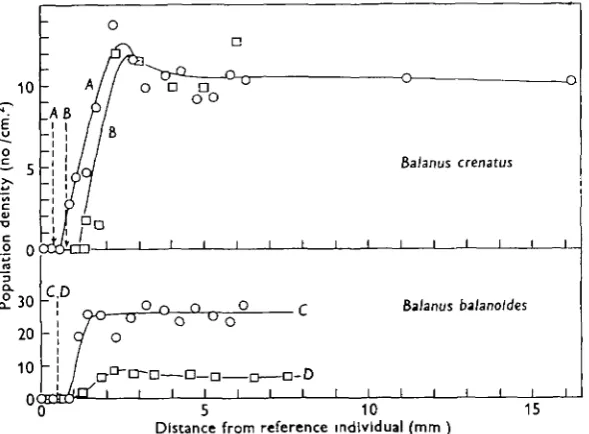
Text-fig. 5. Population densities as a function of distance from an individual for settlements of B. crenatus {A, E) and B. baUmoides (C, D). The dotted lines indicate the position of the boundary of already settled spat.
Table 2. Territorial separation and dimensions of cyprids and spat
Species E. modestus B. balanoides (linear) B. crenatus Density (no./cm.1)
85 22-5 I5-O 12-5 3-5 25 3 3/cm-104 io-4
Territorial separation dl
(mm.) 086 1-25 1-25 1-42 i-oo i-9 1-55 i-8 2-3 Radius of spat d, (mm.) 0-30 0-40 0-25 o-35 o-75 o-55 0-40 o-45 o-35 0-85 Length of cyprid dt (mm.) 0-5 o-S o-5 o-S 0-9 0 9 0 9 o-75 o-75 (mm.) 0-06 o-35 0-50 o-57 0-65 0-15 o-6o 0-2O 0-70 0-70
Territorial behaviour of different species
[image:7.451.82.377.129.346.2]436 D. J. CRISP
Table 2 summarizes the values of territorial separation for all three species, including those of linear settlements of Balanus balanoides shown in Text-figs. 1 and 2. It will be seen that the species with larger larvae and spat have larger territorial separations. The two curves for B. crenatus were from the same settlement, using, as reference individuals, just-metamorphosed cyprids (curve A) and the largest spat (curve B). The results show that the settlement around larger spat (mean diameter 1-7 mm.) has a territorial separation which exceeds that around cyprids and just-metamorphosed individuals of diameter 0-4 mm. by a distance equal to the difference in the radius of the central individual. Evidently territorial behaviour depends on physical contact in
Text-fig. 6. Movements of cyprids of Balanus balanoides just before fixation (semi-diagram-matic). Straight lines with arrows represent normal translation, to and fro movements are shown conventionally by thinner parallel lines, and swivelling movements by thick curved arrows. dlt territorial separation; d,, radius of existing spat; d,, length of cypns larva.
barnacles, as it does in Spirorbis (Wisely, i960), the newly settled individual having spaced itself from the edge of the previously established one. Moreover, if the mean radius of the existing spat (dt, column 4) is added to the mean length of the cypris
437
If there were sufficient space available few individuals would chance to settle in the position shown in Text-fig. 6 with the caudal setae as close as possible to another individual. If the amount of space had become very restricted, as in a dense settlement, such a site might be the only suitable one to be found, and so an increasing proportion of individuals, even after a long search, would lie within this distance of each other.
Influence of the base of detached specimens
When a settling cyprid encounters a small barnacle it may receive two kinds of stimuli: a simple physical stimulus, which would be invoked by touching any similar object, and a more specific stimulus, possibly chemical, through which it might recognize the object as another barnacle. When a barnacle is removed from a surface it usually leaves behind its base, which remains firmly cemented in position. Knight-Jones (1953) demonstrated that barnacle cyprids could recognize these bases, as well as the living barnacle, and if they belonged to the same or related species settlement was encouraged (Knight-Jones, 1955). Hence we may assume that if the base were
2- £ 30 '20 10 0,
Mean position [Position edge of edge of base
of central pit
5 10 15 Distance from centre of detached adult barnacle (mm )
Text-fig. 7. Variation in population density of spat of B. balanoida settled over the adherent base of individuals which had been removed, as shown in PI 1.
flat it could be specifically recognized, though the physical stimulus it exerted would be small.
A number of plates of inert plastic, on which small pits had been drilled in order to localize settlement, were placed in the sea and one barnacle was allowed to settle and grow in each pit (see Crisp, 1960 a). After the barnacles had grown to about 1 cm. in diameter the pits were usually to be found near the centres of the bases. The basal membrane covered the pit, but did not fill it up, and the membrane itself replicated the concavity. The barnacles were then cleaned off the panels, leaving behind the bases, together with a few strands of muscle tissue. These were then exposed in the sea to settlement during the following season. PI. 1 shows the appearance, both of the original settlement of adult barnacles and of the later spat in identical positions on two of the panels. It can be seen that the new settlement was very dense in the membrane-covered pits situated roughly at the centre of each base, and another dense zone of settlement took place at the periphery of the base. The remainder of the base was generally sparsely colonized.
438 D. J. CRISP
density; finally the curve rises to a further peak at a distance of 4 mm., approxi-mating to the radius of the base of the adult shell. The low value of population density just outside the pit may be caused in part by the territorial influence of the spat settled in the pit, but this cannot account for settlement densities less than the average at distances of up to 4 mm. from the pit, because the territorial influence does not normally extend beyond 2 mm. (Table 2). Moreover, a few adult barnacles did not settle over a pit, and their bases therefore did not include a concavity (PI. 1, X, Y). These also showed sparse subsequent settlement within the basis, though they lacked the dense central colony. These experiments indicate that the centre of the base tends to be avoided, but the periphery to be heavily colonized. While this behaviour suggests that there may be a specific response to the integument causing the barnacle to avoid the base of a detached individual or one of its own species, there remains the possibility that the centre of the base or the outside of a small individual may have a physical contour that is unfavourable for settlement in comparison with other surfaces nearby.
Territorial behaviour in pits
Concavities in the surface are preferentially colonized by cyprids (Crisp & Barnes, 1954). When more than one cyprid enters a small pit, it is forced to settle very close to the original occupant. Hence within such a pit one would expect territorial behaviour to be reduced or eliminated. In some instances cyprids can be seen to have settled so close together that some are unavoidably in contact with small spat of their own species. However, it is possible that the behaviour leading to the recognition of and settlement in a pit may be separate from the recognition and avoidance of a previously settled individual. If this were so, the two elements of behaviour might play opposing roles during the colonizing of a small pit.
An experiment was devised to investigate whether there was any tendency to ' space out' when settlement occurred within a small pit. Into a sheet of inert plastic were drilled out three groups of hemispherical pits having different radii of curvature. Twelve of each of the different sized pits were randomized into groups of 36, and each of these groups were replicated three times. After drilling, the pits were polished with fine carborundum followed by jewellers' rouge, then scrubbed with a detergent solution, washed in water, and exposed to a settlement of Baianus balanoides.
439
only to the fact that two adjacent small barnacles cannot overlap each other. An alternative method was therefore employed to confirm that territorial behaviour was displayed during settlement in pits.80
20
0 1 2 3 - 4
Distance separating nearest individual (mm )
Text-fig. 8. Distribution of nearest neighbours in a settlement of B. bcdanoida on surfaces of various curvatures. Curve i, on plane surface; curve 2, in pit of radius of curvature 13-5 mm.; curve 3, in pit of radius of curvature 6-5 mm.; curve 4, in pit of radius of curvature 1-5 mm.
Table 3. Distances separating individuals in pits of various curvature after
exposure to the same spatfall of Balanus balanoides
Radius of curvature of pit (cm.) Plane i-35 0-65
0-15
Curve in Text-fig. 8
1 2 3 4
Mean settlement
density (no. /cm.1)
1 0 33 45 85
Modal value of distance from
nearest neighbour in Text-fig. 8 (mm.)
i"5
1-25 1-15
0-65
Expected modal distance
for random
V(2n<r) (mm.)
1-26
0-69 ° S 9
0-44
all the pits would be filled by one individual each before any were entered by a second, and so on. The value of the variance would then always lie between o (when the average number per pit was an integer) and 025 (when the average number contained half an integer). A simple presentation of the results is shown in Table 4 where the proportions of pits with o, 1, 2, 3, etc., individuals are given for a mean settlement of i-o and 2-0 individuals per pit respectively. At these relatively low values of settlement density there was adequate space in each pit, and particularly in the larger pits, for further individuals to settle. This is clear from the columns giving the dimensions of the various pits and the maximum number observed in each pit at high settlement density. The figures show that the distribution is very different from the Poisson; the central frequencies are much higher. Even in the largest pits there was only a slight approach towards the values predicted for chance settlement. The variance increased in the larger pits, but was everywhere well below the Poisson value. Evidently the existence of an individual settled in a pit greatly reduced the chance of a second entering the same pit.
Table 4. Distribution of numbers of Balanus balanoides cyprids among pits of
various sizes at an average settlement rate of vo and 2-0 individuals per pit
(The predicted values for random settlement and for an infinite repulsion between individuals within a single pit (completely territorial behaviour) are given in the last two rows.)
Maxi-mum no. ob-served ype A B C D E F Area (mm •) 5 °3 10 15 1280 25 3 507 8 9 2
Radius, distance to rim (mm ) 1 0 1 5 1 9 2 4 3 7 4 9 in pit of this type uunriff experi-ment 0 6 8 1 0 9
Random settlement (Poisson) Completely territorial behaviour
Zeros 1 2 2 3 1 9 2 4 2 0 2 7 37 0
Mean settlement — 1 *o per pit Percentage of Single-tons 77 55 6 2
£
5 1 37 ICO Doub-lets 11 2 1 1 7 1 8 1 6 1 7 2 2 0 Others 0 1 2 2 2 5 4 0 Variance0 4 8
0 40
0 4 9
0-04 1 00 0 Zeros 0 0 0 1 0 6 13 5 0 Mean Single-tons 2 2 2 4 15 2 0 2 4 1 4 2 7 0
settlement - 2 0 per pit. Percentage of Doub-lets 56 & 56 5 1 55 2 7 ICO Triplets 2 2 2 4 1 5 1 8 2 2 2 2 1 8 0 Others 0 0 2 5 3 3 1 4 5
0
Varian 0 4 4 0*48 0 3 8 0 0 2 0 5 8 0 7 2
2-00
0
OBSERVATIONS ON SETTLING CYPRIDS
Cyprids of B. balanoides were obtained from plankton hauls during April and observed in the laboratory under a low-power binocular microscope as they explored and settled on various surfaces presented to them. The cyprids were presented with the following surfaces: barnacled stones, both smooth and rough; barnacled stones with various densities of young spat already settled on them; flat plastic sheets covered in small hemispherical pits spaced 0-5 mm. apart of radius of curvature of approxim-ately 1 mm.; and flat plastic sheets with grooves approximapproxim-ately 1 mm. wide and
\ mm. deep containing a few spat. In one experiment on the pitted surface, each pit
Table 5. Behaviour of cyprids on various surfaces
441
Condition of surface Bare surfaces
Smooth plastic Rough stones Barnacled surfaces
Rough stones with spat Rough stones with spat and
adults
Rough stones with spat and adults
Grooved and pitted surfaces Grooves with very few spat PitB with bases of spat only Pits with dense spat
Barnacle density (spat + adults) (no. /cm.1)
0 0
0-2-3-0 2-0-5-0
> 10
o - i
0 4-0* No. of explora-tions observed 1 2 5 6 5 S 16 6 9 Mean time per exploration (min.) o-8 0-9 13-8 8-6 9 7 6-9 25-2 36-6 Maximum tune of an ex-ploration (min.) 3"i i - 6
2 4 0 35'3 29-7 42-8 S5-o 92-2 Percentage of ex-plorations ending in a settlement (%) 0 0 67 2 0 0 6 8 0 1 1
* Expressed per unit area of curved surface of pit the value would be 30-40.
075 mm., and a less deliberate movement, characterized by pivoting and oscillating on the antennules, often accompanied by a change of direction, which will be called a ' halt'. Translatory steps generally predominated during the early phase of settlement, and halts towards the end. Table 5 records the length of time of the exploratory phase and shows very clearly the influence of previously settled spat or their bases. These provide the necessary stimulus which causes the cyprids to remain on the surface and to continue to search for suitable sites on which to settle. However, although this response was common to all surfaces which were barnacled, the best settlement occurred where a low density of settled spat (0-3/cm.2) was present on the surface. Where the density was more than 10/cm.2 a clear reduction in the tendency to settle was evident. The time that was spent exploring the surface was not greatly affected by the presence of dense spat. In fact, the exploration time on panels containing pits was greater when spat had already occupied the pits than when the pits were vacant. The cyprids could be seen entering the occupied pits one after another, exploring them and walking on to the next, apparently seeking an empty one. Indeed the only occasion when a cyprid was observed to settle on this type of panel took place when it encountered a pit which happened to be unoccupied. The number of times that cyprids entered pits, walked out and entered others is shown in Table 6.
The exploration time of the cyprids which were presented with the grooved panel containing only a very few spat in one corner was much less. This could be attributed to the small number of spat, which resulted in few of the larvae encountering them, the majority making short and fruitless searches which terminated in their swimming away from the surface. Those which did encounter spat remained for about the same length of time as those on more heavily barnacled surfaces, as can be judged from ^column 5 which gives the maximum times.
442
Table 6. Behaviour of cyprids when presented with turf ace depressions containing
previously settled spat and their bases
Surface Plastic containing
grooves with few spat
Plastic containing pits with bases only Plastic containing
pits with dense spat
Spat density (no./cm.1)
o - i
o
4-0
Total no. of times pits and grooves
visited
158
8 0
271
No. of cyprids
settled 1
5
1
Mean no. of pits or grooves
visited before settlement
158
16
271
Mean no. of pits or grooves
visited per excursion
9 9
I3'3
30-1
MECHANISM OF TERRITORIAL BEHAVIOUR
Unlike the territorial behaviour of active animals, in which the holder of a territory usually displays aggression, that of sedentary animals must be attributed solely to the behaviour of the invading individual, through which the territory of the first is respected. It can hardly be doubted that the observed separation is brought about by the characteristic short to and fro excursions and the twisting movements that take place repeatedly just before fixation.
The territory avoided by later arrivals has been shown to be quite limited in range. It does not usually extend beyond a circle of radius 2 mm. from the previously settled individual. Of this distance 0-3-0-5 mm., according to the species, must be allowed for the radius of the central individual and a similar distance for the radius of the new arrival because the shells of the two individuals obviously cannot interpenetrate. Only the observation of a regular separation of individuals beyond o-6-i-o mm. is therefore of consequence. Such separations, though small, are nevertheless real and may be retained even at population densities as high as 20 to 30 individuals per square centimetre.
In spite of its very short range, territorial behaviour is particularly interesting and significant because it seems contradictory to the thigmotropic tendency displayed by cyprids when they settle preferentially in grooves and pits. One might expect from their reaction to concavities that they would settle in close contact with other indi-viduals, nestling in the angle between them and the substratum. However, it is not certain that cyprids settle in depressions simply in response to increased physical contact. There are a number of reasons for believing that they may be capable of recognition of surface contour. First, they do not settle into a pit as soon as they come to it, but explore it, entering it or similar pits many times. Secondly, pits and grooves with very large radii of curvature attract cyprids although the increased contact compared with a plane surface must be very small indeed. Thirdly, cyprids avoid sharp angles and prominences, just as they seek out depressions.
settling a little way off. The base of a large barnacle, on the other hand, is much less convex; indeed a species such as Elmimus modestus with a sinuous octaradiate outline has eight concavities which are depressed in both planes, and so are highly attractive, often being occupied by a small barnacle in each.
If the reaction of cyprids to contact with other individuals were clearly different from their reaction to an inert surface, the mechanism of territorial behaviour would involve, in addition to the physical response to an obstacle, the specific recognition of other barnacles as their own species and a change of behaviour in consequence. Recognition of their own species has been clearly shown by Knight-Jones (1953) to exist in barnacles. Knight-Jones & Moyse (i960) also find that, while the cyprids of certain barnacles avoid contact with individuals of their own species, they settle directly in contact with barnacles of other species. This clearly implies that specific recognition of the surface of their own species is the basis not only of gregarious but also of territorial behaviour. Some of the observations reported in this paper lend support to the view that the three species studied avoid to some extent settling on the surface of their own species. The sparse colonization of the membranous base suggests a specific response. It is difficult to explain why cyprids do not settle readily into a pit containing young spat without assuming that they recognize them as barnacles. Such a pit, even though it contains a small barnacle, remains essentially a concavity. At the bottom of the pit, where the small barnacle generally lies, a groove is formed between it and the pit wall. When a pit is drilled with a blunt twist drill a similar configuration is produced at the bottom of the pit, but in this case it is of inert material and the cyprids settle readily all round the groove. The similar groove formed by the sides of a barnacle already settled at the bottom of the pit is avoided, however, and later cyprids entering usually settle high up on the walls of the pit. However, pits retaining the basis of a small barnacle, but otherwise empty, seem very attractive. Perhaps, therefore, both a convex surface contour and the presence of a barnacle surface produce the strongest avoiding reaction.
Not all barnacles avoid settling on adults of their own species. Cyprids of Balanus
hameri settle predominantly on the sides of the adults, forming in time groups of
barnacles growing out in a tree-like form from an older basal individual (Moore, 1935). In the season of settlement of this species the adults are covered with young spat to a greater degree than the Modiolus shells on which they commonly grow. Chelonobia
patula, an epizoic barnacle found in America predominantly on Callinectes sapidus
also settles heavily on its own adults, not only on the sides but also just in the angles of the opercular aperture. They seem commoner on their own species than on the cuticle of the crab itself. Young individuals of Lepas anatifera and Pollicipes cornucopiae settle very close to or even on the stalk of other individuals, though they avoid the valves. In another pedunculate genus, Scalpellum, the complemental male must settle on the valves of hermaphrodite specimens. All these examples are species which are obviously gregarious; it follows that territorial behaviour during settlement is entirely independent of gregariousness. These species also resemble each other in having an isolated or restricted habitat, and in not spreading out over it to the same extent as rock-living balanoids.
^ The three species investigated in this paper behaved very similarly at settlement, Pand seemed to possess the same basic mechanism. If soon after alighting the cyprid
444 D. J. CRISP
came in contact with its own species it would continue to explore the surface for a long time. If it did not encounter its own species it was likely to swim off. Towards the end of its exploration, when it was about to settle, contact with its own species caused a renewal of exploring and testing behaviour until the cyprid obtained a more acceptable position nearby, such as an unoccupied depression.
It is necessary to postulate only that contact with its own species stimulates further walking to account both for gregariousness over a wide area, and territorial behaviour at short range. Early in the pre-setdement phase contact with another barnacle would cause the cyprid to walk and explore widely, so that it eventually settled somewhere in the vicinity. Towards the end of settlement, when the activity of the cyprid was mainly confined to halting and pivoting, contact stimulation by its own species would similarly cause it to explore further; but, because of its slower progress, it would not move far before attempting to settle again (Fig. 6).
THE SIGNIFICANCE OF TERRITORIAL BEHAVIOUR
small specimen might be crushed rather than pushed along. The interval of time from fixation of the cyprid to the completion of the shell plates and the beginning of growth in girth is in B. balanoides about 1 to i£ weeks. The rate of growth of fast-growing young barnacles is about 1 mm. per week (Barnes & Powell, 1953; Crisp, 1960a). Hence a spacing out of about 1 mm. from established individuals would allow just enough time for subsequent spat to establish themselves, but would probably make very insecure any individual that attempted to settle in between. Territorial behaviour is therefore to be expected in those dominant forms which spread out flat during growth, covering the substratum to the exclusion of other species. Forms which exist as small isolated groups in unusual habitats are relatively free from competition; they need not therefore become adapted to monopolize the available surface and so may not need to protect themselves against being squeezed off by spacing out during settlement.
SUMMARY
1. An analysis of the natural pattern of settlement of barnacles, whether arranged along a groove or over a plane area, shows that later settlers tend to maintain a distance of about 2 mm. from earlier ones. This phenomenon in a sedentary form is analogous to territorial behaviour in active species.
2. A method is described which gives average values for population density as a function of the distance from any reference individual. It is found that the reference individual lies in a trough of very low population density, and that the latter rises sharply a short distance away. The distance from the reference individual, at which the population density reaches the average value for the whole population, is defined as the territorial separation.
3. The territorial separation is reduced, but not entirely eliminated, as the popula-tion density rises.
4. The value of territorial separation is a little greater than the sum of the radius of the previously settled spat and the length of the cyprid, and is slightly smaller in species with smaller cyprids and spat.
5. Cyprids settle at the periphery of the base of detached specimens rather than at the centre.
6. Though strongly attracted to pits in the surface, cyprids continue to behave territorially within a pit, and avoid pits containing previously settled individuals. They settle readily in pits with only the bases of detached individuals present.
7. Observations on settling cyprids show that after encountering settled barnacles they tend to remain and explore the surface. If they continue to encounter settled individuals at the time they are about to settle, the period of final searching is prolonged until they find a suitably vacant area.
8. Territorial behaviour is probably an adaptation allowing the recently meta-morphosed cyprid time to establish itself before it touches the growing edge of another barnacle.
REFERENCES
BAKNES, H. & POWELL, H. T. (1953). The growth of Balanus balanoida (L.) and B. crenattu Brug. under varying conditions of submersion. J. Mar. Biol. Ass. U.K. 33, 107-28.
CLARKE, P. J. & EVANS, F. C. (1954). Distance to nearest neighbour as a measure of spacial relationships in populations. Ecology, 35, 445-53.
CoNNEix, J. H. (1959). An experimental analysis of interspecific competition in natural populations of intertidal barnacles. Proc. XVth Int. Congr. Zool. Land. 3, 290—3.
CRISP, D. J. (1960a). Factors influencing the growth rate of Balanus balanoida. J. Anim. Ecol. 39, 95-116.
CRISP, D. J. (19606). Mobility of barnacles. Nature, Lond., 188, 1208-9.
CRISP, D. J. & BARNES, H. (1954). The orientation and distribution of barnacles at settlement with particular reference to surface contour. J. Anim. Ecol. 33, 142-62.
KNIGHT-JONES, E. W. (1953). Laboratory experiments on gregariousness during setting in Balanut
balanoides and other barnacles. J. Exp. Biol. 30, 594-8.
KNIGHT-JONES, E. W. (1955). The gregarious setting reaction of barnacles as a measure of systematic affinity. Nature, Lond., 174, 266.
KNIGHT-JONES, E. W. & CRISP, D. J. (1953). Gregariousness in barnacles in relation to the fouling of ships and to anti-fouung research. Nature, Lond., 171, 1109—10.
KNIGHT-JONES, E. W. & MOYSE, J. (i960). Intraspecific competition in sedentary marine invertebrates.
Soc. exp. Biol. Symposium on Mechanisms of Competition (in the Press).
MOORE, H. B. (1935). The growth rate of Balanus hameri (Ascaniua). J. Mar. Bid. Ass. U.K. 30,
57-63-MORISITA, M. (1954). Estimation of population density by spacing method. Mem. Fac. Set. Kyusku
Univ. Ser. E, 1, 187-97.
THOMPSON, H. B. (1956). Distribution of distance to iVth neighbour in a population of randomly distributed individuals. Ecology, 37,
391-4-WISELY, H. B. (i960). Observations on the settling behaviour of larvae of the tubeworm Spirorbis
boreatis Daudin (Polychaeta). Aust. J. Mar. Freshw. Res. 3, 55-73.
EXPLANATION OF PLATE