Abstract— Water soluble conducting polymer composite
poly(vinyl alcohol-threonine) [PVAT] was chemically synthesized and characterized by FTIR, LCZ and SEM-EDX analysis. The corrosion inhibition performance was evaluated for mild steel corrosion in 1M HCl at various concentrations, and the results were compared with that of the Polyvinyl alcohol (PVA). The inhibition properties of synthesized polymer composite have been investigated using chemical and electrochemical techniques such as Linear Polarization Resistance (LPR), Potentiodynamic Polarization and Electrochemical Impedance Spectroscopy (EIS). The data obtained from these techniques are comparable. The results showed that the presence of composite in the acid solution suppress the corrosion rate of mild steel. The inhibition efficiency of the composite was found to be concentration dependent. Potentiodynamic polarization studies suggest the mixed nature of the composite. Electrochemical impedance spectroscopy was used to investigate the mechanism of corrosion inhibition.
Index Terms—Poly(vinyl alcohol-threonine); Mild Steel; Acid Corrosion; Weight Loss; Electrochemical Impedance Spectroscopy.
I. INTRODUCTION
he investigation of the inhibition of corrosion of iron is a matter of high theoretical as well as practical interest.
Previous studies had revealed the relationship between structural characteristics of the organic compounds and their inhibiting effects. The electron donating character of N, O & S [1]-[4] atoms having unshared pair of electrons was responsible for the corrosion inhibition of iron in acidic solutions. The use of polymers as corrosion inhibitors has attracted considerable attention recently. Polymers are used as corrosion inhibitors [5], [6] because, they form complexes with metal ions through their functional groups and complexes occupy a large surface area of the exposed metal. The adsorbed film thereby blanketing the surface and protect the metal from the aggressive medium. The inhibitive power
Manuscript received July 26, 2011; revised August 16, 2011. A. Ali fathima Sabirneeza wish to thank Council of Scientific and Industrial Research for their financial assistance.
S. Subhashini is with the department of chemistry, Avinashilingam Institute for Home Science and Higher Education for Women University, Coimbatore, Tamilnadu, PIN 641043 India. (phone: +91422 2433889; e-mail:[email protected]).
A. Ali Fathima sabirneeza is with the Department of chemistry, Avinashilingam Institute for Home Science and Higher Education for Women University, Coimbatore, Tamilnadu, PIN 641043 India. (e-mail: [email protected]).
of the polymers also related to cyclic structures, aromatic rings and the presence of heteroatom (oxygen and nitrogen). These are the major active centers for adsorption on the metal surface. According to the type of inhibitor species and the nature of metal, adsorption may be chemical or physical adsorption [7], [8].
In the present work, a polymer composite of very low percentage L-threonine and less expensive PVA was chemically synthesized and their inhibition effect on the corrosion behavior of mild steel in 1M HCl was studied using weight loss method, linear polarization resistance, potentiodynamic polarization and electrochemical impedance spectroscopy methods.
II. EXPERIMENTAL DETAILS
A. Inhibitor Preparation
The polymer composite PVAT was synthesized according to the procedure described elsewhere [9], [10]. 10% PVA (mol.wt. 14,000g/mol) and 1% L-threonine in 0.5 M oxalic acid were used as feed solution and kept at 5– 10°C. To this reaction mixture, freshly prepared solution of 1%ammonium persulphate in 0.5 M oxalic acid was added as a free radical initiator with constant stirring for 2 h. The reaction mixture was kept under refrigerator for 24 h and the formed composite, PVAT was precipitated out using a non-solvent. It was filtered, washed and air dried. The polymerization of L-threonine by persulphate was confirmed by the SEM-EDX analysis.
Double distilled water and analar grade hydrochloric acid (Merck) were used for preparing stock solution of the composite and test solution (1M HCl).
B. Gravimetric Measurements
The experiments were performed with mild steel specimens having composition (% by weight) 0.196 Mn, 0.106 C, 0.027 P, 0.022 Cr, 0.016 S, 0.012 Ni, 0.006 Si, 0.003 Mo and remainder Fe. Weight loss measurements were performed with the dried rectangular strips following the ASTM standard procedure [11]. The strips were immersed in triplicates in 1M HCl in the absence and presence of various concentrations of PVAT for different immersion periods at room temperature. At elevated temperatures, a constant immersion period of ½ hour was selected and studies were conducted with various concentrations of PVAT. The strips were taken out, cleaned and weighed. From the obtained weight loss, corrosion rate
Gravimetric and Electrochemical Investigation
of Water Soluble Poly(Vinyl
Alcohol-Threonine) as Corrosion Inhibitor for Mild Steel
S. Subhashini, and A. Ali Fathima Sabirneeza
(CR) and inhibition efficiency (IE) were calculated using the following equations.
DxAxT
xW
mpy
CR
(
)
534
eq. (1)100
(%) x
CR CR CR
IE
o o
eq. (2)
where CR0 and CR are the corrosion rates in the absence and presence of inhibitor, respectively, W is the weight loss in g, D density of the mild steel in g/cm2, A area of the specimen in cm2 and T is the time of immersion in hours.
C. Electrochemical Measurements
Frequency response analyzer (Solatron 1208B) was used for the electrochemical measurements. Polarization experiments were carried out in a conventional three electrode cell with a platinum counter electrode, saturated calomel electrode (SCE) as reference electrode and mild steel specimens having an exposed area of 1 cm2 as working electrode. All tests were performed at 30±2oC under unstirred conditions without deaeration. The working electrode was held in the test environment for half an hour prior to each experiment which was sufficient for open circuit potential (OCP) to attain a stable value. The polarization studies were carried out from a potential of +250 to –250 mV (Vs. SCE) with respect to the steady-state potential at a scan rate 0.2 mVs-1. The corrware software directly calculates the linear polarization resistance values on the basis of Stern – Geary theory. Then inhibition efficiency has been calculated from the polarization resistance (Rp) values.
Tafel segments of the potentiodynamic plots were extrapolated to obtain corrosion potential (Ecorr) and
corrosion current densities (Icorr). The inhibition efficiency
was also evaluated from the measured Icorr values.
Electrochemical Impedance measurements were carried out using AC signals of 10mV amplitude and sweeping the frequency from 20 kHz to 0.1 Hz. The charge transfer resistance (Rct) obtained by fitting the semicircles of the
Nyquist representations has been used to calculate inhibition efficiencies of PVAT. The double layer capacitance (Cdl)
was obtained from the maximum value of the imaginary component of the Nyquist plots.
III. RESULTS AND DISCUSSION
A. Characterization of Polymer Composite
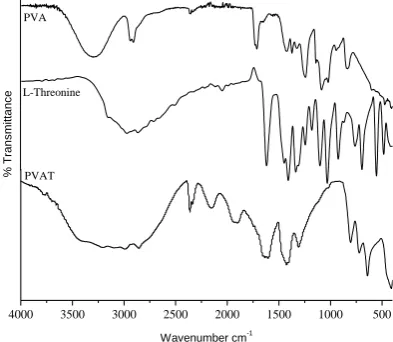
The UV-Visible spectra of water soluble PVAT gave absorption bands at 238 and 236 nm respectively. This is due to the n-П* transitions of the carbonyl group. Figure 1 shows the FTIR spectra of PVA, L-threonine and the composite (PVAT). Polyvinyl alcohol shows characteristic peaks for OH, C-O along with those of C-H vibrations. Spectrum of L-threonine shows peaks corresponding to OH, NH2, COOH and that of –CH2- backbone. The composite
shows the main characteristic band of polyvinyl alcohol at 3400 cm-1which is due to OH stretching. This absorption band is broadened due to overlapping of NH stretching and the hydrogen bonding between the NH of the polyamide and the OH group of polyvinyl alcohol. The band at 1636 cm-1 clearly indicates the presence of amide carbonyl group. The absence of prominent bands in the region 1730-1700 cm-1 confirms the absence of free carboxylic acid group.
The micrographs shown in figure 2 depict the surface morphology of the synthesized polymer composite PVAT. This SEM images clearly indicates the presence of small ratio of secondary phase (polymerized threonine) being randomly distributed on the surface of polyvinyl alcohol matrix. EDX analyses of the two phases were carried out and it shows the presence of nitrogen atom only in the minor phase. The hydrogen bonding holds the polyamide of L-threonine to PVA matrix.
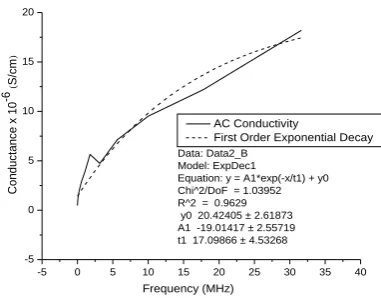
The composite was made into a pellet of 11.01 mm diameter and 2.95 mm thickness. The electrical connection was made using silver paste and copper wire. Then AC conductivity of the pelletized composite was measured by LCZ analyzer by varying frequency from 300 Hz to 3 MHz and it was found to be in the range of ~1-5 x 10⁻⁶ siemens per centimeter, which is of semiconductors (103 to 10−8 siemens per centimeter). The Figure 3 shows the variation of conductivity of the composite with the operating frequency and the first order exponential decay.
4000 3500 3000 2500 2000 1500 1000 500
PVA
L-Threonine
PVAT
%
Tr
an
s
mi
tt
an
c
e
[image:2.595.70.267.577.748.2]Wavenumber cm-1
[image:2.595.302.545.579.764.2]Fig. 1. FTIR Spectrums of PVA, L-Threonine and PVAT
B. Gravimetric Studies
Effect of Immersion Time and Concentration
Results presented in table 1 show the effect of immersion period on the inhibition efficiencies of PVAT for different concentrations in 1 M HCl at 30o C. 0.6% PVA showed 72% inhibition efficiency. The results clearly revealed that compositing polyvinyl alcohol with L-threonine increased the inhibition efficiency to 94.4%. With the immersion time the inhibition performance increases upto 6 h. After that decrease in IE was observed. This was due to the instability of the adsorbed film. It is also apparent that the inhibition efficiency has increased from 60s-90s as the concentration of PVAT was increased from 0.06 to 0.6% by weight. Further increase in concentration did not cause any appreciable change in the performance of the inhibitor, indicating the attainment of the limiting value. This effect may be attributed to the electrostatic interactions between the metal surface and the composite PVAT. The higher performance of the composite is attributed to the presence of nitrogen atom, large number of oxygen atoms, larger molecular size and linearity in the polymeric chain.
TABLEI
VARIATION OF INHIBITION EFFICIENCY -WEIGHT LOSS MEASUREMENT
RESULTS FOR MILD STEEL CORROSION IN 1MHCl
Conc. Of PVAT
(%)
Exposure Time in Hrs / Inhibition efficiency
1/2 1 3 6 12 24
0.6-PVA - - 70.46 72.50 - -
0.12 73.61 77.92 82.81 91.10 74.32 70.37
0.24 75.53 80.19 85.12 91.27 78.89 73.17
0.36 75.66 81.60 85.78 92.24 79.74 74.11
0.48 77.12 82.80 86.99 92.92 80.52 76.59
0.60 77.94 84.66 90.77 94.36 81.93 79.42
Effect of Immersion Temperature
The variation of inhibition efficiency with temperature is presented in table 2. It clearly indicates that with increase in
temperature the inhibition efficiency decreases. This is attributed to the adsorption – desorption equilibrium exists between these two processes at a particular temperature. With increase of temperature the equilibrium shifts to a higher desorption rate until the attainment of new equilibrium. This explains the lower inhibition efficiency at higher temperature [12]. The decrease in inhibition efficiency with temperature suggests physorption of the polymer composite on to the metal surface [13]. At temperature higher than 333 K the inhibition efficiency increases this may be due the initiation of chemical adsorption of PVAT.
Activation Energy and Thermodynamic Parameters
The relationship between the corrosion rate of mild steel in acidic media and temperature is often expressed by Arrhenius equation. From the plot of log CR against 1/T for MS corrosion in the absence and in the presence of different concentrations of PVAT, the activation energy (Ea) values calculated and presented in table 2. It is clear from the table that the inhibition efficiency decreases at higher temperatures and Ea of inhibited solution is higher than the Ea of uninhibited solution. This indicates that the corrosion reaction of mild steel is inhibited by PVAT composites [14] hence supports the phenomenon of physical adsorption [15]. Higher values of Ea in the presence of inhibitor can be correlated with increasing thickness of the double layer which enhances Ea of the corrosion process. According to Damaskin the value of activation energy lesser than 80 kJ/mol represents physical adsorption [16]. This assertion supports the experimental results obtained in the present work.
The free energy of adsorption (ΔGads) at different
temperatures was calculated using the following equation [16], [17] and also presented in table 2.
ΔGads = −RT ln(55.5K) eq (3)
) 1 (
C
K eq (4)
where θ is degree of coverage on the metal surface (θ=IE/100), C is the concentration of the inhibitor and K is equilibrium constant. The negative values of free energy of adsorption indicate spontaneous adsorption of inhibitor molecules on the mild steel surface. The value of -ΔGads for
inhibited system is less than 20 kJ mol−1 indicates that the inhibitor molecules are physically adsorbed on the surface of mild steel [16]. The higher -ΔGads at 323 K may be
attributed to the initiation of the chemisorption of PVAT on mild steel surface and it reduces above 323 K which is attributed to the decrease in spontaneity of adsorption of PVAT as temperature increases. The ΔGads values are used
to calculate enthalpy and entropy of adsorption process by plotting ΔGads versus temperature. The obtained values of
ΔHads snd ΔSads are also presented in table 2. The negative
ΔHads values indicate that the adsorption of inhibitor
molecules is an exothermic process [17]. The negative ΔSads
values are attributed to the adsorption process which is accompanied by an increase in order of the system resulting from the associated complex of inhibitor and mild steel [18].
Conc. Of PVAT (%)
Exposure Temperature in K/ Inhibition Efficiency
313 K 323 K 333 K 343 K
0.12 73.49 88.25 72.96 71.89
0.24 74.01 89.26 75.28 73.70
0.36 79.32 91.56 77.37 74.07
0.48 80.81 91.72 80.52 74.50
0.60 82.92 92.24 81.13 76.93
-5 0 5 10 15 20 25 30 35 40 -5
0 5 10 15 20
Frequency (MHz)
C
on
du
c
tan
c
e x
10
-6
(
S
/c
m
)
AC Conductivity
First Order Exponential Decay Data: Data2_B
Model: ExpDec1
[image:3.595.70.261.65.214.2]Equation: y = A1*exp(-x/t1) + y0 Chi^2/DoF = 1.03952 R^2 = 0.9629 y0 20.42405 ± 2.61873 A1 -19.01417 ± 2.55719 t1 17.09866 ± 4.53268
[image:3.595.45.294.553.743.2]TABLE2
KINETIC AND THERMODYNAMIC PARAMETERS FOR MILD STEEL
CORROSION IN 1MHCl
P
V
A
T
(%)
Ea -G (kJ/mol) -H -S
kJ/mol 313 K 323 K 333 K 343 K kJ/mol kJ/Kmol
0.12 57.71 18.01 20.52 16.41 17.89 24.23 0.0188
0.24 56.62 16.33 19.03 15.31 16.37 21.06 0.0135
0.36 57.57 16.06 18.68 14.58 15.40 21.68 0.0174
0.48 58.10 15.57 18.00 14.23 14.73 21.66 0.0190
0.60 57.73 15.37 17.62 13.75 14.50 20.83 0.0176
Adsorption Isotherms
The inhibitor efficiency depends on the type and number of active sites at the metal surface, the charge density, the molecular size of the inhibitor and the metal inhibitor interactions. The adsorption isotherms can give valuable information about the metal inhibitor interactions. The degree of surface coverage (θ) for various concentrations of the inhibitors at different immersion temperatures has been tested graphically to fit a suitable isotherm. The plots of log(θ /1- θ )Vs log C yields a straight line (with slope close to unity), proving that the adsorption of the composite PVAT on the mild steel surface obeys the Langmuir (figure 4) adsorption isotherm.
C. Electrochemical Measurements
Polarization Studies
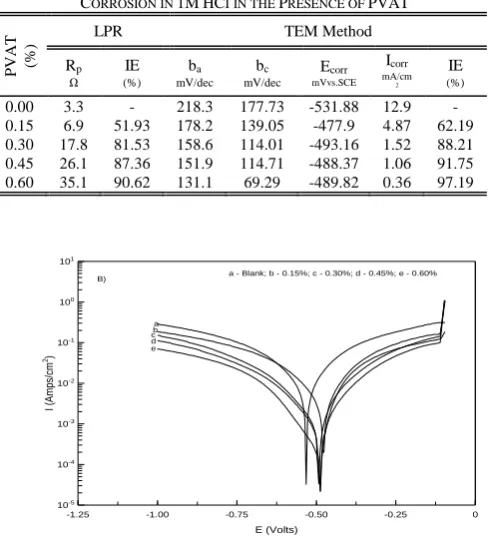
Figure 5 represents the potentiodynamic polarization plots for mild steel in 1 M HCl in the presence of various concentrations of PVAT. The Tafel extrapolation method and linear polarization method were used to obtain the electrochemical parameters shown in table 3. It is evident that in the presence of inhibitor, the cathodic and anodic curves were shifted towards positive potential region and the shift was found to be dependent on the inhibitor concentration. The values of both cathodic and anodic Tafel slopes were found to change with inhibitor concentrations. This clearly indicates that the inhibitor controlled both the cathodic and anodic reactions. According to the literature, if the displacement in (Ecorr) values (i) >85 mV in inhibited system with respect to uninhibited, the inhibitor could be recognized as cathodic or anodic type and (ii) if
displacement in Ecorr is <85 mV, it could be recognized as mixed-type. For PVAT, the maximum displacement range was 75 mV towards anodic region, which indicates that PVAT is a mixed-type inhibitor [19]. The Icorr values were
used to calculate the inhibition efficiencies which are presented in table 3. The inhibition efficiencies were also calculated from the linear polarization resistance Rp. It was
found that Rp increases from 3.30 to 35.14 Ω which results
in increase in inhibition efficiency from 0 to 91% on the addition of 0.6% PVAT to 1M HCl.
TABLE3
POTENTIODYNAMIC POLARIZATION PARAMETERS FOR MILD STEEL
CORROSION IN 1MHCl IN THE PRESENCE OF PVAT
P
V
A
T
(%)
LPR TEM Method
Rp Ω
IE
(%)
ba mV/dec
bc mV/dec
Ecorr
mVvs.SCE
Icorr
mA/cm
2
IE
(%)
0.00 3.3 - 218.3 177.73 -531.88 12.9 -
0.15 6.9 51.93 178.2 139.05 -477.9 4.87 62.19
0.30 17.8 81.53 158.6 114.01 -493.16 1.52 88.21
0.45 26.1 87.36 151.9 114.71 -488.37 1.06 91.75
0.60 35.1 90.62 131.1 69.29 -489.82 0.36 97.19
Impedance Studies
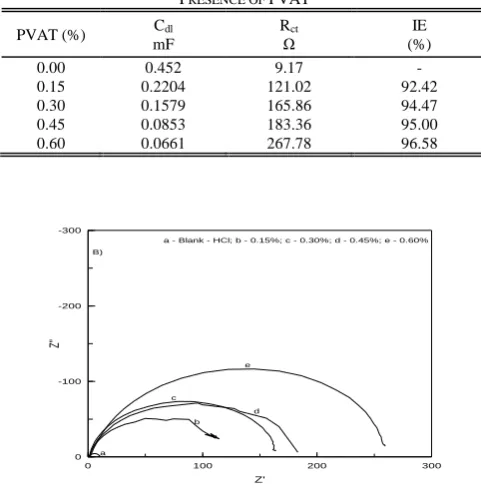
Nyquist representations of mild steel in uninhibited and inhibited solutions containing various concentrations of PVAT are shown in figure 6. The measured impedance parameters such as charge transfer resistance (Rct) and
double layer capacitance (Cdl) and IE values were provided
in the Table 4. The Rct values increased as the
concentration of inhibitors increased, whereas Cdl values
decreased. The charge transfer resistance of the blank is increased from 9.17 to 268 Ω on the addition of 0.6% PVAT which results in 97% inhibition efficiency. This is attributed to the increase in the surface coverage by the inhibitors leading to an increase in inhibition efficiency. This suggests that the polymer composites function by adsorption at the metal-solution interface [20]. The double layer capacitance decreased from 0.4520 to 0.0661 mF for 0.6% PVAT. The decrease in Cdl values may be due to the
decrease in local dielectric constant and/or increase in the thickness of the double layer [21]. The change in Rct and
Cdl values were caused by the gradual replacement of
water molecules by the adsorption of the composites on the
-1.4 -1.2 -1.0 -0.8 -0.6 -0.4 -0.2
0.2 0.3 0.4 0.5 0.6
Log
(
/1
-
)
Log C 30o
C 40o
C 50o
C 60o
C 70o
[image:4.595.304.549.206.479.2]C
Fig. 4. Langmuir Isotherms for PVAT adsorption on mild steel in 1M HCl
a b c d e
B) a - Blank; b - 0.15%; c - 0.30%; d - 0.45%; e - 0.60%
-1.25 -1.00 -0.75 -0.50 -0.25 0
10-5
10-4
10-3
10-2
10-1
100
101
E (Volts)
I
(A
m
ps
/c
m
2)
Fig. 5. Polarization curves for mild steel in 1 M HCl in absence and presence of different concentration of PVAT at 30o C.
[image:4.595.50.274.574.761.2]metal surface, decreasing the extent of metal dissolution [20].
TABLE4
IMPEDANCE PARAMETERS FOR MILD STEEL CORROSION IN 1MHCl IN THE
PRESENCE OF PVAT
PVAT (%) Cdl
mF
Rct
Ω (%) IE
0.00 0.452 9.17 -
0.15 0.2204 121.02 92.42
0.30 0.1579 165.86 94.47
0.45 0.0853 183.36 95.00
0.60 0.0661 267.78 96.58
D. Mechanism of Inhibition
Corrosion inhibition of mild steel in hydrochloric acid medium by different inhibitors (organic, inorganic, polymers) can be explained on the basis of molecular adsorption. These compounds inhibit corrosion by controlling both anodic as well as cathodic reactions. In most of the cases, the nitrogen/oxygen atom present in the inhibitor molecules can be easily protonated in acidic solution and converted into quaternary / oxonium ions. These protonated species get adsorbed on the cathodic sites of the mild steel and decrease the hydrogen evolution and/or to anodic sites through chloride ion inter-bridge thereby decreasing the metal dissolution [22].The chloride ions from
the medium gradually replace the water molecules and get adsorbed on the mild steel surface. The adsorbed chloride ions stimulate the adsorption of protonated polymer composites on the mild steel surface. This process is similar to the so-called anion induced adsorption and represented by the following mechanism (fig 7). The adsorption on anodic sites may also occur through the lone pair electrons of the non protonated nitrogen/oxygen atoms which will decrease the anodic dissolution of the mild steel [23].
The high performance of the inhibitor is attributed to the presence of nitrogen atom, large no. of oxygen atoms, larger molecular size and linearity in the polymeric chain.
IV. CONCLUSION
From the above studies, it can be concluded that
The synthesized polymer composite shows conductivity in the range of semiconductors.
The composite provides ~97% IE at 0.6% (by weight). The weight loss and electrochemical measurements
show the similar trends.
PVAT is proved to be good inhibitor for mild steel acid corrosion in ambient as well as at higher temperatures. The closest description of the adsorption behavior of the composites is given by Langmuir adsorption isotherms.
The values of free energy of adsorption indicate its spontaneity and physical nature.
The cathodic and anodic Tafel slopes reveal mixed nature of the studied inhibitor.
REFERENCES
[1] P. Zhao, Q. Liang and Y. Li, “Electrochemical, SEM/EDS and quantum chemical study of phthalocyanines as corrosion inhibitors for mild steel in 1 mol/l HCl,” Appl. Surf. Sci. vol. 252, no. 5, pp. 1596–1607, Dec. 2005.
[2] A.M.S. Abdennabi, A.I. Abdulhadi and S. Abu-Orabi, “Relationship between the molecular structure and the inhibition performance of triazole compounds using electrochemical methods,” Anti-Corros. Met. Mater. vol. 45, no. 2, pp. 103–108, Mar. 1998.
[3] K.F. Khaled, “The inhibition of benzimidazole derivatives on corrosion of iron in 1 M HCl solutions,” Electrochim. Acta vol. 48, no. 17, pp. 2493-2503, July. 2003.
[4] K. Emregul and O. Atakol, “Corrosion inhibition of mild steel with Schiff base compounds in 1 M HCl,” Mater. Chem. Phys. vol. 82, no. 1, pp. 188-193, Sep. 2003.
[5] S.A. Umoren and E.E. Ebenso, “The synergistic effect of polyacrylamide and iodide ions on the corrosion inhibition of mild steel in H2SO4,” Mater. Chem. Phy. vol. 106, no. 2-3, pp. 387-393,
Dec. 2007.
[6] Baojiao Gao, Xin Zhang and Yanling Sheng, “Studies on preparing
and corrosion inhibition behaviour of quaternized
polyethyleneimine for low carbon steel in sulfuric acid,” Mater. Chem. Phy. vol. 108, no. 2-3, pp. 375-381, April. 2008.
[7] Y. Abboud, A. Abourriche, T. Saffaj, M. Berrada, M. Charrouf, A. Bennamara, A. Cherqaoui and D. Takky, “The inhibition of mild steel corrosion in acidic medium by 2,2′-bis(benzimidazole),” Appl. Surf. Sci. vol. 252, no. 23, pp. 8178-8184, Sep. 2006.
[8] A. Yurt, V. Butun, B. Duran, “Effect of the molecular weight and structure of some novel water-soluble triblock copolymers on the electrochemical behaviour of mild steel,” Mater. Chem. Phy. vol. 105, no. 1, pp. 114-121, Sep. 2007.
[9] A. Ali Fathima Sabirneeza, S. Subhashini. and R. Rajalakshmi, “Water soluble conducting polymer composite of polyvinyl alcohol Fig. 7. Mechanism for Corrosion Inhibition
P(s) - polymer composite; - P+(s) - protonated composite; M+ -positively
charged metal surface; X
-(s) - negatively charged halide ions; M+-X-ads -
ion-pair in the adsorbed state; M+-X-ads-P+ads - joint adsorption of halide ion and
the protonated composite
a
b c
d e B)
a - Blank - HCl; b - 0.15%; c - 0.30%; d - 0.45%; e - 0.60%
0 100 200 300
-300
-200
-100
0
Z'
Z'
'
Fig. 6. Nyquist representations for mild steel in 1 M HCl in absence and presence of different concentration of PVAT at 30o C.
[image:5.595.46.287.112.360.2] [image:5.595.46.287.595.718.2]and leucine: An effective acid corrosion inhibitor for mild steel,” Mater. Corros. DOI :10.1002/maco. 201106096.
[10] S. Sathiyanaraynan, S.K. Dhawan, D.C. Trivedi and K. Balakrishnan, “Soluble conducting poly ethoxy aniline as an inhibitor for iron in HCl,” Corros. Sci. vol. 33, no. 12, pp. 1831-1841, Dec. 1992.
[11] ASTM G 1-2, Volume-0.3.02, Wear and Erosion; Metal Corrosion, Annual Book of ASTM Standards, ASTM, West Conshohocken, PA, 1996, pp. 89-95.
[12] M. A. Quraishi, Rana Sardar and Danish Jamal, “Corrosion inhibition of mild steel in hydrochloric acid by some aromatic hydrazides,” Mater. Chem. Phy. vol. 71, no. 3, pp. 309-313, Sep. 2001.
[13] W. Li, L. Hu, Z. Tao, H. Tian and B. Hou, “Experimental and quantum chemical studies on two triazole derivatives as corrosion inhibitors for mild steel in acid media,” Materials and Corrosion, DOI: 10.1002/maco.201005965.
[14] E. E. Ebenso, “Synergistic effect of halide ions on the corrosion inhibition of aluminium in H2SO4 using 2-acetylphenothiazine,”
Mater. Chem. Phy. vol. 79, no. 1, pp.58-70, March 2003.
[15] S. A. Umoren and I. B. Obot “Polyvinyl pyrollidone and Polyacrylamide as Corrosion Inhibitors for Mild Steel in Acidic Medium,” Surf. Rev. Let. vol. 15, no. 3, pp. 277-286, June. 2008. [16] B.B. Damaskin, “Adsorption of Organic Compounds on
Electrodes,” Plenum Press, New York, 1971, pp. 221-228. [17] G. Nan Mu, X. Li and F. Li, “Synergistic inhibition between o
-phenanthroline and chloride ion on cold rolled steel corrosion in phosphoric acid,” Mater. Chem. Phys. vol. 86, no. 1, pp. 59-68, July 2004.
[18] M.A. Migahed, A.A. Farag, S.M. Elsaed, R. Kamal, M. Mostfa and H. Abd El-Bary, “Synthesis of a new family of Schiff base nonionic surfactants and evaluation of their corrosion inhibition effect on X-65 type tubing steel in deep oil wells formation water,” Mater. Chem. Phys. vol. 125, no. 1-2, pp. 125-135, Jan 2011.
[19] Dileep Kumar Yadav, B. Maiti and M.A Quraishi, “Electrochemical and quantum chemical studies of 3,4-dihydropyrimidin-2(1H)-ones as corrosion inhibitors for mild steel in hydrochloric acid solution” Corros. Sci. vol. 55, no. 11, pp. 3586-5398, Nov. 2010.
[20] M.A Quraishi and R. Sardar, “Hector bases – a new class of heterocyclic corrosion inhibitors for mild steel in acid solutions,” J. Appl. Electrochem. vol. 33, no. 12, pp. 1163-1168, Dec. 2003. [21] M. Lebrini, M. Lagrenée, H. Vezin, L. Gengembre and F. Bentiss,
“Electrochemical and quantum chemical studies of new thiadiazole derivatives adsorption on mild steel in normal hydrochloric acid medium,” Corros. Sci. vol. 47, no. 2, pp. 485-505, Feb. 2005. [22] M. Jayalakshmi, V.S. Muralidharan, Correlation between structure
and inhibition of organic compounds for acid corrosion of transition metals, Ind. J. Chem. Tech, vol. 5, no. 4. pp. 16-28, Oct. 1998. [23] M.A. Quraishi, J. Rawat and M. Ajmal, “Dithiobiurets: a novel class
of acid corrosion inhibitors for mild steel,” J. Appl. Electrochem. vol. 30, no. 6, pp. 745-751, June. 2000.
[24] M.A. Abdel Rahim, H.B. Hassan and M.W. Khalil, “Naturally Occuring Organic Substances as Corrosion Inhibitors for mild steel in acid medium,” Mat-wiss. Werkstofftech, vol. 28, no. 2, pp. 98-102, Feb. 1997.