Int. J. Electrochem. Sci., 6 (2011) 2943 - 2954
International Journal of
ELECTROCHEMICAL
SCIENCE
www.electrochemsci.org
Solid-State Thermolysis Preparation of Co
3O
4Nano/Micro
Superstructures From Metal-Organic Framework for
Supercapacitors
Fang Zhang, Liang Hao, Luojiang Zhang, Xiaogang Zhang*
College of Material Science & Technology, Nanjing University of Aeronautics and Astronautics, Nanjing 210016, China
*
E-mail: [email protected]
Received: 4 May 2011 / Accepted: 4 June 2011 / Published: 1 July 2011
We describe here a novel strategy for the preparation of Co3O4 nano/micro superstructures from a
cobalt ion-based metal-organic framework (MOF). First, cobalt ion-based coordination polymer with metal-organic framework was synthesized through solvothermal method by using p-benzenedicarboxylic acid (p-H2BDC) as ligand. Second, porous Co3O4 nano/micro superstructures
were prepared from solid-state annealing of MOF precursor at 450 ℃ for 2 h. The resulting superstructures were assembled by porous microsheet building blocks, which primarily composed of uniform nanoparticles. When used as electrode material of supercapacitors, the as-prepared porous Co3O4 superstructures exhibited a specific capacitance of 208 F·g-1 at the current density of 1 A·g-1 and
a specific capacitance retention of ca. 97% after 1000 continuous charge-discharge cycles in 6.0 M aqueous KOH solution (vs. SCE), suggesting their potential applications for supercapacitors.
Keywords: Co3O4, superstructures, metal-organic framework, supercapacitors
1. INTRODUCTION
nanoscale electrode materials, such as low thermodynamic stability and high activity towards surface reaction, were unfavorable for their practical applications [8]. It has been well established that electrode material self-assembled with nano/micro hierarchical structures are one of the best systems in the field of supercapacitors [9-10]. The nano/micro hierarchical structures assembled from nanoparticles, combined with the advantages of both nanoparticles and micro- or submicrometer-sized assemblies, are expected to display high performance for supercapacitors.
Cobalt oxides, in particular spinel Co3O4, have been the subject of intense interest due to their
wide-range applications in catalysts [11-13], magnetic material [14-15], sensors [16-17] and electrochemistry [18-19]. The past few years, considerable effort has been devoted to develop various methods to synthesize Co3O4 micro- and nanostructures for supercapacitors. For instance, needle-like
Co3O4 nanorods were synthesized by a polymer-assisted hydrothermal method and sequential heat
treatment [20]; mesoporous Co3O4 microspheres were fabricated through a hard template route [21];
Co3O4 nanoplates were prepared by a facile binary-solution route and sequential thermal
decomposition [22].
Recently, some coordination polymers with metal-organic framework have been utilized to generate metal oxides micro- and nanostructure with regular shape. For instance, Xie et al. prepared γ-MnO2 [23] nanowires and ZnO nanorods [24] via a solution-based thermolysis procedure by using
right coordination polymer as precursors. From the crystallography viewpoint and growth mechanism, it may be an effective and reasonable method. But the selection of precursor is crucial to control the morphology and size of metal oxides. It is highly desirable to understand the formation mechanism of metal oxides micro- and nanostructure generated from coordination polymer with various types of metal-organic framework under different condition.
For its strong chelating ability and diverse bridging tendency, coordination polymers based on p-benzendicarboxylic acid (p-H2BDC) has been studied extensively, much effort has been devoted to
design and synthesis of metal-organic framework with permanent porosity [25-26]. In the present work, we introduce a simple calcination procedure to prepare porous Co3O4 nano/micro
superstructures from the cobalt-p-benzendicarboxylic acid (Co-p-BDC) coordination polymer. Electrochemical measurements demonstrate that the as-prepared Co3O4 nano/micro superstructures can
offer a large specific capacitance and a high electrochemical stability. The effects of annealing temperature on the capacity of porous Co3O4 nano/micro superstructures also have been discussed.
2. EXPERIMENTAL
2.1. Synthesis of cobalt ion-based coordination polymer and preparation of Co3O4 nano/micro superstructures
All chemicals were of analytical grade and used as received without further purification. In a typical procedure, CoCl26H2O (0.349 g) and p-benzenedicarboxylic acid (p-H2BDC) (0.166 g) were
autoclave, which was heated gradually to 180 ℃ and maintained at this temperature for 12 h followed by cooling down to room temperature at a cooling rate of 2 ℃/h. The pink-colored product was collected by centrifugation and washed with distilled water for several times, before drying at 40 ℃ in an oven. Solid-state annealing of coordination polymer was performed in a tube furnace with both-ends opened to air at temperature up to 450 ℃ for 2h with a heating rate of 5 ℃·min-1. Similarly, annealing of coordination polymer at 550 and 650 ℃ followed the same condition.
2.2. Characterization of cobalt ion-based coordination polymer and Co3O4 nano/micro superstructures
Fourier transform infrared (FT-IR) spectra of p-H2BDC and Co-BDC coordination complex
were recorded from KBr pellets in the range of 400 - 4000 cm-1 on a Nicolet 5DX spectrometer. Element analysis of Co-BDC coordination complex was done by Perkin-Elmer 240 analyzer. Thermogravimetry/differential scanning calorimetry (TG-DSC) of Co-BDC coordination complex was performed on thermogravimetry analyzer (NETZSCH STA 409) with a heating rate of 20 ℃·min-1 and an air flow rate of 20 mL·min-1. X-ray powder diffraction (XRD) pattern of thermal decomposed product was acquired on a Bruker D8 powder X-ray diffractometer with graphite monochromatized CuKa radiation (λ = 1.5406 Ǻ). SEM images and EDX spectrum of the Co3O4 nano/micro structures
were taken with a field emission scanning electron microscope (LEO 1530 VP). TEM images were taken on a transmission electron microscope (FEI Tecnai-G2) with an accelerating voltage of 200 kV. The BET measurements were determined by using Micromeritics ASAP2010 surface area analyzer.
2.3. Preparation and electrochemical measurements of Co3O4 electrode
All electrochemical measurements were performed on a CHI660 electrochemical workstation (Shanghai Chenhua Co. Ltd. China) in a three-electrode system with Pt foil as the counter electrode and a standard calomel electrode (SCE) as the reference electrode. The working electrode was prepared by mixing the active material (Co3O4, 80 wt%), acetylene black (15 wt%) and
polytetrafluoroethylene (5 wt%). The mixture was then pressed onto a nickel grid (1 cm2) and dried at 50 ℃. All electrodes were tested in a 6.0 M KOH aqueous electrolyte and all electrochemical measurements were carried out at room temperature.
3. RESULTS AND DISCUSSION
3.1. Characterization of cobalt ion-based coordination polymer and its decomposed product
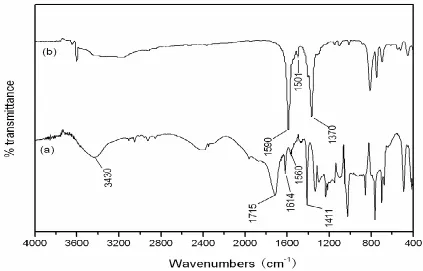
FT-IR spectrum was employed to reveal the composition of the pink-colored product. For easy to compare, we recorded the spectra of p-H2BDC ligand and Co-BDC coordination complex, the
1a, the characterization peaks at 1715 and 1411 cm-1 were attributed to the υ(C=O) and δ(O-H) stretching vibrations of carboxylic acid.
Figure 1. FT-IR spectra of (a) ligand p-H2BDC and (b) as-synthesized cobalt ion-based coordination
polymer
Two distinct absorption peaks at 1560 and 1614 cm-1 were attributed to the υ(C=C) stretch of benzene ring (Fig. 1a). By contrast with Fig. 1a, the characterization peak of C=O at 1715 cm-1 does not appear in the Fig. 1b, which indicates the coordination of carboxyl group to Co. The strong bands at 1590 and 1370 cm-1 were assigned to the asymmetric and symmetric stretching modes of coordinated (COO) group, respectively. Adsorptions due to the asymmetric and symmetric stretching of the coordinated COO groups in the 1610-1570 and 1390-1370 regions indicate that the BDC-Co complex have polymeric structures [28]. The weak band at 1501 cm-1 is the vibration of benzene ring υ(C=C). It is to note that broad band centered at 3430 cm-1
from H2O of hydration does not appear in
the Fig. 1b, which implies the absence of coordinated and free solvent H2O molecules in the complex.
The wavenumber separation (Δυ) between υas(COO
-) and υs(COO-) can be used to indentify the coordinate modes of carboxylic group to metal ion. The separation between asymmetric and symmetric stretching of COO- anion is 220 cm-1, which is greater than 200 cm-1, indicating that the COO- of p-BDC coordinated to Co in a monodentate mode.
[image:4.596.86.509.137.408.2]
pattern shows an obvious exothermic peak for the decomposition and oxidation of coordination polymer to Co3O4. It is to note that no weight loss or endothermic peak were observed below 363 ℃,
indicating the absence of coordinated or crystallized H2O molecules in the coordination complex,
[image:5.596.89.509.163.419.2]which is in agreement with the IR result.
Figure 2. TG-DSC curves of as-synthesized cobalt ion-based coordination polymer
[image:5.596.93.510.479.730.2]
On the basis of FT-IR, TG-DSC analysis and electrical neutrality supposition, we proposed that the probable molecular formula for the as-synthesized coordination complex is [Co(BDC)2H2]n.
Because the weight loss converted into Co3O4 based on the proposed molecular formula is 38%, which
is very close to the value of measurement (37.34%). To confirm the supposition, the composition of the as-synthesized BDC-Co coordination complex was further examined by element analysis. EA(%) result calcd: C, 42.25; O, 37.52; Co, 17.28; H, 2.95; Found: C, 42.2; O, 37.6; Co, 17.6; H, 2.6. The determined EA(%) matched well with the calculated value from the formula of [Co(BDC)2H2]n. Thus,
the proposed molecular formula is reasonable.
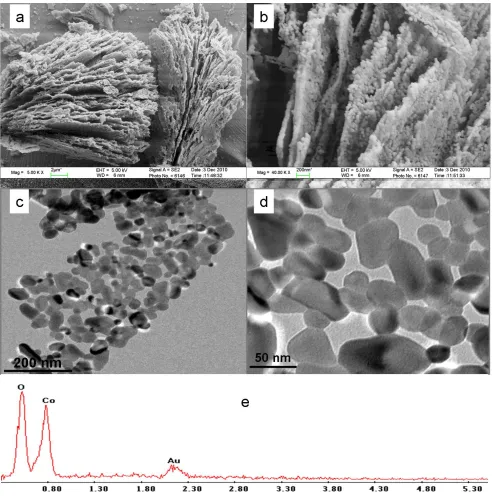
Figure 4. Typical FESEM images (a, b) and TEM images of Co3O4 nano/micro superstructures, (e)
[image:6.596.53.545.231.732.2]
According to the TG-DSC results, the heat treatment temperature of the p-BDC-Co coordination complex to Co3O4 was set at 450 ℃ to ensure the complete decomposition. The
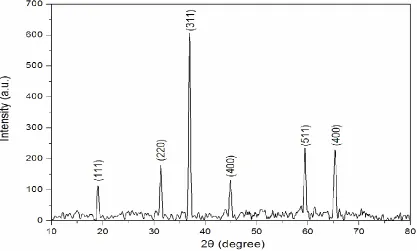
crystalline structure and phase purity of thermal decomposed product were examined by XRD pattern, the result was shown in Fig. 3. All the diffraction peaks in the Fig. 3 can be indexed to cubic phase Co3O4 (Lattice: face-centered; S.G.: Fd3m (227); Cell parameters: a = 8.0837 Å; JCPDS card no.
42-1467). No characterization peaks from other impurities were observed, indicating the high purity of decomposed product.
The morphology of the decomposed product was investigated by FESEM and TEM, respectively. The panoramic view in Figure 4a shows that the Co3O4 product consists of 3D
superstructures, which actually assembled from hundreds of microscale two-dimensional sheets. The detailed morphology of Co3O4 superstructures is supported by the high-magnification image shown in
Figure 4b, which reveals that these microscale sheets are densely composed of many uniform nanoparticles with an estimated mean size of ca. 30 nm. Furthermore, it can be clearly observed from the images that the accumulation of particles makes the microsheet form a great deal of pores between particles, which identified carefully in the nanosized scale. From TEM images (Fig. 4c and 4d), further information about the superstructures can be obtained. Fig. 4c clearly presents the projected shape of one microplate from Co3O4 superstructures, which are seen to be assembled by a large number of
[image:7.596.53.545.442.727.2]nanoparticles, consistent with the FESEM results. Additionally, the TEM image further demonstrated the porous nature of microsheets. A high-magnification image shown in Fig. 4b confirms the uniform size (ca. < 50 nm) of nanoparticles and the nanoscale pore size.
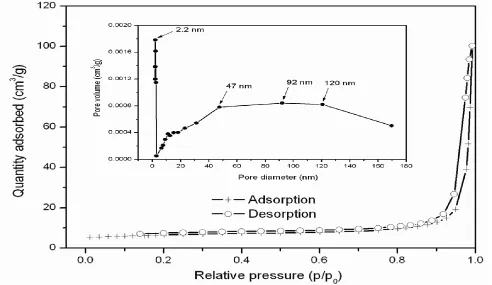
Figure 5. Nitrogen adsorption-desorption isotherms of the Co3O4 nano/micro superstructures measured
An analysis by energy-dispersive X-ray (EDX) spectroscopy in Figure 4e demonstrates that the crystal is composed of Co and O (Au came from the sprinkled Au for SEM examination of the sample), furthermore atomic% confirms the right chemical formula of Co3O4.
To investigate the specific surface areas and the porous nature of the Co3O4 nano/micro
superstructures, Brunauer-Emmett-Teller (BET) gas-sorption measurements were performed. Nitrogen adsorption-desorption isotherms of these nano/micro superstructures are shown in Figure 5, and the inset illustrates the corresponding Barrett-Joyner-Halenda (BJH) pore size distribution plot. The isotherms can be categorized as type of IV according to IUPAC classifications. The sharp increase in the uptake of N2 at higher relative pressure (p/p0>0.9) demonstrates the existence of macropores in the
samples which due to the interparticle space. Furthermore, the uptake of N2 in the macropore region is
significantly for the sample, suggesting the presence of higher fraction of macropores. The BJH pore size distribution calculated from the adsorption curve revealed the presence of multimodal and hierarchical porosity: mesopores together with macropores. It can be observed from the plot that the pore size of great than 50 nm is relatively less intense. Therefore, the contribution of macropore volume to the total pore volume is comparatively less and the total porosity in the sample is mostly due to mesopores. The detailed textural properties of the Co3O4 nano/micro superstructure are
quantitatively shown as follows: the BET specific surface area is 21.5 cm2·g-1, the pore volume is 0.16 cm3·g-1 and the average pore size is 28.8 nm. Such hierarchical porosity of Co3O4 nano/micro
superstructures can facilitate electrolyte impregnating into particles and ensure that there are enough electrolyte ions to rapid contact the much larger surfaces of the electroactive Co3O4 materials. This is
significant for supercapacitor electrode materials given a high-rate charge-discharge ability.
3.2. Electrochemical properties of Co3O4 nano/micro superstructures
To examine the effect of unique nano/micro superstructures to the electrochemical properties of Co3O4 electrode, the performance of the as-prepared Co3O4 nano/micro superstructures for
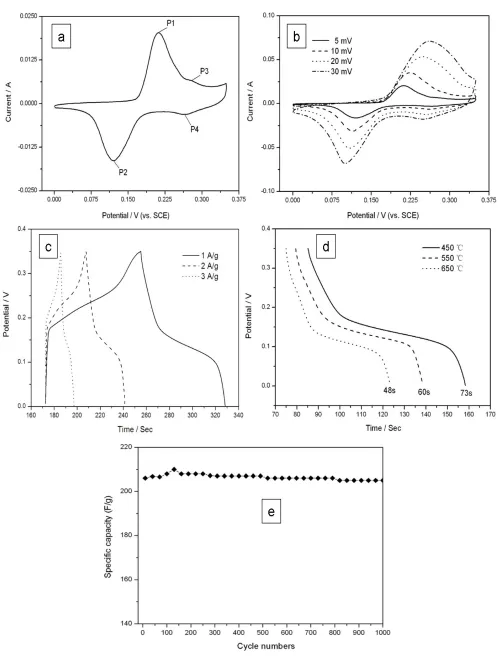
supercapacitor was studied by cyclic voltammetry (CV), galvanostatic charge-discharge and cycling life measurements. Fig. 6a shows the CV curve of prepared Co3O4 nano/micro superstructures at a scan
rate of 5 mV·s-1 within the potential range of 0.00 to 0.35 V (v. SCE). Two well-defined peaks were observed in the curve: the anode peak of P1(centered at 0.21 V) and cathodic peak of P2 (centered at 0.12 V). In addition, two weak peaks labeled as P3 and P4 in the potential range of 0.25-0.30 V also appeared in the same CV curve. In terms of previous literatures [29], these two pairs of peaks stand for the following two redox processes:
Co3O4 + OH- + H2O ↔ 3CoOOH + e- (1)
CoOOH + OH- ↔ CoO2 + H2O + e- (2)
The CV curves shown in Fig. 6b are for the Co3O4 nano/micro superstructures at various scan
rates relative to the first scan rate. It can be seen that the CV curves with good symmetry are independent of scan rate, indicating a stable reversibility of the redox reaction. The capacitance of Co3O4 electrode at various scan rates can be calculated from the following equation:
0 35 . 0 ) ( 35 . 0 1 dV V I mv mv qSC (3)
The specific capacitance value of Co3O4 electrode at a low scan rate of 5 mV·s-1 is 210 F·g-1.
Impressively, the specific capacitance value still retains 179 F·g-1 at a high scan rate of 30 mV·s-1. As is known, with the increase of scan rate, the diffusion of OH- is much slower, and the ions only can reach the outer surface of the Co3O4 materials. Therefore, the effective utilization of the electroactive
material has been greatly limited, leading to the decrease of specific capacitance [30-31]. In the present Co3O4 nano/micro superstructures, the hierarchical porosity made up of mesopores and macropores
can supply enough electrolyte ions to rapidly contact the much larger surface and reduce the diffusion lengths, which in turn ensuring better utilization of the electroactive Co3O4 materials at a high scan
rate.
To acquire more information for the supercapacitive performance of as-prepared Co3O4
electrode, galvanostatic charge-discharge measurement was performed in the potential range of 0 - 0.35 V (vs. SCE). Fig. 6c shows the charge-discharge curve of Co3O4 electrode at the current density
of 1, 2 and 3 A·g-1. As it can be found, the discharge curve can be divided into two parts: a linear variation of potential versus on time (0 to 0.1 V) parallel to vertical axis which indicates a pure douber-layer capacitance behavior from the charge separation at the electrode/electrolyte interface. By contrast, a sloped variation of potential versus on time (0.1 to 0.35 V) caused by electrochemical adsorption/desorption or a redox reaction, indicates the typical pseudocapacitive behavior [32-33]. The specific capacitance of the electrode at different current densities can be calculated by using C = It/ΔVm, in which I is the discharge current, t is the total discharge time, ΔV is the potential drop during discharge, and m is the mass of Co3O4 within the composite electrodes. The specific capacitance value
of Co3O4 nano/micro structures electrode are 208, 194, 102 F·g-1 at the current density of 1, 2, 3 A·g-1,
respectively. These results demonstrate that the Co3O4 nano/micro superstructure is a better candidate
for supercapacitor electrode compared with Co3O4 nanosheets [22] (92 F·g-1 at the current density of 5
mA·cm-2 with potential window of 0-0.6 V); mesoporous Co3O4 microspheres [21] (102 F·g-1 at the
sweep rate of 3 mV·s-1 between the potential range of 0.1-0.6 V) and needle-like Co3O4 nanorods [20]
(111 F·g-1 at the current density of 2.5 mA·cm-1 with potential window of 0-0.5 V). The discharge capacitance of Co3O4 nano/micro superstructures electrode decreased with the increase in
charge-discharge current densities, which was responsible for the internal resistance and polarization of the electrode [34]. As a result, the Co3O4 nano/micro superstructures are appropriate for applications in
supercapacitors to be used at low current density.
To evaluate the electrochemical capacitance of the Co3O4 samples as a function of the heating
temperature. Fig. 6d shows the potential versus time for the electrode made by the annealing temperature of 450, 550 and 650 ℃, respectively. It can be seen that the discharge time decreased with the increase of annealing temperature, which implies the decline of specific capacitance for the Co3O4
electrode. Once the oxide phase is formed, further heat-treatment at higher temperature may cause the increase in crystal size, and accordingly a decrease in specific surface area, and also possibly its reactivity for surface chemical process, thereby leading to a decreased capacitance.
The cycling stability for the Co3O4 nano/micro superstructures is an important quality require
for practical applications, and examined by the continuous charge-discharge measurements over 1000 cycles (the Co3O4 sample was obtained at an annealing temperature of 450 ℃). Fig. 6e shows the
specific capacitance variation for the Co3O4 samples as a function of cycle number at the current
density of 1A·g-1 within a voltage range between 0.00 and 0.35 V in 6 M KOH electrolyte. During the first 130 cycles, the specific capacitance increased from ca. 206 to 210 F·g-1, resulting from the activation process of the Co3O4 electroactive material. Thereafter, it decreases to 204 F·g-1 after the
subsequent 870 continuous cycles. The lowest specific capacitance after 1000 cycles remains 97% of the maximum capacitance. This demonstrates that the charge-discharge processes do not seem to induce significant structural changes of the Co3O4 electrode materials as expected for
pseudo-capacitance reactions. The cycling life test suggests that the porous Co3O4 nano/micro superstructures
electrode has high stability for long-term applications.
4. CONCLUSIONS
In summary, Co3O4 nano/micro superstructures assembled by uniform nanoparticles and porous
microsheets have been prepared by solid-state thermal decomposition from a cobalt ion-based coordination polymer. The Co3O4 nano/micro superstructures have been applied to supercapacitor, it
could deliver a specific capacitance of 208 F·g-1 at a current density of 1A·g-1 and offers a lower specific capacitance degradation of ca. 3% after 1000 cycles in 6.0 M aqueous KOH solution (vs. SCE). This indicates that the Co3O4 nano/micro superstructures can provide simultaneous larger
specific capacitance and higher electrochemical stability. The results showed that the Co3O4
nano/micro superstructures might have potential applications in supercapacitors. We expected that the preparation strategy of Co3O4 nano/micro materials reported here should be viable to extend to other
transitional metal oxides systems.
ACKNOWLEDGEMENTS
This work was supported by the National Natural Science Foundation of China under grant No. 20633040, 20873064 and Nanjing University of Aeronautics and Astronautics Research Funding under grant No. NS2010170.
References
2. L.T. Lam, R. Louey, J. Power Sources 158 (2006) 1140 3. M. Winter, R.J. Brodd, Chem. Rev. 104 (2004) 4245
4. T.Y. Wei, C.H. Chen, H.C. Chien, S.Y. Lu, C.C. Hu, Adv. Mater. 21 (2009) 1 5. B. Liu, H. Shioyama, H.L. Jiang, X.B. Zhang, Q. Xu, Carbon 48 (2010) 456 6. H. Jiang, T. Zhao, C.Y. Yan, J. Ma, C.Z. Li, Nanoscale 2 (2010) 2195
7. D.C. Wang, W.B. Ni, H. Pang, Q.Y. Lu, Z.J. Huang, J.W. Zhao, Electrochim. Acta 55 (2010) 6830 8. Y.G. Guo, J.S. Hu, L.J. Wan, Adv. Mater. 20 (2008) 2878
9. C.Z. Yuan, X.G. Zhang, L.H. Su, L.F. Shen, J. Mater. Chem. 19 (2009) 5772 10.W. Wei, Z.Z. Yang, Adv. Mater. 20 (2008) 2965
11.H.K. Lin, C.B. Wang, H.C. Chiu, S.H. Chien, Catal. Lett. 86 (2003) 63
12.D.N. Srivastava, N. Perkas, G.A. Seisenbaeva, Y. Kolty-pin, V.G. Kessler, A. Gedanken, Ultrason. Sonochem. 10 (2003) 1
13.K. Ebitani, H.B. Ji, T. Mizugaki, K. Kaneda, J. Mol. Catal. A 212 (2004) 161
14.S. Takada, M. Fujii, S. Kohiki, T. Babasaki, H. Deguchi, M. Mitome, M. Oku, Nano Lett. 1 (2001) 379
15.E.L. Salabas, A. Rum-plecker, F. Kleitz, F. Radu, F. Schueth, Nano Lett. 6 (2006) 2977 16.A.M. Cao, J.S. Hu, H.P. Liang, W.G. Song, L.J. Wan, X.L. He, X.G. Gao, S.H. Xia. J. Phys.
Chem. B 110 (2006) 15858
17.H.J. Nam, T. Sasaki, N. Koshizaki, J. Phys. Chem. B 110 (2006) 23081 18.F.M. Zhan, B.Y. Geng, Y.J. Guo, Chem. Eur. J. 15 (2009) 6169
19.G.X. Wang, H. Liu, J. Horvat, B. Wang, S.Z. Qiao, J. Park, H.J. Ahn, Chem. Eur. J. 16 (2010) 11020
20.T. Zhu, J.S. Chen, X.W. Lou, J. Mater. Chem. 20 (2010) 7015
21.L. Wang, X.H. Liu, X. Wang, X.J. Yang, L.D. Lu. Curr. Appl. Phys. 10 (2010) 1422 22.S.L. Xiong, C.Z. Yuan, X.G. Zhang, B.J. Xi, Y.T. Qian, Chem. Eur. J. 15 (2009) 5320 23.Y.J. Xiong, Y. Xie, Z.Q. Li, C.Z. Wu, Chem. Eur. J. 9 (2003) 1645
24.Z.Q. Li, Y.J. Xiong, Y. Xie, Nanotechnology 16 (2005) 2303
25.H.L. Li, M. Eddaoudi, M. O’keeffe, O.M. Yaghi, Nature 402 (1999) 276
26.M. Eddaoudi, J. Kim, N. Rosi, D. Vodak, J. Wachter, M. O’keeffe, O.M. Yaghi, Science 295 (2002) 469
27.J.F. Arenas, J.I. Marcos, Spectrochim. Acta 36A (1980) 1075
28.S.G. Baca, I.G. Filippova, O.A. Gherco, M. Gdaniec, Y.A. Simonov, N.V. Gerbeleu, P. Franz, R. Basler, S. Decurtins, Inorg. Chim. Acta 357 (2004) 3419
29.S. Palmas, F. Ferrara, A. Vacca, M. Mascia, A.M. Polcaro, Electrochim. Acta 53 (2007) 400 30.C. Xu, B. Li, H. Du, F. Kang, Y. Zeng, J. Power Sources 180 (2008) 664
31.V. Subramanian, H. Zhu, R. Vajtai, P.M. Ajayan, B. Wei, J. Phys. Chem. B 109 (2005) 20207 32.W. Sugimoto, H. Iwata, Y. Yasunaga, Y. Murakami, Y. Takasu, Angew. Chem. 115 (2003) 4226 33.G.Q. Zhang, Y.Q. Zhao, F. Tao, H.L. Li, J. Power Sources 161 (2006) 723
34.Y.G. Wang, Y.Y. Xia, J. Electrochem. Soc. 153 (2006) A450