©IJRASET: All Rights are Reserved
3106
Advanced E-Nose System
Monika Nandu Temkar
1, Kajal Ramchandra Pawar
2, Sai Sanjay Ambavane
3, Bhagyshree Anil Dawande
4, Prof. Dr. B.K
Sarkar
51, 2, 3, 4Student, 5Professor, PVPIT College of Engineering, Pune, Maharashtra
Abstract: In today's life, we all have some health issues due to the pollutions. We did not know the current pollution conditions in a specific area or room. Also, there are no such systems which alert the user when the levels of harmful gases are increased. So there is a need for such system which controls the harmful gases in or outside of the room. The proposed system deals with all the mentioned issues like controlling the pollution and gives the alert notification to the user when the level of harmful gases exceeds the particular limit. This system can give real-time pollution of particular room values like oxygen level, temperature level, moisture in the air etc. The hardware kit work with the Arduino WeMos Microcontroller which can send the sensor data to the server through WIFI. In the alert condition, the system can notify the user. Also, the kit plays the buzzer to alert the user. Keywords: Arduino WeMos, E-Nose System, Harmful Gase Detection.
I. INTRODUCTION
Nowadays, pollution is rapidly increasing, and the occurrence of particulates, chemicals or biological resources into the environment that causes unexpected, humans death, or disease, damage source of revenue, or spoil the natural environment. In reality, pollution content in the air is most vital environmental problems in developed and urban cities. The environment is affected in terms of global climate change and adverse effects on plants and ecosystems due to urbanization in recent years.
Pollution is rapidly increasing due to various human activities, the introduction of harmful gases like SO2, particulate matter (PM), NO2 [11], oxide of carbon, CH4 , biological materials into the atmosphere or that cause discomfort, disease, or death to humans, damage other living organisms such as food crops, or damage the natural environment or built environment.
The harmful air pollutant[8] cause hazardous effects on the ecological system of a human being such as a disease, discomfort or death to humans, damage to other living organisms so it's very important to control pollution and avoid these problems.
As the primary purpose of E-noses [1][3][7] is to guarantee secure surroundings for human users. E-noses should preferably be human-centered devices that can be either deployed in a distributed fashion around human users or integrated with the mobile/wearable devices of the user
Here we proposed an E- Nose system that can help to detect We are developing a system which can help to detect and monitor the harmful gases; fire extinguisher detected in a particular room.
II. LITERATURE REVIEW
Selda GUNEY et al. [1] develop an e-nose an electronic device which can measure chemical compounds in air and consequently classify different odors. Chemical compounds are represented by a decision tree whose nodes are composed of classifiers such as Support Vector Machines and K-Nearest Neighbor.
Pablo Gomez et al.[2] design and implementation of an electronic nose, which was 13 applied to classify and identify hazardous gases generated in underground coal mines. An electrochemical sensor array was used to detect a set of toxic gases on indoor environments. The paper gives a success rate of 97% using principal components analysis (PCA) and 24 Linear Discriminant Analysis (LDA).
Kea-Tiong Tang et al.[3] developed a prototype of a portable electronic nose (E-Nose) comprising a sensor array of eight commercially available sensors. This system is used to identify the fragrance of three fruits, namely lemon, banana, and litchi. Andrey Somov et al.[4] build a complete wireless sensor-actuator system for hazardous gases detection based on wireless sensor network paradigm. The author used the catalytic sensor for long term operation for safety requirements.
Nitin Sadashiv et al. [5] develop an air pollution measurement and prediction system using IoT for a smart city which stores the data in the cloud. Cloud data is used for data analytics which can be used for taking the decision to minimize pollution and reduce the effect of pollution on environment.
©IJRASET: All Rights are Reserved
3107
detect high reading on either the particulate matter or carbon monoxide. The components included in the hardware is a Dust Sensor which will measure the particulate matter in the area, Carbon Monoxide Sensor for measuring the gas detected, microcontroller, and a Raspberry Pi in order to send the data through email.
Shivani Bist et al.[9] gives an Automated room temperature controlled devices and Air pollution detection system. The system can help as a pollution detector; one also comes to know the pollution levels in the room among normal, danger and safe. The system is designed with microcontroller. Temperature sensor: LM 35: used to detect the room temperature and MQ 7 is used to detect the Air Quality Index in the room.
Chaitanya H P et al. [11] to monitor and control the pollutants in the vehicle by using the pollution control circuit. This pollution control circuit consists of various sensors like gas sensors, temperature sensor, GSM, Pulse width modulator (PWM) and all of them are integrated and connected to a Controller. When a vehicle reaches beyond certain threshold pollution level then the speed of the system gets automatically slow down and if the temperature reaches beyond some threshold value fan is automatically turned on. The DC motor speed control of the system is done using PWM. It is also demonstrated using MATLAB simulink simulation using PID and PWM mentation IOT based system to measure the pollution of public transports using MQ7 Arduino which is sensitive for Carbon Monoxide. Global Positioning System (GPS) is implemented in these arduino which would find the location of the transport vehicle. The amount of Carbon Monoxide emitted is sensed once in 20km and also the locality of vehicle is used for finding the area which is polluted the most. These are then integrated to the Amazon Cloud IOT which is more securable and many services of AWS can be used along with it. This would enable a Simple Notification Service (SNS) to the mobile phone when the vehicle is causing higher level of pollutants.
III. PROPOSED SYSTEM
Existence of harmful gases is a serious problem, especially to the aging population. The factors such as smoke coming from vehicles and factories as well as dust and debris contribute to air pollution which also leads to people having health problems. In recent years, many works related to e-nose systems and odor sensing has emerged.
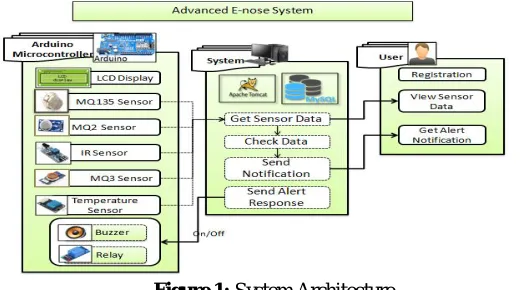
[image:2.595.161.421.422.567.2]The aim of the proposed system is to detect the real-time harmful gases values that can send the sensor data to the server through WIFI and system can notify the user if the limit exceeds. The kit plays the buzzer to alert the user.
Figure 1: System Architecture
The proposed system will be more effective than the existing system because we will remove the offline process and switch them to a completely automatic process using IoT.
1) User Registration: The user should be registered in the system. They can add their details like phone number, username, password etc.
2) Get Sensor Data: In the system can gather the data through the hardware kit and send it to the server using WIFI based Arduino WeMos Microcontroller. The hardware kit contains the following sensors:
a) Oxygen Sensor: Get Oxygen value in the air.
b) Temperature Sensor: Get current temperature value.
c) Moisture Sensor: It gets the current moisture in the air.
d) MQ7 Sensor (For CO2): Get Carbon level in the air.
e) Used for person counting in the room.
©IJRASET: All Rights are Reserved
3108
4) Check Sensor Data: The system checks the sensor data and gives the proper response. It checks the sensor values against thepredefined sensor limits. If the sensors values exceed the limit then the system can send the response to the kit and also notify the user through SMS.
5) Send Alert Notification to User: If the sensor is cross the normal range then the system can send the alert notification to the user's registered number. The user receives notification through the SMS.
6) Send Response to Kit: After sending a notification to the users, the systems also send the response to the kit. In alert condition, the system sends a response to the kit for playing the buzzer and on/off the light relay.
A. Sensors Used
1) MQ 135 Air Quality Sensor: Air quality sensor for detecting a wide range of gases, including NH3, NOx, alcohol, benzene, smoke and CO2. It mainly used for Air quality monitoring application.
2) MQ-2 Gas sensor [10]: It can detect or measure gasses like LPG, Alcohol, Propane, Hydrogen, CO and even methane.
3) MQ 3 Methane Sensor: useful for gas leakage detection (in home and industry). It is suitable for detecting Alcohol, Benzine, CH4, Hexane, LPG, CO. Due to its high sensitivity and fast response time, measurements can be taken as soon as possible.
4) LM 35 Temperature Sensor [9] [10]: LM35,the temperature can be measured more accurately than with a thermistor. The operating temperature range is from -55°C to 150°C.
5) IR Sensor: An IR sensor can measure the heat of an object as well as detects the motion.These types of sensors measures only infrared radiation, rather than emitting it that is called as a passive IR sensor.
B. Mathematical Model
Let us consider S be a Systems such that U=Users
D= Sensor Data R=Response from kit S=System
S= {U, D, S,R,T},where
1) U= {U1, U2, U3…….Un | ‘U’ is a Set of all USERS }There may be number of users for making use of system. So this is the Infinite Set.
2) D= {D1, D2, D3…….Dn | ‘D’ is a data getting from the hardware kit }A lot of sensor data is getting from the system. So this is the Infinite Set.
3) R={R1,R2,R3 | R is response getting from the kit}After sending a notification to the users, the systems also send the response to the kit T={T1,T2,T3 | T is a set of data mining techniques}There may be n number of recommendations of the system. So this is a finite set.
4) DS = {SENSOR DATAINFO, AIR QUALITY info, | DS is a Set of data table for permanent storing of data on server }
5) SS = {SREG, SLOGIN, | SS is a Set of Storage Service }STORAGE SERVER will provide two services like Registration, Login. As this set also has finite attributes, so this is also Finite Set.
a) Activities / Events
i) Event 1
User will make registration on SYSTEM & Storage Server. Let f(U) be a function of User
Thus, f(U) {Ss}
ii) Event 2
System can gather the data through the hardware kit and send it to the server Let f(S) be a function of System.
Thus, f(S) {D1,D2,D3……Dn}
iii) Event 3
System checks the sensor data and gives the proper response Let f(S) be a function of Systems.
Thus, f(D) {D1,D3,D3,…Dn} € R If D > L R (to kit)
©IJRASET: All Rights are Reserved
3109
C. System Flow For Gas DetectionThe proposed system can gather the data through the hardware kit and send it to the server using WIFI based Arduino WeMos Microcontroller. All the sensors values are checked against the threshold value. If the value are increased above the threshold then an alert notification is send to the user. Below figure gives the overall system flow of the proposed system.
Figure: System Flow
D. Algorithm Used
1) ID 3 ((Iterative Dichotomiser 3) Algorithm: ID3 builds a decision tree from a fixed set of examples. The resulting tree is used to classify future samples. The leaf nodes of the decision tree contain the class name whereas a non-leaf node is a decision node. The decision node is an attribute test with each branch (to another decision tree) being a possible value of the attribute. ID3 uses information gain to help it decide which attribute goes into a decision node.
a) Algorithm
1)
Establish Classification Attribute (in Table R)
2) Compute Classification Entropy.3) For each attribute in R, calculate Information Gain using classification attribute.
4) Select Attribute with the highest gain to be the next Node in the tree (starting from the Root node).
5) Remove Node Attribute, creating reduced table RS.
6) Repeat steps 3-5 until all attributes have been used, or the same classification value remains for all rows in the reduced table.
b) Entropy
©IJRASET: All Rights are Reserved
3110
E. Application1) To detect the harmful gases of the particular room.
2) Industrial Application: The proposed system can check the harmful gases for a room by using the sensor mentioned above. Most of the toxic gases are produced in the industry which needs to be detected. By increasing the components or high level sensitive sensors we can expand this system for large scale application ranging from food processing, industrial manufacturing, quality control, environmental protection, security, safety and military applications to various pharmaceutical, medical, microbiological and diagnostic applications as a safety measures for worker or indirectly for environment.
IV. CONCLUSION
Harmful gases or an unwanted gas being major issues as it creates many hazardous effects on the ecological system of human being. So it must be required to monitor these gases in a room to maintain the required oxygen level. Carbon emissions increased significantly from urbanization.
The proposed system can monitor the air of room using Arduino microcontroller. The system helps to improve the quality of air in addition to the enhancement of the process of monitoring various aspects of the environment. The MQ7 sensor is used for monitoring Air Quality as it detects most harmful gases and can measure their amount accurately.
V. FUTURE SCOPE
Technology in India is bigger which can able to detect the harmful gases upto the large extents. The present system can detect some of the gases like LPG, Alcohol, Propane, Hydrogen, CO and even methane. Again existing systems are more expensive and need huge equipment to detect gases.
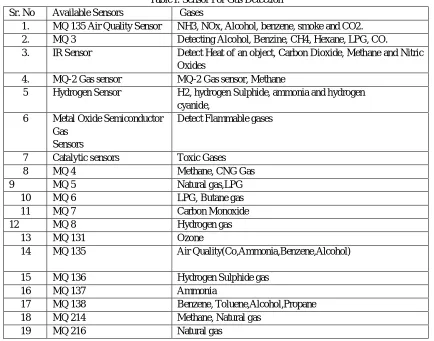
[image:5.595.82.516.411.752.2]So there still need of the technology and algorithm to detect the harmful gases. Below table gives the detail of available sensors for detecting particular gases and again the research needed to detect more gases with advanced sensors.
Table I: Sensor For Gas Detection
Sr. No Available Sensors Gases
1. MQ 135 Air Quality Sensor NH3, NOx, Alcohol, benzene, smoke and CO2.
2. MQ 3 Detecting Alcohol, Benzine, CH4, Hexane, LPG, CO.
3. IR Sensor Detect Heat of an object, Carbon Dioxide, Methane and Nitric
Oxides
4. MQ-2 Gas sensor MQ-2 Gas sensor, Methane
5 Hydrogen Sensor H2, hydrogen Sulphide, ammonia and hydrogen
cyanide, 6 Metal Oxide Semiconductor
Gas Sensors
Detect Flammable gases
7 Catalytic sensors Toxic Gases
8 MQ 4 Methane, CNG Gas
9 MQ 5 Natural gas,LPG
10 MQ 6 LPG, Butane gas
11 MQ 7 Carbon Monoxide
12 MQ 8 Hydrogen gas
13 MQ 131 Ozone
14 MQ 135 Air Quality(Co,Ammonia,Benzene,Alcohol)
15 MQ 136 Hydrogen Sulphide gas
16 MQ 137 Ammonia
17 MQ 138 Benzene, Toluene,Alcohol,Propane
18 MQ 214 Methane, Natural gas
©IJRASET: All Rights are Reserved
3111
The above table gives the availabe sensors used for gas detection. Still there are some gases that can not be detected using this availablle sensors.
Catalytic sensors mentioned in above table are not sensitive enough todetect toxic gas present in the atmosphere at verylow concentrations. So there is need to detect a highly sensitive catalyticsensor which will beable to detect accurately toxic gases in concentrationsranging from as low as 100 ppm to severalten thousand ppm.
REFERENCES
[1] Si Chen, Rui Shi, Zhuangyu Ren, Jiaqi Yan, Yani Shi, Jinyu Zhang, “A Blockchain-based Supply Chain Quality Management Framework”, 14th, IEEE International Conference on e-Business Engineering, 2017.
[2] Pablo Gómez1, Cristhian Duran1 and Rafael Acosta2"Wireless Smell System for Hazardous Gases Detection",2018.
[3] Kea-Tiong Tang , Shih-Wen Chiu, Chih-Heng Pan, Hung-Yi Hsieh, Yao-Sheng Liang and Ssu-Chieh Liu"Development of a Portable Electronic Nose System for the Detection and Classification of Fruity Odors",Sensors 2010, 10, 9179-9193; doi:10.3390/s101009179.
[4] AndreySomov,Alexander Baranov, Denis Spirjakin,"A wireless sensor–actuator system for hazardous gases detection and control",Volume 210, 1 April 2014, Pages 157-164.
[5] Nitin Sadashiv Desai, John Sahaya Rani Alex, IoT based air pollution Monitoring and predictor system on Beagle Bone Black, International Conference on Nextgen Electronic Technologies: Silicon to Software (ICNETS2), IEEE, 2017.
[6] Meo Vincent C. Caya ; Angeline P. Babila ; Alyssa Moya M. Bais ; Seoi Jin V. Im ; Rafael Maramba ,”Air pollution and particulate matter detector using raspberry Pi with IoT based notification”, 2017 IEEE 9th International Conference on Humanoid, Nanotechnology, Information Technology, Communication and Control, Environment and Management (HNICEM).
[7] Jiaqi Chen, Zhuo Chen, Farid Boussaid, Daquan Zhang, † Xiaofang Pan, Huijuan Zhao, Amine Bermak Chi-Ying Tsui, Xinran Wang, § and Zhiyong Fan * "Ultra-Low-Power Smart Electronic Nose System Based on Three-Dimensional Tin Oxide Nanotube Arrays",OI: 10.1021/acsnano.8b02371 ACS.
[8] Marina Sruthi, Dr.L.Josephine Mary,"Smart Pollution Detection and Tracking System Embedded With AWS IOT Cloud",International Journal of Advanced Research inComputer Science and Software Engineering,2016.
[9] Shivani Bist1, Isha Chawla2, Y.N. Prajapati,"Automated Room Temperature Controlled Devices and Air Pollution Detection System",INTERNATIONAL JOURNAL FOR RESEARCH & DEVELOPMENT IN TECHNOLOGY,2017.
[10] Prof.D.D Mondal1, Rutuja Deshpande2, Pooja Bhagat3 ,Gitanjali Bandal4,"A System detecting an Air Pollution and tracking using GPS & GSM",irjet,2017.
[11] Chaitanya H P1,H. Prasanna Kumar,"AUTOMATED SYSTEM FOR AIR POLLUTION DETECTION AND CONTROL OF SPEED IN
VEHICLES",International Journal of Advances in Engineering & Technology, Aug., 2016.