warwick.ac.uk/lib-publications
A Thesis Submitted for the Degree of PhD at the University of Warwick
Permanent WRAP URL:
http://wrap.warwick.ac.uk/109307
Copyright and reuse:
This thesis is made available online and is protected by original copyright.
Please scroll down to view the document itself.
Please refer to the repository record for this item for information to help you to cite it.
Our policy information is available from the repository home page.
Dynamics of surface homeomorphisms: braid
types and coexistence of periodic orbits
J o h n G u a s c h i
T hesis su b m itte d for th e degree of P h .D to th e U niversity of W arwick
N onlinear S ystem s L aboratory M ath em atics In stitu te U niversity of Warwick
C oventry C V 4 7 A L E ngland
t •
Abstract
In this Thesis, we discuss the following general problem in dynamical systems: given a surface homeomorphism, and some information about its periodic orbits, what else can we deduce about its periodic orbit structure? Using the concept of the ‘braid type’ of a periodic orbit, its relation to Artin’s braid group, and the Nielsen-Thurston classifi cation of surface homeomorphisms, we examine problems pertaining to the coexistence of periodic orbits, in particular for homeomorphisms of the disc, annulus and 2-torus. We aim to elucidate the underlying geometry and topology in such systems. The main original results are the following:
• classification of braid types for periodic orbits of diffeomorphisms of genus one surfaces with topological entropy zero (Theorems 2.5 and 2.6).
• lower bounds on the size of the rotation sets of annulus homeomorphisms which possess certain periodic orbits or finite invariant sets (Theorems 3.17 and 3.19, Theorem 3.20).
• bounds on the size and shape of rotation sets of torus homeomorphisms possessing certain periodic orbits. (Theorems 3.24 and 3.25).
• the coexistence of periodic orbits in the disc, for periodic orbits of prime pe riod (Theorem 4.2), of period 4 (Theorem 4.10), and for 3-point invariant sets (Theorem 4.11).
• the coexistence of periodic orbits in the annulus (Theorem 4.4), and of the sphere with a 4-point invariant set (Theorem 4.12).
• given a torus homeomorphism isotopic to the identity which possesses a fixed point, it is isotopic to the identity relative to that fixed point (Theorem 5.6).
• given a periodic orbit of a disc homeomorphism of period 3, the coexistence of a strongly linked fixed point (Theorem 5.10).
• given a periodic orbit of the annulus homeomorphism of pseudo-Anosov braid type, its rotation number lies in the interior of the rotation set (Theorem 6.1). •
Contents
Acknowledgements iv
Declaration v
0 Introduction 1
1 T hurston’s classification o f surface hom eom orphism s and the braid
typ e o f a periodic orbit 4
1.1 N otation... 4
1.2 The specification of a periodic orbit ... 5
1.2.1 Requirements for a specification ... 5
1.2.2 The braid type of a periodic orbit ... 5
1.3 Artin’s braid g ro u p ... 8
1.3.1 Geometric b ra id s ... 8
1.3.2 Braid types and Artin’s braid g r o u p ... 9
1.4 The partial order on braid t y p e s ... 10
1.5 Nielsen-Thurston theory of surface hom eom orphism s... 11
1.5.1 Classification of toral automorphisms ... 11
1.5.2 Classification of surface hom eom orphism s... 12
1.6 Properties of pseudo-Anosov homeomorphisms ... 15
1.7 Train tracks and periodic o rb its ... 17
1.8 Irreducible and reducible braid ty p e s ... 21
1.8.1 Thurston types of braid ty p e s ... 21
1.8.2 Decomposition of reducible braid types ... 21
1.9 Concluding r e m a r k s ... 23
2 A classification o f braid types for periodic orbits o f diffeomorphisms o f surfaces o f genus one with topological entropy zero 24 2.1 Introduction... 24
2.2 Classes of diffeomorphisms... 25
2.3 Classification of homeomorphisms of finite order of the torus ... 28
2.4 Results... 30
2.5 Two corollaries... 34
2.6 Classification of isometries of the to r u s ... 36
3 Flow-equivalence and rotation sets 40 3.1 Introduction... 40
3.2.1 The suspension construction and geometric b r a i d s ... 41
3.2.2 Cross-sections and homology directions ... 42
3.2.3 Flow-equivalence and pseudo-Anosov homeomorphisms ... 44
3.3 Rotation numbers of the a n n u lu s ... 45
3.4 Farey intervals and rotation s e t s ... 48
3.5 Ramified covering of the s p h e re ... 51
3.6 Periodic orbits of period 2 of homeomorphisms of the an n u lu s... 54
3.6.1 Relative rotation numbers of periodic o r b its ... 54
3.6.2 Calculations using the Weierstrass m a p ... 57
3.7 Flow-equivalence and the 2 -to ru s ... 65
3.7.1 Introduction ... 65
3.7.2 Reformulation of flow-equivalence... 66
3.8 Rotation sets for homeomorphisms of T2 ... 67
3.8.1 Rotation sets and isotopy c la s s e s ... 67
3.8.2 The Farey sq u a re ... . ' . . . . 68
3.8.3 The set 72 3.8.4 The set jC(Pii>r) ... 73
3.8.5 Conclusions about the structure of rotation s e ts ... 74
4 C oexistence o f p erio d ic o rb its in th e d isc 75 4.1 Introduction... 75
4.2 Notation and indices of fixed points ... 76
4.3 Coexistence of periodic orbits for prime p e rio d s... 80
4.4 Coexistence of periodic orbits with one of period 4 ... 83
4.5 Coexistence of periodic orbits in D3... 85
4.6 Coexistence of periodic orbits in S2... 86
5 T h e B u ra u re p re s e n ta tio n an d linking 80 5.1 Introduction... 89
5.2 Free differential c a lc u lu s... 89
5.3 Geometric interpretations and the Lefschetz n u m b e r ... 91
5.4 The linking number problem ... 98
5.4.1 Linking of a fixed point with a periodic o r b i t ... 99
5.4.2 The Alexander polynomial and n = 3 ... 99
6 R o tatio n sets o f hom eom orphism s o f t h e an n u lu s 102 6.1 Introduction... 102
6.2 Markov partitions and periodic orbits ...103
6.3 The Reidemeister trace and Nielsen fixed point t h e o r y ...106
6.3.1 A brief r£sum£ of Nielsen fixed point th e o r y ...106
6.3.2 Pseudo-Anosov homeomorphisms and the fundamental group . . 107
6.4 Existence of periodic orbits of periodic braid ty p e ... 109
7 D ynam ics e m b ed d e d in pseudo-A nosov hom eom orphism s 111 7.1 Notation and preliminaries ...I l l 7.2 The normal form for B3 ...112
7.3 Axiom A and pseudo-Anosov hom eom orphism s... 115
7.4 Directed graphs for B3...116
7.4.2 Construction of the directed g r a p h ... 117 7.4.3 Embedded dynamics for higher periods ...126 7.5 Global shadowing in BT3 ... 127
Acknowledgements
Firstly, I would like to thank Robert MacKay for being my supervisor. He was (almost) always able to understand what I was trying to say, however vaguely I said it, he was very patient with my numerous silly questions, and was always able to encourage me when I was having a hard time understanding something. I consider it a great privilege to have had him as a supervisor. I would also like to thank him for reading carefully this Thesis, and making many useful comments and suggestions. I would also like to thank Anthony Manning for acting as my supervisor this year, and for reading much of this Thesis.
I would like to thank everyone at Warwick for three happy years here, the laid-back atmosphere was conducive to work. I definitely cannot say T owe you nothing ooo-err’ to ‘Uncle’ Peter Ashwin and Matthias ‘Mathematical Weirdo’ Gundlach, it has been a real honour to have had them as colleagues and friends. I thank Peter especially for being an all-round good bloke, and for letting me stay with him this last summer, and Matthias for his Milli Vanilli impersonations, his ‘M att ‘n’ Luke’, and his great sense of humour. Thanks are also due to Helen Byrne, Martin Gray, Bernice Bennett, Mike Rawlinson, Mark Muldoon and Peter Capewell.
I wish to thank everyone at Northwestern University, U. S. A. for making my stay so pleasant, especially John Franks for helping organize it and for acting as my supervisor, Catherine Carroll for many useful conversations and her friendship, Rob Bradley for being a good bloke, David Fried and Ziggy Nitecki for seeing me whilst I was in Boston, and also Michael Jones. I owe special thanks to Philip Boyland for having given such an excellent set of seminars on surface homeomorphisms in Warwick, and for showing me ‘the Prarie’, even if there were no bison there.
I owe a debt of gratitude to everyone at Nice University, especially Boris Kolev, for giving me much of his understanding of mathematics and from whose thesis I learnt a great deal. I would like to thank him, Marie-Christine Pérouéme, Marc ‘get me a beer - and make it snappy’ Perret for their kindness and generosity. I also wish to thank Jéróme Los for explaining many im portant things to me, and especially Jean-Marc Gambaudo and Gerard Iooss for their efforts in securing a C. N. R. S.-funded post for me this coming year.
I would like to thank everyone who I met at Cambridge, especially Angelica Fer nando, David Viles, Jonathan Partington, Nick Cavanagh, Paul Wells, Mike Luscombe and Michael Jenner. I would like to thank Toby Hall for his friendship and for im parting his knowledge to me, and Colin Sparrow, Paul Glendinning and Ben Mestel for having got me interested in dynamical systems in the first place.
Council for funding two visits to Nice in May 1990 and February 1991; Warwick Uni versity Mathematics Institute for partial funding to attend Düsseldorf Dynamics Days 1989, and Lyon ‘Systèmes Dynamiques’ conference in July 1990; and the Düsseldorf Dynamics Days committee for ‘local expenses’.
Finally, I wish to express my gratitude to Alison Solman, who always had time to talk to me, and was a tremendous comfort and confidante especially when things weren’t going so well, mathematically or (more often) otherwise, Dominic and Sally Verity who have been really great friends, Sarah Toms and my sister Jane for being so kind and understanding, and for being great fun, and lastly, to my parents for their love and support, and without whom none of this would have been possible.
D e c la r a tio n
Chapter 0
Introduction
In the study of dynamical systems, we are interested in the following problem: given a map / : M —*M of a topological space and a point x £ M , what do we know about the set
x , f ( x ) , f \ x ) , . . . 7
We call this set the forward orbit of i under / . Some questions we may wish to ask are:
• is the forward orbit of x under / dense in M?
• Is x a periodic point of / i.e. does there exist q e N such that fil(x) = x? If x is periodic, we call the least such q the period of x.
• given the forward orbit of i , what can we say about other orbits of /?
Usually we do not know / explicitly. For example, given experimental data, we will only be able to follow the path of a few orbits - we cannot possibly expect to know everything about the system. Even if we do know / explicitly, it may be too difficult computationally to allow a thorough investigation of th e system. Hence we are lead to ask: given a small amount of information about / , what properties can we deduce? For example, if / has a periodic orbit, what other periodic orbits coexist? This line of questioning was followed by Sharkovskii, who proved the following well-known Theorem.
T heorem 0.1 ([Sha, B G M Y , C E]) Define the following ordering y on the natural numbers:
3 y b y 7 y . . . y 3.2 >- 5.2 > - ...> - 3.22 >- 5.22 X . . > 2 2 > - 2 > - l .
If f : R—*R is continuous and has a periodic orbit o f period m, then it possesses a periodic orbit of period n for all m y n. Thus if f has a periodic orbit of period 3, it has periodic orbits of all periods.
We may refine further Sharkovskii’s ordering of the natural numbers by considering the cyclic permutation induced by the action of / on the points of the periodic orbit rather than just the period (see for example, [Be, CE, MSS]).
This provides an example of ‘universal structure’ in such families, in which we may also observe the phenomenon of ‘self-similarity’. If we study the bifurcation diagram of the standard unimodal map / M : [0,1]—>[0,1], /^(x ) = 4/ix(l — x) for 0 < p < 1, and magnify arbitrarily small parts of it, then these magnifications appear to be the same as the whole diagram [CE, TS]. For instance, it is possible to find infinitely many copies of the period-doubling cascade within the diagram.
Whilst the study of one-dimensional spaces continues to thrive, much attention has turned to the analogous problems in two dimensions. In particular, given a map / of a surface and information about its periodic orbits, what else can we say about /? In this case just the period of an orbit tells us nothing; for example consider a rigid rotation by 2t/ 3 of the disc D2 about its centre. All points of this map have period 3, except for the centre which is a fixed point. It becomes necessary to know more about a periodic orbit to be able to make meaningful statements about the dynamics of / . One way of doing this is to specify a periodic orbit by the isotopy class of the map relative to the orbit, which is (up to conjugacy) what we shall call the braid type of a periodic orbit. As we shall see in Chapter 1, it is possible to define a partial ordering on the set of braid types. There we shall discuss in more detail the reasons for choosing the braid type as a specification. One motive for doing so is that we may utilize the Nielsen-Thurston classification of isotopy classes of surface homeomorphisms to furnish ourselves with a ‘simplest’ map in the isotopy class relative to the periodic orbit. According to this classification, a braid type is either simple (‘periodic’), complicated (‘pseudo-Anosov’) or is made up of components of these two forms (‘reducible’). Dynamically, the pseudo- Anosov isotopy classes are the most interesting, and we will concentrate our work on them. We examine several important properties of pseudo-Anosov homeomorphisms, including the persistence of their periodic orbits under isotopy, the existence of Markov partitions which provides symbolic dynamics, and the associated notion of an embedded branched 1-submanifold or ‘train track’, which enables us to understand something of the underlying topology of the homeomorphism.
In Chapter 2, we study the braid types of homeomorphisms of the 2-torus which are not pseudo-Anosov, and we shall see that this restriction places strong constraints on the dynamics.
In Chapter 3, we discuss the notions of flow-equivalence and homology directions,
and relate them to homeomorphisms of the annulus and 2-torus. It turns out that flow-equivalence elucidates much of the inherent self-similarity in the partial order on braid types. As a consequence, we prove several results on the size and shape of the set of rotation numbers of annulus and torus homeomorphisms (the rotation number of a point is a measure of its average displacement). We study the Weierstrass map,
which relates homeomorphisms of the 2-torus (which we understand) to those of the sphere S 2, enabling us to find lower bounds on the size of rotation sets for annulus homeomorphisms possessing 2-point invariant sets.
In Chapter 5, we discuss the notion of linking of periodic orbits of a homeomorphism, and the relation with the Lefschetz number of a map via algebraic representations such as the Burau representation, for which we exhibit two geometric interpretations. The Lefschetz number is a homotopy invariant which gives information about the fixed point structure. We give a number of examples of the use of such representations; in particular we show that given a homeomorphism of the 2-torus isotopic to the identity which has a fixed point, then it is isotopic to the identity relative to that fixed point. As another application, we answer in the affirmative the ‘linking number’ conjecture for the case of a periodic orbit of period 3, which asserts the existence of a fixed point which is strongly linked with the given periodic orbit.
In Chapter 6, we provide a generalisation of the Aubry-Mather Theorem by proving the existence of periodic orbits of homeomorphisms of the annulus whose braid type is periodic. Further, we show that if the braid type of a periodic orbit is pseudo-Anosov, then the corresponding rotation number lies in the interior of the rotation set. In order to do this, we discuss Nielsen fixed point theory and the Reidemeister trace which gives us an important homotopy invariant. We relate these ideas to the topological nature of pseudo-Anosov homeomorphisms.
In Chapter 7, we consider the set B2,i of pseudo-Anosov braid types of periodic orbits of the annulus of period 2, and show that there exist two ‘minimal’ elements, minimal in the sense that any element of B2,1 dominates (at least) one of the two in the partial order. Using flow-equivalence, this has possible implications for periodic orbits of homeomorphisms of the annulus other than those of period 2. We also prove similar results for braid types in the set BT3 of pseudo-Anosov braid types of periodic orbits
of homeomorphisms of the disc of period 3. In this case, there exists a unique braid I type which is dominated by all others; we conjecture analogous results for B T n.
Finally, we give an extensive bibliography, containing many references not cited explicitly in the text, but which are related to the general development of th e subjects discussed.
Chapter 1
Thurston’s classification of
surface homeomorphisms and
the braid type of a periodic orbit
In this Chapter, we recall the classification of Thurston o f surface homeomorphisms up to isotopy, introduce the concept of the braid type of a periodic orbit of a surface homeomorphism, and relate it to A rtin’s braid group.
1.1
N o t a t i o n
We start by fixing some notation which shall be used throughout. Let M be a compact, orientable, connected surface, with or without boundary. M may be characterized by
its genus g (the number of torus summands), and the number of boundary components
b (the number of discs removed). The Euler characteristic x(Af) of M is given by
X(Af) = 2 - 2 g - b .
There exists a Riemannian metric of constant curvature k for M , which by a suitable choice of metric we can assume to be +1, 0 or —1 [Wo]. If x( Af) > 0, e.g. the sphere, the metric is elliptic with k = +1. If x(Af ) = 0 e.g. the 2-torus, the metric is Euclidean and k = 0. If x(Af) < 0, the Gauss-Bonnet Theorem [DC] implies that the metric is hyperbolic and k = —1. It is the last case that we shall be interested in.
Let Homeo+(M ) denote the space of orientation-preserving homeomorphisms of A/,
equipped with the topology of uniform convergence. We say that two homeomorphisms
f u f i 6 Homeo+(M ) are isotopic, which we write f \ ~ / j , if f \ and f i may be joined by an arc in Homeo+(M ). ~ defines an equivalence relation on Homeo+(M ). Set
A ut(M ) = Homeo+(M )/ ~ . (1.1)
Let Iso t(M ) be the subset of Homeo+(M ) of homeomorphisms isotopic to the identity.
Then we can rewrite equation 1.1 as
A ut(M ) = Homeo+ (M )/1 sot( M ).
For / € Homeo+(M ), let [/] denote its isotopy class in Aut(M ). Let A C M \ dM
notation:
Homeo+(M , A) — { / £ Homeo+(M ) : f(A ) = A}
and Aut(M , A) is the group of isotopy classes in A ut(M ) relative to A.
1.2
T h e s p e c if ic a t io n o f a p e r io d ic o r b it
1.2.1 R e q u irem en ts for a sp ecifica tio n
As outlined in the Introduction, the problem that we shall be interested in is to generalize Sharkovskii’s theorem [Sha, Ste] to two dimensions. Let / : be a homeomorphism of a surface M , such that / has a periodic orbit P of period n. W hat can we say about the set of periodic orbits of / , their structure, and the topological entropy of /?
The first question is what to choose as a specification of periodic orbits. In one dimension, one can choose the period of the orbit to deduce non-trivial information. One can gain more information by choosing the permutation induced by the periodic orbit, and this leads to a more refined ordering e.g. the MSS ordering in the unimodal case [MSS]. In two dimensions however, the period is not sufficient as a specification, as on the disc any period can come from a rigid rotation through an appropriate angle. Further, the concept of permutation is not well-defined. We require a generalization of the notion of permutation which describes the manner in which the map moves topologically the points of the orbit. In analogy with the one-dimensional case, we would like to choose a specification of periodic orbits satisfying the following conditions [Boy2, BoyF]:
1. given periodic orbits P,Q and a specification spec of periodic orbits, there exists an ordering on the set of specifications, such that spec(P) dominates spec(Q) in the ordering if and only if any map with a periodic orbit of type spec(P) also has one of type spec(Q).
2. given a periodic orbit P, and its specification spec(P), there exists a ‘simplest’ map exhibiting P. In particular, for any periodic orbit Q of this simplest map with specification spec(Q), there exists a periodic orbit of type spec(Q) for any map which exhibits a periodic orbit of type spec(P). So this simplest map has minimal structure with respect to the specification.
3. it is possible to calculate the structure of the ordering In case 1.
With such a structure, and a given family of maps, one can study how the family moves through the ordering, to suggest the bifurcations occurring.
1.2.2 T h e braid ty p e o f a p erio d ic orb it
An idea, due essentially to Bowen [Bo], is to specify a periodic orbit P = { P i,. . . , P„} C Int(Af) of a homeomorphism / of a surface M by the isotopy class of / restricted to the surface minus the orbit, or equivalently, the isotopy class of the map relative to the orbit. We formalize this notion in the following manner (c.f. [Boyl, Boy3, LM1, GLM]). Define a surface Mp by deleting P from M and recompactifying by adding a circle, the circle of unit tangent vectors, at each end of M \ P . Let Si be the circle replacing each
If / is a C'-diffeomorphism, then f \ \ i \ p extends to a homeomorphism fp : M p—>Mp
by setting
We call this process blowing up P. Given two diffeomorphisms f ,g of M with periodic orbits P,Q C IntM respectively, we say that (P, f ) and (Q ,g) have the same braid type
if there exists an orientation-preserving homeomorphism h : M p—>Mq with hfph~ x
isotopic to gq. This defines an equivalence relation on such pairs, and we call the equivalence class of (P , / ) its braid type bt(P, / ) . This will serve as our characterization of periodic orbits. We remark that it was not necessary that P was a single periodic orbit; we could have taken P to be any finite union of periodic orbits.
We have assumed / to be C x, but for the purposes of defining the braid type of a periodic orbit P of / , it suffices that / is differentiable at the points of P . We can in fact relax this condition by modifying slightly the definition of braid type. Given two homeomorphism8f,g of M with finite unions of periodic orbits V ,Q C Int(Af) respectively, we say that (V, / ) , (Q ,g) have the same braid type if there exists an orientation-preserving homeomorphism h : M —*M such that
1. h{V) = Q, and
2. h fh 1 is isotopic to g relative to Q.
This defines an equivalence relation on such pairs, and we call the equivalence class of ( P ,/ ) its braid type bt(V, /) . If / is a C'-diffeomorphism, the two definitions coincide. This is a consequence of the following Theorem.
Theorem 1.1 Suppose M is a compact, connected orientable surface, and suppose Q = { Q i,. . . , £>„} is an n-point set in Int(M ). Let Mq be the compact surface obtained by blowing up the points of Q. Then there exists a canonical isomorphism between Aut(Mq) and A u t(M ,Q ).
Proof
Let p : Mq—*M be the natural projection, p induces a morphism
p. : A ut(M o)—*Aut(M, Q).
The following Proposition affirms the surjectivity of p.:
Proposition 1.2 ([Ko4]) Let f € / / omeo+(M , Q). Then for all t > 0 sufficiently
small, there exists 6 >0 and g € // omeo+(Af, Q) isotopic to f relative to Q, such that: l. f = g on M \ U"=1P(Q i,c), where P (Q ,,c) is the closed ball of radius e centred
on Qi.
2. g is a C°°-diffeomorphism on U"= l/i(Q ;,b).
3. the isotopy between f and g fixes M \ U”_, B(Q,, c). Proof
Pick c > 0 small enough so that the balls are pairwise disjoint. Let a be the permutation induced by / on Q, let V be a closed disc containing Qi, satisfying
Choose 6 > 0 satisfying
Ay C / J(D) for 0 < j < n,
where Ay = B ( 2 „ j ( L e t Ty be a translation sending Ay onto Ay+1. Let
Uj = C1(/>(P)) \ Ay for j = 0 , 1 ,..., n,
where Cl denotes the closure. Define g on (Af \ U (Jy=o Ay as follows:
{
Tj on Ay for 0 < j < n — 1/ o n M \ U ^ p ( V ) .
For each j , there exists an orientation-preserving homeomorphism which maps Uj to Cfy+i and which coincides with g on dUj, using the Alexander isotopy e.g. [Bi3]. So one may extend g to an orientation-preserving homeomorphism of M satisfying:
1. f ~ 3g = Id on M \ U ^ P ( V ) .
2. for each j = 0,1, . . n — 1, / _1g| ji(V) *s a homeomorphism of the disc /■’('£>) onto itself which is the identity on d p ( V ) and which fixes the point
Thus f ~ l g\}, (v) is isotopic to the identity by an isotopy fixing Q„j(j) and the comple
ment of □
Injectivity of p, is a consequence of the following argument. Let / G /f omeo+( Mg), and let / G Homeo+(M , Q) be the homeomorphism induced by / . Pick a basepoint io 6 Int(Afg), and let x0 = p(xo). Let F = xy(Af \ 2 ) , and let Aut.F be the group of all automorphisms of F which are induced by elements of Homeo+(M , 2 ) . Let 7nn(F) denote the group of all inner automorphisms of F, then there exists a homomorphism
A : Homeo+(M , Q )-*A ut.F /Inn(F ).
But Aut(M , 2 ) — A u t.F //n n (F ) [ZVC, Epl]. So if / is isotopic to the identity (the basepoint is not necessarily fixed during the isotopy), the action induced by / on
x i(M \Q ,x o ) , an inner automorphism, is the same action induced by / on
It follows from Theorems of Whitehead, see [Sp], and Epstein [Epl] that / is isotopic
to the identity. □
This ensures that the isotopy class of the map relative to the orbit is equivalent to the isotopy class of the map restricted to the surface minus the orbit. So we may (and shall) switch between these two viewpoints in any given situation.
In the case of the disc DJ, it is convenient to work with a standard model D„ of the disc minus n points [Boy3, HT1], Let D2 = {x G R2 : ||*|| < 1}, and z, = (2i/(n + 1) — 1,0) for i G [n] = { 1 ,..., n}. Then set
X = {Xi : i G [n]}. (1.2)
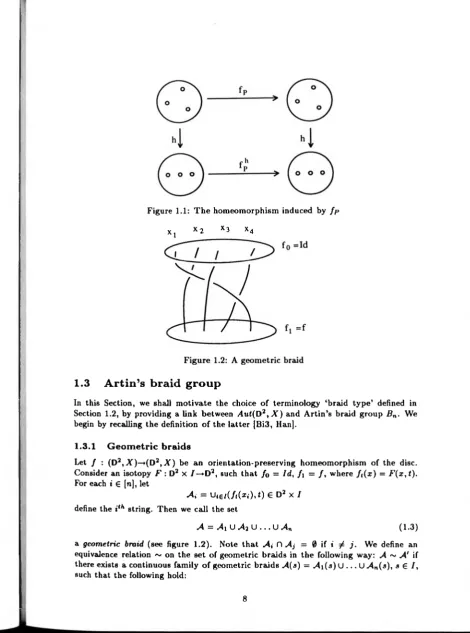
Figure 1.1: The homeomorphism induced by fp
X, x 2 x 3 X4
1.3
A r t in ’s b ra id g r o u p
In this Section, we shall motivate the choice of terminology ‘braid type’ defined in Section 1.2, by providing a link between Aut(D2, X ) and Artin’s braid group Bn. We begin by recalling the definition of the latter [Bi3, Han],
1.3.1 G eo m etric braids
Let / : (D2, A )—»(D2, A) be an orientation-preserving homeomorphism of the disc. Consider an isotopy F : D2 x / —*D2, such that f0 = Id, f\ = / , where /i(x ) = F (x,t).
For each ¿ 6 [n], let
A i = U ,6/(/i(*i).0 G D2 x / define the ith string. Then we call the set
A = A \ U A2 U .. , U A (1.3)
[image:16.581.57.528.20.654.2]jSo SB
Figure 1.3: Composition of geometric braids
1. .4(0) = A, .4(1) = A '.
2. the endpoints of each strand are held fixed as s passes from 0 to 1.
The composition of geometric braids is defined by concatenation as shown in figure 1.3. If we substitute equivalent braids A ', B' such that A! ~ A , B' ~ B, then Bo A ~ B' oA'.
Thus composition is well-defined on equivalence classes of geometric braids, and so provides a group structure on this set of classes. This group is Bn, 4rf«n’s braid group
on n strings. We call an element of Bn a braid.
Theorem 1.3 (Artin [Ar, Bi3]) The group Bn admits a presentation with genera
tors o i, . . . , <r„_i and defining relations
OiOj = OjOi if |t — j| > 2, 1 < t , j < n —1
^¿^+1^1 = <T|+1<T.<T.+1, 1 < « < » » - 2 . (1.4)
The generator tr,- corresponds to the braid given in figure 1.4. The centre Z (B n) of
Bn is the infinite cyclic subgroup generated by a full twist 8n = .. .<T„_i)n.
1.3.2 B raid ty p e s an d A r tin ’s braid grou p
Given an element / e //om eo+(D2, X ) and an isotopy ft from Id to / , it is clear from Section 1.3.1 that we may associate a braid with / . In fact, the following is true: Theorem 1.4 ([Bi3]) 4uf(D J,X )2 i Bn/Z ( B n).
This correspondence can be understood by mapping each generator o, of B„ to a homeomorphism m(<7,) whose support is a small neighbourhood containing the points
[image:17.587.58.560.6.662.2]Figure 1.5: The homeomorphism m(<r,)
between conjugacy classes of j4ut(D2,X ) and of Bn/Z ( B n), so we may identify the braid type 6t(P ,/ ) of a periodic orbit P of period n by a conjugacy class in Bn/Z ( B n).
We shall say that a braid 0 e Bn represents the braid type of P if the conjugacy class of 0 Z (B n) is bt(P, /) . Hence we may express 6i(P, f ) symbolically, in terms of the generators of Bn.
1 .4
T h e p a r tia l o r d e r o n b r a id t y p e s
In this Section, we describe the partied order on braid types [Boy3, HT1]. Let £„ denote the symmetric group on n elements i.e. the group of all permutations of the set [n], and let jt„ : Bn—► £„ be the homomorphism defined by ir„(<7,) = (»,» + 1). Since r„ (i„ ) = Id, irn induces a homomorphism Wn : B „ /Z (B n)—► £„. We say a conjugacy class in Bn/Z (B n) is cyclic if its image under 5rn is an n-cycle. Define
Theorem 1.5 (Boyland [Boy3]) The order relation (B T , y ) is a partial order.
be found in Chapter 4). For y to be a partial order, it must be
1. reflexive (0 y ß).
2. transitive (/? >- 7 ,7 >- 6 => ß y 6).
3. antisymmetric (/? >- 7 ,7 v ß => ß =7).
The first two properties follow from equation 1.6. The third follows from the fact that any two maps of the disc are isotopic, and a Theorem of Brunovskii [Bru] which
BTn = {cyclic conjugacy classes in Bn/Z ( B n)}.
For / € Zfomeo+(D2), define
bt{f) = {bt(P, / ) : P is a periodic orbit of /} .
JeHom'o+( D2)
(1.5)
We define an order relation on B T as follows:
a y ß for all / € Borneo*(D2),a e b t(f) => ß € bt(f). (1.6)
[image:18.582.77.534.3.668.2]asserts the existence of an isotopy compelling two chosen braid types to disappear at different points during the isotopy. Hence (BT,>~) is also antisymmetric. □
The fundamental problem of the complete elucidation of this order is still open, but some partial results have been found. For example, Matsuoka [Ma2] has an algorithm to uncover the ordering in BT3 (see Chapter 7 for more details), and Hall [HT1] has analysed braid types occurring in Smale’s horseshoe.
As we have seen, the braid type of a periodic orbit is an isotopy class (up to conjugacy). We may gain a deeper insight into them by understanding isotopy classes on surfaces, which we shall now proceed to describe.
1.5 N ie ls e n - T h u r s t o n t h e o r y o f s u r fa c e h o m e o m o r p h is m s
In this Section, we describe Thurston’s work on homeomorphisms of surfaces [Tl, T2, CB, FLP, HT], We motivate briefly this work by recalling the classification of toral automorphisms.
1.5.1 C lassification o f toral a u to m o r p h ism s
Consider the torus T2 as the quotient of R2 by the integer lattice Z2, equipped with a fixed orientation. Then jtj(T2) /fj(T2,Z) 9? Z © Z. Given an element A of the special linear group S L (2, Z), it preserves the lattice Z2, so there exists an induced homeomorphism ha : T2—>T2. Further, (/m). : jti(T2)—>xi(T2) has matrix A. On the other hand, two homeomorphisms of T2 are isotopic if and only if they induce the same isomorphism on jti(T2). Hence Aui(T2) — SL (2, Z). The characteristic polynomial of A may be written as
A2 — (Trace(A))A + 1. The eigenvalues are either [CB]:
1. complex i.e. Trace(A)=l, -1 or 0. Applying the Cayley-Hamilton Theorem leads to the conclusion that Ha has period 6,3 and 4 respectively, is said to be
periodic.
2. both ±1. Then A has an integral eigenvector which projects to an invariant simple closed curve 7 on T2, and which is homotopically non-trivial. Up to a change of coordinates,
a
={ ±
q
±0
which is a Dehn twist. This means that 7 has a tubular neighbourhood U home- omorphic to an annulus A, which we parametrize as { (r ,0) : 0 < r < 1}. The
Dehn twist in 7 is the homeomorphism whose support is A, and which is given by
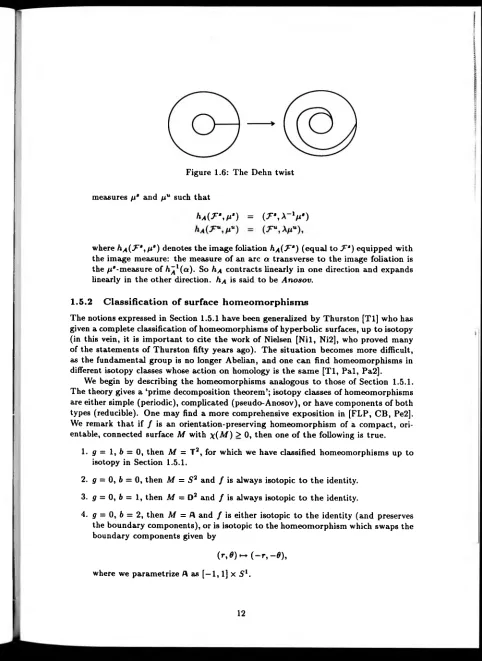
(r, 9) (r, 6 + 2irr) on A (see figure 1.6). Ha is said to be reducible.
3. The eigenvalues of A are distinct real numbers A, A- 1 , satisfying |A| > 1 > I A-11. has infinite order, and leaves no simple closed curve invariant. The eigendirections induce two transverse, invariant foliations T ‘ (stable) and J-u
Figure 1.6: The Dehn twist
measures /j* and /ju such that
hA( r \ s ) = (^ * ,a- V )
where hA( F ',fi‘) denotes the image foliation h ^ J 7“) (equal to T ‘) equipped with the image measure: the measure of an arc a transverse to the image foliation is the /i'-measure of h ^1(a). So hA contracts linearly in one direction and expands linearly in the other direction. hA is said to be Anosov.
1.5.2 C lassification o f surface h o m eom orp h ism s
The notions expressed in Section 1.5.1 have been generalized by Thurston [Tl] who has given a complete classification of homeomorphisms of hyperbolic surfaces, up to isotopy (in this vein, it is important to cite the work of Nielsen [Nil, Ni2], who proved many of the statements of Thurston fifty years ago). The situation becomes more difficult, as the fundamental group is no longer Abelian, and one can find homeomorphisms in different isotopy classes whose action on homology is the same [Tl, P al, Pa2],
We begin by describing the homeomorphisms analogous to those of Section 1.5.1. The theory gives a ‘prime decomposition theorem’; isotopy classes of homeomorphisms are either simple (periodic), complicated (pseudo-Anosov), or have components of both types (reducible). One may find a more comprehensive exposition in [FLP, CB, Pe2]. We remark that if / is an orientation-preserving homeomorphism of a compact, ori- entable, connected surface M with x ( M) > 0, then one of the following is true.
1. g = 1, b = 0, then M = T2 3 4, for which we have classified homeomorphisms up to isotopy in Section 1.5.1.
2. g = 0, 6 = 0, then M = £ 2 and / is always isotopic to the identity.
3. g = 0, 6 = 1, then M = D2 and / is always isotopic to the identity.
4. g = 0, b = 2, then M = A and / is either isotopic to the identity (and preserves the boundary components), or is isotopic to the homeomorphism which swaps the boundary components given by
■
;
( r ,0)b+ ( - r , -0),
[image:20.581.62.544.4.665.2]Figure 1.7: A three-pronged singularity
Let M be a compact, connected surface with Euler characteristic x(Af ) < 0, possibly with boundary, and let / : M —*M be a homeomorphism. We consider the three cases in turn.
1. / is periodic if it is an isometry of a hyperbolic metric. As a consequence, / ” = Id
for some n € N [Ni2].
2. / is a pseudo-Anosov homeomorphism if:
(a) there exist two foliations T ‘ and T u invariant under / having the same Unite set of singularities in Int(Af).
(b) each singularity of T ‘ and T u in Int(Af) has at least three séparatrices (‘prongs’). A neighbourhood of a fc-pronged singularity of a measured foli ation may be obtained by gluing together k rectangles along edges e.g. see figure 1.7.
(c) if dM / 0, each component of dM is a cycle of leaves (i.e. a finite union of leaves and singular points) of T ‘ and T u, and contains at least one singu larity of each foliation (see figure 1.8).
(d) T* and T u are transverse in Int(A/).
(e) T ‘ and admit transverse measures p ‘ and pu respectively, and there exists a real number A > 1 such that
= ( ^ * ,a- V )
/(^ •“,/i“) = (Pru, A/i“), (1.7)
where f ( F ‘,p ‘ ) denotes the image foliation / ( f ) (equal to T ‘ ) equipped with the image measure. Thus / contracts on the leaves of T ‘ where dis tance is measured by /i“, and expands on the leaves of T u where distance is measured by p ‘ . We call A the dilatation factor of / .
Figure 1.8: An example of the foliations at the boundary dM
figures 1.7 and 1.8 have P, = 3 for T u. Then the Euler-Poincare formula gives the following relation:
2X (M )= E (2 ~ P .)- (1-8)
»^SingF
This formula is a consequence of the Poincare-Hopf Theorem [DC, CB] which relates the indices of (isolated) singularities of a line field (recall that a line field is locally the non-oriented version of a nowhere-zero vector field) to the Euler characteristic in the following manner:
X(A/) = E / ( s ) ,
where /(s) is the winding number of the line field obtained by counting the rota tions of the tangent vector restricted to the boundary of a small disc containing
s, and the sum is over all singularities of the line field defined by T . We may verify that I(s) = 1 — £*•, and equation 1.8 follows.
3. / is reducible if there exists a family T = {Ti, T j,. . . , Tn} of simple closed curves such that
(a) each T, is essential i.e. it is neither null-homotopic nor boundary parallel. (b) n Tj = e i f « / j.
(c)
/(r)
=r.
Define a generalized twist to be a diffeomorphism of the open annulus A° = S1x ( —1,1) of the form
O' = ± i + u (r), r' = ±r,
where (0, r) € S ' x ( — 1,1), ui : [—1, l]-+5* is C 1, and w '(± l) = 0.
Theorem 1.8 ([T l]) Let <f> : M-+M be a homeomorphism, then <f> is isotopic to f , for which exactly one of the following holds:
1. f is periodic.
2. f is pseudo-Anosov.
3. f is reducible. In this case, there exists an invariant tubular neighbourhood U(T) of T, such that for each component M \,. . . , Af* of M \ U(T) and a (least) n,■ €
N, f n‘(Mi) = Mi, and satisfies I or 2. Further, if are the
Figure 1.9: The local picture at a one-pronged singularity
We shall refer to the isotopy class [4>] as being periodic, pseudo-Anosov or reducible, and as irreducible if it is pseudo-Anosov or periodic. We shall also refer to the Thurston type of a homeomorphism, and call / the Thurston canonical form of [<j>\. If [</>] is peri odic, then any complicated behaviour of 4> can be isotoped away. However complicated behaviour of a pseudo-Anosov homeomorphism persists under isotopy, as we shall see later.
To conclude this section, we introduce a generalization of Handel ([H5], see also [FLP]) of pseudo-Anosov homeomorphisms which will be useful in what follows. Let / : M— be a homeomorphism of a compact connected surface, and let i f be a finite invariant set. Then / is pseudo-Anosov relative to K if it satisfies all the properties of a pseudo-Anosov homeomorphism except that the stable and unstable foliations are permitted to have one-pronged singularities at the points of K . Figure 1.9 illustrates the local picture at such a singularity. Equivalently, one can carry out the process of blowing up K , but as we have seen in Section 1.2.2 we may consider isotopy classes relative to a finite invariant set for the purposes of our investigation.
1.6 P r o p e r t ie s o f p s e u d o - A n o s o v h o m e o m o r p h is m s
In this Section, we review some of the properties of pseudo-Anosov homeomorphisms (see [FLP] for details). Let g : M —+M be a homeomorphism of a compact orientable surface Af and let A be a finite invariant set.
1. Let o (x,g) be a periodic orbit of (least) period n. o (x ,g) is said to be unremovable
if for any homeomorphism g\ isotopic to g = go (rel. K ), there exists an isotopy (rel. K) g ^,p € / , and a continuous arc 7(p) with -y(p) fl K = 0, such that for all p e / , 7(p) is a period n point for g„ and 7(0) = x (see [AF, HT2] for more details).
The following result is an extension of a Theorem of Asimov and Franks [AF].
T heorem 1.7 (Boyland [Boy3], Hall [HT2]) Let g: M —>M, K be as above, and suppose g is a pseudo-Anosov homeomorphism relative to K . Then all its periodic orbits not in dM are unremovable.
So periodic orbits of g persist under isotopy. We recall from Section 1.2.1 that this is the kind of behaviour that we are looking for in the ‘simplest’ map i.e. it has minimal structure with respect to periodic orbits. For the remainder of this Section, we take g to be pseudo-Anosov relative to K .
T h e o re m 1.8 (H an d el [H3]) Given f isotopic to g, there is a closed subset Y C M and a continuous surjection t : Y —+M that is homotopic to inclusion, such that j o r = iro f\ y . Further, if f has the same topological entropy as g (it
is at least as large), then f is semi-conjugate to g.
Thus all the dynamics of g persist in its isotopy class. The topological entropy />(/) of a homeomorphism / is a quantity which characterizes the dynamical complexity of / (see [Wa] for an exposition). If h (f) = 0, strong constraints are placed on the dynamics, in particular the periodic orbits of / , as we shall see in Chapter 2. For a pseudo-Anosov homeomorphism g, h(g) = log X, where A is the dilatation factor of g. In particular, the topological entropy of a pseudo-Anosov homeomorphism is strictly positive.
3. For any / ~ g, and for any essential curve C, f n(C) jk C for all n / 0 [Mi]. Thus there are no periodic points in the induced map on free homotopy classes. 4. g has a Markov partition by topological rectangles, i.e. there exists a finite collec
tion of subsets H = ( f i i , . . . , Rk} of M such that:
(a) for each Ri, 1 < f < k, there exists an embedding 4>i : I X I —*M whose image is Ri such that for all t € / , U,€/ </>,(f,a) (respectively U,e/ 4>,(s, t))
is contained in a finite union of leaves and singularities of T ‘ (respectively
Jru), and in fact in one leaf if t € (0,1). We call the set U,e/ <f>i(t,s)
(respectively U,6/ 4>,(s, t)) an T ‘- (respectively T u-) fibre. A point x 6 R{
is contained in just one T ‘- (respectively T '1-') fibre, which we denote by
T ‘ (x, Ri) (respectively T u(x, Ri)). (b) M = u jL jfli.
(c) Int Ri n Int R j = 0 for i / j.
(d) If x e Int Ri and g(x) € Int Rj then
g (F ‘(x,R i)) C T ‘(g(x), Rj), and
g - \ r '( g ( x ) , R j ) ) C F \ x , R i ) .
Further we may choose TZ so that
g ( ^ ( x , R i ) ) r \ R j = F »(g(x),R j), and
g - \ F ‘(g ( x ),R j) )n R i = T ‘{x,Ri).
So g(Ri) crosses Rj just once.
Given 7Z, we construct the subshift of finite type as follows. Let A be the k x k
matrix given by
aij = 1 if j(In t Ri) n Int Rj / 0 = 0 otherwise.
Let
Ha = {c : c € [fc]Z and aClC.+1 = 1 for all t € Z}
be the transition matrix for R , where [fc] = (1 , . . . , k ) . Let oa : be the shift map, defined by o^C i) = c,+i for all i 6 Z, where c = (cj)j€z € HA-<>a '• Ha~»Im defines the subshift of finite type, which is semi-conjugate to g
o
-o -o- A
Figure 1.10: Examples of n-gons
outgoing
Figure 1.11: structure of the vertex of a train track
5. g is topologically transitive [FLP] i.e. there exists a dense orbit.
6. Periodic points of g are dense [FLP], and there are a finite number of periodic points of each period.
7. Suppose g is pseudo-Anosov relative to a periodic orbit K . Since there are an infinite number of periodic orbits of g which persist under isotopy, then bt(K ,g)
dominates an infinite number of other braid types in the partial order.
8. There exists an invariant train track for g. A train track is a branched 1- submanifold which is essentially a retract of the stable foliation. Its behaviour under the induced action of g is exactly that of a related Markov partition, so knowing the train track and the induced action of g on it, one may reconstruct the dynamics of g. We give a brief exposition of the theory of train tracks in the next Section.
1 .7 T rain tr a c k s a n d p e r io d ic o r b its
We start by recalling some basic definitions and facts about train tracks, more details of which may be found in [T3, HP, P al, P el, PP1, BH1, BH2]. Let M be a compact, connected, oriented surface of Euler characteristic x(M ) < 0. We define an n-gon to be a disc with n discontinuities in the tangent space of the boundary. Figure 1.10 gives examples of a nullgon, a monogon, a bigon and a trigon. A train track t on M
is a branched 1-submanifold (i.e. a differentiable graph embedded in M such that the branches are tangent at the vertices), such that no component of M \ r is a smooth annulus nor a nullgon, a monogon or a bigon. At each vertex of the train track, the branches partition into two disjoint sets depending on the tangency of the branch at the vertex. We label (arbitrarily) one set incoming and the other outgoing (see figure 1.11).
Figure 1.12: The switch condition at a vertex of a train track
Figure 1.13: Construction of a partial measured foliation of At from a measured train track
such that (r, p.) is a measured train track. Let M F { M ) be the space of equivalence classes of measured foliations on At, with equivalence relation generated by isotopy and Whitehead moves (see [FLP]).
There exists a map <p : E (t)— F(At), which is a homeomorphism onto its image [Pal], ip is defined in the following way. Given a train track r and a positive measure n €
E (t), replace each branch 6,- of r by a rectangle of width /i(6t) foliated by arcs parallel to 6,. The switch conditions guarantee that the rectangles may be glued together to provide a partial measured foliation S3 of At (see figure 1.13). By identifying the edges of the complement in At of S3, we obtain a measured foliation T of At whose equivalence class depends only on (r,/i) (see figure 1.14). Distinct measures on r define distinct classes of measured foliations, but there are distinct train tracks corresponding to the same class. By defining an equivalence relation on measured train tracks, there exists a one-to-one correspondence between classes of measured train tracks and classes of measured foliations of At [HP]. The equivalence relation on measured train tracks is generated by the following three moves:
1. isotopy.
2. shifting (letters indicate measures), see figure 1.15.
Figure 1.14: Identification of the edges of the complement in A/ of T
Figure 1.15: The shift move on train tracks
The inverse of splitting is called collapsing. Given a train track r , there exists a fibred neighbourhood N (t) of r , with a retraction N (t)~*t, and whose fibres, or ties,
are given by this retraction. A singular tie is a tie which meets a cusp of N( r ) (see figure 1.17). Identifying the complementary regions of M \ N( r) gives a measured foliation T of M, and we say that T is carried by r. We say that r is suited to T
if T can be represented by a partial measured foliation 9 of support N (t) which is transverse to the ties and has no leaves connecting cusps of A (r). If a is another train track on A/, we say that a is carried by r if a is isotopic to a train track which is contained in N( r) and is transverse to the ties. Let / : M —*M be a homeomorphism, then r is invariant if the train track / ( r ) is carried by r.
Suppose r is an invariant train track for / with branches bt , . . . , bn. For each branch
bij choose a point yi in the interior of 6,. Let t, be the tie which retracts to yx. Let <r(r) be the isotopic image of / ( r ) carried by r , then we define the incidence matrix M( r)
relative to <r(r) to be
( A /( r)),,= Card {t, l~l ( a (6,))}, 1 < i , j < n. (1.9)
If ^ 0, we say that the branch 6, covers the branch 6;.
T heorem 1.9 ([P P 1 ]) If f : M —*M is a pseudo-Anosov homeomorphism and J-u €
M T ( M ) is the class of its unstable foliation, then there exists an invariant train track r on M suited to T u. Further, the incidence matrix M( r ) is Perron-Frobenius.
A/(r) is Perron-Frobenius if there is a positive integer N such that each entry of
M N is strictly positive. This implies [Gan]:
1. It has a multiplicity one eigenvalue AT > 1, strictly larger than the modulus of all the other eigenvalues. Note th at AT > 1 is the dilatation factor of the pseudo-Anosov homeomorphism / [Lol] .
2. The corresponding eigenvector VT is positive i.e. each entry of VT is strictly posi tive.
So given a pseudo-Anosov map, there exists an invariant train track r with its fibred neighbourhood N(r). For each branch 6; of r one may define a rectangle R, in N( r)
bounded by the segments of the boundary d N ( r ) which retract to 6,, and the singular ties of the cusps which correspond to the endpoints of 6,.
P roposition 1.10 ([L ol]) For a given pseudo-Anosov map f : M —*M and its invari ant train track, the collection V. of rectangles defined above is a partial Markov partition
m a fixed fibred neighbourhood N (t). The transition matrix of this Markov partition is exactly the incidence matrix M (t) of the train track.
Let / : M —*M be a pseudo-Anosov homeomorphism, let r be an invariant train track for / , and let ( F ‘,J ru) be the pair of invariant foliations. They have the same finite set of singularities in the interior of M, and on dM the singularities of T ‘ and
by —2x(Af) (this follows from the Euler-Poincare formula). So the number of branches and the number of switches of r are bounded and depend explicitly on x( Af) [PP2]. Recently, Bestvina and Handel [BH1, BH2] have found an algorithm to determine the train track of a pseudo-Anosov homeomorphism.
1
1.8
I r r e d u c ib le a n d r e d u c ib le b r a id t y p e s
In this Section, we combine the main ideas in this Chapter, viz. the braid type of a periodic orbit, the set B T of braid types, and the Nielsen-Thurston classification of surface homeomorphisms. The latter provides a decomposition for B T, and implies that we only need to know the partial order on a subset I B T of B T.
1.8.1 T h u rsto n ty p e s o f braid ty p es
Let / 6 Homeo+(B2), A be a periodic orbit of / of period n as in equation 1.2, and let b t ( X, f ) = /3 € BTn. Then we say that (3 is pseudo-Anosov (respectively periodic, reducible, irreducible) if the isotopy class of / rel. X is pseudo-Anosov (respectively periodic, reducible, irreducible). This is well-defined because Thurston type is an in variant of conjugacy. Let IBT„ be the subset of B T n of irreducible braid types, and let IB T = Un>iIB T n. Let fp € Bomeo+(D2, X ) be the Thurston representative in the isotopy class rel. X i.e. fp is either pseudo-Anosov, periodic or reducible relative to X .
Suppose /? is periodic, then there exists a (least) p € N such that fp = Id, and P = n. From a Theorem of Brouwer [Bro] (see also [Ei, Kel]), fp is conjugate to a rotation through an angle 2 kx /n , for some k, 0 < k < n. Hence /3 is conjugate to (up to an element of Z( Bn))
<*k/n = ( a ia2. . . c r „ - i ) k.
e.g. There are two periodic elements of BT3 (see figure 1.18). We remark that there exists an algorithm [BGN] to determine the Thurston type of an element of BT.
1.8.2 D e co m p o sitio n o f redu cib le braid ty p e s
Figure 1.19: The arrangement of the discs Z>i,.. , , T > i in D2
for example, as some form of product, from which we may deduce the irreducible components, and how they relate to the partial order on B T .
So suppose f , X , P and fp are as defined in Section 1.8.1, and suppose fp is reducible relative to X. Let Afo, M i,. . . , Af* be the decomposition components invariant under some iterate of fp (see Theorem 1.6), and let Afo be the component containing dD2.
Since X is a periodic orbit, M0n X = 0 and f p( M0) = Af0- Let dMo = {dD2,C i,. . . ,C;}, and let >i be the discs bounded by the curves C i,...,C | respectively. As fp
permutes these discs, each V, contains n /l points of X, and by conjugation if necessary, we may assume that V \ , .. .,T>i are as arranged in figure 1.19.
Let 7j 6 BTi be the braid type of [fp\M0\ in Aut(D2 \ Uj - i ’Dj) and /?' e BTn/ t be the braid type of [/¿ |p j in Aut(D2, X PlDj) (note that /¿|x>, and fp\v, are conjugate for 1 < i , j < /); both 71 and /?' are uniquely defined. Write
/? = [ 7 i , n
where 71 is an irreducible braid (this follows from Theorem 1.6). For example, sec figure 1.20.
This process is inductive, and we continue until /? = [7i , . . . ,7P], where each 7,- €
BTn> is an irreducible braid type. It is clear from the construction that n = nj . . . n p.
T heorem 1.11 ([B oyF , L oi]) Each braid type /? € B T admits a unique decomposi tion
P = [7i> • •
where 7, is an irreducible braid type. Further, if n is prime, then BTn = IB T n. □
This decomposition preserves the partial order, more precisely:
T heorem 1.12 ([B oyF , L oi]) Let 71, . . . , ~ip,P, cr € I B T , then
1- [7i. — .7*.] >" [7 1» • • *»7p-i]‘
2. [7 ii • • • > 7p> P\ y [7 ii • • •I'tpi <*] if and only if ¡3 y a.
So in B T , there is a certain self-similarity, the structure of which is determined by elements of I BT. Hence it is reasonable to concentrate on the study of irreducible braid types.
1.9
C o n c lu d in g rem a rk s
Chapter 2
A classification of braid types
for periodic orbits of
diffeomorphisms of surfaces of
genus one with topological
entropy zero
We classify the braid types that can occur for finite unions of periodic orbits of diffeo morphisms of surfaces of genus one with zero topological entropy.
2.1
I n tr o d u c tio n
In this Chapter we classify the braid types that can occur for finite unions of periodic orbits of diffeomorphisms of surfaces of genus one with zero topological entropy. This extends the analysis from the case of genus zero [LM1, GST1]. One case of interest to us is that of diffeomorphisms of the torus isotopic to the identity. This is relevant to the behaviour of three coupled oscillators, for example. A good picture of their dynamics is developing [AGK, KMG, LM2, MZ, H6, Fr7, BGKM1, BGKM2]. We hope that our results will help solve the intriguing problem of understanding the boundary of zero topological entropy in the space of C'-diffeomorphisms of the torus. The work in this Chapter was done jointly with J. Llibre and R. S. MacKay [GLM], and is to appear in the Publicacions Matematiques Universität Autonoma de Barcelona.
2.2
C la s se s o f d iffe o m o r p h is m s
We say that two homeomorphisms / : M -*M , g : N —*N of orientable surfaces M ,N
equipped with fixed orientations are orientation-preserving conjugate, written / ss g, if there exists an orientation-preserving homeomorphism k : M —>N such that k f = gk.
We recall the definitions of the classes of diffeomorphisms which we call disc trees, reversing disc trees and reversing annulus trees from [LM1]. Suppose / : M —>M is a homeomorphism of an orientable surface. A set S has f-period n 6 N if f nS — S and n ¡6 the least such integer. If d M 0, let N j : N—>Z+ be the function giving the number
Nj(p) of boundary components of Af of /-period p. Define Z,, to be the following set for t 6 N, given by
• L\ = {0}.
• for m > 1, let Lm = {/ € — 1} : 1 and m are coprime}.
We now consider canonical classes of diffeomorphisms. For k € Z+ , let A* be the sphere S2 with k equal-size discs equally spaced around the equator E removed, Bk
be the disc D2 with k equal-size discs equally spaced around the circle E of radius 1/2 removed, and Ct be the annulus A with k equal-size discs equally spaced around its mid-circle E removed.
Define K to be the set consisting of the following diffeomorphisms (see figure 2.1):
a m,t,l : A i m *A,m
for m > 1, i > 1, / € Lm, is the rigid rotation of Atm by angle 2x l/m about the polar axis. Note that a iitio is the identity on A{.
• B,m *Bim
for m > 2,» > 1, / € Lm, is the rigid rotation of ¿?;m by angle 2irl/m .
cm,i,/ : Cim
for m > 2, i > 1, / 6 Lm, is the rigid rotation of C,m by angle 2irl/m.
Note that distinct diffeomorphisms in K have different braid types.
We say that two circles Co, C\ C Af are connected by an annulusA ° C Af if
df\° = Co U
Ci-Now we glue these difTeomorphisms together to obtain the class we call disc trees, defined recursively.
1. A disc tree (of size n € N) is a diffeomorphism d : X —*X of a disc with holes such that d is one of Oj^o, » = 1,2, or:
Figure 2.1: The standard diffeomorphisms amj j , 6m,«,/ and cmj j
Figure 2.2: Example of a disc tree. The numbers indicate the /-periods of the circles.
(b) X has a decomposition as a disjoint union of n subsets S j homeomorphic to sets of the form Ak,Bk,Ck, k € Z+ , and some number of subsets homeomor phic to A°.
(c) one of the subsets S j , S o say, has do(X) as a boundary component and d|$, is orientation-preserving conjugate to one of a iitio (i > 3), bmjj, or cmj j .
(d) given any remaining orbit of boundary components of So, let p be its period (equal to 1 or m), and denote it by dj, j = 1 ,.. .,p . Then either Bj belongs to d X for all j , or there exists a disc tree d' : X '—*X' and a generalized twist
g : A°—>A° such that each dj is connected to the outer boundary of a copy
X j of X ' via an annulus A°, dr \x> « d! and dp|^> « g.
(e) the sum of the sizes of d! over boundary components of So is n — 1.
An example of a disc tree is given in figure 2.2.
2. Let r ij, i j > 0 be reflection in a vertical diameter D of R ij, a disc minus i
holes centred along D, with j holes in the left half-disc, and their j reflections in the right half-disc (see figure 2.3). A reversing disc tree (of size n € N) is a diffeomorphism r : X —*X of a disc with holes such that
(a) X has n disjoint invariant subsets 5* homeomorphic to R ij on which r « r ij, depending on k.
(b) each period 1 boundary component of Sk either lies in d X or is connected via an annulus on which r is orientation-preserving conjugate to a generalized twist, to another 5*>.
(c) given a period 2 orbit do,di of boundary components of Sk, either do,di C d X
Figure 2.3: The standard diffeomorphism rtJ
Figure 2.4: Example of a reversing disc tree
that each of dj, j = 0,1 is connected to the outer boundary of a copy X'j of
X ' via an annulus AJ, r2\x' » d and r 2|^» « g.
An example of a reversing disc tree is given in figure 2.4.
3. Let Sm.ij,/, m > 2, / € Lm, be the diffeomorphism
r ' = - r
O' = 0 + 2irl/m
of the annulus S1 X [—1,1] with i orbits of the disc centred on r = 0 removed, all the removed discs being disjoint (see figure 2.5). A reversing annulus tree is a diffeomorphism s : X —*X of an annulus with holes such that
(a) X has an invariant subset S on which s is conjugate to either a generalized
twist or to for some
(b) for each orbit of boundary components dj of S of even period p (p = 2 if m is odd and p = 2 or m if m is even) not contained in 8X , there exists a disc tree d : X '—*X' and a generalized twist g such that each dj is connected to the outer boundary of a copy X'j of X ' via an annulus A®, and sp\x' « d,