P R O C E E D I N G S
Open Access
An open annotation ontology for science
on web 3.0
Paolo Ciccarese
1, Marco Ocana
2, Leyla Jael Garcia Castro
3, Sudeshna Das
1, Tim Clark
1,4*From
Bio-Ontologies 2010: Semantic Applications in Life Sciences
Boston, MA, USA. 9-10 July 2010
* Correspondence: [email protected]
1Harvard Medical School and
Massachusetts General Hospital, Boston MA, USA
Abstract
Background:There is currently a gap between the rich and expressive collection of published biomedical ontologies, and the natural language expression of biomedical papers consumed on a daily basis by scientific researchers. The purpose of this paper is to provide an open, shareable structure for dynamic integration of biomedical domain ontologies with the scientific document, in the form of an Annotation Ontology (AO), thus closing this gap and enabling application of formal biomedical ontologies directly to the literature as it emerges.
Methods:Initial requirements for AO were elicited by analysis of integration needs between biomedical web communities, and of needs for representing and
integrating results of biomedical text mining. Analysis of strengths and weaknesses of previous efforts in this area was also performed. A series of increasingly refined annotation tools were then developed along with a metadata model in OWL, and deployed for feedback and additional requirements the ontology to users at a major pharmaceutical company and a major academic center. Further requirements and critiques of the model were also elicited through discussions with many colleagues and incorporated into the work.
Results:This paper presents Annotation Ontology (AO), an open ontology in OWL-DL for annotating scientific documents on the web. AO supports both human
and algorithmic content annotation. It enables“stand-off”or independent metadata
anchored to specific positions in a web document by any one of several methods. In AO, the document may be annotated but is not required to be under update control of the annotator. AO contains a provenance model to support versioning, and a set model for specifying groups and containers of annotation. AO is freely available under open source license at http://purl.org/ao/, and extensive
documentation including screencasts is available on AO’s Google Code page:
http://code.google.com/p/annotation-ontology/ .
Conclusions:The Annotation Ontology meets critical requirements for an open, freely shareable model in OWL, of annotation metadata created against scientific documents on the Web. We believe AO can become a very useful common model for annotation metadata on Web documents, and will enable biomedical domain ontologies to be used quite widely to annotate the scientific literature. Potential collaborators and those with new relevant use cases are invited to contact the authors.
Background
Bridging the gap between ontologies and documents
Much current work in biomedical ontologies now focuses on detailed formal classification of objects, functions and processes, using description logics [1-14]. This approach creates a set of fixed categories for searching, navigating and integrating ontology-annotated con-tent on the web, whether in the standard journal publications or in web“collaboratories” [15] or other web publication vehicles.
However, we currently lack a robust common set of methods for linking text in new biomedical publications to formal ontological elements, with full annotation prove-nance. This is a curious omission, as scientific publications have been the core units of work, credit, and collaboration in the scientific enterprise since approximately the end of the seventeenth century [16]. Science as a system of inquiry has functioned and evolved since that time based on the use of scientific papers as its fundamental bound-ary objects [17] or “literary technology”[18] and therefore scientific publication as its fundamental social activity. The purpose of this paper is to provide an open, shareable representational structure for dynamic integration of biomedical domain ontologies with the scientific document.
Basic requirements for such a structure are that it must (a) function without update control of the annotated resource; (b) support provenance, versioning and access control information;
(c) enable association of terms (classes or instances) in ontologies, terminologies, vocabularies and/or folksonomies, with robustly defined fragments of the annotated resource;
(d) be orthogonal to all domain ontologies; and
(e) be implemented in a form compatible with the Semantic Web.
Seminal lines of research in distributed link services (DLS) [19] and in conceptual open hypermedia (such as COHSE) [20] have explored this area, as did the Annotea project, without yet to our knowledge publishing an annotation metadata specification fully meeting requirements for annotation of biomedical research on the semantic web. In the case of COHSE, this may well have been due to an issue of timing. At the time COHSE was developed, there were far fewer semantic web resources capable of being mapped to documents that there were today, and the available technologies were rela-tively immature [21]. In the case of Annotea, timing was probably a factor as well. However, today we are in a situation that allows us to proceed differently.
The authors believe that a remedy for this gap falling between the available suite of biomedical ontologies and the world of scientific documents, will be of great value to the research community.
The Annotation Ontology provides a common model for document metadata derived from either (or both) text mining and manual annotation of scientific papers. Using this ontology, such metadata can now be published as open linked data on the Web, and shared amongst interested parties, or all parties. This means the elements of domain ontologies can now link new scientific content arising as documents, across scientific specializations and their associated web communities of discourse, as the annotation is applied to specific sets of documents.
Doing this in practice requires a framework for generating document annotations with algorithmic assistance, under human supervision. We have built such a frame-work, which will be described in a separate forthcoming paper. The process of defining the elements and structure of AO proceeded in tandem with developing the framework and soliciting feedback from its users. The framework we have developed need not be the sole way of annotating web documents using the annotation ontology, and we hope additional such tools are built wherever needed.
We believe these tools will allow an expansion in the application of biomedical domain ontologies to the place most scientists focus: new publications and the results they report. And they are also needed to integrate findings across the emerging publication model of biomedical web communities, or collaboratories.
As researchers in, and cooperating developers of, such collaboratories [23-25], we note that –particularly in complex phenomena such as neurodegenerative disorders– there is both a requirement to focus on a single disorder, such as Parkinson’s Disease (PD) – and a requirement to be aware of relevant information from other related fields. These requirements would seem to work against each other. Why would a PD researcher read the literature on addiction? Yet both phenomena deal with dopaminer-gic pathways, and investigators have reported surprising crossover phenomena, such as the development of pathological addictions or impulse control disorders in PD patients overmedicated with dopamine agonists [26,27]. If the literature in both PD and addic-tion were automatically marked up with semantic metadata, these connecaddic-tions might emerge much more freely.
Content in web collaboratories has the advantage of providing a strong focus to the collected, evolving discourse. Specialists accessing material in such a focused web com-munity –such as PD Online [24] (http://pdonlineresearch.org), or Alzforum [28,29] (http://www.alzforum.org)–will not need to wade through extraneous material on car-diology, drug addiction, hematology, and so forth. Essentially what these communities do is dramatically improve the signal-to-noise ratio for specialists, making the informa-tion explosion in science nearly tractable within a given specialty.
Annotation –either marking up contributions with comments, or more importantly, with relevant concepts and entities from biomedical ontologies –provides a technolo-gical boost to ”strategic reading“for members of such communities [30] and selectively breaches established specialist focus boundaries and semantic barriers where required [23]. This of course also applies to subscribers to specialist journals as well.
AO’s features are specifically designed to support content linking in collaboratories, and can also be used for many other applications requiring persistent mapping of ontology elements to scientific web resources or resource fragments.
ontologies [31,32] or as instances in SKOS taxonomies [32]. Subjects for ontological structuring include biological processes, molecular functions, anatomical and cellular structures, tissue and cell types, chemical compounds, genes and proteins.
We take proteins as a typical example. There are a number of database resources that catalog and identify proteins. UniProt is certainly the most popular but, at the moment, is not available in OWL format (i.e. as a description logic). The PRO Ontol-ogy [2] is a project which represents a growing proportion of the content of UniProt and other protein databases as declarations in OWL, and is interoperable with other OBO Foundry ontologies - such as the Sequence Ontology [33] and the Gene Ontol-ogy [10,34] - that provide representations of protein qualities. This interoperability facilitates cross-species comparisons, pathway analysis, disease modeling, and the generation of new hypotheses through data integration and machine reasoning.
Social tagging
AO also supports social tagging, which has emerged with the increasing use of social media in science publishing, as a kind of “bottom-up”informal terminology system completely opposite in spirit to the formal ontology, but with a similar purpose. Social tagging systems, also known as folksonomies, have become increasingly popular with the advent of Web 2.0 [35]. The process of tagging allows association of free text to web resources, thus improving their classification and organization. The simplicity and immediate benefits for end users are some of the reasons behind the acceptance of tags [35,36]. Tags improve retrieval [37], and promote social interaction by enabling the construction of social networks based on the common interests that they represent [37,38].
However, tags have certain limits: i) free text tags can have several variations, e.g morphological and spelling variations, ii) tags can be ambiguous and iii) they are usually defined in different levels of granularity according to the user expertise [39-41]. Also, folksonomies do not share a common representation; thus sharing and reusing tags can be difficult [38].
Nonetheless meta-models [42] and ontologies [43-45] for representation of social tagging exist and there are various ways of using these approaches to migrate informal tags into more formal systems. They are very important to capture as use cases because of the widespread use of social tagging and the need to integrate tagging approaches and structured terminology approaches dynamically.
Formal semantic models and annotation of web resources
Currently, several well-controlled formal semantic models are available for use by bio-medical communities. A prominent example is the OBO Foundry suite of ontologies [4], which includes the Gene Ontology [46] and other important resources previously mentioned. These can be used out of the box to semantically annotate content - pro-viding there is a mechanism for attaching the semantic tags to the target.
include database entries and biomedical images on the web in our view of documents. Some examples of document fragments that should be capable of independent referen-cing would be: a chunk of text in an html page or a section of an image, a portion of audio/video file, an entry in a database, or a portion of a table. The mechanisms to refer to document fragments have to cover multiple use cases, from the simple ones represented by very stable documents to the tricky ones where documents are constantly changing.
Electronic documents on the web are not always stable. We like them because they are
“dynamic”, but this feature is also a bug. Blogs change very often, dynamic data sets pro-duce evolving tables, materials and methods in research papers may be appended. There-fore it is important to be able to anchor the annotations so that the anchor remains stable irrespective of the evolution of the document. The Annotea Project [47,48] attempted to address this issue and allowed the definition of a context to specify the portion of the document where the tag is attached. In the same vein, Garcia et al. [49] propose a Living Document, where annotations can also be attached to an atomic component within a document and related to semantic entities as well as online resources.
Finally, it should be possible to adopt the same mechanisms for other kinds of anno-tation, in addition tosemantic and scoial tagging. Comments and notes are a good example. It should be possible as well to refer to a part of a document specifying, for instance, an erratum, a definition, an example related to it, or even discourse elements such as claims and hypothesis that are represented in that part of the document.
Methods
We developed the Annotation Ontology (AO) [50][51] (http://purl.org/ao/) to meet the requirements previously stated. These and other requirements are the result of an investigation phase carried out mainly in the context of the online scientific commu-nities developed by our group and its collaborators in the last few years [23-25,52] and of ongoing collaborations with colleagues in multiple institutions. These include (a) a major U.S.-based pharmaceutical company, (b) the NIH-funded Neuroscience Informa-tion Framework project [53,54]; and recently also (c) a major scientific publisher, as well as (d) early-stage collaborations with academic biomedical textmining groups.
Given these requirements, and our approach consistent with semantic web principles to re-use and extend previous work wherever possible, we determined the best starting point in the Semantic Web world to be the work done in the Annotea Project [47], a seminal research project of the World Wide Web Consortium (W3C, http://w3.org) dating from the early 2000’s. The Annotation Ontology presented here was strongly influenced by an analysis of strengths and weaknesses of the Annotea work.
Also, consistent with the social tagging use case previously discussed, we determined to provide integration with existing semi-formal ontologies such as SIOC (Semanti-cally-Interlinked Online Communities) [55], Newmann’s Tagging Ontology [44], and MOAT [56].
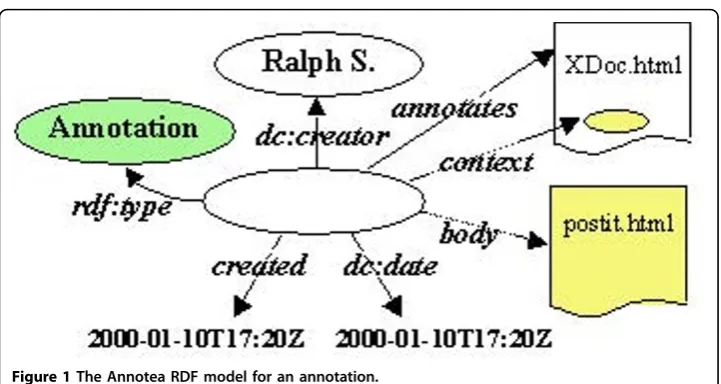
Annotea was developed as a Web-based shared annotation system based on a gen-eral-purpose open RDF infrastructure [57] where annotations are modeled as a class of metadata. Annotations, identified by a URI, are viewed as statements or remarks made by an author about a Web document. In the Annotea model (see Figure 1), the context defines where exactly inside the document the annotation is attached, and the body is a link to the content of the annotation identified by a URI and conceived to contain textual or graphical content.
Annotations are external to the documents and can be stored on one or more anno-tation servers responsible for controlling access –this allows us to implement local/ private and remote/shared annotations. Annotations in Annotea are typed and users can classify them while creating them (examples: comment, example, explanation, change,...).
The Annotea project re-uses existing W3C technology including RDF, Xpointer [58], Xlink [59], and HTTP [60]. The XPointer mechanism is used to identify the context within a document and works well for unchanging documents but with documents that go through revision, it is possible to end up with orphan annotations or annota-tions that are pointing to wrong places.
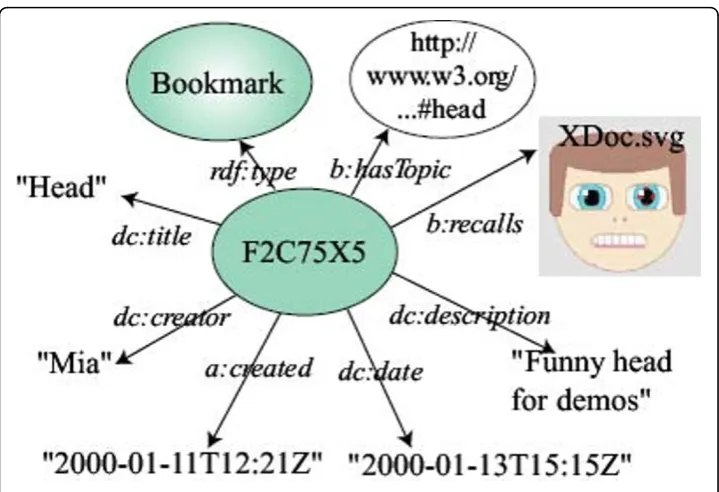
Besides the Annotation, the concept of a Bookmark was also defined by the Annotea project [61]. Annotea assumed the body of the Annotation to be an XHTML docu-ment. Bookmarks are metadata about Web documents or other resources and they are associated through the relationship hasTopic to an instance of the class named Topic defined as: an informal category for the purpose of classifying bookmarks. Topics may have subtopics and may sometimes also refer to categories in more formal ontologies. Bookmark shares a similar structure with Annotation (see Figure 2).
Results
The annotation ontology: core features
The core of AO is inspired by the Annotea model with a few important differences: ■In AO we do not distinguish between Annotation and Bookmarks as we find the distinction confusing. The two concepts are combined in one single generalized model defined as Annotation Core detailed in the following sections of this paper.
■In AO the goal is to be able to refer to several kinds of documents and document parts. Therefore, the context is defined through a more complex mechanism making use of instances of subclasses of the class Selector.
■ In AO it is possible to create annotation types in two different ways: by sub-classing as done in Annotea and by composition. The latter mechanism is introduced in AO for improving integration with already existing ontologies.
Several other features have been conceived to extend the original Annotea (Annota-tion and Bookmark) model in particular for allowing annota(Annota-tion cura(Annota-tion –crucial for our scientific communities - and for improving annotation management and publishing.
One of the original requirements for AO was to be able to annotate content compu-tationally with editor supervision. This requirement was identified in the early stages of the project while developing AlzSWAN (http://hypothesis.alzforum.org/swan/) –the SWAN platform for Alzheimer’s Disease developed in collaboration with AlzForum (http://www.alzforum.org/) and online since August 2008 - and StemBook (http:// www.stembook.org/), online since September 2008. We later determined that multiple web communities needed to share their annotation metadata, which required a formal specification and a second-generation annotation tool.
Furthermore, we desired to incorporate a key advance over the first-generation AlzS-WAN authoring tool: to reference discrete sections of any web document positionally with the annotations. Lastly, we incorporated annotation sets so that the same anno-tated documents could target multiple use cases. To support these features we need to go beyond Annotea. The formal metadata specification we developed allows us to define and localize document associated ontology terms and several other kinds of annotation such as comments, notes, examples, errata and definitions. The annotation is stored in a mySQL database (for performance reasons), which mirrors a set of triples
instantiated according to AO. Triples and database are stored separately from the documents.
The annotation ontology: modules
The Annotation Ontology has a modular architecture with the following list of modules:
■Core: represents the heart of AO and collects the core elements such as Annota-tion, the abstract Selector, AnnotationSet and AnnotationDocument.
■Selectors: lists the selectors we provide for identifying document fragments. The list of selectors can be easily extended according to the specific needs.
■Types: lists all the annotation types we provide. The list of annotation types can be easily extended following simple extension rules.
■Integration with Annotea: the triples connecting the two are collected in a separate module/file to keep the core of AO independent.
■ Integration with FOAF: all the dependencies or connections between the FOAF vocabulary and AO have been collected in this module. This choice has been moti-vated by the fact that not all our collaborators use FOAF for the representation of agents and documents. Therefore, we wanted to guarantee independence of AO from FOAF.
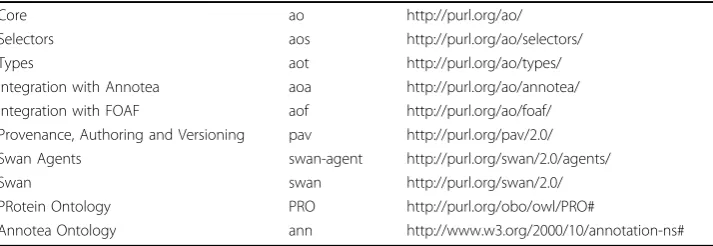
Table 1 shows the namespace prefixes used in subsequent sections of this paper both in pictures and in text. Classes and relationships are represented with font Italic.
When classes and relationships do not have a prefix they are intended as part of the AO core module and therefore implicitly have the‘ao’prefix.
In the Discussion section we demonstrate how AO is used for annotating an entire document to provide an overview of the ontology. In the following sections we will describe the different modules in detail.
Discussion
Annotation of an entire document
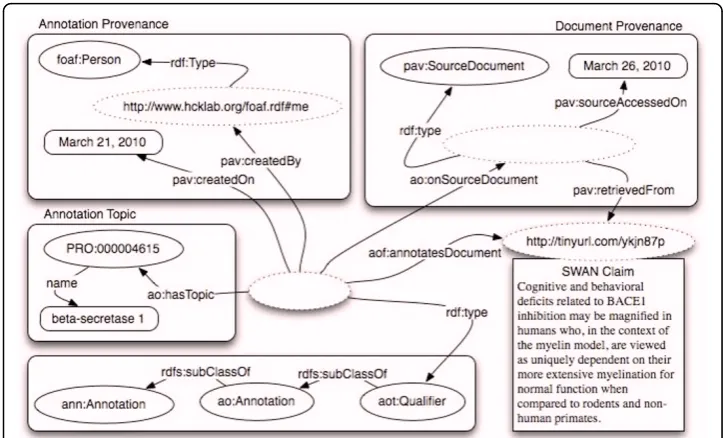
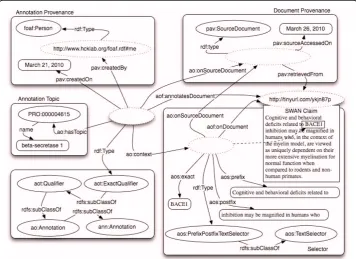
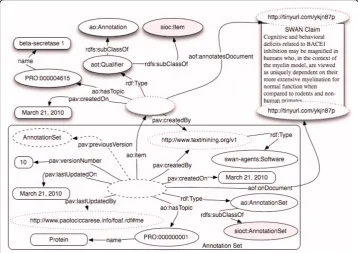
The simplest example of annotation is depicted in Figure 3, where an entity from the PRotein Ontology (PRO) [2] has been linked. The predicate ao:hasTopichas been used for this purpose. By design, ao:hasTopic allows either classes and individuals as its range. This is to support the use of both“classes-only”ontologies such as PRO of the OBO Foundry, and/or SKOS-like terminologies whose terms are instances, as annota-tion. We are aware that this approach could lead to an OWL Full representation but
Table 1 Namespace prefixes.
Core ao http://purl.org/ao/
Selectors aos http://purl.org/ao/selectors/
Types aot http://purl.org/ao/types/
Integration with Annotea aoa http://purl.org/ao/annotea/
Integration with FOAF aof http://purl.org/ao/foaf/
Provenance, Authoring and Versioning pav http://purl.org/pav/2.0/
Swan Agents swan-agent http://purl.org/swan/2.0/agents/
Swan swan http://purl.org/swan/2.0/
PRotein Ontology PRO http://purl.org/obo/owl/PRO#
we decided not to transform the predicate into an Annotation Property. In fact, we don’t want to preclude, for those who are interested, OWL DL reasoning and querying. Instead, we recommend our users, in case of reference to classes, to express the rela-tionship as a restriction and therefore a valid DL statement.
The dashed ovals in the diagram represent instances while the remaining ovals repre-sent classes. In this case annotation –an AlzSWAN claim http://tinyurl.com/ykjn87p concerning the protein‘Beta-Secretase 1’ –is linked to a whole document. In this par-ticular case the annotation is of typeaot:Qualifierthat states the document is related to the linked entity. Annotation types will be extensively discussed in a subsequent sec-tion. It is important to notice that it is trivial to apply the same annotation to multiple documents simply linking more documents to the annotation instance.
Annotation provenance
AO uses FOAF [62] as the preferred way for representing agents and documents. However the integration between the two ontologies is performed through a module that is external to the core of the annotation ontology. This guarantees the indepen-dence of AO from FOAF allowing alternatives to users of AO. When FOAF is used, as in the rest of this paper, the AO annotation can be created by an agent (foaf: Agent): a person (foaf:Person), a software agent (swan-agent:Software), a group (foaf: Group) or an organization (foaf:Organization) annotating a resource. Annotation provenance is represented using the PAV (Provenance Authoring and Versioning, http://code.google.com/p/pav-ontology/) module of the SWAN ontology [52,63]. Resources that are the subject of an annotation are mainly documents (foaf: Document) but they can be any online resource. Alternatively some provenance can be provided through Dublin Core or Dublin Core Terms (http://purl.org/dc/ elements/1.1/). We recommend using them not as an alternative but as addon -PAV remains the first choice for AO due to its wide offer of features for curation
that is particularly important for scientific communities. Curation will be discussed later in this paper.
Source document provenance
In Figure 3 we see that the Document (foaf:Document) is linked twice to the annotation - once directly through the Annotea relationship aof:annotatesDocument and once through a pav:SourceDocumentclass defined in the version 2.0 of the PAV ontology [64]. FOAF defines –or better loosely defines - a foaf:Document class as: The Document class represents those things, which are, broadly conceived, ‘ docu-ments’. In AO, user needs to point to the document that he is annotating and typi-cally this happens by means of a URI. Unfortunately, often the document changes over time but the URI stays the same. Using a property such as pav:accessedOn is useless if the URI is always the same as we will end up with a URI and multiple access dates with no way to determine the date is associated with each annotation. The solution we propose, which at first glance seems to introduce some redundancy, is to have a stable URI for the webpage and a different URI for each detected version of the document. To keep compatibility with FOAF, Figure 3 would translate into the following RDF:
<rdf Descriptionrdf about: : ="http: / /my example org sd 2332. . / / ">
<< = >
<
rdf typerdf resource pav SourceDocument ao retrieve
: : "& ; " / : ddFrom
rdf resource http tinyurl com ykjn87p pav sour
: " : / / . / " / :
= >
< cceAccessedOn 2 1 5 1 pav sourceAccessedOn rdf Descr
> − − < >
<
0 0 0 0 / : / : iiption
rdf Descriptionrdf about http tinyurl com ykj
>>
< : : =" : / / . / nn87p rdf type
rdf resource http xmlns com foaf 1 Do
" :
: " : / / . / / . /
> <
= 0 ccument
rdf Description
" / / :
>
< >
Through this approach it is now possible, for an annotation to point both to the URI of the webpage (foaf:Document) and to the URI of the specific version of the document (pav:SourceDocument).
Annotation core and selectors
In this section, we describe how the core and selectors of AO are used to attach anno-tations to various types of documents. In the context of online scientific communities, resources targeted by an annotation can be HTML pages, documents, images, videos, databases and fragment or sections of them. This variety of possible targets –not all of them with a definition of how to construct a fragment URI - and their mutability motivates the introduction of the classSelector.
that not all HTML pages are immutable and some sections of these pages may vary with time –news and advertisements are often embedded in the document - requiring more reliable and customized fragment identification mechanisms. In AO we use the Annotea property ann:context to attach an XPointer to an annotation instance as shown below:
<rdf Description rdf about: : ="http: / /my example org ann 2933. . / / 22 rdf typerdf resource aot Qualifier
rdf typerdf r
" : : "& ; " /
: :
>
< = >
< eesource ao Annotation rdf typerdf resource ann Ann
= >
< =
"& ; " / : : "& ; ootation
ann context http serv1 example com some page " /
: : / / . . / /
>
< > .. # (
(" / ) / : :
html xpointer i d Main") p[2] ann context
aof annotat
< >
< eesDocument
rdf resource http tinyurl com ykjn87p ao
: " : / / . / " / :
= >
< hhasTopic
rdf resource: ="http: / /purl obolibrary org obo PRO. . / / _000000 0 0 0
4615 pav createdOn 2 1 3 21 pav createdOn pav
" /
: / :
>
< > − − < >
< ::
: " : / / . . / . # createdBy
rdf resource= http www hcklab org foaf rdf me"" / / :
> < rdf Description>
In AO, we also provide aaos:XPointerSelector that allows the use of XPointers and has additional benefits of aSelector, including the ability of defining the document pro-venance through an instance ofpav:SourceDocument.
Figure 4 provides a similar example to Figure 3, but instead of annotating the whole document, only a portion of it has been annotated. The fragment is detected
through a type of aos:TextSelector that identifies the exact piece of text specifying its prefix and its postfix. Also, while the annotation in Figure 3 was created manually by a foaf:Person, the annotation here depicted has been created by a text mining ser-vice. The annotation type is aot:ExactQualifier as the chunk of text is representing the protein beta-secretase 1.
Selector has several sub-classes that can be chosen based on the nature of the source document (images, videos, records in databases and text). Figure 4 illustrates an example of annotating a portion of a text document - aos:PrefixPostfixSelector, a subclass of aos:TextSelector – a subclass ofSelector. Such selector works through three properties: the aos:exact is equal to the exact string or sequence of characters being annotated. The aos:prefix and aos:postfix are defined as the sequence of characters preceding and following the match. The three properties are defined ignoring any HTML/XML markup and normalizing the white spaces. The concatena-tion of the values of aos:prefix, aos:exact and aos:postfix is used to identify the section of text.
The above selector allows us to identify a portion of the document text, and link it with a term from a formally defined vocabulary. This specific selector works particu-larly well when the document is not immutable. In fact, even if other sections of the document change, it is possible to still detect the context if the annotated content is still present.
The RDF generated is shown below:
<rdf Description rdf about: : ="http: / /my example org ann 213. . / / 000" : : "& ; " /
:
>
< = >
<
rdf type rdf resource aot ExactQualifier rdf typee rdf resource aot Qualifier rdf type rdf resource
: "& ; " / : : "
= >
< = && ; " / : : "& ; " /
ao Annotation rdf typerdf resource ann Annotation
>
< = >>
< =
aof annotatesDocument rdf resource http tinyurl com y
:
: " : / / . / kkjn87p ao context
rdf resource http my example org s " / :
: " : / / . . /
> <
= eel 1 3
ao hasTopic
rdf resource http purl obolibra
/ " / :
: " : / / .
0 00 > <
= rry org obo PRO 4615 pav createdOn 2 1 3 21 pav
. / / _ " /
: /
00000 0 0 0
>
< > − − < ::
:
: " : / / . .
createdOn pav createdBy
rdf resource http www hcklab
> <
= oorg foaf rdf me rdf Description
rdf Description rdf
/ . # " / / :
: :
>
< >
< aabout http my example org sel 1 3 rdf typerdf reso
= >
<
" : / / . . / / "
: :
0 00 u
urce aos TextSelector rdf typerdf resource aos Pre
= >
< =
"& ; " / : : "& ; ffixPostfixSelector aos exact BACE1 aos exact
aos pre
" /
: / :
:
>
< > < >
< ffix Cognitive and behavioral deficitsrelated to aos prefi
> </ : xx
aos postfix inhibition may be magnified inhumans who a
>
< >
<
: / oos postfix
ao onSourceDocument rdf resource http my ex
: :
: " : / / .
> <
= aample org sd 1339 aof onDocument
rdf resource http t
. / / " / :
: " : / /
> <
= iinyurl com ykjn87p rdf Description
. / " / / :
>
< >
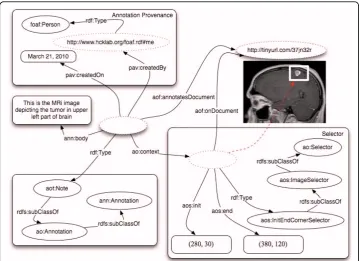
Figure 5 depicts an example annotation where a rectangular section of an MRI image depicting a brain tumor is selected. The selector identifies the portion of the image through specifying the coordinates of a rectangular box. In this particular case the reference to the specific version of the document through pav:SourceDocument has been omitted. This has been done to simplify the picture and it would normally be acceptable only if the image were immutable.
AO users have the flexibility of extending the selector class based on their particular use cases (instruction available on the wiki page). To allow the community around AO to grow coherently and enable interoperability, we recommend contributing the new selectors back to the AO project.
It is important to notice that multiple instances of the class Selectorcan be attached to each annotation item. This allows performing annotation of multiple targets located in the same document. The same mechanism allows the annotation of multiple targets located in different documents.
Annotation types
In Annotea, users can create additional sub-types of annotations by using sub-classes of the Annotation class. Through this mechanism, it is possible, for instance, to introduce ‘note’where the purpose is not to attach a term but to attach an explanatory text to a portion of a document. The list of possible sub-types can be virtually unlimited and in Annotea the users could define types of annotations on the fly.
In AO we maintain the same mechanism, however we maintain a more conservative approach where a predefined set of annotation types are recommended. These are shown in Table 2. We also allow the implementation of types through a second mechanism called ‘composition’ which is based on multiple inheritance. We intro-duced it to foster reuse of the already available ontologies including SWAN [52,63]; it does not imply connecting classes but rather works by creating instances of both the Annotation class and the one we reuse, for instance, swan:ResearchStatement for a claim or hypothesis.
Aot:Qualifier is one of the key annotation types in AO and allows the definition of parallelism between AO and the Simple Knowledge Organization System (SKOS) model [32]. A aot:Qualifier (see Figure 4) defines a generic connection between the annotated online resource – HTML pages, digital images, audio files, etc. - or resource fragments and the URI of a term in an ontology or terminology. This mimics the relationship skos:relatedMatch. Qualifier SKOS-compatible subclasses that are: aot:ExactQualifier(Figure 4), aot:CloseQualifier, aot:Narrow-Qualifier andaot:BroadQualifier; these correspond respectively to the SKOS proper-ties: skos:exactMatch, skos:closeMatch, skos:broadMatch and skos:narrowMatch (see Table 3).
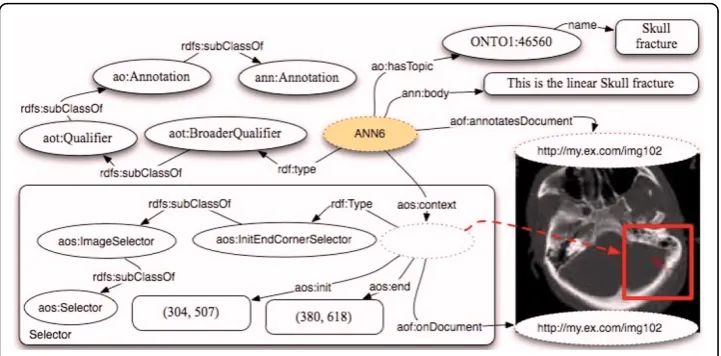
In Figure 6 we depict the annotation of a portion of an MRI image representing a linear skull fracture, usingaot:BroadQualifier, a subclass ofaot:Qualifier.
The annotator declared the image to express a ‘linear skull fracture’through a tex-tual label. As a textex-tual label has a limited classification value and as the annotator could not find this specific term in the available ontologies/terminologies, she/he declared the image fragment to be represented by the term ‘skull fracture’coming from a specific ontology and identified by a URI. As the annotator considers the term
‘skull fracture’to have a broader meaning than what the image really expresses, the qualifier is declared to be broader than the ideal one. The parallelism with SKOS
Table 2 AO Annotation types defined as sub-classes of the AnnoteaAnnotationclass.
Note Note is a brief written record associated with a document or part of it. The body of a Note is usually free text and it can contain markup.
Errata An Errata provides a correction of a document. The annotation body is the corrected version of the content or a description of the error.
Example The annotation body represents the typical case of a class or group.
Definition The annotation body contains a concise explanation of the meaning of a word, phrase, symbol or image to which the annotation points.
Table 3 Additional annotation types can be used for creating SKOS like annotation.
Qualifier skos: relatedMatch
Qualifier expresses the relationship between the object of the annotation and a well-defined representational unit. It allows a free text body. If only free text is present -this is equivalent to a tag.
ExactQualifier skos: exactMatch
Used when the object of the relationship ao:hasTopic represents exactly the portion of the annotated document.
CloseQualifier skos: closeMatch
Used when the object of the relationship ao:hasTopic represents closely but not exactly the portion of the annotated document.
BroadQualifier skos: broadMatch
Used when the object of the relationship ao:hasTopic represents more broadly the portion of the annotated document.
NarrowQualifier skos: narrowMatch
allows exploring automatic ontology building and improving the analysis of clouds of tags and annotations. In general, it is possible to either relate‘a skull fracture’or ‘the skull fracture of patient X’to the portion of the image. The choice is left to the users and their specific needs. Also, when referring to raster images the accuracy of the selection is not as good as it can be with, for instance, with vectorial images. That is why the property ao:hasTopic might result having a different precision in different contexts.
In the same example it would be trivial to add another Qualifier defining as context the very same Selector. For instance we could state that the portion of the images also exactly represents an instance of the entity ‘Hematoma’; in this case we can use anaot: ExactQualifierin a similar way to that depicted in Figure 4.
In summary, we state that the area identified by the selector has a more precise meaning than the term “Skull Fracture” and has the exact meaning of the term
“Hematoma” where both of these terms are entities specified in some other ontol-ogy/vocabulary. For images and fragments of images, it is not as easy to see the advantage of applying the SKOS approach as it is for text. For instance, if we focus on the example presented in Figure 4, where a chunk of text “BACE1” has been classified exactly as “Beta Secretase 1” from the PRO ontology, we can easily add, reusing the same selector, that the same chunk of text is classified as a narrower concept than a Protein in BIRNLex – the Biomedical Informatics Research Network (BIRN) project lexicon – which is identified by the URI: http://bioontology.org/ projects/ontologies/birnlex#birnlex_23. As result, we could derive that the entity
“Beta Secretase 1” in the PRotein Ontology (PRO) has a narrower meaning than the entity “Protein” in the BIRNLex vocabulary. As more annotations are attached to documents, we can infer cross-ontology relationships.
Integration with SWAN and other existing ontologies
As mentioned above, as in Annotea, AO allows the creation of additional sub-types of annotations by sub-classing the Annotation class. In addition, in AO it is possible to define annotation by composition or multiple inheritance. An example is the SWAN
Ontology which can be integrated with AO by defining an instance of both ao: Annotationandswan:Claimas depicted in the following RDF.
<rdf Description rdf about: : ="http: / /my example org ann 824. . / / 000
0
" :
: " : / / . / / . /
> <
=
rdf type
rdf resource http purl org swan 2 discourrse elements ResearchQuestion
rdf typerdf resource a
− >
< =
/ " /
: : "& nnn Annotation rdf typerdf resource ao Annotation
; " / : : "& ; " /
>
< = >
<aaof annotatesDocument rdf resource http tinyurl com 25g
:
: =" : / / . / ccavg
swande description Can overexpressed DR6 inneuron " /
:
>
< > ss
trigger ligand independent
degeneration as reported for p
−
, 7
75NTR swande description
pav createdOn 2 1 3 21 ? / :
...
: /
< >
< > 0 0−0 − < ppav createdOn pav createdBy
rdf resource http www hckl
: :
: " : / / .
> <
= aab org foaf rdf me rdf Description
. / . # " / / :
>
< >
This second mechanism works well for integrating existing entities of other ontolo-gies. The SWAN Ontology is just an example; there are others that we are already considering integrating such as CiTO [65] and BIBO [66], [65]which would be used for annotating citations.
Curation
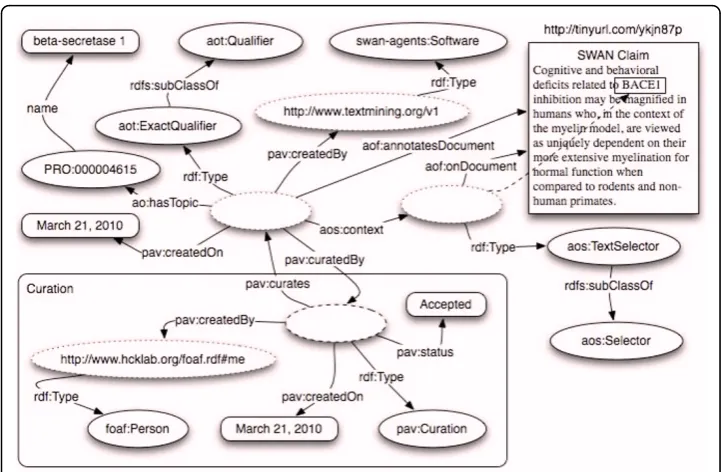
Curation is a crucial aspect of scientific publication and therefore an important aspect for our annotation ontology. In order to enable the complete cycle of activities that we define here as a RECS (Run, Encode, Curate, Share) process, AO supports a curation process that includes both manual annotation and text mining services. Figure 4 demonstrated an annotation generated by a text mining service, which is not yet evalu-ated and accepted by a human curator through what in AO is called‘Curation Token’. In Figure 7 we display the same example with the curation token –some details such as those of the selector are omitted to keep the picture fairly simple. In the case depicted in Figure 7, a foaf:Personaccepts the Software generated annotation.
In general, every annotation can undergo a multi-step curation process that can involve one or more users generating one or more curation tokens each. In Figure 8, we show a typical example of semi-automatic annotation workflow that can be summarized as follows: annotation is created by a text mining service, and first a user expresses a judgment on the validity of the automatic annotation, for instance“rejected”(curation #1). Later on a second curator might want to discuss the reason(s) for rejection (curation #2 with status: discussed). And finally a decision is taken and the annotation is ether rejected or accepted (curation #3 with status: accepted). We assume that the curation process is a linear story where the timeline can be determined through the curation dates. Alternatively, it is possible to compile explicitly an ordered list of curation item using for instance the SWAN Ontology module for collections [67].
Annotation sets
proteins, the collection of all the annotation items representing scientific discourse ele-ments, the collection of all the annotation items that have been published by a scienti-fic community as ofscienti-ficially curated. Also sets can be used to collect all the results by a specific text mining service, in this case the criterion would be the sharing of the same provenance. For grouping annotation items we introduced the concept of annotation set. The ao:AnnotationSetis a container of annotations.
Versioning and evolution of the annotation
When observing carefully Figure 9 it is possible to notice the presence of an object property pav:previousVersion and a datatype property pav:versionNumber. AO has been designed to be monotonic as much as possible. Therefore, once an annotation item is created in a set, it would be good practice to not be deleted by removal from the set. The term can be rejected through curation. Note that in Figure 9, the ao: AnnotationSet was created by a software agent and includes an automatically gener-ated item.
Every new annotation item is created with a correspondent URI. Curation can be applied to the annotation. Edits of the annotation item, as well as new curation tokens, may (or may not) be defined as a new version of the annotation according to the requirements of the specific application. If a new version of the item is encoded, it will get a new URI and a pointer to the previous version of the same item. If multiple cura-tion is performed a new item version will result having a longer curacura-tion chain as shown in Figure 8. An instance of an ao:AnnotationSet can be versioned every time the set of annotation items changes–a new item added - or even every time any item of the set changes. A new version of ao:AnnotationSet will result in a new item –with a new URI–pointing to the previous version of the same set.
It is also possible to derive one ao:AnnotationSet from another. This is common when a set that is publicly available is imported by an application and branched. In AO the second set will be connected to the first one through a relationship pav:deri-vedFrom. This will assure continuity to the annotation and the possibility to establish the correct attribution of the contributions. Branching one set into another is estab-lishing the evolution of the annotation.
Figure 8Multiple instances of the class pav:Curation on automatic annotation may be ordered via pav:previousCuration predicate.
Another example of annotation evolution happens when an annotation, initially defined as a tag, is later on attributed with a semantic entity (Figure 10 ). To keep the representation monotonic, we are going to define a second annotation with the ao:has-Topic property. The second annotation supersedes the first annotation that remains in the knowledge base.
Alignment with the SIOC ontology
In Figure 8, besides the annotation set and its provenance and versioning, it is also possible to detect the mappings of the annotation ontology to the SIOC ontology [55,68]. SWAN and SIOC have been objects of an alignment process in the context of the Scientific Discourse Task Force (http://esw.w3.org/HCLSIG/SWANSIOC), one of the sub groups of the W3C Health Care and Life Sciences Working Group [69]. As creators of the SWAN ontology we confirm our commitment to keeping the two efforts aligned. The classes ao:Annotation and ao:AnnotationSet are declared sub-classes of respectivelysioc:Itemandsioc:AnnotationSet.
Comparison to existing tagging ontologies
The scope of AO is much wider than tagging. However, tagging represents an impor-tant component for current online applications. We dedicated a fair amount of time trying to clarify the similarities/differences between AO and existing ontologies such as Newmann’s Tagging Ontology [44] and MOAT [56]
The MOAT (Meaning Of A Tag) project aims to solve the problem of ambiguous or redundant tags by providing a way for users to define meaning(s) of their tag(s) using URIs of Semantic Web resources. Even if AO was born to provide semantically defined data, we recognized the possibility of having a free text tag; we recommend this to be
done natively leveraging the Annotea property ‘body’. Alternatively, it is possible to fully reuse the existing MOAT content in a way that increases its expressiveness and, at the same time, allows performing AO-style curation. The latter approach is depicted in Figure 11 where the free text tag“Linear skull fracture” is modeled using themoat: Tag class and attached to the annotation through the relationship ao:hasTagging. We haven’t reused the relationshipmoat:taggedWith because, as depicted in the same picture, it is supposed to link the annotated resource to the instance of the moat:Tag class.
It is also possible to notice that a meaning of the tag has been expressed through an instance of the class moat:Meaning. As the connected meaning is more general than the actual tag, the annotation instance refers to the meaning instance through the property ao:hasNarrowerMeaningThan. As you can see, from the perspective of the annotation we can define something more precise than moat:hasMeaning. AO allows us to define different levels of meaning through a set of properties that can be mapped directly into the Simple Knowledge Organization System (SKOS) model [32]: ao:has-RelatedMeaning, ao:hasExactMeaning, ao:hasCloseMeaning, ao:hasNarrower-MeaningThan and ao:hasBroaderMeaningThan. As was done for the Qualifier annotation types, these properties can mapped respectively toskos:relatedMatch, skos: exactMatch,skos:closeMatch,skos:narrowMatchandskos:broadMatch.
The model in Figure 11 can be translated or expressed –if the annotation does not derive from preexisting MOAT content - into pure AO annotation using qualifiers and the previously introduced SKOS-compatible subclasses: ExactQualifier,CloseQualifier, NarrowQualifierandBroadQualifier. This is the case of Figure 6 where this example is expressed in pure AO.
Besides the possibility of reusing and improving the existing MOAT content in AO, it is also worth mentioning how the annotation type Qualifier, that in RDF can look like:
<rdf Descriptionrdf about: : ="http: / /my example org ann 21332. . / / "" : : " " /
:
>
< = >
<
rdf type rdf resource Qualifier rdf typpe
rdf resource http www w3 org 2 1 annotation ns A
: " : / / . . / / / #
= 000 0 −
n nnotation
ann annotatesrdf resource http tiny " /
: : " : / /
>
< = uurl com ykjn87p
ao hasTopic rdf resource http
. / " / :
: " : / /
> <
= ppurl obolibrary org obo PRO 4615 pav create
. . / / _ " / :
00000 > < ddOn 2 1 3 21 pav createdOn
pav createdBy rdf res
> − − < >
<
0 0 0 / : :
: oource http www hcklab org foaf rdf me rdf Descript
= >
<
" : / / . . / . # " / / : iion>
can be transposed in MOAT and Newmann’s Tagging Ontology as a tag:Restricted-Tagging, which represents the meaning of a tag in a specific context:
< > < tag RestrictedTagging tag taggedResource rdf resource : :
: == >
<
" : / / . . / / " / :
:
http my example org ann 21332 foaf maker
rdf ressource http www hcklab org foaf rdf me tag tagN
= >
<
" : / / . . / . # " / : aame BACE1 tag tagName
moat tagMeaning rdf resource
> < >
< =
/ : :
: "hhttp purl obolibrary org obo PRO 4615 tag Rest
: / / . . / / _ " / / :
00000 >
< rrictedTagging>
Once again, the scope of AO is much bigger than MOAT, but we wanted to provide integration with MOAT to be able to reuse already existing content. It is also possible to apply MOAT tags to any other annotation type - for instance a Note –even if we generally recommend creating multiple annotations pointing to the same document or selector. Doing so, it will be possible to perform curation for each specific piece of information.
Conclusions
The AO model of web document annotation allows users, including journal or web community editorial staff, individual scientists, and computational web agents, to con-struct and persist scientific document annotation as RDF; making it possible to publish the annotation data as Linked Open Data as well as to query it by means of languages such as SPARQL, and to reason about it with SWRL. The AO ontology does not propose a new domain ontology nor tagging vocabulary to represent activities within folksonomies; on the contrary, it reuses and extends existing approaches such as New-man’s Tagging Ontology and MOAT, so that they can easily interoperate. It is also compatible with SCOT since it is built upon Newman’s ontology.
way; (4) curation, with provenance, authoring and versioning of all annotations; and (5) human, algorithmic, and human-reviewed algorithmic annotation. In summary, AO allows bringing the Semantic Web to the masses under the form of annotations of several kinds – notes, definitions, qualifiers,…- including linking documents and document parts to terms in existing ontologies–particularly, but not necessarily only, scientific biomedical ontologies.
The AO model of scientific document annotation has been developed and tested in prototype and early-development versions of the SWAN Annotation Framework, an online application for both manual and machine-generated markup of web content developed in the context of the project SWAN 2.0 - Hypothesis Management for Drug Discovery –started in collaboration with a major pharmaceutical company. The same tool is currently under customization to be deployed for the NIF (Neuroscience Information Framework, http://www.neuinfo.org/) community.
Acknowledgements
Development of the AO has been funded by a grant from the National Institute on Drug Abuse, National Institutes of Health, as part of the Neuroscience Information Framework; by a grant from EMD Serono, Inc. as part of the MS Discovery Forum project; and by a grant from Eli Lilly and Company. We are most grateful for the financial support of these institutes and corporations.
We thank Professor Carole Goble of the University of Manchester, Professor Maryann Martone of the University of California at San Diego, Anita deWaard of Elsevier B.V., Jonathan Rees of Science Commons, Eric Prud’hommeaux of W3C, Alex Garcia Castro of the University of Bremen, and Adam West and Ernest Dow of Eli Lilly and Company, for their continuing support and for many fruitful discussions.
This article has been published as part ofJournal of Biomedical SemanticsVolume 2 Supplement 2, 2011: Proceedings of the Bio-Ontologies Special Interest Group Meeting 2010. The full contents of the supplement are available online at http://www.jbiomedsem.com/supplements/2/S2.
Author details
1Harvard Medical School and Massachusetts General Hospital, Boston MA, USA.2Balboa Systems, Newton MA, USA. 3
Universität der Bundeswehr München, Neubiberg, Germany.4University of Manchester, School of Computer Science, Manchester UK.
Authors’contributions
Paolo Ciccarese is the author of the Annotation Ontology (AO) and the main contributor to this paper. He is currently co-developing an Annotation Framework in tandem with AO that allows users to annotate online documents producing content in Annotation Ontology format.
Marco Ocana co-developed server-side and persistence software for the Annotation Framework and provided critical use cases and productive input to development of the Annotation Ontology.
Sudeshna Das is the project manager for the Science Collaboration Framework (sciencecollaboration.org) and contributed to the annotation use cases for a scientific community particularly the need to capture the provenance of semi-automatically generated annotations. She also contributed to the editing and revisions of the manuscript. Leyla Jael Garcia Castro provided significant use cases for AO and wrote the section on folksonomic tagging. She also collaborated in the definition of the AO and MOAT integration.
Tim Clark conceived of and provided overall guidance for development of the Annotation Ontology and Annotation Framework projects, wrote the Introduction and Discussion sections of this paper, and had overall responsibility for editing it.
Competing interests
The authors declare that they have no competing interests.
Published: 17 May 2011
References
1. Smith B:The Logic of Biological Classification and the Foundations of Biomedical Ontology.InInvited Papers from
the 10th International Conference in Logic Methodology and Philosophy of Science, Oviedo, Spain, 2003.Amsterdam:
Elsevier-North-Holland;Westerståhl D 2004:.
2. Natale D, Arighi C, Barker W, Blake J, Chang T-C, Hu Z, Liu H, Smith B, Wu C:Framework for a Protein Ontology.BMC
Bioinformatics2007,8(Suppl 9):S1.
3. Alexander CY:Methods in biomedical ontology.J of Biomedical Informatics2006,39(3):252-266.
5. Natale DA, Arighi CN, Barker WC, Blake J, Chang TC, Hu Z, Liu H, Smith B, Wu CH:Framework for a protein ontology.
BMC Bioinformatics2007,8(Suppl 9):S1.
6. Natale DA, Arighi CN, Barker WC, Blake JA, Bult CJ, Caudy M, Drabkin HJ, D’Eustachio P, Evsikov AV, Huang H,et al:The Protein Ontology: a structured representation of protein forms and complexes.Nucleic Acids Res2011,39(Database issue):D539-545.
7. Smith B, Ceusters W, Klagges B, Kohler J, Kumar A, Lomax J, Mungall C, Neuhaus F, Rector AL, Rosse C:Relations in biomedical ontologies.Genome Biol2005,6(5):R46.
8. Aranguren ME, Bechhofer S, Lord P, Sattler U, Stevens R:Understanding and using the meaning of statements in a bio-ontology: recasting the Gene Ontology in OWL.BMC Bioinformatics2007,8:57.
9. Eilbeck K, Lewis SE, Mungall CJ, Yandell M, Stein L, Durbin R, Ashburner M:The Sequence Ontology: a tool for the unification of genome annotations.Genome Biol2005,6(5):R44.
10. Ashburner M, Ball C, Blake J, Botstein D, Butler H, Cherry J, Davis A, Dolinski K, Dwight S, Eppig J,et al:Gene ontology: tool for the unification of biology. The Gene Ontology Consortium.Nature Genetics2000,25(1):25-29.
11. Smith B, Brochhausen M:Putting biomedical ontologies to work.Methods Inf Med2010,49(2):135-140.
12. Burek P, Hoehndorf R, Loebe F, Visagie J, Herre H, Kelso J:A top-level ontology of functions and its application in the Open Biomedical Ontologies.Bioinformatics2006,22(14):e66-73.
13. Schulz S, Suntisrivaraporn B, Baader F:SNOMED CT’s problem list: ontologists’and logicians’therapy suggestions.
Stud Health Technol Inform2007,129(Pt 1):802-806.
14. Bodenreider O, Stevens R:Bio-ontologies: current trends and future directions.Brief Bioinform2006,7(3):256-274. 15. Bos N, Zimmerman A, Olson J, Yew J, Yerkie J, Dahl E, Olson G:From shared databases to communities of practice: A
taxonomy of collaboratories.Journal of Computer-Mediated Communication2007,12(2), article 16.
16. Fjällbrandt N:Scholarly Communication: Historical Development and New Possibilities.International Association of
Scientific and Technical University Libraries (IATUL)Trondheim, Norway: IATUL; 1997.
17. Star SL, Griesemer JR:Institutional Ecology,‘Translations’and Boundary Objects: Amateurs and Professionals in Berkeley’s Museum of Vertebrate Zoology, 1907-39.Social Studies of Science (Sage)1989,19(3):387-420.
18. Shapin S:Pump and Circumstance: Robert Boyle’s Literary Technology.InThe Scientific Revolution.Oxford: Blackwell; Hellyer M 2003:.
19. Carr L, De Roure D, Hall W, Hill G:The Distributed Link Service: A Tool for Publishers, Authors and Readers.Fourth
International World Wide Web ConferenceBoston, Massachusetts, USA: World Wide Web Consortium (W3C); 1995.
20. Bechhofer S, Goble C:COHSE: Conceptual Open Hypermedia Service.InAnnotation for the Semantic Web.Amsterdam: IOS Press;Handschuh S, Staab S 2003:.
21. Bechhofer S:Informal Discussion on COHSE and the MGH Annotation Framework.2010.
22. Schober D, Smith B, Lewis SE, Kusnierczyk W, Lomax J, Mungall C, Taylor CF, Rocca-Serra P, Sansone SA:Survey-based naming conventions for use in OBO Foundry ontology development.BMC Bioinformatics2009,10:125.
23. Das S, Girard L, Green T, Weitzman L, Lewis-Bowen A, Clark T:Building biomedical web communities using a semantically aware content management system.Brief Bioinform2009,10(2):129-138.
24. Das S, Rogan M, Kawadler H, Corlosquet S, Brin S, Clark T:PD Online: a case study in scientific collaboration on the
Web.Workshop on the Future of the Web for Collaborative Science, 19th International World Wide Web Conference
Raleigh, NC, USA; 2010.
25. Clark T, Kinoshita J:Alzforum and SWAN: the present and future of scientific web communities.Brief Bioinform2007, 8(3):163-171.
26. Diana MET, Lorys C:Reward pathways in Parkinson’s disease: Clinical and theoretical implications.Psychiatry and
Clinical Neurosciences2008,62(2):203-213.
27. Antonini A, Cilia R:Behavioural adverse effects of dopaminergic treatments in Parkinson’s disease: incidence, neurobiological basis, management and prevention.Drug safety : an international journal of medical toxicology and
drug experience2009,32(6):475-488.
28. Kinoshita J, Clark T:Alzforum.Methods Mol Biol2007,401:365-381.
29. Kinoshita J, Strobel G:Alzheimer Research Forum: A Knowledge Base and e-Community for AD Research.In
Alzheimer: 100 Years and Beyond.Berlin and Heidelberg: Springer Verlag;Jucker M, Beyreuther K, Haass C, Nitsch RM,
Christen Y 2006:457-463.
30. Renear AH, Palmer CL:Strategic Reading, Ontologies, and the Future of Scientific Publishing.Science2009, 325(5942):828-832.
31. McGuinness D, van Harmelen F:OWL Web Ontology Language.W3C Recommendation2004.
32. Miles A, Bechhofer S:SKOS Simple Knowledge Organization System Reference.W3C Recommendation2009. 33. Eilbeck K, Lewis S, Mungall C, Yandell M, Stein L, Durbin R, Ashburner M:The Sequence Ontology: a tool for the
unification of genome annotations.Genome Biology2005,6(5):R44.
34. Harris MA, Clark J, Ireland A, Lomax J, Ashburner M, Foulger R, Eilbeck K, Lewis S, Marshall B, Mungall C,et al:The Gene Ontology (GO) database and informatics resource.Nucleic Acids Res2004,32(Database issue):D258-261.
35. O’Reilly T:What Is Web 2.0: Design Patterns and Business Models for the Next Generation of Software.O’Reilly Network; 2005.
36. Berendt B, Hotho A, Stumme G:Bridging the Gap–Data Mining and Social Network Analysis for Integrating Semantic Web and Web 2.0.Web Semantics: Science, Services and Agents on the World Wide Web2010,8(2-3):95-96. 37. Specia L, Motta E:Integrating Folksonomies with the Semantic Web.InThe Semantic Web: Research and Applications.
Volume 4519.Springer; 2007:624-639.
38. Kim H-L, Scerri S, Breslin J, Decker S, Kim HG:The State of the Art in Tag Ontologies.International Conference on
Dublin Core and Metadata ApplicaitonsGermany; 2008.
39. Angeletou S, Sabou M, Motta E:Semantically Enriching Folksonomies with FLOR.Workshop on Collective Intelligence
and the Semantic Web, European Semantic Web ConferenceTenerife, Spain; 2008.
40. Golder SA, Huberman BA:Usage Patterns of Collaborative Tagging systems.Journal of Information Science2006, 32(2):198-208.
42. Mika P:Ontologies Are Us: A Unified Model of Social Networks and Semantics.International Semantic Web
ConferenceGalway, Ireland; 2005.
43. Tanasescu V, Streibel O:Extreme Tagging: Emergent Semantics throught the Tagging of Tags.International Workshop
on Emergent Semantics and Ontology EvolutionKorea; 2007.
44. Tag Ontology Design.[http://www.holygoat.co.uk/projects/tags].
45. Gruber T:Ontology of Folksonomy: A Mashup of Apples and Oranges.International Journal on Semantic Web and
Information Systems2007,3(2).
46. The Gene Ontology C:The Gene Ontology project in 2008.Nucl Acids Res2008,36(suppl_1):D440-444. 47. Kahan J, Koivunen M-R, Prud’Hommeaux E, Swick RR:Annotea: An Open RDF Infrastructure for Shared Web
Annotations.WWW10 International ConferenceHong Kong: World Wide Web Consortium; 2001.
48. Koivunen M-R, Swick R:Collaboration through Annotation in the Semantic Web.InAnnotation for the Semantic Web. Amsterdam: IOS Press;Handschuh S, Staab S 2003:46-60.
49. Garcia-Castro A, Labarga A, Garcia L, Giraldo O, MontaÒa C, Bateman JA:Semantic Web and Social Web heading towards Living Documents in the Life Sciences.Web Semantics: Science, Services and Agents on the World Wide Web 2010,8(2-3):155-162.
50. Ciccarese P, Ocana M, Das S, Clark T:AO: An Open Annotation Ontology for Science on the Web.Bio Ontologies 2010 Boston MA, USA; 2010.
51. The Annotation Ontology on Google Code.[http://code.google.com/p/annotation-ontology/].
52. Ciccarese P, Wu E, Wong G, Ocana M, Kinoshita J, Ruttenberg A, Clark T:The SWAN biomedical discourse ontology.
J Biomed Inform2008,41(5):739-751.
53. Gardner D, Akil H, Ascoli GA, Bowden DM, Bug W, Donohue DE, Goldberg DH, Grafstein B, Grethe JS, Gupta A,et al: The neuroscience information framework: a data and knowledge environment for neuroscience.Neuroinformatics 2008,6(3):149-160.
54. Gupta A, Bug W, Marenco L, Qian X, Condit C, Rangarajan A, Muller HM, Miller PL, Sanders B, Grethe JS,et al:Federated access to heterogeneous information resources in the Neuroscience Information Framework (NIF).Neuroinformatics 2008,6(3):205-217.
55. Breslin J, Harth A, Bojars U, Decker S:Toward Semantically-Interlinked Online Communities.Lecture Notes in Computer
Science2005,3532/2005:500-514.
56. Passant A, Laublet P:Meaning of a Tag: A Collaborative Approach to Bridge the Gap Between Tagging and Linked Data.Llinked Data on the Web Workshop, International World Wide Web ConferenceBeijing, China; 2008.
57. Becket D:RDF/XML Syntax Specification (Revised).W3C Recommnedation2004.
58. Grosso P, Maler E, Marsh J, Walsh N:Xpointer Framework.W3C RecommendationWorld Wide Web Consortium; 2003. 59. DeRose S, Maler E, Orchard D:XML Linking Language (XLink) Version 1.0.W3C Recommendation2001.
60. Fielding R, Getty J, Mogul J, Frystyk H, Masinter L, Leach P, Berners-Lee T:Hypertext Transfer Protocol–HTTP/1.1, IETF RFC 2616.Internet Engineering Task Force1999.
61. Koivunen M, Swick R, Prud’hommeaux E:Annotea shared bookmarks.Proceedings of the Annotation Workshop, KCAP03 Sanibel, Florida, USA; 2004.
62. Brickley D, Miller L:FOAF Vocabulary Specification 0.97. Namespace Document 1 January 2010 - 3D Edition.2010. 63. Semantic Web Applications in Neuromedicine (SWAN) Ontology, W3C Interest Group Note 20 October 2009.
[http://www.w3.org/2001/sw/hcls/notes/swan/].
64. PAV Ontology on Google Code: PAV Ontology 2.0.[http://code.google.com/p/pav-ontology/].
65. Shotton D, Portwin K, Klyne G, Miles A:Adventures in semantic publishing: exemplar semantic enhancements of a research article.PLoS Comput Biol2009,5(4):e1000361.
66. Bibliographic Ontology Specification: Specification Document - 4 November 2009.[http://bibliontology.com/ specification].
67. SWAN Collections Ontology Specification.[http://swan.mindinformatics.org/spec/1.2/collections.html].
68. SIOC Ontology: Applications and Implementation Status.[http://www.w3.org/Submission/sioc-applications/], W3C Member Submission 12 June 2007.
69. SWAN/SIOC: Alignment Between the SWAN and SIOC Ontologies.[http://www.w3.org/TR/hcls-swansioc/], W3C Interest Group Note 20 October 2009.
doi:10.1186/2041-1480-2-S2-S4
Cite this article as:Ciccareseet al.:An open annotation ontology for science on web 3.0.Journal of Biomedical
Semantics20112(Suppl 2):S4.
Submit your next manuscript to BioMed Central and take full advantage of:
• Convenient online submission
• Thorough peer review
• No space constraints or color figure charges
• Immediate publication on acceptance
• Inclusion in PubMed, CAS, Scopus and Google Scholar
• Research which is freely available for redistribution