Public Perceptions of the Bene
fi
ts and
Risks of Newborn Screening
Fiona A. Miller, PhDa, Robin Z. Hayeems, PhDa,b, Yvonne Bombard, PhDa,c, Céline Cressman, MSca, Carolyn J. Barg, MSca, June C. Carroll, MDd, Brenda J. Wilson, MBChB, MSce, Julian Little, PhDe, Judith Allanson, MDf,g, Pranesh Chakraborty, MDf,g, Yves Giguère, MD, PhDh, Dean A. Regier, PhDi,j
abstract
BACKGROUND:Growing technological capacity and parent and professional advocacy highlight the needto understand public expectations of newborn population screening.
METHODS:We administered a bilingual (French, English) Internet survey to a demographically
proportional sample of Canadians in 2013 to assess preferences for the types of diseases to be screened for in newborns by using a discrete choice experiment. Attributes were: clinical benefits of improved health, earlier time to diagnosis, reproductive risk information, false-positive (FP) results, and overdiagnosed infants. Survey data were analyzed with a mixed logit model to assess preferences and trade-offs among attributes, interaction between attributes, and preference heterogeneity.
RESULTS:On average, respondents were favorable toward screening. Clinical benefits were the most important outcome; reproductive risk information and early diagnosis were also valued, although 8% disvalued early diagnosis, and reproductive risk information was least important. All
respondents preferred to avoid FP results and overdiagnosis but were willing to accept these to achieve moderate clinical benefit, accepting higher rates of harms to achieve significant benefit. Several 2-way interactions between attributes were statistically significant: respondents were willing to accept a higher FP rate for significant clinical benefit but preferred a lower rate for moderate benefit; similarly, respondents valued early diagnosis more when associated with significant rather than moderate clinical benefit.
CONCLUSIONS:Members of the public prioritized clinical benefits for affected infants and preferred to minimize harms. Thesefindings suggest support for newborn screening policies prioritizing clinical benefits over solely informational benefits, coupled with concerted efforts to avoid or minimize harms.
WHAT’S KNOWN ON THIS SUBJECT:Infant screening is valued by members of the lay public, but how different benefits are independently valued, and whether harms are disvalued, is not known. Public expectations of screening can inform decisions about what diseases to screen for.
WHAT THIS STUDY ADDS:The public values clinical benefits of screening and disvalues harms, with tolerance for harm proportional to clinical benefit. These findings support newborn screening policies prioritizing clinical benefits over solely informational benefits, coupled with concerted efforts to avoid or minimize harms. aInstitute of Health Policy, Management, and Evaluation, University of Toronto, Toronto, Canada;bChild Health
Evaluative Sciences, Hospital for Sick Children Research Institute, Toronto, Canada;cLi Ka Shing Knowledge Institute, St Michael’s Hospital, Toronto, Canada;dDepartment of Family and Community Medicine, Mount Sinai Hospital, University of Toronto, Toronto, Canada; Departments ofeEpidemiology and Community Medicine and g
Pediatrics, University of Ottawa, Ottawa, Canada;fDepartment of Genetics, Children’s Hospital of Eastern Ontario, Ottawa, Canada;hDepartment of Medical Biology, Centre Hospitalier Universitaire de Quebec, University of Laval, Quebec City, Canada;iSchool of Population and Public Health, University of British Columbia, Vancouver, Canada; andjCanadian Centre for Applied Research in Cancer Control, BC Cancer Agency, Vancouver, Canada
Dr Miller led the study and led the development of the questionnaire items that are the focus of this manuscript and the drafts and revisions of the manuscript; she also helped develop the data analysis plan; Dr Hayeems, Dr Bombard, Ms Cressman, and Ms Barg were involved in study design and oversight, helped develop the questionnaire items that are the focus of this manuscript, reviewed initial data memos, and offered suggested revisions to versions of the manuscript; Dr Carroll, Dr Wilson, Dr Little, Dr Allanson, Dr Chakraborty, and Dr Giguère were involved in study design and oversight, reviewed initial data memos, and offered suggested revisions to versions of the manuscript; Dr Regier developed the experimental design and the data analysis plan, conducted the data analysis, reviewed initial data memos, and offered suggested revisions to versions of the manuscript; and all authors approved thefinal manuscript as submitted.
www.pediatrics.org/cgi/doi/10.1542/peds.2015-0518
Propelled by technological developments and parent and professional advocacy,1–4newborn
screening (NBS) programs have expanded markedly, fostering debate about the relative importance of the several outcomes of NBS (clinical improvements, early diagnosis, reproductive risk information)5–7and
how these potential benefits should be traded off against potential harms (false-positives [FPs], overdiagnosis of mild disease).8–10Given the public
interest in a careful balance between the benefits and burdens of programs that enroll large portions of the public and measurably affect the public’s health, there is a need to start “discussing screening with the public”11to understand the nature
of public expectations.
To date, empirical data provide limited insight about public
expectations. Evidence suggests that infant screening is valued by invested stakeholders (parents of NBS-identified infants, clinicians)8–10,12–16
and members of the lay public.1,17
Yet, little is known about how the different benefits of screening are independently valued, and thus what types of benefits give warrant to NBS. Those who call for an expanded definition of benefit suggest that informational benefits may suffice,18,19whereas others
emphasize a hierarchy of benefits, with screening justified only by primary benefits, even though secondary benefits may be
important.20,21 In addition, although
early diagnosis is often identified as an important benefit of NBS, to avoid the so-called diagnostic odyssey and support life planning,22preferences
for such an outcome are not necessarily uniform.1Finally, the
burdens of screening are ignored in much of the literature on stakeholder attitudes,12–16so we lack data on
whether harms are actually and uniformly disvalued. Even where harms are probed, we lack insight into the willingness to trade between different benefits and between
benefits and harms.8–10To assess
how the varied outcomes of NBS are valued independently and relative to others, we conducted a stated preference discrete choice experiment (DCE) to engage members of the public about the types of diseases they would recommend be screened for in newborns.
The merits of DCEs have led to increased application in health policy,23,24 and they offer particular
advantages in measuring preferences for population screening programs. Designed to assess how preferences for one outcome are valued relative to another outcome, DCEs can measure how people rank the several benefits of NBS (eg, reproductive risk
information relative to clinical benefits) and trade benefits for harms (eg, clinical benefits for affected infants relative to FP results in unaffected infants). In addition, DCEs can independently measure
preferences for concurrent outcomes, such as those associated with early diagnosis (eg, early diagnosis of disease unto itself, and the clinical benefits that early diagnosis often yields). Furthermore, in recognition of the contested utility of outcomes such as early diagnosis, and the potential for misunderstanding of complex concepts such as
overdiagnosis, newer DCE methods allow measurement of heterogeneity in the direction of preferences, given that some respondents may positively value an outcome whereas others negatively value it.
METHODS
With approval from the Health Sciences Research Ethics Board at the University of Toronto, we conducted a national cross-sectional survey of Canadians on expectations of NBS using a DCE.
Sampling Frame
Members of the public were recruited through an Internet panel from
Survey Sampling International (SSI), a company specializing in online data collection. Over 2 weeks (January 2013), SSI invited panelists; those who met Canadian population criteria25for age, gender, and region
of residence were eligible. To recognize time invested, SSI provided an incentive (eg, sweepstakes, prize drawings, or cash, as preferred) to eligible panelists who completed any of 3 questionnaire sections. Section completion required answers to all items, ensuring no missing data. We followed generally accepted guidance to estimate a sample size of 1200, to permit subgroup analysis by
participant characteristics, and for respondents exposed or not to the reasoning exercise.26
Questionnaire Design
DCEs elicit preferences by asking individuals to choose between different options, each of which is described by a number of attributes. The assumption is that services or policies can be described by their attributes. People assign their preferences to attribute levels and choose the most preferred option from available alternatives. From people’s choices, indirect utility can be estimated.27,28
The study team developed the questionnaire on the basis of previous qualitative research1,29and a literature
review.9,30–34It was pretested by
using cognitive interviews (n= 16 respondents recruited through online advertisements), then piloted (n= 87 respondents) through SSI. The survey was developed and pre- and pilot-tested in English, then translated into French.
concepts, including the types of severe, child-onset diseases typically screened for, the 2-step screening process (initial testing, confirmatory testing), the outcomes of screening for families of affected infants (early diagnosis, clinical outcomes of early treatment, reproductive risk information), and the unintended outcomes for other families (FP results, overdiagnosis). After each element was explained, a set of true/false quizzes assessed
understanding, followed by real-time corrected answers (Supplemental Information 1). These items were summed to generate a measure of understanding (scored as 0–21). The questionnaire also measured selected attitudes and demographic
characteristics.
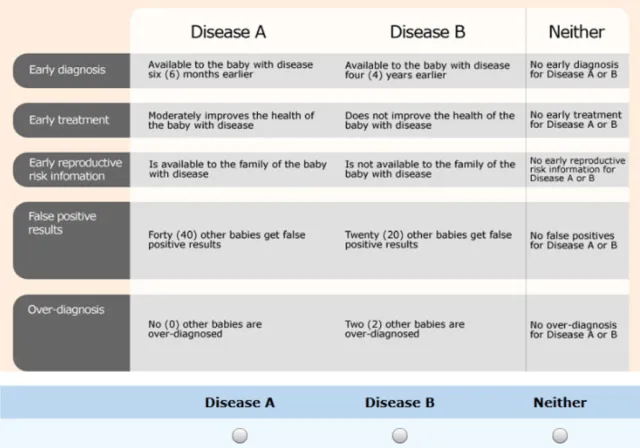
For the DCE (section 2), we asked participants to imagine that they were“advising the government about the types of diseases to screen for in newborns.”In each choice set, participants were asked to choose which of 2 diseases they would prefer to screen for, or whether they would prefer that neither disease be screened (Fig 1; example choice set).35The choice sets incorporated 5
attributes: earlier time to diagnosis (1 week to 4 years), clinical benefits of early treatment (none, moderate, significant), early reproductive risk information (available, not available), FP results (1–40 per affected infant), and overdiagnosed infants (0–2 per affected infant) (Table 1).
We did not include false-negative results as an attribute but explicitly noted that screening was designed to
find almost all infants with a disease, such that these results were very rare. In the scenario provided alongside the DCE, we reiterated information about the types of rare diseases screened for, and that the small risk of false-negative results was to be held constant across choices (Supplemental Information 2).
To test the effect of being exposed to value-based reasons, half of the respondents were randomly assigned to a reasoning exercise in which they were asked to select the most important among 6 reasons for their selection for each choice set (eg, maximize health benefits for affected infants versus minimize harms to others; Supplemental Information 3).30
We examined error variance between
groups to assess the effect of being exposed to the reasoning exercise.
Model Estimations and Data Analysis
The choice tasks were constructed by using SAS version 9.2 (SAS Institute, Cary, NC).36Estimates from the pilot
study informed the previous parameters for the D-efficient experimental design. The design procedures reduced the total number of possible choices to 48 choice sets, which were grouped into 6 sets of 8 choice tasks, to which respondents were randomly assigned.
The discrete response data were analyzed in Stata 12 (StataCorp, College Station, TX) by using an error components generalized multinomial logit model.37–39The generalized
multinomial logit model can account for the fact that each person completed 8 choices (ie, choices are not independent) and allows for heterogeneity of scale (ie, implying choice behavior is more variable for some than others) and heterogeneity in respondent preferences.38The
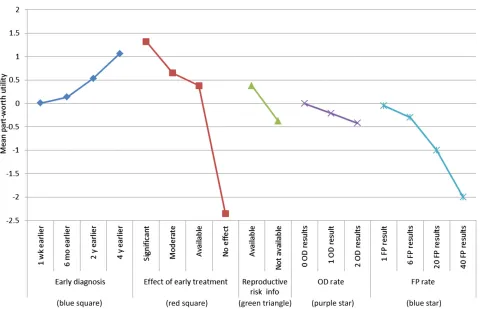
latter is important where outcomes may be positively valued by some and disvalued by others because of differences in preferences or misunderstanding. Results are presented as mean part-worth utilities, which estimate preferences for each level within an attribute. Absolute differences in parameter estimates between levels indicate the magnitude of preference for moving from one level to another, for example, the transition from moderate to significant health improvement.
Each attribute, statistically significant 2-way interactions between attributes, and the“neither testing”alternative (ie, that neither disease be screened for) were included in the model. Tests for interaction effects between participant characteristics and attribute levels showed no statistically significant influence on preferences; participant characteristics were not included in thefinal model. The FIGURE 1
neither-test alternative was coded such that if individuals had an average preference for NBS, the parameter for the alternative representing neither testing would be negative.23,40Effects
coding was used for categorical attributes. The attributes representing early diagnosis, the provision of reproductive risk information, rate of overdiagnosis, and rate of FPs were assigned normal heterogeneity distributions, which allows
respondents to have positive or negative utility value. The attribute representing the clinical outcomes of early treatment and 2-way interaction effects were specified asfixed.41We tested each
continuous variable for nonlinearity by assessing the square of the variable, retaining those that were statistically significant in thefinal model.
The benefit-harm trade-offs between the attributes of clinical benefit of early treatment and rates of overdiagnosis and FPs were estimated by using a compensating variation formula.42The SEs
surrounding the benefit-harm metrics were estimated by using the delta method.43The relative importance of
each attribute was calculated such that the importance values of the attributes add to 100%.44
RESULTS
Sample
The survey participation rate (ie, proportion of visitors to the invitation page who started the survey) was 94% (n= 2345).45The survey was
long and complex; thus, to minimize disengaged completion, respondents were rewarded by section and asked for permission to continue. Of those who started, 907 dropped out before completing the second section and 225 were excluded for quality reasons (eg, less than minimum completion times per section) for a 52% completion rate for section 2 (n= 1213). Most respondents (79.8%) completed the English-language survey.
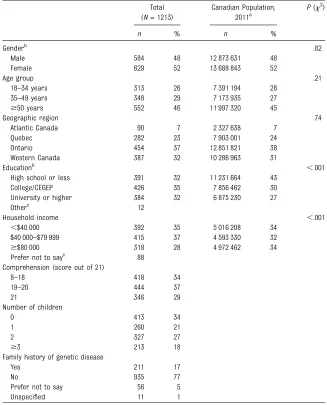
Our sample was reflective of the Canadian population by age, gender, and region but was better educated and had a more narrowly distributed income than Canadian averages (P,.001). Understanding of screening concepts was high (mean score = 18.86/21, SD = 2.24) (Table 2). TABLE 1 Attributes and Levels Used in the Choice Experiment
Attribute Attribute Definitionsa Levels Opt-Out Column Early diagnosis NBS leads to diagnosis of disease in thefirst
weeks of an infant’s life. For some diseases, this is much earlier than would be possible without newborn screening. For other diseases, newborn screening does not change the time of a infant’s diagnosis very much.
Available to the infant with disease 4 years earlier
No early diagnosis for Disease A or B
Available to the infant with disease 2 years earlier
Available to the infant with disease 6 months earlier
Available to the infant with disease 1 week earlier
Early treatment When an infant is diagnosed with a disease, medical treatments can be started right away. For some diseases, early medical treatment will improve the infants’health. For others, early medical treatment will have no effect on infants’health.
Significantly improves the health of the infant with disease
No early treatment of Disease A or B
Moderately improves the health of the infant with disease
Does not improve the health of the infant with disease
Early reproductive risk information
When NBS identifies an infant with an inherited disease, parents learn that they are at risk for having another infant with the same disease. If the disease is not inherited, this information about the parents’reproductive risk would not be available.
Is available to the family of the infant with disease
No early reproductive risk information for Disease A or B Is not available to the family of the infant with
disease
FP results Most of the infants who have an abnormal result on the initial test will be confirmed to not have a disease when they have a follow-up test at the hospital. These are called
“false positive”results.
Forty other infants have FP results No FP results for Disease A or B Twenty other infants have FP results
Six other infants have FP results One other infant has FP results
Overdiagnosis Some of the infants who have an abnormal result on a follow-up test have a mild form of the disease. This mild form of disease might not cause health problems later on. However, there is often no way to know which infants will develop health problems and which will not. Because of this, all infants diagnosed with a disease will be seen by a doctor for monitoring and sometimes treatment. This is what is called overdiagnosis.
Two other infants are overdiagnosed No overdiagnosis for Disease A or B
One other infant is overdiagnosed No other infants are overdiagnosed
Respondents who completed section 2 (n= 1213) were more likely to be female (P,.001), to be older (P,.01), and to score better in understanding (P,.01) than those who stopped after section 1
(n= 669). There was no difference in whether they had children or a family history of genetic disease.
Respondents randomly assigned to the reasoning exercise showed less error variance than those who were not exposed (Table 3). However, this difference was not statistically
significant; thus, results are reported for the full sample.
Estimation Results
On average, respondents positively valued NBS; opting-out was chosen in only 2.8% of the scenarios. Among attributes for which we assessed preference heterogeneity, preferences across respondents were consistent for 3: all respondents positively valued reproductive risk information (100%); all respondents disvalued FP (100%) and OD (100%). Preferences
for earlier diagnosis were
heterogeneous: whereas the average utility estimate was positive, 8% of respondents disvalued earlier diagnosis (92% positively valued this outcome). As seen in Table 3, all attributes had a statistically significant difference from zero influence on choice. Among clinical outcomes, respondents showed the greatest preference for the transition from no impact of screening on health toward significant health improvement, compared with the transition from no impact of screening on health toward moderate health improvement (see Fig 2 for mean part-worth utilities depicted as a function of attributes).
Several of the assessed 2-way interactions between attributes were statistically significant. Specifically, respondents were willing to accept a higher FP rate where affected infants gained significant improvement in health; however, respondents preferred a lower FP rate where affected infants gained only moderate improvement in health. Similarly, respondents valued early diagnosis more highly where affected infants gained significant health improvement but less highly where health improvement was moderate. Together with the FP rate, the statistically positive coefficient for the square of the FP rate shows that although respondents strongly disvalued FP results for thefirst few infants, their dislike was moderated as the number of FP results increased.
Relative Importance of Attributes
Importance scores represent the relative weight each attribute had on respondents’choices. The clinical benefit of early diagnosis was the most important attribute, followed by early diagnosis itself, which was followed by the 2 harm attributes (overdiagnosis, FPs). Reproductive risk information was the least important attribute (Fig 3).
Trade-offs
We estimated respondents’ willingness to trade the positively TABLE 2 Participant Demographic Characteristics
Total (N= 1213)
Canadian Population, 2011a
P(x2)
n % n %
Genderb .82
Male 584 48 12 873 631 48
Female 629 52 13 688 843 52
Age group .21
18–34 years 313 26 7 391 194 28 35–49 years 348 29 7 173 935 27
$50 years 552 46 11 997 320 45
Geographic region .74
Atlantic Canada 90 7 2 327 638 7
Quebec 282 23 7 903 001 24
Ontario 454 37 12 851 821 38
Western Canada 387 32 10 286 963 31
Educationb ,.001
High school or less 391 32 11 231 664 43 College/CEGEP 426 35 7 856 462 30 University or higher 384 32 6 875 230 27
Otherc 12
Household income ,.001
,$40 000 392 35 5 016 208 34
$40 000–$79 999 415 37 4 593 330 32
$$80 000 318 28 4 972 462 34
Prefer not to sayc 88 Comprehension (score out of 21)
8–18 418 34
19–20 444 37
21 346 29
Number of children
0 413 34
1 260 21
2 327 27
$3 213 18
Family history of genetic disease
Yes 211 17
No 935 77
Prefer not to say 56 5
Unspecified 11 1
CEGEP, collège d’enseignement général et professionnel.
aStatistics Canada data (gender, age, region, income = 2011 Census data; education = 2011 National Household Survey). bAged$18 years.
valued clinical benefits of NBS for affected infants against the negatively valued harms (FPs,
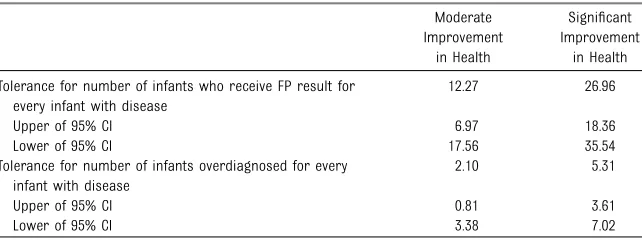
overdiagnosis) for other infants and their families. As Table 4 shows, respondents
were willing to make these trades, with the expected
increase in tolerance for harms in TABLE 3 Generalized Multinomial Logit Model
Attributes/Interactions Levels/Interaction Terms Mean Part-Worth Utility Valuec(SD) Main-effects attributes
Early diagnosisa [Weeks] earlier 5.1231023* (3.7131023*) Clinical effect of early treatment Significant health improvement 1.32* (N/A)
Moderate health improvement 0.65* (N/A)
No effectb —
Reproductive risk information Available 0.38* (0.18)
Not availableb —
Overdiagnosis ratea Per infant with disease 20.21* (0.06)
FP ratea Per infant with disease 20.05* (9.8331023)
Square of FP ratea — 0.70*31023(N/A)
Neither testing alternative — 24.35* (N/A)
Interaction between attributes
Clinical effect of early treatment, FP rate FP rate, significant health improvement 0.02* (N/A) FP rate, moderate health improvement 20.01* (N/A) Clinical effect of early treatment, timing of diagnosis Early diagnosis, significant health improvement 3.2031023* (N/A)
Early diagnosis, moderate health improvement 24.6131023* (N/A)
Scale (rational exercise arm) — 20.07
t — 21.29*
g — 21.78
PseudoR2= 0.33. *P,.05. N/A, not applicable. aContinuous coding.
bDenotes reference level.
cMean part-worth utilities estimate preferences for each level within an attribute. Absolute differences in parameter estimates between levels within an attribute indicate the magnitude of preference for moving from one state to another, that is, the transition from moderate to significant health improvement.
FIGURE 2
exchange for greater clinical benefits.
DISCUSSION
Through a DCE with members of the public in Canada, we offer insight into how the multiple outcomes of NBS are valued, both independently and relative to each other. Afirst
conclusion is that although the public highly valued NBS, with few opting out of the opportunity to screen, 100% of our respondents preferred to avoid the harms of screening. Furthermore, the willingness to tolerate burdens to unaffected infants and their families depended on the extent of clinical benefits for affected infants. Respondents were willing to trade higher numbers of infants exposed to the harms of FPs or overdiagnosis to achieve significant clinical benefits compared with moderate clinical benefits. In addition, the interaction between these attributes showed that the degree of tolerance for the incidence
of harms was influenced by the degree of benefit. That is, whereas respondents were willing to accept a higher FP rate to achieve significant clinical benefits, they required a lower FP rate for moderate clinical benefits. A further conclusion concerns the relative and mixed preferences for some of the informational outcomes of NBS. Specifically, we show that one of the outcomes of NBS that is typically discussed among advocates of expansion as a benefit (ie, early knowledge of disease) is interpreted by a minority of respondents as a harm (ie, it is disvalued).
Furthermore, respondents’valuation of early diagnosis was clearly linked to the clinical benefits that it could support, as revealed by the statistically significant interaction between these attributes. Earlier diagnosis was valued more when combined with significant health improvements and less when combined with moderate health improvement, further calling into
question the strength of preference for this outcome. Finally, reproductive risk information was the least important attribute, suggesting that this informational benefit in isolation might not be sufficient to warrant screening.
Our rigorous approach to engaging respondents, with a detailed training module that incorporated clear textual and visual depictions of screening concepts, educational quizzes, and feedback with corrected answers, reduces many sources of survey bias and gives us confidence in the quality of these data.24 However, several limitations
must be acknowledged. A primary limitation relates to the ratios of FP and overdiagnosis cases to affected cases. We drew these ratios from the limited data available and consultation with experts.6,46–50
However, because of the risk of confusion in representing 2 ratios, we elected to retain the same denominator (ie, number of affected cases) for both; thus, the upper limit in our ratio of overdiagnosis to affected cases (2:1) may be an overestimate of the worst-case scenario. In addition, the
introduction of ranges for FP and overdiagnosis results is likely to have had a strong framing effect; the statistical significance of the FP-squared variable in our model suggests that although respondents had a strongly negative reaction to small numbers of FP results, they became inured to this harm as the numbers increased, more easily accepting still more FP cases where larger numbers of FP cases were presented. Because of these several limitations, we do not place great interpretive weight on the trade-off values identified (ie, number of overdiagnosis cases traded off to achieve cases with clinical benefit), although we remain confident in the mainfindings of our study regarding the relative valuation of attributes. Second, we elected not to include false-negative results as an attribute FIGURE 3
Attribute importance score.
TABLE 4 Maximum Acceptable Risk of Gain in Health Benefit
Moderate Improvement
in Health
Significant Improvement
in Health Tolerance for number of infants who receive FP result for
every infant with disease
12.27 26.96
Upper of 95% CI 6.97 18.36
Lower of 95% CI 17.56 35.54
Tolerance for number of infants overdiagnosed for every infant with disease
2.10 5.31
Upper of 95% CI 0.81 3.61
Lower of 95% CI 3.38 7.02
because of the rarity of this outcome and the complexity of introducing an additional risk-based attribute. However, we explicitly noted that this rare event was to be held constant across the choices, so although we lack data on
preferences for this outcome, we are confident that our data remain robust in its absence. Furthermore, although the French version of the survey was not pretested, post hoc analyses suggest no language effect on preferences. Finally, the study was conducted with an Internet panel of Canadian residents, who were significantly different from Canadian averages on some measured demographic
characteristics, and who may also have differed on unmeasured characteristics, such as ethnicity, thus limiting the generalizability of thesefindings.
Limitations notwithstanding, these
findings extend a limited literature on how the public appreciates and balances the benefits and harms of population screening51–53and offer
important insights into public values for the types of diseases that should be screened for in newborns. Our study aligns with existing literature in showing strong support for
NBS1,13,14,54but expands significantly
on what is known about stakeholder expectations. Much of the existing empirical research has failed to attend to any harms,13–16,55whereas studies
that have explicitly considered harms (although not overdiagnosis) showed some acknowledgment by parents or members of the public but do not
illuminate how harms and benefits should be traded off.1,9,54,56These
findings also add to a broader literature on attitudes toward population screening by exploring several complex harms.57–66
Specifically, that 100% of our respondents showed a statistically significant preference to avoid harms (FPs, overdiagnosis) is important, because misunderstanding of risk-based harms is common,67and
recent work exploring attitudes toward overdiagnosis in the context of breast cancer screening has shown
considerable confusion as well as limited valuation.68–71Furthermore,
the identification of both positive and negative preferences for early diagnosis reinforces qualitative research that suggests the complexity of beliefs about early knowledge of disease in an infant, including concern about the risk of unwanted knowledge and negative consequences for the parent-child bond.1,9,54The
identification of a negative preference is an important corrective to the literature that identifies early knowledge as valuable in itself, by permitting family adjustment and planning, and averting difficult “diagnostic odysseys.”18,19,22Finally,
ourfinding that reproductive risk information was the least important attribute should factor into
deliberations about the pursuit of reproductive benefit through NBS.18–21
CONCLUSIONS
These findings provide novel and important insight into what “wider
and clear-eyed discussion[s] with the public about the magnitude of benefits and harms of screening”11
can generate. Our study shows that members of the public value clinical benefits for affected infants and are willing to accept harms to
unaffected infants and their families in proportion to the clinical benefits that can be realized. Significantly, members of the public preferred to avoid the harms of screening, with tolerance for harms reduced where clinical benefits were more moderate. Furthermore, a small but meaningful minority of respondents preferred to avoid early knowledge, and support for this outcome remained linked to the benefits that early diagnosis might yield through clinical treatment. Thesefindings suggest support for NBS policies
prioritizing clinical benefits over solely informational benefits, coupled with concerted efforts to avoid or minimize harms.
ACKNOWLEDGMENTS
We thank the study participants for the time and insights they provided for our study. We also thank Mr Dan Farrow of squarebracket.net for his design work.
ABBREVIATIONS
DCE: discrete choice experiment FP: false-positive
NBS: newborn screening
SSI: Survey Sampling International
Address correspondence to Fiona A. Miller, PhD, Institute of Health Policy, Management, and Evaluation, University of Toronto, 155 College St, 4thfloor, Toronto, ON, M5T 3M6, Canada. E-mail:fi[email protected]
PEDIATRICS (ISSN Numbers: Print, 0031-4005; Online, 1098-4275).
Copyright © 2015 by the American Academy of Pediatrics
FINANCIAL DISCLOSURE:The authors have indicated they have nofinancial relationships relevant to this article to disclose.
POTENTIAL CONFLICT OF INTEREST:Drs Miller, Hayeems, Carroll, Little, and Allanson have acted as advisors to newborn screening programs; Dr Chakraborty runs Newborn Screening Ontario; Dr Giguère runs Quebec’s newborn blood spot screening program; the other authors have indicated they have no potential conflicts of interest to disclose.
REFERENCES
1. Hayeems RZ, Miller FA, Bombard Y, et al. Expectations and values about expanded newborn screening: a public
engagement study.Health Expect. 2015; 18(3):419–429
2. Bombard Y, Miller FA, Hayeems RZ, et al. Public views on participating in newborn screening using genome sequencing.Eur J Hum Genet. 2014;22(11):1248–1254
3. Goldenberg AJ, Sharp RR. The ethical hazards and programmatic challenges of genomic newborn screening.JAMA. 2012;307(5):461–462
4. Paul DB. Patient advocacy in newborn screening: continuities and
discontinuities.Am J Med Genet C Semin Med Genet. 2008;148C(1):8–14
5. Baily MA, Murray TH.Ethics and Newborn Genetic Screening: New Technologies, New Challenges.Baltimore, MD: Johns Hopkins University Press; 2009
6. Pollitt RJ, Green A, McCabe C, et al. Neonatal screening for inborn errors of metabolism: cost, yield and outcome. Health Technol Assessment. 1997;1(7): i–iv, 1–202
7. Grosse SD, Boyle CA, Kenneson A, Khoury MJ, Wilfond BS. From public health emergency to public health service: the implications of evolving criteria for newborn screening panels.Pediatrics. 2006;117(3):923–929
8. de Monestrol I, Brucefors AB, Sjöberg B, Hjelte L. Parental support for newborn screening for cysticfibrosis.Acta Paediatr. 2011;100(2):209–215
9. Kerruish NJ. Parents’experiences of newborn screening for genetic susceptibility to type 1 diabetes.J Med Ethics. 2011;37(6):348–353
10. Christie L, Wotton T, Bennetts B, et al. Maternal attitudes to newborn screening for fragile X syndrome.Am J Med Genet A. 2013;161A(2):301–311
11. Harris R. Overview of screening: where we are and where we may be headed. Epidemiol Rev. 2011;33(1):1–6
12. Parsons EP, Clarke AJ, Hood K, Lycett E, Bradley DM. Newborn screening for Duchenne muscular dystrophy:
a psychosocial study.Arch Dis Child Fetal Neonatal Ed. 2002;86(2):F91–F95
13. Hayes IM, Collins V, Sahhar M, Wraith JE, Delatycki MB. Newborn screening for mucopolysaccharidoses: opinions of patients and their families.Clin Genet. 2007;71(5):446–450
14. Lipstein EA, Nabi E, Perrin JM, Luff D, Browning MF, Kuhlthau KA. Parents’ decision-making in newborn screening: opinions, choices, and information needs.Pediatrics. 2010;126(4):696–704
15. Koopmans J, Ross LF. Does familiarity breed acceptance? The influence of policy on physicians’attitudes toward newborn screening programs. Pediatrics. 2006;117(5):1477–1485
16. Hiraki S, Ormond KE, Kim K, Ross LF. Attitudes of genetic counselors towards expanding newborn screening and offering predictive genetic testing to children.Am J Med Genet A. 2006; 140(21):2312–2319
17. Wood MF, Hughes SC, Hache LP, et al. Parental attitudes toward newborn screening for Duchenne/Becker muscular dystrophy and spinal muscular atrophy.Muscle Nerve. 2014; 49(6):822–828
18. Bailey DB Jr, Skinner D, Warren SF. Newborn screening for developmental disabilities: reframing presumptive benefit.Am J Public Health. 2005;95(11): 1889–1893
19. Alexander D, van Dyck PC. A vision of the future of newborn screening.Pediatrics. 2006;117(5 pt 2, suppl 3):S350–S354
20. Bombard Y, Miller FA, Hayeems RZ, Avard D, Knoppers BM. Reconsidering reproductive benefit through newborn screening: a systematic review of guidelines on preconception, prenatal and newborn screening.Eur J Hum Genet. 2010;18(7):751–760
21. Bombard Y, Miller FA, Hayeems RZ, et al. Health-care providers’views on pursuing reproductive benefit through newborn screening: the case of sickle cell disorders.Eur J Hum Genet. 2012;20(5): 498–504
22. Bailey DB Jr, Beskow LM, Davis AM, Skinner D. Changing perspectives on the benefits of newborn screening.Ment Retard Dev Disabil Res Rev. 2006;12(4): 270–279
23. Ryan M, Gerard K, Amaya-Amaya M.Using Discrete Choice Experiments To Value Health and Health Care. Dordrecht, The Netherlands: Springer; 2008
24. de Bekker-Grob EW, Ryan M, Gerard K. Discrete choice experiments in health economics: a review of the literature. Health Econ. 2012;21(2):145–172
25. Statistics Canada. Census of Population. 2010. Available at: http://www12.statcan. gc.ca/census-recensement/2011/rt-td/ index-eng.cfm#tab5. Accessed March 21, 2013
26. Orme B.Sample Size Issues for Conjoint Analysis Studies. Sawthooth Software Research Paper Series. Squim, WA: Sawthooth Software; 1998
27. Lancaster K. A new approach to consumer theory.J Polit Econ. 1966; 74(2):132–157
28. McFadden D. Conditional logit analysis of qualitative choice behavior. In: Zarembka P, ed.Frontiers of Econometrics. New York: Academic Press; 1973
29. Bombard Y, Miller FA, Hayeems RZ, et al. Citizens’values regarding research with stored samples from newborn screening in Canada.Pediatrics. 2012;129(2): 239–247
30. Johri M, Damschroder LJ, Zikmund-Fisher BJ, Kim SY, Ubel PA. Can a moral reasoning exercise improve response quality to surveys of healthcare priorities?J Med Ethics. 2009;35(1): 57–64
31. Willison DJ, Swinton M, Schwartz L, et al. Alternatives to project-specific consent for access to personal information for health research: insights from a public dialogue.BMC Med Ethics. 2008;9:18–30
32. Straten GF, Friele RD, Groenewegen PP. Public trust in Dutch health care.Soc Sci Med. 2002;55(2):227–234
technologies? A multicountry
comparison.Health Aff (Millwood). 2001; 20(5):194–201
34. Gaskell G, Allansdottir A, Allum N, et al. The 2010 Eurobarometer on the life sciences.Nat Biotechnol. 2011;29(2): 113–114
35. Ryan M, Skåtun D. Modelling non-demanders in choice experiments. Health Econ. 2004;13(4):397–402
36. Kuhfeld WF, Tobias RD, Garratt M. Efficient experimental design with marketing research applications.J Mark Res. 1994;31(4):545–557
37. Gu Y, Hole AR, Knox S. Fitting the generalized multinomial logit model in Stata.Stata J. 2013;13(2):382–397
38. Fiebig DG, Keane MP, Louviere J, Wasi N. The generalized multinomial logit model: accounting for scale and coefficient heterogeneity.Marketing Science. 2010; 29(3):393–421
39. Train KE.Discrete Choice Methods With Simulation. Cambridge, United Kingdom: Cambridge University Press; 2003
40. Bridges JF, Hauber AB, Marshall D, et al. Conjoint analysis applications in health —a checklist: a report of the ISPOR Good Research Practices for Conjoint Analysis Task Force.Value Health. 2011;14(4): 403–413
41. Regier DA, Ryan M, Phimister E, Marra CA. Bayesian and classical estimation of mixed logit: an application to genetic testing.J Health Econ. 2009;28(3): 598–610
42. Rosen HS, Small KA. Applied Welfare Economics With Discrete Choice Models. Cambridge, MA: National Bureau of Economic Research Cambridge; 1981
43. Hole AR. Modelling heterogeneity in patients’preferences for the attributes of a general practitioner appointment.J Health Econ. 2008;27(4):1078–1094
44. Louviere J, Hensher D, Swait J.Stated Choice Methods: Analysis and Applications. Cambridge, United Kingdom: Cambridge University Press; 2000
45. Eysenbach G. Improving the quality of Web surveys: the Checklist for Reporting Results of Internet E-Surveys (CHERRIES). J Med Internet Res. 2004;6(3):e34
46. Wilcken B, Haas M, Joy P, et al. Expanded newborn screening: outcome in
screened and unscreened patients at age 6 years.Pediatrics. 2009;124(2). Available at: www.pediatrics.org/cgi/ content/full/124/2/e241
47. Kemper AR, Knapp AA, Green NS, Comeau AM, Metterville DR, Perrin JM. Weighing the evidence for newborn screening for early-infantile Krabbe disease.Genet Med. 2010;12(9):539–543
48. Coulm B, Coste J, Tardy V, et al; Dépistage Hyperplasie Congénitale des Surrénales France Study Group. Efficiency of neonatal screening for congenital adrenal hyperplasia due to 21-hydroxylase deficiency in children born in mainland France between 1996 and 2003.Arch Pediatr Adolesc Med. 2012;166(2):113–120
49. Schulze A, Lindner M, Kohlmüller D, Olgemöller K, Mayatepek E, Hoffmann GF. Expanded newborn screening for inborn errors of metabolism by electrospray ionization-tandem mass spectrometry: results, outcome, and implications. Pediatrics. 2003;111(6 pt 1):1399–1406
50. Kwon C, Farrell PM. The magnitude and challenge of false-positive newborn screening test results.Arch Pediatr Adolesc Med. 2000;154(7):714–718
51. Woloshin S, Schwartz LM. The benefits and harms of mammography screening: understanding the trade-offs.JAMA. 2010;303(2):164–165
52. Gigerenzer G, Mata J, Frank R. Public knowledge of benefits of breast and prostate cancer screening in Europe.J Natl Cancer Inst. 2009;101(17):1216–1220
53. Schwartz LM, Woloshin S, Fowler FJ Jr, Welch HG. Enthusiasm for cancer screening in the United States.JAMA. 2004;291(1):71–78
54. Detmar S, Dijkstra N, Nijsingh N, Rijnders M, Verweij M, Hosli E. Parental opinions about the expansion of the neonatal screening programme.Community Genet. 2008;11(1):11–17
55. Schittek H, Koopmans J, Ross LF. Pediatricians’attitudes about screening newborns for infectious diseases. Matern Child Health J. 2010;14(2): 174–183
56. Whitehead NS, Brown DS, Layton CM. Developing a Conjoint Analysis Survey of Parental Attitudes Regarding Voluntary Newborn Screening. Research Triangle Park, NC: RTI International; 2010
57. Perneger TV, Cullati S, Schiesari L, Charvet-Bérard A. Impact of information about risks and benefits of cancer screening on intended participation.Eur J Cancer. 2010;46(12):2267–2274
58. Perneger TV, Schiesari L, Cullati S, Charvet-Bérard A. Does information about risks and benefits improve the decision-making process in cancer screening—randomized study.Cancer Epidemiol. 2011;35(6): 574–579
59. Marshall DA, Johnson FR, Phillips KA, Marshall JK, Thabane L, Kulin NA. Measuring patient preferences for colorectal cancer screening using a choice-format survey.Value Health. 2007;10(5):415–430
60. Hall J, Fiebig DG, King MT, Hossain I, Louviere JJ. What influences
participation in genetic carrier testing? Results from a discrete choice experiment.J Health Econ. 2006;25(3): 520–537
61. Salkeld G, Solomon M, Short L, Ryan M, Ward JE. Evidence-based consumer choice: a case study in colorectal cancer screening.Aust N Z J Public Health. 2003; 27(4):449–455
62. Gyrd-Hansen D, Søgaard J. Analysing public preferences for cancer screening programmes.Health Econ. 2001;10(7): 617–634
63. Wordsworth S, Ryan M, Skåtun D, Waugh N. Women’s preferences for cervical cancer screening: a study using a discrete choice experiment.Int J Technol Assess Health Care. 2006;22(3): 344–350
64. Hol L, de Bekker-Grob EW, van Dam L, et al. Preferences for colorectal cancer screening strategies: a discrete choice experiment.Br J Cancer. 2010;102(6): 972–980
65. van Dam L, Hol L, de Bekker-Grob EW, et al. What determines individuals’ preferences for colorectal cancer screening programmes? A discrete choice experiment.Eur J Cancer. 2010; 46(1):150–159
67. Schwartz PH. Questioning the quantitative imperative: decision aids, prevention, and the ethics of disclosure.Hastings Cent Rep. 2011; 41(2):30–39
68. Waller J, Douglas E, Whitaker KL, Wardle J. Women’s responses to information about overdiagnosis in the UK breast
cancer screening programme: a qualitative study.BMJ Open. 2013;3(4)
69. Hersch J, Jansen J, Barratt A, et al. Women’s views on overdiagnosis in breast cancer screening: a qualitative study. BMJ. 2013;346
70. Waller J, Whitaker KL, Winstanley K, Power E, Wardle J. A survey study of women’s
responses to information about
overdiagnosis in breast cancer screening in Britain.Br J Cancer. 2014;111(9):1831–1835
DOI: 10.1542/peds.2015-0518 originally published online July 13, 2015;
2015;136;e413
Pediatrics
Chakraborty, Yves Giguère and Dean A. Regier
Barg, June C. Carroll, Brenda J. Wilson, Julian Little, Judith Allanson, Pranesh
Fiona A. Miller, Robin Z. Hayeems, Yvonne Bombard, Céline Cressman, Carolyn J.
Public Perceptions of the Benefits and Risks of Newborn Screening
Services
Updated Information &
http://pediatrics.aappublications.org/content/136/2/e413
including high resolution figures, can be found at:
References
http://pediatrics.aappublications.org/content/136/2/e413#BIBL
This article cites 60 articles, 14 of which you can access for free at:
Subspecialty Collections
http://www.aappublications.org/cgi/collection/genetics_sub Genetics
http://www.aappublications.org/cgi/collection/ethics:bioethics_sub Ethics/Bioethics
following collection(s):
This article, along with others on similar topics, appears in the
Permissions & Licensing
http://www.aappublications.org/site/misc/Permissions.xhtml
in its entirety can be found online at:
Information about reproducing this article in parts (figures, tables) or
Reprints
http://www.aappublications.org/site/misc/reprints.xhtml
DOI: 10.1542/peds.2015-0518 originally published online July 13, 2015;
2015;136;e413
Pediatrics
Chakraborty, Yves Giguère and Dean A. Regier
Barg, June C. Carroll, Brenda J. Wilson, Julian Little, Judith Allanson, Pranesh
Fiona A. Miller, Robin Z. Hayeems, Yvonne Bombard, Céline Cressman, Carolyn J.
Public Perceptions of the Benefits and Risks of Newborn Screening
http://pediatrics.aappublications.org/content/136/2/e413
located on the World Wide Web at:
The online version of this article, along with updated information and services, is
http://pediatrics.aappublications.org/content/suppl/2015/07/08/peds.2015-0518.DCSupplemental
Data Supplement at:
by the American Academy of Pediatrics. All rights reserved. Print ISSN: 1073-0397.