Explaining the causes of infeasibility of Boolean formulas has practical applications in numerous fields: electronic design, formal verification, and artificial intelligence. In design applications, for example, a large Boolean function is formed such that a feasi-ble design is obtained when the function is satisfiafeasi-ble, and design infeasibility is indi-cated when the function is unsatisfiable. An example of this is the routing of signal wires in an FPGA. We are usually interested in a “minimal” explanation of infeasibil-ity that excludes irrelevant information. For Boolean formulas in conjunctive normal form (CNF), the notion of minimality is defined as follows. Consider an unsatisfiable CNF formula . An unsatisfiable subformula (a US) of is a minimal-unsatisfiable subformula (MUS) if it becomes satisfiable whenever any of its clauses is removed. Algorithms for finding MUSes are presented in [1, 2, 7].
Since an unsatisfiable formula might have many MUSes, specific ones might be of greater value based on the application. For example, in verification applications the quality of refinement affects the number of iterations in the abstraction-refinement flow. While a US represents a set of spurious behaviors, an MUS represents a larger set of spurious behaviors. Thus, an MUS in general, and a smallest cardinality MUS (SMUS) in particular, tend to be more effective in reducing the number of refinement steps. Lynce et al. [4] presented an algorithm that computes an SMUS by implicitly searching all USes of a formula.
In this paper, we tackle the problem of finding an SMUS by a branch-and-bound algorithm that utilizes iterative MAXSAT solutions to generate lower and upper bounds on the size of the SMUS, and branch on specific subformulas to find it. The paper is
ϕ ϕ
A Branch-and-Bound Algorithm for Extracting
Smallest Minimal Unsatisfiable Formulas
Maher Mneimneh1, Inês Lynce2, Zaher Andraus1, João Marques-Silva2, and Karem Sakallah1
1
University of Michigan,
{maherm, zandrawi, karem}@umich.edu
2 Technical University of Lisbon, Portugal
{ines,jpms}@sat.inesc-id.pt
Abstract. We tackle the problem of finding a smallest-cardinality MUS (SMUS) of a given formula. The SMUS provides a succinct explanation of infeasibility and is valuable for applications that rely on such explanations. We present a branch-and-bound algorithm that utilizes iterative MAXSAT solutions to generate lower and upper bounds on the size of the SMUS, and branch on specific subformulas to find it. We report experimental results on formulas from DIMACS and DaimlerChrysler product configuration suites.
1 Introduction
from DIMACS and DaimlerChrysler Automotive Product Configuration benchmarks are presented in Section 4.
Consider an unsatisfiable formula . A US of is an MUS if removing every clause results in a formula that is satisfiable. is an SMUS if it is an MUS and for all other MUSes of , . We denote the set of MUSes of by . The MAX-SAT problem finds a satisfiable subformula of with the maximum number of clauses; we call a MAX-SAT solution of . We solve MAX-SAT by reducing it to an integer optimization problem as follows. We define a set of new Boolean clause selector variables , and construct a
new formula . The MAX-SAT solution is
obtained by maximizing the objective subject to the clauses of . Consider the Boolean formula:
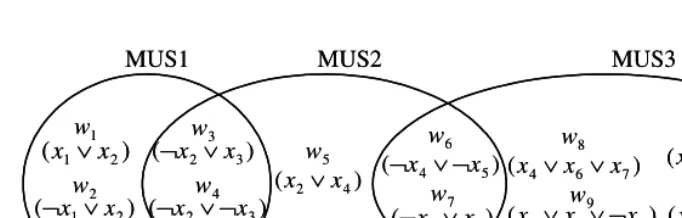
(1) We call the clause of . has three MUSes that are illustrated with a Venn diagram in Figure 1. MUS1 is an SMUS. There are several possible MAX-SAT solutions for . Two of them are , and .
A simple approach to compute an SMUS of a formula is to generate all MUSes and then select the smallest MUS. This approach is hindered by the fact that the number of MUSes of a formula can be exponential in the number of its variables. To solve this problem efficiently, we present a branch-and-bound algorithm to compute the SMUS.
ϕ = w1w2… wm α ϕ α
β ϕ α ≤ β ϕ
Muses( )ϕ α ϕ
ϕ α– ϕ
m Y = {y1, , ,y2 … ym}
ϕ′ = (¬ y1∨ w1) ¬( y2∨ w2) … ¬( ym∨ wm)
y1+y2+… +ym ϕ′
ϕ = (x1∨ x2)(¬ x1∨ x2)(¬ x2∨ x3)(¬ x2∨ ¬ x3)(x2+x4)(¬ x4∨ ¬ x5)(¬ x4∨ x5) x4∨ x6∨ x7
( )(x4∨ x6∨ ¬ x7)(x4∨ ¬ x6∨ x7)(x4∨ ¬ x6∨ ¬ x7)
wi 1 i 11≤ ≤ ith ϕ ϕ
ϕ {w3,w7} {w1,w6} )
(x1∨ x2 ) (¬ x1∨ x2
) (¬ x2∨ x3
) (¬ x2∨ ¬ x3
)
(x2∨ x4 (¬ x4∨ ¬ x5) ) (¬ x4∨ x5
) (x4∨ x6∨ x7
)
(x4∨ x6∨ ¬ x7 (x4∨ ¬ x6∨ ¬ x7) ) (x4∨ ¬ x6∨ x7 1 w 2 w 3 w 4 w 5
w w6
7 w 8 w 9 w 10 w 11 w
MUS1 MUS2 MUS3
) (x1∨ x2
) (¬ x1∨ x2
) (¬ x2∨ x3
) (¬ x2∨ ¬ x3
)
(x2∨ x4 (¬ x4∨ ¬ x5) ) (¬ x4∨ x5
) (x4∨ x6∨ x7
)
(x4∨ x6∨ ¬ x7 (x4∨ ¬ x6∨ ¬ x7) ) (x4∨ ¬ x6∨ x7 1 w 2 w 3 w 4 w 5
w w6
7 w 8 w 9 w 10 w 11 w
MUS1 MUS2 MUS3
2 Preliminaries
[image:2.522.44.385.84.193.2]3 Computing a Smallest MUS
Fig. 1. The formula ∏ of (1) and its MUSes
a possible solution. Thus, every MUS must contain one of these clauses. In the third iteration, we have the following optimization problem: Maximize subject to
which has the solution .
After adding the constraints , and , the optimization problem be-comes UNSAT because of the MUS . The aggregated set of
claus-es from MAX-SAT solutions is . At this point,
we can conclude that any MUS contains at least 3 clauses since:
(2)
Thus, the number of iterations of MAX-SAT is a lower bound (LB) on the number of clauses of the SMUS of .
To obtain an upper bound on the size of the SMUS, we can generate all the MUSes of the subformula . The upper bound on the size of the SMUS is the size of the smallest MUS found in . For our example has a single MUS of size 5, and consequently the upper bound is 5.
Given and the initial LB and UB, if LB is equal to UB, then an MUS whose size is UB is an SMUS for . If this is not the case, we search the remaining MUSes of (the ones not in ) for an MUS (if any) whose size is smaller than UB. We achieve this by recursively branching on specific subformulas of , and bounding the search using LB and UB. The subformulas we branch on are where and is the set of all MAX-SAT solutions of . Each of the sub-formulas in this recursion returns its SMUS if it is smaller than the one currently found in (and consequently ’s UB is updated). Otherwise, an empty set is returned. For the running example, all MAX-SAT solutions of are: , , , and . Thus, five recursive calls are made on the subformulas ,
, , , and .
To understand why this approach efficiently searches the space of , we have to address the following questions. Why will
yi i=1 11
!
ϕ′( )( )y3 ( )y7 ( )y4 ( )y6 {w1,w5,w8} y1
( ) ( )y5 ( )y8 w3,w4,w5,w6,w7
{ }
ϕ maxsat = {w1,w3,w4,w5,w6,w7,w8}
α ϕ⊆ α is MUS
∀ → {w3,w4,w1} ⊆ α ∨ {w3,w4,w5} ⊆ α∨ w3,w4,w8
{ } ⊆ α ∨… ∨ {w7,w6,w1} ⊆ α ∨… ∨ w{ 7,w6,w8} ⊆ α
ϕ
ϕmaxsat
ϕ maxsat ϕmaxsat
Muses(ϕmaxsat)
ϕ
ϕ ϕ maxsat
ϕ ϕ δ– i
δi∈ ∆ ∆ ϕ maxsat
ϕ ϕ
ϕmaxsat { }w3 { }w4 { }w5
w6
{ } {w7} ϕ –{ }w3
ϕ –{ }w4 ϕ –{ }w5 ϕ –{ }w6 ϕ –{ }w7 Muses( )ϕ –Muses(ϕ maxsat)
3.2 Branch-and-Bound
We utilize iterative MAX-SAT solutions to get a lower bound on the size of the SMUS. Let us consider in (1) and its extended with selector variables. We have seen that one possible MAX-SAT solution is . From this, and the properties of MAX-SAT, we can conclude that every MUS of contains or (or both), and conse-quently contains at least one clause. To improve this lower bound, we repeat the above process by finding another MAX-SAT solution that contains clauses other than and . This can be achieved by adding the constraints and to the MAX-SAT optimization problem to get: Maximize subject to . is
ϕ ϕ '
w3,w7
{ }
ϕ w3 w7
w3
w7 ( )y3 ( )y7
yi i=1 11
!
( )ϕ′ ( )y3 ( )y7 {w4,w6}(3) We can continue the iterations of MAX-SAT on the formula starting with the set . In other words, the initial optimization problem for
α ϕ⊆ –{ }w3 α is MUS
∀ → {w7,w4,w1} ⊆ α ∨ {w7,w4,w5} ⊆ α∨ … ∨ w{ 6,w7,w8} ⊆ α
Algorithm 1 FindSMUS
FindSMUS( )
smus = FindSMUSRec( , , 0, );
if(smus == ) print “NO MUS. Formula is Satisfiable”; else print smus;
FindSMUSRec(set , set pMaxSat, int pLB, int pUB) if(IsSat( )) return ;
(comp,numIter,cMaxSat)=IterateMaxSat( ,pMaxSat,pUB-pLB); if(!comp) return ;
cLB = pLB + numIter;
;
(muses, allMaxSats) = FindAllMuses( );
cMUS = Smallest(muses); cUB = cMUS.size();
smallestTillNow = (cUB < pUB)? cUB: pUB; set smallestMUS = (cUB < pUB)? cMUS: ;
if(smallestTillNow<=cLB+1) return smallestMUS; foreach (ms in allMaxSats)
;
;
recMUS=FindSMUSRec( , ,cLB, smallestTillNow);
if(recMUS!= )
smallestTillNow = recMus.size(); smallestMUS = recMUS;
if(smallestTillNow == cLB + 1) return smallestMUS; return smallestMUS;
ϕ
ϕ φ ϕ ⋅size() φ
ϕ
ϕ φ
ϕ φ
ϕ maxsat = cMaxSat + pMaxSat
ϕ maxsat
φ
ϕnew = ϕ –ms
maxsatrec = ϕmaxsat–ms
ϕ new maxsatrec φ
[image:4.522.48.380.232.520.2]ϕ –{ }w3 ϕ maxsat–{ }w3
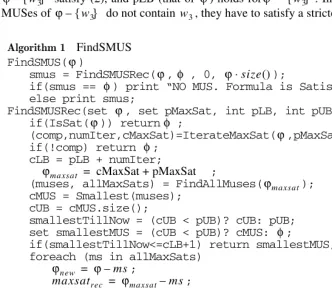
Fig. 2. The algorithm for finding an SMUS
bound and MAX-SAT solution to compute its own lower bound? Finally, why is this an efficient solution? The first question addresses completeness, and its answer is omitted due to space limitations. We address the last two questions in what follows.
We use parent lower bound (pLB) and parent upper bound (pUB) to designate the upper and lower bounds of the parent formula, and current upper bound (cUB) and cur-rent lower bound (cLB) to designate the upper and lower bounds of a subformula . To understand how to compute ’s cLB, let us consider the subformula . It is easy to verify that includes all MUSes of except
the ones that contain . Since , then MUSes of
satisfy (2), and pLB (that of ) holds for . In fact, since all the MUSes of do not contain , they have to satisfy a stricter version of (2):
ϕ δ– i ϕ δ– i
ϕ –{ }w3 Muses(ϕ –{ }w3 ) ϕ
w3 Muses(ϕ –{ }w3 ) ⊆ Muses ϕ( )
ϕ –{ }w3 ϕ ϕ –{ }w3
ϕ –{ }w3 w3
point, the optimization problem is unsatisfiable; consequently cLB = 4. Next, we gen-erate all MUSes of the current MAX-SAT solution: . We get the MUS: . Since the size of this MUS is equal to cLB, we have found the smallest MUS in . Since this MUS is smaller than cUB for , we update cUB to reflect the smallest MUS we have up to this point. The recursive calls on the remaining subformula can proceed with pLB = 3 and pUB = 4. No smaller MUS is found in these formulas. Thus the smallest MUS for is .
An additional optimization can be applied to enhance the above algorithm. Consid-er again. From (2), we know that each MUS contains at least 3 clauses. If thConsid-ere is an MUS that contains exactly three clauses then it must be in . Since we did not find an MUS of size 3 in then we know that the SMUS of has size at least cLB + 1. Using this observation, and after returning from the branch of the subformula , and updating cUB of to 4, we conclude that we have found the SMUS since cUB = cLB + 1.
The pseudo code for algorithm that follows from the above description is illustrated in Figure 2. FindMusRec() is the recursive procedure for finding the SMUS. It takes as arguments the formula , the parent’s MAX-SAT clauses pMaxSat, the parent lower bound pLB, and the parent upper bound pUB. If is satisfiable, it contains no MUS and the empty set is returned. Otherwise, the procedure calls IterateMaxSat() using the arguments , pMaxSat, and pUB-pLB. IterateMaxSat() returns three values. The Boolean variable comp is set to 0 if the optimization problem remains satisfiable after running pUB-pLB iterations, and is set to 1 otherwise. If comp is set to 1, numIter is the number of iterations, and is cMaxSat is the set current MAX-SAT clauses. If comp is 0 then the formula does not contain an MUS smaller than cUB and the empty set is re-turned. Otherwise, cLB is set to pLB + numIter, and all the MUSes and MAX-SAT so-lutions of are computed. If the smallest of these MUSes is equal to cLB or cLB
w1,w3,w4,w5,w7,w2
{ }
w1,w2,w3,w4
{ }
ϕ –{ }w6 ϕ
ϕ {w1,w2,w3,w4}
ϕ
ϕmaxsat
ϕmaxsat ϕ
ϕ –{ }w6 ϕ
ϕ
ϕ
ϕ
ϕ maxsat
mula. Thus, cLB for is 6, and consequently, the smallest MUS in
has at least 6 clauses. In fact, has a single MUS of size 6. As a result, does not contain an MUS smaller than the best we have till now (5 clauses). The above conclusion can be reached with fewer computations by noting that numIter must be at most pUB - pLB. If the optimization problem remains satisfiable after pUB pLB iterations, the current subformula does not contain an MUS smaller than pUB
and the search is bound.
Let us consider the next recursive call on the subformula and the MAX-SAT solution . We know that pLB and pUB are 3 and 5 respectively. The optimization problem is: Maximize subject to
. is a solution. At this
ϕ –{ }w3 ϕ –{ }w3
ϕ –{ }w3 ϕ –{ }w3
ϕ –{ }w6 ϕ maxsat–{ }w6
y1+… +y5+y7+… +y11 ϕ′ –{(¬ y6∨ ¬ x4∨ ¬ x5)}
( )( )y3 ( )y7 ( )y4 ( )y1 ( )y5 ( )y8 { }w2
for is four. The next solutions are and (at this point, the opti-mization problem is unsatisfiable). Following the above reasoning, we have cLB = pLB + numIter where numIter is the number of MAX-SAT iterations in the
subfor-ϕ –{ }w3 {w10} {w11}
is: Maximize subject to
. A possible solution for this problem is . By combining this with (3), we know that the current lower bound ϕ maxsat–{ }w3 y1+y2+y4… +y11
ϕ′ –{(¬ y3∨ ¬ x2∨ ¬ x3)}
( )( )y7 ( )y4 ( )y6 ( )y1 ( )y5 ( )y8 w9
{ }
-+ 1, it is returned as the sMUS for . If this is not the case, we branch on all MAX-SAT solutions of in a depth-first manner. After each branch terminates, we update the smallest MUS of and designate it as an SMUS if its size is equal to cLB + 1. After all recursive calls end, the SMUS is returned.
4
Experimental Results
To experimentally evaluate the effectiveness of our algorithm, we implemented it in C++ and used Satzoo [6] to solve MAX-SAT problems. For generating all MUSes we use the algorithms in [3]. All experiments were conducted on a 2 GHz Pentium 4 machine having 1 GB of RAM and running the Linux operating system.
Table 1 lists the results for representative aim benchmarks from the DIMACS set. The number of clauses of the SMUS range between 10% and 40% of the total number of clauses. The short run time is due to the fact that the total number of MUSes in these formulas is very small.
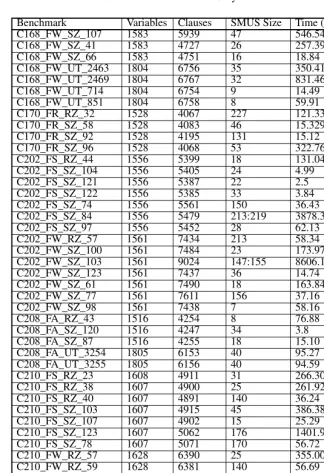
Table 2 presents the results for representative unsatisfiable formulas from the DaimlerChrysler Automotive Product Configuration Benchmarks [5]. To our knowl-edge, there exists no previous work that shows the sizes of the SMUSes for these bench-marks. The last column reports the number of MUSes obtained by running the algo-rithm in [3]. In some cases, the algoalgo-rithm does not terminate and consequently either no
ϕ ϕmaxsat
ϕ
Table 1 Results on Representative Aim Benchmarks
Benchmark Variables Clauses SMUS Size Time (sec) aim-50-1_6-no-2 50 80 32 0.08 aim-50-2_0-no-1 50 100 22 0.01 aim-100-1_6-no-1 100 160 47 0.14 aim-100-2_0-no-2 100 200 39 0.1 aim-200-1_6-no-1 200 320 55 0.36 aim-200-2_0-no-1 200 400 53 0.3
information or a lower bound on the number of MUSes is provided. The total number of MUSes for these formulas ranges from 1 to more than a million. The size of the SMUS ranges from 0.1% to 5.5% (the average size is 1%) of the size of its formula. This shows that the SMUSes for these formulas are very small. Even in the cases where the number of MUSes is extremely large, our algorithm was able to efficiently find the SMUS. This shows the effectiveness of the implicit search utilized by the branch-and-bound process. For C202_FS_SZ_84, C202_FW_SZ_103, C210_FW_SZ_90, and C210_FW_SZ_91 the number of MUSes in was very large. To limit the run time, a cut-off of 500 seconds was used when generating all MUSes. The size column for these benchmarks has the format n1:n2 where n1 is the LB and n2 is the smallest MUS found before time-out. The difference between the best MUS found in the time limit and the lower bound for these formulas is 6, 8, 6, and 14 respectively. Thus, even
ϕ maxat
Benchmark Variables Clauses SMUS Size Time (sec) # MUSes C168_FW_SZ_107 1583 5939 47 546.54 NA C168_FW_SZ_41 1583 4727 26 257.39 NA C168_FW_SZ_66 1583 4751 16 18.84 NA C168_FW_UT_2463 1804 6756 35 350.41 NA C168_FW_UT_2469 1804 6767 32 831.46 NA C168_FW_UT_714 1804 6754 9 14.49 NA C168_FW_UT_851 1804 6758 8 59.91 102 C170_FR_RZ_32 1528 4067 227 121.33 32768 C170_FR_SZ_58 1528 4083 46 15.329 >16140 C170_FR_SZ_92 1528 4195 131 15.12 1 C170_FR_SZ_96 1528 4068 53 322.76 >172032 C202_FS_RZ_44 1556 5399 18 131.04 >79336 C202_FS_SZ_104 1556 5405 24 4.99 >1109330 C202_FS_SZ_121 1556 5387 22 2.5 4 C202_FS_SZ_122 1556 5385 33 3.84 1 C202_FS_SZ_74 1556 5561 150 36.43 NA C202_FS_SZ_84 1556 5479 213:219 3878.3 NA C202_FS_SZ_97 1556 5452 28 62.13 >63936 C202_FW_RZ_57 1561 7434 213 58.34 1 C202_FW_SZ_100 1561 7484 23 173.97 NA C202_FW_SZ_103 1561 9024 147:155 8606.1 NA C202_FW_SZ_123 1561 7437 36 14.74 4 C202_FW_SZ_61 1561 7490 18 163.84 NA C202_FW_SZ_77 1561 7611 156 37.16 NA C202_FW_SZ_98 1561 7438 7 58.16 NA C208_FA_RZ_43 1516 4254 8 76.88 >9542 C208_FA_SZ_120 1516 4247 34 3.8 2 C208_FA_SZ_87 1516 4255 18 15.10 12884 C208_FA_UT_3254 1805 6153 40 95.27 17408 C208_FA_UT_3255 1805 6156 40 94.59 52736 C210_FS_RZ_23 1608 4911 31 266.30 NA C210_FS_RZ_38 1607 4900 25 261.92 >188688 C210_FS_RZ_40 1607 4891 140 36.24 15 C210_FS_SZ_103 1607 4915 45 386.38 NA C210_FS_SZ_107 1607 4902 15 25.29 NA C210_FS_SZ_123 1607 5062 176 1401.97 >972463 C210_FS_SZ_78 1607 5071 170 56.72 NA C210_FW_RZ_57 1628 6390 25 355.00 >129272 C210_FW_RZ_59 1628 6381 140 56.69 15 C210_FW_SZ_106 1628 6405 49 789.58 NA C210_FW_SZ_111 1628 6393 15 35.17 NA C210_FW_SZ_128 1628 6401 22 151.33 NA C210_FW_SZ_90 1628 6977 271:277 6404.18 NA C210_FW_SZ_91 1628 6709 267:281 6329.91 NA C220_FV_RZ_12 1530 4017 11 50.58 >56872 C220_FV_RZ_13 1530 4014 10 33.35 6772 C220_FV_RZ_14 1530 4013 11 33.89 80 C220_FV_SZ_46 1530 4014 17 78.44 >5160 C220_FV_SZ_65 1530 4014 23 18.85 >84943
Table 2. Results on DaimlerChrysler Benchmarks
generating an MUS whose size is close to the lower bound. We can see a large run time for these formulas. Most of this run time was spent computing ϕ maxsat.
Understanding the causes of infeasibility of Boolean formulas is of interest in various theoretical and practical areas of computer science. Minimal unsatisfiable subformulas provide useful explanations of infeasibility. We have presented an algorithm to find an SMUS of a Boolean formula: an MUS with the least number of clauses. The algorithm utilizes the relation between MAX-SAT and MUSes to construct lower and upper bounds on the size of the SMUS. These bounds are the basis for a branch-and-bound procedure that finds the SMUS by recursively branching on specific subformulas. We have presented novel experimental results on two benchmark suites.
This work was funded in part by the National Science Foundation under ITR grant number No. 0205288.
5 Conclusions
Acknowledgment
[1] R. Bruni and A. Sassano, “Restoring Satisfiability or Maintaining Unsatisfiability by finding small Unsatisfiable Subformulae,” in Electronic Notes in Discrete Mathematics, vol. 9, 2001.
[2] J. Huang, “MUP: A Minimal Unsatisfiability Prover,” in Proceedings of Asia South Pacific Design Automation Conference, 2005.
[3] M. Liffiton, Z. Andraus, and K. Sakallah, “From MAX-SAT to Min-UNSAT: Insights and Applications,” Technical Report CSE-TR-506-05, University of Michigan, 2005.
[4] I. Lynce and J. Marques-Silva, “On Computing Minimum Unsatisfiable Cores”, in Seventh
International Conference on Theory and Applications of Satisfiability Testing (SAT), 2004.
[5] SAT benchmarks from Automotive Product Configuration, http://www-sr.informatik.unituebingen.de/~sinz/DC/ [6] Satzoo, http://www.cs.chalmers.se/~een/Satzoo/
[7] L. Zhang and S. Malik, “Extracting Small Unsatisfiable Cores from Unsatisfiable Boolean Formula,” in Sixth International Conference on Theory and Applications of Satisfiability Testing (SAT 2003), S. Margherita Ligure - Portofino, Italy, 2003.