Research article
Available online www.ijsrr.org
ISSN: 2279–0543
International Journal of Scientific Research and Reviews
Application of GAs to Determine the Parameters of a Time Series
Model
Zouaoui Chikr El Mezouar* and Laid Gasmi
Bechar University F.S.T Algeria.
ABSTRACT
We have witnessed in recent years a very rapid growth of work using genetic algorithms (GA). This trend can be observed in all areas of science economic. The aim of this article, we are interested in the application genetic algorithms for estimating the parameters of ARMA model (in the context of linear time series). To confirm the effectiveness of these new mechanisms, we apply both methods (the method of Box and Jenkins and her GA), to estimate the parameters of the model and compare the results obtained.
KEY WORDS -
Genetic algorithm, parameters; ARMA models; Time series; method of Box and Jenkins.IJSRR, 4(1) Jan. – March. 2015 Page 32
INTRODUCTION : -
The study of time series or time series corresponds to the statistical analysis of observations
equally spaced in time. For the majority of these phenomena, there is often a dependence time
between observations, which have autoregressive modeling: the past is used to explain the present
and predict the future. Model and predict a time series is assumed in the most cases, to make
assumptions about its behavior using as it is non-deterministic series he’ll have the random
component "varies, but not too much." This condition will result in the "stationary "Which implies a
certain regularity of the process and allows deriving its asymptotic properties. When one has a series
Xt
in non-stationary stochastic, it should be modeled by a processARIMA p d q
; ;
, where d is theorder of differentiation (or integration).
Having successfully transformed these data, the problem is to find a satisfactory ARMA model
and particularly as to determine and to find the autocorrelation functions and autocorrelation
functions partial. The identification is mainly based on the analysis of the ACF (autocorrelation
function) and PACF (the partial autocorrelation functions) series considered.
The prediction method of Box-Jenkins1, 2 is particularly well suited to the treatment of series
complex historical and other situations in which the Basic Law is not immediately apparent.
However, as she deals with much more complicated situations, it is difficult to grasp the principles
of this technique, as well as the limits of its application. In addition, the cost of me- Box-Jenkins
method in a given situation is usually much higher than that of all other quantitative methods. We
know that the applications of genetic algorithms are multiple: Medicine3, robotics 4, analysis of time
series 5, 6, image processing 7
Our application examples helped us realize that the coding of data for model a problem is
complex. On the other hand, we also saw difficulties effectively choose good parameter for the
various operators (mutation, crossover, selection, replace placement). Choices in relation to the
operators themselves are also manageable, knowing that some are most appropriate to the problem
and let correlation means that they optimizer.
APPLICATION
We will study two sets of simulated and the other with real data by two methods-Box
Modeling the simulated series (B-J)
Begin with a series of simulated autoregressive process (2), 300 observations. Table 1 gives
the coefficients of the model8,9,10.
The graphic (1): Series
Yt and the series (Yt adjusted) adjusted by the model, shows the absence ofa net difference between the two curves (we see a good fit).
Figure 1 - and Ytadjusts
To validate the model we are going to study the residues (Table2). Coefficient(s) Estimate Std. Error
1 1.5572 0.03665
2 -0.76809 0.03658
Table 1 Coefficient model AR (2) of the series
Table 2 Tests on residue
Test Formula p -value
Kolmogorov-Smirnovles lillie:test(residus) 0.08785
Student t test(residus;mu = 0; conf:level = 0:95) 0.4671
IJSRR, 4(1) Jan. – March. 2015 Page 34
Modeling the simulated series (AG)
Now to the second method (Genetic Algorithm). it various the number of observations, the size of the initial population (solutions
i) number of iteration of the algorithm genetic, crossoverprobability (from 1% to 100%) mutation probability (from 1% to 100%) and stop criterion ( mse is
minimum). (
1and
2) Best, we got was (according to Table 3):
1, 2
1.5619365334 , 0.7727730311
Best ), mse1.6944448763. The adjusted this model
(GA) series is stationary over we see no difference between the two chronics (Figure 2).
Figure 2 Yt and Yt ajus AG
This allows us to conclude that the residues form a white noise (Table 4), where model validation.
We can have confidence in our predictions.
Table 3. The conditions for obtaining the best result (
1and
2)NBOBSERVATIONS = 298 number of observations NBITERATIONS = 290 the initial population size
NBITERATIONS = 100 Iteration number of genetics algorithm
PROBCROISEMENT =90% crossing probability
PROBMUTATION = 10% probability of mutation
0.000001
stop criterion : mse
Table 4 Tests on residue
Test Formula p -value
Kolmogorov-Smirnovles lillie:test(residus) 0.3175
Student t test(residus;mu = 0; conf:level = 0:95) 0.88
The graphic (3) Summarizes the quality of prediction and hence the performance of both models.
Figure 3 Performance of the two models GA & BJ
Visually, we see no difference between the two models. But the measures contained in the table(5),
give preference to the model of Box and Jenkins.
MAPE MSE
B-J 1.158333 1.231707
GA 1.160062 1.233228
This time we discuss a real series, which represents the number of car accidents (weekly) for
the years 1992 and 1995. We have 140 observations (source : Department of Statistics and O R
,Faculty of science, Kuwait University)14.
Modeling and Prediction of the real series (number of car accidents)
1.1 Method B- J
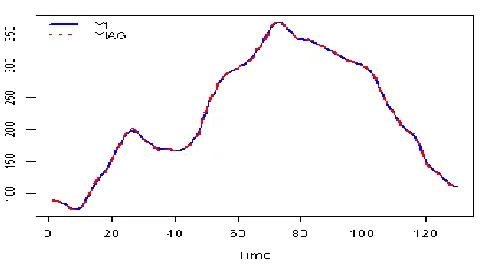
The graphic (4) Series, which represents the number of car accidents (weekly) for the years 1992 and
Figure 4 Yt , ACF,PACF
After the two transformations : Lt = log(Y t) and DL = diff(Lt) = diff(log(Y t)) we obtain a
stationary series (DL) : p - value = 0:02066 test (adf.test). Best suited to this model is
2;1;0
ARIM . Table (6) gives the coefficients of the model14.
Move on to the adjustment of our series by this model. According to the graphic (5), there is no
differentiation between the two series.
Figure 5 The adjustment of the series by this model (ARIMA (2; 1; 0))
Coefficient(s) Estimate Std. Error
1 1.4139 0.0767
2 -0.4827 0.0772
To validate the model we will study the residues.
This allows us to conclude that the residues form a white noise (Table7), where model validation.
We can have confidence in our predictions.
1.2 Method AG
Best
1and2
, Which was obtained under the conditions (8):
1, 2
1.3623294021, 0.4199999997
The adjusted by the model and the real series are graphically almost identical graphic (6)
Table 7 Tests residues
Test Formula p -value
Kolmogorov-Smirnovles lillie:test(residus) 0.1994
Student t test(residus;mu = 0; conf:level = 0:95) 0.8935
Ljung - Box Box.test(residus; lag = 50; type = "LjungBox") 0.9477
Table 8 The conditions for obtaining the best result
1and2
NBITERATIONS = 1000 the initial population size
NBITERATIONS = 100 nombre d’iteration of genetics algorithme
PROBCROISEMENT =90% crossing probability
PROBMUTATION = 10% probability of mutation
0.000001
Table 9 Tests residues
Test Formula p -value
Kolmogorov-Smirnovles lillie:test(residus) 0.3175
Student t test(residus;mu = 0; conf:level = 0:95) 0.88
Ljung - Box Box.test(residus; lag = 50; type = "LjungBox") 0.6273
This enables us to conclude that the residues form a white noise (Table 9), where model validation.
The graphic (7) summarizes the quality of prediction and hence the performance of both models.
Figure 7 Performance of both models AG & BJ
Visually, there is a clear difference between the qualities of predictions, where the second validation
method (GA).
Table 11 conclusion of comparison
MAPE MSE
B-J 1.158333 1.231707
GA 1.160062 1.233228
CONCLUSIONS
The first inspiration and driving force of this study were convinced that the sharing of
experiences and knowledge between different fields of knowledge are an essential element of this
enrichment even knowing . In the experimental part, we found that the use of GA Allow to obtain
very good results in comparison with the results given by the method of Box Jenkins ( in particular ,
for the actual chronic ). Therefore, the conclusion of this study is not only proposal to continue the
way of using Genetic Algorithms in the field of time series ( parameter estimation ), and thus predict,
they provide fairly quickly an acceptable solution. Nevertheless, it is possible to improve effectively
enough by combining it with a deterministic algorithm.
REFERENCES
1.
Box P., Jenkins G. M. Time series analysis: Forecasting and control. San Francisco, CA:Holden-day Inc; 1976.
2.
Jean M. V., Reto G. Model selection using a simplex reproduction genetic algorithm. SignalProcessing. 1999; 78: 321-327.
3.
Yang, G., Reinstein, L.E., Pai, S., Xu, Z., Carroll, D.L., A new genetic algorithm technique inoptimization of prostate implants, accepted for publication in the Medical Physics Journal,
1998.
4.
Zalzala, A.M.S. and Fleming, P.J., Genetic Algorithms in Engineering Sytems, p161-202,IEE, London, 1997.
5.
Mahfoud, S.W. and Mani, G., Financial forecasting using genetic algorithms, AppliedArtijicial Intelligence, 1996; 10: 543-565,.
6.
Packard, N. H., A genetic learning algorithm for the analysis of complex data, ComplexSystems, 1990; 4(5):543412,
7.
Chen, Y.W.,N akao, Z., Arakaki, K., Tamura, S., Blind deconvolution based on geneticalgorithms, IEICE Transactions on Fundamentals of Electronics, Communications and
Computer Sciences. 1997; E80A (12): 2603-2607.
8.
Akaike H., Fitting autoregressive models for prediction, Ann. Inst. Stat. Math. 1969; 21:243-247.
9.
Engle R.F. Autoregressive conditional heterocedasticity with estimates of the variance ofUK inflation, Econometrica. 1982; 50: 145-157.
10.
Commandeur J. J. F., Koopman S. J. An Introduction to State Space Time Series Analysis.Oxford, New York; 2007.
11.
Dickey D.A. et Fuller W.A., Distribution of the estimators for autoregressive time series witha unit root, J. Amer. Stat. Soc. 1979; 74: 427-431.
IJSRR, 4(1) Jan. – March. 2015 Page 40
13.
Sharpe, W.. Capital asset prices: A theory of market equilibrium under conditions of risk.Journal of Finance. 1964; 19: 425–442.