INTERNATIONAL RESEARCH JOURNAL OF PHARMACY
www.irjponline.com
ISSN 2230 – 8407
Research Article
OPTIMIZATION OF COMPONENT VARIABLES FOR SELF MICRO EMULSIFYING DRUG DELIVERY
SYSTEMS BY USING EXTREME VERTICES MIXTURE DESIGNS
Pooja Mittal
1, Nimrata Seth
2, Ramit Kapoor
3, Brahmeshwar Mishra
1*
1
Department of Pharmaceutics, Indian Institute of Technology, BHU, Varanasi-221005, India
2
Department of Pharmaceutics, Rayat Institute of Pharmacy, Railmajra, Distt S.B.S Nagar, Punjab- 144533, India
3Department of Pharmacy, Amity University Noida (U.P), India
*Corresponding Author Email: [email protected]
Article Received on: 19/05/18 Approved for publication: 10/07/18
DOI: 10.7897/2230-8407.097140
ABSTRACT
Self-micro emulsifying drug delivery systems (SMEDDS) are the isotropic mixtures of natural or synthetic oils, solid or liquid surfactants, and hydrophilic co-solvents/surfactants that have a unique ability of forming fine oil-in-water (o/w) micro emulsions upon mild agitation followed by dilution in aqueous media, such as GI fluids. These were developed to overcome problems like low solubility and oral bioavailability associated with the delivery of Candesartan Cilexetil (CSC), a poorly water-soluble Angiotensin receptor blocker. Solubility of CSC in oily phases and surfactants was determined to identify components of SMEDDS. The composition of optimized formulation was Carbitol (50%), Cremophore EL (20%), Propylene Glycol (30%) and CSC (40 mg) as oil, surfactant, Co surfactant and drug, respectively. Extreme Vertices Mixture design was employed to optimize the formulations and the final formulation was optimized by utilizing desirability function approach. The globule size of optimized formulation was found to be approximately 47 nm which was not affected by the pH of dilution medium. The optimized SMEDDS released CSC approximately 90 % irrespective of the pH of dissolution medium. The present study ratified the use of principles of quality by design in optimization of pharmaceutical formulations.
Keywords: Micro emulsion, Candesartan Cilexetil, Bioavailability, SMEDDS, Solubility, Phase diagrams.
INTRODUCTION
The oral administration of hydrophobic drugs remains a significant challenge for pharmaceutical researcher due to their poor solubility and thereby less absorption. An increasingly popular approach to improve the bioavailability of BCS class II drugsvia the oral route are self-micro emulsifying drug delivery systems (SMEDDS). This could lead to increased solubilization with concomitant modification of their pharmacokinetic profiles, leading to increase in therapeutic efficacy1,2. Interest in these
versatile carriers is increasing and their applications have been diversified to various administration routes in addition to the conventional oral route. This can be attributed to their unique solubilization properties, industrial feasibility, and thermodynamic stability which have drawn attention for their use as novel vehicles for drug delivery. Self-micro emulsifying drug delivery systems (SMEDDS) would be one such approach to achieve optimum delivery of hydrophobic ingredients.
SMEDDS are defined as isotropic mixtures of natural or synthetic oils, solid or liquid surfactants, and hydrophilic co-solvents/surfactants that have a unique ability of forming fine oil-in-water (o/w) micro emulsions upon mild agitation followed by dilution in aqueous media, such as GI fluids. They spread readily in the GI tract and the digestive motility of the stomach and the intestine provide the agitation necessary for self-emulsification and form transparent microemulsions with a droplet size between 1-100 nm. They are physically stable formulations that are easy to manufacture. The self-emulsification process is specific to the
particular pair of oil and surfactant, surfactant concentration, oil/surfactant ratio, and the temperature at which self emulsification occurs3-5.
Candesartan Cilexetil (CSC) is an esterified prodrug of candesartan, a nonpeptide angiotensin II type 1 (AT1) receptor antagonist used in the treatment of hypertension. Based on its solubility across physiologically relevant pH conditions and absorption characteristics, candesartan Cilexetil is classified in the Biopharmaceutics Classification System as a class II drug. Low solubility of candesartan Cilexetil across the physiological pH range results in incomplete absorption from the gastrointestinal (GI) tract and hence is reported to have an oral bioavailability of about 15%. This problem can be rectified by incorporating the drug in microemulsion system. An approach, which will increase drug solubility, is highly desirable for optimizing the therapeutic performance of CSC.
might be developing an insecticide that blends four chemical ingredients.
In the simplest mixture experiment, the response (the quality or performance of the product) depends on the relative proportions of the components (ingredients). The number of components, measured in weights, volumes, or some other units, add up to a common total. In contrast, in a factorial design, the response varies depending on the amount of each factor.
Minitab provides three designs (simplex centroid, simplex lattice, and extreme vertices) and analyzes from three types of experiments:
Mixture: The response is assumed to only depend on the proportions of the components in the mixture. For example, paint color only depends on the pigments used.
Mixture-process variable: The response is assumed to depend on the relative proportions of the components and the process variables, which are factors in an experiment that are not part of the mixture but might affect the blending properties of the mixture. For example, the flavor of a cake depends on the cooking time and cooking temperature, and the proportions of the cake ingredients.
Mixture-amount: The response is assumed to depend on the proportions of the components and the amount of the mixture. For example, the yield of a crop depends on the proportions of the insecticide ingredients and the amount of the insecticide applied.
MATERIALS AND METHODS
Candesartan Cilexetil (CSC) was a generous gift from QINGDAO Para-life Biochem Co Ltd (Shandong, China). Cremophore EL, Cremophore RH 40, Solutol HS (BASF Mumbai, India), Carbitol (Swastik Oil Products, Mumbai, India), Capmul MCM, Capmul MCM C8, Capmul MCM C10, Captex 200
P, Captex 355 EP/NF, Acconon MC8-2, EP/NF (Abitec, Janseville), Acrysol K140, Acrysol EL-135 (Corel Pharma Chem, Ahmedabad, Gujraat), Capryol 90, Labrafac PG, Maisine 35-1, Labrafil M 2125 Cs, Lauroglycol 90 (Gattefosse Mumbai, India) were obtained as gift samples. Tween 80, Tween 20, PEG 400, PEG 600 and Propylene Glycol were purchased from S.D Fine chemicals (Mumbai, India). All the excipients and reagents were used as received. Double distilled water was prepared freshly whenever required.
Saturated Solubility of CSC in different Oils, Surfactants and Co Surfactants/ Screening of Oil
In order to find out appropriate oil with good solubilizing capacity of CSC, the saturation solubility of CSC was investigated in some oils/surfactants/co-surfactants by shake flask method. An excess amount of candesartan Cilexetil was added to vial containing 0.5 g of each solvent. After sealing, the mixture was vortexed using a cyclomixer for 10 min in order to facilitate proper mixing of drug with the vehicles. Mixtures were then shaken for 48 h in a water bath shaker (Remi, Mumbai, India) maintained at room temperature. Mixtures were centrifuged at 5000 rpm for 15 min. Aliquots of supernatant were filtered through membrane filter (0.45 µm) and diluted with mobile phase (Methanol). Drug content was quantified directly by using UV-VIS spectrophotometer6.
Screening of Surfactants for Emulsifying Ability
The turbidimetric method was used to assess relative efficacy of the co surfactant to improve the nano emulasion Emulsification ability of various surfactants was screened. Briefly, 300 mg of surfactant was added to 300 mg of the selected oily phase. The mixture was gently heated at 45–60ᵒC for homogenizing the components. The isotropic mixture, 50 mg, was accurately weighed and diluted with double distilled water to 50 ml to yield fine emulsion. The ease of formation of emulsions was monitored by noting the number of volumetric flask inversions required to give uniform emulsion. The resulting emulsions were observed visually for the relative turbidity. The emulsions were allowed to stand for 2 h and their % transmittance was assessed at 638.2 nm by UV-VIS 1700 double beam spectrophotometer (Shimadzu) using double distilled water as blank. After that Droplet size and poly dispersity index (PDI) was determined using Zeta Sizer6.
Screening of Co-Surfactant
The turbidometric method was used to assess relative efficacy of the co-surfactant to improve the nano emulsification ability of the surfactants and also to select best co-surfactant from the large pool of co-surfactants available for per oral delivery. 0.2 g of each of the Co-Surfactant was added to 0.3 g of selected surfactant and 0.3 g of selected oil phase, vortexes for two minutes followed by warming at 40-450C for 30 seconds, so we can obtain an isotropic
mixture. 50 mg of isotropic mixture was taken and diluted with double distilled water previously filtered through (0.45 µm) membrane filter in a volumetric flask. Number of volumetric flask inversions was observed visually to form a clear emulsion. The resulting emulsions allowed standing for 2 h after that transmittance were observed at 638.2 nm. After that Droplet size and poly dispersity index (PDI) was determined using Zeta Sizer.
Optimization by Mixture Extreme vertices design
Optimization of the concentrations for oil, surfactant and co-surfactant was performed by using Minitab ver17. Mixture extreme vertices design was chosen with one centroid point. (Table 3,4 & figure 4). Dilution method was used for the construction of Ternary phase diagrams7. Concentration of oil,
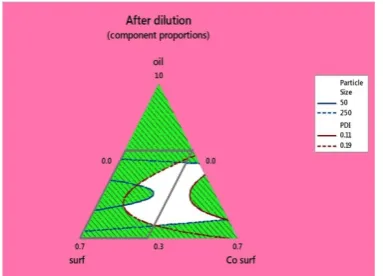
surfactant and co surfactant were chosen as independent variables and Particle size & PDI were the dependent variables (Table 5 & 6). Significant and non significant parameters were calculated from the ANOVA table. (Table 7).Response surface plots were plotted for each response which clearly indicated the narrow range concentrations of significantly affecting parameters where the desired values of the responses can be found(Figure 5 & 6). Overlaid plot was plotted for both the responses where each corner of the triangle was represented by the concentration of surfactant, co-surfactant and oil respectively8. The surfactant
after that transmittance were observed at 638.2 nm7. After that
Droplet size and poly dispersity index (PDI) was determined using Malvern ZetaSizer. Dispersions, having globule size 200 nm or below were considered desirable. The area of micro emulsion (design space) formation is identified for the respective system in which micro emulsions with desired globule size are obtained. The white area in the overlaid plot represents the o/w microemulsion existence region where the particle size and PDI are optimal.
Effect of pH of the aqueous phase on ternary phase diagrams of the selected system
The drugs as well as pH of the vehicle have considerable influence on the phase behavior of the spontaneously emulsifying systems9-11. In view of this, the effect of pH of the aqueous phase
on the phase behavior and area of microemulsion formation was studied. In these investigations, formulations were prepared and the influence of the pH of aqueous phase on the phase behavior and area of microemulsion formation was investigated by diluting 200 mg of the mix to 50 ml with various vehicles viz. HCl buffer pH 1.2 and Phosphate buffer saline (PBS) pH 6.8. The mean globule size and PDI of the resulting dispersions was measured by using Malvern Zetasizer and the data obtained was used to identify the area of microemulsion (Design space) formation. (Figure 8 & 9)
Further the composition with optimum responses was calculated by utilizing numerical based desirability function approach.
Preparation of SMEDDS
The ratio of oil: surfactant: co-surfactant was optimized by plotting an overlaid plot. Formulation containing drug was prepared by dissolving the weighed amount of drug in the specified amount of all the selected excipients. Then mixtures were vortexes by vortex shaker until clear solution was obtained and placed in oven at 500C for 1 h to form an isotropic
mixture7, 12-14.
Characterization of SMEDDS
Droplet Size and Polydispersity Index Determination
Optimized SMEDDS formulation was subjected to sonication prior to estimation of droplet size and PDI. After 2 h of sonication, 200 µL of formulation was diluted with 50 ml Distilled water in a volumetric flask and gently mixed by inverting the flask 200 times manually. The droplet size & PDI of the resultant emulsion were determined by particle size analyzer (DelsaNano C, Beckman coulter)
Polydispersity is the ratio of standard deviation to the mean droplet size. This signifies the uniformity of droplet size within the formulation. The higher the value of polydispersity, the lower is the uniformity of the droplet size in the formulation12, 15.
Robustness to dilution
Robustness of formulation to the dilution was studied by diluting it 50, 100 and 1000 times with various dissolution media viz. water, buffer pH 1.2 and buffer pH 6.8. The diluted microemulsions were stored for 12 h and observed for any signs of phase separation or drug precipitation7.
Zeta potential determination
Zeta potential for microemulsion was determined using Zetasizer (DelsaNano C, Beckman coulter). Sample was placed in clear disposable zeta cells and results were recorded. Before putting the fresh sample, cuvettes were washed with the methanol and rinsed using the sample to be measured before each experiment.
Transmission electron microscopy (TEM) photograph of Candesartan Cilexetil microemulsion
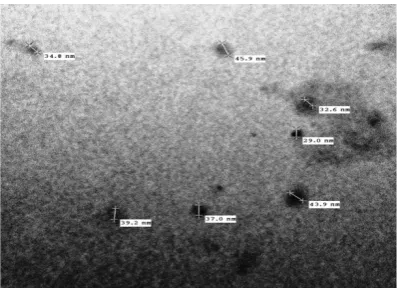
When formulation was dispersed with water, it turned into CSC microemulsion. The morphology of the microemulsion was photographed on a transmission electron microscope. Droplet size of the microemulsion was examined from the TEM photograph.
Rheological Determination
SMEDDS (1 mL) was diluted 10 times and 100 times with the distilled water in beaker with constant stirring on magnetic stirrer. Viscosity of the resultant microemulsion and initial SMEDDS was measured using Brookfield Viscometer.
Drug Content Determination
Accurately weighed formulation (equivalent to 16 mg of Candesartan Cilexetil) was taken in 100 ml volumetric flask. The contents were sonicated for 10 min with methanol (50ml), made the volume 100 ml and filtered through whattmann filter paper. Absorbance of this solution was measured at 203 nm and drug concentration followed by the percentage of drug content was calculated.
In vitro drug release study
In vitrorelease of final formulation was studied by using dialysis
bag method. Candesartan Cilexetil microemulsion & pure drug suspension of candesartan cilexetil were instilled into the dialysis bag, firmly sealed with clamp, and were placed in 150 mL phosphate buffer pH 6.8 (0.25% sodium lauryl sulphate) and HCL buffer pH 1.2 as the dissolution medium at 37°±0.5ᵒC. The revolution speed of the paddle was maintained at a rate of 100 rpm. At designated time intervals (0, 0.25, 0.50, 0.75,1, 2, 3, 4, 5, 6, 7 and 8 hrs), 5 mL of release medium was collected, and the same volume of fresh dissolution medium was replenished. Concentration of drug was analyzed by UV-VIS 1700(Shimadzu) Spectrophotometer at λ max 203 nm. All measurements were performed in triplicate16.
RESULTS AND DISCUSSION Solubility Studies
Solubility studies were aimed at identifying suitable oily phase and surfactant/s for the development of CSC SMEDDS. Identifying the suitable Oil, Surfactant/Co-Surfactant having maximal solubilizing potential for drug under investigation is very important to achieve optimum drug loading17, 18.
Figure 1: Solubility of CSC in various oily phases Figure 2: Solubility of CSC in various surfactant solutions
Figure 3: Solubility of CSC in various Co- surfactant solutions Figure 4: Ternary Phase Diagram
Figure 5: Contour surface plot of particle size vs. surfactant and oil concentration
Figure 6: Contour surface plot of PDI vs. surfactant and oil concentration
Figure 9: Overlaid plot of responses after dilution with PBS buffer
pH 6.8 Figure 10: TEM photo of Candesartan Cilexetil microemulsion (x 100,000)
Figure 11: In-vitro release profile of formulation and pure drug solution
Figure 12: Percentage Drug Content of S1 Formulation during Stability Studies
Table 1: Screening of various surfactants
Surfactant No. of inversions %T PDI Particle size(nm)
Tween 80 26 98.0±0.24 0.302±0.001 704±0.15 Tween 20 35 97.5±0.12 0.710±0.023 879.7±0.45
CremophoreEL 20 98.7 ±0.23 0.228±0.002 180±0.23
Data expressed as mean±S.D; n=3
Table 2: Screening of Co-Surfactants
Co surfactants No. of inversions % T PDI Particle size (nm)
Propylene Glycol 21 99.2±0.14 0.292±0.02 26.5±0.11
PEG 400 30 98.5±0.32 0.851±0.03 433.7±0.21 Data expressed as mean ±S.D; n=3
Table 3: Composition of various formulations
Formulation Code Oil (mg) Surfactant (mg) Co surfactant(mg)
F1 50 35.0 15.0
F2 60 32.5 7.5
F3 40 37.5 22.5
F4 40 52.5 7.5
F5 30 70.0 0.0
F6 70 30.0 0.0
F7 30 40.0 30.0
F8 60 17.5 22.5
Table 4: Details of Extreme Vertices Design
Amount Proportion Pseudocomponent
Comp Lower Upper Lower Upper Lower Upper
A 30.00 70.00 0.300 0.700 0.00 0.57143 B 0.00 70.00 0.00 0.700 0.00 1.0000 C 0.00 30.00 0.00 0.300 0.00 0.42857
Components: 3 Design points: 9 Process variables: 0 Design degree: 1
Mixture total: 100
Table 5: Compositions of the various formulations and their respective responses
Formulation Code
Oil (mg) Surfactant (mg) Co-surfactant (mg)
Drug (for 1g formulation) (mg)
Particle Size(nm)
PDI
F1 50 35.0 15.0 32 109.4±0.23 0.217±0.005 F2 60 32.5 7.5 32 140.9±0.21 0.277±0.001 F3 40 37.5 22.5 32 79.45±0.12 0.122±0.001 F4 40 52.5 7.5 32 127.7±0.16 0.197±0.005 F5 30 70.0 0.0 32 209±0.21 0.271±0.004 F6 70 30.0 0.0 32 240.3±0.10 0.325±0.006 F7 30 40.0 30.0 32 67.5±0.21 0.271±0.004 F8 60 17.5 22.5 32 60.95±0.13 0.161±0.004 F9 70 0.0 30.0 32 260.3±0.10 0.325±0.006
Data expressed as mean±S.D; n=3
Table 6: Details of variables
Independent Variables: Low levels High levels
Oil concentration 0 (%) 70(%) Surfactant concentration 30(%) 70(%) Co surfactant concentration 0(%) 30(%)
Dependent Variables
Particle size 50 (nm) 250 (nm)
PDI 0.05 0.19
Table 7: Result table for the mixture design
R-Sq = 87.05% RR-Sq(adj) = 84.10%
Term Coefficient
Oil 8.20361
Surfctant 7.79679 Co surfactant -0.72246 Oil* Surfcatant -0.271764 Oil*Co surfactant -0.151019
From the ANOVA table, it was observed that the Oil concentration and surfactant concentration were the most significant parameters affecting the responses.
Table 8: Composition, droplet size and PDI of optimized formulation with drug
Composition Drug (mg)
Results (Experimental value)
Results (Predicted value)
% Prediction Error
Particle size (nm)
PDI Particle size (nm)
PDI Particle size PDI
50:20:30 40 67.3±0.13 0.152±0.003 65.5489 0.1544 2.60 % 1.5% Data expressed as mean±S.D; n=3
Table 9: Dilutions with water, Phosphate buffer pH 6.8 & HCl buffer pH-1.2
T.I Formulation
(50:20:30)
50 times 100 times 1000 times
Immediately After dilution - - - - - - - - -
After12 h - - - - - - - - -
After24 h - - - - - - - - -
Table 10: Zeta Potential of the optimized formulations
Sr.No Formulation Zeta Potential(mV)
1. 50:20:30 -31.8±0.12 Data expressed as mean±S.D; n=3
Table 11: Viscosity of SMEDDS formulation
Formulation(S1) Viscosity(cp) Temperature (0C)
Initial SMEDDS 49 220C
100 times dilution with distilled water 11 240C
Screening of Surfactants for Emulsification Ability
The % transmittance, particle size, no. of inversions and PDI values of various dispersions are given in Table 1. Emulsification studies clearly distinguished the ability of various surfactants to emulsify CSC. These studies indicated that Cremophore EL and tween 80 had very good ability to emulsify CSC whereas; Tween 20 appeared to be poor emulsifier for CSC. Although, the HLB values of the surfactants used in the investigation were in the range of 11 to 16, there was a great difference in their emulsification ability. This observation is in line with the investigations reported by Malcolmson et al.6 and
Warisnoicharoen et al. who concluded that micro emulsification is also influenced by the structure and chain length of the surfactant. Cremophore EL rendered very good microemulsions requiring short time for emulsification and was selected for further investigation.
Screening of Co-Surfactants
In order to find appropriate Co-Surfactant with good solubilising capacity, emulsifying ability of different co-surfactants (which had higher solubility) with the screened oil and surfactant was investigated. The %T, particle size, number of inversions and PDI values of various dispersions are given in Table 2. From the results it was revealed that propylene glycol had good ability to emulsify the screened oil (Carbitol) and surfactant (Cremophore EL) as compared to other co-surfactants. All the results were presented in Table 2.
Optimization by Mixture Extreme Vertices Design
The phase diagram of Cremophore EL, Carbitol and Propylene Glycol is shown in Figure 4. The outer parallelogram indicated the area, which was explored for locating micro emulsification region.
To obtain the proportion of components that can result in desired microemulsion existence area (where both the responses were optimal), overlaid contour plots were constructed. The white area in figure 7 indicated the region in which microemulsions of desired size were obtained. In the present study, total 9 formulations were prepared using the Dilution method by varying oil concentration from 370%, Surfactant concentration from 0-70 % and Co-Surfactant concentration from 0-30 %.
The combinations having smallest particle size (<200 nm) and lowest PDI (<0.3) were selected.
Effect of pH of the aqueous phase on ternary phase diagrams of the selected system
The phase diagrams indicating effect of pH of the aqueous phase on phase behavior and area of microemulsion existence are shown in Figures 8 & 9. Phase diagrams studies indicated that there was
remarkable influence of CSC and also the pH of dilution medium on the area of microemulsion formation of the Cremophore based system. Dilution of CSC SMEDDS with different mediums (PBS 6.8 & HCl buffer pH 1.2) lead to a considerable reduction in the area of microemulsion formation when compared to the area in figure 7.CSC, due to its low aqueous solubility, was likely to participate in the microemulsion by orienting at the interface. Interestingly, area of microemulsion formation was smallest at pH 6.8. This behavior supports the aforementioned hypothesis about the orientation of CSC.As CSC was having much less solubility in PBS pH 6.8 than water, it likely to migrate more in the interface leading to reduction in the amount present at external phase. This may lead to decrease in the effective concentrations of surfactant and co-surfactant available for microemulsion formation, which may be responsible for lowest area of microemulsion formation at pH 6.8. The area of microemulsion formation reduced for buffer pH 1.2 and was highest for water.
Preparation of SMEDDS
In the present study, ratio of 50:20:30 (oil: surfactant: co surfactant) was optimized by numerical based desirability approach and drug encapsulated SMEDDS were prepared by using this optimized composition.
Characterization of CSC loaded SMEDDS
Droplet Size and Polydispersity Index Determination
Determination of droplet size of SMEDDS is crucial factor for the purpose of self-emulsification because the rate and extent of drug release as well as absorption depends on droplet size. Polydispersity is the ratio of standard deviation to the mean droplet size. This signifies the uniformity of droplet size within the formulation. The higher the value of polydispersity, the lower is the uniformity of the droplet size in the formulation. Droplet size and PDI were determined for all the formulations by Delsa NanoC particle sizer. Further from the values, various statistical studies were performed, and the composition of the final formulation was determined. For which the particle size and PDI were calculated and the values are given in table 8.
Robustness to dilution
Zeta potential determination
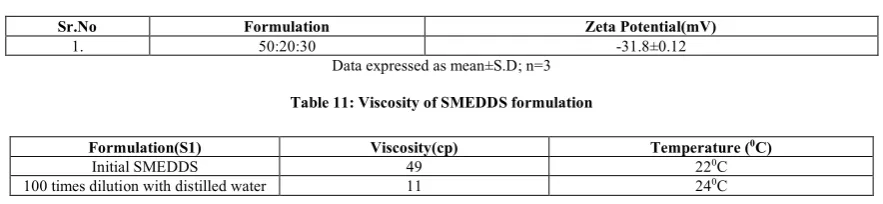
Zeta potential plays an important role in SMEDDS formulations. Increase of repulsive forces between microemulsion droplets prevents coalescence of microemulsion droplets. Zeta potential of the optimized formulations when diluted 100 times was represented in Table 10. Final Formulation had -31.8 mV zeta potential which showed that the formulation will be stable upon storage.7, 15, 17.
Transmission electron microscopy (TEM) photograph of CSC micro emulsion
The surface morphology of SMEDDS as well as droplet size was predicted by using a Transmission electron microscopy (TEM). Figure 10 showed the average droplet size of microemulsion dispersed from formulation S1 was within 50 nm and droplets were shown to be nearly spherical in shape.
Rheological Determination
Viscosity of the resultant microemulsion and initial SMEDDS was measured using Brookfield viscometer. Results were shown in Table 11. Initial viscosity of SMEDDS was found very high (49 cp), which was suitable for filling of SMEDDS in hard gelatin capsule without risk of leaking problem. When SMEDDS was diluted 100 times with water, viscosity of the system was decreased, indicated that when SMEDDS formulation will be diluted with the stomach fluid its viscosity will be decreased and therefore absorption from stomach will be fast.
Drug Content Determination
Drug content of selected (S1) formulation was determined and was found to 99.62 %.
In Vitro Release Profile
The data obtained from in vitro study were shown in Figure 11. The cumulative percentage drug release (%CPDR) for the optimized SMEDDS formulation of candesartan cilexetil in PBS 6.8 buffer was found to be approximately 90.82 ±1.2 % in 4 hours as compared to the pure drug suspension (27.34± 1.3 %) whereas in HCL 1.2 buffer, the % CPDR of the formulation was found to be 22.12± 0.56 % and for pure drug suspension, it was approximately 8.6± 0.23 % for pure drug 16. Factors responsible
may be the droplet size as the smaller the droplet size provides more surface area for releasing drug from the system thereby increasing the drug release rate or the oil phase of SMEDDS may act as carrier molecules which itself did not diffuse through the barrier but allow drug molecules to get diffused from membrane of dialysis bag.
Stability Studies
Stability studies of the selected SMEDDS were performed at Refrigerated (4°C/75%RH), Real time storage (30°C/75%RH) and Accelerated (40°C/75% RH) conditions. The test results of the study were presented in the figure 12. Significant change in droplet size physical appearance and drug content were not observed.
CONCLUSION
The method employed in the investigation for screening of SMEDDS excipients helped in understanding the emulsification
efficiency of various surfactants for selected oily phase. An optimized SMEDDS formulation consisting of carbitol (50%), cremophore EL (20%), Propylene Glycol (30%) and CSC (40 mg) was successfully developed with an increased solubility and dissolution rate of CSC. The developed formulation showed 90 % cumulative drug release. Results from stability studies confirmed the stability of the developed formulation. Thus the use of design of experiments statistical tools in the formulation development was found to be a better way for the optimization process which can make the research economic and more effective.
ACKNOWLEDGEMENT
Authors are thankful to QINGDAO Para-life Biochem Co Ltd (Shandong, China), BASF Mumbai, India, Swastik Oil Products, Mumbai, India, Capmul MCM, Abitec Corporation, Janseville, Corel Pharma Chem, Ahmedabad, Gujraat, Gattefosse Mumbai, for providing gift samples. Authors are also thankful Director and teachers of Rayat Institute of Pharmacy, S.B.S Nagar (Pb) for providing the facilities to carry out research work.
REFERENCES
1. Pooja M, Rana A, Rajni B, Nimrata S. Lipid based self micro emulsifying drug delivery systems (SMEDDS) for lipophilic drugs: An acquainted review. International Research Journal OF Pharmacy IRJP:2011,2(12); 75-80.
2. Constantinides PP. Lipid microemulsions for improving drug dissolution and oral absorption: physical and biopharmaceutical aspects. Pharmaceutical research.
1995;12(11):1561-72.https://doi.org/10.1023/A:1016268311867 PMid:8592652 3. Gershanik T, Benita S. Self-dispersing lipid formulations for improving oral absorption of lipophilic drugs. European Journal of Pharmaceutics and Biopharmaceutics.
2000;50(1):179-88.https://doi.org/10.1016/S0939-6411(00)00089-8
4. Gursoy RN, Benita S. Self-emulsifying drug delivery systems (SEDDS) for improved oral delivery of lipophilic drugs. Biomedicine & Pharmacotherapy. 2004;58(3):173-82.https://doi.org/10.1016/j.biopha.2004.02.001
PMid:15082340
5. Cui J, Yu B, Zhao Y, Zhu W, Li H, Lou H, et al. Enhancement of oral absorption of curcumin by self-microemulsifying drug delivery systems. International journal of pharmaceutics. 2009;371(1):148-55. https://doi.org/10.1016/j.ijpharm .2008.12.009 PMid:19124065
6. Kommuru T, Gurley B, Khan M, Reddy I. Self-emulsifying drug delivery systems (SEDDS) of coenzyme Q 10: formulation development and bioavailability assessment. International journal of pharmaceutics. 2001;212(2):233-46. https://doi.org/10.1016/S0378-5173(00)00614-1
7. Venkatesh G, Majid M, Mansor S, Nair N, Croft SL, Navaratnam V. In vitro and in vivo evaluation of self-microemulsifying drug delivery system of buparvaquone. Drug development and industrial pharmacy. 2010;36(6):735-45. https://doi.org/10.3109/03639040903460446 PMid:20136493
8. Yao J, Lu Y, Zhou JP. Preparation of nobiletin in self-microemulsifying systems and its intestinal permeability in rats. Journal of Pharmacy & Pharmaceutical Sciences. 2008;11(3):22-9. https://doi.org/10.18433/J3MS3M 9. Kim H-J, Yoon KA, Hahn M, Park E-S, Chi S-C. Preparation
and industrial pharmacy. 2000;26(5):523-9. https://doi.org/ 10.1081/DDC-100101263 PMid:10789064
10.Dixit AR, Rajput SJ, Patel SG. Preparation and bioavailability assessment of SMEDDS containing valsartan. AAPS pharmscitech. 2010;11(1):314-21. https://doi.org/
10.1208/s12249-010-9385-0 PMid:20182825
PMCid:PMC2850450
11.Pouton CW. Lipid formulations for oral administration of drugs: non-emulsifying, self-emulsifying and 'self-microemulsifying' drug delivery systems. European Journal of Pharmaceutical Sciences. 2000;11:S93-S8. https://doi.org/10.1016/S0928-0987(00)00167-6
12.Martin A. A book on physical pharmaceutical sciences. Lippincott Williams, UK; 1999.
13.Goyal U, Gupta A, Rana AC, Aggarwal G. Self microemulsifying drug delivery system: a method for enhancement of bioavailability. International journal of pharmaceutical sciences and research. 2012;3(1):66. 14.Kawakami K, Yoshikawa T, Moroto Y, Kanaoka E,
Takahashi K, Nishihara Y, et al. Microemulsion formulation for enhanced absorption of poorly soluble drugs: I. Prescription design. Journal of Controlled Release. 2002;81(1):65-74. https://doi.org/10.1016/S0168-3659(02)00049-4
15.Pouton CW. Self-emulsifying drug delivery systems: assessment of the efficiency of emulsification. International
Journal of Pharmaceutics. 1985;27(2-3):335-48. https://doi.org/10.1016/0378-5173(85)90081-X
16.Singh B, Bandopadhyay S, Kapil R, Singh R. Self-emulsifying drug delivery systems (SEDDS): formulation development, characterization, and applications. Critical Reviews™ in Therapeutic Drug Carrier Systems. 2009;26(5). 17.Warisnoicharoen W, Lansley A, Lawrence M. Nonionic
oil-in-water microemulsions: the effect of oil type on phase behaviour. International journal of pharmaceutics. 2000;198(1):7-27. https://doi.org/10.1016/S0378-5173(99)00406-8
18.Krishnamoorthy B, Rahman SH, Rajkumar M, Vamshikrishna K, Gregory M, Vijayaraghavan C. Design, formulation, in vitro, in vivo, and pharmacokinetic evaluation of nisoldipine-loaded self-nanoemulsifying drug delivery system. Journal of Nanoparticle Research. 2015;17(1):34. https://doi.org/10.1007/s11051-014-2818-z
Cite this article as:
Pooja Mittal et al. Optimization of component variables for self micro emulsifying drug delivery systems by using extreme vertices mixture designs. Int. Res. J. Pharm. 2018;9(7):144-152 http://dx.doi.org/10.7897/2230-8407.097140
Source of support: Nil, Conflict of interest: None Declared