www.iosrjen.org
Innovative Conceptual Design on Car using TRIZ Method for
Optimum Parking Space
N Manohar
1, Praveen Kalla
2 1M Tech (Machine Design) II Year II Semester
2
Associate Professor Department of Mechanical Engineering, MVGR College of Engg, Andhra Pradesh
ABSTRACT : There has been a wide gap in the growth of infrastructure and the growth of the Indian automobile industry, there is already a huge parking problem that the country faces today. For the less informed, India is currently the 11th largest passenger car market in the world and as per the estimates, it will be the third largest market in the world by the end of 2020. There have been several debates about the changes required in the Parking Act in order to be future ready but at the same time; the government cannot lose its focus on developing new mechanisms and installing modern parking solutions. Parking convenient trendy automotive designs are the need of the hour. These designs should be safe and convenient for the drivers and passengers.
This paper presents the innovative conceptual design to expand/contract the car when required. A new problem solving method TRIZ is used to re-design the car. Furthermore, this method can help a designer to solve the design contradiction. In addition, computer aided engineering (CAE) is also applied to evaluate the telescopic car chassis strength of a car design by finite element method.
Keywords -Triz Theory, Telescopic Car Chassis, Car Body, CAE, finite element method.
I. INTRODUCTION
In many areas, especially urban areas, parking is a serious problem. Shortages of parking space, complaints about high parking tariffs and congestion due to visitors in search for a parking place are only a few examples of everyday parking problems. Many cities and urban areas recognize these problems, but the solution proves to be very complicated.
In the, MIT City Car Electric Automobile, developed and prototyped by Smart Cities, is designed to meet the demand for enclosed personal mobility Design and Computation program. It presents a proposal for urban transportation based on the design of a small collapsible vehicle. Problems associated with travel by passengers, although every developed country has built important infrastructure in the form of roads. Based on this problems, the conceptual car design architecture has that expand/contract the car when it have required front transmission system, independent suspension system and dampers at chassis for minimize vibrations. Computer Aided Engineering (CAE) used to design the model of a conceptual car. By approaching TRIZ theory is employed to assist the way to get new drawing which is used to resolve the contradiction. The 40 engineering principles are also used as the design guideline. The finite element used to validate the strength of the new telescopic chassis based on the car body design.
II. TRIZMETHODREVIEWS
TRIZ is a problem solving method based on logic and data, not intuition, which accelerates the project team’s ability to solve these problems creatively. TRIZ also provides repeatability, predictability, and reliability due to its structure and algorithmic approach. TRIZ is the (Russian) acronym for the “Theory of Inventive problem solving” is an international science of creativity that relies on the study of the patterns of problems and solutions, not on the spontaneous and intuitive creativity of individuals or groups. TRIZ research began with the hypothesis that there are universal principles of creativity that are the basis for creative innovations that advance technology. TRIZ theory principles could be identified and codified, they could be taught to people to make the process of creativity more predictable. The research has proceeded in several stages during the last sixty years. The three primary findings of this research are as follows:
Problems and solutions are repeated across industries and sciences. The classification of the contradiction in each problem predicts the creative solutions to that problem.
Patterns of technical evolution are repeated across industries and sciences.
Creative innovations use scientific effects outside the field where there were developed.
principle guidelines of problem solving. The separation principles, laws of technical evolution and technology forecasting and 76 standard solutions. The TRIZ generic solution is now obtained. The solution is then transformed to effects and examples of analogical thinking based on generic solution.
In the application of TRIZ method, three aspects are applied to improve products, services, and systems; learning by repeating patterns of problem solutions, using scientific effects, and applying the general TRIZ patterns. Hsin - Sheng Lee and Long-Chang Hsieh [3], innovative design of an automatic car – door opening system. Hassan (2004) [11] used TRIZ method in taking into account of safety on both design and exploitation levels highlights management contradictions comprising technical, economic or human aspects. The objective of this communication is to propose element to pilot the emergence of new solutions concerning the resolution of contradictions related to the safety integration by using our “working situation” model.
2.1 Contradiction matrix:-
Analyzing more than 200 thousand patents since 1950’s, Genrich Altshuller and his colleagues developed the contradiction matrix as one tool to solve contradictions in techniques by inducing 39 engineering parameters and 40 inventive principles. Based on the TRIZ theory, the existing systems always contain contradictions and an innovation is materialized with these contradictions excluded from a question. To find a feasible solution principle, Genrich Altshuller arranged 39 engineering parameters into two axes of the matrix where in the vertical axis contains parameters to improve and the horizontal axis includes parameters to be deteriorated. The corresponding grid intersected by both contradiction parameters is the solution principle recommended.
Car design improve feature parameters consist of length of moving object (3), volume of moving object (7), shape (12), strength (14), and parameters to be avoided to be deteriorated are weight of moving object (1) and reliability (27). As shown in table 2.A.1 for the contradiction matrix, the most frequent solution principle is principle counter weight (8), physical contradiction also called “inherent” contradictions are situations in which one object or system has contradictory..
Worsening factor
Improving factor
Weight of moving object (1)
Reliability (27)
Length of moving object (3) 8, 15, 29, 34
Volume of moving object (7) 2, 26, 29,40
Shape (12) 10, 40, 16
Strength (14) 1, 8, 40, 15
The above contradiction matrix step aims to increases/decreases the car volume by using hydraulic or pneumatic system. As prior mentioned, the major car design consists of car chassis frame and car body structure.
2.2 Idealized design theory:-
The concept of idealized design developed by Genrich Altshuller emphasis that any technical system is always evolved to a simplified, effective, idealized system within its life cycle. Supplying a systematic method to help a designer to correctively define questions, the idealized design theory can generate innovative concepts for idealized design theory can generate innovative concepts for defining and analyzing questions to discover a scheme for settlement in an idolized design in this study are:
1)Finalized targets for one design: improvement for expand/contract of car body and telescopic car chassis. 2)Idealized solution: Parking convenient trendy automotive designs.
3)Obstacles for idealized solution: owing to complexity of design the telescopic chassis and car body. 4)Results with obstacles occurred: Employment of a parking system of a car.
5)Conditions without obstacles occurred: To design the telescopic chassis and car body expand/contract, operated by hydraulic system.
III. Design of the Innovation Scheme
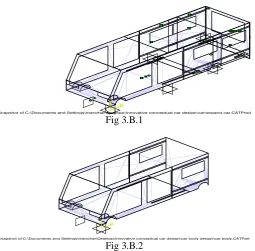
Conceptual Car Design mainly consists of car chassis frame and car body structure. Car chassis designed as telescopic frame for extract/ contract when required with high support to the car body. Similarly car body consists of two side doors, this designed like as sliding when extract/ contract and dickey door as designed slide when extract/ contract.
3.1 Design of Car Chassis:-
The telescopic chassis as designed in rectangular hallow sections, one chassis smaller rectangular rod is easily inserted in another rectangular hallow chassis, by this way getting extract/contract by hydraulic system. Generally, the telescopic car chassis frame is bolted with car body frame.
Type of chassis
Length of chassis
Width of chassis Front rear
Mass of chassis
Smart chassis 3850 mm 1350 mm
1388 mm
175 kg
Expandable chassis
4850 mm 1350 mm
1388 mm
175 kg
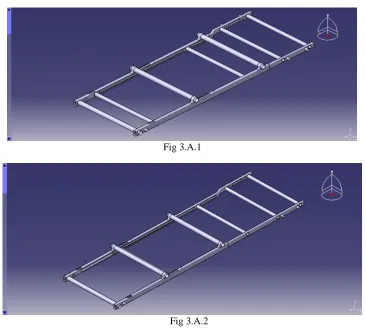
The fig 3.A.1 is telescopic chassis when contract position that means it occupies lesser area. It suits for lesser passengers and it occupies lesser parking place. The fig 3.A.2, telescopic chassis when expand of a car, it requires for more no. of passengers are to travel with free area in a car.
Fig 3.A.1
Fig 3.A.2
3.2 Car body structure:
Fig 3.B.1
Fig 3.B.2
3.3 Front engine front transmission
system:-The power is transmitted to the front wheels through the clutch, gear box, differential gear, and short shaft. The engine on a front wheel drive car is usually mounted sideways in the car with the transaxle tucked under it on the side of the engine facing the rear of the car. Front axles are connected directly to the transaxle and provide power to the front wheels. In this example,
power flows from the engine, through the torque converter to a large chain that sends the power through a 180 degree turn to the transmission that is alongside the engine. From there the power is routed through the transmission to the final drive where it is split and sent to the two front wheels through the drive axles.
I.4 Independent suspension system:
Rear axle is usually a live axle with power being transmitted to the rear wheels. hence independent suspension has not become very popular for the rear wheels. Further, the rear wheels have to carry lot of weight and while the weight on the front wheel remains more or less constant in case of rear wheels it make a lot of difference when the car is running empty or when it is fully occupied. The suspension system has to cater to both these conditions.
IV. Analysis on Telescopic Chassis
A static analysis calculates the effect of steady loading conditions on a structure, while ignoring inertia and damping effects, such as those caused by time-varying loads. Static analysis determines the displacements the displacements, stresses, strains, and forces in structures or components caused by loads that do not induce significant inertia and damping effects.
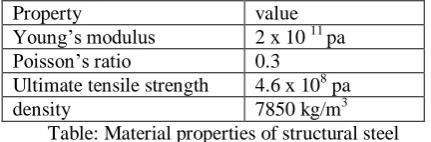
Property value
Young’s modulus 2 x 10 11 pa
Poisson’s ratio 0.3
Ultimate tensile strength 4.6 x 10⁸ pa
density 7850 kg/m3
Table: Material properties of structural steel
For practical calculations, it was recommended that the load on the chassis frame, including its own weight, is concentrated at a small number of points. These point loads were statically equivalent to the actual distributed load carried by the vehicle. The weight of components mounted was considered as point loads acting on the chassis.
4.1 Total Deformation:-
Fig: Smart chassis
Fig: expandable chassis
4.2 Equivalent stress:-
Fig: expandable chassis
Table: equivalent stress values
V. CONCLUSION
The innovative conceptual design on car using TRIZ method considerably reduces parking area required. The rear body panel of an automobile or a side body panel of a van is designed as an accordion sliding door to define an original enclosed usable volume in the collapsed/extracted position. The volume is created by increasing/decreasing the chassis and cabin body portion with the balance of the vehicle. The relationship of structure, strength, function, and shape of a car body and car chassis is determined in TRIZ table using a new car design. In addition, computer aided engineering (CAE) is also used to evaluate the strength of car chassis by FE Analysis. Finally, conceptual design based on TRIZ method provides the guidelines for a car body designer to improve and develop the four wheeler for optimized parking.
REFERENCES [1] George E Dieter, “Engineering Design”, third edition, Tata Mc Graw Hill
[2] C. Gao, creative conceptual design ideas can be gotten with triz methodology, proceedings of the TRIZ conference paper, school of mechanical engineering, shandog university, jinan, 2005.
[3] Hsin – Sheng Lee and Long – Chang Hsieh, Innovative Design of an Automatic Car – Door Opening System, IMECS, 2009. [4] D.K. Lau, TRIZ development model in china, proceedings of the TRIZ conference, University of Electronics Science and
Technology, 2005.
[5] J. Hipple, the use of TRIZ principles in consumer product design, proceeding of the TRIZ conference, Milwaukee, 2006. [6] Ideation International Inc., “Tool of Classical TRIZ”, 1999.
[7] S.Butdee and F. Vignat, journal of AMME,2008.
[8] Kitti Wirotrattanaphaphisan, Innovative Conceptual Design for a Convenient Car Seat, Sirindhorn International Thai – German Graduate School of Engineering, 2007.
[9] Kah – Hin Chai, Jun Zhang and, Kay – Chuan Tan, A TRIZ- Based Method For New Service Design, 2005. [10] James Scanlan, TRIZ – 40 Principles, University of Southampton, Module SESA3002a
[11] R. Hassan, solving contradiction problems related to safety integration in design process, proceedings of the TRIZ conference, university henri Poincare, faculty of sciences, Vancouver les nancy, 2004.