Heavy-Ion Physics in a Nutshell
Tetsufumi Hirano1,a
1Depatment of Physics, Sophia University, Tokyo 102-8554, Japan
Abstract.The physics of quark gluon plasma (QGP) and heavy ion collisions at the collider energies is briefly
reviewed. We first discuss about the discovery of a nearly perfect fluidity of the QGP. We also highlights recent topics on responses of the QGP to initial deformation and propagation of a jet.
1 Introduction
The standard theory of strong interaction is quantum chro-modynamics (QCD) which governs dynamics of color charged particles/fields such as quarks and gluons. Like photons in quantum electrodynamics, gluons are gauge bosons which mediate the strong force among matter parti-cles (namely quarks in QCD). Contrary to photons which do not have electric charges, gluons carry color charges and consequently interact among themselves. This kind of self-interaction is manifestation of QCD as a non-Abelian gauge theory. It was shown that the coupling “constant" among color charges decreases with increasing energy scale in non-Abelian gauge theory [1, 2]. Then one can expect that quarks and gluons, which are ordinary con-fined into hadrons at low energies, are freed at extremely high temperature. The novel matter in which the quarks and gluons are thermally equilibrated is called thequark gluon plasma(QGP) [3].
Let us suppose that a sort of transition from a hadron gas to the QGP takes place when the lightest hadrons, pions, are packed. The number density of close-packed system is
nπ = v−π1, vπ= 4πr
3
π
3 , (1)
whererπ ∼0.5 fm (=5×10⁻¹⁶m). On the other hand, let us further suppose that pions obey the equation of state of a relativistic ideal gas. Thus, the number density becomes
nπ ≈ 3.6T3. (2)
where T is temperature of the gas. From Eqs. (1) and (2), transition temperature can be estimated as ∼100 MeV/kB ≈1012K. Although estimation above is the sim-plest enough, the first principle calculation based on lattice QCD [4] also gives the same order of the transition tem-perature∼160 MeV/kB: Energy density rapidly increases around the temperature and the quark/gluon degree of free-dom inside hadrons are "activated" above this temperature.
ae-mail: [email protected]
In a more strict sense, susceptibility of the chiral order pa-rameter has a peak around this, but does not diverge. Thus the two phases are not clearly separated. Such a continu-ous change is called "cross-over".
The matter at such an extremely high temperature ex-isted up to ∼ 10 micro second after the Big Bang. In this era, the universe was filled with the QGP. There is a unique opportunity to investigate such an extreme matter even on the Earth using heavy-ion reactions at relativis-tic energies: By accelerating heavy nuclei almost at the speed of light and colliding them with each other, kinetic energy of colliding nuclei could turn into thermal energy. The matter created in this way can exist only for a very short time (∼10 fm/c≈10−23sec). Unlike experiments in
the condensed matter physics, one cannot control thermo-dynamic variables or even lifetime of the system in these experiments. One measures at most the final particle dis-tributions originated from the created matter and tries to find traces of the QGP in them. The main purpose of the physics of relativistic heavy ion collisions is to pursue the properties of the QGP through these experimental results. Heavy ion programs at Large Hadron Collider (LHC) in CERN and at Relativistic Heavy Ion Collider (RHIC) in Brookhaven National Laboratory have been running cur-rently to explore the QGP.
As of the time writing this article, temperature mea-sured at RHIC was recorded as the highest man-made tem-perature by the Guinness World Records [5]. PHENIX Collaboration measured photon spectra and deduced the temperature of created matter as T ∼ 220 MeV/kB [6]. It should be noted that new photon data at LHC break this "world’s record" very recently and the measured max-imum temperature is estimated asT ∼300 MeV/kB[7].
In this paper, the physics of the QGP and relativistic heavy ion collisions is briefly reviewed. Responses of the QGP to initial deformation and jet propagation are also discussed.
DOI: 10.1051/
C
Owned by the authors, published by EDP Sciences, 2013 epjconf 201/ 34902001
This is an Open Access article distributed under the terms of the Creative Commons Attribution License 2 0 , which . permits unrestricted use, distributi and reproduction in any medium, provided the original work is properly cited.
scribed by kinetic theory. On the other hand, what was dis-covered at RHIC [8] exhibits totally opposite behaviour: it turned out that hydrodynamic description of the QGP works reasonably well, which indicates discovery of a nearly perfect fluidity of the QGP and, in turn, strong cou-pling nature of quarks and gluons in the QGP [9–14]. One of the key observables is azimuthally anisotropic tion, namely, the second order harmonics of the distribu-tion, also known as elliptic flow [15],v2=hcos(2φ)i. Here
φ is azimuthal angle measured from the reaction plane andh· · · iis an average weighting azimuthal distribution of produced particles.v2is sensitive to degree of
thermali-sation and hydrodynamic property of the matter. Thus this is an ideal probe of produced matter in relativistic heavy ion collisions.
Relativistic hydrodynamic equation describes energy momentum conservation
∂µTµν = 0, (3)
Tµν = euµuν−(P+ Π)∆µν+πµν. (4)
HereTµν is energy momentum tensor,eis energy density andPis hydrostatic pressure. Πis bulk pressure andπµν is shear stress tensor, both of which are dissipative quan-tities. uµis four flow velocity and∆µν = gµν −uµuνis a projection tensor perpendicular touµ. The above equation requires the equation of state, P = P(e), in ideal hydro-dynamic simulations. In addition, constitutive equations (i.e., relations between dissipative currents and thermody-namic forces) and transport coefficients such as shear vis-cosity and bulk visvis-cosity are needed in the case of viscous hydrodynamics simulations.
Early ideal hydrodynamic calculations using the Glauber model initialisation and neglecting dissipative quantities were successful in reproduction of v2 data at
RHIC [16–21]. After the discovery, a main focus in the hydrodynamic analysis was put on constraint of transport coefficients, in particular, the ratio of shear viscosity to entropy density,η/s, using viscous hydrodynamic simula-tions. It should be noted that it is not a trivial task to imple-ment viscosity in relativistic hydrodynamics since a naive extension of Navier-Stokes type hydrodynamic equations to its relativistic version violates causality [22]. To rem-edy this issue, the relaxation effect on dissipative currents plays an important role in the formulation of causal hy-drodynamics and has to be taken into account in consti-tutive equations [23–25]. The effect has already been im-plemented in recent viscous hydrodynamic simulations to constrain the transport coefficients [26–31]. The ratio,η/s, is found to be∼0.08−0.16 through an analysis using a cutting-edge hybrid model which combines viscous hydro-dynamic description of the QGP fluid with kinetic descrip-tion of the hadron gas [30, 31]. It is interesting to men-tion thatη/sfor water is∼400 time larger than this value.
3 Highlights from Recent Topics
In this section, we pick up recent intriguing phenomena at RHIC and LHC and discuss about them from a theo-retical point of view. We first show the QGP response to fluctuation of initial profiles which result in higher order harmonics of azimuthal distributions. We next describe propagation of an energetic parton inside the QGP which wakes intriguing patterns of flow.
3.1 QGP Response to Initial Fluctuation
Transverse position of nucleons inside a nucleus is dis-tributed according to the Woods-Saxon nuclear density profile. Collisions between two nucleons inside colliding two nuclei happen randomly in the overlap area in a single event. Thus, the shape of initial QGP fluctuates from event to event.
To quantify the deformation of the QGP, one defines then-th order of deformation parameter as
εn =
|hr2einφi|
hr2i , (5)
whereris a distance from center of "mass", (hxi,hyi),φ is azimuthal angle and h· · · idenotes an average weight-ing an initial profile of,e.g., energy density distribution or entropy density distribution.
The system responds to initial deformation of the QGP profile in the configuration space. This can be measured through,e.g., two-particle correlation function1
C(∆φ)≈1+2
∞
∑
n=1
vn(p1)vn(p2) cosn∆φ. (6)
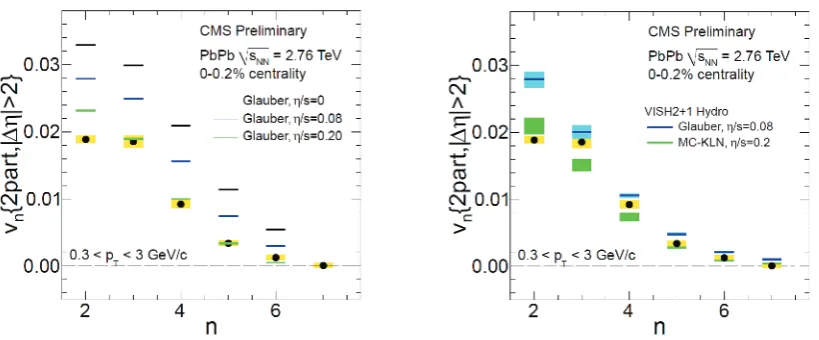
Figure 1 showsvnas a function of the ordern[36] in ultra-central Pb+Pb collisions at LHC, which are compared with results from recent state-of-the-art viscous hydrodynamic simulations from two independent groups. By changing the ratio of shear viscosity to entropy density η/s, they calculated higher order anisotropic flowvnin top 0-0.2% central Pb+Pb collisions at √sNN =2.76 TeV. Since the corresponding impact parameters are tiny for these events, initial deformation contains solely fluctuating effects. Fig-ure 1 (left) shows a comparison of the CMS data with sults from Luzum and Ollitrault [34]. Hydrodynamic re-sults are obtained by using the Glauber model initialisa-tion. vn results with η/s ∼0.2 are comparable with the CMS data. In Fig. 1 (right), hydrodynamic results from Shen, Qiu and Heinz [35] are compared with the CMS data. A largerη/sin the Kharzeev-Levin-Nardi model ini-tialisation is needed to reproduce the CMS data than in the Glauber model initialisation.
Figure 1.vnversusnin ultra-central (0-0.2%) Pb+Pb collisions at
√
sNN=2.76 TeV obtained by the CMS Collaboration are compared with hydrodynamic results. Figures are taken from Ref. [36].
These data remind us an analysis of cosmic microwave background [37, 38]. Similar to this, higher order coeffi -cients correspond to small structure of the system, which might be related with small coarse graining size. There have been several analyses on flow data from this point of view [39–45].
3.2 QGP Response to Jet Propagation
Jets and mini-jets are produced in relativistic heavy ion collisions at the collider energies. Contrary to proton-proton collisions, these energetic partons are subject to tra-verse QGP medium created at the same time. During trav-eling medium, these partons lose their energies through interaction between the parton and the medium. In gen-eral, this is called jet quenching [46]. When path length of two jets differs from each other, this results in an im-balanced jet pair. Apparently, energy and momentum are not balanced in some events. A natural question would be “Where do these lost energies go?" One of the clues to an-swer this question is distribution of particles out of the jet cones.
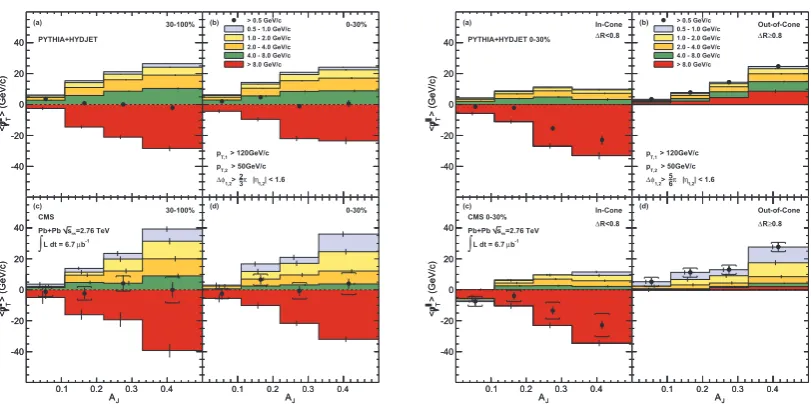
Figure 2 shows a sum of transverse momenta projected onto the sub-leading jet axis
pkT =∑ i
−piTcos(φi−φLJA) (7)
as a function of asymmetric parameter
AJ=
pT,1−pT,2
pT,1+pT,2
(8)
from the CMS Collaboration [47]. HerepT,1>120 GeV/c
andpT,2>50 GeV/care, respectively, transverse
momen-tum of leading and sub-leading jets. piT andφi are trans-verse momentum and azimuthal angle for each particle, respectively. φLJA is azimuthal angle of leading jet axis.
Figure 2 (left) shows that total momentum parallel to the jet axis is balanced among large (p > 8 GeV/c) momen-tum particles in the leading jet direction and small (p<8
GeV/c) momentum particles in the sub-leading (opposite) direction. It turns out that transverse momentum along the jet axis is balanced between leading particles with high pT inside the jet cone and low momentum particles dis-tributed over a wide angular range from the sub-leading jet axis, which is shown in Fig. 2 (right). This implies that low momentum particles at large angle from the jet axis carry lost energies from the jet traversing medium.
It is not well understood how the lost energy is distributed among low momentum particles. To study the response of the QGP fluid to propagation of a jets, we use relativistic hydrodynamic equations with source terms [48]
∂µTfluidµν (x)=Jν(x). (9)
Here Tfluidµν is the energy momentum tensor of the QGP
fluid andJνis the density of the four momentum deposited from the traversing jets. We assume that the deposited en-ergy and momentum are instantaneously thermalised in-side a fluid cell. For simplicity, we conin-sider collisional en-ergy loss only. When a massless jet partcle travels through the QGP fluid, the source term is given by
J0(x) = − d p0
jet
dt δ
(3)(
x−xjet(t)
)
, (10)
J(x) = pjet
p0 jet
J0(x). (11)
We solve Eq. (9) numerically without linearisation. In this way, we describe collective flow induced by jets on top of an expanding background QGP fluid in high-energy heavy-ion collisions.
0.1 0.2 0.3 0.4
0.1 0.2 0.3 0.4
J
A
0.1 0.2 0.3 0.4
> (G e V/ c) T p < -40 -20 0 20 40 CMS =2.76 TeV NN s Pb+Pb -1 b µ
L dt = 6.7
∫
30-100% (c)
J
A
0.1 0.2 0.3 0.4
> (G e V/ c) T p < -40 -20 0 20 40
0.1 0.2 0.3 0.4
3
0.1 0.2 0.3 0.4
J
A
0.1 0.2 0.3 0.4
-40 -20 0 20 40 0-30% (d) J A
0.1 0.2 0.3 0.4
-40 -20 0 20 40
0.1 0.2 0.3 0.4
0.1 0.2 0.3 0.4
J
A
0.1 0.2 0.3 0.4
> (G e V/ c) T p < -40 -20 0 20 40 CMS 0-30% =2.76 TeV NN s Pb+Pb -1 b µ
L dt = 6.7
∫ In-Cone R<0.8 ∆ (c) J A
0.1 0.2 0.3 0.4
> (G e V/ c) T p < -40 -20 0 20 40
0.1 0.2 0.3 0.4
6
0.1 0.2 0.3 0.4
J
A
0.1 0.2 0.3 0.4
-40 -20 0 20 40 Out-of-Cone 0.8 ≥ R ∆ (d) J A
0.1 0.2 0.3 0.4
-40 -20 0 20 40
Figure 2.The top and bottom rows show results for PYTHIA+HYDJET and PbPb data, respectively. Left: pkT for particles withpT>
0.5 GeV/cprojected onto the leading jet axis (solid circles) for 30-100% centrality (a) and (c) and 0-30% centrality (b) and (d). Right:
pkTfor 0-30% centrality, inside (∆R<0.8) one of the leading or sub-leading jet cones (a) and (c) and outside (∆R>0.8) the leading and sub-leading jet cones (b) and (d). Figures are taken from Ref. [47].
Figure 3 (left) shows the energy density distribution and the flow velocity field of the QGP fluid in a plane in-cluding a jet axis at a fixed timet=9 fm/c. Initial energy density of the fluid is 0.019 GeV4. Propagation of the jet
particle starts in thex-direction from the origin at the speed of light att = 0 fm/c. One sees the Mach cone, namely a "V-shaped" cone-like structure of higher energy density region in three dimensional space. The energy density in-side the cone is lower than that of the backgrounds. On the surface of the cone, flow velocity is nearly perpendicular to the surface. The jet particle is followed by a strong col-lective flow in the positive xdirection. Behind the cone, one sees vortices around (x, y) = (5 fm, ±2 fm) which form a vortex ring around the passage of the jet in three dimensional space.
Next, we consider a pair of jets traveling through a QGP fluid which expands radially. Initial energy density distribution is
e(t=0, x)=
3T4 0 π2 exp
(
− x2
2σ2
)
, (|x| ≤R) 0. (|x|>R) (12)
Here, we chooseT0=0.5 GeV,σ=1.5 fm andR=6 fm
as a typical parameter set for central heavy collisions at the LHC energy. Without jets, the fluid expands isotropically. A pair of jets is supposed to be created at an off-central position (x, y,z) = (3 fm,0 fm,0 fm) with the common initial energy 150 GeV, both of which are traveling in the opposite direction. One jet goes in the positivexdirection and is to be observed as a leading jet. The other goes in the negative xdirection, loses more energy and is to be observed as a sub-leading jet.
To see the momentum acquired by the QGP fluid from the jets, we calculate
∆
(
dhp||ii dcosθ
)
= ∑
p∈i d p|| dcosθ−
∑
p∈i d p|| dcosθ
no jet,(13) whereθis the polar angle from the leading jet, pthe mo-mentum of the particle from the fluid, andithe index of the momentum regions. Summation of the particles is taken over in the momentum region: high-momentum (p> 8 GeV), intermediate momentum (4 GeV < p <8 GeV) or low momentum (0 GeV < p <4 GeV). We calculate the deposited momentum distribution, Eq. (13), through the Cooper-Frye formula [49] at a fixed time and do not consider jets’ momentum. Figure 3 (right) shows the deposited momentum distribution as a function of cosθ. cosθ=−1 corresponds to the direction of the sub-leading jet. A prominent peak appears in this direction for each momentum region. At large angles from the sub-leading jet (cosθ > −0.94), low momentum particles give dom-inant contribution. This result is qualitatively consistent with the results shown in Fig. 2 [47]. The distribution of deposited momentum would be sensitive to transport prop-erties of the QGP as well as energy loss mechanism of a jet traversing the medium.
4 Summary
We first discussed the discovery of a nearly perfect fluidity of the QGP in relativistic heavy ion collisions and the latest results for the ratio of shear viscosity to entropy density,
-6 -4 -2 0 2 4 6 8
2 4 6 8 10 12 14 16 18
y
[fm]
x
[fm] flow velositye =0.06 GeV4 0.03 GeV4 0.022 GeV4 0.02 GeV4 0.018 GeV4
0 50 100 150 200 250 300 350 400
-1 -0.9 -0.8 -0.7 -0.6 -0.5
∆
(d
p
||
/dcos
θ
)
[GeV]
cos
θ
8- GeV 4-8 GeV 0-4 GeV
Figure 3.Left: Energy density contours and flow velocity vectors around the jet axis att=9 fm/c. A jet particle is located at (x,y)=(9
fm, 0 fm). Background energy density is 0.019 GeV4. Right: Deposited momentum distribution as a function of polar angle measured
from the leading jet direction. Figures are taken from Ref. [48]
We showed low momentum particle emission at wide an-gular range can result from a Mach cone structure due to energy loss of an energetic parton on top of the isotropi-cally expanding medium.
References
[1] D. J. Gross and F. Wilczek, Phys. Rev. Lett.30, 1343 (1973).
[2] H. D. Politzer, Phys. Rev. Lett.30, 1346 (1973). [3] K. Yagi, T. Hatsuda and Y. Miake, Camb. Monogr.
Part. Phys. Nucl. Phys. Cosmol.23, 1 (2005).
[4] S. Borsanyi, G. Endrodi, Z. Fodor, A. Jakovac, S. D. Katz, S. Krieg, C. Ratti and K. K. Szabo, JHEP
1011, 077 (2010).
[5] http://www.guinnessworldrecords.com/
world-records/10000/highest-man-made-temperature [6] A. Adareet al.[PHENIX Collaboration], Phys. Rev.
Lett.104, 132301 (2010)
[7] R. Preghenella [ALICE Collaboration], these proceed-ings.
[8] http://www.bnl.gov/newsroom/news.php?a=1303 [9] U. Heinz and P. F. Kolb, Nucl. Phys. A 702, 269
(2002).
[10] M. Gyulassy, preprint arXiv:nucl-th/0403032 [11] T. D. Lee, Nucl. Phys. A750, 1 (2005).
[12] M. Gyulassy, L. McLerran, Nucl. Phys. A 750, 30 (2005).
[13] E. V. Shuryak, Nucl. Phys. A750, 64 (2005). [14] T. Hirano and M. Gyulassy, Nucl. Phys. A769, 71
(2006).
[15] J. Y. Ollitrault, Phys. Rev. D46, 229 (1992). [16] P. F. Kolb, P. Huovinen, U. W. Heinz and H.
Heisel-berg, Phys. Lett. B500, 232 (2001).
[17] P. Huovinen, P. F. Kolb, U. W. Heinz, P. V. Ruuska-nen and S. A. Voloshin, Phys. Lett. B503, 58 (2001). [18] D. Teaney, J. Lauret and E. V. Shuryak, Phys. Rev.
Lett.86, 4783 (2001);
[19] D. Teaney, J. Lauret and E. V. Shuryak, preprint arXiv:nucl-th/0110037
[20] T. Hirano, Phys. Rev. C65, 011901 (2002).
[21] T. Hirano and K. Tsuda, Phys. Rev. C 66, 054905 (2002).
[22] W.A. Hiscock and L. Lindblom, Phys. Rev. D31, 725 (1985).
[23] I. Müller, Z. Phys.198, 329 (1967). [24] W. Israel, Annals Phys.100, 310 (1976).
[25] W. Israel and J. M. Stewart, Annals Phys.118, 341 (1979).
[26] P. Romatschke and U. Romatschke, Phys. Rev. Lett.
99, 172301 (2007).
[27] M. Luzum and P. Romatschke, Phys. Rev. C 78, 034915 (2008).
[28] K. Dusling and D. Teaney, Phys. Rev. C77, 034905 (2008).
[29] H. Song and U. W. Heinz, Phys. Rev. C77, 064901 (2008).
[30] H. Song, S. A. Bass, U. Heinz, T. Hirano and C. Shen, Phys. Rev. Lett.106, 192301 (2011) [Erratum-ibid.109, 139904 (2012)].
[31] H. Song, S. A. Bass, U. Heinz, T. Hirano and C. Shen, Phys. Rev. C83, 054910 (2011).
[32] T. Hirano, U. W. Heinz, D. Kharzeev, R. Lacey and Y. Nara, Phys. Lett. B636, 299 (2006).
[33] S. A. Voloshin, A. M. Poskanzer and R. Snellings, arXiv:0809.2949 [nucl-ex].
[34] M. Luzum and J. -Y. Ollitrault, arXiv:1210.6010 [nucl-th].
[35] Z. Qiu, C. Shen and U. Heinz, Phys. Lett. B707, 151 (2012).
[36] CMS Collaboration, CMS-PAS-HIN-12-011. [37] E. Komatsu et al. [WMAP Collaboration],
Astro-phys. J. Suppl.180 (2009) 330
[38] http://lambda.gsfc.nasa.gov/toolbox/ [39] P. Sorensen, arXiv:0808.0503 [nucl-ex].
[hep-ph] th].