Efficient Blurring and De-Blurring Techniques for
Secure the Document Images
Dr. S. Vijayarani, A. Sakila, V. Nivetha
Abstract : Document images is more fashionable in today’s world and it is using in digitalized libraries and digitalized organization. These images are shared over the internet through emails, online messengers and social media/public channels. Unauthorized persons can be used it for fraudulent purposes like duplicating without getting permissions, hacks and attacks, copyright or patent infringement/abuse and so on. Hence it is necessary to provide certain security mechanisms for protecting these document images which becomes important for securing the confidential document images from unauthorized persons. The primary aim of this research work is to protect the document images before sharing and it is to be converted into its original form to authorized persons after sharing. In this research work, blur techniques are used for protecting the document images whereas deblur techniques are used to convert the protected document images into its original form. This work has proposed blear blur technique for protecting the document images and it is compared with average blur, gaussian blur and motion blur. We proposed dabber de-blur technique for reconstructing the blurred images and extracted the original image. The performance of dabber de-blur is compared with blind de-convolution and lucy richardson techniques. From the performance and output results it is observed that the proposed techniques have produced good results than an existing ones. Keywords: Document Images, Information Retrieval, Image Security, Blurring, De-Blurrin
————————————————————
I INTRODUCTION
Searching and retrieving important information from great amount of image data is known as image mining. These image data are collected from disparate sources such as scanned documents images, medical images, remote sensing images, natural images, etc. Image mining utilizes methods from image retrieval, artificial intelligence, image processing, computer vision and machine learning. In Image mining there are two different approaches; first one is to retrieve important information from the collection of images or database. Next method is to mine a combination of associated alphanumeric data and/or collection of images. Image mining applications are document image analysis, medical images (brain tumor, kidney stone, heart disease prediction, magnetic resonance imaging [MRI] and diamond eye), intelligent satellite mining system and multimedia miner. Traditional libraries and organizations handled large amount of hard copy and printed materials that are expensive and massive. However, at present, more libraries and organizations are slowly getting digitized, which means paper documents can be converted into image format by using digitized equipment‟s. This conversion process has several pros and cons. The advantages are easy to convert, requires minimum memory space, information sharing becomes simple, easy to take multiple copies, compact to store, and so on. The disadvantages are difficult to extract information, unable to convert into their original form and security. Document
images can be handled by the unauthorized persons and they may use it for fraudulent purposes like copying or duplicating without permission, hacks and attacks, copyright or patent infringement/abuse and so on. Hence it is mandatory to provide some security mechanisms for protecting the document images. Normally, encryption and decryption techniques are used for security. In this research work also encryption and decryption techniques are used. The primary objective of this research work is to secure the document images by using blurring and de-blurring techniques. In encryption, hiding the information from document image is done by using blurring techniques. During decryption, de-blurring techniques are used for extracting the information from blurred document images.
The remaining portion of the paper is organized as follows. Section 2 presents the related works. Section 3 represents the proposed methodology. Section 4 provides the experimental results. This paper is concluded in Section 5.
II RELATED WORKS
Jaipuneet Singh, et.al [2013] discussed the basic concept of motion blur and its techniques and how it is essential for producing high-quality animations. The authors have described about the importance of shutter speed in the field of motion Blur. This work calculated the shutter speed for adjusting the blur level. They assumed faster shutter speed has produced less motion blur level and slower shutter speed might be able to capture the motion blur and its frame.
Ariyan Zarei [2014] has analyzed optical CAPTCHAs to decrease the readability by OCR programs using Gaussian Blur filter. They produced two sequence of blur CAPTCHAs, first one is with radius of one and the other with radius of two. Their proposed system made CAPTCHAs nearly unreadable by OCR programs. Considering their results, blur CAPTHCAs with radius of two are more efficient than the radius one. The authors
————————————————
Author Dr. S.Vijayarani is currently working as Assistant Professor in Department of Computer Science at Bharathiar University, Coimbatore, Tamilnadu, India. E-mail:
Co-Author A. Sakila is currently pursuing Ph.D in Computer Science at Bharathiar University, Coimbatore, Tamilnadu, India. E-mail: [email protected]
acquired better result against OCR programs and also their readability by human users are extremely high.
Yogesh K. Meghrajani, et.al [2012] analyzed the performance of motion blur technique for automatically detected and discovered information from images. The authors proposed an interactive de-blur method for single blurred image. It is used to restore the blur kernel of the decimal parameters using image interpolation. Based on the experimental results, this method gives satisfactory restoration results for most desirable quality. Though this is very simple method, it is time consuming method for small volume.
Yan Chen, et.al [2011] analyzed local motion blur for image restoration. In this work they extracted blurred part from the difficult background, after that the blurred part is attached with a lowermost monochromatic background. The primary model of local motion blur is performed as a formation mechanism. Their proposed algorithm is effectual, simple and fast method of blur image restoration.
Sudha Yadav, et.al [2016] analyzed performance of various existing image de-blurring techniques such as Weiner filter, Lucy-Richardson, Regularized filter, Blind de-convolution, hyper spectral (PCA), neural network, Motion density, Handling outliers, ADSD-AR, and Blurred/Noisy image pair. Based on their performance analysis, ADSD-AR is efficient technique and it gave good results than other techniques.
III METHODOLOGY
This research work used blurring and de-blurring techniques to secure the document images.
3.1 Blurring Techniques
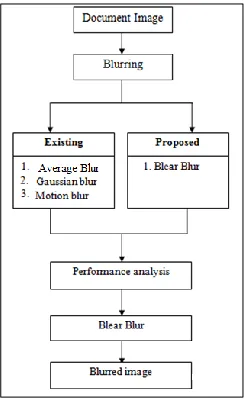
The basic definition of Blurring is, unclear/ invisible or not understanding the information. Generally images are looks sharper or more detailed if it was able to identify all the objects and their shapes correctly in it [5]. However blur is un-sharp image region produced by camera or inaccurate focusing, subject movement or shallow depth of field. Blur makes perfect image into imperfect image of realization process [1] which is restricted to within the boundaries of a single pixel of the original image. Blur involves calculating weighted averages of areas of pixels in a source image for each pixel of the final blurred image. Computing these weighted averages can be very expensive [7]. Hence it is difficult to identify any object/content from the blur images. In research field, blurring plays vital role, because it is used for security purpose, hence unauthorized persons difficult to identify the image. This is very powerful operation used in image processing and procedural texture generation. Figure 1 depicted in blurring architecture.
Figure 1 Blurring Architecture
3.1.1 Average Blur
The noise is present in the entire raw image is known as average blur. This blurring can be distribution of vertical direction and horizontal in the document image. It can be circular averaging by radius R which is computed by the following formula:
𝑅 = √𝑔 + 𝑓
where 𝑔 is horizontal blurring size direction and 𝑓 is
vertical blurring size direction and 𝑅 is the radius size of the circular average blurring [10]. It is most cost-efficient method to choose when producing a high quality images. Especially if there is a collection of images or small differences across a number of similar images. The visual quality of average blur is pixel-perfect which can be produced at a resolution fit for just about anything you can imagine [11].
3.1.2Motion Blur
𝐿 = ∫ ∫ 𝐿(𝑥, 𝑤, 𝑡)𝑠(𝑥, 𝑤, 𝑡)𝑔(𝑥)𝑑𝐴(𝑥)𝑑𝑡
Where g () is the filter function, s() represents the shutter exposure, and L() is the radiance contribution.
3.1.3Gaussian Blur
Gaussian blur is used in the pre-processing stage in computer vision technique to improve the image structures at different scales [9]. It blends a particular amount of pixels incrementally, following a bell-shaped curve. The kernel coefficients decrease with expanding the distance from the kernel‟s center. Center of the pixels have a greater weighting than these on the periphery. Larger values of σ present a wider peak (greater blurring). Kernel size should increase with increasing σ to manage the Gaussian nature of the filter. Gaussian kernel coefficients calculate on the value of σ. In the edge of the mask, coefficients should be nearby 0. The kernel is rotationally radial with no directional bias. Gaussian kernel is independent that permits fast computation. Gaussian filters might not preserve image brightness. The blurring is a dense in the middle and plumages at the edge. It is commonly applied to an image when more switch over the Blur effect is needed [2]. A Gaussian blur is the end result of blurring of an image through Gaussian function.
𝐺(𝑥) = 1/(2π𝜎 )𝑒̂(−𝑥 /(2𝜎 ))
Gaussian kernel coefficients are experimented from the 2D Gaussian function and it is defined as:
𝐺(𝑥, 𝑦) = 1/(2π𝜎 )𝑒̂(−𝑥 +𝑦 /(2𝜎 ))
Where σ is that the variance of the distribution. It is a generally used effectively in graphics software to reduce image noise.
3.1.4 Blear Blur
This work has proposed a new technique for blurring the document image named as blear blur. Blear blur is to make the difference between two things, first one is blurring function another one is adding noise to the original images. Therefore the proposed blear blur technique is to produce imperfect image quality from the original input images. It makes unclear or less distinct with the original images. The following equation is used to evaluate the blur level of an image.
𝐵(𝑥, 𝑦) = ∗ 𝑓(𝑥, 𝑦) + 𝑛(𝑥, 𝑦)
Where 𝐵(𝑥, 𝑦) is the original image, is the degradation operator, 𝑓is the blur function and 𝑛 speckle noise, introduced during image degradation, that corrupts the image. The proposed technique is used to evaluate the how much the document is more blur than the existing techniques.
3.2 De-Blurring Techniques
The De-blurring techniques are basically used to sharp an image using different methods and parameters. Authorized owners only de-blur or reconstruct the blurred document images. In this work, we have analyzed two existing de-blurring techniques; they are, Blind De-convolution and Lucy Richardson and one proposed technique is Dabber blur. Figure 2 represents de-blurring architecture.
Figure 2 De-Blurring Architecture
3.2.1 Blind De-convolution
Blind De-convolution algorithm is used to retrieve information from blurred images. It can be used effectively when no information about the distortion (blurring and noise) is known. The algorithm restores the image and the point-spread function simultaneously. Additional optical system characteristics can be used as input parameters. It helps to improve the quality of the image restoration. The blurred pattern from the digital images is called as Point Spread Function (PSF). The standard non-linear and linear deconvolution technique used a known PSF. For blind deconvolution, the PSF is estimated from the collection of images to perform the deconvolution. PSF constraints can be passed through a user-specified function. Definition of the blind de-blurring method can be expressed by:
𝑔(𝑥, 𝑦) = 𝑃𝑆𝐹 ∗ 𝑓(𝑥, 𝑦) + η(x, y)
Where 𝑔(𝑥, 𝑦) is the observed image, 𝑃𝑆𝐹 is Point Spread Function, 𝑓(𝑥, 𝑦) is the constructed image and
η(x, y) is the additive noise term.
3.2.2 Lucy Richardson
The Richardson–Lucy algorithm, also named as Lucy–Richardson convolution. It is very popular de-blurring algorithm in the area of image processing. This algorithm not required any information from the original clear image and it is an iterative algorithm. The equation of the Lucy- Richardson algorithm is:
Where (g) is a blurred image, (𝐻) is the blur filter and (𝐻 ) is the adjoin of (𝐻), (n) is the number of the iteration. Where 𝑓̂(𝑛 + 1) is derived estimation from the blurred image 𝑓̂𝑛. This algorithm will be utilized but the
only difference is that instead of using (𝐻∗) in the original equation. This equation is optimized by Lucy- Richardson technique and it is described in the subsequent equation:
𝑓 (𝑛 + 1) = 𝑓 𝑛𝐻 ∗ (9/(𝐻𝑓 𝑛))
Where, in the first iteration, the value of 𝑓(𝑛) = 𝑔.
This algorithm is the implementation of maximum likelihood method and it is the ability to provide a good quality reconstruc
ted images.
3.2.2 Da
bber De-blur
Da bber de-blurring is used for recovering the information and it can be seen by the authorized persons. It is used to get the information very clearly from the blurred images. It is considered as decryption method which is used to restore the original image from the blur image. The following equation is used to reconstruct the blurred image, de-blur is approximately described by this equation:
𝐷(𝑥, 𝑦) = (𝑥, 𝑦) ∗ 𝑓 + 𝑚(𝑥, 𝑦)
Where 𝐷(𝑥, 𝑦) is the blured image, de-blur operator, 𝑓 is de-blur function and 𝑚 is noise removal operator for
image reconstruction from the blurred image.
IV EXPERIMENTAL RESULTS
The primary objective of this research work is to secure the document images by using blurring and de-blurring techniques. Three existing and one proposed blurring techniques has been used for blur the document images. From the performance analysis blear blur technique is better than the other three techniques. Two existing de-blurring and one proposed de-de-blurring techniques have been used for de-blur the document images.
4.1 Performance Analysis of the Blurring and De-Blurring Techniques
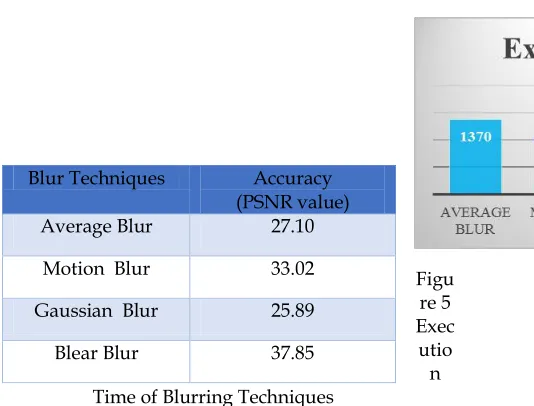
The PSNR (Peak Signal to Noise Ratio) measures have been used to estimate the performance of the proposed and the existing blurring techniques. Table 1 represents the Performance Analysis of Blurring Techniques. Figure 3 gives pictorial representation of the performance analysis of Blurring Techniques. Table 2 represents the Performance Analysis of De-Blurring
Techniques. Figure 4 gives pictorial representation of the performance analysis of De-Blurring Techniques. From the results it was found that the proposed blear blur and dabber de-blur techniques performs better than the existing techniques.
Table 1 Performance Analysis of Blurring Techniques
Figure 3 Performance Analysis of Blurring Techniques
Table 2 Performance Analysis of De-Blurring Techniques
Figu re 5 Exec utio n Time of Blurring Techniques
Table 4 Execution Time of De-Blurring Techniques
Blur Techniques Accuracy
(PSNR value)
Average Blur 27.10
Motion Blur 33.02
Gaussian Blur 25.89
Blear Blur 37.85
De-Blur Techniques
Accuracy (PSNR value) Blind
de-convolution
22.63
Lucy Richardson 24.55
Dabber De-blur 26.45
De-Blur
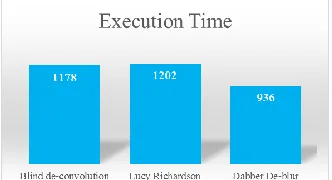
Techniques Execution Time Blind
de-convolution
1178
Lucy Richardson 1202
Figure 4 Performance Analysis of De-blurring Techniques Table 3 Execution Time of Blurring Techniques
Figure 6 Execution Time of De-Blurring Techniques
Table 5 Experimental results of Blurring Techniques
Blur Techniques Execution Time
Average Blur 1370
Motion Blur 1102
Gaussian Blur 1594
Blear Blur 947
Input
Document
Average Blur
Motion Blur
Gaussian blur
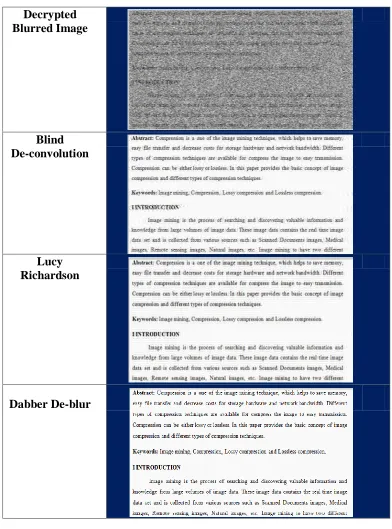
Table 4 Experimental results of De-blurring Techniques
Decrypted
Blurred Image
Blind
De-convolution
Lucy
Richardson
Dabber De-blur
V CONCLUSION
This research work is used to secure the document images by using blurring and de-blurring techniques. Three existing and one proposed blurring techniques have been used for blur the document images. From the performance analysis, it was found that the proposed
research work will be extended for handling large amount of images for securing the document images.
R
EFERENCES1. Almeida, M.S.C.; Almeida, L.B.; “Blind and Semi-Blind Deblurring of Natural Images,” IEEE Trans. on ImageProcessing, vol.19, no.1, pp.36- 52, Jan. 2010.
2. Sudha TIwari.et.al, “Multiple Blur Images Restoration- A Parallel Computing Approach”, 2012 Fourth International Conference on Computational Intelligence and Communication Networks.
3. Jaipuneet Singh et.al, “Motion Blur: An Introduction”, Vol. 2. ISSN: 2319 8753, January2013.
4. M. Ben-Ezra and S. K. Nayar, “Motion-based motion deblurring,”IEEE Trans. PAMI, vol. 26, no. 6, pp. 689–698,Jun. 2004.
5. Reka Durai et.al, “A Study and Analysis on Image Processing Techniques for Historical Document Preservation”, Vol. 2, ISSN (Online): 2320-9801, ISSN (Print): 2320-9798, July 2014.
6. J. Shi, L. Xu., and J. Jia, "Discriminative blur detection features," in Proc. IEEE Int. Conf. Comput. Vis. Pattern Recognit., pp. 2965-2972, 2014. 7. Anat Levin, “Blind Motion Deblurring Using Image Statistics”, 8. Bolan Su et.al, “Blurred Image Region Detection and Classification”. 9. Sheng Yuan, et.al, “Cryptanalysis and security enhancement of optical
cryptography based on computational ghost imaging”, journal homepage: www.elsevier.com/locate/optcom, Optics Communications 365 (2016) 180–185.
10. Shamik Tiwari et.al, “ Review of Motion Blur Estimation Techniques”, Journal of Image and Graphics Vol. 1, No. 4, December 2013.
11. De jee Singh, R. K. Sahu, “Analysis of Quality Measurement Parameters of Deblurred Images”. International Journal of Advanced Research in Electrical, Electronics and Instrumentation Engineering, Vol. 3, Issue 10, October 2014.
12. Su.,S. Lu., and C.L. Tan, "Blurred image region detection and classification," in Proc. ACM Int. Conf. Multimedia, pp. 1397-1400, 2011. 13. S. Ramya and T. Mercyl, “Restoration of blurred images using Blind
Deconvolution algorithm” in Proc.: Emerging Trends in Electrical and Computer Technology (ICETECT), 2011 International Conference, pp. 496499, Tamilnadu, India, March 23-24, 2011.
14. Guangcan Liu, et.al, “Blind Image Deblurring by Spectral Properties of Convolution Operators”,
15. Y.-W. Tai, P. Tan, and M. S. Brown.Richardson-lucy deblurringfor scenes under a projective motion path.IEEETrans. Pattern Anal. Mach. Intell., 33(8):1603–1618, 2011.
16. Madri Thakur,et.al, “Image Restoration Based On Deconvolution by Richardson Lucy Algorithm”, International Journal of Engineering Trends and Technology (IJETT) – Volume 14 Nu[mber 4 – Aug 2014.
17. Rama Singh and Neelesh Gupta, „Image Restoration Model with Wavelet Based Fusion‟, Journal of Information Engineering and Applications, ISSN 2224-5782 (print) ISSN 2225-0506 (online) Vol.3, No.6, 2013.
18. Salem Saleh Al-amri, Dr. N.V. Kalyankar and Dr. Khamitkar S.D. “,Deblured Gaussian Blurred Images”. Journal of Computing, volume 2, issue 4, april 2010, issn 2151-9617.
19. Jian Fan,et.al, “ A New Deblurring Algorithm for Textual Document Images”, The 7th International Telecommunications Symposium (ITS 2010) .