Effects of Age and Work Experience on Job Satisfaction of Primary School Teachers: Implications for Career Counseling
Abiodun .M. Gesinde (Department of Psychology, Covenant University, Ota, Ogun State, Nigeria)
Gbadebo .O. Adejumo (Department of Psychology, Covenant University, Ota, Ogun State, Nigeria)
Author (s)
Abiodun .M. Gesinde
Department of Psychology Covenant
University, Ota, Ogun State,
Nigeria.
E-mail:[email protected]
Gbadebo O Adejumo
Department of PsychologyCovenant
University, Ota, Ogun State,
Nigeria.
E-mail:[email protected]
Effects of Age and Work Experience on Job Satisfaction of Primary School Teachers: Implications for Career Counseling
Abstract
This descriptive survey investigated the influence of age and working experience on job satisfaction of primary school teachers. The participants (n=238) were primary school
teachers randomly selected from public and private schools in Ota, Ogun State, Nigeria. An adapted version of Bellingham
(2004) job satisfaction survey with reliability index of .96 was employed to generate data from the participants. Pearson Moment Correlation Coefficient and t-test statistics were used
to analyse the three hypotheses set to channel the study. The results obtained indicated that there were significant positive
relationship between age and work experience and job satisfaction (r =.312; .229) and that significant difference existed between teachers with less and above five years of
working experience (t = -2.68, P<0.05). The implications of these findings on career counselling were discussed.
Key Words: Age, Work Experience, Job satisfaction, Primary school teachers, Career counseling
Introduction
A happy employee is widely acknowledged worldwide to be more productive than an
unhappy one. An employee who is happy tends to be satisfied with virtually everything that is
associated with the job. Charlie (2010) asserts that success of any organization depends on the performance of its employee and employees can
give their best if only they are satisfied with their job. Job satisfaction as a terminology has
its origin from Hoppack according to Khan (2006) in Rajat (2009). It has been described in diverse manner by numerous scholars and
writers. For instance, Spector (1997) perceives
it to be people‟s attitude towards their job and organization and the extent to which they like
or dislike the job while Rajat (2009) argues that job satisfaction describes how contented an
individual is with his job. Charlie (2010) similarly submits that job satisfaction is
proportional to the feelings of happiness and contentment in the minds of employees about their job. Job satisfaction is subjective as far as
individual is concerned (Komolafe, 2010) as well as situational (Healthfied, 2010). It is
employees stay in an organization because they are satisfied with an employer‟s environment.
The benefits accruable from employees that are genuinely satisfied with their jobs are copious.
It has been pointed out by Mosadeghrad, Ferlie, & Rosenberg (2008) that job satisfaction and
commitment are critical to retaining and attracting well qualified personnel. Murrells, Robinson & Griffiths (2008) observe that in the
field of nursing job satisfaction can also impact on patient safety, productivity, and performance,
quality of care retention and turnover, commitment to the organization and profession.
The fact that employees from diverse professions are satisfied or dissatisfied with
their job has theoretical and empirical support from review of literature. There are quite a number of theories that attempt to explain
factors associated with job satisfaction or dissatisfaction. For instance, the „Affect Theory‟ of Locker (1976) posits that workers who are committed to their profession are more affected (positively or negatively) than their
counterpart who have a casual approach towards the job. On the other hand, Judge‟s (1998) „Dispositional Theory‟ argues that people have inborn disposition that tend to make them have tendencies toward a certain level of satisfaction in respective of one‟s job (Judge, Locke, Durham, 1997). Herzberg (1964) „Two-Factor Theory‟ also known as Motivator Hygiene Theory identifies motivation and hygiene factors contribution to job satisfaction.
The theory posits that satisfaction and dissatisfaction are driven first by motivator
factors (such as achievement and promotion) and then by hygiene factors (such as policies
and pay of the establishment).
The Conference Board in the United States of America, as reported by Healthfied (2010), recently released the outcome of 2009 job
satisfaction level of 5000 United States households of all ages and income brackets.
The findings from the survey among others indicate that:
45% of Americans are satisfied with
their jobs as against 49% in 2008 and 61.1% in 1987 when the survey was
first conducted;
roughly 64% of workers under 25 say they are unhappy in their job;
the most satisfied are those age 25-34; 43% of workers feel secured in their
job as against 47% in 2008;
56% say they like their co-workers as against 57% in 2008 and 68% in 1987; 51% say they are satisfied with their
boss as against 55% in 2008 and 60%
in two decades.
In Iran, Mosadeghrad, Ferlie, & Rosenberg (2008) descriptive, correlational and
cross-sectional study of 629 hospital employees indicated that the job satisfaction level of the
participant can be seen to be medium scales mainly because of salaries and benefits, working conditions, recognition, and job
security. It was also confirmed that a positive relationship exist between job satisfaction and
organizational commitment.
In Nigeria, the job satisfaction level of
educators/lecturers in Colleges of Education had been determined in a study conducted by
(2006) among 230 randomly selected Colleges of Education educators in Southern Nigeria.
The outcome of the investigation showed that educators were most satisfied with their workload followed by co-workers, supervision,
and promotion. Further analysis indicated that educators experienced a high degree of
dissatisfaction with their present pay. Correlational analysis further showed that there was a significant negative correlation between
age, educational level, and academic rank and various facets that determine job satisfaction.
In another study by Alao (1997) which aimed at ascertaining the status and job satisfaction level
of 34 cataloguer in Nigeria as well as determine whether or not age, sex, marital status, length of
service were accountable for differences in job satisfaction, it was found that cataloguers‟ had an overall job satisfaction score of 58.2%. This
is in addition to the fact that none of the variables was significantly correlated with
cataloguers overall job satisfaction and the fact that the variables were variously and significantly correlated with some aspect of the cataloguers‟ level of job satisfaction with that of other groups of librarian. The study conducted
by Uwaimeiye & Onyewadume (2001) among 480 technical teachers randomly selected from 18 southern states of Nigeria showed that out of
the 22 items related to job satisfaction the participants disagree with all except three. This
clearly showed that the participants were dissatisfied with their job
It is clearly evident from these researches and other not mentioned in this paper that workers
generally or specifically had been found to either be satisfied with their job as a whole or
aspects of the job or dissatisfied with the entire job or part of the job. This generates the need to
understand the reasons behind dissatisfaction with the whole or part of the job. Komolafe (2010) opines that job dissatisfaction is not
caused by a small pay check but rather an over-burning work, high turnover and poorly
structured job. Salesboom (2009) on the other hand concurs that employees are dissatisfied with their job because they feel that their
concerns, problems, and concerns or complaints are ignored by management. It might also be
due to the fact that they feel that they are stuck in position with no potential for advancement. Americans who are dissatisfied or unhappy with
their job in the Conference Board survey complained that incomes have not kept up with
inflation and that the soaring cost of health insurance has eaten into workers take home pay (Healthfied, 2010).
The consequences of job dissatisfaction are not
palatable. Economists, according to Healthfield (2010) propose that if the downward trend of job satisfaction in America is not reversed it
could stifle innovation and hurt competitiveness and productivity. It could also make unhappy
older workers less incline to spare time to share knowledge and skills with younger workers. Consequently, strenuous efforts must be made
to identify job satisfaction or dissatisfaction level of all professions and factors influencing
or and associated with it through diverse researches and also reverse the untoward trend noticeable.
Statement of the Problem
There are quite a number of studies on job
studies exist on job satisfaction of teachers/lecturers such as studies by Uwaimeiye
& Onyewadume (2001) and Akpofure, Ikhifa, Imide, Israel, & Okokyo (2006), Adetayo (2008). However, it must be noted that there are
different categories of teachers for different categories of pupils/students. While we have
studies on teaching profession generally and studies on job satisfaction level of lecturers in higher institutions and teachers in post primary
schools insufficient studies permeate primary school teachers‟ job satisfaction in Nigeria. Ironically, primary school teachers are trained to lay the foundation of education on which other teachers build on in secondary schools
and higher institutions. It, therefore, implies that job satisfaction of teaching profession
suppose to start with teachers in primary schools. When teachers at this level of education are unhappy with their job it poses
great danger for future development of education in the nation. As rightly pointed by
Uwaimeiye & Onyewadume (2001), education is an instrument of development and teachers are a pivot to the education process. The
importance of primary school teachers to the development of education as a programme of
the nation and pupils as leaders of tomorrow makes studies on their job satisfaction germane. Hence, the more we have adequate information
on their job satisfaction level the more employers are equipped to identify and meet
their psycho-socio-economic needs.
Purpose of the Study
This study aims at providing empirical information on job satisfaction of primary
school teachers in Nigeria with particular focus on those residents in Ota, Ogun State, Nigeria
by comparing the influence of age and length of service on their job satisfaction level. It is
anticipated that the outcome of this research will give room for a better understanding of factors contributing to primary school teachers‟ satisfaction or dissatisfaction in Nigeria and equally enables policy makers design
enhancement workshop for teachers.
Research Hypotheses
1) There is no significance relationship between age and the job satisfaction
level of primary school teachers. 2) There is no significance relationship
between years of working experience
and the job satisfaction level of primary school teachers.
3) There is no significance difference between the job satisfaction level of primary school teachers with less and
above five years of working experience.
Methodology
Research Design The study was conducted as a descriptive survey design which incorporated aspect of correlational research.
Participants
The population of this study consists of all primary school teachers in private and public
schools in Ota. The sample, however, consists of two hundred and thirty-eight teachers
randomly selected from twenty primary schools (10 public and 10 private schools) in Ota, Ogun State. The demographic information of the
participants showed that 95 (39.9%) were males and 143 (60.1%) were females. 123 (51.7%)
(37.4) were degree holders and 146 (61.3%) had Nigerian certificate in Education.
Instrument
The instrument employed to gather data was
adapted version of Job Satisfaction Survey by Bellingham (2004). It is a two sections
inventory with the section A requesting the respondents to provide demographic information on their gender, age, marital status,
religion, educational qualification, years of working experience, position at workplace,
profession, and name address of workplace. The second section consists of 30 positively worded items that deals with intrinsic and extrinsic
aspects of job satisfaction. A 4 point Likert type scale of 4= very much like me; 3 = like me; 2 =
somewhat like me; 1 = unlike me. A typical item on the scale reads „‟I feel positive and up most of the time I am working.‟‟ The minimum score obtainable by a respondent is 30 while the maximum is 120. The higher the score the more
satisfied the respondent. The reliability co-efficient of the instrument was .96 using Spearman Brown formula. The questionnaire
was administered to the participants in their various schools by the researchers with the
assistance of three research assistance. The return rate was about 95% for it was collected on the day of administration.
Data Analysis
Data generated from the instrument were analysed using Statistical Package for Social Science (SPSS 11 for Window, „V‟ 11(SPSS, Inc). The relationship between independent variables (age and working experience) and
independent variable (job satisfaction) was analyzed using Pearson Moment Correlation
Co-efficient while t-test statistic was employed to test differences between groups.
Results
Discussion
The study set out to determine the comparative
effects of age, years of working experience on job satisfaction of primary school teachers in Ota, Ogun state, Nigeria. The analysis of the
data revealed that age and work experience had low but significant positive relationship with
job satisfaction. This implies that the two variables are important in the determination of job satisfaction of primary school teachers. This
finding is consistent with the findings of other studies that have concluded that age and
working experience among other variables are correlated with workers‟ job satisfaction (Bodur, (2002). What has been found to be of no significance relationship to teachers‟ job satisfaction is leadership behaviour of
principals (Khanna, 2010). This study therefore affirms Mosadeghr, Ferlie., & Rosenberg (2008) who had earlier in their study reported that variables such as employees‟ age, gender, marital status, work experience years,
organizational position, educational level, type of employment and salary received have significant effects on job satisfaction.
The result of hypothesis three which indicated
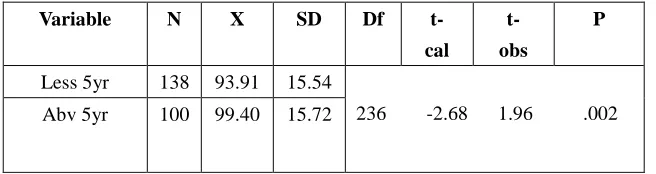
that the participants are satisfied with their job (as evident in the mean scores of 93.91 and 99.40) but with a significant difference
between the job satisfaction of primary teachers with less and above five years of working
Adetayo (2008) which discovered that majority of teachers are satisfied with their job and
teachers differed significantly on a number of variables. Adetayo (2008) and Clark, Oswald, & Warr (1996) reported that the youngest and
oldest workers have greater job satisfaction. In the contrary, Perie, Baker, & Whitener (1997)
reported that in the United States of America younger and less experience teachers have higher levels of satisfaction than older and more
experienced teachers in public schools, whereas the relationship is bipolar in the private schools
because the very youngest and very oldest teachers had the highest level of satisfaction just like the least and most experienced teachers.
When teachers are satisfied with their job the following conditions, from diverse studies,
according to Assist beginning Teachers (2010) are in existence- the administration is supportive and encouraging; principals
frequently discuss instructional practices with teachers; there is a great deal of cooperative
effort among staff; and teachers participate in making important school decisions. Others are the fact that staff members are recognized for a
well job done; necessary material are available; the level of misbehaviour in their school does
not interfere with teaching; student apathy is not a problem; and parents support teachers‟ work. It could therefore be assumed that most
of these conditions are resident in the schools of the participants of this study since they are
satisfied with their work.
Implications for Career Counseling
The findings of this study have a number of implications for career counselling. Career
counselling is an aspect of counselling that deals with entry into a vocation, maintenance of
the vocation and making progress in the vocation. The finding of the study which
established the fact that primary school teachers, irrespective numbers of length of service, are satisfied with their job implies that career
counsellor has a platform by which they can encourage and motivate clients who are just
entry into teaching profession. Similarly, it is practicable for career counsellor to inform proprietors of school that their employees‟ satisfaction depends on a number of intrinsic and extrinsic conditions which they can give
room to in their institutions.
Table 1: Correlation between Age and Job Satisfaction of Primary School Teachers Variab N r-cal DF R-tab P Rmk
Age 238 .312 236 2.05 .000 S
Correlation significant @ 0.01 level (2-tailed).
The Pearson Moment correlation co-efficient analysis from Table 1 indicated r = .312 @ .000 level of significant level. This means that there
exist low but significant positive relationship between teachers‟ age and job satisfaction level. Correlation significant @ 0.01 level (2-tailed). The Pearson Moment correlation co-efficient analysis from Table 11 indicated r = .229
@ .000 level of significant level. This means that there exist low but significant positive
relationship between teachers‟ age and job satisfaction level.
The result in Table I11 shows that the calculated t-value of -2.68 is greater than t-observed of
-1.96 at .05 level of significance. Hence, the null hypothesis which states that there is no significance difference between the job
with less and above five years of working experience is rejected.
11: Correlation between Working Experience and Job Satisfaction of Primary School Teachers
Variable N r-cal DF R-tab P Rmk
Work Exp
23
8
.229 236 2.05 .000 S
Table 111: Mean, Standard Deviation, and T-Value of Primary School Teachers with Less and Above Five Years Working Experience
Significant @ .05 alpha level
References
Adetayo, J. O (2008) “Level of Teachers Job Satisfaction in Ogun Secondary Schools” International Journal of Emotional Psychology and Sport Ethics. Vol.10, pp.208-216.
Akpofure, R, Ikhifa, G.O, Imide, O and I.E. Okokoyo (2006) “Job Satisfaction among Educators in Colleges of Education in Southern Nigeria” Journal of Applied Science, Vol.6, No.5, pp.1094-1098.
Assist Beginning Teachers (2010) “Tool: What the New Generation Teachers Seek in
Job Satisfaction”. Retrieved 15th July, 2010
from
http:/assist.edu.msu.edu/ASSIT/index.php? tab == 4
Bellinham, R. (2004) “Job Satisfaction Survey” Retrieved 15th July, 2010 from
http://www.welcoa.org/freeservices/pdf/job_s
atisfaction_survey.pdf
Bodur, S. (2002) “Job Satisfaction of Health Care Staff Employed at Health Centres in
Turkey” Occupational Medicine, Vol.52, pp.353-355.
Charlie, S (2010) “Employee Satisfaction Surveys-Questionnaire on Employee Job Satisfaction” Retrieved 16th July, 2010 from
http://www.buzzle.com/articles/job-satisfactio
Variable N X SD Df t-
cal
t- obs
P
Less 5yr 138 93.91 15.54
n
Clark, A . E, Oswald, A .J and P. Warr (1996) “Is Job Satisfaction U-shaped in Age?” Journal of Occupational Psychology, Vol. 69, pp.57-81.
Healthfield, S. M. (2010) “What Contributes to or Destroys Employee Job Satisfaction?”
Retrieved 16th July, 2010 from http;//humanresources.about.com
Herzberg, F. (1964) The Motivation-hygiene Concept and Problems of Manpower. Personnel Administration, Jan-Feb, 3-7.
Judge, T. A, Locke, E. A and C.C Durham (1997) “The Dispositional Causes of Job Satisfaction: A Core Evaluations Approach”
Research in Organizational Behavior, Vol.19, pp.151–188.
Khanna, M. J. (2010) A Comparative Study of Leadership Behaviour of Principals in Relation to Job Satisfaction of Teachers in
Government and Non-government Schools of U.T. Retrieved 27th July, 2010 from
http://www.academicleadership.org/empirical_
research/index/shtml
Komolafe, A. A. (2010) Job Satisfaction and vs Compensation: Battle for Employee‟s Heart. http://www.californiachronicle.com
Locke, E.A (1978) The Nature and Causes of Job Satisfaction: Handbook of Industrial and Organizational Psychology. McNally, Chicago,
IL 12971343.
Mosadeghrad, A.M, Ferlie, E, and D. Rosenberg (2008) “A Study of Relationship Between Job Satisfaction, Organizational Commitment, and Turnover Intention among
Hospital Employees” Health Services Management Research, Vol.21, No.4,
pp.211-227.
Murrells, T, Robinson, S, and P. Griffiths
(2008) Satisfaction Trend during Nurses early career. http://www.biomedical.com
Perie, M, Baker, D.P, and S Whitener (1997) Job Satisfaction among American Teachers: Effects of Workplace, Conditions, Background
Characteristics and Teachers‟ Compensation. U.S Department of Education: Office of
Education Research and Improvement. Rajat, G. (2009) A Case Study of Job Satisfaction of Open Access Technology
International (OATI) Employees. Unpublished Master of Business
Administration submitted to Punjab Technical University.
Salesboom (2009) Employee Motivation and Job Satisfaction. Retrieved 16th July, 2010 from http://www.salesboom.com
Spector, P.E. (1997) Job Satisfaction: Application, Assessment, Cause, and Consequences. Thousand Oaks, CA: Sage.