Learning Strategies of Malay Language Among International Students in Institution of Higher Education
Yong Chyn Chye (Social Science and Communication Department, Centre for Foundation Studies and Extension Education (FOSEE), Multimedia University)
Vijayaletchumy a/p Subramaniam
(Department of Malay Language, Faculty of Modern Languages and Communication, University Putra Malaysia)
462 Author (s)
Yong Chyn Chye Social Science and Communication Department, Centre for Foundation Studies and Extension Education (FOSEE), Multimedia University. E-mail:[email protected]
Vijayaletchumy a/p Subramaniam
Department of Malay Language, Faculty of Modern Languages and Communication, University Putra Malaysia.
E-mail:[email protected]
Learning Strategies of Malay Language Among International Students in Institution of Higher Education Abstract
This paper is focusing on the strategies used by the international students in learning Malay language. The most frequent strategies applied by students in learning Malay language via their second language; English will be determined. Besides that, this research was also to analyse the relationship between the learning strategies and predisposing factors in learning the language. The Language Learning Strategy Model by Mohamed Amin Embi (2000) has been adapted and modified to fulfill the research objectives. The sample was taken from among the first year students from the Multimedia University, Cyberjaya. The population was from seven countries. There were 79 questionnaires managed to be gathered and analysed by using SPSS and MS Excel to reach the accurate information and findings of the study. The findings of the study showed that from the 20 strategies listed, 4 strategies were the most frequent applications among the students to learn Malay language in the class. In determining the learning strategies mastered by the students, instructors could plan the lecturing sessions so that the learning could be better in making the international students become more interested in learning the national language. According to Tyacke and Mendelson (1986), instructors who could teach students the language properly, could influence them with effective strategies. Students were also managed to use varities of methods, techniques, ways or strategies like the ones used by their language teachers.
Keywords: Learning strategies, Predisposing factors, Malay language and International students
Background
In the globalisation era, people are free to further their studies in any countries of their choice. In vision Malaysia as one of the excellent education in this region, Malaysia welcomes students from all over the world. To cater that scenario and the needs of these international students, the Private Institution of Higher Education (PIHE) has a lot of private institutions in Malayia. To ensure the quality of the graduates, in 21st December 2005, government has decided to combine the
463 In Malaysia, there are 25 registered private
universities. In order to overcome the communication problem among the international students in Malaysia and with accordance to Phase 152 Constituency, the syllabus for Bahasa Kebangsaan B that is Malay language is offered to interested non-Malaysian citizens. Bahasa Kebangsaan B is the compulsory subject to be taught in the private institution and English language is the medium of instruction. The teaching and learning of this language emphasises on the aspect of communication and the easy method of teaching. The goal of learning the Malay language not only to assist the foreign students to use the Malay language in their daily activities, but also could help them to do the reference books and other academic materials in Malay language.
The learners can be acquired the target language easily only if the language is made use of in our daily affairs (Nirmala and E.Sugantha Ezhil Mary, 2011). Besides that, the succesful of the international students in learning the Malay language, instructors also should play important role in determining the suitable, effective and good strategies to inculcate their interests. Based on the students‟ interest, instructors could motivate the students to use the most effective strategy to enhance their learning process. According to Abu Talib (1998), learning strategy is a way that students take to quicken their process of absorbing, storing, recalling and using of sources of information to help the students to produce effective learning process. The knowledge about the student‟s strategy are benefit to instructors. Therefore, instructors should play important role in teaching Malay language to these non-native speakers.
Weinstein and Hayer (1986) said that the reason of using strategy is to „influence‟ the motivation situation or the effective learning of selecting, receiving, organizing or interacting with new knowledge as below:
a) Centralising the chosen and new aspects of information,
b) Analysing and controlling information while receiving,
c) Organising or controlling new information while in the process of guessing,
d) Evaluating the learning after work is settled, and
e) Assuring someone that the learning process does happen to help in reducing doubts.
The communication strategies are important especially in determining meanings, linguistics structure or even sociolinguistics methods which are not given fairly between the learning of the second language and the second speaker (Tarone, 1981).
Objective of Study
i. To determine the strategies used by the international students in learning Malay language. ii. To analyse the relationship
between the learning strategies of the Malay language and the predisposing factors.
Significance of Study
In determining the most frequent language learning strategy applied by the international students, instructors could plan the teaching and learning process to be more effective. This study is important especially to instructors who teach Malay language as a foreign language. The language is not only being taken at the highest peak but at the same is spread to all over the world. In determining the predisposing factors in the basic level, the process could help the students to learn their third language. They will become more motivated to learn more about Malay language.
Literature Review
464 strategies is also influenced by its external
factors. Studies that have investigated language learning strategies (LLS) in foreign language in Malaysia are such as Kang, Hyeok (1999) –Korean, Roslina Mamat (1999) – Japanese, Anida Abdul Rahim (2003) – Arabic, Neo Swee Leng (2005) – Spanish, and Suzana Ismail (2005) – Japanese.
Apart from the efforts that have been undertaken to identify the types of LLS for foreign languages, studies on LLS in the learning of English and Malay have also received attention among researchers. These studies are generally conducted to see the relationship between the uses of language learning strategies with the success achieved by the students in language learning, and to suggest a model of language learning based on the findings of the research. Examples are Mohamed Amin Embi (1996), Abu Talib (1998), Mohd Nazali et al. (1999), Zamri Mahamod et al. (2002), Supian (2003) dan others. Previous studies on LLS in the subject of Malay language as the first language or second language were at the primary school, secondary school or university level. However, the application of LLS in a group of foreign learners who are learning the Malay language as the third, fourth or foreign language in developing countries, for example Malaysia fails to be detected.
To further clarify the differences of LLS, the majority of researchers have touched on issues relating to the identification of strategies used by language learners who excelled (Griffiths, 2003; Chamot and El-Dinary, 1999), analysis of relationship between the use of LLS and the achievement of students‟ performance (Wharton, 2000), differences between students across different academic levels in self regulated learning strategies (Abdul Rahman Awad Al Asmari and Nasrah Mahmoud Ismail, 2012) or the evaluation of students‟ strategic performance in the different areas of language skills (Rocio Dorninguez and Silvia Pessoa, 2005). Meanwhile, the findings of these past studies have given different views. The difference lies in the level of flexibility of the student when choosing strategies, and the manner in
which the LLS are applied to specific situations. In addition, the findings of research on the LLS factors are also not so consistent and consensus that is uniform failed to be achieved. Research on gender differences showed that the use of LLS that is significant by females (Green and Oxford, 1995; Ehrman and Oxford, 1989; Oxford and Nyikos, 1989; Politzer, 1983) while the research by Tran (1988) and reported the opposite. With regard to the relationship of language ability and the use of LLS, new findings have also been reported. Several ESL/EFL (English as a Second Language/ English as a Foreign Language) research have shown that the level of language ability influences the use of LLS, with students of higher language ability generally using more varied strategies (Chang, 1991) and using the strategies more frequently compared to students of weaker language ability. However, there are studies that report no consistent differences between the skill groups (Phillips, 1991).
Based on the past studies before this, researchers and teachers around the world have been conducting research that includes students of different races, nations, countries or cultures. Most of them focus on the examination of factors that influence the student‟s choice of learning strategies. The majority of these factors are related to motivation, age, gender, attitude and confidence, type of activities, teaching methods, learning styles, level of academic ability, cultural background and ethnic groups. Nevertheless, most of the researchers have neglected the notion of „influence of culture, community and educational policy‟ from their research consideration in LLS. Clearly, this research that is grounded on the identification of LLS and the extralinguistic factors among the foreigners seems really necessary.
Methodology
465 Nevertheless, one student did not come on the
day of the study was conducted. This resulted in 79 forms were returned to be analysed. They were the first year university students. Furthermore, they came from different programmes like Engineering, Management, Information Technology and Creative Multimedia. Due to the big number of students, the 80 respondents were divided into two separate classes. Even though they learned from two separate classes, the instructor is the same people and they were using the same syllabus. The only different was at the time and venue.
All of the population number has been used as the sample of this study. Besides, the samples of this study were made compulsory to follow this subject Bahasa Kebangsaan B that is the basic Malay language based on the syllabus given by the MQA-Malaysian Qualifications Agency for one semester that is 14 weeks. They follow the lesson in a class complete with air-conditional, computer and other basic needs like chairs, table and whiteboard. The
Basic Malay (2009) book was given to them as guidance and exercises besides the use of „power point’ slides presentation in the class. The questionnaire consists of questions on strategies used by the students in learning Malay language in, out classroom and during examination based on the Mohamed Amin Embi (2000) model. The modification was done according to its suitability with the subject and types of study. The modification included purpose, needs and opinions from the subjects in learning Malay language. Based on the questionnaire, data were gathered and analysed in answering the two objectives of the study. The objectives are to determine the strategy used by the international students in learning Malay language and to analyse the relationship between the learning strategy of the Malay language and predisposing factors. The quantitative analysis of this study was conducted by using SPSS (Statistical Package for Social Science) version 18.
The Limitation of the Study
This study was limited to strategies in learning Malay language only among the international students. The population of this study is the first year students who took this paper Bahasa Kebangsaan B in the Multimedia University. They were at the range of 21 to 25 years old. The samples were form these 7 countries; Iran, Bangladesh, Arab Saudi, Mauritius, China, Botswana and German. Malay language is a foreign language to them. In this study, the students were asked to evaluate 40 strategies listed; 20 strategies learn in the classroom, 14 strategies learn outside the classroom and 6 strategies used in the examination. The researcher had this assumption of the students‟ mastery level of English language is homogenous.
Methods of the Study
i. Questionnaire: The distribution of the questionnaires was based on the Mohamed Amin Embi (2000) model. The modification was done according to its suitability with the subject and types of study. The modification included purpose, needs and opinions from the subjects in learning Malay language.
ii. Observation: Researcher was observing the behaviour of the students in the classroom for 3 hours for 14 weeks.
iii. Library Research: Journals, thesis and magazines were used to check on the past studies. Instruments of Study
Questionnaire was the main source to collect the data for this study. The statements in the questionnaire were divided into two sections; Section One consists of 4 parts (A, B, C and D), Section Two has 8 demographic questions on gender, age, faculty, programme, semester, mother tongue and a question on the status of Malay language to them.
466 i) Part A has 20 questions about
strategies used by the students in the class.
ii) Part B has 14 questions about strategies used by the students outside the class.
iii) Part C has 6 questions about strategies used by the students during the examination.
iv) Part D has 9 questions about the predisposing factors in learning Malay language.
To each statement in Section One, there are four numbers that need to be chosen by the subject of the study based on their learning strategies. Each number represents as the following:
i) 1 as Strongly Disagree ii) 2 as Disagree
iii) 3 as Agree
iv) 4 as Strongly Agree
Data Analysis
The data gathered from the questionnaire were analysed quantitatively by using MS Excel and SPSS. For the statistical test, Pearson Correlation was used to determine the relationship of the Malay language learning strategies in the classroom, outside the classroom and during the examination. The formula for the test is as follows:
Pearson Correlation, YY XX XY
S
S
S
r
where
N
X
X
S
XX 2 2
,
N
Y
Y
S
YY 2 2
,N
Y
X
XY
S
XY
with these hypotheses;
H0: r = 0 (there is no relationship between
the learning strategies and predisposing factors in learning the Malay language)
HA: r ≠ 0 (there is a relationship between the
learning strategies and predisposing factors in learning the Malay language)
Research Findings
Objective 1: To determine the strategy used by the international students in learning Malay language.
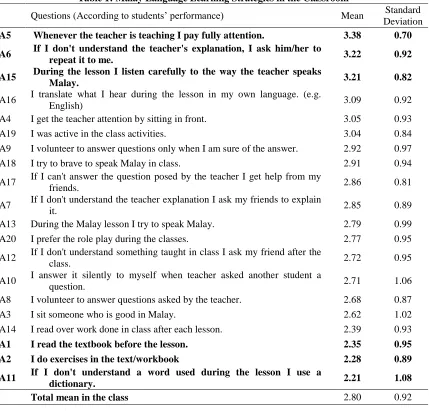
Questionnaires have been distributed to 79 international students in MMU. The table below was the finding based on the analysis from the 20 learning strategies for Malays language in the classroom which have been arranged according to its mean level.
According to the finding of this study, the international students prefer or like to learn Malay language through the instructor in the classroom. The main and most frequent strategy in learning the language is paying attention to the instructor while she/he is teaching. This strategy obtained the highest mean that is 3.38. The second higher is 3.22 with the strategy of the students asked for further explanation from the instructor if they do not understand what is being taught. The third strategy is listen to carefully to what the lecturer is saying in the Malay language with 3.21 for the mean.
467 Based on the analysis given, the learning
process happened most of the time in the classroom and relying on the instructor is their best strategy. This happened because they have an open opportunity to learn and understand the language only in the class. This opportunity will be happening outside the classroom especially at the location or learning centre near the city. The environment somehow will encourage them to communicate in English.
Referring to a dictionary is the least favourite strategy since they know that they can rely on the lecturer. Using reference books is also not the students‟ choice. Hence the students prefer to read the textbooks as their main aim is to pass the exam. Therefore they will be using all the strategies that they feel could help them to make sure they pass. This can be seen from the figure below:
The Scale of 3 and 4 in the questionnaire are representing the more positive learning strategy. Scale 1 and 2 are less positive. From the figure above, it was found out that the highest percentage 61.7% came from the Scale 3 and 4 to the learning strategies in the classroom. The strategy became less positive when they were applied outside the classroom and during the examination, 47.7% only. As for the prediction, the Malay language learning strategy outside the classroom is more practical compared to strategies in other situations.
The comparison of the learning strategies in the classroom and during the examination at the positive scale of 4 found out that the strategy applied during the examination was higher with 32.2% compared to in the classroom with 29.2%. Through this findings, the international students could be seen as applying the positive learning strategies when sitting for the examination.
Objective 2: To analyse the relationship between the learning strategy of the Malay language and predisposing factors.
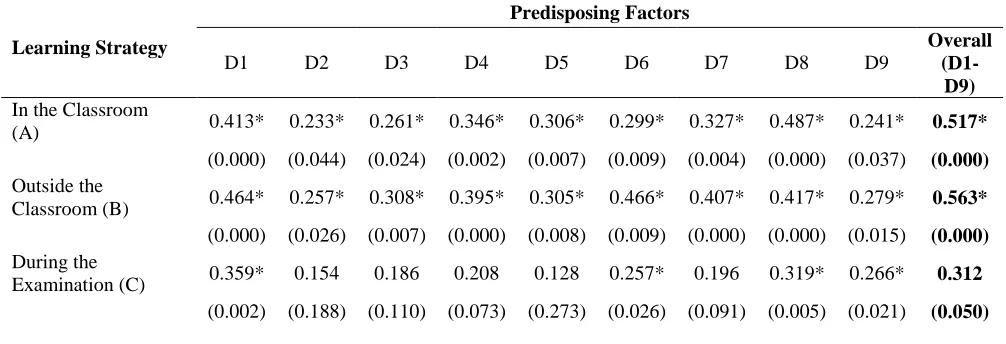
Overall, the learning strategy in the classroom showed significant correlation. The factor that the international student like to attend the
Malay language class became the predisposing factor as the highest correlation when the strategy was applied into the classroom. Clearly shown that instructors play important role in the effort of inculcating interest onto the international students in learning Malay language. Whereas the correlation value for learning the language outside the classroom is to used when bargaining prices when buying goods. Students were seen as using all the strategies for the outside purposes most of the time. This scenario shows that Malay language is so useful during shopping here in Malaysia. On the other hand, the correlation between learning strategies during examination and the predisposing factors was not convincing at all. The table above shows only four from the nine predisposing factors were significant with weak correlation value. If everything was to be taken into account, the combination of D1 till D9 failed to show the significant relationship with learning strategies while sitting for examination. In a nutshell, learning strategies were not influenced by the predisposing factors during the examination. D1- I like Malay language so much.
D2-Learning Malay could help me communicate better in Malaysia.
D3- While ordering food and beverage. D4-Asking for directions to certain destination.
D5- Reading signboards. D6- Bargaining prices of goods.
468 plan for teaching and learning Malay
language among the foreign speakers. This also showed that a question should be studied again especially in getting to know the methods of teaching and learning especially in the effort to spread the Malay language around the world.
Conclusion
The findings of the study showed that lecturers play important role in encouraging the students to use the language learning strategies in learning Malay language. According to Mohamed Amin Embi (2000) one of the predisposing factors to success in learning a language is to find and use opportunity to practise the language in the reality world. On the other hand, this study shows that the students prefer to rely on the instructors in learning the language. Therefore the lecturers need to use the teaching method through the outside activities so that the students are exposed the real environment. Based on the findings, students rarely did their revisions after the class, prepare before the class or even use a dictionary to refer to difficult words. To make sure these strategies will be used, instructors could give assignments to the students based on the topic discussed in the following class. One of the activities that can encourage the students to use the dictionary is by asking the students to create words from the letters given. To make this activity more interesting, it can be done in groups and make it as competition.
In determining the language learning strategies used by the students, lecturers can plan their teaching and learning lesson properly. Students will use varieties of techniques, ways, methods or even strategies to learn like the ones used by the instructors themselves. This study also emphasised on the Malay language learning strategies among the foreign speakers that encompased adults and children. Tyacke and Mendelson (1986), said that instructors who teach the students to learn the language good will make the students learn the language good as well. From day to day more and more international students have chosen Malaysia to further their
studies in any education institutions; public or private. Therefore we need to value this golden opportunity so that our Malay language can be used widely among the international students here in Malaysia. Finally, the proper and well arranged teaching and learning of the language can make the process effective. This matter does not only will take the standard of Malay language high but to spread our national language around the global.
References
Abdul Rahman Awad Al Asmari and Nasrah Mahmoud Ismail (2012) “Self regulated learning strategies as predictors of reading comprehension among students of English as a foreign language” International Journal of Asian Social Science Vol. 2, No.2, pp.178-201.
Abu Talib Abdullah (1998) “Gaya dan Strategi Pembelajaran Bahasa Melayu di Kalangan Pelajar Tingkatan 4, Daerah Johor Bahru” Thesis (Ph.D.), Bangi: Universiti Kebangsaan Malaysia.
Anida Abdul Rahim (2003) “Strategi Pembelajaran Bahasa Arab di Kalangan Pelajar Melayu” Dissertation (M.M.L.S), Kuala Lumpur: Universiti Malaya.
Chamot, A.U. and El-Dinary (1999) “Children‟s learning strategies in language immersion classrooms” The Modern Language Journal Vol.83, No.3, pp.319-341. Chang, S-J. (1991) “A Study of Language Learning Behaviors of Chinese Students at the University of Georgia and the Relation of Those Behaviors to Oral Proficiency and Other Factors” Thesis (Ph.D.), University of Georgia, Athens, GA.
Ehrman, M. and Oxford, R.L. (1989) “Effect of sex differences, career choice, and logical type on adults‟ language learning strategies” The Modern Language Journal Vol.73, pp.1-13.
Glenn Wharton. (2000). “Language learning strategies use of bilingual foreign language learner in Singapore” Language Learning Vol.50, No.2, pp.203-243.
469 Griffiths, C. (2003) “Patterns of language
learning strategy use” System Vol.31, No.3, pp.367-383.
J.R.Nirmala and E.sugantha Ezhil Mary (2011) “Communicative language teaching enable students to acquire communicative competence” International Journal of Asian Social Science Vol.1, No.2, pp.21-23.
Kang, Hyeok (1999) “Learning Style Preferences of Korean High School Students” Dissertation (M.E.S.L), Kuala Lumpur: Universiti Malaya.
Mohamed Amin Embi (1996) “Language Learning Strategies Employed by Secondary School Students Learning English as A Foreign Language in Malaysia” Thesis (Ph.D.), School of Education: University of Leeds.
Mohamed Amin Embi (2000) “Language Learning Strategies: A Malaysian Context” Thesis (Ph.D.), Bangi: Universiti Kebangsaan Malaysia.
Mohd Nazali Abu Bakar, Mohamed Amin Embi and Zamri Mahamod (1999) “Hubungan antara penggunaan strategi pembelajaran bahasa Melayu dengan pemboleh ubah jantina, etnik, pencapaian bahasa dan status sosioekonomi pelajar” Jurnal Teknologi Vol.31, (E), pp.43-62. Neo, S. L. (2005) “Strategi Pembelajaran Bahasa : Satu Kajian di Kalangan Pelajar-pelajar Bahasa Sepanyol di Universiti Malaya” Dissertation (M.M.L.S.), Kuala Lumpur: Universiti Malaya.
Oxford, R.L. and Nyikos, M. (1989) “Variables affecting choice of language learning strategies by university students” The Modern Language Journal Vol.73, No.3, pp.291-300.
Phillips, V. (1991) “A Look at learner strategy use and ESL proficiency” CATESOL Journal Vol.4, pp.57-67.
Politzer, R. (1983) “An explanatory study of self-reported language learning behaviours and their relation to achievement” Studies in Second Language Acquisition Vol. 6, No. 1, pp. 54-65.
Rocio Dorninguez and Silvia Pessoa (2005) “Early versus late start in foreign language education: documenting achievements” Foreign Language Annals Vol.38, No.4, pp.473-483.
Roslina Mamat (1999) “Strategi Komunikasi Pertuturan dalam Bahasa Jepun di Kalangan Pelajar-pelajar Melayu di Universiti Teknologi Malaysia, Kuala Lumpur” Dissertation (M.M.L.S), Kuala Lumpur: Universiti Malaya.
Siti Saniah Abu Bakar (2009) Basic Malay, Kuala Lumpur: Sarjana Press.
Supian Mohd Noor (2003) “Strategi Pemerolehan Ayat Satu Dasar” Thesis (Ph.D.), Serdang: Universiti Putra Malaysia.
Suzana Ismail (2005) “Communication Strategies in Japanese Language Interactions among Malay Students at the University of Malaya” Dissertation (M.M.L.S.), Kuala Lumpur: Universiti Malaya.
Tarone, E. (1981) “Some thoughts on the nation of communication strategy” TESOL Quarterly Vol.15, pp.285-95.
Tyacke, M. and Mendelson, D. (1986) “Students need: cognitive as well as communicative” TESL Canada Journal Vol.1, pp.171-183.
Weinstein C.E. and R.E. Hayer (1986) “The Teaching of Learning Strategies” in Handbook of Research on Teaching by M.C. Wittrock, Ed., New York: Macmillan, pp.315-327.
470 Table 1: Malay Language Learning Strategies in the Classroom
Questions (According to students‟ performance) Mean Standard Deviation A5 Whenever the teacher is teaching I pay fully attention. 3.38 0.70 A6 If I don't understand the teacher's explanation, I ask him/her to
repeat it to me. 3.22 0.92
A15 During the lesson I listen carefully to the way the teacher speaks
Malay. 3.21 0.82
A16 I translate what I hear during the lesson in my own language. (e.g.
English) 3.09 0.92
A4 I get the teacher attention by sitting in front. 3.05 0.93
A19 I was active in the class activities. 3.04 0.84
A9 I volunteer to answer questions only when I am sure of the answer. 2.92 0.97
A18 I try to brave to speak Malay in class. 2.91 0.94
A17 If I can't answer the question posed by the teacher I get help from my
friends. 2.86 0.81
A7 If I don't understand the teacher explanation I ask my friends to explain
it. 2.85 0.89
A13 During the Malay lesson I try to speak Malay. 2.79 0.99
A20 I prefer the role play during the classes. 2.77 0.95
A12 If I don't understand something taught in class I ask my friend after the
class. 2.72 0.95
A10 I answer it silently to myself when teacher asked another student a
question. 2.71 1.06
A8 I volunteer to answer questions asked by the teacher. 2.68 0.87
A3 I sit someone who is good in Malay. 2.62 1.02
A14 I read over work done in class after each lesson. 2.39 0.93
A1 I read the textbook before the lesson. 2.35 0.95
A2 I do exercises in the text/workbook 2.28 0.89
A11 If I don't understand a word used during the lesson I use a
dictionary. 2.21 1.08
Total mean in the class 2.80 0.92
471 Table 2: Statistical Correlation between the Predisposing Factors and Malay Language Learning Strategy
Learning Strategy
Predisposing Factors
D1 D2 D3 D4 D5 D6 D7 D8 D9
Overall
(D1-D9) In the Classroom
(A) 0.413* 0.233* 0.261* 0.346* 0.306* 0.299* 0.327* 0.487* 0.241* 0.517* (0.000) (0.044) (0.024) (0.002) (0.007) (0.009) (0.004) (0.000) (0.037) (0.000) Outside the
Classroom (B) 0.464* 0.257* 0.308* 0.395* 0.305* 0.466* 0.407* 0.417* 0.279* 0.563* (0.000) (0.026) (0.007) (0.000) (0.008) (0.009) (0.000) (0.000) (0.015) (0.000) During the
472 Appendix 1: Descriptive Statistics and Reliability Test (Cronbach's Alpha = 0.9000)
Item
Descriptive Statistics Reliability Test
N Mean Std. Dev Skewness Kurtosis
Scale Mean if
Item Deleted
Scale Variance if Item Deleted
Corrected Item-Total Correlation
Cronbach's Alpha if Item Deleted
A1 79 2.35 0.95 0.34 -0.74 150.01 595.77 0.6179 0.8960
A2 79 2.28 0.89 0.20 -0.68 150.08 598.51 0.5957 0.8964
A3 73 2.62 1.02 -0.03 -1.09 149.74 597.99 0.5255 0.8967
A4 79 3.05 0.93 -0.69 -0.42 149.31 612.55 0.2566 0.8993
A5 78 3.38 0.70 -0.94 0.54 148.98 613.07 0.3366 0.8988
A6 79 3.22 0.92 -0.55 -1.34 149.15 607.31 0.3794 0.8983
A7 79 2.85 0.89 -0.36 -0.60 149.51 607.73 0.3802 0.8983
A8 78 2.68 0.87 -0.15 -0.60 149.68 608.72 0.3679 0.8984
A9 77 2.92 0.97 -0.53 -0.69 149.44 607.30 0.3556 0.8984
A10 75 2.71 1.06 -0.17 -1.20 149.65 612.07 0.2302 0.8997
A11 78 2.21 1.08 0.39 -1.11 150.16 604.81 0.3636 0.8983
A12 78 2.72 0.95 -0.33 -0.73 149.64 602.69 0.4668 0.8974 A13 78 2.79 0.99 -0.38 -0.87 149.57 609.13 0.3095 0.8989
A14 79 2.39 0.93 0.22 -0.74 149.97 599.74 0.5441 0.8968
A15 77 3.21 0.82 -0.70 -0.36 149.15 607.63 0.4185 0.8980 A16 79 3.09 0.92 -0.68 -0.48 149.27 611.74 0.2777 0.8992 A17 78 2.86 0.81 -0.02 -0.88 149.50 612.27 0.3068 0.8989 A18 78 2.91 0.94 -0.20 -1.15 149.45 599.56 0.5416 0.8968 A19 79 3.04 0.84 -0.47 -0.50 149.32 604.57 0.4845 0.8975 A20 79 2.77 0.95 -0.27 -0.84 149.59 602.51 0.4703 0.8974
B1 75 2.21 1.08 0.37 -1.12 149.35 605.07 0.4629 0.8976
B2 74 2.66 1.07 -0.18 -1.17 148.75 576.78 0.0970 0.9348
B3 75 2.76 0.96 -0.29 -0.82 149.44 604.88 0.5269 0.8973
B4 74 2.88 0.86 -0.36 -0.48 149.80 605.86 0.4222 0.8979
B5 73 2.23 1.03 0.36 -0.97 149.52 605.61 0.4720 0.8976
B6 74 2.74 1.04 -0.36 -0.98 149.72 598.80 0.6250 0.8963
B7 74 2.68 0.94 -0.15 -0.80 150.15 593.50 0.5827 0.8960
B8 75 2.51 1.14 0.01 -1.38 149.70 599.19 0.4782 0.8971
B9 75 1.88 1.10 0.97 -0.47 149.60 601.06 0.4954 0.8971
B10 75 2.11 1.03 0.42 -1.03 149.48 605.44 0.4500 0.8977
B11 75 1.80 1.03 1.16 0.15 150.13 611.71 0.2446 0.8995
B12 75 2.49 0.95 -0.16 -0.86 149.62 602.51 0.4251 0.8977 B13 75 2.77 0.86 -0.03 -0.80 149.68 601.40 0.5011 0.8971
B14 75 2.40 1.12 0.20 -1.30 149.85 598.71 0.4542 0.8973
C1 74 3.15 0.86 -0.93 0.41 150.48 604.84 0.3562 0.8984
473
C3 75 2.80 0.95 -0.13 -1.03 150.56 603.59 0.4094 0.8979
C4 74 2.49 1.20 0.10 -1.52 149.87 599.27 0.5381 0.8968
C5 74 2.80 0.93 -0.44 -0.56 149.59 607.51 0.4034 0.8981