Nomination for the Highest Publications and Citations: Productivity Study of Academic Psychologist of ASEAN Countries
Cai-Lian Tam (School of Medicine and Health Sciences Monash University Sunway Campus, Malaysia)
Soon-Li Lee (School of Arts and Social Sciences Monash University Sunway Campus, Malaysia)
Teck- Heang Lee (Department of Business Studies Help University )
Kiew-Heong Yap Angeline (Department of Business Studies Help University)
411 Keywords: ASEAN, productivity, citation, publication, database.
Introduction
Publication is part and parcel of the job function of all academicians. There is no exception for any discipline taught in a university. In an academic environment, the number of publication plays as an important criteria for a promotion and getting better incentives. Hence, publication within academic organizations is closely related with performance appraisal, which defines performance quality and determine how well employees meet the requirement (Spector, 2008). If an academician fails to publish, it is possible that the chance for getting more payment and better promotion opportunity is slim.
The meaning of „publish‟ in academic setting is closely related to research productivity,
measured by quantity and quality of the academicians‟ published scholarly works (Duffy, Martin, Bryan & Raque-Bogdan, 2008; Duffy, Jadidian, Webster & Sandell, 2011). Malouff, Schutte and Priest (2010) indicated that the higher level of publication significantly related with higher ranks for academicians. This result supports that the number of publication being used to appraise performance for academic psychologists. Another study from McNally (2010) replicated the result from Malouff et al. (2010), with the addition finding that the total of citation was used to measure the impact of a scholarly work. Research impact or total of citation was the highest for the most establish staff, signaling that it is also a part of appraisal. There are various research conducted to understand the productivity of academicians in different discipline such as economy (Ben-Nomination for the Highest Publications and Citations: Productivity Study of Academic Psychologist of ASEAN Countries
Abstract
Author (s)
Cai-Lian Tam School of Medicine and Health Sciences Monash University Sunway Campus, Malaysia.
E-mail: [email protected]
Soon-Li Lee School of Medicine and Health Sciences Monash University Sunway Campus, Malaysia.
E-mail:[email protected]
Teck- Heang Lee Department of Business Studies Help University.
E-mail:[email protected]
Kiew-Heong Yap Angeline Department of Business Studies Help University.
E-mail:[email protected]
412 David, 2010), accounting (Cargile & Bublitz,
1968), environmental science (Sombatsompop et al., 2011).
From the previous paragraph, the variety of research on scholars‟ productivity is not questionable. Within the range of the variety of research, the productivity of academic psychologists is included as well. The need for this kind of research is crucial as there was a survey to indicate that researchers should be practicing as well (Meyer, 2007), suggesting a need to find a new way to appraise performance. This can be achieved by understanding the nature of scholarly productivity. Smith‟s et al. (2003) research on productivity was conducted by reviewing five different educational psychology journals. The productivity of the authors was defined using scoring method by Howard, Cole and Maxwell (1987), with the total sum which will determine their institutions‟ ranking. Research topics and article type from the journals were ranked as well. This study revealed that institution with greater facilities and scholars with high profile were able to attract more outstanding researchers. This argument is supported by Kahn (2005), adding that such institution will produce more productive scholars.
Continuing Smith‟s et al. (2003) research, Hsieh et al. (2004) replicated Smith‟s et al. (2003) research by focusing on individual productivity only. There was a disagreement with the ranking of most productive educational psychologists in both researches as some of the researchers produced articles with multiple authors, which affected their rank. This contradiction shows that it is possible for changes in productivity with time, as both research involved a slightly different time interval. This suggestion is supported by Buboltz et al. (2005), with their finding of previously lowly ranked institutions improved their rankings.
Another research on productivity of academic psychologist was conducted by Stewart, Wu, and Roberts (2007). This research used 166 PhD candidates for clinical psychology programs. Participants‟ productivity was measured using PsyINFO database, extracting scholarly work ranging from year 2000 to 2004.
From this research, they argue that the measure of total publication might be bias, as it favors faculty which are well-known and experienced in the area of research. Thus, the researchers proposed that the measurement of total publication peer-reviewed journal articles will be a less bias form of productivity measure. Research from Mahoney, Bublotz, Calvert and Hoffmann (2010) reported that faculty size might be related with overall productivity. The rationale behind this is that a larger faculty will have more student, research staffs and resources. A country which is more advance in the field of psychology tends to be more productive, as by supported by Smith et al. (2003) and Kahn (2005). Stewart, Roberts, and Roy (2007), states that size of a faculty does not relate much with productivity but only increase the chance for having a highly productive academia. Other than the advancement of technology and expertise in the faculty, Barnard-Brak, Saxon and Johnson (2011) suggested that productivity can increase with the competition in securing an academician‟s position in an educational institution.
Other than using publication rate and number of citation, productivity research can be conducted using keywords from the title. The rationale behind this is to investigate the research trend (Xie, Zhang, & Ho, 2008; Li et al., 2009). Other than investigating the trend of research, it can be used to understand the relevance of the scholarly work to the field of psychology. The analysis of categories or subject area of the journals can be used to understand the main interest of the research (Saracevic & Perk, 1973). The understanding on the subject area can provide information about the relevance of scholarly work on a particular field.
413 Philippines, Singapore, and Thailand
(Sombatsompop et al., 2011). It is expected that Singapore will be ranked as the most productive contributors as it is more advance compared with the other ASEAN countries. This prediction is supported by Smith et al. (2003), Kahn (2005) Stewart et al. (2007) and Mahoney‟s et al. (2010) research outcome. However, the findings from Smith et al. (2003), Kahn (2005), Stewart et al. (2007) and Mahoney‟s et al. (2010) might not be true as Sombatsompop et al. (2011) found that Thailand produced more research related to the field of energy and fuel compared with Singapore. In addition, Sombatsompop et al. (2011) found that Singapore has the most total citations, suggested that Singapore produced research of quality and with impact. The most productive university was also from Singapore, with a high number of citations as well. Although it is not necessary for the country with the most resources to be the most productive county, there are still quite a number of researches which support that statement. Other than studying the productivity of academic psychologist in ASEAN countries, this study also intends to find the most productive university and academic psychologist within the ASEAN countries. In addition, the quality or relevance of the research produced by ASEAN academic psychologist will be examined by looking at the subject area for the published journals. This study included keywords as well in order to understand the trend and focus of research for ASEAN academic psychologists.
Methodology
Countries
Ten ASEAN countries were included in this study and they are Brunei, Cambodia, Indonesia, Laos, Vietnam, Malaysia, Myanmar, Philippines, Singapore, and Thailand. The sampling involve was based on the availability of these ASEAN countries.
Material The material involved in this study was an online database, which is known as Scopus. This study included Scopus as the single search
engine. Another apparatus involved was PASW version 18, which being used for analysis purposes.
Procedure
Searches were conducted using Scopus. Searches were made using the word psychology and the searches were later limited into the publications within ASEAN countries in the 2007-2011. The searches were limited to article on document type, journals as source type, and English as the language for the documents. The amount of publication and number of citation for each country within a five years period, top five subject areas, top five keywords, top five researchers and universities with number of publication and citation were recorded. Productivity was measured by total publications while impact was measured by total citations. The subject area was used to understand the main concern of ASEAN‟s researchers while keywords were used to understand the research trend in ASEAN countries.
Myanmar, Laos, Brunei and Cambodia were excluded as these three countries have less than 10 total publications within 5 years period. Thus, the remaining six ASEAN countries, which were Malaysia, Singapore, Thailand, Philippines, Indonesia and Vietnam were included into this study and the data obtained were being analyzed and being summarized into tables.
Results
414 From Table 1, Singapore had the most
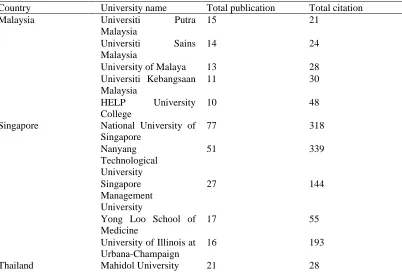
publication rate, with the total of 225 publications in reviewed period, followed by Malaysia with the total of 92 publications and Thailand with the total of 78 publications. Hence, the three most productive countries were identified. From the similar table, Singapore had the most impact or number of citation with the total citation of 1158, followed by Thailand with the total citation of 223 and Malaysia with the total citation of 171. Table 3 summarized the amount of publications and citations for the listed first five universities which appeared in Scopus for each ASEAN countries while Table 4 consisted of the means and standard deviations for Table 3.
Table 3 and Table 4 revealed that universities from Singapore were the most productive universities, followed by Thailand and Malaysia. The most productive university in ASEAN is the National University of Singapore with 77 publications. The same table also reveals that universities from Singapore have the most citations, followed by Thailand and Malaysia. The university with the most citations is Nanyang Technological University with 339 citations. The next Table 5 consists of a summary for the listed five keywords and subject area for each country.
From Table 5, Singapore, Philippines, and Indonesia‟s articles mainly fall into the category of Psychology, while Malaysia, Thailand and Vietnam articles‟ fall into the category of Medicine. Other than that, every country showed consistency in keywords like human, humans and gender. Table 6 consists of mean and standard deviation for each keyword from Table 5.
Table 6 revealed that the most article belong to the subject area of Psychology, following by Medicine, Social Sciences, Business, Management and Accounting, Nursing, Neurosciences, Biochemistry, Genetic and Molecular Biology and Arts and Humanities. The following Table 7 consists of mean and standard deviation for each keywords from Table 5.
Table 7 revealed that most of the most frequent keyword is Article. This suggests that researchers in ASEAN countries focused in producing articles. The next most frequent keyword is Human, followed by Humans, Female, Male, Adult and Vietnam. The next Table 8 recorded the top five productive and impactful researcher from each ASEAN country.
From Table 8, the most productive researcher is Viren Swami from Malaysia, with 11 publications from 2007 till 2011. Researcher who produced the most influential research within the investigated years is Chiyue Chiu from Singapore, with the total citation of 99.
Discussion
From Table, 1 and Table 2, the ranking of the most productive ASEAN country is Singapore, followed by Malaysia and then Thailand. When it comes to quality of publication or impact of publication, Table 3 and Table 4 revealed that Singapore was ranked first, followed by Thailand and Malaysia. The most productive universities with high citation numbers also comes from Singapore, followed by Thailand and Malaysia.
According to Table 5 and Table 6, Singapore, Philippine, and Indonesia‟s articles mainly fall into the subject area of Psychology. This suggests that these three countries have been contributing to the field of psychology, by producing relevant articles. The remaining ASEAN countries, i.e. Malaysia, Thailand and Vietnam‟s articles mainly fall into the category of Medicine. These three countries make limited contribution to the field of psychology except for Vietnam, without any articles in the subject area of Psychology during the review period. However, these three countries may be focusing on the medical values of psychology, unlike Singapore, Philippine and Indonesia which might be producing research which are purely psychology related.
415 the medical value or the clinical implication of
psychology, producing research and journals with the application of psychology into the field of medicine. The third most common subject area is Social Sciences, which include the application of psychology into the society. Overall from Table 5 till Table 6 shows that there are some countries which produced more research which are not related to psychology. However, ASEAN countries still produce a large number of researches which fall under the subject area of Psychology which, suggests that ASEAN countries did produce relevant research to psychology.
From Table 7, the most frequently appear keywords are Article, Human and Gender. This might suggest that most of the ASEAN countries focus much on understanding issues on human and gender. Gender roles or gender differences are the key areas of focus for ASEAN researchers, such as research from Ellis and Awang (2011) and Noor and Zainuddin (2011). Using information from Table 5, Table 6 and Table 7, ASEAN‟s research might be emphasizing more towards social values derived from the conducted research as Social Science is another common subject area, although some of the countries focus on the medical application of psychology. From Table 8, the most productive researcher is Viren Swami from Malaysia, as indicated by Scopus database. Researcher who produce the most impactful research is Chiyue Chiu from Singapore. The appearance of Viren Swami is due to this reseacher‟s collaboration with Malaysian‟s researchers. This finding can be challenged as Viren Swami is not a researcher from ASEAN countries. However, there is no attempt to control the nationality of the researchers. Hence, this finding is reported without any alteration. The findings from Smith et al. (2003) and Kahn (2005) can be used to explain the rankings. As Singapore is more advance as compared with other ASEAN countries, there is no doubt that this country has more resources to attract outstanding researchers and to provide better research facilities. Thus, researchers from this country are able to produce a large number of relevant articles without sacrificing the quality of their
research. However, the size of each faculty is not included in present study. Hence the findings from Stewart et al. (2007) and Mahoney et al. (2010) could not be supported.
With the most productive academic psychologist being a foreigner, this suggests that academic psychologist in ASEAN are less productive. In the field of psychology, ASEAN countries are still dependent on foreign countries which have more established facilities and expertise. Perhaps the population of academic psychologists in ASEAN countries is very small, which explains the exclusion of Myanmar, Laos, Brunei and Cambodia due to small number of published research. The academic psychologist profession is not getting attention from the public, thus only a few received training for this profession. This can be explain by the availability of the program to be trained as an academic psychologist, which is very limited within the ASEAN countries. This in turn limits the capability for researcher to conduct research as well and also training centers which caters for research facilities is rather limited in ASEAN. This study also reveals that the profession of academic psychologist in ASEAN countries is not competitive, as according to Barnard-Brak‟s et al. (2011) finding, productivity increases with competitiveness for job security.
416 Brunei and Cambodia. Thus, the rankings made
earlier reflected on the advancement of psychology in the country. Within ASEAN countries, Singapore is the most advance country in the field of psychology due its first ranking in overall number of publication and citation.
This study can be used as a guide for students in selecting their research supervisors, by understanding the ranking of researchers. Furthermore, this research can be used to guide students or researchers in selecting the most suitable ASEAN country and the most suitable ASEAN universities for training. Other than that, this study also reveals that one of the reasons for low productivity could be explained by the lack of competitiveness of the profession. As the population of academic psychologist can be very small, this profession is not competitive in nature. To increase competitiveness, this research provided the most productive and influential ASEAN country, the most productive and influential researcher, and most productive and influential university in the field of psychology as a start.
A few recommendations to improve productivity are provided in this paragraph. These recommendations were made based on Mayrath‟s (2008) survey on 22 top productive psychologists. One of it is to publish or to work with talented graduate students, which in turn can be productive scholars in the future. Another recommendation is to work with colleagues, who are able to provide honest feedback on the research papers, and enable the exchange of ideas to take place. To plan the whole research beforehand is also important as well, as it will affect the efficiency of the whole research. Researchers need to be well verse within their area of research, continuously learn about the development of the area and the variety of research method and statistics. Scheduling time or manage time to write is important as well but during the period of writing one must be free from all sort of distraction. Setting a deadline for a research project can be used to end a research or to inflict the needed pressure to complete the research. Hence, it plays an important role as well.
However, this study suffers from a few limitations. There is no attempt to control the nationality of the researchers provided by the database, which might provide misleading details about this research. The data were obtained using a single database, which is Scopus, which might be providing data which are bias. Some ASEAN countries might publish their papers in other databases.
Future research can be conducted using multiple databases or local journals within ASEAN countries. The position and gender of each ASEAN researcher can be taken into consideration for future research, by analyzing the effect of gender and position on productivity and number of citation. Other than position and gender, ASEAN researcher‟s experience and incentive can be included as the predictor for productivity. Future research can include a more sophisticated method to measure productivity, using Howard et al. (1987) author-weighted publication formula, which provides different weights for publications authorship order and individual contribution towards a specific publication. Other than that, future research can be conducted on the population of academic psychologist within ASEAN countries in order to accurately identify the number of academic psychologist and to specify their publication and citation.
417 countries did contribute to the field of
psychology to a certain extent, but overall ASEAN countries are not that productive due to
exclusion of a few countries with low publication and citation.
Table-1 Publication and Citation Per Year for Malaysia, Singapore, Thailand, Philippines, Indonesia and Vietnam.
Publication per year(Citation per year)
Year Malaysia Singapore Thailand Philippines Indonesia Vietnam
2011 24(84) 44(485) 7(103) 4(21) 2(29) 0(24)
2010 32(61) 68(387) 17(68) 7(23) 7(25) 5(19)
2009 13(18) 57(193) 21(40) 8(8) 5(8) 2(18)
2008 18(7) 24(77) 19(12) 3(6) 2(2) 8(11)
2007 5(1) 32(16) 14(0) 4(0) 5(0) 5(0)
Total 92(171) 225(1158) 78(223) 26(58) 21(64) 20(72)
Table -2 Mean and Standard Deviation for Table 1
Universities Publication Citation
M SD M SD
Singapore 45.00 17.92 231.60 200.15
Malaysia 18.40 10.31 34.20 36.41
Thailand 15.60 5.45 44.60 41.93
Phillipines 5.20 2.17 11.60 9.96
Indonesia 4.20 2.17 12.80 13.37
Vietnam 4.00 3.08 14.40 9.29
Table-3 Amount of Publications and Citations for the Listed First Five Universities in The Six ASEAN Countries.
Country University name Total publication Total citation
Malaysia Universiti Putra
Malaysia
15 21
Universiti Sains Malaysia
14 24
University of Malaya 13 28
Universiti Kebangsaan Malaysia
11 30
HELP University College
10 48
Singapore National University of Singapore
77 318
Nanyang Technological University
51 339
Singapore Management University
27 144
Yong Loo School of Medicine
17 55
University of Illinois at Urbana-Champaign
16 193
418 Chulalongkorn
University
17 103
Chiang Mai University 9 16
Prince of Songkhla University
6 15
Thailand Ministry of Public Health
4 10
Philippines Ateneo de Manila University
4 14
University of Phillipines Diliman
4 4
Washington State University Pullman
3 20
De La Salle
University-Manilla
3 14
Brock University 2 13
Indonesia University of Indonesia 4 5
Universitas Padjadjaran
4 11
Arizona State
University
2 11
Monash University 2 6
University of Queensland
2 1
Vietnam Karolinska Institutet 4 16
Hanoi Medical University
4 13
Hung Vuong Hospital 2 7
Medical Committee Netherlands Vietnam
2 3
International Centre for Diarrhoel Disease Research Bangladesh
2 8
Table- 4 Mean and Standard Deviation for Table 2
Universities Publication Citation
M SD M SD
Singapore 37.60 26.15 209.80 119.35
Malaysia 12.60 2.07 30.20 10.55
Thailand 12.80 7.40 34.40 38.91
Phillipines 3.20 0.84 13.00 5.74
Indonesia 2.80 1.10 6.80 4.27
Vietnam 2.80 1.10 9.40 5.13
419 Country Subject area (Number of
article)
Keyword (Number of article)
Malaysia Medicine (36) Article (62)
Social Sciences (30) Human (58) Psychology (20) Humans (47)
Nursing (7) Female (44)
Business, Management and Accounting (7)
Male (39)
Singapore Psychology (120) Article (135)
Medicine (65) Human (121)
Social Sciences (47) Humans (113) Business, Management
and Accounting (31)
Male (104) Neurosciences (31) Female (100)
Thailand Medicine (42) Article (65)
Social Sciences (17) Human (64)
Nursing (16) Humans (60)
Psychology (12) Female (53) Biochemistry, Genetic
and Molecular Biology (4)
Adult (45)
Philippines Psychology (10) Article (13)
Medicine (9) Human (12)
Social Sciences (9) Humans (11) Neurosciences (2) Adult (8)
Nursing (2) Female (8)
Indonesia Psychology (8) Article (15)
Social Sciences (8) Human (14)
Medicine (6) Humans (13)
Nursing (4) Female (12)
Agricultural and Biological Sciences (2)
Male (9)
Vietnam Medicine (15) Article (19)
Social Sciences (8) Human (18)
Nursing (5) Humans (18)
Neurosciences (2) Female (15) Arts and Humanities (1) Viet Nam (15)
Table-6 Mean and Standard Deviation for Subject Areas From Table 5
Subject area M SD
Medicine 33.40 22.43
Social sciences 22.20 16.42
Psychology 40.50 53.18
Business,
Management and Accounting
19.00 16.97
Neurosciences 11.67 16.74
Nursing 16 _
Biochemistry, Genetic and
420 Molecular Biology
Arts and
Humanities
1 _
Table-7 Mean and Standard Deviation for Keywords From Table 5
Keywords M SD
Article 51.50 47.20
Human 47.83 42.51
Humans 43.67 39.37
Female 39.33 36.34
Male 24.67 39.88
Adult 8.83 18.00
Vietnam 2.50 6.12
Table-8 Top 5 Researcher From Each ASEAN Countries With The Publication and Citation Country Researcher‟s name Total publication Total citation
Malaysia Swami, Viren 11 19
Furnham, Adrian 5 18
Jennifer, Perera 3 6
Chamorro-Premuzic, Tomas
3 4
Mohamed Rusli bin Abdullah
2 9
Singapore Chiu, Chiyue 7 99
Sim, Kang 5 14
Tong E, M, W 5 6
Kua E. Heok 5 29
Chao, Melody Manchi 5 55
Thailand Pensri, Praneet 3 3
Charoensuk, Sukjai 3 14
Janwantanakul, Prawit 3 3
Arunpongpaisal, Suwanna
3 2
Varma, Jay K. 2 3
Philippines Katigbak, Marcia S. 3 20
Montiel, Christina Jayme
3 1
Church, Austin Timothy
2 20
Reyes, Jose Alberto S. 2 14
Miramontes, Lilia G. 2 10
Indonesia Purwono, Urip 2 11
French, Doran C. 2 11
Eisenberg, Nancy 2 11
Suryanti, Telie Ari 2 11
Prasetya, Paulus Hidajat
1 1
Vietnam Gien, Lan T. 2 1
Gaudine, Alice P. 2 1
421 Margaret
Thuan, Tran T. 2 1
Dung, Do Van 2 1
References
Barnard-Brak, Saxon, T. F., & Johsnon, H. (2011) “Publication productivity among doctoral graduates of educational psychology programs at research universities before and after the year 2000” Educational Psychology Review, Vol.23, No.1, pp. 65-73. Ben-David, D. (2010) “Ranking Israel‟s economists” Scientometrics, Vol.82, pp.351-364.
Buboltz Jr, W. C., Jenkins, S. M., Thomas, A., Lindley, L. D., Schartz, J. P., & Loveland, J .M. (2005) “Research productivity in Counseling Psychology: An update” The Counseling Psychologist, Vol.33, No.5, pp.709-728.
Cargile, B. R., & Bublitz, B. (1986) “Factors contributing to published research by accounting faculties” The Accounting Review, Vol.61, No.3-4, pp.158-178.
Duffy, R. D., Martin, H. M., Bryan, N. A., & Raque-Bogdan, T. L. (2008) “Measuring individual research productivity: A review and development of Integrated Research Productivity Index” Journal of Counseling Psychology, Vol.55, No.4, pp. 518-527. Duffy, R. D., Jadidian, A., Webster, G. D., & Sandell, K. J. (2011) “The research productivity of academic psychologists: Assessment, trends, and best practice recommendations” Scientometrics, Vol.89, No.1, pp. 207-227.
Ellis, L. & Awang, S. N. (2011) “Taxi drivers, cashiers, and restaurant servers: A cross-cultural study of gender differences” Mankind Quarterly, Vol.52, No.1, pp. 90-99.
Howard, G. S., Cole, D. A., & Maxwell, S. E. (1987) “Research productivity in psychology based on publication in the journals of the American Psychological Association” American Psychologist, Vol.42, No.11, pp. 975-986.
Hsieh, P. H., Acee, T., Chung, W. H., Hsieh, Y. P., Kim, H., Thomas, G. D., You, J, I., & Robinson, D. H. (2004) “An alternate look at educational psychologist‟s productivity from
1991 to 2002” Contemporary Educational Psychology, Vol.29, No.3, pp. 333-343. Kahn, J. H. (2005) “Institutional research productivity, use of theory-driven research, and statistical application in counseling psychology: Examining the research base” The Counseling Psychologist, Vol.33, No.3, pp.340-348. Li, L. L., Ding, G. H., Feng, N., Wang, M. H., & Ho, Y. S. (2009) “Global stem cell research trend: Bibliometric analysis as a tool for mapping of trends from 1991 to 2006” Scientometrics, Vol.80, No.1, pp.41-60. Mahoney, K. T., Buboltz, W. C., Calvert, B., & Hoffmann, R. (2010) “Research productivity in select psychology journals, 1986-2008” The Journal of Psychology, Vol.144, No.4, pp. 361-411.
Malouff, J., Schutte, N., & Priest, J. (2010) “Publication rates of Australian academic psychologists” Australian Psychologist, Vol.45, No.2, pp. 78-83.
Mayrath, M. C. (2008) “Attribution of productive authors in educational psychology journals” Educational Psychology Review, Vol.20, No.1, pp. 41-56.
McNally, G. P. (2010) “Scholarly productivity, impact, and quality among academic psychologists at Group of Eight Universities” Australian Journal of Psychology, Vol.62, No.4, pp.204-215.
Meyer, B. (2007) “Do clinical researchers believe they should be clinically active? A survey in the United States and the United Kingdom. Psychology and Psychotherapy: Theory” Research and Practice, Vol.80, No.4, 543-561.
Noor, N. M. & Zainuddin, M. (2011) “Emotional labor and burnout among female teachers: Work-family conflict as mediator” Asian Journal of Social Psychology, Vol.14, No.4, pp. 283-293.
422 Smith, M. C., Plant, M., Carney, R. N.,
Arnold, C. S., Jackson, A., Johnson, L. S., Lange, H., Mathis, F. S., & Smith, T. J. (2003) “Productivity of educational psychologists in educational psychology journals, 1997-2001” Contemporary Educational Psychology, Vol.28, No.3, pp.422-430.
Sombatsompop,N., Markpin, T., Ratchatahirun, P., Yochai, W., Ittiritmeechai, S., Premkamolnetr, N., & Wongkaew, C. (2011) “Research productivity and impact of ASEAN countries and universities in the field of energy and fuel” Malaysian Journal of Library & Information Science, Vol.16, No.1, pp.35-46.
Spector, P. E. (2008) Industrial and Organizational Psychology (5th ed.). United States of America: John Wiley & Son, Inc. Stewart, P. K., Roberts, M. C., & Roy, K. M. (2007) “Scholarly productivity in Clinical Psychology PhD Programs: A normative assessment of publication rates” Clinical Psychology: Science and Practice, Vol.14, No.2, pp. 157-171.
Stewart, P. K., Wu, Y. P., & Roberts, M. C. (2007) “Top producers of scholarly publications in Clinical Psychology PhD programs” Journal of Clinical Psychology, Vol.63, No.12, pp. 1209-1215.