IJEDR1803021
International Journal of Engineering Development and Research (
www.ijedr.org
)
110
Loading by Using Staad-Pro Software
1Kapil Dev Mishra, 2Dr A. K. Jain
¹ P.G. Student, ² Head of The Department
¹ Department of Civil Engineering, N.I.T.T.T.R. Bhopal, M.P.
Abstract - Floating columns are a typical feature adopted in the modern age multi-storey building construction These floating columns reduces the efficiency of the building to resist seismic forces up to large extent, that is why these are the extremely undesirable unit in the seismic prone areas. In this paper, a multi storied Plaza building of storey (G+2+3) having different position of floating columns(4 columns of mid ordinate axis or 4 columns of diagonal axis) at different height of building( at the level above second floor) at two different zones (ZONE III and ZONE IV)are considered for analysis. The plan area of building up to second floor is 30m×30m and above this floor area is reduced to 20m×20m. Height up to second floor of the building is used for parking or commercial shops having floor height of 4m and above this it is used for residential and office purpose. Different combinations of office and residential floors are considered. Floating columns are provided at office floor. These are the following consideration where comparison is done based on results from the software, Support reaction at the base, maximum moment at the joint.
Keywords - STAAD Pro, Base Shear, PLAZA Building, Seismic Analysis, Floating Columns, Bending Moment etc.
1 INTRODUCTION
In the twenty-first century the population of the world is increasing at very fast rate in this situation it is imperative to design urban life spaces in accordance to the needs of modern time. Now earlier concept of horizontal development is becoming obsolete due to space constraint. Adoption of vertical system (high rise buildings, plaza buildings, shopping malls) is need of the hour. The structure which provides facility of commercial public recreation along with residential space is called Plaza building. These are the structure which fulfils the requirements of wide variety of users for various purposes. This space acts as a junction point to meet all the basic facilities for various communities such as providing homes for public art, settings for recreation and relaxation, and inconspicuous security.
Most urban dwellers in the world are facing one common challenge; the challenge of commuting from one place to another, the problem is further aggregated during peak hours. When scours of commuters rush for their offices, often resulting in traffic jams and congestion, one radical solution being worked upon to tackle the problem of congestion is to design and build multipurpose composite buildings with offices and residential apartments in the same building. One of the solutions being suggested could be the plaza building in which extensive use of floating columns or walls considering different requirement of various residential and commercial spaces can be used.
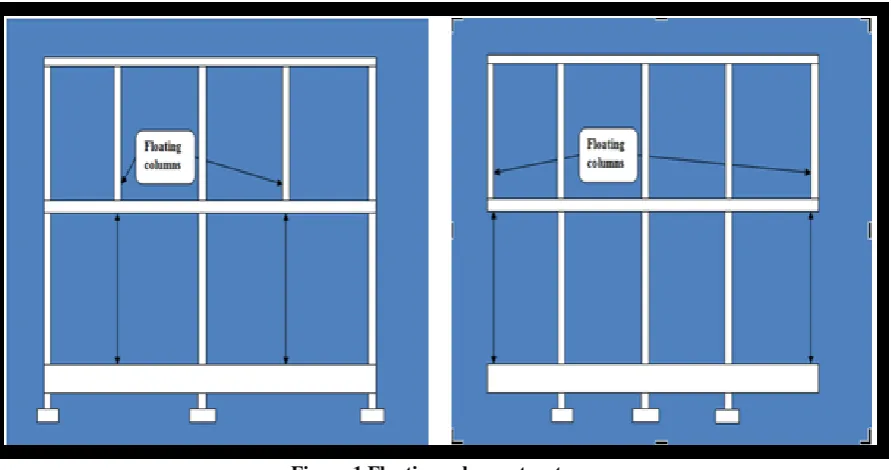
Now a day's multi-storey buildings constructed for the purpose of residential, commercial, industrial or any other purpose. Floating column has become a common feature. For a hotel or commercial building, where the floors contain conference rooms, banquet halls, lobbies, parking areas or show rooms, large interrupted space is required for the movement of people or vehicles. The columns which are closely spaced in the floors above are not advisable in such floors. So to avoid this problem, floating column concept has come into practise.
IJEDR1803021
International Journal of Engineering Development and Research (
www.ijedr.org
)
111
Figure 1 Floating column structure2 LITERATURE REVIEW
There are several studies done before on the effect of floating column. Some of the literature related to the topic is as follows Ms. Waykule S. B. (2017) conducted static analysis for a multi-storey building with and without floating columns. Different cases of the building are studied by varying the location of floating columns floor wise. The structural response of the building models with respect to, Base shear, and Storey displacements is investigated. The author investigated the structural response of the building with respect to this. The analysis is carried out using software sap 2000. It was observed that displacement of each storey of floating column building is more as compared to without floating column building. Sreekanth Gandla Nanabala et al. (2015) carried out analysis for G+ 5 structures with two conditions, one with floating column and another without floating column. The complete analysis is done with the help of the software SAP2000. The software is used to analyze whether the structure is safe or not with floating column and also analyzed the economic value of the floating column in seismic zone area. He found that building with floating column has large displacement as compared to without floating column building and he concluded that floating columns are unsafe for construction. Prerna Nautiyal et al. (2014) investigated the effect of a floating column under earthquake excitation for various soil conditions and as there is no provision or magnification factor specified in I.S. Code, hence the determination of such factors for safe and economical design of a building having floating column. Linear Dynamic Analysis is done for 2D multi storey frame with and without floating column to achieve the above aim i.e. the responses (effect) and factors for safe and economical design of the structure under different earthquake excitation. They found that the magnitude of base shear is higher for medium soil then hard soil. Sampath Kumar M. P. (2016) analyzed two types of building which include mass irregular and soft story buildings in zone V for the effect of floating column. To attain the above objective the author considered the six G+15 stories RC bare frame structure having the column height of 3 meter and 4 meter. The software ETABS 9.7.4 was used to compare base and mass shear of soft storey and mass irregular structure. He found that the displacement is higher in floating column building as compared to non floating column building. He also found that lateral displacement increases with the height of the building and base shear for floating column building are higher than non floating column buildings. Sabari S. (2015) studied the importance of explicitly recognizing the presence of the Floating Column in the analysis of building. Alternate measures, involving stiffness balance of the first storey and the storey above, are proposed to reduce the irregularity introduced by the Floating Columns. FEM analysis carried for 2D multi storey frames with and without floating column to study the responses of the structure under different earthquake excitation having different frequency content keeping the PGA and time duration factor constant. The time history of roof displacement, inter storey drift, base shear, column axial force are computed for both the frames with and without Floating Column. The dynamic analysis of frame is studied by varying dimension of column. It is concluded that by increasing column size maximum displacement and inter storey drift can be reduced.
3 METHODOLOGY For the seismic analysis of structure was done using STAAD Pro software Following sequence has been followed to analyze them using STAAD .PRO :- Step-1 Start the STAAD PRO and Designing the Types of Structures and Unit. Step-2 Preparing the Model Structure
The plaza building considered has ground floor + 2 commercial floors + 3 more floors(having different arrangement of office and residential floor as mentioned below)
Structure Detail of the Plaza Building Plan area- (30x30)𝑚2
IJEDR1803021
International Journal of Engineering Development and Research (
www.ijedr.org
)
112
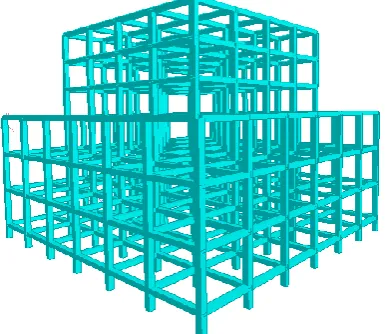
Figure 2, Plan Of Framed ModelFigure 3, Elevation Of Framed Model
Figure 4, Rendered Isometric View Of Framed Model
Model 1: Have ground floor + 2 commercial floors +office + residential + residential floor, Model 2: Have ground floor + 2 commercial floors + residential +office + residential floor, Model 3: Have ground floor + 2 commercial floors + residential + residential +office floor.
In each model group of four floating columns are provided at office floor only. Further there are two types of possible arrangement of floating columns either at mid ordinate position or at diagonal position .
• Arrangement of normal and residential floor columns are as follows:
Figure 5, rendered view of residential floor columns
IJEDR1803021
International Journal of Engineering Development and Research (
www.ijedr.org
)
113
Figure 6, rendered view of mid-ordinate arrangement of floating columns of office floor• Arrangement of office floor columns having Diagonal Orientation of floating columns are as follows:
Figure 7, rendered view of diagonal orientation of floating columns office floor
Step-3 Defining the General Parameters Step-4 Defining the Support for the Structure
Step-5 Defining the seismic load and other parameters related to seismic analysis. Load Case Details
In the analysis of structure various types of loading conditions studied are given below :- 1. Static Load :-
A. Dead load (IS 875 : part I)
Dead loads are external loadings act vertically downward and arise due to self-load of the structure. These include weight of beams columns, slabs floor finish wall load etc.
These are calculated by multiplying cross sectional area by their densities Densities of the following material are used:
Density of RCC member:25kN/𝑚3 Density of brick wall: 19.2kN/𝑚3 B. Live load ( IS 875: part II & IV )
The load which changes their position and magnitude and act vertically downward on the structure are called live load such as load on roof etc.
C. Load combinations :(IS 875 Part V) 2. Seismic load [IS :1893(2002)]
When ground motion is subjected to structure, structure responds in shaking fashion. The motion of structure in random in all possible direction and for analysis it is resolved in two directions horizontal(X) and vertical directions(Y).Due to this motion structure vibrate in all three directions.
The seismic force is evaluated as per IS:1893(2002).
Here Zone III and Zone IV are selected with following details. (i) Response Reduction factor:3
(ii) Importance factor:1 (iii) Damping:5%
(iv) Soil type: Medium Soil
Step-6 Structural Analysis of the Structure.
Step-7 Comparative Analysis of Results In Terms Of Bending Moment, Maximum Reaction. Step-8 Critical Study of Results.
4 RESULTS
Results of static seismic analysis of mentioned cases for zone III and zone IV are as follows :
IJEDR1803021
International Journal of Engineering Development and Research (
www.ijedr.org
)
114
model 3232.43 346.62 Without Floating model
172.18 244.86
Table-2 For Maximum Bending Moment (in kN-m) [Diagonal orientation of floating columns]
type of structure
Zone III Zone IV
model 1
182.12 271.37 model 2
211.09 312.16 model 3
233.18 347.86 Without Floating model
172.18 244.86
Table-3 For Maximum Support Reaction (in kN) [Mid-Ordinate orientation of floating columns]
type of structure
Zone III Zone IV
model 1
3398.63 3398.63 model 2
3424.1 3424.1 model 3
3104.51 3104.57 Without Floating model
2949.39 2949.39
Table-4 For Maximum Support Reaction (in kN) [Diagonal orientation of floating columns] No table of figures entries
found. Zone III Zone IV
model 1
3333.29 3333.29 model 2
3378.4 3378.4 model 3
3004.06 3004.06 Without Floating model
2949.39 2949.39
IJEDR1803021
International Journal of Engineering Development and Research (
www.ijedr.org
)
115
5 CONCLUSIONSOn the results mentioned above of study the following conclusions can be made;
➢ Maximum Bending Moments as well as Maximum Support Reaction for the structures having floating columns are higher than that of structures without floating columns.
➢ Maximum Bending Moments at seismic Zone IV are greater than that of Zone III.
➢ Structures having floating column constructed in Zone IV are more affected by earthquake than Zone III.
REFERENCES
[1]. Ms.Waykule S.B et al. Comparative Study of floating column of multi storey building by using software Int. Journal of Engineering Research and Application www.ijera.com ISSN : 2248-9622, Vol. 7, Issue 1, ( Part -3) January 2017, pp.31-
[2]. Sreekanth Gandla Nanabala , Pradeep Kumar Ramancharla , Arunakanthi E, Seismic Analysis of A Normal Building Floating Column Building, International Journal of Engineering Research & Technology (IJERT),ISSN: 2278-0181Vol. 3 Issue 9, September- 2015.
[3]. Prerna Nautiyal A et al "Seismic Response Evaluation of RC frame building with Floating Column considering different Soil Conditions" International Journal of Current Engineering and Technology E-ISSN 2277 – 4106, P-ISSN 2347 - 5161 ©2014 INPRESSCO®, All Rights Reserved Available at http://inpressco.com/category/ij
[4]. Sampath Kumar M.P , V.S.Jagadeesh , ” EFFECT OF FLOATING COLUMNS ON SEISMIC RESPONSE OF MULTISTORY BUILDING” International Research Journal of Engineering and Technology (IRJET) eISSN: 2395 -0056 Volume: 03 Issue: 09 | Sep -2016
[5]. Sabari S. et al " Seismic Analysis of Multi storey Building with Floating Column" International Journal of Civil and Structural Engineering Research ISSN 2348-7607 (Online) Vol. 2, Issue 2, pp: (12-23), Month: October 2014 - March 2015, Page | 12
[6]. Mamidala Ashwini & Dr.Md.Subhan (2017) " Comparison Of Buildings With And Without Floating Columns By Using Staad Pro" International Journal of Research, Volume 04 Issue 14, November 2017.
[7]. Ms.Waykule S.B et al. Comparative Study of floating column of multi storey building by using software Int. Journal of Engineering Research and Application www.ijera.com ISSN : 2248-9622, Vol. 7, Issue 1, ( Part -3) January 2017, pp.31-
[8]. Bureau of Indian Standards: IS-875,Part 1, Dead loads on buildings and structures, New Delhi, India, 1987 [9]. Bureau of Indian Standards: IS-875,Part 1, Live loads on buildings and structures, New Delhi, India, 1987
[10]. Bureau of Indian Standards: IS-1893,Part 1, Criteria for earthquake resistant design of structures; Part 1, General provisions and Buildings, New Delhi, India, 2002