Height as a Marker of Childhood Development and Late-life Cognitive
Function: The Honolulu–Asia Aging Study
Robert D. Abbott, PhD*i¶; Lon R. White, MD‡; G. Webster Ross, MD§¶; Helen Petrovitch, MDi¶; Kamal H. Masaki, MDi¶; David A. Snowdon, PhD#; and J. David Curb, MDi¶
ABSTRACT. Objective. Growing evidence suggests that structural and functional brain reserves, thought to develop in childhood and adolescence, may be crucial in determining when cognitive impairment begins. The purpose of this report is to examine the relationship of height, as a marker of childhood development, to late-life cognitive function in a sample of elderly Japanese-Amer-ican men.
Method. Cognitive performance was assessed from 1991 to 1993 in the Honolulu–Asia Aging Study in 3733 men aged 71 to 93 years and related to height that was measured 25 years earlier.
Results. Among the study sample, shorter men were older, leaner, and less educated than taller men. Shorter men also spent more years of their childhood living in Japan and were more likely to have had fathers in un-skilled professions. After adjustment for age, the preva-lence of poor cognitive performance declined consis-tently with increasing height from 25% in men shorter than 154 cm (61 in) to 9% in those taller than 174 cm (69 in). Excluding men with stroke or dementia did not alter the association between height and cognitive perfor-mance. Apolipoprotein E4 was unrelated to height and did not effect the association between height and cogni-tive function. The prevalence of Alzheimer’s disease was higher in men who were 154 cm (61 in) or shorter as compared with men who were taller (4.7% vs 2.9%, re-spectively). There was no association between height and vascular dementia.
Conclusion. Efforts to improve prenatal and early life conditions to maximize growth in childhood and adoles-cence could diminish or delay the expression of cognitive impairments that occur later in life. Prevention of some late-life cognitive impairments may have pediatric ori-gins. Pediatrics 1998;102:602– 609; dementia, cognitive function, childhood development.
A
lthough the processes leading to dementia are complex, specific factors that modulate its clinical expression are almost entirely unde-fined. There is growing evidence, however, thatstructural and functional brain reserves, thought to develop in childhood and adolescence, may be cru-cial in determining when cognitive impairment be-gins.1–5If correct, these findings suggest that cogni-tive impairment and dementia in late life could be more frequent among elderly persons who experi-enced nutritional, educational, or social deprivation during childhood. Such reports further suggest that effective strategies for reducing the frequency of clin-ically apparent Alzheimer’s disease in late life may involve maximizing brain reserves through public health measures that optimize childhood growth and development. The purpose of this report is to exam-ine height in middle life, as a marker of childhood conditions that promote growth, in relation to late-life cognitive function and dementia in a large group of elderly Japanese-American men living in Hawaii.
MATERIALS AND METHODS Study Sample
The Honolulu–Asia Aging Study began in 1991 as a prospective study of aging and cognition in a sample of Japanese-American men who were originally enrolled in the Honolulu Heart Program from 1965 to 1968.6Men who comprised the original cohort were
either immigrants or the progeny of immigrants from Japan who migrated to Hawaii as contract laborers in the sugar and pineap-ple industries. Most came from the rural districts of a few prefec-tures in southern Japan. Many of the men of the migrating gen-eration remained in Hawaii at the close of their contracts where they worked as artisans, merchants, and independent farmers. The second generation continued in these trades, although others gained in affluence and worked in professions that were less physically demanding.
The original cohort included 8006 men. During the time of study enrollment (1965 to 1968), study participants received a baseline physical examination, including the collection of data on standing height, body mass index (kg/m2), educational
attain-ment, place of birth, years lived in Japan, and father’s occupation. Height was measured to the nearest inch in all but 3 men. Proce-dures followed were in accordance with institutional guidelines and approved by an institutional review committee. Informed consent was obtained from the study participants.
Among the members of the original cohort, 3734 received screening examinations for dementia and cognitive performance 25 years later from 1991 to 1993. To account for genetic suscepti-bility to Alzheimer’s disease,7frequency of apolipoprotein E4 was
also determined based on plasma protein phenotyping by the Northwest Lipid Research Laboratories in Seattle, Washington. After excluding 1 man whose height was not available, analysis was based on 3733 men. Those screened for dementia comprised
;80% of the surviving members of the original cohort enrolled into the Honolulu Heart Program.
Measurement of Cognitive Performance
Cognitive performance was assessed using the Cognitive Abil-ities Screening Instrument, which was developed and validated From the *Division of Biostatistics and Epidemiology, Department of
Health Evaluation Sciences, University of Virginia School of Medicine, Charlottesville, Virginia; ‡the National Institute on Aging, Bethesda, Mary-land; the §Department of Veteran’s Affairs, Honolulu, Hawaii; thei Hono-lulu–Asia Aging Study, Kuakini Medical Center, Honolulu, Hawaii; the ¶Department of Medicine, John A. Burns School of Medicine, University of Hawaii, Honolulu, Hawaii; and the #Sanders-Brown Center on Aging and the Department of Preventive Medicine, College of Medicine, University of Kentucky, Lexington, Kentucky.
Received for publication Jan 12, 1998; accepted Apr 14, 1998.
for use in cross-cultural studies as a brief but comprehensive measure of intellectual function. It is a composite of the Folstein Mini-Mental State Examination,8the Modified Mini-Mental State
Examination,9the Hasegawa Dementia Screening Scale,10and
ad-ditional items to assess judgment and language fluency.11,12Scores
range from 0 to 100 with 100 indicating optimal cognitive perfor-mance. For this report, poor cognitive performance is defined as a score less than 74. Scores below this value were selected a priori as an indicator of possible dementia during the first stages of demen-tia case-finding.13 For men who were ultimately diagnosed as
having dementia, 96% had screening scores under 74. For men without dementia, 11% had screening scores under 74. The value of 74 corresponds closely to a score of 22 on the Mini-Mental State Exam.
Diagnosis of Dementia
Cases of dementia were identified using a three-phase screen-ing and evaluation system that has been described previously.13A
diagnosis of dementia was based on an evaluation by a neurolo-gist that consisted of a history from a family informant, a stan-dardized neuropsychologic evaluation, and a neurologic exami-nation. Laboratory findings and computed tomography were also used for the classification of dementia. Final diagnoses were as-signed by a consensus panel consisting of a neurologist and three other physicians with expertise in dementia. Participants with dementia met the criteria of theDiagnostic and Statistical Manual of Mental Disorders(3rd ed, revised).14Research criteria established
by the National Institute of Neurological and Communicative Disorders and Stroke and the Alzheimer’s Disease and Related Disorders Association were used in the diagnosis of Alzheimer’s disease.15 For this report, Alzheimer’s disease was defined to
include all persons whose diagnosis was probable or possible and was considered to be the primary cause of the dementia.13
Diag-noses of vascular dementia used the California criteria.16Vascular
dementia included probable or possible cases in which a vascular cause was considered the primary contributing factor.
Statistical Methods
The relationship of height to poor cognitive performance and dementia was examined through the use of logistic regression models.17For comparison of cognitive performance and each
de-mentia outcome across height strata, rates were adjusted for age and early childhood exposures including years of childhood lived in Japan, level of education, and father’s occupation (skilled ver-sus unskilled).18 Prevalence of poor cognitive performance by
height is also given for men without stroke or dementia. Here, stroke is defined to include events with either a hemorrhagic of thromboembolic origin that preceded the cognitive screening ex-amination. Further description of the definition of stroke is pro-vided elsewhere.19Proportional hazards regression models were
also used to examine the effect of height on survival from the time of study enrollment (1965–1968) among all cohort members.20
RESULTS
At the time height was measured (1965–1968) in the 3733 men who were later screened for dementia (1991–1993), the average age was 52.7 6 4.7 years. The average age at the time of screening was 77.86 4.7 years. In this group, 586 (16%) had poor cognitive performance and 226 (6%) had dementia. Alzhei-mer’s disease was the sole or primary cause in 118 cases and vascular dementia was the sole or primary cause in 80 cases.
In Table 1, the distribution of age and childhood exposures are given according to height based on information that was collected at the time of study enrollment (1965–1968). In each instance, age, the percentage of men born in Japan, and the number of childhood years spent in Japan declined significantly with increasing height (P,.001). As compared with men who were 173 cm (68 in) or taller, those who were 152 cm (60 in) or shorter were nearly 5 years older. Nearly 20% of the shortest men were born in Japan versus only 2% of the tallest men. On average, the tallest group of men spent 6 months of their childhood in Japan as compared with more than 5 years for the shortest men.
Height was also consistently and significantly (P, .001) related to the percent of men whose fathers were in skilled professions and to level of education. For men who were 173 cm (68 in) or taller, 43% had fathers in skilled professions versus 23% for men who were 152 cm (60 in) or shorter. Men in the shortest group, on average, received no more than an intermediate or junior high school level of education as compared with the tallest group of men who tended to be at least high school graduates. Height was unrelated to frequency of apolipoprotein E4.
Table 2 compares the sample of men who had poor and acceptable cognitive performance based on the screening examination which occurred from 1991 to 1993. Comparisons are also made between men who were screened and not screened for dementia. Among the latter group, 3374 died before the cogni-tive screening examination took place. The remain-ing 896 men either declined to be examined or could
TABLE 1. Mean Age and Childhood Exposures According to Standing Height of the Men Screened for Dementia*
Height (cm)
n Age† (y)
Born in Japan (%)†
Years of Childhood Spent
in Japan†
Fathers in a Skilled Profession (%)‡
Education§ Presence of Apolipoprotein
E4 (%)
#152 (#60)¶ 163 55.8 19.0 5.3 23.0 2.0 16.2
155 (61) 219 54.6 15.1 4.5 27.6 2.3 10.7
157 (62) 401 53.7 10.7 2.8 30.7 2.5 15.2
160 (63) 579 53.1 7.9 2.2 35.6 2.6 15.9
163 (64) 677 52.7 6.2 2.0 32.6 2.6 17.7
165 (65) 592 52.0 4.2 1.4 39.6 2.8 15.9
168 (66) 511 51.9 4.5 1.2 40.4 2.8 16.8
170 (67) 303 51.8 3.3 0.7 43.8 3.0 15.7
$173 ($68) 288 51.0 2.1 0.5 42.9 3.1 20.2
Overall 3733 52.7 6.9 2.0 36.0 2.7 16.3
* Height, age, and the childhood exposures were recorded at the time of study enrollment (1965–1968). Apolipoprotein E4 was determined at the time of screening for cognitive impairment (1991–1993).
† Age, percent of men born in Japan, and years of childhood spent in Japan decline significantly with increasing height (P,.001). ‡ Percentage of men with fathers in a skilled profession increases significantly with increasing height (P,.001).
§ Education is recorded as the highest level of education achieved (05none, 15primary, 25intermediate or junior high school, 35
not be scheduled to participate in a screening exam-ination.
Among the men screened for dementia, those with poor cognitive performance were 4 to 5 years older and had heights that were 3 cm (1 in) less than men with acceptable cognitive performance (P , .001). Twenty-one percent of the men with poor cognitive performance were born in Japan as compared with 4% of men with acceptable cognitive performance (P , .001). Men with poor cognitive performance spent significantly more years of their childhood in Japan and were less educated (P,.001). Among the men with acceptable cognitive performance, 38% had fathers in skilled professions as compared with 26% of the men with poor cognitive performance (P,.001).
Similar comparisons exist between men with poor
cognitive performance and those who were alive but not screened for dementia. Except for age and the percent of men born in Japan, this is also the case when comparing men who died before being screened for dementia with those who had poor cognitive performance. Frequency of apolipoprotein E4 was only slightly higher in men with poor versus acceptable cognitive performance.
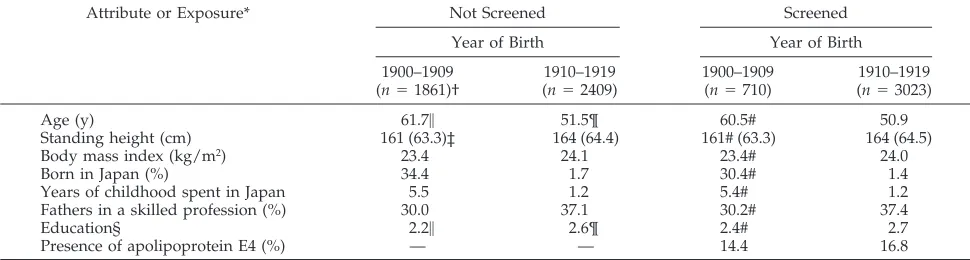
Factors considered in Table 2 are described in Ta-ble 3 for men who were born from 1900 to 1909 versus men who were born from 1910 to 1919. For men who were screened for dementia, those born later were, on average, 3 cm (1 in) taller than men born earlier (P, .001). In addition to being shorter, the men who were older were also significantly leaner, although the difference was modest (P , .001). It was also uncommon for men in the younger TABLE 2. Means and Percents of Physical Attributes and Childhood Exposures in the Men Who Were Screened for Dementia by Their Level of Cognitive Performance as Compared With the Men Who Were Not Screened But Who Were Original Cohort Members
Attribute or Exposure‡ Not Screened Screened
Status at Time of Screening Cognitive Performance at Screening
Alive (n5896)§
Dead (n53374)
Acceptable* (n53147)
Poor† (n5586)
Age (y) 53.1# 56.7 52.0# 56.5
Standing height (cm) 163# (64.1)\ 162# (63.9) 164# (64.5) 161 (63.4)
Body mass index (kg/m2) 23.9 23.8 23.9 23.7
Born in Japan (%) 7.8# 18.1 4.3# 21.0
Years of childhood spent in Japan 2.1# 3.3# 1.5# 4.7
Fathers in a skilled profession (%) 36.3# 33.4# 37.9# 25.7
Education¶ 2.4# 2.4# 2.8# 1.9
Presence of apolipoprotein E4 (%) — — 16.1 17.8
* A score of 74 or higher on the Cognitive Abilities Screening Instrument. † A score of under 74 on the Cognitive Abilities Screening Instrument.
‡ Except for apolipoprotein E4, attributes and exposures correspond to levels that were observed at the time of study enrollment (1965–1968). Apolipoprotein E4 was only determined in men who underwent screening for cognitive impairment (1991–1993). § Number of men.
\Corresponding value in inches.
¶ Education is recorded as the highest level of education achieved (05none, 15primary, 25intermediate or junior high school, 35
high school, 45technical school, and 55university).
# Significantly different from men who had poor cognitive performance (P,.001).
TABLE 3. Means and Percents of Physical Attributes and Childhood Exposures in the Men Who Were Screened for Dementia According to When the Men Were Born as Compared With the Men Who Were Not Screened But Who Were Original Cohort Members
Attribute or Exposure* Not Screened Screened
Year of Birth Year of Birth
1900–1909 (n51861)†
1910–1919 (n52409)
1900–1909 (n5710)
1910–1919 (n53023)
Age (y) 61.7\ 51.5¶ 60.5# 50.9
Standing height (cm) 161 (63.3)‡ 164 (64.4) 161# (63.3) 164 (64.5)
Body mass index (kg/m2) 23.4 24.1 23.4# 24.0
Born in Japan (%) 34.4 1.7 30.4# 1.4
Years of childhood spent in Japan 5.5 1.2 5.4# 1.2
Fathers in a skilled profession (%) 30.0 37.1 30.2# 37.4
Education§ 2.2\ 2.6¶ 2.4# 2.7
Presence of apolipoprotein E4 (%) — — 14.4 16.8
* Except for apolipoprotein E4, attributes and exposures correspond to levels that were observed at the time of study enrollment (1965–1968). Apolipoprotein E4 was only determined in men who underwent screening for cognitive impairment (1991–1993). † Number of men.
‡ Corresponding value in inches.
§ Education is recorded as the highest level of education achieved (05none, 15primary, 25intermediate or junior high school, 35
high school, 45technical school, and 55university).
cohort to have been born in Japan as compared with men in the older cohort (1% vs 30%;P,.001). Older men lived in Japan as children more than four times longer than younger men (P,.001). Older men were less likely to have had fathers in a skilled profession and they were less educated as well (P , .001). Frequency of apolipoprotein E4 was unrelated to when the men were born.
In comparisons between men within the same 10-year birth cohort (1900 –1909 and 1910 –1919), men who were not screened for dementia were signifi-cantly older and less educated than men who were screened (P , .001). Differences in the other at-tributes and exposures were not statistically signifi-cant.
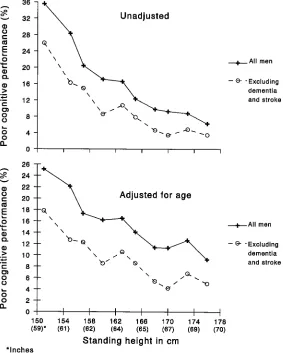
Figure 1 illustrates the relationship between height and poor cognitive performance. After adjustment for age, the prevalence of poor cognitive perfor-mance declined consistently with increasing height (P,.001) from 25% in men shorter than 154 cm (61 in) to 9% in those taller than 174 cm (69 in). After removing men diagnosed with dementia and stroke, the association between height and poor cognitive performance remained (P,.001). Here, poor cogni-tive performance occurred in 18% of the shortest men and declined to 5% in those who were the tallest.
Figure 2 provides similar data for dementia (all causes combined) and for Alzheimer’s disease and vascular dementia. After adjustment for age, the prevalence of dementia declined from 8% in men
shorter than 154 cm (61 in) to ,3% in those taller than 174 cm (69 in). Perhaps because of small num-bers, the association with dementia from all causes combined is not statistically significant (P5.101), as is the case for Alzheimer’s disease (P 5 .064) and vascular dementia (P 5 .655). Alzheimer’s disease, however, was significantly more common in men 154 cm (61 in) or shorter as compared with those who were taller (4.7% vs 2.9%, respectively;P5 .018).
To address the possibility that observations might have been the result of taller men failing to live as long as those who were shorter, data were further analyzed to describe the relationship of height to death among the entire group of men who received the baseline examination from 1965 to 1968. After adjustment for age, the association between height and mortality was absent, with men of all heights having similar risks of death.
DISCUSSION
Growth of the brain is greatest during late gesta-tion and in the early years of life.21–23 Although ge-netics has an influence on its development, environ-mental factors such as malnutrition, poverty, neglect, infection, and stress may also have a role in the full expression of structural and functional brain re-serves.24 –26 Maternal height, as a genetic or environ-mental marker, has also been related to infant length and head circumference with uncertain effects on intelligence in early life.27,28 Malnutrition, however,
may be the most important modifiable determinant of stunting and early cognitive development.26,29,30 Animal studies have also suggested that malnutri-tion has an adverse effect on specific regions of the brain, including the hippocampus,31 an important structure for memory formation, and in humans, a region of the brain that is effected by early Alzhei-mer’s disease. Low birth weight has further been related to deficits in cognition,24and small head size and short stature have been related to poor intelli-gence testing in schoolchildren.29,30In children with-out neurologic abnormalities, small head size at 8 months was associated with poor cognitive perfor-mance at 8 years of age.29It has also been noted that the impact of these deficits may be greatest in disad-vantaged urban communities where rates of low birth weight infants are especially high.24 Although some effects are thought to be reversible, even subtle failures in growth potential may have unknown long-term consequences on cognitive function later in life.
Although assessment of specific public health in-tervention programs to improve childhood and ad-olescent development needs encouragement, long-term effects on late-life cognition in areas in which childhood stress and deprivation are highest may be impossible to evaluate. Nevertheless, arguments have been made that prenatal and early life expo-sures could partially influence the clinical expression
of Alzheimer’s disease, particularly in those who are most vulnerable.1,3,4 Others have argued that atten-tion to nutriatten-tion and factors that promote growth should be extended to the adolescent as well.32 Al-though attention to the progression of patterns of growth that include weight, height, and head cir-cumference is important, it needs to be routinely accompanied by the often difficult task of identifying and altering nutrition and environmental factors that might deter growth potential within the family or community.26,33
Such attention could have real benefits if improve-ments can be made in the health and environment of high-risk children. Indeed, increases in food produc-tion and its distribuproduc-tion, along with improvements in medical care and quality of life, may be partly re-sponsible for increases in human brain weight and head circumference that have been observed to occur during the century.4,21,22 Data from Hawaii indicate that height is also increasing in younger birth co-horts. In addition, younger men in Hawaii had greater body mass index than those who were older, suggesting that increases in height throughout time are related to improved nutrition. Because poor nu-trition and stress in childhood can influence height, brain growth, and cognitive capacities, one might suspect that these same childhood exposures, by vir-tue of their effect on attained brain reserves, could Fig 2. Unadjusted and age-adjusted rates of
also influence the expression of brain aging and de-menting diseases in late life.1–3,24 –26,29,30
Support for this latter possibility is based on the observation that education and occupation tend to have an association with the development of brain reserves and clinically apparent Alzheimer’s dis-ease.1,2 Investigators from Seattle and New York observed that small head size was a determinant of the severity of Alzheimer’s disease.4,5 In Seattle, small head circumference was more common in poorly educated persons who lived their early lives in Japan and who were presumed to have migrated to the United States in an effort to im-prove their socioeconomic status. Similar phenom-ena could have occurred in the Honolulu cohort where a high proportion of subjects may have achieved a limited adult body and head size that cannot be entirely attributed to genetic predispo-sition. In a third report linking childhood intellec-tual development to late-life brain degeneration, investigators described an association between the density of neocortical neurofibrillary tangles at death and high verbal idea density in essays writ-ten on enrollment into a Catholic order more than a half century earlier.3
It is not clear how these factors relate to the de-clines in brain weight that progressively occur after 50 years of age.22,23Perhaps the effects of this decline on cognitive function are too subtle or harder to detect in individuals who have developed maximum brain reserves. Case detection in those with high levels of education or in those in highly skilled pro-fessions may also be more difficult because of delays in subtle pathologic changes that precede neurofi-brillary tangles and neuritic plaques in Alzheimer’s disease.
Of course, a definitive examination of the direct consequence of prenatal and early childhood devel-opment on late-life cognitive impairment is con-strained by the inherent limits of any long-term ep-idemiologic study and by the lack of precision in identifying early childhood exposures in adult sam-ples. More careful assessment would involve the fol-low-up of large cohorts of individuals over succes-sive generations that bridge the gap between studies of cognition in childhood and adolescence with those that occur in the elderly. Conclusions from this re-port are only hypothetical and inferred from obser-vations made in the Honolulu–Asia Aging Study in combination with data that link early nutrition and deprivation to childhood development24 –26,29,30 and with reports that link education and cognition in young adulthood to late-life memory and thinking impairment.1–3
Even within studies, however, conclusions are of-ten subjected to flaws because of bias, self-selection, and imprecision. In the Honolulu–Asia Aging Study, short height in middle life may not be the best marker of brain size. Although height reflects genetic constitution and growth throughout the first 2 de-cades of life, neural capacity is thought to be almost entirely determined by the end of the first decade. Height, however, is still known to be correlated with brain weight.22,34
Education, father’s occupation, and childhood res-idence also suffer from deficiencies as surrogates of childhood exposures that might influence growth and development. These factors were se-lected for analysis in this report because they seemed to be the most logical markers of child-hood exposures that were available. Of course, it would have been more interesting to have inter-viewed the parents of the cohort members with regard to nutrition and childhood conditions. Al-though this might have been feasible when the Honolulu Heart Program began in 1965, it might have been possible in only a select group of sur-viving or available parents whose recall of condi-tions that may have existed at the beginning of the century would be uncertain.
Other than age and education, late-life cognitive function seems to have a stronger relationship with height than with the other exposure factors consid-ered in this report. After adjustment for age, body mass index, years of childhood lived in Japan, level of education, and father’s occupation, an association between height and cognitive performance remained statistically significant (P5.001). Here, the adjusted prevalence of poor cognitive performance in the shortest men was 20% vs 12% in the tallest men. Associations continued to persist after excluding men with dementia and stroke (P 5 .002). Among the other factors, only years lived in Japan was pos-itively and independently related to poor cognitive function (P 5 .004). Although the relationship seemed weaker as compared to height, it suggests that there may have been other environmental con-ditions associated with living in Japan during child-hood in the early part of the century that could have resulted in suboptimal growth and late-life cognitive impairment.
Although height seems to be related to cognitive performance in the elderly in the Honolulu–Asia Aging Study, its relationship with specific dement-ing illnesses is less clear, possibly because of small numbers. Height has a stronger relationship with Alzheimer’s disease than with vascular dementia. Vascular dementia, however, most often involves a series of discreet and abrupt drops in cognitive function thought to be related to brain infarction. In contrast, Alzheimer’s disease tends to progress slowly with beginnings in the entorhinal cortex and proceeding to the hippocampus and other re-gions of the brain, particularly the cerebral cortex. Although both forms of dementia may become clinically apparent only after functional or integra-tive thresholds are reached, the influence of pre-existing brain reserves, as influenced by childhood exposures that affect growth, might have a greater role in the pathogenic process involving Alzhei-mer’s disease.
func-tion seemed to improve across the full range of in-creasing heights, differences in the percentages of men with poor cognitive performance between adja-cent heights seemed to be greater in the shorter height ranges than in the taller height ranges.
Whether our results apply to other ethnic groups or generations is unknown. The association between height and late-life cognitive performance could be harder to detect in samples comprised of taller indi-viduals. Replication of findings from Hawaii in other population-based samples may require the study of persons of small stature or those who experienced deprivation during childhood. Observed differences across populations in the age-specific prevalence of cognitive impairment and Alzheimer’s disease, such as the apparent differences between findings from Honolulu,13Framingham,35and East Boston,36might also be partially a result of differences in childhood experiences and nutrition.
Data from Hawaii are consistent with the possi-bility that generations which preceded the Hono-lulu cohort could have been more vulnerable to greater rates of late-life cognitive impairment be-cause of their being shorter than current genera-tions or because of exposure to environmental fac-tors while living in Japan. Short life expectancy among earlier generations, however, might have prevented high rates of cognitive impairment from occurring. Data further suggest that as height in-creases and childhood development improves in younger birth cohorts, the prevalence of cognitive impairment and dementia in late life could decline in future years. Improvements in education might also contribute to this decline.1 Increases in life expectancy, however, and survival of low birth weight infants without attention to neonatal growth or to factors that promote childhood and adolescent development could reverse this trend.29 Our observations support the hypothesis that sub-optimal nutrition and growth during childhood contribute to the development of cognitive impair-ment and deimpair-menting disease in late life and that dementia and cognitive impairment in the elderly may be partially preventable diseases.
ACKNOWLEDGMENTS
This work was supported by contract NO1-AG-4 –2149 from the National Institute on Aging, the National Institutes of Health, and by a Research Centers in Minorities Institutions Award (P20 RR/AI 11091) from the National Institutes of Health.
REFERENCES
1. Mortimer JA, Graves AB. Education and other socioeconomic determi-nants of dementia and Alzheimer’s disease.Neurology.1993;43:839 – 844 2. Stern Y, Gurland B, Tatemichi T, et al. Influence of education and occupation on the incidence of Alzheimer’s disease.JAMA.1994;271: 1004 –1010
3. Snowdon DA, Kemper SJ, Mortimer JA, et al. Linguistic ability in early life and cognitive function and Alzheimer’s disease in late life: findings from the nun study.JAMA.1996;275:528 –532
4. Graves AB, Mortimer JA, Larson EB, et al. Head circumference as a measure of cognitive reserve: association with severity of impairment in Alzheimer’s disease.Br J Psychiatry.1996;169:86 –92
5. Schofield PW, Mosesson RE, Stern Y, Mayeux R. The age at onset of Alzheimer’s disease and an intracranial area measurement.Arch Neurol. 1995;52:95–98
6. Yano K, Reed DM, McGee DL. Ten-year incidence of coronary heart
disease in the Honolulu Heart Program: relationship to biologic and lifestyle characteristics.Am J Epidemiol.1984;119:653– 666
7. Strittmatter WJ, Saunders AM, Schmechel D, et al. Apolipoprotein E: high-avidity binding to beta-amyloid and increased frequency of type 4 allele in late-onset familial Alzheimer disease.Proc Natl Acad Sci U S A. 1993;90:1977–1981
8. Folstein MF, Folstein SE, McHugh PR. Mini-Mental State: a practical method for grading the cognitive state of patients for the clinician. J Psychiatry Res. 1975;12:189 –198
9. Teng EL, Chui HC. The Modified Mini-Mental State (3MS) examination. J Clin Psychiatry.1987;48:314 –387
10. Hasegawa K. The clinical assessment of dementia in the aged: a demen-tia screening scale for psychogeriatric patients. In: Bergener M, Lehr U, Lang E, Schmitz-Scherzer R, eds.Aging in the Eighties and Beyond. New York, NY: Springer; 1983:207–218
11. Teng EL, Hasegawa K, Homma A, et al. The Cognitive Abilities Screen-ing Instrument (CASI): a practical test for cross-cultural epidemiological studies of dementia.Int Psychogeriatrics.1994;6:45–58
12. Graves AB, Larson EB, KuKull WA, White LR, Teng EL. Screening for dementia in the community in cross-national studies: comparison between the Cognitive Abilities Screening Instrument and the Mini-Mental State Examination. In: Corain B, Iqbal K, Nicolini M, Winblad B, Wisniewski H, Zatta P, eds. Alzheimer’s Disease: Advances in Clinical and Basic Research. New York, NY: John Wiley and Sons; 1992:113–119
13. White L, Petrovitch H, Ross GW, et al. Prevalence of dementia in older Japanese-American men in Hawaii: the Honolulu–Asia Aging Study. JAMA.1996;276:955–960
14. American Psychiatric Association.Diagnostic and Statistical Manual of Mental Disorders. 3rd ed, revised. Washington, DC: American Psychiat-ric Association; 1987
15. McKhann G, Drachman D, Folstein M, Katzman R, Price D, Stadlan EM. Clinical diagnosis of Alzheimer’s disease: report of the NINCDS-ADRDA work group under the auspices of Department of Health and Human Services task force on Alzheimer’s disease.Neurology.1984;34: 939 –944
16. Chiu HC, Victoroff JI, Margolin D, Jagust W, Shankle R, Katzman R. Criteria for the diagnosis of ischemic vascular dementia proposed by the state of California Alzheimer’s Disease Diagnostic and Treatment Centers.Neurology.1992;42:473– 480
17. Hosmer DW, Lemeshow S.Applied Logistic Regression.New York, NY: John Wiley and Sons; 1989
18. Lane PW, Nelder JA. Analysis of covariance and standardization as instances of prediction.Biometrics.1982;38:613– 621
19. Kagan A, Popper JS, Rhoads GG. Factors related to stroke incidence in Japanese men: the Honolulu Heart Study.Stroke.1980;11:14 –21 20. Kalbfleisch JD, Prentice KL.The Statistical Analysis of Failure Time Data.
New York, NY: John Wiley and Sons; 1980
21. Miller AKH, Corsellis JAN. Evidence for a secular increase in human brain weight during the past century.Ann Hum Biol.1977;4:253–257 22. Dekaban AS. Changes in brain weights during the span of human life:
relation of brain weights to body heights and body weights.Ann Neurol. 1978;4:345–356
23. Ho KC, Roessmann U, Straumfjord JV, Monroe G. Analysis of brain weight: I. adult brain weight in relation to sex, race, and age.Arch Pathol Lab Med.1980;104:635– 639
24. Breslau N. Psychiatric sequelae of low birth weight. Epidemiol Rev. 1995;17:96 –105
25. Pine DS, Cohen P, Brook J. Emotional problems during youth as pre-dictors of stature during early adulthood: results from a prospective epidemiologic study.Pediatrics.1996;97:856 – 863
26. Lifshitz F, Tarim O. Nutritional dwarfing.Curr Probl Pediatr.1993;23: 322–336
27. Nelson KG, Goldenberg RL, Hoffman HJ, Cliver SP. Growth and de-velopment during the first year in a cohort of low income term-born American children.Acta Obstet Gynecol Scand.1997;165(suppl):87–92 28. Markestad T, Vik T, Ahlsten G, et al. Small-for-gestational-age (SGA)
infants born at term: growth and development during the first year of life.Acta Obstet Gynecol Scand.1977;165:93–101
29. Hack M, Breslau N, Weissman B, et al. Effect of very low birth weight and subnormal head size on cognitive abilities at school age.N Engl J Med.1991;325:231–237
30. Lynn R. A nutrition theory of the secular increases in intelligence, positive correlations between height, head size and IQ.Br J Educ Psychol. 1989;59:372–377
changing concerns.J Nutr.1995;125:2212S–2220S
32. Brown JL, Sherman LP. Policy implications of new scientific knowledge. J Nutr.1995;125:2281S–2248S
33. Karp R, Martin R, Sewell T, Manni J, Heller A. Growth and academic achievement in inner-city kindergarten children: the relationship of height, weight, cognitive ability, and neurodevelopmental level.Clin Pediatr.1992;31:336 –340
34. Ho KC, Roessmann U, Straumfjord JV, Monroe G. Analysis of brain
weight: II. adult brain weight in relation to body height, weight, and surface area.Arch Pathol Lab Med.1980;104:640 – 645
35. Bachman DL, Wolf PA, Linn R, et al. Prevalence of dementia and probable senile dementia of the Alzheimer type in the Framingham Study.Neurology.1992;42:115–119
36. Evans DA, Finkenstein HH, Albert MS, et al. Prevalence of Alzheimer’s disease in a community population of older persons.JAMA.1989;262: 2551–2556
WHY HMOs NOW LOVE REGULATION
Twenty-five (25) of America’s largest health maintenance organizations (HMOs) endorsed legislation that would subject their industries to more government reg-ulation. A response to political pressure? Not likely. Instead, it is an example of how large corporations use government to protect what they have rather than risk it in a truly competitive market.
Managed care is dying. HMOs such as Aetna, Kaiser, and Oxford are losing money because they are no longer able to dictate to consumers which health care services they can have. Faced with fed-up consumers, HMOs will, like the Big Three auto makers did in the 1980s, reluctantly restructure— becoming more responsive than before, but with a significantly smaller market share. Nothing can prevent this consumer-driven shakeup in health care.
Nothing, that is, except the HMO regulations Congress claims will protect consumers. The proposed regulations—mandating easier access to emergency care, drugs, specialists, and physicians not in HMO networks—will raise the cost of running a health plan. The likely result: more mergers, bigger HMOs, and more market concentration. More important, higher costs will crush HMOs’ competi-tion— entrepreneurial ventures that are responding to consumer demand for qual-ity care.
Goldberg RM.Wall Street Journal.July 17, 1998
DOI: 10.1542/peds.102.3.602
1998;102;602
Pediatrics
Masaki, David A. Snowdon and J. David Curb
Robert D. Abbott, Lon R. White, G. Webster Ross, Helen Petrovitch, Kamal H.
Asia Aging Study
−
The Honolulu
Height as a Marker of Childhood Development and Late-life Cognitive Function:
Services
Updated Information &
http://pediatrics.aappublications.org/content/102/3/602
including high resolution figures, can be found at:
References
http://pediatrics.aappublications.org/content/102/3/602#BIBL
This article cites 31 articles, 7 of which you can access for free at:
Subspecialty Collections
ub
http://www.aappublications.org/cgi/collection/metabolic_disorders_s
Metabolic Disorders
http://www.aappublications.org/cgi/collection/endocrinology_sub
Endocrinology
milestones_sub
http://www.aappublications.org/cgi/collection/growth:development_
Growth/Development Milestones
rning_disorders_sub
http://www.aappublications.org/cgi/collection/cognition:language:lea
Cognition/Language/Learning Disorders following collection(s):
This article, along with others on similar topics, appears in the
Permissions & Licensing
http://www.aappublications.org/site/misc/Permissions.xhtml
in its entirety can be found online at:
Information about reproducing this article in parts (figures, tables) or
Reprints
http://www.aappublications.org/site/misc/reprints.xhtml
DOI: 10.1542/peds.102.3.602
1998;102;602
Pediatrics
Masaki, David A. Snowdon and J. David Curb
Robert D. Abbott, Lon R. White, G. Webster Ross, Helen Petrovitch, Kamal H.
Asia Aging Study
−
The Honolulu
Height as a Marker of Childhood Development and Late-life Cognitive Function:
http://pediatrics.aappublications.org/content/102/3/602
located on the World Wide Web at:
The online version of this article, along with updated information and services, is
by the American Academy of Pediatrics. All rights reserved. Print ISSN: 1073-0397.