Lincoln University Digital Thesis
Copyright
Statement
The
digital
copy
of
this
thesis
is
protected
by
the
Copyright
Act
1994
(New
Zealand).
This
thesis
may
be
consulted
by
you,
provided
you
comply
with
the
provisions
of
the
Act
and
the
following
conditions
of
use:
you
will
use
the
copy
only
for
the
purposes
of
research
or
private
study
you
will
recognise
the
author's
right
to
be
identified
as
the
author
of
the
thesis
and
due
acknowledgement
will
be
made
to
the
author
where
appropriate
you
will
obtain
the
author's
permission
before
publishing
any
material
from
the
thesis.
Detection of Progression of Mastitis by Automatic Milking
Systems using Neuro-Fuzzy Networks
A Thesis Submitted in Partial Fulfilment of the
Requirements for the Degree of
Masters of Software and Information Technology
by
Manishi Kohli
Lincoln University
New Zealand
~ I ~
Abstract
Mastitis in dairy cattle is the most expensive disease in the dairy industry. It poses a
significant concern to the dairy farmers as it negatively impacts both the milk yield and the
cow health. Various measures have been taken to reduce the occurrence of mastitis including
pre and post milking teat disinfection, good hygiene at milking time, antibiotic therapy etc.
However, these measures have been found effective to a limited extent. Therefore, a need has
been identified for developing a more effective, technology-based mastitis control strategy in
order to have a safe, infection-free and nutritious milk supply. One potential mean of
addressing the mastitis problem is through the use of intelligent computational systems such
as neural and neuro-fuzzy approaches.
A number of studies using neural networks have been conducted in the past. The area of focus
of these studies is the exploitation of neural network concepts such as Self Organizing Maps
(SOM) that determine the health state of a cow in crisp form, i.e., whether the cow is sick or
healthy. However, in many cases, a cow can be neither perfectly healthy nor clinically ill but
falls in an overlapping area (e.g., marginally healthy, very ill, etc.). Also, as of now, the
dynamicity of the problem hasn’t been focused on in these studies. Therefore, this study
hypothesizes that a diagnosis of the health state of cattle in a more realistic fuzzy form than
the current crisp form will be closer to the actual health state. This will further help in the
development of effective treatment strategies leading to improved cow health, increased milk
yield and substantial reduction of income loss.
This study attempts to effectively classify the health state and determine the likelihood of that
health state in cows. Exploiting the data collected by robotic milking stations, the aim is to
specify where the health of a cow lies in the spectrum of Mastitis. To achieve this, the existing
research studies have been extended to another level by incorporating fuzziness into neural
network models.
Self-organizing map is the artificial neural network being used in the study, and three different
fuzzy algorithms have been applied on the results extracted from SOM. Subsequently a
comparative analysis has been done to determine the fuzzy algorithm that is best suited for
~ II ~
algorithms has been obtained from Ward clustering of SOM. The results obtained have been
justified using statistical methods. The study finally converges to a point, where a “critical
area” or the “transition phase” is identified. This phase indicates the border or a “progressive”
region where the healthy cattle advance towards a sickness stage. Thus, the model shows
success in early identification of mastitis, which could lead to the recovery of cattle and
estimation of the accurate time when the preventive measures need to be taken within the
identified critical area.
The practical implementation of the research might help in saving infected dairy cattle by
timely recognition of the disease and administering the treatment to infected cattle at an early
stage. The quality of cattle would improve and so would the amount of milk they produce.
This would further have an impact on dairy products manufactured from milk. This is not only
valuable from biological perspective with enhanced longevity of cattle and maintaining
diverse gene-pool but also from monetary perspective. The financial losses incurred every
year, due to Mastitis disease, are of mammoth proportions. The research has the potential to
contribute to a reduction of this amount significantly.
Keywords: Artificial Neural Networks, Self-organizing map, Fuzzy clustering, Ward
clustering.
~ III ~
Acknowledgements
I wish to express my deep gratitude to my supervisor Associate Professor Sandhya
Samarasinghe for her immaculate supervision and guidance throughout the course of the
research. Her valuable support has helped in smooth and conclusive progression of my
project.
I am also grateful to my associate supervisor Prof. Don Kulasiri for extending his support and
encouraging me in completing this program successfully.
I would like to extend my appreciation to the Postgraduate Administrators Douglas Broughton
and Tracey Shields. They have helped me in understanding and navigating all the university
processes at each and every step.
My sincere thanks to my friend Raj Pillai for listening patiently about the progress or failure
encountered throughout the course of the research.
My special thanks to the Lincoln University for giving me the opportunity to make this project
a reality.
Last but not least I would like to thank my family for their continuous support and
well-wishes. This thesis would not have been possible without their encouragement. Their
unwavering faith in my abilities has kept me motivated to achieve the rightful culmination of
~ IV ~
Table of Contents
Abstract...I
Acknowledgements...III
Chapter 1 Introduction………...1
1.1Objective of Research………...2
1.2Structure of Thesis………3
Chapter 2 Background………....4
Chapter 3 Methods………...6
3.1 Artificial Neural Networks………6
3.2 Self Organizing Feature Map………...………...6
3.3 Ward Clustering...………...8
3.4 Fuzzy SOM………....9
3.5 Use of ANN for Mastitis Diagnosis………....12
3.6 Use of fuzzy logic in mastitis diagnosis………...17
Chapter 4 Methodology………...19
4.1 Data Analysis………..19
4.2 Model Development………....22
4.2.1 Development of SOM………..23
4.2.2 Fuzzy Clustering………..23
4.2.3 Ward Clustering………...24
4.2.4 Fuzzy SOM………...24
~ V ~
5.1 Results from SOM………...25
5.2 Results from fuzzy clustering..………28
5.3 Results from ward clustering………...31
5.4 Results from fuzzy SOM………...33
5.5 Validity of the proposes model and its worthiness for practical implementation...38
Chapter 6 Conclusions………..44
~ VI ~
List of Tables
Table 5.1 Mean and Standard Deviation of the data in the three FCM clusters for the three
input variables………...29
Table 5.2 Mean and Standard Deviation of the data in the three GK clusters for the three input
variables………...………...30
Table 5.3 Mean and Standard Deviation of the data in the three GG clusters for the three input
variables………...………...31
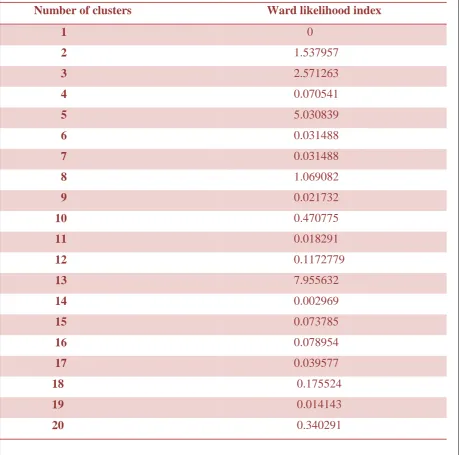
Table 5.4 Ward likelihood index for up to 20 clusters...……….……..32
~ VII ~
List of Figures
Figure 3.1 Self Organizing Feature Map…………....……….6
Figure 4.1 3D plot of the data…………..………..22
Figure 5.1 SOM results depicting the three-dimensional data projected onto the
two-dimensional map. The U-matrix panel shows the variation in health states, being affected by
necRM, necFD and nyfRM shown in the other three panels………25
Figure 5.2 3D plot of SOM output………..………..27
Figure 5.3 3D plot of clusters obtained from FCM clustering on original data………....……28
Figure 5.4 3D plot of clusters obtained from GK clustering on original data...…………....…29
Figure 5.5 3D plot of clusters obtained from GG clustering on original data...…....…………30
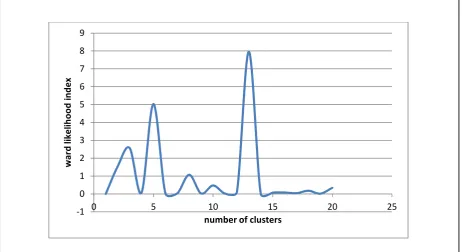
Figure 5.6 Plot of ward likelihood index against number of clusters………....…………33
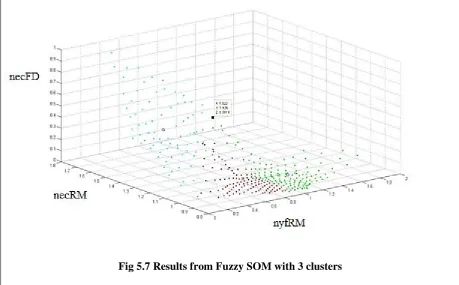
Figure 5.7 Results from fuzzy SOM with 3 clusters………34
~ VIII ~
Figure 5.9 Results from fuzzy SOM with 13 clusters……….37
Figure 5.10: Track of the health state of a sick cow (Cow ID 212) in the developed mastitis
spectrum………39
Figure 5.11 Track of the health state of a sick cow (Cow ID 316) in the developed mastitis
spectrum………40
Figure 5.12 Track of the health state of a sick cow (Cow ID 1401) in the developed mastitis
spectrum………41
Figure 5.13 Track of the health state of a sick cow (Cow ID 3421) in the developed mastitis
spectrum………42
Figure 5.14 Track of the health state of a sick cow (Cow ID 4452) in the developed mastitis
spectrum………42
Figure 5.15 Track of the health state of a sick cow (Cow ID 9420) in the developed mastitis
spectrum………43
~ 1 ~
Chapter 1 Introduction
Mastitis (Mast: breast, itis: inflammation) is defined as an inflammatory reaction of udder
tissue to bacterial, chemical, thermal or mechanical injury. Mastitis may be infectious caused
by microbial organisms or non-infectious resulting from physical injury to the gland (McGill
University). It is the most expensive disease in dairy industry which costs about 180 million
dollars to New Zealand dairy industry (NMAC Report, 2006). It causes enormous amount of
concern to farmers by negatively impacting milk yield and cow’s health. Mastitis is a very
painful condition which should have declined greatly by now, with improved methods of
prevention. Unfortunately, the incidences of Mastitis have been unacceptably high.
Therefore, the early detection of Mastitis is very important in order to reduce the pain that it
causes to cows and to allow instant treatment which will in turn reduce the economic losses.
Also, it will minimise the chances of other cows getting infected.
Early detection of mastitis can be made possible by capturing the quantitative data of the
traits (as a result of the disease) from automatic milking systems and then by using them to
generate an advanced computational model. Various studies have been undertaken over the
years to create classified health clusters (states) for effective diagnosis of mastitis. Up until
now, three distinct clusters have been identified viz. healthy, moderately ill and severely ill to
classify the dairy cattle for mastitis disease (Sun et al., 2008).
However, not only the diagnosis, but an early diagnosis is very significant in this scenario.
Therefore, a diagnostic tool needs to be generated having the potential of detecting mastitis in
a very initial, sub-clinical mastitis stage. Moreover, this tool should be able to derive the
degree or likelihood of a particular health state of a cow. In an endeavour to make this
possible, in this study, artificial neural network (ANN) has been combined with fuzzy logic
approach.
Artificial neural networks attempt to mimic some of the basic procedures for processing data
as being used by the human brain. These are capable of capturing some of the linear and
non-linear patterns in complex data. Cows suffering from mastitis have higher electrical
~ 2 ~
Aoki, 1992; Lake, 1992). An ANN could be trained using these traits, and can be expected to
generate useful patterns. Then fuzzy logic can be applied on a well-trained ANN to capture
the fuzzy nature of the health states of a cow. Fuzzy logic deals with the uncertainty of data,
it handles the data which is variable or approximate rather than fixed and exact. Fuzzy logic
will provide an additional flexibility for the cows to be associated with different clusters
(health states). The outcomes of this research can be very confidently used in early diagnosis,
which can initiate an early treatment of mastitis in the dairy industry.
1.1 Objective of Research
The objective of this study is to classify the health state and to determine the likelihood of
that health state in cows affected with mastitis based on neuro-fuzzy approaches. This study
hypothesizes that:
A diagnosis of the health state in a more realistic fuzzy form than in a crisp form will be
closer to the actual health state and in conjunction with its early detection and location in the
mastitis spectrum will help in the development of effective treatment strategies leading to
improved cow health, increased milk yield and reduction of income loss.
Exploiting the data collected by robotic milking stations, the aim is to specify where the
health of a cow lies in the spectrum of Mastitis.
This study aims to test this hypothesis by extending the existing research studies to another
level by incorporating fuzziness into neural network models with a further addition of a
proposed dynamic model. These two aspects are specified as follows.
• As SOM is a deterministic approach, the final output remains crisp. (SOM is a neural
network that implements unsupervised clustering and, in the case of mastitis, can
reveal potential crisp clusters of health states where one cow belongs to a fixed health
state)
• Fuzzy SOMs can be generated by combining fuzzy concepts with SOM. (Fuzzy
concepts can fuzzify the crisp clustering of SOM by making it possible for a cow to
represent several health states to various degrees of likelihood)
~ 3 ~
model. However, in order to decide which methodology could be the most appropriate and
which could produce the most meaningful outputs, the fuzzy algorithms of interest could be
implemented with the data individually, and an analysis could be made to ascertain which
approach is better. The most fitted approach can then be used with SOM.
1.2 Structure of Thesis
The thesis is organized into six chapters and provides a list of references at the end. A brief
outline of each chapter is presented below:
Chapter 1: Introduction This chapter provides a brief description about the research area
and identifies the problem. It details the objective and scope of the thesis.
Chapter 2: Background This chapter provides a detailed description of the mastitis disease
and its economic impact.
Chapter 3: Methods The ANN, clustering and fuzzy clustering concepts used in the
research has been explained in this chapter. It also provides a survey of literature on the areas
relevant to the research.
Chapter 4: Methodology This chapter describes the process of implementing the methods
in order to achieve the research objective. In other words, it provides a detailed report of how
the research was carried out.
Chapter 5: Results and Discussion This chapter illustrates the results in terms of the goals
achieved throughout the research. Also, a discussion of findings has been included in the
same.
Chapter 6: Conclusion This chapter provides a brief description of the problem and how it
has been resolved. Also, it states specific conclusions and sums up all the process and
~ 4 ~
Chapter 2 Background
Mastitis is a disease resulting from the inflammation of udder (Blowey and Edmondson,
2010). It is defined as an inflammatory reaction of udder tissue to bacterial, chemical, thermal
or mechanical injury (Report from Dept. of Animal Science, McGill University). Mastitis
can be categorised as Sub Clinical Mastitis and Clinical Mastitis. Clinical Mastitis is when
the signs of mastitis are visible such as swollen teat, clotted milk etc. Sub Clinical Mastitis
shows no visible signs, i.e., in this case the udder and milk appear normal.
Mastitis is a very painful condition which should have declined greatly with improved
methods of prevention and treatment (Broom, 2001). However, the incidence of mastitis has
remained unacceptably high. A number of studies since the 1990s report a mean annual
incidence of mastitis ranging from above 30 to over 70 cases per 100 cows (Esslemont and
Kossaibati, 1996; Kossaibati et al., 1998; Esslemont and Kossaibati, 2002, Bradley et al.,
2007).
Inflammation causes changes in the composition of milk from a sick quarter. This includes
increased somatic cell counts (SCC), higher electrical conductivity (EC) and changes in other
components including fat and protein content (Auldist & Hubble, 1998). Somatic cells are
mainly white blood cells sent to fight the infection in the udder. When infection occurs and
starts to damage the udder tissue, the immune system is called into action and, very rapidly,
large quantities of somatic cells are directed to the infection site (Leslie et al., 1983). A report
from Dairy NZ (2006) states that a cow with SCC levels above 150,000 cells /ml is likely to
be infected with mastitis.
As the disease becomes severe, blood-milk barrier is broken and blood (in invisible amounts)
enters milk increasing the EC level in the milk. EC has been widely recognized as an
important indicator of mastitis and employed in mastitis detecting systems in the dairy
industry (Barth et al., 2000). However, in every case, it is not necessary that a cow with high
electrical conductivity would be suffering from Mastitis. Thus, electrical conductivity alone
~ 5 ~
The economic losses of a clinical case in a default situation were calculated as €210, and vary
from €164 to €235 depending on the month of lactation. The total economic losses of mastitis
(sub clinical and clinical) per cow in a default situation varied between €65 and €182/cow per
year depending on the bulk tank somatic cell count (Huijps et al. 2008). In New Zealand, for
the whole industry, the figure amounts to more than $180 million per year (Bentley et al,
~ 6 ~
Chapter 3 Methods
3.1 Artificial Neural Networks
Samarasinghe (2006) states that “a neural network is a collection of interconnected neurons
that incrementally learn from their environment to capture essential linear and non-linear
trends in complex data, so that it provides reliable predictions for new situations containing
even noisy and partial information.” There are various ANNs that can be constructed and
used for various purposes. This research study uses Self Organizing Feature Map (SOM)
which is described in next section.
3.2 Self-Organizing Feature Map (SOM)
The competition among the neurons is the mechanism responsible for self-organization in the
brain. This fact is utilized in developing SOM networks shown in Figure 3.1. The process
involves iterative evolution of the network and has two aspects- winner selection and weight
evolution as follows:
Figure 3.1: Self Organizing Feature Map
3.2.1 Selection of winner
The input layer represents the input variables𝑥1, 𝑥2…. 𝑥𝑛 for the case of n inputs and each
neuron (circles in Figure 1) is associated with an n-dimensional reference vector 𝑤𝑖 = [𝑤1,
𝑤2….𝑤𝑛]. Now the winner selection can be done on the basis of neuron activation or distance
measures.
Each neuron is activated upon receiving an input signal, i.e., an input vector. The activation Neuron Activation
~ 7 ~
of neuron j is the weighted sum of inputs entering that neuron:
𝑢𝑗 = ∑ 𝑤ni=1 𝑖𝑗𝑥𝑖, [3.1]
where𝑥𝑖 is ith input variable, wijis the weight connecting input xi and neuron j and 𝑢𝑗 is the
net input which is the weighted sum of inputs 𝑥𝑖to neuron j.
The neuron havingthe highest activation can be declared the winner. In the natural biological
setting in the brain the winner is found by competition: the output of each neuron𝑢𝑗is sent as
an inhibitory input signal to other neurons and the process is repeated until one neuron
emerges as the winner with a non-zero 𝑢𝑗. Computationally, the winner is the neuron with
the highest activation 𝑢𝑗.
Distance Measure
Euclidean Distance = 𝑑𝑗 = x - 𝑤𝑗 [3.2]
= �∑ �𝑥𝑛𝑖=1 𝑖 − 𝑤𝑖𝑗�2
The competition would be finally won by the neuron associated with the weight that is closest
to an input (i.e., the smallest Euclidean distance). After the winner selection, unlike in
competitive networks, not only the winner but also neurons in the neighbourhood of the
winner adjust their weights during training. This is an important aspect in the preservation of
spatial organization.
3.2.2 Weight evolution (Learning)
The objective of learning in SOM networks is to accurately project the input data onto the
map neurons. Over repeated exposure to inputs during learning, neurons learn to respond to
inputs in such a way that neurons that are closer on the SOM respond to inputs that are closer
in the actual data space. This feature called topology preservation is achieved by moving not
only the winner neuron but also its neighbour neurons towards the input in order to minimise
the distance between these neurons and the input. In this process, the winner moves by a
larger amount than its neighbours according to a Neighbour Strength (NS) function.
Learning can be illustrated by the following equation:
𝑤𝑗 (t) = 𝑤𝑗 (t - 1) + β (t) NS (d,t) [𝑥(t) - 𝑤𝑗(t - 1)] [3.3]
~ 8 ~
𝑤𝑗 ( t - 1) is the weight after the previous iteration,
β(t) is the learning rate variation with iterations t,
NS is the neighbour strength function of distance d from the winner to a neighbour neuron at
iteration t, and
𝑥(t) is the input vector presented at the tth iteration.
The learning rate β(t) is user defined and can take the form of linear exponential etc. Starting
with a larger value, β(t) decreases with iterations. NS(d,t) also can be linear, exponential and
Gaussian etc. and shrinks with iterations so that an initially large neighbourhood size gets
reduced to just the winner or winner and its immediate neighbours at the end of the training.
Training stops when there is no acceptable difference in weight adjustment in successive
iterations. The result is a trained map where inputs that are closer in the data space are
projected onto neurons that are closer on the SOM. Therefore, any large gaps between data
in the data space are shown as large distances between corresponding neurons on the map
thereby revealing on the map potential clusters and cluster boundaries in the actual data.
With an appropriate clustering tool, such as Ward Clustering (Section 3.3), neurons that form
clusters on the map can be grouped to form classes for classification purposes. An unknown
input vector then will belong to the class that it is closest to, i.e., the class with the shortest
distance between its mean vector and the input vector. This provides a crisp classification for
the input vector- one input vector belongs to one class.
3.3 Ward Clustering
Ward clustering is an agglomerative clustering method, which was invented in 1963. The
method calculates the distance between the data in clusters and cluster centres by analysing
the variance amongst them. It aims at minimizing the sum of the squares of the distance
between all the data points in a cluster and the centroid of the cluster which was formed as a
result of joining of two clusters. The two clusters that produce the least square distance are
ultimately joined in each step of the process. The distance is calculated as:
d
ward=
(𝑛𝑟× 𝑛𝑠)
(𝑛𝑟+𝑛𝑠)
||x
r–x
s||
2
~ 9 ~
where r and s, symbolize two clusters and nr & ns are the number of data points in those
clusters. ||xr –xs|| gives the magnitude of the distance between two cluster centres calculated
using Euclidean norm. The ward distance increases with the increase in the number of data
points. The two clusters with minimum dward are joined at each step of this process. The ward
index gives the likelihood of each cluster. The separation of clusters depends upon the value
of the index. The higher the index, more distinctive is the clusters.
Ward Index =
𝑁𝐶1 × 𝑑𝑑𝑡−𝑑𝑡−1 𝑡−1−𝑑𝑡−2 =1 𝑁𝐶×
∆𝑑𝑡
∆𝑑𝑡−1 [3.13]
where, ∆dt is the distance between the centres of two clusters to be merged and ∆dt-1 is the
distance between the centres of the clusters merged previously and prior to that step. NC is
the number of clusters remaining. The method is very effective when the dataset is not too
large. Therefore, it is quiet suitable to be used on a trained SOM to cluster map neurons. In
this case, it uses the neuron weights generated by the trained SOM as input vectors.
3.4 Fuzzy SOM
Our aim is to produce a more comprehensive SOM structure by merging it with Fuzzy
concepts. The hypothesis is that it could produce more realistically classified clusters where
each udder reading belongs more to a specific cluster with a degree of membership, thereby,
fuzzifying the crisp boundaries produced by SOM.
There are two ways to approach the above fuzzy classification:
• The first is to create an SOM with the available data. The result of the SOM can then
be fed into an appropriate fuzzy algorithm. This could be done by using the same
number of clusters as produced by the SOM in the fuzzy algorithm.
• The other way is to start with the fuzzy algorithm first. We can try different number
of clusters in it. Comparing all the results we can identify the number of clusters that
give us a fuzzy map which is nearer to our goal of this study. The same number of
~ 10 ~
Here arises the issue of selecting the most efficient fuzzy algorithm which could be used in
conjunction with SOM. For this, we can work our data with some different and successful
fuzzy algorithms. In the next section we will see how these fuzzy algorithms work.
3.4.1 Fuzzy C- Means (FCM)
The FCM is the most widely used fuzzy clustering algorithm. This technique was developed
by Dunn in 1973 and improved by Bezdek in 1981. It is based on the minimization of the
following objective function:
𝑗𝑚 = ∑ ∑ 𝑢i=1n cj=1 𝑖𝑗m||𝑥𝑖 − 𝑐𝑗||2, 1 ≤ m<∞ [3.4]
where m is any real number greater than 1, 𝑢𝑖𝑗 is the degree of membership of 𝑥𝑖 in
the cluster𝑗, 𝑥𝑖 is the ith d-dimensional measured data vector, 𝑐𝑗 is the d-dimensional centre
of the cluster j and ||*|| is any norm expressing the similarity between any measured data and
the centre.
Fuzzy partitioning is carried out through an iterative optimization of the objective function
shown above, with update of membership 𝑢𝑖𝑗 and cluster centres 𝑐𝑗 . The iteration will stop
when a termination criterion is met.
3.4.2 Gustafson-Kessel Algorithm
The Gustafson-Kessel (GK) algorithm (Gustafson and Kessel 1979) is a powerful clustering
technique. Its main feature is the local adaptation of the distance metric to the shape of the
cluster by estimating the cluster covariance matrix and adapting the distance-inducing matrix
correspondingly.
The GK algorithm is based on iterative optimization of an objective functional of c-means type:
~ 11 ~
Here, U = [µik] ϵ [0,1]KxNis a fuzzy partition matrix of the data Z ϵ R n x N, V = [v1, v2, … vk],
vi ϵ Rn is a K-tuple of cluster prototypes and m ϵ [1,∞) is a scalar parameter which determines
the fuzziness of resulting clusters. The distance norm DikA, can account for different
geometrical shapes in one data set:
D2ikAi = (zk – vi)T Ai (zk – vi) [3.6]
The metric of each cluster is defined by a local norm-inducing matrix Ai, which is used as one
of the optimization variables in the functional in Eq. 3.5. This allows the distance norm to
adapt to the local topological structure of the data.
3.4.3 Gath-Geva Algorithm
Gath-Geva (GG) clustering algorithm (Gath and Geva, 1989) is based on the minimization of
the sum of weighted squared distances between the data points zk and the cluster centers, vi, i
= 1,….c.
J = (Z; U, V) = ∑𝑐𝑖=1∑𝑁𝑗=1(µi,k)mD2ik [3.7]
where V = [v1, v2, … vc] contains the cluster centres and m ϵ [1,∞) is a weighting exponent
that determines the fuzziness of the resulting clusters and m is often chosen to be equal to 2.
The fuzzy partition matrix has to satisfy the following conditions:
U∈ RcxN with µi,k ∈ [0,1], i,k; ∑𝑖=1𝑐 (µi,k)=1, k; 0< ∑𝑐𝑁𝑘=1(µi,k) < N, i [3.8]
The distance is calculated based on the fuzzy covariance matrices of the cluster:
~ 12 ~
The distance function is chosen as
[3.10]
with the a prioriprobability αi
[3.11]
3.5 Use of ANN for Mastitis Diagnosis
Literature on the diagnosis of mastitis in terms of classification of the health state of a cow
using artificial neural networks is not very extensive. However, the amount of research being
done on mastitis is very significant. Early research studies have identified the variables that
are affected by a noticeable amount when a cow suffers from Mastitis. Thereafter, early
1990s saw the beginning of research carried out to exploit neural network techniques to
diagnose mastitis using some or other significant variables. The following review summarizes
some significant research work addressing mastitis diagnosis in chronological order.
1994: NIELEN ET AL.
In the research carried out by Nielen et al. (1994), three analysis techniques were compared
over four models for detection of Clinical Mastitis. The three analysis techniques were
Principal Component Analysis (PCA), Logistic Regression Model (LRM) and Neural
Network model (NNM). The four models were generated by producing different
combinations of input variables. The input variables used in this research were milk
production, milk temperature and electrical conductivity (EC). No preprocessing was
performed on EC data; it was used as it accounts for biological effects as explained before.
The definition of clinical and sub clinical quarters were stated by farmers who could observe
it on the basis of various visible factors.
~ 13 ~
mastitis. For this, PCs were plotted against each other in two dimensional plots. If a
separation between the clinical and healthy quarters occurred, the variation present in the two
components was assumed to be caused by mastitis. LRM & Back propagation neural network
(NN) models were trained to differentiate between healthy and clinical quarters. In LRM 2x2
contingency matrix was used and in NN a three layered feed forward network was used.
PCA explained 90% of the variation for two models and 80% of variation for the other two.
LRM produced 84% sensitivity and 90% specificity where sensitivity is the percentage of
correct classification of mastitis quarter and specificity is the percentage of correct
classification of healthy quarters. Three layered back propagation neural network model
produced 84% sensitivity and 97% specificity. All three models showed almost similar
performance, but NN showed slightly better performance than LRM.
Also, the same three techniques were used to develop models based on data for two prior
milking, i.e., the data extracted just before a cow got signs of mastitis. The LRM and NN
models showed 70% sensitivity and 90% specificity, which mean that not in every instance
clinical mastitis could be observed before clinical signs emerge as deviations are not very
clear always.
1995: NIELEN ET AL.
In this research, artificial neural network techniques were used for diagnosis of sub clinical
mastitis (SCM). The authors used back propagation neural networks to classify healthy and
sub clinical quarters. This research used a three layered feed forward network, with one
output unit which stated 0 for healthy quarters and 1 for sub clinical quarters. The inputs used
for this model were milk production which was calculated using an exponential smoothing
function. Parity (1 and >1) and days in milking were other inputs and the final input used was
electrical conductivity.
They defined a healthy period when a cow’s somatic cell count (SCC) is < 200 x 103 cells/ml.
As soon as the cow’s SCC exceeds this figure, the healthy period was terminated. Period for
severe sub clinical mastitis was defined when cow’s SCC > 1000 x 103 cells/ml and moderate
SCM was between 500 and 1000 x 103 cells/ml. Periods which didn’t fall under the above
~ 14 ~
In this analysis, a period of 14 milkings was chosen with consideration. They defined
sensitivity as a measure for detecting a sub-clinical cow and specificity as a measure for a
healthy cow. For training, a random number of healthy cow milkings were chosen in such a
way that data contains almost equal numbers of healthy and sub-clinical milkings. The full
model consisted of 15 inputs (which were derived from the four basic inputs as mentioned
above), 7 hidden neurons and 1 output neuron.
Sensitivity obtained was 66% and specificity obtained for 14 healthy milkings was 80%. In
the same research, logistic regression model was also used with the same input parameters
which produced sensitivity of 54% and specificity of 92%. They concluded that neural
network model could be trained to be specific or sensitive but never to be both according to
the outputs obtained during training. Also, they highlighted that a low sensitivity of EC to
detect periods of high SCC could be a result of the fact that EC and SCC are related to udder
health but are less related to each other. But they also remarked that this will have only a
slight effect on neural network model as correlated variables are not significant for this
model.
1999: YANG ET AL.
In the work carried out by Yang et al. (1999), neural networks were exploited to distinguish
between the clinical and healthy quarters. They used a number of variables including SCC,
lactation number, milk yield, days in milking, mean SCC for herd, season of calving, herd
size, milk components etc. and the complete dataset had 0.33% of clinical mastitis cases
compared to the total number of records. Three datasets were then created with ratios of 1:1,
1:10 and 1:300 mastitis records: non mastitis records.
The trained network achieved 83% accuracy in distinguishing between clinical and healthy
cows. Also it was observed that 1:1 ratio dataset performed better than the other datasets.
2003: LOPEZ-BENAVIDES ET AL.
In the research carried out by Lopez-Benavides et al. (2003), the state of progression of
~ 15 ~
taken at weekly intervals for 14 weeks and they were observed for electrical conductivity,
somatic cell count, fat percentage and protein percentage. But new informative variables were
used to train the network. New variables included inter-quarter ratio (IQR), conductivity
index (CI), linear score (SCS) and composite milk index (CMI). IQR and CI were derived
from EC values. SCS is a linear transformation of SCC and CMI is the sum of the values of
all the raw and derived milk traits. Electrical conductivity and CMI were used as inputs and
SOM clustered the dataset into previously undefined healthy, moderately ill, ill and severely
ill health categories. A deep investigation into the clusters revealed that the SOM categorized
the data into significant health categories. They also stated that the combination of
moderately and severely ill health categories could be investigated further, as it might
produce improved results. CI, EC and CMI were the most important indicators of the
mastitis status.
2005: WANG AND SAMARASINGHE
In the work performed by Wang and Samarasinghe (2005), the data included the milking data
collected by automated milking systems over a four month period from four farms. In this
research, preprocessing of data played a significant role. The variables were normalized and
final variables used were normalized peak electrical conductivity (EcMax), normalized
quarter yield fraction and maximum relative deviation of EcMax values among four quarters
for a cow. Specifically, these respective variables were running mean of normalized electrical
conductivity and running mean of normalized quarter yield and fractional deviation from the
smallest normalized electrical conductivity value.
The dataset produced after normalization was used to construct SOM artificial neural
networks model. Due to the presence of only 3% mastitis cases in the total number of records,
five random datasets were generated to balance the ratio of sick to healthy cows to some
extent. All neural network models displayed 94% sensitivity and 100% specificity on
average. In order to assess the robustness of the results, three fold cross validation was
exploited over 3 self-organizing maps and 95% sensitivity and 97% specificity was realized.
2008: KRIETER ET AL.
~ 16 ~
generated using electrical conductivity of milk, milk production rate, milk flow rate and days
in milking as input data. They set the block sensitivity (threshold for generating an alert) in
training data to be at-least 80%. The specificity (percentage of mastitis cases recognized) was
recorded as 61.4% and 78.3% for two different definitions of Mastitis and the error rates were
46.5% and 79.1%. They concluded that more detection parameters can help in obtaining more
accurate results.
2009: SUN ET AL.
In the work carried out by Sun et al. in 2009, multi-layer perceptron and self-organizing
feature map were used to detect mastitis in cows from data collected by automated milking
systems. They also used the same variables as those used in Wang et al. (2005), i.e., running
mean of normalized electrical conductivity and running mean of normalized quarter yield and
fractional deviation from the smallest normalized electrical conductivity value. However, the
raw data for the study came from readings from cows diagnosed as clinically ill.
Specifically, readings from these cows from the date of diagnosis back to the point where
they were healthy were assembled into a dataset for all sick cows. This way, the data set
contained information for the whole mastitis spectrum - from healthy through stages of
mastitis up to clinical mastitis. Mastitis was defined as follows: if the quarter milking samples
had 12.8% drop in milk yield and 15% higher than average of the two lowest quarters in
electrical conductivity value, then the quarter has mastitis. According to this definition, they
generated a new data set which had 4.6:1 healthy to sick quarter’s ratio.
Sun et al. (2009) and Sun (2008) report that a thorough investigation of raw electrical
conductivity quarter readings clearly demonstrated that not all infected quarters have the
highest electrical conductivity and lowest milk yield in an udder. Hence four different input
combinations were used amongst which one was formed by using principal components for
addressing multi co-linearity in the data. The PC based MLP model showed better
performance compared to the other models. It had the highest overall correct classification
rate of 90.75%, with sensitivity of 86.90% and specificity 91.35%. The SOM classified the
stage of progression of mastitis into three clusters: healthy, moderately ill and severely ill.
The clusters obtained were validated using K-means clustering, ANOVA and least significant
difference. This research stated that the relatively low sensitivity rate could be the result of
~ 17 ~
model can be used to detect mastitis of a cow and SOM can be used to visualize the health
status of the cow for early diagnosis and treatment. This SOM can also be used to assess the
overall health status of a herd for better management of the herd.
It is worth noting here that our study is a direct extension of Sun et al. (2009) work using
their data. Sun et al. (2009) classified cow health state into 3 categories and we aim to
represent a more refined mastitis spectrum in a model using the same data and build on it a
decision making system. A more complete description of data and inputs are presented in the
Methods section.
3.6 Use of Fuzzy Logic in Mastitis Diagnosis
There are very limited numbers of research studies which have used fuzzy logic for detection
of mastitis. However, the results produced from these studies have been obtained from
practical implementation on automatic milking systems, hence making the conclusions very
significant. The studies are explained in the following section.
2001: MOL ET AL.
In the work carried out by Mol et al. (2001), the information from the sensors which measure
milk yield, temperature of the milk, electrical conductivity of the milk were used. The aim of
this study was to reduce the false-positive cases. False-positive cases can be defined as those
cases which got a positive mastitis alert from the system but they were not afflicted with the
disease. This study used fuzzy logic to develop a model which could produce alerts in an
automated system. The data traits used were yield, temperature, electrical conductivity of the
milk and activity of each cow. Based on these traits, a fuzzy inference system was developed
which followed three steps to complete the process.
In the first step, the fuzzification of the variables was performed, i.e., the real time variables
were transformed into linguistic variables. In the second step, if…then rules were generated,
using linguistic variables. These rules were grouped into rule boxes. In the third step,
defuzzification was performed. Now, the linguistic variables are translated back to real
~ 18 ~
Using this approach the false-positive alerts were reduced from 1266 to 64. Mol et al. (2001)
stated that “classification by a fuzzy logic model proved to be very useful in increasing the
applicability of automated cow status monitoring”.
2006: CAVERO ET AL.
The aim of the research carried out by Cavero et al. (2006) was to develop a fuzzy model to
classify and control mastitis in dairy cows. The data used for this research was collected by
University of Keil’s experimental dairy farm “Karkendamm”. 478 cows were used to collect
the data. Mastitis was identified according to three different definitions. These were: (1)
udder treatments, (2) udder treatment or somatic cell counts (SCC) over 100,000/ml and (3)
udder treatment or SCC over 400,000/ml. The data traits used were electrical conductivity,
milk production rate and milk flow rate.
A multivariate model was used in this study to improve the detection of mastitis. The data
obtained from sensors was used as input data for a fuzzy model. A fuzzy inference system
was generated using same process (fuzzification, fuzzy inference, and defuzzification) as
explained in the previous section. They used random test and training data and set the block
sensitivity to at-least 80%. The specificities obtained were between 93.9% and 75.8% and the
error rate varied between 95.5% and 41.9% depending on mastitis definition. The average
number of true-positive cases obtained per day was 0.1 to 7.2 and the average number of false
positive cases per day varied from 2.4 to 5.2 where the average size of herd data was 39.7
cows per day.
They concluded that fuzzy logic is a very efficient approach for this application. The results
obtained showed that the model could be generalized. The error rate could be decreased
~ 19 ~
Chapter 4 Methodology
This chapter describes the methods used to meet the research objectives of the study. It is a
two stage approach, which puts special emphasis on the data analysis and model
development. In the first stage the data has been observed carefully, so that it could be
efficiently exploited in the model development stage. In the modeling stage,
• SOM, which is an ANN, is trained, and the results obtained are compared with those
from Sun et al. (2009) study.
• Three fuzzy algorithms, namely Fuzzy C Means, Gustafson-Kessel and Gath Geva,
are applied on the original data.
• Ward clustering is performed in order to obtain the optimum number of clusters on
SOM.
• SOM obtained above (step 1) is being used to create the fuzzy SOM using the best
selected fuzzy algorithm (step 2), and the number of clusters to be generated has been
selected using Ward clustering (step 3). Thus a fuzzy SOM is developed at this stage
of the research.
4.1 Data Analysis
Already pre-processed data from Sun et al. (2009) study is used for this research. A brief
description of the data is as follows.
The data were supplied by Dairy NZ, which has been collected from 194 cows by an
automated milking system, constituting 48,546 records from late July 2006 to early April
2007. Although there were a large number of records, as explained previously, the raw data
for the study came from readings from cows diagnosed as clinically ill. Specifically, readings
from these cows from the date of diagnosis back to the point where they were healthy were
assembled into a dataset for all sick cows. These data were augmented with data from
healthy cows to complete the dataset. This way, the data set contained information for the
~ 20 ~
For this study, as in Sun et al. (2009), mastitis was defined as follows: if the quarter milking
samples had 12.8% drop in milk yield and 15% higher than average of the two lowest
quarters in electrical conductivity value, then the quarter has mastitis. As the data originally
contained a very small number of mastitis cases compared to healthy cases, it was assumed
that the results will be highly dominated by healthy cases, thus neglecting the features of
mastitis cases. Hence, a new dataset was created in which there were a total of 4128 quarters
and the ratio of healthy to sick samples approximated 4.6:1.
The variables used for our study are the same as those in Sun et al. (2009) study and these
are: running means of normalized quarter yield fraction (nyfRM) for each quarter, running
means of normalized electrical conductivity (necRM) for each quarter, and fractional
deviation from the smallest necRM value (necFD) for each quarter. The detail derivation of
these variables is as follows:
Running means of normalized quarter-yield fractions (nyfRM)
This variable is calculated in two steps. First step involved the calculation of quarter yield
fraction (QYF) which is the ratio of milk yield of a quarter in a milking to the total milk yield
from all four quarters from that milking. Biologically, this variable accounts for all the
variations in the milk yield between each quarter of each cow. In the case of mastitis, the
sick quarter can be expected to have a lower QYF than the healthy quarters.
Second step involved calculating running means of QYF. It was based on correction of QYF
as per the following equation:
𝑥′𝑡 = 𝑥𝑡 �𝑎1�+ (1−1𝑎)𝑥𝑡−1 [4.0]
where𝑥′𝑡is the running mean of QYF at time t, 𝑥𝑡 is the measured QYF at time t, 𝑥𝑡−1 is the
measured QYF at time t −1 and a is a coefficient that represents ‘running mean length’.
The running mean of QYF was calculated at two levels:
~ 21 ~
ii) Quarter level: This was calculated for individual quarters over their own history
of milking. The value of a was set as 5 at this level.
Now, the quarter running mean of QYF was divided by its corresponding herd running mean
of QYF to obtain the Running Means of Normalized Quarter-yield Fraction for each quarter
of each cow at each milking. This normalization was adopted in order to correct some
machine problems which occur time and again.
Running Means of Normalized Electrical Conductivity (necRM)
This variable was calculated using electrical conductivity of milk, in the same way, as
nyfRM.
Fractional deviations from the smallest necRM value (necFD)
This variable was created to consider the ratio of the three highest necRM values to the
lowest one. It was calculated as
necFDi = necRMnecRMi−necRMmin
min [4.1]
where necFDi is necFD of any of the four quarters of a cow, necRMi is normalized EC
running mean (necRM) of the same quarter, and necRMmin is the smallest value of necRM
between four quarters. This variable is used because the health condition of a cow is not the
same in all four quarters in mastitis, and larger fractional deviation can be expected when a
cow is sick. Therefore, necRMmin is the value of the electrical conductivity when the cow is
in its healthiest stage. Hence, necFDi generates a very high value for an infected case
~ 22 ~
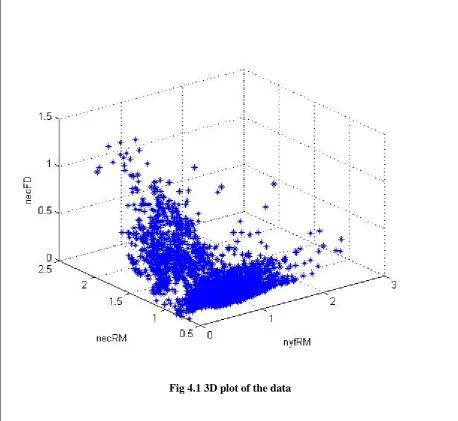
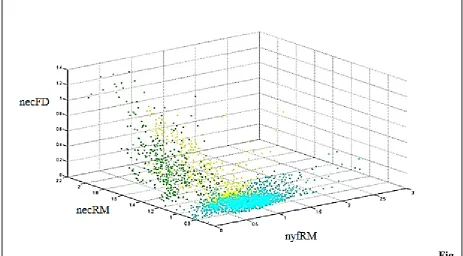
Fig 4.1 3D plot of the data
Figure 4.1 shows a plot of the data used in this study which shows that sick quarters in
general have high electrical conductivity (i.e., high necFD and necRM) and low milk yield
(i.e., nyfRM) and vice versa. As can be seen, the data covers the whole mastitis spectrum
form healthy to clinical mastitis; thus the data satisfy the requirement of a model that is going
to use them to make a representation the whole spectrum.
4.2 Model Development
This section highlights all the techniques which have been used in this study to develop the
~ 23 ~
4.2.1 Development of SOM
Thus each input vector for SOM is of 3 dimensions, necFD, necRM and nyfRM. As SOM is
an unsupervised (clustering) network, there is no output variable. The SOM toolbox2
(Alhoniemi et al., 1999) is used to develop the SOM model and the number of neurons is
calculated as
Units = ceil [5 × dlen0.5] [4.2]
where dlen is the number of records in data and ceil is the ceiling function. The number of
records in the data used is 4128; hence, using equation [4.2], the number of neurons obtained
is 322. To use a more convenient number of neurons, 325 have been used to develop this
model. As the original dataset contains 4128 records, 325 neurons is assumed to be a
sufficient size to represent our data.
Sun et al. (2009) in fact developed an SOM for this data using commercial neural networks
software and their SOM was supposed to be the starting point for our study as our work is an
extension of Sun et al. (2009) study to take it to a higher level of capability. However, as our
study aims to go deeper into the mastitis spectrum, we need to delve deep into the best
possible cluster granularity to build our extended model. Sun et al. (2009) used three clusters
but we need to check all possible clusters. Nonetheless, Sun et al. (2009) could be used as a
benchmark for this data as we proceed with the same data into deeper horizons.
4.2.2 Fuzzy Clustering
Clustering divides the data points in such a way, that data-points in one cluster are as similar
as possible and those in different clusters are as dissimilar as possible. In crisp or hard
clustering, a data-point is fixed with one cluster but in fuzzy clustering one data-point can
belong to more than one cluster with a different membership level associated with each
cluster which describes the degree of belonging of a data-point to a cluster.
In this study, three fuzzy algorithms have been applied to our data. These three algorithms are
Fuzzy C Means, Gustafson Kessel and Gath geva. A comparison has been made between the
outputs from these algorithms to select the best suited algorithm for this application. Further,
in a quest to verify the topological preservation made by SOM, all the algorithms have also
~ 24 ~
4.2.3 Ward Clustering
A novel aspect of our study is the attempt to dig into the intricacies of mastitis progression.
With the aim to obtain a more refined mastitis spectrum, an important issue that arises here is
“what number of distinct health regions or clusters can give us the greatest insight”. In order
to resolve this problem, ward clustering has been adopted. It uses the SOM output (i.e.,
neuron weights) as input data and gives an index value to the number of all possible clusters.
The higher the index value, the more likely is the distinctiveness of that particular number of
clusters. The optimum number of clusters thus formed on the SOM can be thought of as
covering the mastitis spectrum in terms of likely distinct transitions of health states as cow
health moves from healthy to clinical mastitis.
4.2.4 Fuzzy SOM
Using the best selected fuzzy algorithm, and the number of clusters as being proposed by
ward clustering, a fuzzy SOM is generated over the data produced by SOM. Initially, a visual
comparison is made about how the different number of clusters affects the application. Then,
some interpretations are made for the fuzzy SOM with ‘n’ number of clusters which has the
highest likelihood in ward clustering. In a fuzzy SOM, a cow belongs to all the clusters but
have different degree of membership values for each cluster. The higher the degree of
membership value, the higher is the association of the cow in that particular cluster.
~ 25 ~
Chapter 5 Results and Discussion
5.1 Results from SOM
A SOM with 325 neurons was trained to get an initial picture of data distribution and how
individual variables affect the health state. The number of neurons used for training of SOM
was selected as per Eq. 4.2 as explained in Section 4.3.1. Three input variables were used,
i.e., nyfRM, necRM and necFD, in the input layer of this network and these are the
normalised quarter running mean of: yield fraction, electrical conductivity and fractional
deviation of EC, respectively. The Gaussian function was used as the neighbourhood
function and the initial learning rate used was 0.5.
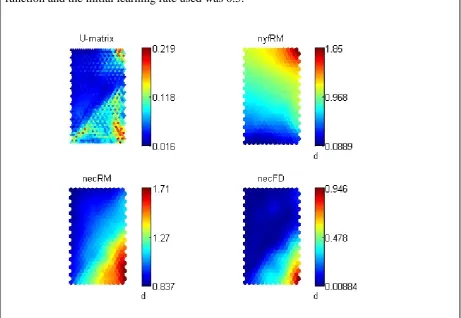
Fig. 5.1: SOM results depicting the three-dimensional data projected onto the two-dimensional
map. The U-matrix panel shows the variation in health states, being affected by necRM, necFD
~ 26 ~
In Fig. 5.1, the U-matrix shows the variation in health states with respect to the combined
effect of all the three variables. The other three panels depict the variation in individual
variables. The location of neurons in the panels corresponds to each other making it possible
to assess the correspondence of variables to each other and to the health state. As an SOM is
a condensed version of the data, each neuron is the centre of gravity of a cluster of inputs.
The whole map therefore, preserves the probability density distribution of the actual data. In
the three panels showing the individual variables, blue colour depicts lower values and red
colour depicts higher values. The two panels for necRM and necFD show strong
correspondence as can be expected since they both depict versions of EC. Also, very high
yield fraction, red area in the nyfRM panel, relates to quite low values of necRM and necFD
showing that the SOM has captured the generally accepted trends among the three variables.
In the U-matrix, colour depicts the distance between adjacent neurons on the map; blue
colour indicates smaller distances indicating areas of tighter clustering and red colour
indicates areas with larger neuron distances indicating either loosely formed clusters or
cluster boundaries. Accordingly, the large bright blue section in the U-matrix represents a
reasonably tight cluster of healthy cows because it could be easily observed that the top left
sections in necRM and necFD panels have the lowest values and the same section in the
nyfRM panel is covered by relatively high values thus making that area in the U-matrix
dominated by healthy cases. The top right section is populated by cows with very high yield
(nyfRM) and pretty low EC (necRM and necFD). However, the red colour in the U-matrix in
the corresponding top left region indicates large distance between neurons. This means that
cows with extremely high yield associated with very low EC (i.e., extremely healthy state)
may be too few and are relatively far from each other to form a tight cluster. It may mean
that such values are not the norm for a typical healthy state.
The bottom right section of U-matrix also shows a red region where neurons are relatively far
from each other. This area is dominated by the highest EC in the necRM and necFD panels
and moderately high yield in the nyfRM panel. Therefore, this region is where very sick
cows are represented and they are more spread out in the data space as indicated by the red
colour in the U-matrix compared to the tightly knit large blue healthy cluster. The presence
of less mastitis cases in data (1 to 4.6 healthy cases) justifies this. Also, Wang and
Samarasinghe (2005) who analysed sick and healthy cow data based on the same 3 inputs as
in our study showed that the healthy data form a much tighter cluster compared to the more
~ 27 ~
case is higher than for a healthy case. However, it could be seen that not always a sick cow
has the highest EC (necRM and necFD) values and the lowest yield (nyfRM) value. This
gives an insight about the fact that there is a peculiar and unique relationship between these
variables, which couldn’t be stated as directly or inversely proportional with respect to the
health state. This gives a very strong reason to explore the spectrum that a cow might be
following while progressing with the disease, and also when changing these variables
abruptly in some or other way. U-matrix shows neuron distances ranging from dark blue and
light blue to red, there appears to be some progressive health stages in the health state
spectrum that could be revealed by formally clustering map neurons, which is the topic of the
next section.
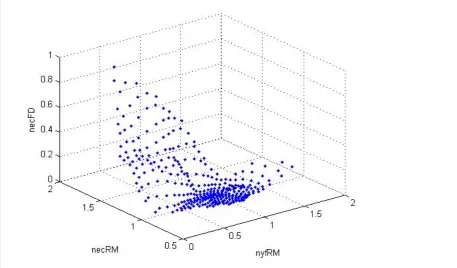
Fig 5.2 3D plot of SOM output (i.e., neuron weights corresponding to the three input variables)
Figure 5.2 shows the 3D plot of SOM weight vectors (SOM output). On comparing this plot
with the plot of the original data in figure 4.1, it can be observed that SOM has preserved the
topological nature of the data, removing the noise. The justification of removal of noise from
the data by SOM will be discussed later in this chapter. Thus, this ‘preservation’, supports the
argument that SOM has treated the data fairly taking into account spatial relations and
probability distribution of the data and improves our confidence to take the SOM to the next
~ 28 ~
5.2 Results from Fuzzy Clustering
In this section, results from the three selected fuzzy algorithms are presented in terms of how
they cluster the original data. Also a comparative study has been performed, in order to
select the best suited fuzzy algorithm for the “mastitis application” which could be used
further in the research. For fuzzy clustering, the number of clusters needs to be
predetermined. Based on the results from the previous research of Sun et al. (2009), three is
the number of clusters used in fuzzy clustering. The input variables used are the same as
those used in Section 5.1 for the development of SOM. First of all, fuzzy c means is used for
performing fuzzy clustering over the data. The value of the weighting component which
determines the fuzziness of the clusters is set to 2 and termination tolerance is 1e-6. Fig. 5.3
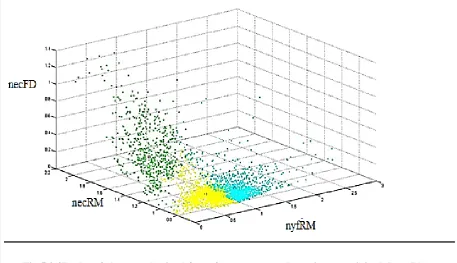
shows the 3D plot of fuzzy c means clustering of the data. Three clusters were obtained as
denoted by three different colours in the picture. The black circles in every cluster represent
the cluster centre. The sky blue cluster is the healthy cluster, yellow cluster represents the
moderately ill health stage and green cluster represents the ill health stage. This assessment of
health stages was done by making an analysis of the data traits being used. For example, a
high yield- low electrical conductivity-low fractional deviation of electrical conductivity is
healthy stage whereas the reverse shows an ill health stage.
Fig 5.3 3D plot of clusters obtained from fuzzy c means clustering on original data (blue-
~ 29 ~
Table 5.1 shows the mean and standard deviation values of the data for all the three FCM
clusters for the three variables. The values are significantly different proving the clusters to
be distinctive and important.
Table 5.1 Mean and Standard Deviation of the data in the three FCM clusters for the three
input variables
Variable Health Category
Healthy Moderately Ill Severely Ill
nyfRM 1.2303±0.2392 0.7379±0.1852 0.4122±0.2836
necRM 0.9924±0.1350 0.9951±0.1149 1.4115±0.1935
necFD 0.0622±0.0890 0.0460±0.0478 0.4383±0.2168
Now, keeping the values of the number of clusters, membership function and termination
tolerance same, Gustafson Kessel (GK) clustering was performed. In Gath Geva (GG)
clustering the only modified value was termination tolerance which was set as 1e-4. The
results obtained are presented further in this section. Next explained is GK clustering.
Figure 5.4 show the plot obtained using the same data, data traits and other parameters by
performing GK clustering. The description of the figure is same as that of Fig 5.3; the blue
cluster represents healthy, yellow – moderately ill and green – ill health.
Fig
5.4 3D plot of clusters obtained from GK clustering (blue- healthy; yellow- moderately ill;
~ 30 ~
Table 5.2 shows the values of mean and standard deviation of the data in all the three GK
clusters.
Table 5.2 Mean and Standard Deviation of the data in the three GK clusters for the three input
variables
Variable Health Category
Healthy Moderately Ill Severely Ill
nyfRM 0.9716±0.3623 0.9123±0.2264 0.3011±0.1991
necRM 0.9332±0.0675 1.2380±0.2060 1.3460±0.1859
necFD 0.0393±0.0473 0.1679±0.2035 0.4248±0.2306
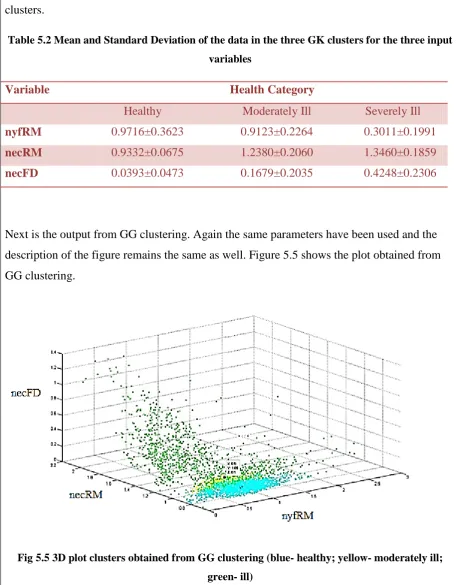
Next is the output from GG clustering. Again the same parameters have been used and the
description of the figure remains the same as well. Figure 5.5 shows the plot obtained from
GG clustering.
Fig5.5 3D plot clusters obtained from GG clustering (blue- healthy; yellow- moderately ill;
green- ill)
~ 31 ~
Table 5.3 Mean and Standard Deviation of the data in the three GG clusters for the three input
variables
Variable Health Category
Healthy Moderately Ill Severely Ill
nyfRM 0.9509±0.3150 0.9240±0.2185 0.6669±0.4697
necRM 0.9195±0.0554 1.0882±0.0370 1.3027±0.2271
necFD 0.0264±0.0265 0.0188±0.0191 0.3391±0.2201
The fuzzy c means clusters as shown in Figure 5.3 are very distinct and less intermingling or
overlapping than GK and GG clusters. In GK clusters as shown in Figure 5.4, the moderately
ill and ill health states are highly overlapping, which gives rises to the increasing probability
of not distinguishing the health states very clearly. GG clustering shows a very little
moderately ill region, which again creates a difficulty in identifying the spectrum of the
health states. Thus, keeping the main objective in mind, which is figuring out the health
spectrum, the fuzzy c means clustering was found to be the most suitable for the application,
as it very clearly distinguishes the three clusters which were asked. But still the health
spectrum is not very clearly visible. This causes an urge to look further into the optimum
number of clusters which are needed to be generated in order to obtain a clear movement of a
cow through various health stages. This could give a very transparent picture of a cow
transitioning from a healthy stage towards the sick health state.
5.3 Results from Ward Clustering
As observed in Section 5.2, there is still a need for exploring the optimum number of clusters
in order to meet our objective of obtaining the health spectrum in a more refined and useful
way. Ward clustering was being opted here, to address this situation. Ward clustering is
capable of providing the number of clusters that could be distinctively extracted from a